
Are Lab-Grown Diamonds Real Diamonds? How They’re Made and How They Compare
Yes, a lab-grown diamond is an actual diamond. It’s the same carbon crystal as a mined diamond, with essentially the same chemical, physical and optical properties, and the FTC’s definition of a diamond covers both. It isn’t an imitation such as cubic zirconia. Our guide to lab-grown diamonds and simulants explains the difference in detail. The difference is where it formed, and that drives a very large gap in price.
We sell lab-grown diamonds, so we have a stake in this answer. You also won’t see us call them “real”, even though that’s the word people search for, and we’ll explain why. Below are what they are, how they’re made, what’s the same and what’s different, how they’re graded, and what they cost and don’t hold.
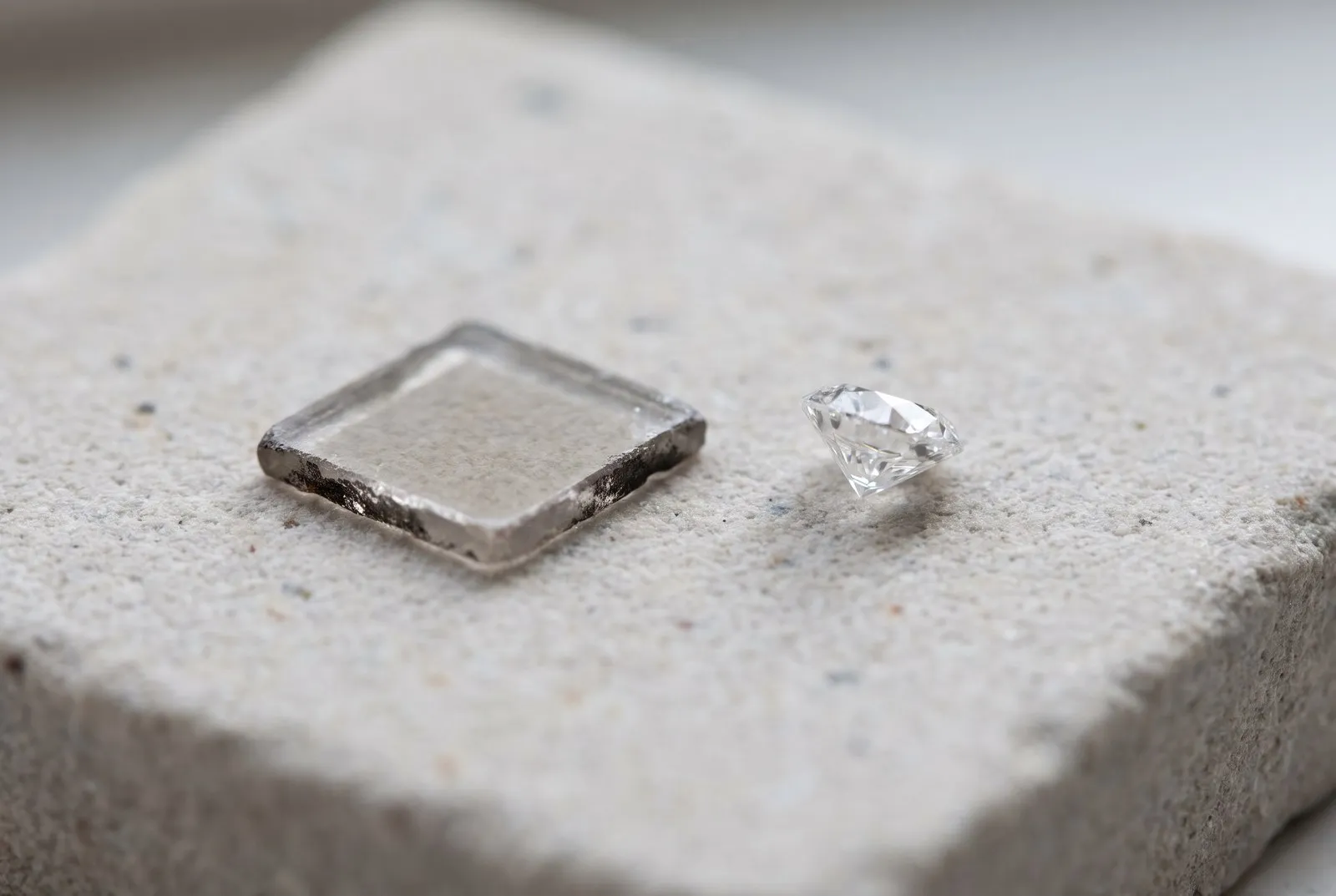
Pictured: an as-grown lab diamond plate beside a finished round diamond. Illustrative image.
Are lab-grown diamonds real or fake?
They aren’t fake. When the FTC revised its Jewelry Guides in 2018, it removed the word “natural” from its definition of a diamond. Its reasoning was short: these stones have essentially the same optical, physical and chemical properties as mined diamonds, and “thus, they are diamonds.” GIA says the same thing from the gem side: they’re not imitations.
So why not say “real”? The FTC’s guides also say it’s deceptive to use “real”, “genuine” or “natural” for anything manufactured. That’s why careful sellers write “lab-grown diamond”, and why a headline like “lab-grown vs real diamonds” is just as misleading: the FTC warned sellers against using those words to imply a lab-grown stone “is not, in fact, an actual diamond.” The trade is still arguing over the wording. The FTC has left the door open to evidence on how shoppers read “real”, and its guides aren’t binding law, but “actual diamond” is the clear way to say it.
| Word | What it means on a listing |
|---|---|
| Lab-grown, laboratory-created | The clear terms for a diamond made in a lab |
| Cultured | Allowed only with a clear lab-grown disclosure beside it |
| Synthetic | Not banned, though many shoppers wrongly read it as fake |
| Created, grown or foundry alone | The FTC couldn’t say these are clear enough alone |
| Faux | Not an adequate disclosure |
| Mined, natural | A diamond formed in the earth |
| Simulated, imitation | Not a diamond, such as cubic zirconia |
What are lab-grown diamonds?
Lab-grown diamonds are diamonds grown from carbon in a factory instead of forming underground. They start from a small diamond seed, and carbon atoms build onto it in the same crystal structure. GIA describes them as having essentially the same chemical composition, crystal structure and physical properties as natural diamonds. They’re then cut and polished the same way.
How are lab-grown diamonds made?
There are two methods, and GIA’s account gives the numbers.
- HPHT (high pressure, high temperature). A carbon source such as graphite goes into a small capsule in a press, with a metal such as iron, nickel or cobalt and a tiny diamond seed. At 1,300–1,600°C and over 870,000 psi, the metal melts and dissolves the carbon, which moves to the seed and crystallizes. It takes several days to weeks.
- CVD (chemical vapor deposition). Flat diamond seed plates go into a vacuum chamber with hydrogen and a carbon gas such as methane. Microwaves turn the gas into a plasma at about 900–1,200°C, and carbon settles on the seeds in thin layers. Crystals come out every few days to be cleaned, and the whole process can take three or four weeks.
You’ll see confident claims that a 1 carat stone takes two weeks. We couldn’t find a primary source for any single figure, because it depends on the method, the size, the quality and how many crystals share a run. “Days or weeks” is what GIA says.
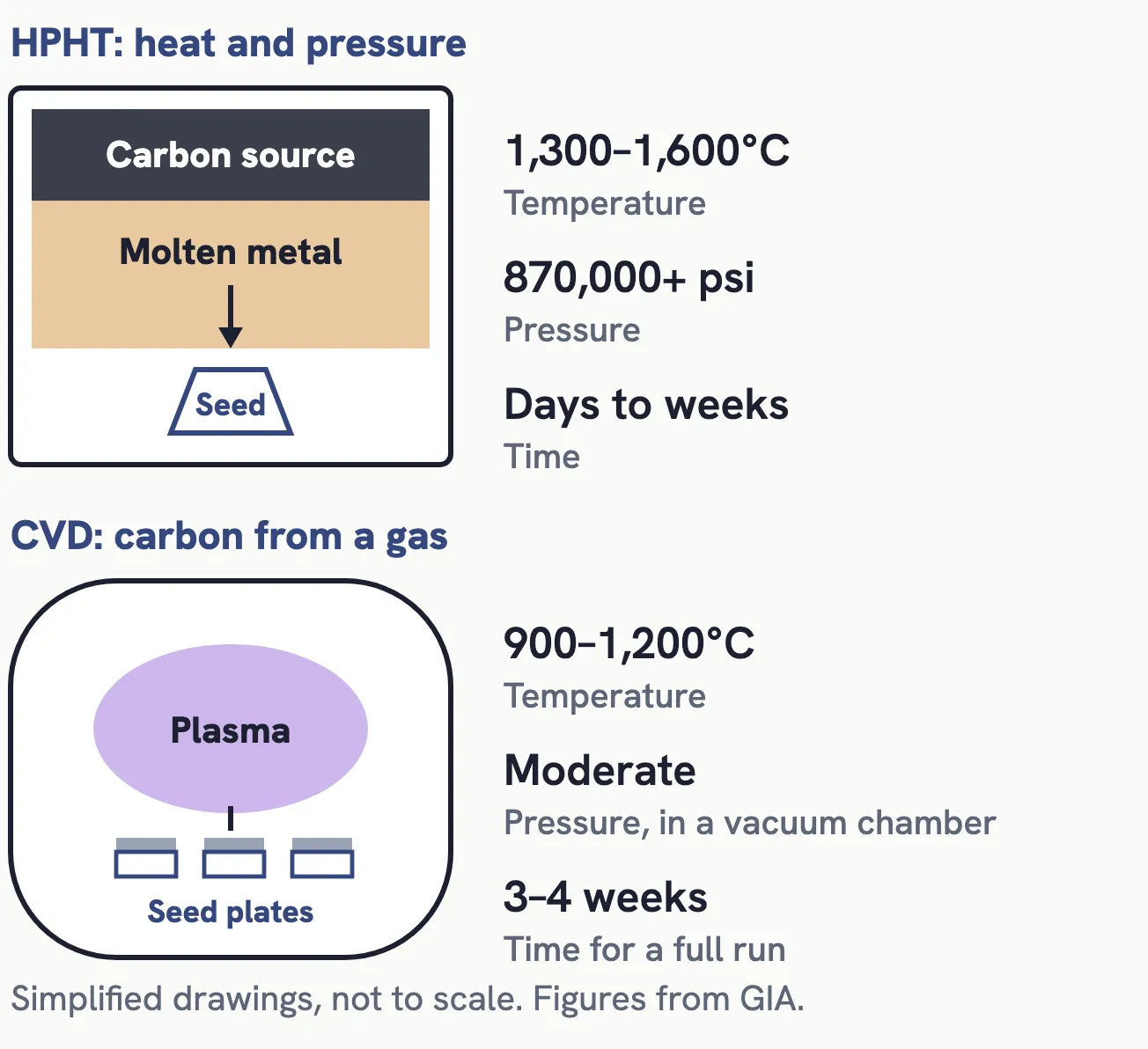
The two ways lab-grown diamonds are made, simplified. Figures from GIA.
Many stones also get a treatment after growth to improve their color, especially CVD stones. Many colored lab-grown diamonds are made this way too, as our guide to colored diamonds explains. That’s normal, and it appears on the report: IGI’s lab-grown reports state the growth method and say either “As Grown” or “Indications of post-growth treatment”.
The idea isn’t new. General Electric made the first verifiable synthetic diamond in December 1954, and GE’s first small gem-quality crystals followed in 1970. Larger gem-quality stones came from the mid-1990s, and they’ve become common in the past decade.
Lab-grown vs natural diamonds: what’s the same and what’s different
The material is the same, so the numbers are too. Both are 10 on the Mohs scale, with a refractive index of 2.42 and a density of about 3.52. What differs is mostly history and price.
| Lab-grown diamond | Natural diamond | |
|---|---|---|
| Material | Carbon crystal | Carbon crystal |
| Hardness | 10 | 10 |
| Refractive index | 2.42 | 2.42 |
| Where it formed | A factory, in days or weeks | Underground, over geological time |
| Typical clues inside | HPHT: metal flux. CVD: dark graphite, growth striations | Natural mineral crystals, natural growth patterns |
| Trace elements | Often very little nitrogen; some contain boron or silicon | Most contain some nitrogen |
| Price | Far lower | Far higher |
| Holds its retail price | No | Not fully either |
They’re “essentially the same”, and that’s the phrase both the FTC and GIA use. It’s better than “identical”, which you’ll see on seller pages, because GIA notes small differences, including in the hue of some pink and blue stones.
Can anyone tell a lab-grown diamond from a natural one?
Not by eye. GIA says only a gem lab with advanced equipment can say for certain where a stone came from. Labs use infrared spectroscopy, photoluminescence and imaging of the growth pattern. Jewelers can use screening instruments, which sort stones into natural or “send for testing”.
Lab-grown diamonds do pass as diamonds on a thermal diamond tester, as you’d expect. That only tells you the material, and it says nothing about origin. Testers aren’t perfect either: moissanite can also pass a thermal probe, and some lab-grown diamonds can read as moissanite on an electrical test. Our guide on how to tell if a diamond is real goes through what each test shows.
Do lab-grown diamonds get cloudy or change color?
We found no published evidence that lab-grown diamonds turn cloudy with age. Seller blogs say they never do, but we couldn’t find a study either way. A film of skin oil dulls any diamond, and our guide to cleaning a diamond ring fixes most of that.
Color is a more interesting story, as a few temporary changes have been documented. GIA has reported a 1.42 carat CVD diamond that turned from grayish yellow to grayish blue after short-wave UV, and returned with about three minutes of strong light. It has also reported an irradiated pink stone that shifted to orange and came back within minutes of daylight. GIA’s researchers told JCK that this isn’t common, and that HPHT treatment removes the cause in CVD stones. We found no solid report of a permanent color change in a finished stone, and no study that gives a rate.
How are lab-grown diamonds graded?
That depends on the lab, and it changed recently. IGI still gives lab-grown diamonds the familiar D-to-Z color and FL-to-I clarity grades. Since October 2025, GIA has replaced those letters on colorless lab-grown stones with two levels, Premium and Standard, saying that more than 95% of them fall into a very narrow range. Stones below Standard get no assessment. Our guides explain IGI reports, GIA reports and how the two compare, and our clarity chart covers what the grades mean.
How much do lab-grown diamonds cost?
Far less than natural diamonds of the same size and grade, as our chart shows. Those are two stores’ typical prices, and a 3 carat is where the gap is widest. Our guide to affordable engagement rings shows what that gap means for a budget. Our 3 carat diamond price guide compares more stores.
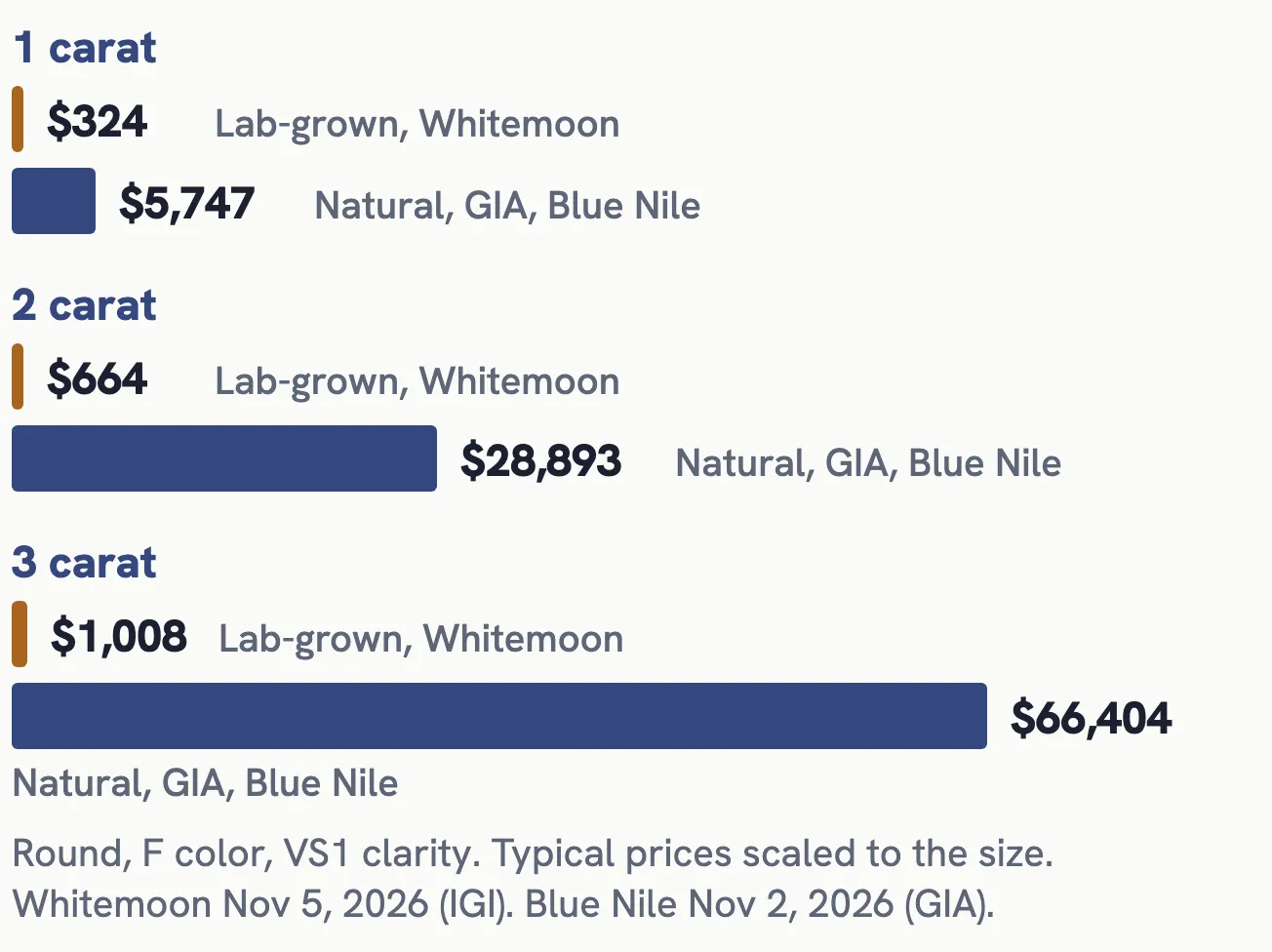
Typical prices for round, F color, VS1 stones. Whitemoon lab-grown with IGI reports, November 5, 2026; Blue Nile natural with GIA reports, November 2, 2026.
Lab-grown diamonds are now the mainstream choice for engagement rings. The Knot’s 2026 study of 10,474 US couples found that 61% of engagement rings had a lab-grown center stone. Those rings averaged $4,300 for 2.0 carats, against $7,000 for 1.6 carats with a natural center.
Do lab-grown diamonds hold their value?
No, and you should know that before you buy. Prices have fallen a long way: one analyst’s wholesale index is down about 92% since 2018, and it’s too early to say the fall has ended. We found no independent data on resale, so we won’t quote a percentage. Lab-grown diamonds don’t hold their retail price, so it’s best to buy one to wear, not as an investment. Our guide to whether lab-grown diamonds are worth it weighs the pros and cons. Paying less up front also leaves less at stake.
Are lab-grown diamonds ethical?
A lab-grown diamond doesn’t come from a mine, so the concerns about mining don’t apply to the stone itself. Beyond that, be careful with big claims, ours included. Factories differ in their energy and labor, and the FTC says sellers must be able to back up what shoppers take “ethical” or “conflict free” to mean. Our post on what the environmental studies show looks at who measured what.
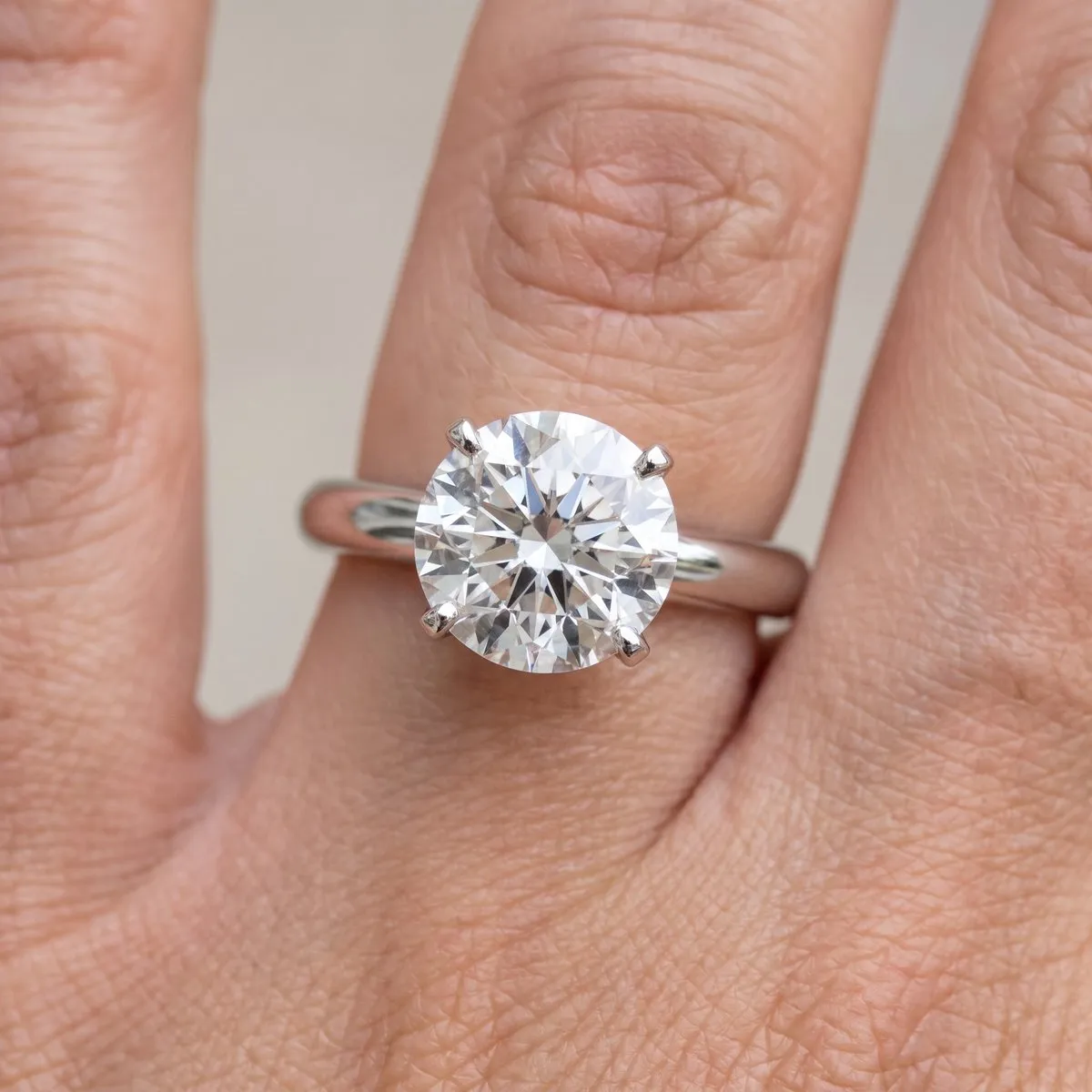
Pictured: a round lab-grown diamond solitaire with a plain platinum band. Image created from the ring’s design.
Lab-grown diamonds at Whitemoon
Our finished jewelry, including stud earrings, tennis bracelets and wedding bands, uses lab-grown diamonds. For an engagement ring, you choose the setting and then the center stone, and the ring builder lists both lab-grown and natural diamonds, with an IGI or GIA report. Our Lifetime Upgrade gives you 100% of what you paid as credit toward a new lab-grown piece worth at least 1.5 times as much. Most Whitemoon rings are made to order in about 10–15 days and ship free with insurance both ways, with 30-day returns on unworn pieces and one free resize within 60 days of delivery.
Lab-grown diamond questions
Are lab-grown diamonds even diamonds?
Yes. They’re carbon crystallized in the same structure as a mined diamond, and the FTC’s definition covers them. The only thing that’s different is that a lab-grown diamond formed in a factory and not in the earth. Because it isn’t mined, it also falls outside the conflict diamond rules in our conflict-free diamonds guide.
Are lab grown diamonds real or fake?
They aren’t fake, because a fake would be a different material, and these are diamonds. The FTC warns sellers against calling them “real” or “genuine”, so the accurate description is “lab-grown diamond”.
Can a jeweler identify a lab-grown diamond?
Not by eye or with a standard tester. A jeweler can read a report or a laser inscription, or use a screening instrument that flags a stone for testing. To say for certain, it takes a gem lab with advanced equipment.
Can lab grown diamonds pass a diamond tester?
Yes, they read as diamond on a thermal tester, because they’re diamond. Some can read as moissanite on an electrical test, which is usually put down to trace boron in the stone and isn’t a sign of a fake.
Do lab grown diamonds sparkle like real diamonds?
A lab-grown diamond has the same refractive index and dispersion as a mined diamond, so a stone of the same cut sparkles the same way. In any diamond, the cut does most of the work.
What are the disadvantages of lab-grown diamonds?
The main one is value: they don’t hold their retail price, and prices have been falling. Some buyers also simply prefer a stone formed in the earth, and a few lab-grown stones have shown temporary color changes under strong UV.
When did lab diamonds become popular?
Mostly in the past decade. Gem-quality stones reached larger sizes from the mid-1990s, and by The Knot’s count their share of engagement ring center stones has risen 239% since 2020, reaching 61% among couples married in 2025.
Why do jewelers not like lab diamonds?
Not all of them dislike them, and large groups such as Signet sell both. Those who object mostly point to falling prices and resale, and some prefer to sell natural stones. Blue Nile, for one, has said it’s moving to primarily natural diamonds.