
IGI Certificate: What It Is and How to Read One
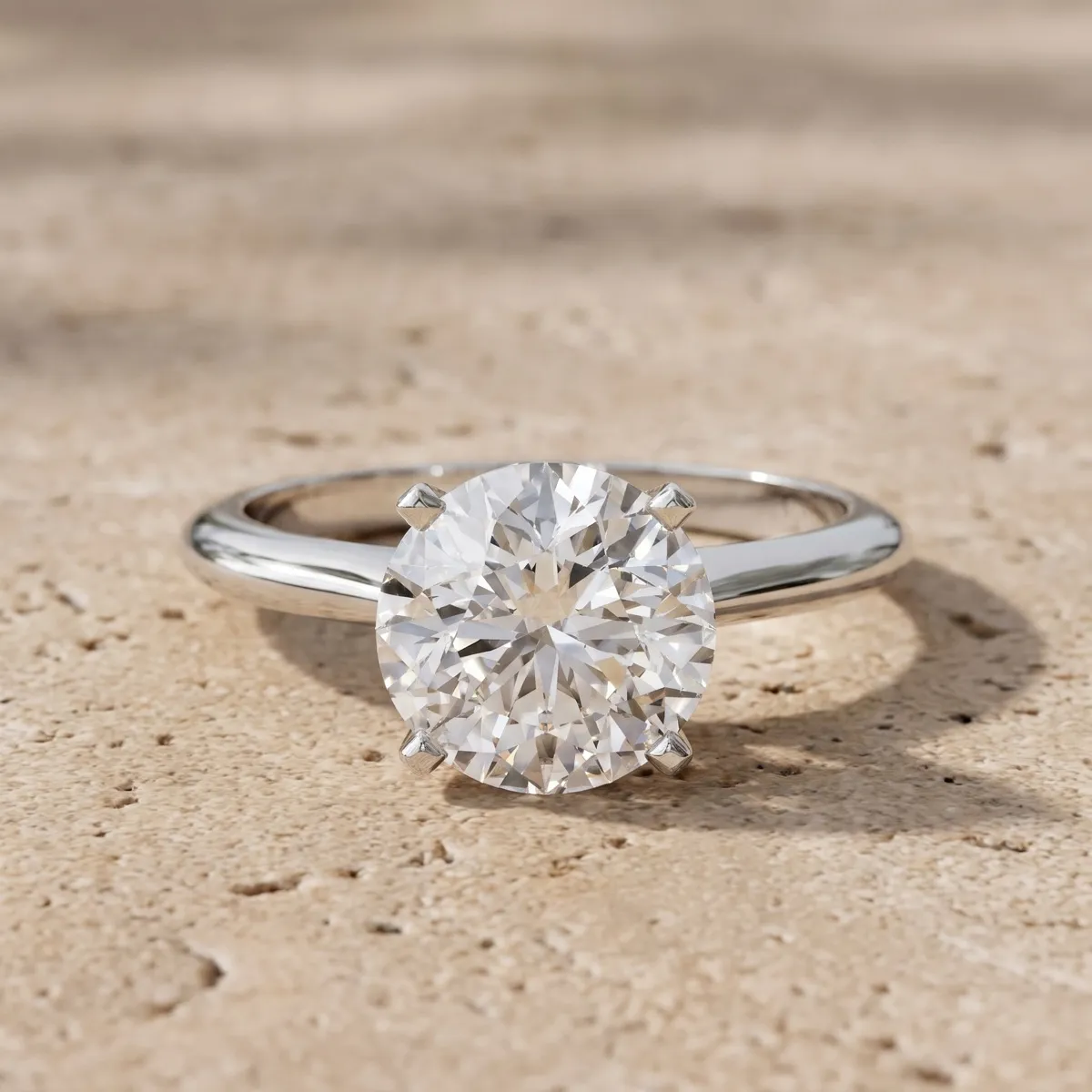
An IGI certificate is a grading report from the International Gemological Institute that describes one diamond: whether it is laboratory-grown or natural, its carat weight, color, clarity, cut and measurements, and, on a lab-grown stone, how it was grown. An IGI certified lab-grown diamond is a lab-grown diamond that IGI has examined and recorded under its own report number. To read the report, verify the number on IGI’s website, confirm the origin line, then work down through the grades, proportions, plot and comments.
This guide takes an IGI lab-grown report line by line, with a made-up sample so you can see where each item sits. It matters if you are shopping for a Whitemoon ring, because most of our center stones carry an IGI report. For every clarity mark in one table, see our guide on how to read a diamond certificate.
Pictured: a round lab-grown diamond solitaire with a plain white gold band. Image created from the ring’s design.
What is an IGI report?
An IGI report is a lab’s written opinion of one stone’s identity and quality at the time it was graded. IGI’s reports say they are an opinion, and neither a guarantee nor an appraisal, so the document states no price. Sellers tend to say “certificate” and labs say “report”, and both words mean the same paper.
IGI was founded in Antwerp in 1975 and now runs laboratories around the world. It describes itself as the largest independent gemological laboratory and says it has graded lab-grown diamonds since 2005; those claims are its own. IGI says its graders assess each stone independently and that a grade is set once enough of their opinions agree. When GIA moved away from letter grades for lab-grown stones in 2025, IGI said it would keep full 4Cs grading, which is why the choice of IGI vs GIA now matters.
The phrase “IGI certified” names the lab and stops there. The quality of the stone sits in the grades, so a report reassures you only as far as its grades and comments do.
How to read an IGI report, line by line
Start at the top and read down: identity lines first, then grades, then comments. The picture is our own drawing of a typical layout, with made-up values. Field names and order can differ on an actual report, and IGI publishes its own guide, How to Read an IGI Laboratory Grown Diamond Report. The numbers below match the drawing.
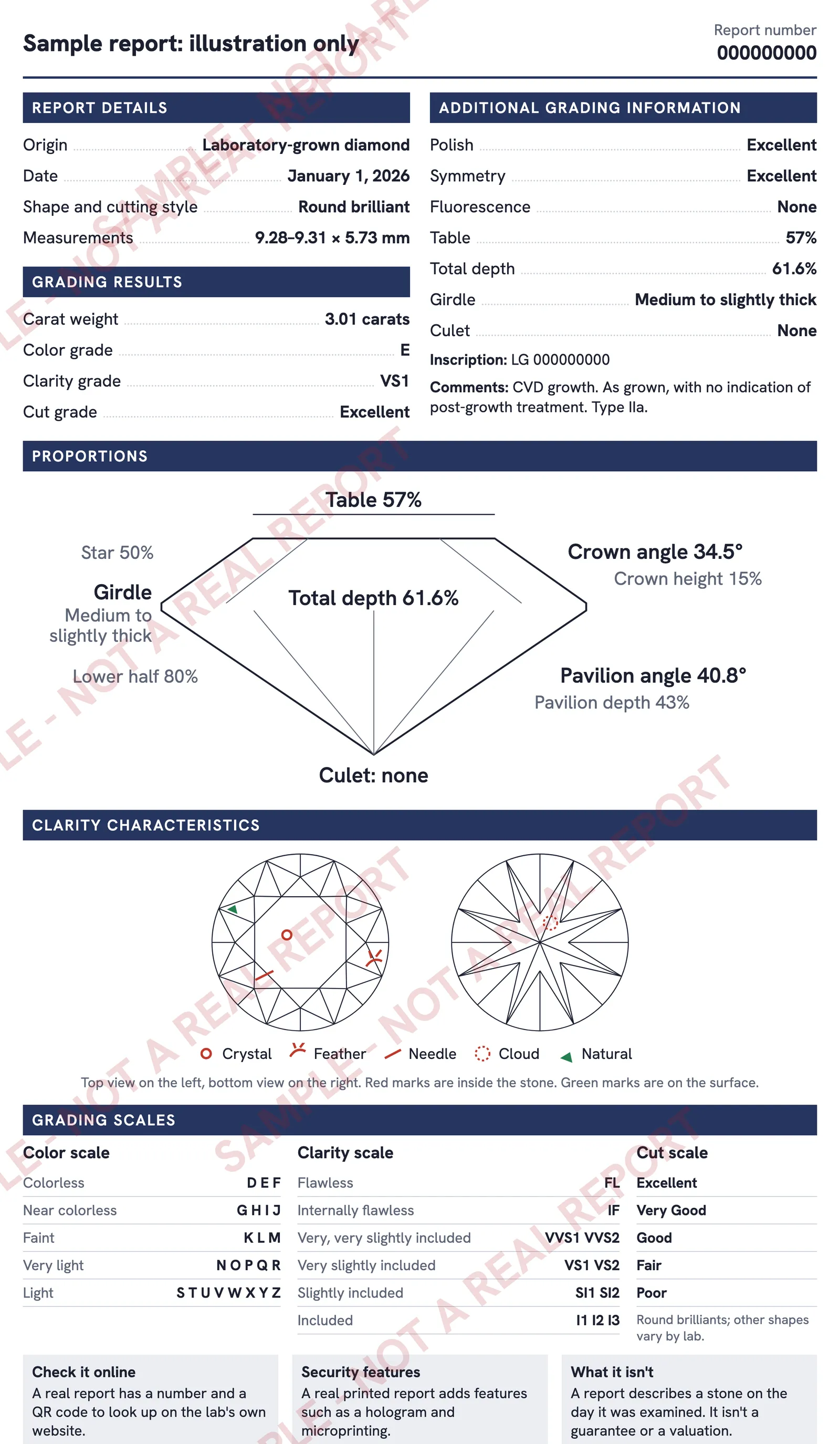
A full sample report for a lab-grown diamond, with made-up values, showing everything a complete report usually carries. Illustration of a typical report, not an actual IGI document. On a phone, pinch to zoom.
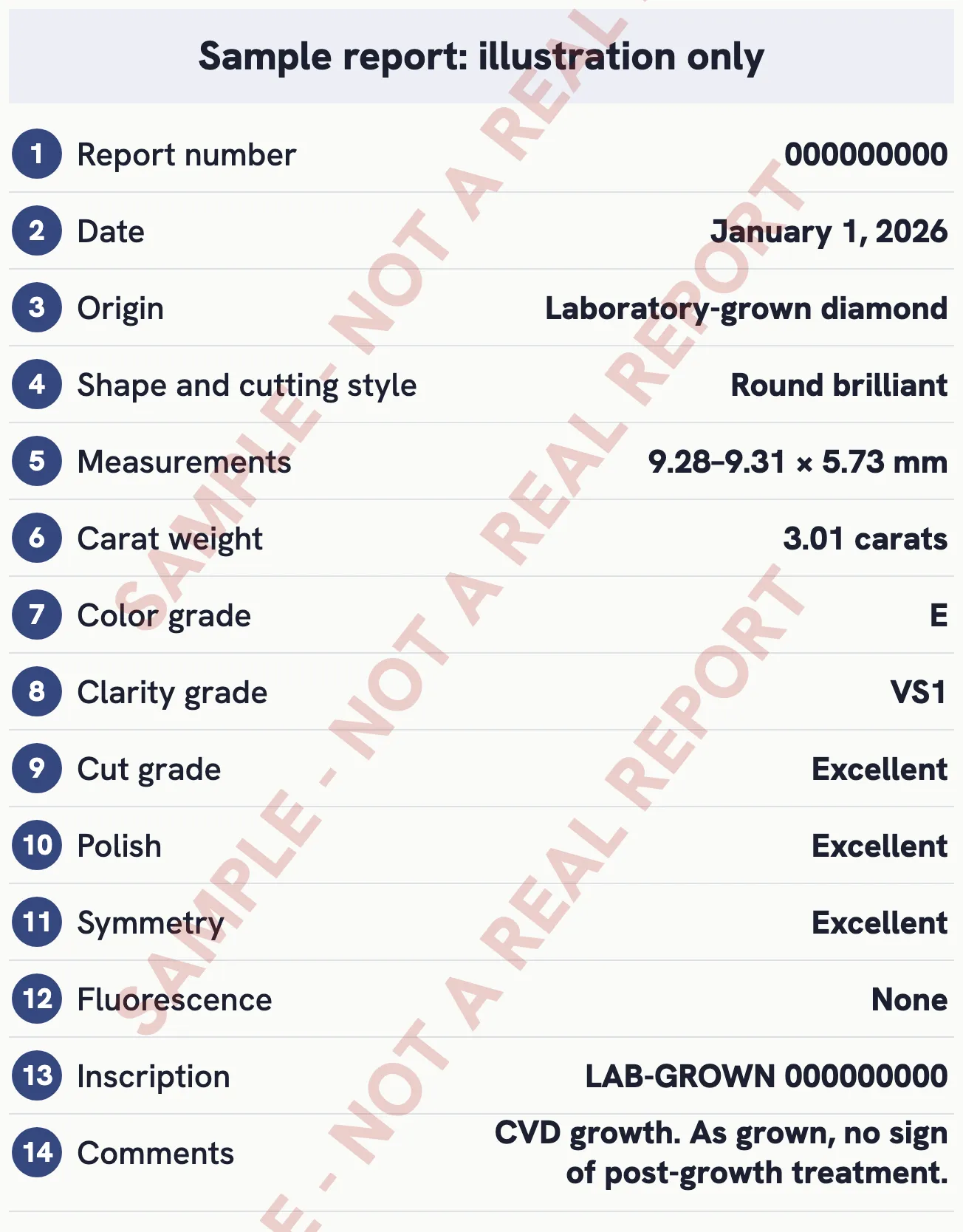
Illustration of a typical report layout, not an actual IGI document.
- Report number. IGI gives each stone an identification number when it arrives, and after grading that number becomes the report number. It is what you enter on IGI’s Verify Your Report page.
- Date. The date printed on the report. The grades describe the stone as it was then, so a chip or a recut after that day won’t appear.
- Origin. IGI’s description states whether the stone is laboratory-grown or natural. Check this line before anything else on the page.
- Shape and cutting style. Shape is the outline, such as round or oval. Cutting style is the facet pattern, such as brilliant or step. Together they tell you which sparkle pattern to expect.
- Measurements. A round stone shows its smallest width, largest width and depth in millimeters. Other shapes show length, width and depth. These numbers tell you how large the stone will look from above, which carat weight alone can’t.
- Carat weight. Weight to two decimal places, where one carat is 0.2 grams. Our 3 carat diamond price guide shows how width changes as weight climbs.
- Color grade. The D-to-Z scale. IGI’s published bands run D–F colorless, G–J near colorless and K–M slightly tinted, then lighter tints down to Z. Fancy colors are handled separately.
- Clarity grade. Judged at 10× magnification, from the Flawless grades through VVS, VS and SI down to I1, I2 and I3. The plot further down shows what set the grade.
- Cut grade. IGI’s scale runs from Ideal down to Poor. On a round brilliant, IGI compares the proportions with its studies of brightness, fire, scintillation and pattern. It describes a separate four-step assessment for fancy shapes, so check what your report prints for an oval or a pear.
- Polish. How smooth and clean the facet surfaces are. IGI says every shape and color gets this grade.
- Symmetry. How exact the outline is and how well the facets line up. A slightly lower symmetry grade is hard to see, while a low one can change the pattern of light in the stone.
- Fluorescence. The stone’s reaction to ultraviolet light. IGI reports can use words such as None, Very Slight or Slight, where GIA’s scale runs None, Faint, Medium, Strong and Very Strong.
- Inscription. IGI laser-inscribes “LG” ahead of the report number on the girdle of every lab-grown diamond it reports on, and notes it in the comments. Our drawing spells the word out; on the stone itself, look for LG.
- Comments. The line that says the most about a lab-grown stone. It can name the growth process, carry the treatment wording explained next, and add notes such as a diamond type or a hearts and arrows pattern.
What CVD, HPHT and “as grown” mean on an IGI report
These words tell you how the stone was made and whether IGI found signs of treatment after growth. CVD and HPHT are the two growing methods, and both produce diamond crystal. IGI says the growth process and any treatment are noted in the comments, in some cases on request, so ask if your report leaves that line blank.
| Wording | What it means |
|---|---|
| CVD | Chemical vapor deposition. Carbon from a gas such as methane settles on seed plates in a vacuum chamber, layer by layer, at roughly 900–1,200°C over three or four weeks. |
| HPHT | High pressure, high temperature. Carbon dissolves in molten metal inside a press at 1,300–1,600°C, then crystallizes on a seed over days to weeks. |
| As grown, with no indication of post-growth treatment | IGI found no sign that the stone was treated after growing. The wording dates from January 2021. |
| May include post-growth treatment | The stone may have been treated after growth, a step normally used to improve color. |
| Type IIa | A scientific class of diamond with almost no measurable nitrogen. IGI adds type on request. |
Treatment after growth is common. GIA reported in 2024 that about 80% of the CVD stones submitted to it since 2020 had been through post-growth processing, though that covers GIA’s own submissions only. The treatment wording matters most when you compare two stones, because you want like against like.
How to read the proportions on an IGI report
The proportions show how a stone is built, as angles and as percentages of its width. They explain a round brilliant’s cut grade and give you something firm to go on with fancy shapes. IGI says its reports may include this graphic, so not every document will have it. The drawing uses made-up values for a round brilliant.
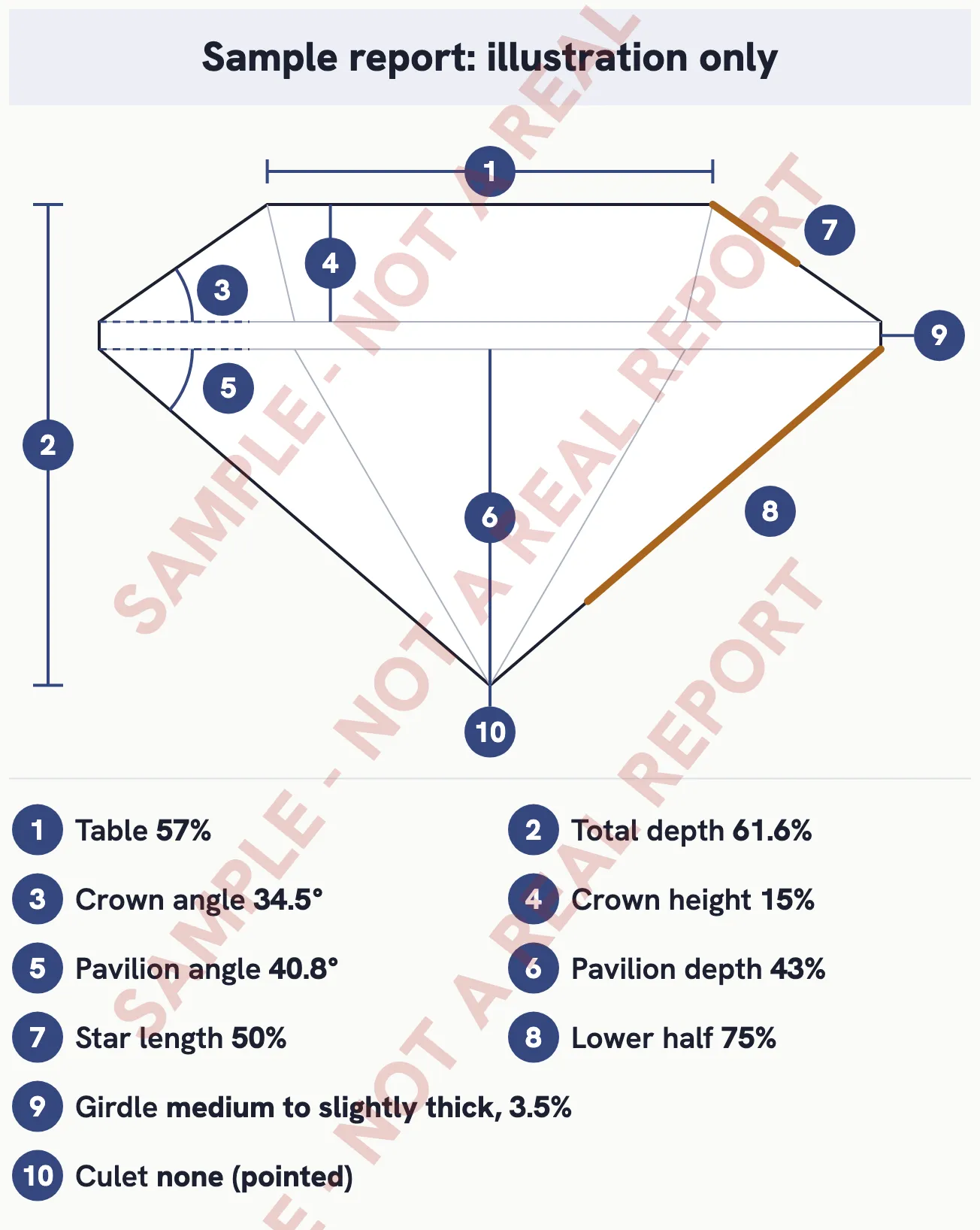
Illustration of a typical report layout, not an actual IGI document.
- Table. The width of the flat top facet as a share of the stone’s width.
- Total depth. Height from table to bottom tip as a share of width. A deep stone keeps weight where nobody sees it and can look small for its carats.
- Crown angle. The slope of the upper section, which affects how light scatters into color.
- Crown height. How tall the upper section stands above the girdle.
- Pavilion angle. The slope of the lower section. Small changes here have a large effect on how much light comes back through the top.
- Pavilion depth. How far the lower section reaches down from the girdle.
- Star length. How far the small star facets run from the table toward the girdle. Some reports leave this out.
- Lower half. How far the lower facets run from the girdle toward the tip. Some reports leave this out too.
- Girdle. The thin edge around the stone’s widest point. IGI reports give a range, such as Medium to Slightly Thick, plus a word like Faceted for its finish. Very thin edges chip more easily, and very thick ones add weight without adding width.
- Culet. The bottom tip. IGI reports often read Pointed, meaning the facets meet with no flat tip. A large flat tip can show as a dark dot through the table.
IGI uses its own cut system. For a published yardstick, our GIA certificate guide lists the ranges GIA allows for its top cut grade on round brilliants.
How to read the clarity plot on an IGI report
The plot is a map of the marks that set the clarity grade, drawn on an outline of the stone from above and below. It answers the question a clarity grade leaves open, which is where the marks are. Our diamond clarity chart explains the grades themselves. As with proportions, IGI says a report may include it, so a shorter document can come without one.
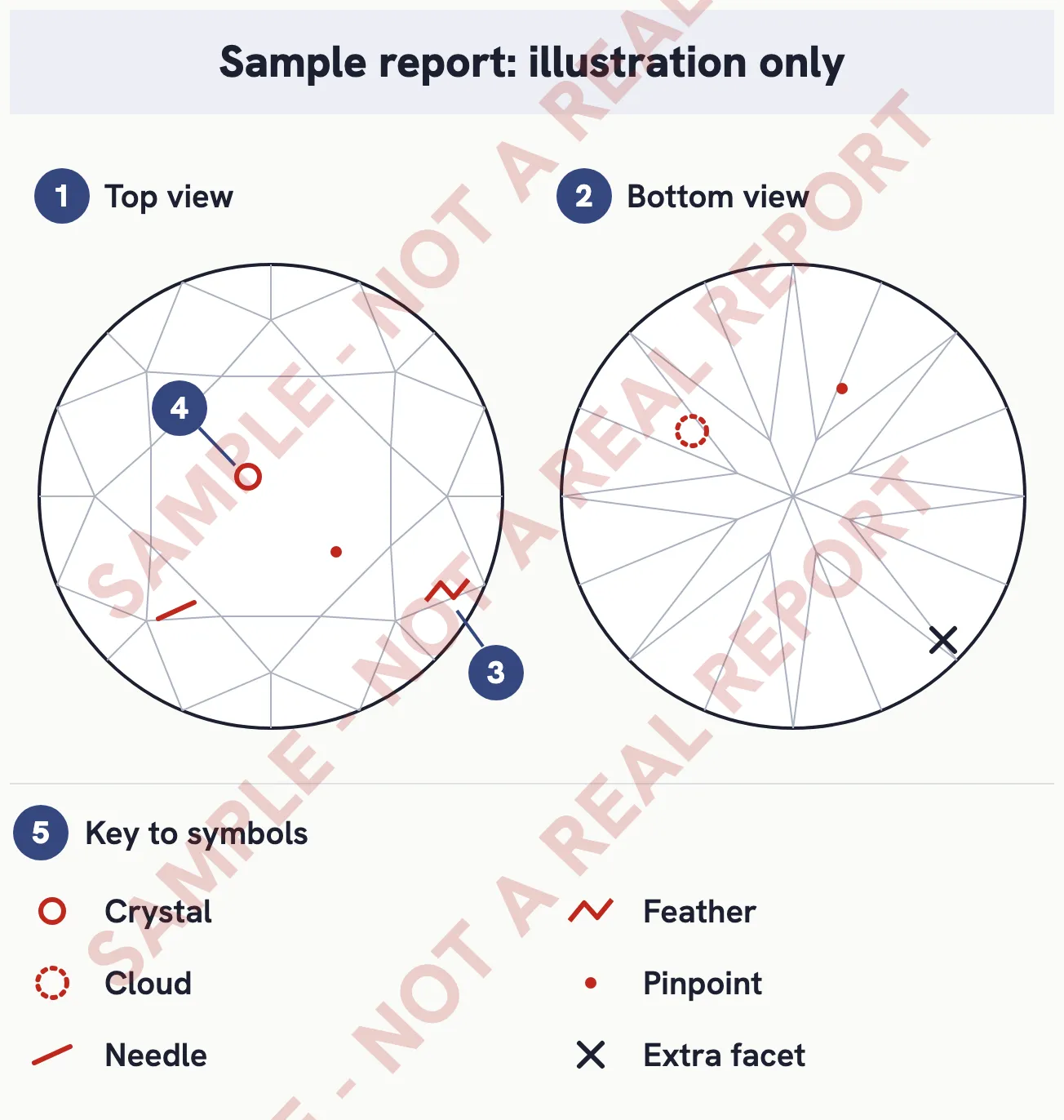
Illustration of a typical report layout, not an actual IGI document.
- Top view. The stone seen through the table, which is how you will see it once it is set.
- Bottom view. The stone seen through the lower facets. A mark drawn here can be harder to spot from above.
- A mark near the edge, here a feather. A prong may cover a mark in this spot. Even so, a break that reaches the surface at the edge is the place a hard knock could start a chip.
- A mark under the table, here a crystal. The closer a mark sits to the center of the table, the more it tends to count and the easier it is to find.
- Key to symbols. The list of mark types on this stone. Read it first, then find each one on the map.
Step cuts have open facets that show marks more readily, so read the plot with extra care on an emerald or Asscher cut. Our diamond certificate guide explains all the marks in two tables: what each looks like, whether it usually matters, and which to look at closely.
Marks that show up on lab-grown diamonds
Lab-grown diamonds carry the same kinds of marks as other diamonds, with some growth-related differences. In GIA’s published reviews, the most common grade-setting marks on CVD stones were clouds, pinpoints, crystals and needles, usually dark and graphite-like. On HPHT stones, crystals led, with feathers, pinpoints and clouds behind them, and metallic inclusions left by the growing process are a known sign. GIA notes these marks don’t prove origin on their own. Those reviews covered stones graded up to about 2016, when most CVD stones graded VVS2 to VS1 and most HPHT stones VS1 to VS2, so treat the grades as history.
How to verify an IGI report
Enter the report number on IGI’s website and compare the online record with the paper, line by line. That takes a minute and catches most mismatches. Then tie the report to the stone itself:
- Check the record. Weight, measurements and grades should match exactly. If a number won’t load, IGI has a page for missing or problematic reports.
- Scan the code. IGI says the QR code on a printed report opens the online copy.
- Read the inscription. A jeweler with a loupe can read “LG” and the number on the girdle.
- Compare the stone. Measurements and plotted marks should fit the stone in front of the jeweler.
The last two steps matter because inscriptions can be faked. IGI reported a 6.01 carat lab-grown pear-shaped stone inscribed with a number belonging to a natural diamond’s report. IGI also says its printed reports use security paper with at least five features, including tear-proof paper, microprinting and holograms, and these are hard to judge at home, which makes the online record your practical check.
What an IGI report leaves out
An IGI report covers one stone’s identity and quality, so several things you may care about sit outside it:
- Price. It gives no value. An appraiser may use the report to reach one.
- The look of the stone. Two stones with the same grades can look different, so ask for a photo or video of the actual stone.
- Other stones in the piece. The small lab-grown diamonds around a center stone aren’t covered, and neither is the metal.
- Other labs’ scales. An IGI grade and another lab’s grade aren’t a strict match, so compare stones graded by the same lab. Our guide to diamond grading labs shows how the scales differ.
IGI reports and your Whitemoon ring
Most center stones in the Whitemoon ring builder carry an IGI report, and a smaller number carry a GIA report. You can begin with solitaire engagement rings or a shape such as round engagement rings, oval engagement rings or emerald cut engagement rings, then choose the center in the next step. Rings with the center already set include 1 carat lab-grown diamond rings and 3 carat lab-grown diamond rings.
The report ships with the ring, so keep it with your purchase papers, since a return needs it. If you would like help reading one, call or message us. Most Whitemoon rings are made to order in about 10–15 days and ship free with insurance both ways, with 30-day returns on unworn pieces and one free resize within 60 days of delivery.
IGI certificate questions
What does IGI certified mean?
It means the International Gemological Institute examined the stone and issued a report under its own number, recording the stone’s identity and grades. The phrase doesn’t promise high quality: an IGI certified lab-grown diamond can be D VVS1 or far lower. Read the color, clarity and cut lines, then confirm the number on IGI’s website.
What does IGI do?
IGI is a gemological laboratory. It examines diamonds, colored stones and finished jewelry, then issues reports on what it finds. It also screens stones to separate mined diamonds, lab-grown diamonds and simulants, and it runs schools of gemology. Founded in Antwerp in 1975, it now operates in many countries, and much of its grading today is lab-grown.
How to tell if an IGI report is real?
Enter the report number on IGI’s Verify Your Report page, or scan the QR code on a printed report, and compare the online record with the paper line by line. Then ask a jeweler to match the girdle inscription and measurements to the stone. Paper and inscriptions can both be copied, so all three checks together give you the answer. Our guide on how to tell if a diamond is real covers the stone itself.
Does IGI certify natural diamonds?
Yes. IGI issues natural diamond reports with the same kinds of color and clarity grades, and the description line says which origin it found. IGI says it screens every diamond for origin and won’t issue reports on stones with non-permanent treatments. For natural diamonds, many shoppers and jewelers still treat GIA as the usual benchmark, which is an opinion worth knowing about.
Are IGI reports accurate?
IGI says several graders assess each stone independently and a grade is set when enough of them agree. Many jewelers feel IGI grades a little more generously than GIA. That is opinion, and we haven’t found a recent independent study that settles it. Treat any grade as a close description, compare stones graded by one lab, and look at the stone.
Does IGI certify moissanite?
IGI has issued moissanite reports. In 2022 it announced a program for one maker’s lab-grown moissanite, stating the gem’s identity, shape, weight and colorless character for stones of 0.50 to 5 carats. That is narrower than a diamond grading report. Moissanite is a different gem from diamond, and any report on it should say so plainly.