
IGI vs GIA: Which Report Should You Choose for a Lab-Grown Diamond?
For most lab-grown diamond shoppers, an IGI report is the more practical choice today, because it gives exact color and clarity grades you can compare from stone to stone. GIA’s current lab-grown document sorts stones into Premium or Standard with no letter grades, while GIA remains the usual benchmark for natural diamonds. Neither lab is better at everything, and each lab’s reputation is partly a matter of opinion.
You should know where we stand: most Whitemoon center stones carry an IGI report and a smaller number carry a GIA report. So read this as a jeweler’s view, and check anything important on the labs’ own sites. Below are the differences, the reasoning behind GIA’s change, the two report styles side by side and what the price gap looks like.
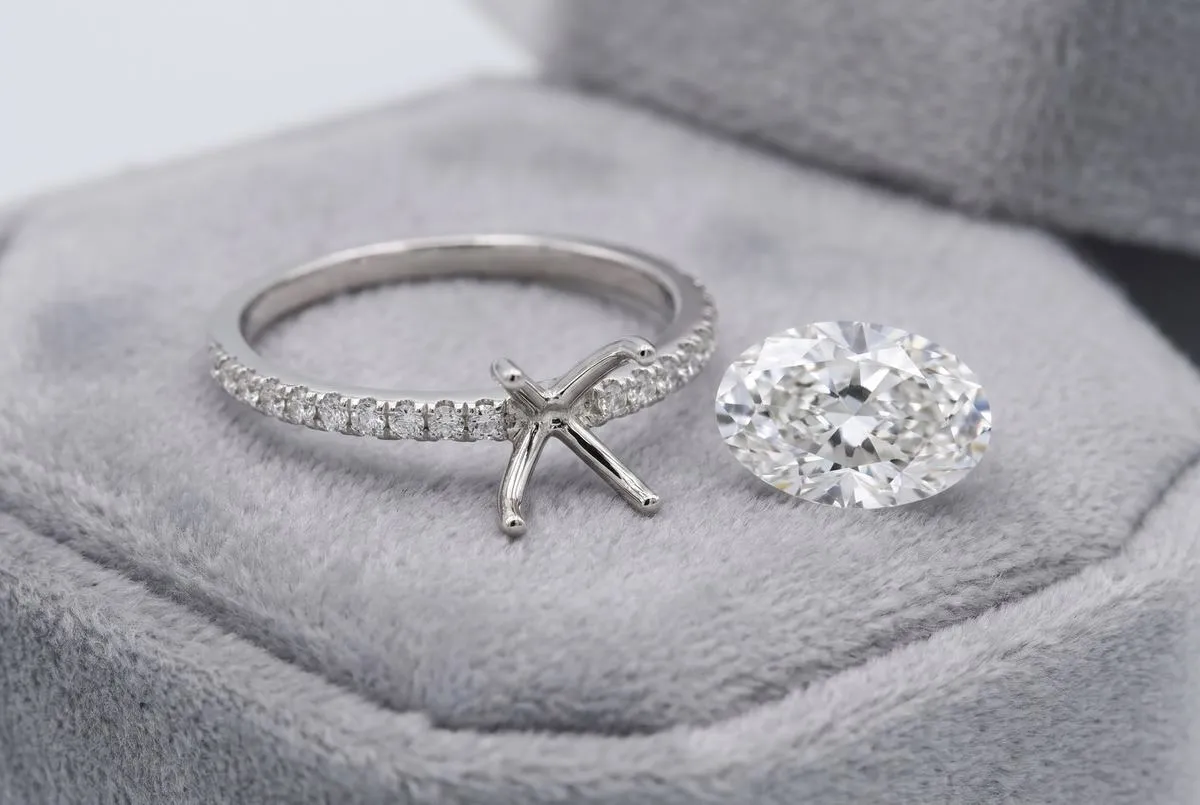
Pictured: a white gold setting beside a loose oval lab-grown diamond. Image created from a Whitemoon setting design.
What is the difference between IGI and GIA?
The main difference is what each lab prints on a lab-grown diamond. IGI gives separate color, clarity and cut grades, and GIA gives one overall class. Both still give full letter grades on natural diamonds, where the two labs’ documents look much more alike.
| Compare | IGI | GIA |
|---|---|---|
| Started | Antwerp, 1975 | United States, 1931 |
| Ownership | Company backed by Blackstone | Independent nonprofit |
| Current lab-grown paper | Lab-grown diamond report | Quality Assessment, printed |
| Color and clarity | Letter grades | Premium or Standard class |
| Round cut | Ideal to Poor | Built into the class |
| Clarity plot | Report may include one | None on GIA’s sample |
| Growth method | In the comments, some on request | None on GIA’s sample |
| Origin check | IGI says it screens every stone | GIA’s sample says origin was disclosed, with no further testing |
| Inscription | “LG” plus report number | “Laboratory-Grown” plus assessment number |
| Look it up | Verify Your Report | Report Check |
Our IGI certificate guide and GIA certificate guide go through each lab’s document line by line.
Why GIA dropped letter grades for lab-grown diamonds
GIA’s stated reason is that lab-grown stones have bunched into a narrow band of quality. On June 2, 2025, it said more than 95% of lab-grown diamonds entering the market fall into a very narrow range of color and clarity, and that its natural-diamond terms are no longer relevant to them. The Quality Assessment launched on October 1, 2025, and GIA said existing lab-grown reports remain valid.
This is GIA’s third approach to lab-grown stones. JCK reported that GIA first used general categories, moved to full 4Cs grading in 2020, and now uses the two classes. The same report quoted GIA’s chief executive saying the lab grades fewer than 5% of lab-grown diamonds, which helps explain why you see far more IGI reports on these stones.
IGI went the other way. On July 14, 2025, it said it would keep applying the 4Cs to natural and lab-grown diamonds alike, to avoid confusing shoppers, and it criticized what it called a diluted scale. Reaction in the trade split along predictable lines, with natural-diamond groups welcoming GIA’s move and some lab-grown sellers calling it repositioning.
The same stone under each report style
A letter-grade report describes each quality on its own, and a Premium or Standard document tells you which band the stone falls in. The drawing shows one made-up stone both ways, and the numbers below explain each row. GIA publishes its assessment criteria, and IGI publishes its own guide to its lab-grown report.
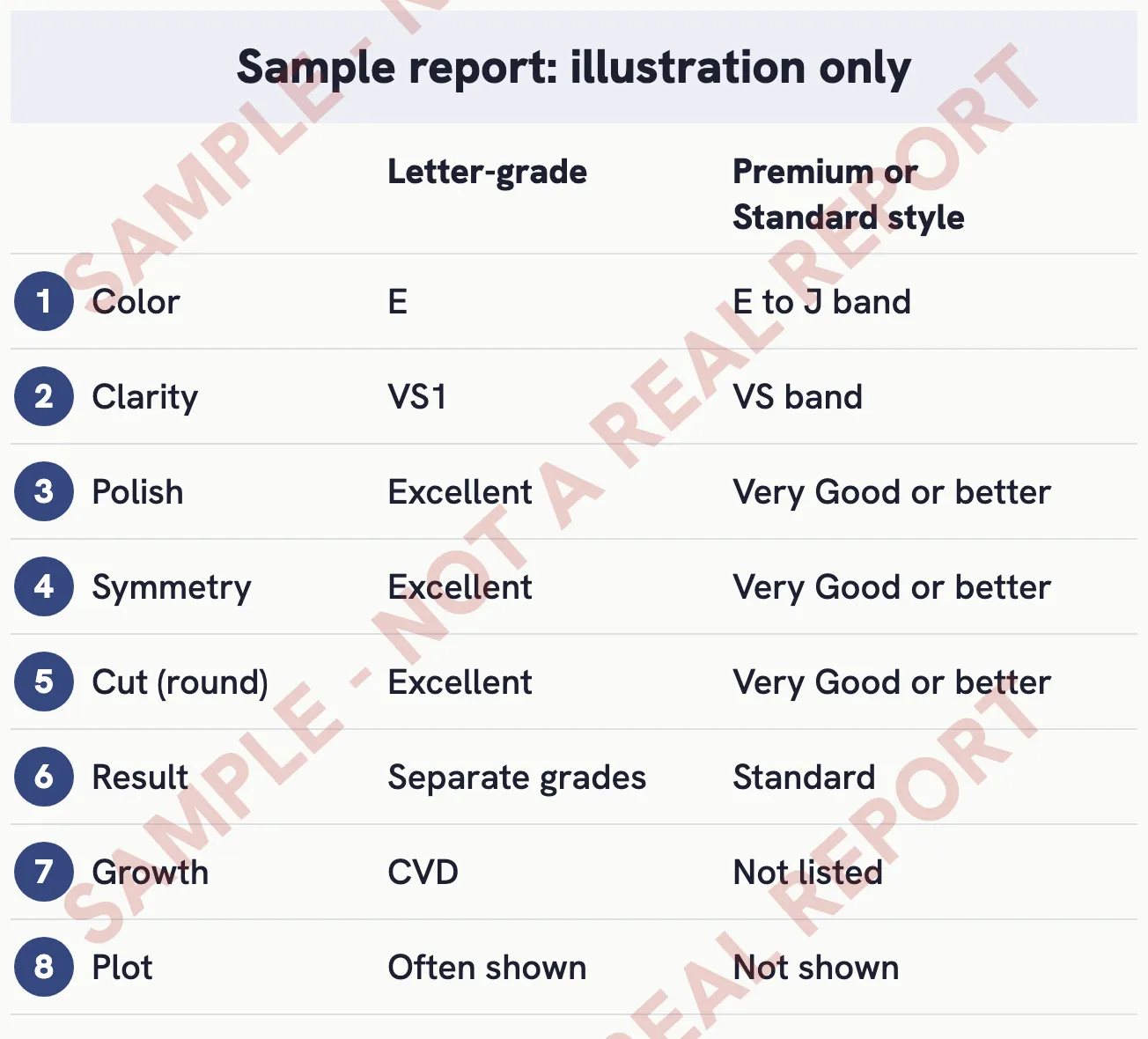
Illustration of a typical report layout, not an actual IGI or GIA document.
- Color. A letter report says E. On GIA’s system, anything from E to J falls in Standard, so the class alone can’t separate an E from a J, which can look quite different side by side.
- Clarity. VS1 and VS2 both fit Standard. A stone needs VVS or higher to reach Premium on this measure.
- Polish. Standard asks for Very Good or better, and Premium asks for Excellent.
- Symmetry. The same rule applies on round brilliants. GIA accepts Good on fancy shapes in Standard.
- Cut, round only. Standard needs a Very Good cut grade on a round brilliant, and Premium needs Excellent. Fancy shapes have no cut requirement.
- Result. A letter report leaves you to weigh the grades. On GIA’s system, Premium needs the top mark on all five measures, including D color, and any miss drops the stone to Standard. An F VVS1 stone and a J VS2 stone can therefore share one class. A stone that falls short of Standard gets no assessment.
- Growth. IGI’s comments can name CVD or HPHT. GIA’s published sample of the Quality Assessment shows no growth method.
- Plot. Letter-grade reports often include a clarity map. GIA’s published sample has only a proportions drawing, so you can’t see where any marks sit.
Does IGI grade more softly than GIA?
Many jewelers believe IGI grades a little more generously than GIA, and we haven’t found a recent independent study that proves or disproves it. Treat it as a common opinion. GIA no longer gives letter grades on new lab-grown stones, so a fresh side-by-side comparison on those stones isn’t even possible today.
The practical answer holds either way. Compare stones graded by one lab, read the plot where there is one, and look at the actual stone in a photo or video. If you are weighing an IGI stone against an older GIA stone, don’t assume one lab’s E equals the other’s.
How much more does a GIA-graded stone cost?
At Whitemoon on November 2, 2026, a 3 carat round E VVS2 lab-grown diamond typically cost $1,200 with an IGI report and $3,087 with a GIA report, about two and a half times as much. Read those figures with care. Few GIA stones were listed, and they carry older letter-grade reports, since the Premium and Standard document prints no E or VVS2. This is a snapshot of one size and grade, so don’t treat the gap as a rule.
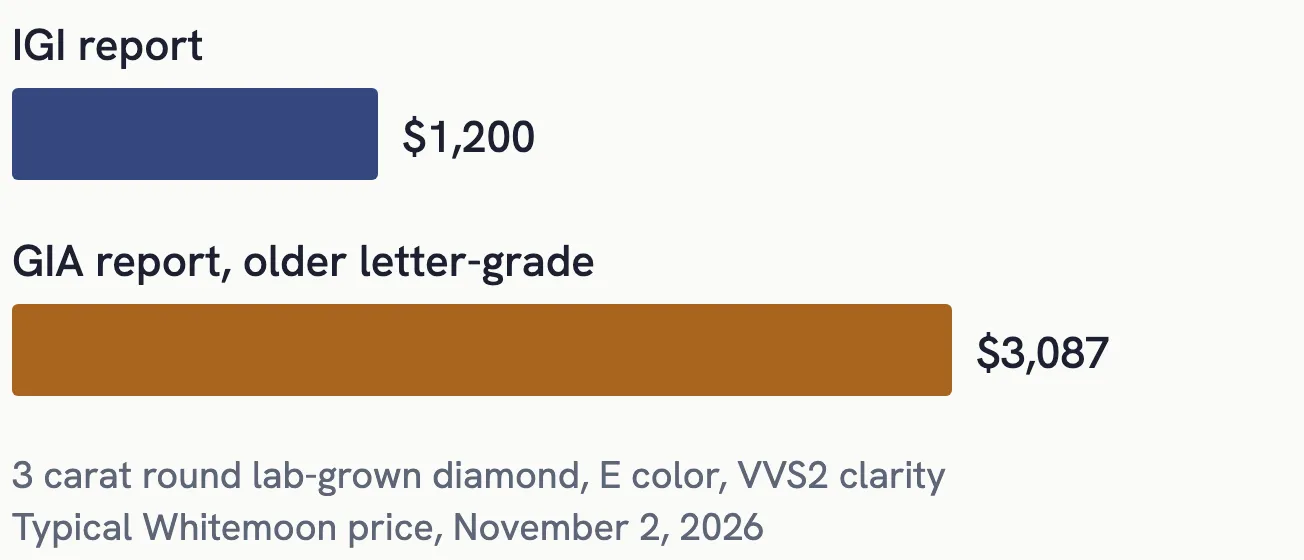
3 carat round lab-grown diamond, E color, VVS2 clarity, typical Whitemoon price on November 2, 2026. Few GIA-graded stones were listed, and they carry older letter-grade reports.
The grading fee explains little of it. GIA’s fee schedule lists $15 per carat for its current assessment, or about $45 on a 3 carat stone, though older reports were priced differently. Limited supply and the appeal of the GIA name probably account for more, which is our reading and not something we can measure. Our 3 carat diamond price guide shows how prices move by grade and shape.
How to compare an IGI stone with a GIA stone
Compare the stones themselves, because the two papers won’t line up row for row. If you are weighing an IGI-graded stone against a GIA-graded one, these steps close most of the gap:
- Verify both numbers. Check each one on the issuing lab’s own site, and confirm that the record matches the paper.
- Note which GIA document you have. An older GIA report shows letter grades. A Quality Assessment shows only a class, so a Standard stone could sit anywhere from E to J in color.
- Get the same measurements for both. GIA’s sample of the Quality Assessment shows carat weight with no millimeter sizes, so ask the seller for the width across the top.
- Check the build. On a round brilliant, compare table, depth, crown angle and pavilion angle where both documents give them. A stone that is deep for its weight will look smaller.
- Look for growth and treatment wording. If one paper names the method and the other is silent, ask the seller what they know.
- View both stones the same way. Photos or videos in the same light tell you more than any row on either document.
If two stones look alike and one costs far more because of the lab name, you are paying for the name. That can be a fair choice, as long as you make it knowingly. Our guide on how to read a diamond certificate explains each term as you go.
Which report should you choose?
Choose the report that answers the questions you care about. For a lab-grown diamond, that usually means letter grades you can compare, and for a natural diamond it usually means GIA.
- Choose IGI if you want exact color and clarity on paper, a plot where the report includes one, and growth details in the comments. You will also have many more stones to compare.
- Choose GIA if the GIA name carries weight for you, if a simple class is enough, or if you are buying a natural diamond.
- Either way, verify the number on the lab’s site, read the comments, and look at the stone itself.
Don’t choose either report with resale in mind. Lab-grown diamonds don’t hold their retail price whichever report comes with them, so buy for the ring you want to wear. Whitemoon’s Lifetime Upgrade gives you 100% of what you paid as credit toward a new lab-grown piece worth at least 1.5 times as much. If you are curious about other names you may see on a report, our comparison of diamond grading labs covers them.
IGI and GIA at Whitemoon
The center stone of a Whitemoon engagement ring comes with an IGI or GIA report, and most carry IGI. You pick the center in the Whitemoon ring builder, after choosing from engagement rings such as halo engagement rings or pear-shaped engagement rings. Rings with the center already set include 2 carat lab-grown diamond rings and 3 carat lab-grown diamond rings. Most Whitemoon rings are made to order in about 10–15 days and ship free with insurance both ways, with 30-day returns on unworn pieces and one free resize within 60 days of delivery.
IGI vs GIA questions
Is GIA the same as IGI?
No. They are separate organizations with different scales for lab-grown stones. GIA is a nonprofit founded in 1931 and now classes colorless lab-grown diamonds as Premium or Standard. IGI, founded in Antwerp in 1975, gives them letter grades for color and clarity. Each lab keeps its own records, so you verify a GIA number with GIA and an IGI number with IGI.
What are the key differences between GIA and IGI diamond grading systems?
On natural diamonds, both use letter scales for color and clarity, and their top cut grades have different names, Excellent at GIA and Ideal at IGI. On lab-grown stones they part ways: IGI prints separate grades, while GIA prints one overall class based on color, clarity, polish, symmetry and, on rounds, cut. GIA’s sample also shows no plot or growth method.
Why are GIA certified diamonds more expensive than IGI?
Part of the answer is supply and name recognition. GIA has said it grades fewer than 5% of lab-grown diamonds, so GIA-graded stones are scarcer, and some buyers pay more for the name. On natural diamonds, GIA’s standing also carries weight in the trade. The grading fee itself is a small part: GIA lists $15 per carat for its lab-grown assessment.
Are there different grades of lab-grown diamonds?
Yes, and how you see them depends on the lab. IGI grades lab-grown diamonds from D to Z in color and from the Flawless grades down to Included in clarity. GIA’s current document uses two classes: Premium for D color and VVS or higher, and Standard for E to J color and VS. Stones below those minimums get no GIA assessment.
Is IGI or GIA worth it for a lab-grown diamond?
A report is worth having for the proof of what you bought, and most shoppers will find IGI’s letter grades more useful for comparing stones. Paying much more for a GIA document is harder to justify unless the name matters to you, as a higher price doesn’t make the stone look different. Neither report adds much resale value to a lab-grown diamond.