
GIA Certificate: What It Is and How to Read One
A GIA diamond certificate is a report from the Gemological Institute of America that describes one loose diamond: its origin, weight, color, clarity, cut, measurements and identifying marks. GIA itself calls the document a report, and it states no price. To look up a number you already have, go straight to GIA Report Check. To understand what the report says, read on.
What you see depends on the stone. A natural diamond gets full letter grades. A lab-grown diamond graded before October 2025 may carry a similar report with letter grades, and one graded since then gets a Premium or Standard assessment with no color or clarity grade. This guide covers all three, using our own made-up drawings, so you can follow along with any GIA document.
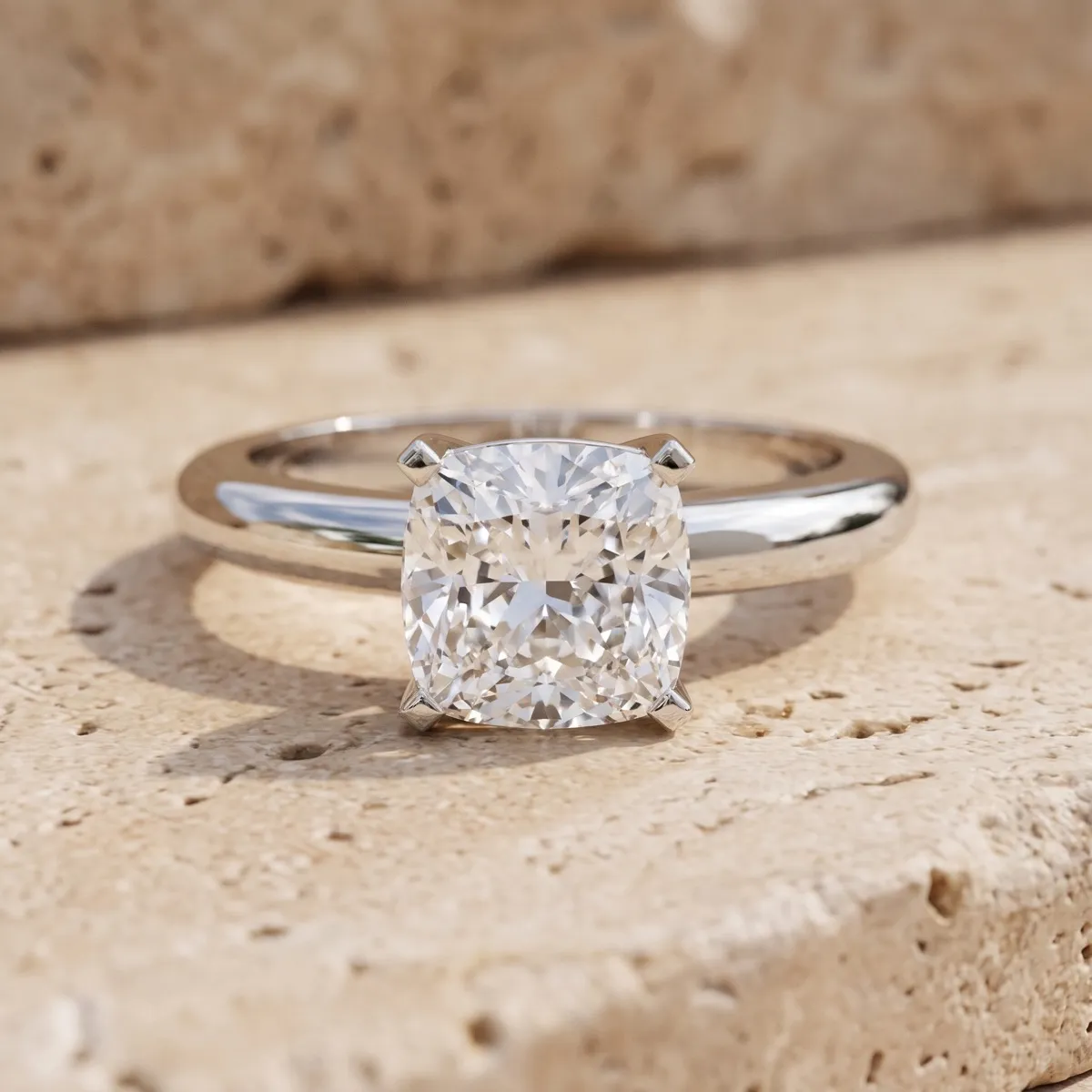
Pictured: a cushion cut lab-grown diamond solitaire with a plain platinum band. Image created from the ring’s design.
What is a GIA certificate?
A GIA certificate is GIA’s written record of what its graders found, and GIA’s own wording is that it grades diamonds and doesn’t certify them. The lab avoids the word “certificate” for that reason, though shoppers and sellers use it all the time. Each report says it is neither a guarantee nor a valuation.
GIA is an independent nonprofit founded in 1931. It doesn’t mine, buy or sell diamonds, so a “GIA diamond” is simply a stone GIA has graded. Anyone can submit a stone, and because GIA works on loose stones only, a ring’s center has to come out of its setting first. Many people ask a local jeweler to handle it.
Which GIA document do you have?
The title at the top of the document tells you which one you are reading, and that decides how much detail you get. GIA’s natural diamond fee schedule and lab-grown services page describe each one.
| Document | Used for | What you get |
|---|---|---|
| Diamond Grading Report | Natural, 0.15 carats and up | 4Cs, clarity plot, proportions drawing |
| Diamond Dossier | Natural, 0.15–1.99 carats | 4Cs, proportions drawing, inscribed number, no plot |
| Diamond eReport | Natural, 0.15–2.99 carats | Digital 4Cs and photograph, no plot |
| Diamond Focus Report | Natural rounds, 0.15–0.39 carats | Digital 4Cs, inscribed number |
| Diamond Origin Report | Natural, tracked from the rough | 4Cs, plot, geographic origin |
| Older lab-grown report | Lab-grown, about 2020 to September 2025 | Letter grades; the full version adds a plot, growth method and treatment |
| Quality Assessment | Colorless to near-colorless lab-grown, since October 1, 2025 | Premium or Standard, printed |
| Lab-Grown Colored Diamond Report | Fancy-color lab-grown | Digital quality assessment, plot, growth type, treatment |
How to read a GIA report, line by line
A GIA report runs from identity to grades to notes, and most lines read the same on a natural report and an older lab-grown report. The drawing below is our own illustration with made-up values, shown for an older lab-grown report. For the document itself, GIA publishes How to Read a GIA Diamond Grading Report.
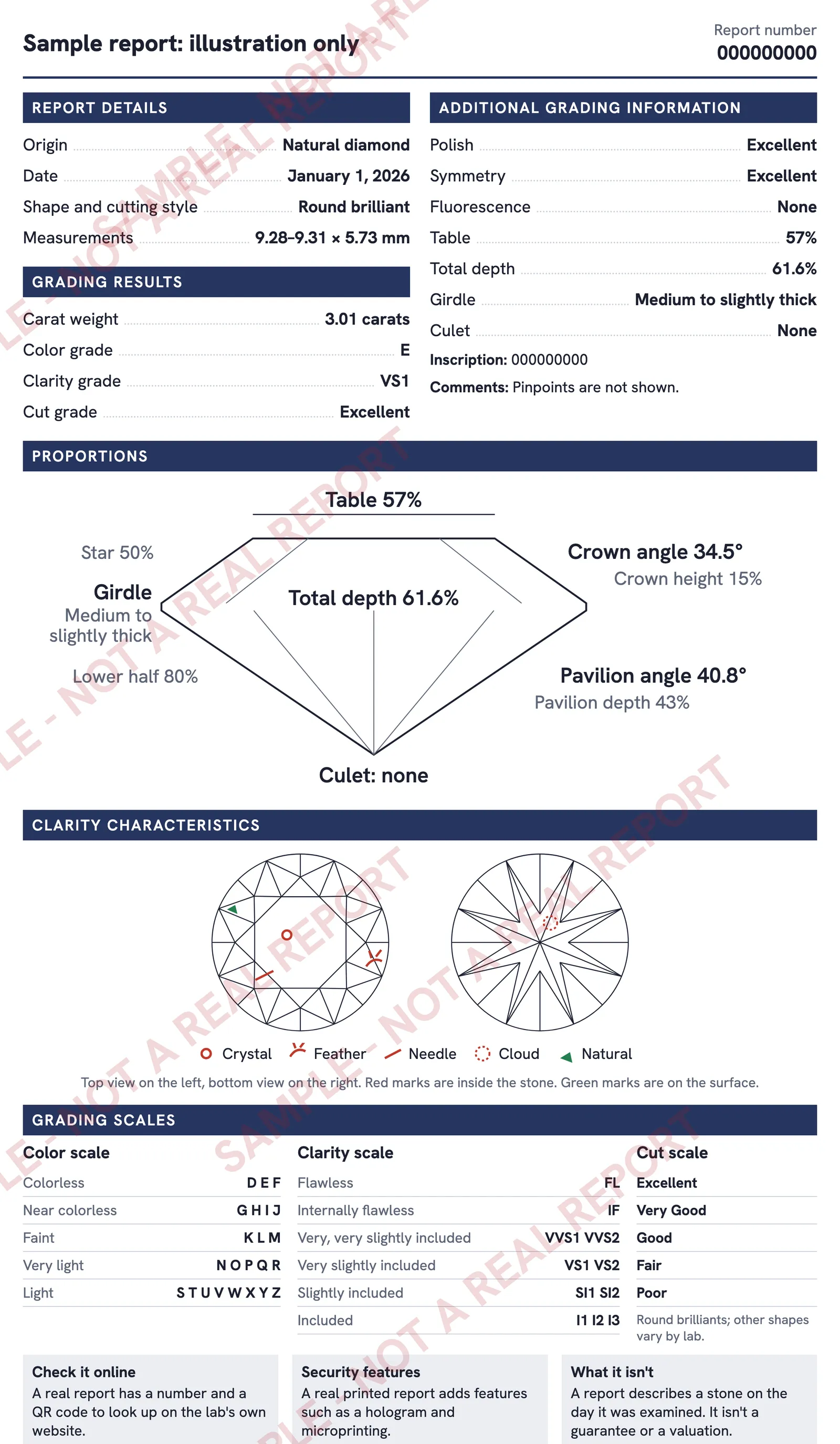
A full sample report for a natural diamond, with made-up values, showing everything a complete report usually carries. Illustration of a typical report, not an actual GIA document. On a phone, pinch to zoom.
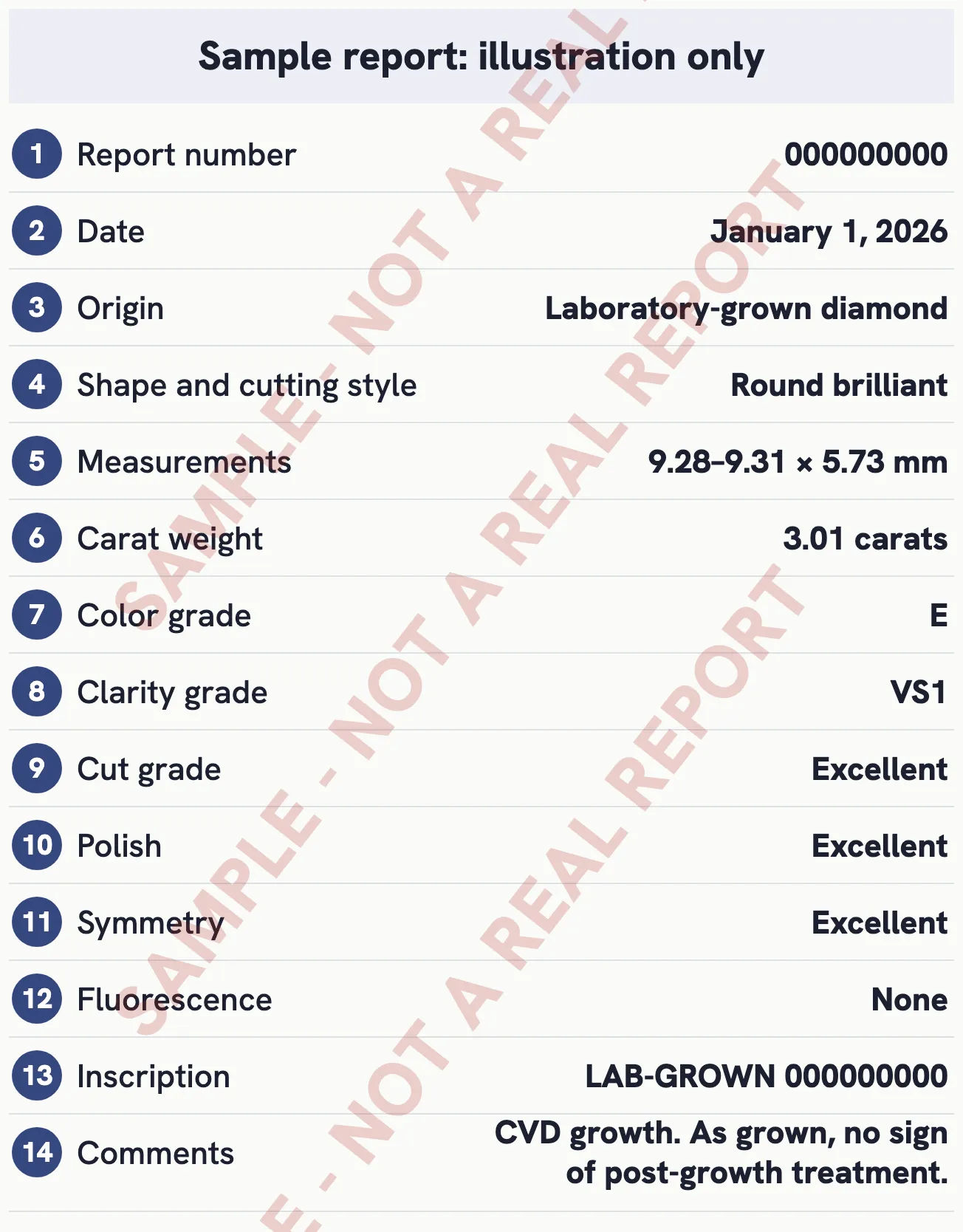
Illustration of a typical report layout, not an actual GIA document.
- Report number. A unique number held in GIA’s global database, and the number you enter in Report Check.
- Date. The day GIA examined the stone.
- Origin. A natural report says natural in its title, and GIA’s testing covers whether a stone is natural or laboratory-grown. An older lab-grown report says laboratory-grown in plain words.
- Shape and cutting style. GIA records the outline and the facet pattern separately, as in round brilliant.
- Measurements. Rounds read minimum diameter, maximum diameter and depth. Fancy shapes read length, width and depth.
- Carat weight. Recorded to the nearest hundredth, where one carat is one-fifth of a gram.
- Color grade. Assessed from D to Z against GIA’s master comparison stones. An asterisk beside the grade means a color treatment was detected, and treated natural stones have “TREATED COLOR” inscribed on the girdle.
- Clarity grade. Flawless to Included, based on the size, nature, number, position and relief of what graders see at 10× magnification. Our clarity chart covers each grade.
- Cut grade. Excellent to Poor, given only on standard round brilliants in the D-to-Z range. It weighs face-up appearance, design and craftsmanship, and the lowest component sets the final grade. GIA gives fancy shapes no overall cut grade.
- Polish. Surface smoothness, Excellent to Poor. An Excellent cut grade needs polish of at least Very Good.
- Symmetry. How exact the outline and facet placement are, Excellent to Poor, with the same Very Good floor for an Excellent cut.
- Fluorescence. Strength and color of the glow under long-wave ultraviolet light. “None” covers everything from indiscernible to very faint. GIA says this line is there for identification.
- Inscription. Any text, symbols, logo or report number on the girdle. It is optional on a Diamond Grading Report, so a missing inscription isn’t a warning sign there. Older lab-grown stones show the number and “LABORATORY-GROWN”.
- Comments. Anything the other lines can’t hold. A treatment such as laser drilling would be described here. Natural stones are also tested for fracture filling.
What is different on an older GIA lab-grown report
From 2020, GIA graded lab-grown diamonds on the same color and clarity scales it used for natural stones, in a digital-only format. The full report could name the growth method and state whether evidence of post-growth treatment was found, not found or undeterminable. A Dossier version left growth method and treatment out. Reports from before 2020 use general terms such as colorless and near colorless. GIA said in 2025 that existing lab-grown reports remain valid, so you will still see these documents on stones for sale.
How to read a GIA Premium or Standard assessment
A GIA Quality Assessment gives one result, Premium or Standard, in place of color and clarity grades. Premium is the higher class. Standard covers every stone that clears the minimums without reaching Premium on all five measures, and a stone below the minimums gets no assessment at all. The drawing is our own illustration, built from the fields on GIA’s published sample, with made-up values.
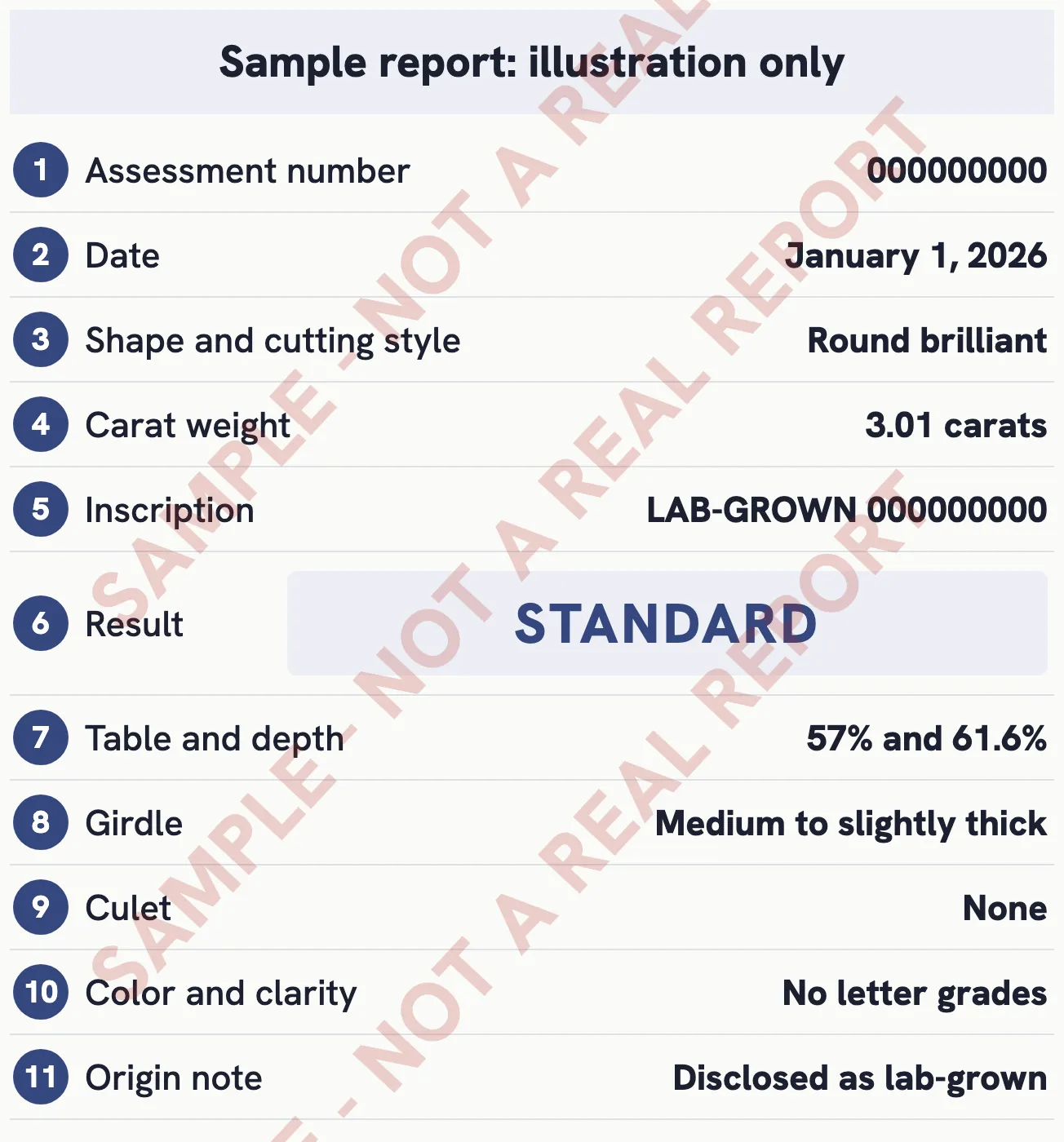
Illustration of a typical report layout, not an actual GIA document.
- Assessment number. Enter it in Report Check, as with a report number.
- Date. GIA’s sample shows a date at the top of the details.
- Shape and cutting style. The same outline and facet pattern wording as a full report.
- Carat weight. Given to the hundredth. GIA’s sample shows no millimeter measurements, so ask the seller for them.
- Inscription. GIA inscribes “Laboratory-Grown” and the assessment number on the girdle of every stone it assesses. Our drawing shortens the wording.
- Result. Premium or Standard, and the one quality statement on the page.
- Table and depth. A small profile drawing gives these two percentages.
- Girdle. Described in words on the same drawing.
- Culet. Also described in words, usually None on a modern cut.
- Color and clarity. No letter grades appear. The class tells you the band, as the table below shows.
- Origin note. GIA’s sample says the stone’s lab-grown status was disclosed and that GIA did no further testing, so read this document as a quality opinion on a stone already declared lab-grown.
| Measure | Premium needs | Standard accepts |
|---|---|---|
| Color | D | E through J |
| Clarity | VVS or better | VS |
| Polish | Excellent | Very Good |
| Symmetry, rounds | Excellent | Very Good |
| Symmetry, fancy shapes | Excellent | Very Good or Good |
| Cut, rounds only | Excellent | Very Good |
Source: GIA’s assessment criteria chart. A stone that mixes the two columns is Standard, so a D VVS1 stone with Very Good polish is still Standard. The service covers loose stones of 0.15 carats and up. Our comparison of IGI vs GIA explains why GIA made the change and what it means when you compare stones.
How to read the proportions on a GIA report
The proportions drawing is a side view of the stone with its key angles and percentages. On a round brilliant, GIA has published the range each measure can sit in and still allow an Excellent cut grade, which makes these numbers a handy yardstick. A stone inside every range can still grade lower, because GIA also judges how the numbers work together.
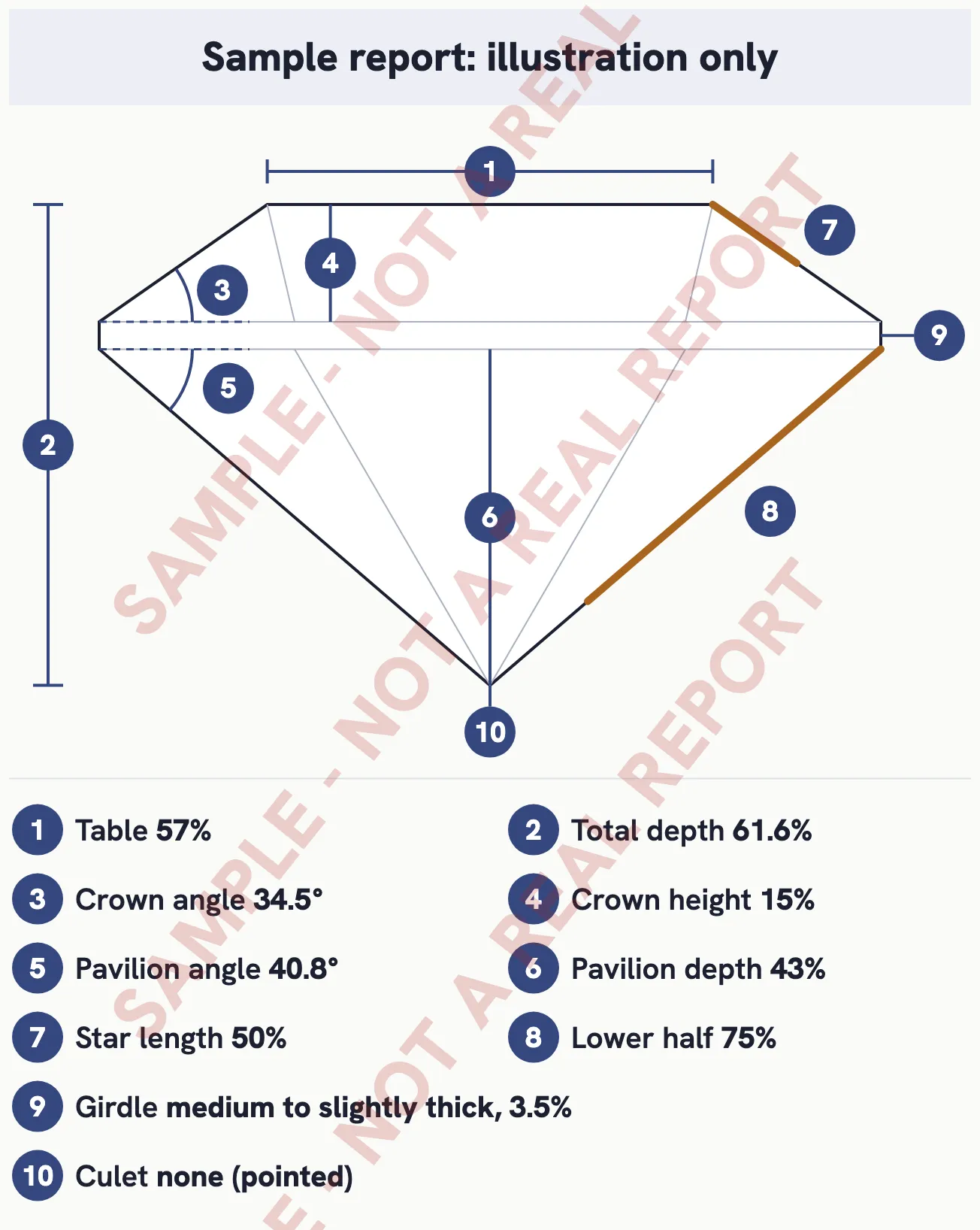
Illustration of a typical report layout, not an actual GIA document.
- Table. Excellent allows 52% to 62% of the stone’s width.
- Total depth. Excellent allows 57.5% to 63%.
- Crown angle. Excellent allows 31.5° to 36.5°.
- Crown height. Excellent allows 12.5% to 17%.
- Pavilion angle. The tightest range of all, 40.6° to 41.8°.
- Pavilion depth. Follows from the pavilion angle, so it sits near 43% on a well-cut round.
- Star length. Excellent allows 45% to 65% of the way from table to girdle.
- Lower half. Excellent allows 70% to 85% of the way from girdle to culet.
- Girdle. GIA reports the thinnest and thickest points in words, from Extremely Thin to Extremely Thick, and the average as a percentage. Excellent allows an average of about 2.5% to 4.5%.
- Culet. Described from None through Very Small, Small and Medium up to Extremely Large. None means the facets meet in a point. Excellent allows None to Small.
How to read the clarity plot on a GIA report
The plot is an approximate map of the stone’s clarity characteristics, showing their type, position and rough size. It appears on the Diamond Grading Report and the Origin Report. The shorter Dossier, eReport and Focus Report leave it out, as does GIA’s published sample of the Quality Assessment. The drawing is our own, with made-up marks.
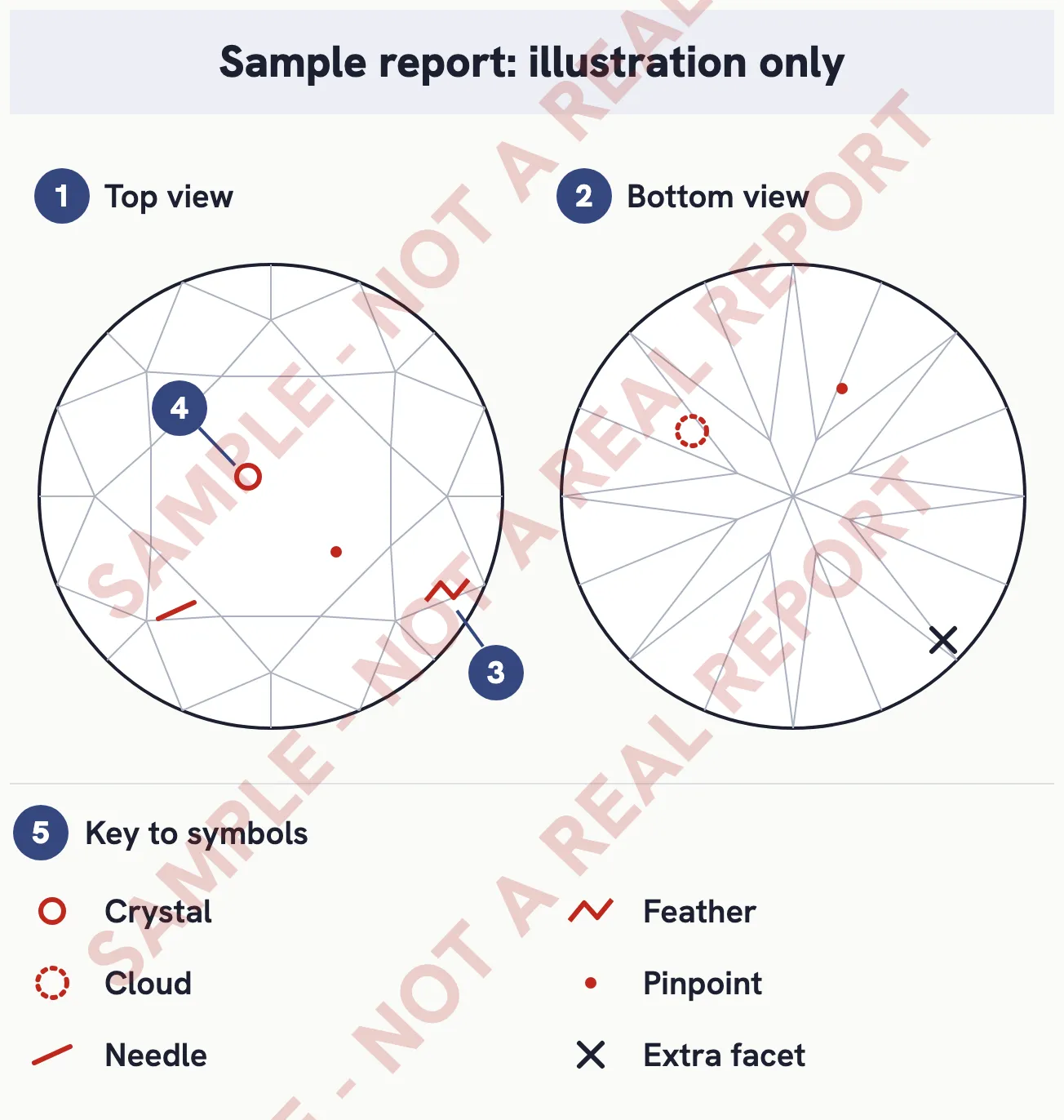
Illustration of a typical report layout, not an actual GIA document.
- Top view. The crown side, looking down through the table.
- Bottom view. The pavilion side, looking up through the lower facets.
- Red marks. Most inclusions, such as the feather drawn here. GIA uses red and green together for marks that also reach the surface: cavities, indented naturals, knots, etch channels and laser drill holes.
- Position. GIA says the closer an inclusion sits to the center of the table, the greater its effect on the grade. That is why the crystal drawn here counts for more than one at the edge.
- Key to symbols. GIA lists marks in order of importance to the grade, with laser drill holes first for disclosure, then the grade-setting inclusions, other inclusions, naturals and extra facets, the last two drawn in green and black.
GIA notes that its plot may not show every characteristic. Marks that are widespread or faint can be left off and mentioned under comments instead, and details of finish aren’t drawn at all. Our diamond certificate guide has the full table of inclusions and blemishes, with what each looks like and whether it usually matters.
How to check a GIA report
Enter the number in Report Check and confirm that the online record matches the paper. On a printed report, the QR code does the same job. GIA says its reports also carry microprinting, security screens, watermarks, a hologram and numbered sheets, which are harder to judge without training.
Checking the record proves the report exists, and it doesn’t prove the report belongs to the stone in front of you. Fake GIA inscriptions on CVD stones have been documented in GIA’s own journal, and trade press has reported reprinted reports paired with other stones. A jeweler can match the inscription, weight and plotted marks to the stone. GIA also offers a paid Report Verification service, which requires the original report.
GIA reports and your Whitemoon ring
The center stone of a Whitemoon engagement ring comes with an IGI or GIA report. Most carry IGI, a smaller number carry GIA, and our IGI certificate guide covers the more common document. GIA stones with letter grades carry the older report format described above. You can start in the Whitemoon ring builder or from engagement rings by shape, such as cushion cut engagement rings, radiant cut engagement rings or princess cut rings, or by style, such as three stone engagement rings. Rings with the center already set include 4 carat lab-grown diamond rings, and our 3 carat diamond price guide shows how the lab affects price at that size.
If you are still deciding between labs, our overview of diamond grading labs covers the others you may see. Most Whitemoon rings are made to order in about 10–15 days and ship free with insurance both ways, with 30-day returns on unworn pieces and one free resize within 60 days of delivery.
GIA certificate questions
What does GIA certified mean?
It means GIA examined the stone and issued a document under its own number. GIA prefers to say a diamond is graded, since it describes a stone’s qualities and doesn’t vouch for its value. A GIA document can belong to a high-grade stone or a low-grade one, so the meaning is in what the grades or class say.
Can a jeweler fake a GIA report?
A paper report or a girdle inscription can be copied, and trade press has reported both. That is why you check the number in Report Check and compare every line, then ask an independent jeweler to match the stone’s inscription, weight, measurements and plotted marks to the record. A report that matches the database can still be paired with the wrong stone.
How much does a GIA certificate cost?
It depends on the stone’s weight and the service. GIA’s US fee schedule dated July 1, 2026 lists a Diamond Grading Report at $119 for a 1.00–1.19 carat natural diamond and $301 at 3.00–3.99 carats. The lab-grown Quality Assessment is $15 per carat with a $15 minimum, and a stone that doesn’t qualify is charged $5. Check GIA’s site for current fees.
How do you get a GIA certificate for a diamond?
Set up a lab account with GIA, then ship the stone or bring it to a drop-off location. GIA grades loose stones only, so a mounted center has to be removed first, and many people ask a jeweler to submit it for them. Lab-grown stones go through the Quality Assessment, which needs a loose, colorless to near-colorless stone of at least 0.15 carats.
Is it okay to buy diamonds without GIA certificate?
Yes, provided the stone comes with a report from another recognized lab, or you have a clear reason to skip one. Plenty of lab-grown diamonds carry an IGI report, since GIA has said it grades fewer than 5% of them. For a costly natural diamond, many buyers do want GIA. Small accent stones usually have no individual report at all.
How much is my GIA certified diamond worth?
A GIA report won’t tell you, because it states no price and says it isn’t a valuation. The value depends on the stone’s grades, size, origin and the market. For insurance, ask an independent appraiser, who will likely want to see the report. For resale, get offers from buyers, and expect less than the retail price, especially for a lab-grown diamond.
Do all GIA certified diamonds have a laser inscription?
No. On GIA’s Diamond Grading Report and eReport, the inscribed number is an optional extra. It is included on the Dossier and Focus Report, and every stone receiving a lab-grown Quality Assessment is inscribed with “Laboratory-Grown” and its number. If a stone has no inscription, a jeweler can compare its weight, measurements and plotted marks against the report.