
Diamond Clarity Chart: What Each Grade Means and Which to Buy
A diamond clarity chart ranks diamonds by how many marks they have and how easy those marks are to see at 10x magnification. The scale has 11 grades, from Flawless (FL) at the top down to Included (I3). For most rings, a VS1 or VS2 stone is the sensible middle: a grader finds its marks with effort, and you normally won’t see them at all.
We sell mostly lab-grown diamonds, and most of our center stones carry an IGI report, so the prices below are ours and the buying advice is a jeweler’s opinion. The grade definitions come from GIA, which created this scale. Below you’ll find the chart, what each mark is, what “eye-clean” means, and how little clarity can change the price of a lab-grown stone until you reach the top grades.
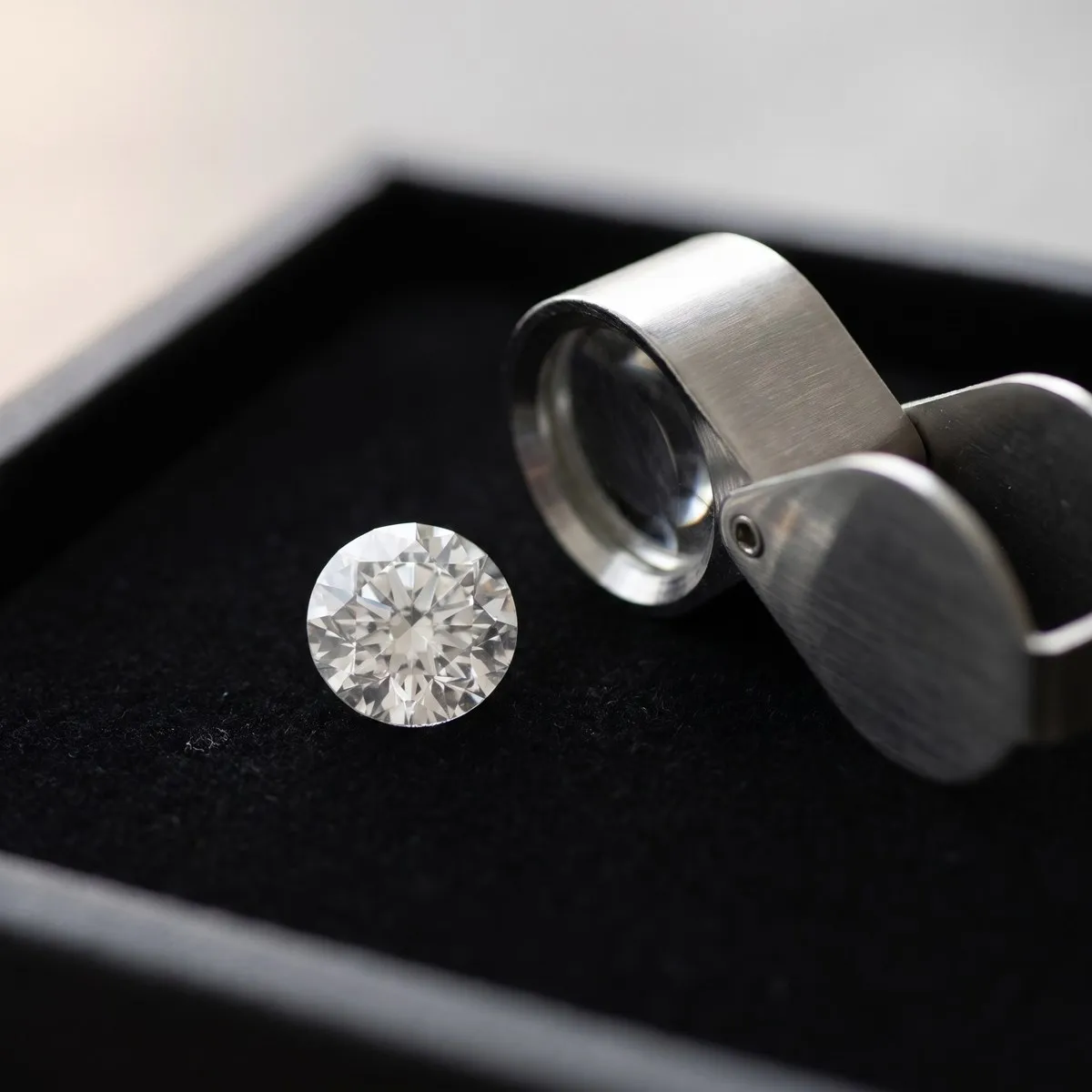
Pictured: a loose round diamond beside a 10x loupe, the magnification graders use. Illustrative image.
The diamond clarity chart, best to worst
Read the chart from top to bottom. Each step down means marks that are larger, more numerous or easier to see. The grades are judged at 10x by a skilled grader, not by eye, so two neighboring grades usually look the same on your hand.
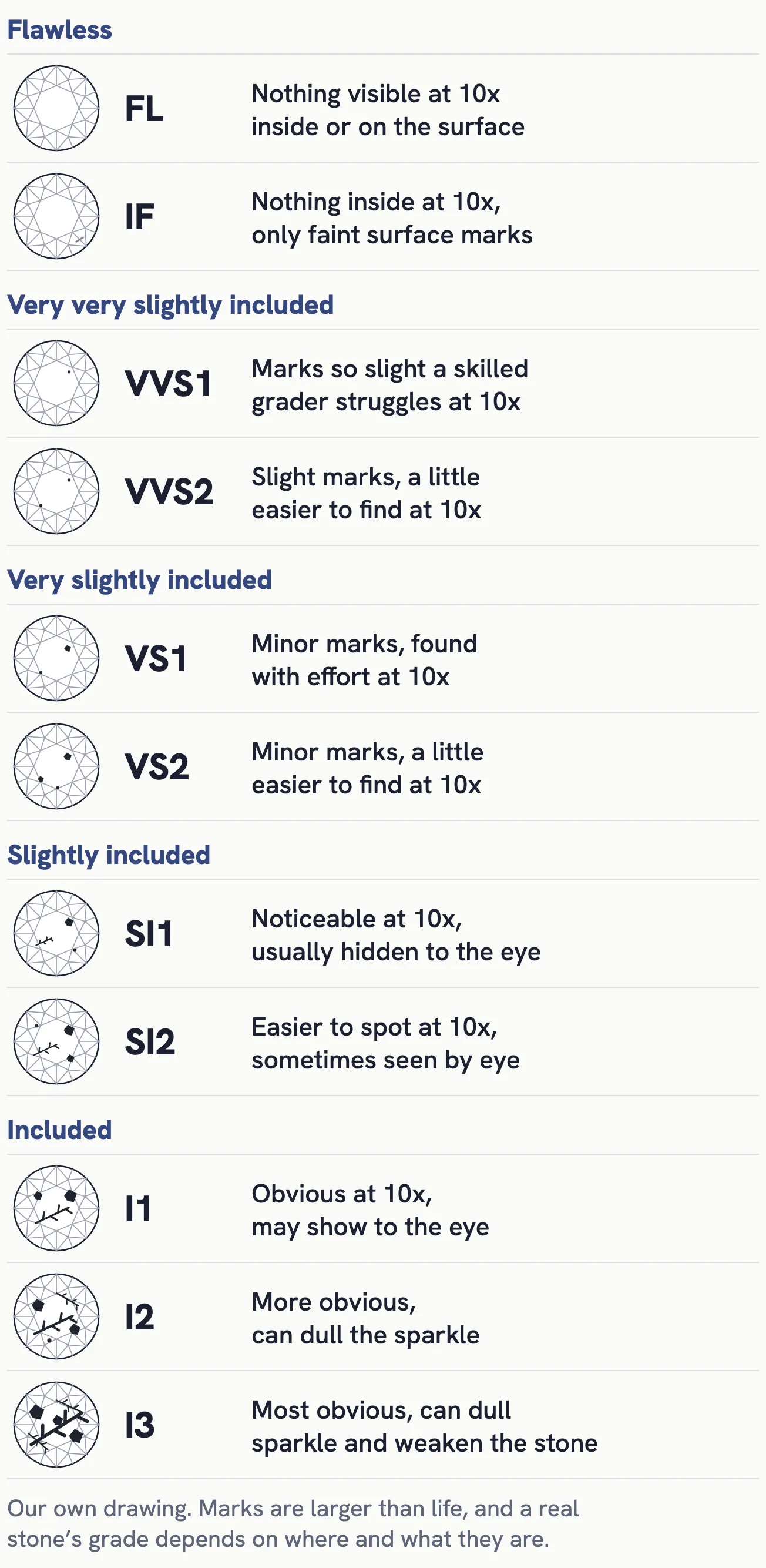
The clarity scale in order. Our own drawing, with marks larger than life.
| Grade | Full name | At 10x | By eye |
|---|---|---|---|
| FL | Flawless | Nothing inside or on the surface | Clean |
| IF | Internally Flawless | Faint surface marks only | Clean |
| VVS1, VVS2 | Very Very Slightly Included | Very hard for a grader to see | Clean |
| VS1, VS2 | Very Slightly Included | Minor, seen with effort | Almost always clean |
| SI1, SI2 | Slightly Included | Noticeable | Varies stone by stone |
| I1, I2, I3 | Included | Obvious | Often visible |
GIA defines these as bands and doesn’t publish a separate line for VVS1 against VVS2, or VS1 against VS2. Within a band, the 1 grade simply has less to find than the 2. The “by eye” column is our own summary, as no lab grades a stone that way.
What is diamond clarity?
Clarity measures the marks a diamond carries, inside and on its surface. Marks inside, or reaching in from the surface, are called inclusions. Marks that sit only on the outside, such as a polish line or a small scratch, are called blemishes.
A grader doesn’t just count them. GIA weighs five things: how many marks there are, how large they are, how much they stand out against the stone, what type they are, and where they sit. A small dark crystal under the table can lower a grade more than a larger pale mark hidden near the edge. At GIA, at least two graders record their findings independently, which is one reason it’s hard to judge a grade from a photo.
Types of diamond inclusions
Most of what you’ll see named on a report falls into a short list. A report’s clarity plot uses these names, and our guide to how to read a diamond certificate shows how each one is marked.
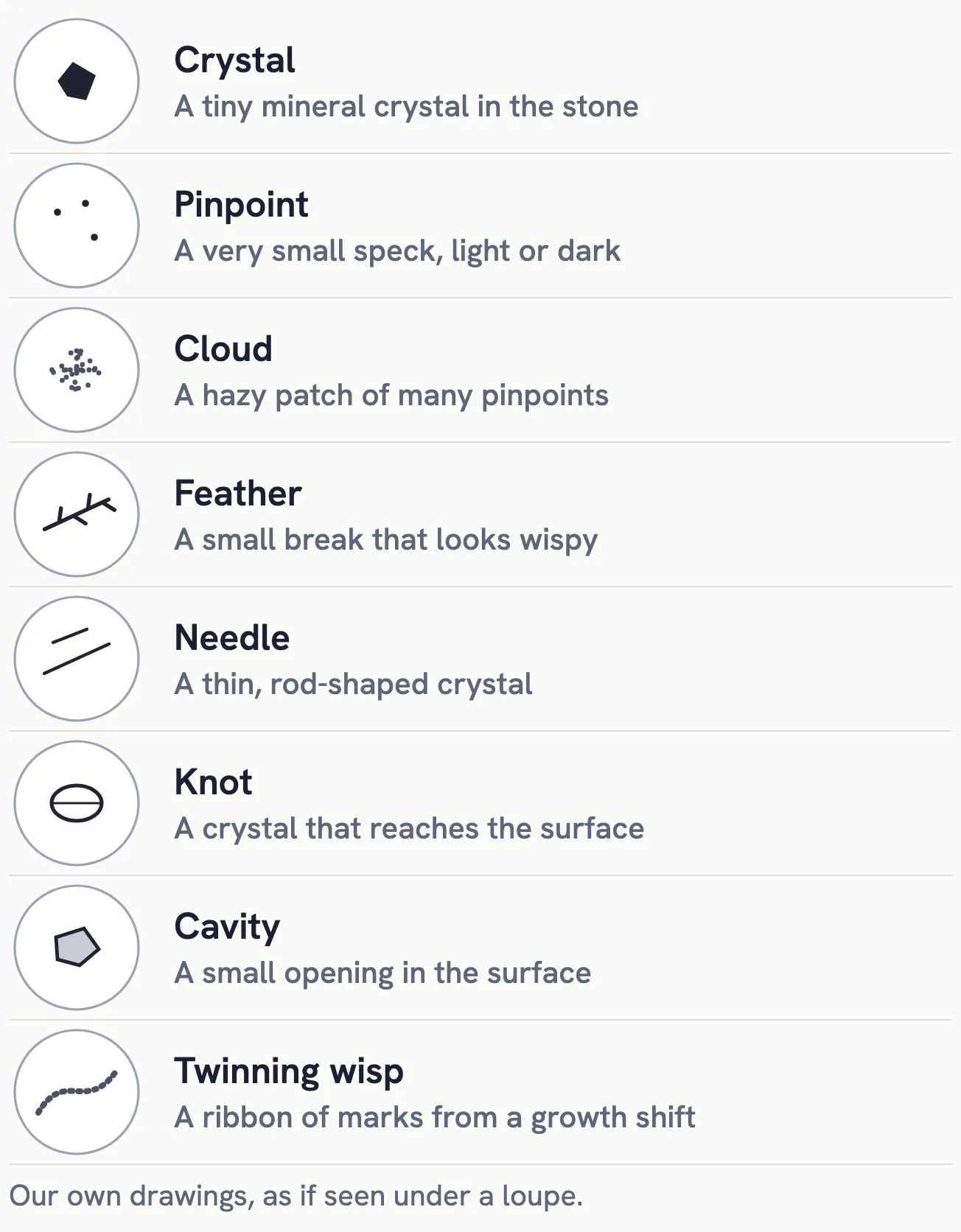
Common inclusion types, in our own drawings.
Another type you may see is the indented natural, a bit of the rough diamond’s skin left just below the polished surface. Crystals and pinpoints are often harmless. Feathers deserve more attention, because they are small breaks, and that matters when we get to durability below.
Do lab-grown diamonds have inclusions?
Yes. They can have crystals, feathers, pinpoints and clouds, and the growing method leaves its own marks. GIA’s published studies describe dark metallic flux in HPHT stones and black graphite-like particles in CVD stones. Those studies also found most HPHT stones around VS and most CVD stones around VVS2 to VS1, though they looked at stones sent in by growers some years ago. An inclusion alone doesn’t prove where a diamond came from. Our post on lab-grown and mined diamonds covers how the two differ in other ways.
Who created the clarity scale, and do all labs use it?
GIA built the scale in the early 1950s, led by Richard T. Liddicoat. Most labs now use the same letters, though they don’t always agree on a stone. IGI uses the same letter grades, also at 10x. The American Gem Society grades on numbers instead:
| AGS number | Roughly the same as |
|---|---|
| 0 | FL or IF |
| 1 to 2 | VVS |
| 3 to 4 | VS |
| 5 to 7 | SI |
| 7 to 10 | I |
One big exception applies to lab-grown diamonds. Since October 1, 2025, GIA’s current lab-grown document doesn’t print a clarity grade at all. It sorts stones into Premium, which needs VVS or better, and Standard, which needs at least VS. Older GIA letter-grade reports stay valid, and IGI still prints a grade, as our IGI vs GIA comparison explains.
Two labs can also grade the same stone differently. We haven’t found a large independent study of IGI against GIA, and claims that one lab always runs a grade soft tend to come without evidence. So treat a grade as a strong guide, and look at the stone as well. Our comparison of diamond grading labs covers the other names you may meet.
What does eye-clean mean?
A diamond is eye-clean if you can’t see any marks without magnification. It’s an industry term and not a lab grade, and there’s no agreed test. A common version is someone with good eyesight, looking at the stone face-up from about 10 inches.
Two things change the answer more than the grade does:
- Shape. Round brilliants and other brilliant cuts break up light across many small facets, which hides marks. Emerald and Asscher cuts have long, open steps that work like a window. Our diamond shapes guide explains step and brilliant cuts.
- Size. The same grade can allow a larger mark in a larger stone, so a mark hidden at 1 carat can show at 3 carats.
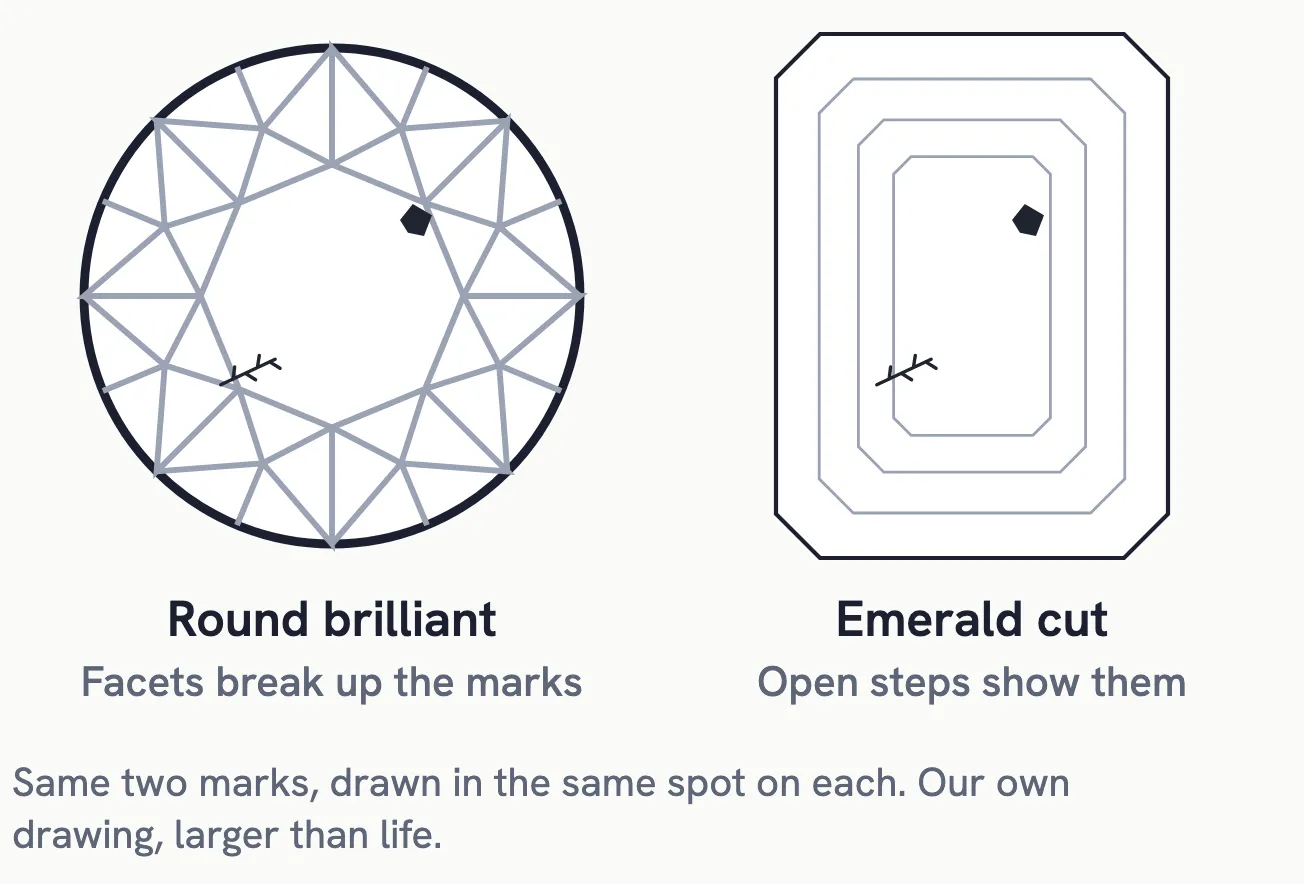
The same marks in two cuts. Our own drawing, larger than life.
These are our rules of thumb, and they’re opinions, not lab standards:
| Shape and size | Usually eye-clean from |
|---|---|
| Round, oval, cushion, pear, radiant, under 2 carats | VS2, some SI1 |
| Same shapes, 2 carats and over | VS2 or VS1 |
| Emerald or Asscher, under 2 carats | VS2 or VS1 |
| Emerald or Asscher, 2 carats and over | VS1 or VVS2 |
That’s why it’s worth paying a little more for clarity on emerald cut engagement rings, and less on a round. If you’re deciding on size as well, our 3 carat diamond price guide shows how large stones compare.
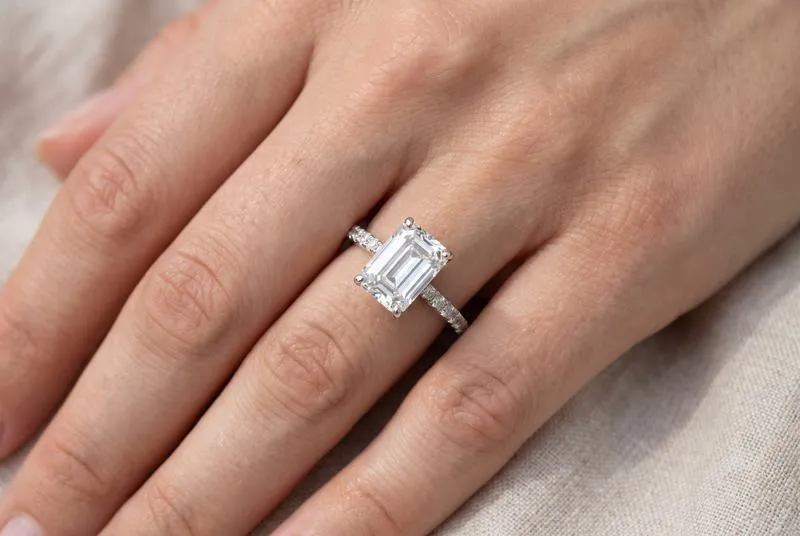
An emerald cut’s long, open facets. Pictured: a lab-grown diamond solitaire with a pavé band in white gold. Image created from the ring’s design.
What is the best clarity for a diamond?
The highest grade is FL, but the best grade to buy is usually the lowest one that looks clean to you. For most people that’s VS2 or VS1 in a brilliant cut. Beyond eye-clean, you’re paying for something only a grader with a loupe can confirm.
Clarity also isn’t where most of a diamond’s beauty comes from. GIA doesn’t name a single most important C, but it does say cut has the greatest effect on sparkle, and that most inclusions can’t be seen without 10x. So we’d settle cut first, then color, then clarity, then spend what’s left on carat weight.
With lab-grown stones, you may find you don’t need to compromise. VVS2 is the most common grade in our own listing, at nearly half of the white lab-grown stones we show from about 1 to 7 carats, and VVS1 and VS1 follow. SI stones are only about 1% of the list.
How clarity changes the price of a lab-grown diamond
On lab-grown diamonds, moving up through the middle grades costs surprisingly little. At 2 carats, going from VS2 to VVS2 adds about 3%. The real jumps come at VVS1 and especially at IF, where a 2 carat stone costs about 80% more than a VS2.
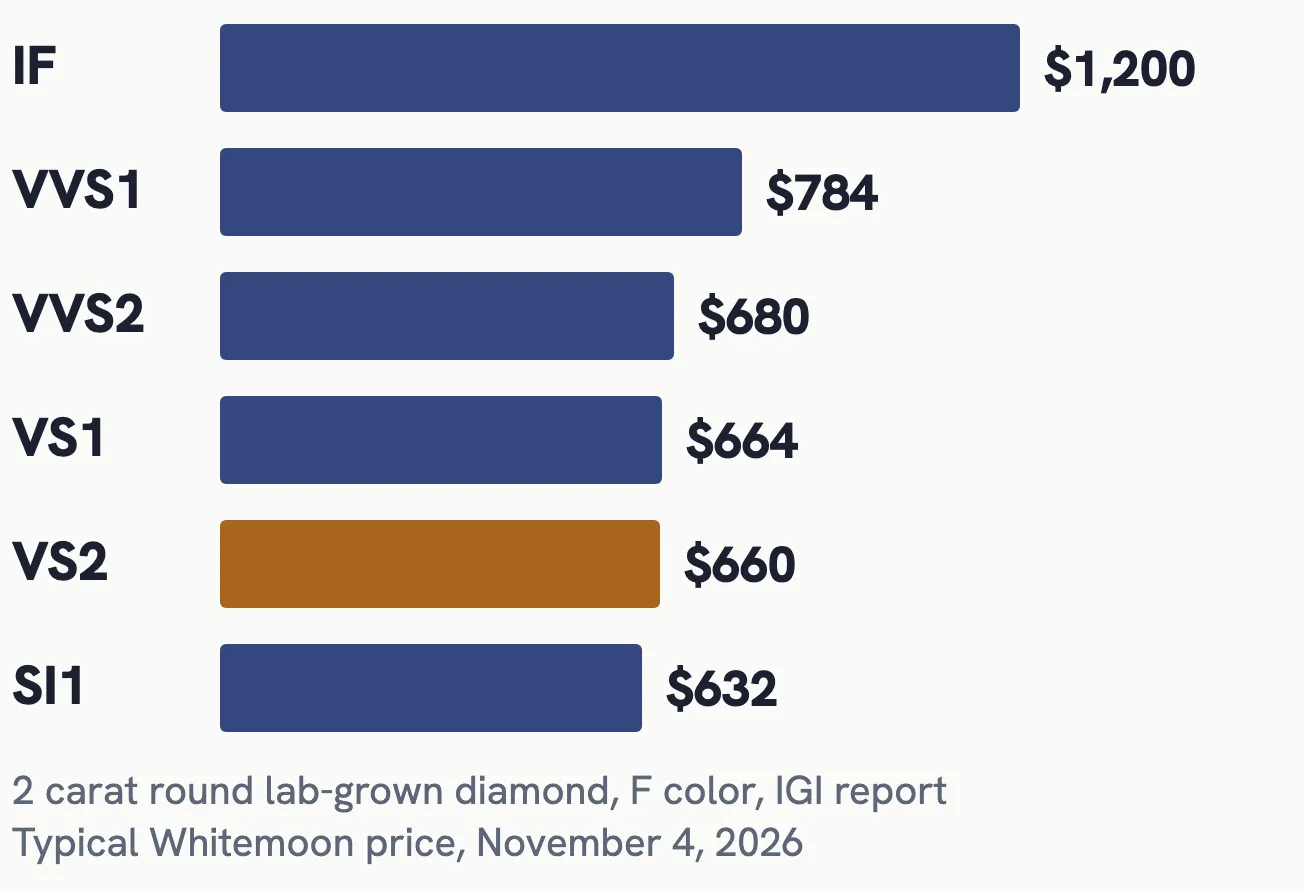
Typical Whitemoon prices for one size and color, November 4, 2026.
| Clarity | 1 carat | 2 carats | 3 carats |
|---|---|---|---|
| IF | $456 | $1,200 | $2,483 |
| VVS1 | $340 | $784 | $1,320 |
| VVS2 | $328 | $680 | $1,032 |
| VS1 | $324 | $664 | $1,008 |
| VS2 | $316 | $660 | $984 |
| SI1 | $280 | $632 | $1,128 |
These are typical Whitemoon prices for a round lab-grown diamond, F color, with an IGI report, on November 4, 2026. We list few IF stones at 2 and 3 carats and few SI1 stones at any size, so those figures move around, which is why the 3 carat SI1 sits above the VS2. Prices change often, so check the stone you’re looking at. They cover the loose diamond only, not the setting.
So on a lab-grown stone, there’s little reason to go below VS2, and rarely much reason to go above VVS2. Our 1 carat diamond price guide shows the same pattern at that size. Natural diamonds price differently, so don’t apply these gaps to a mined stone.
Does clarity affect a diamond’s durability?
Usually not, except at the bottom of the scale. A seriously weakened stone rarely survives cutting, and GIA notes that I2 and I3 diamonds can have durability problems. The marks to watch are feathers that reach the surface or sit near the girdle, the stone’s thin outer edge, where a knock is more likely to cause a chip. A jeweler can often place a prong over a mark like that, and a protective style such as a bezel engagement ring covers the whole edge.
Clarity treatments to ask about
Some diamonds are treated to look cleaner. Laser drilling burns a tiny channel to reach a dark inclusion and lighten it. GIA grades drilled stones and discloses the drilling on the report. Fracture filling puts a glass-like material into a feather so it’s harder to see, and GIA won’t issue a report on a filled stone, because the effect may not last.
The FTC’s Jewelry Guides tell sellers to disclose treatments that aren’t permanent, need special care or significantly affect value. If a price looks low for the grade, ask directly whether the stone has been treated, and read the comments on the report.
How to check a diamond’s clarity yourself
You can’t grade a diamond at home, but you can check most of what matters:
- Find the grade on the report, then look up the report number on the lab’s own site.
- Look at the clarity plot, if the report has one, to see where the marks sit and whether any are near the edge.
- Ask for a magnified photo or video of the actual stone, as the same grade can look different from one stone to the next.
- Look at it face-up from about 10 inches, in ordinary light, because that’s how you’ll see it when you wear it.
Our guides to the IGI certificate and the GIA certificate go through each document line by line.
Choosing clarity at Whitemoon
Every center stone in the Whitemoon ring builder shows its own clarity grade and report number, and you can filter from IF down to SI2, so you can compare one VS2 against another and against the price of a VVS2. You choose the setting from our engagement rings and then pick the center stone.
Finished jewelry works in bands instead. Many lab-grown diamond stud earrings and lab-grown diamond tennis bracelets let you choose VVS–VS or VS–SI for the whole piece, and at those small stone sizes the two look much alike once worn. Lab-grown diamonds don’t hold their retail price, so buy for how the stone looks to you, not as an investment. Our Lifetime Upgrade gives you 100% of what you paid as credit toward a new lab-grown piece worth at least 1.5 times as much. Most Whitemoon rings are made to order in about 10–15 days and ship free with insurance both ways, with 30-day returns on unworn pieces and one free resize within 60 days of delivery.
Diamond clarity questions
What is a good clarity for a diamond?
VS1 or VS2 is a good clarity for most buyers, because the marks are minor at 10x and normally invisible by eye. In an emerald or Asscher cut, or in a stone over 2 carats, we’d look at VS1 or VVS2. SI1 can also work in a smaller round, but check that particular stone before you buy it.
What is the highest clarity of a diamond?
Flawless, shown as FL, is the highest clarity. It means a skilled grader finds no inclusions and no blemishes at 10x. Internally Flawless, or IF, is one step below, with faint surface marks only. FL stones are exceptionally rare among natural diamonds, and you’ll pay heavily for a difference you can’t see.
Is VS1 clarity better than VS2?
Yes, VS1 ranks one step above VS2, so its marks are a little harder to find at 10x. By eye, the two usually look identical. On a typical 2 carat round lab-grown stone at Whitemoon, the gap on November 4, 2026 was just $4, so choose the individual stone that looks better.
What is the best color and clarity of a diamond?
The top grades are D color and FL clarity, but that isn’t the best value. For a stone that looks white and clean, many buyers land around F to H color and VS1 to VS2 clarity. In a yellow gold setting you can often go lower in color. Cut matters more to sparkle than either. Our diamond color chart explains each color grade.
What is the best clarity for a lab-grown diamond?
VS2 to VVS2 is the range we’d look at first. Lab-grown prices barely move across those grades, so you can often have VVS2 for only a little more. Paying for IF is harder to justify, since it can cost far more and looks the same as a VVS2 without a loupe.
How can you tell the clarity of a diamond?
The reliable way is a report from a grading lab, whose graders work at 10x under controlled conditions. At home you can only check whether marks show by eye, so hold the stone about 10 inches away, face-up. A loupe helps you find marks, but grading them takes training.
Do lab-grown diamonds have clarity ratings?
It depends on the lab. IGI gives them the same letter grades as natural diamonds, from Flawless to Included. GIA’s current lab-grown document gives no clarity grade and instead places a stone in Premium or Standard. Older GIA reports for lab-grown stones do show a letter grade and remain valid.