
How Much Is a 1 Carat Diamond? Prices by Shape
Prices last updated November 8, 2026. We recheck them every month. Other stores’ prices were read the same day, except VRAI (November 5).
At the stores compared below, a round F VS1 1 carat lab-grown diamond costs about $320 to $1,400: $324 at Whitemoon, $595 at Brilliant Earth and $1,377 at VRAI. A natural 1 carat diamond of the same grade costs about $4,700 to $5,700, which is about 16 times our price and about 9 times Brilliant Earth’s.
We sell lab-grown diamonds, so these figures come from stones actually listed for sale, not from a general chart: about 27,500 round lab-grown stones at this size in our ring builder, plus the listings at the other stores. Two things stood out. Color and clarity move the price far less on lab-grown than on natural, and the usual advice to buy just under 1 carat mostly doesn’t carry over.
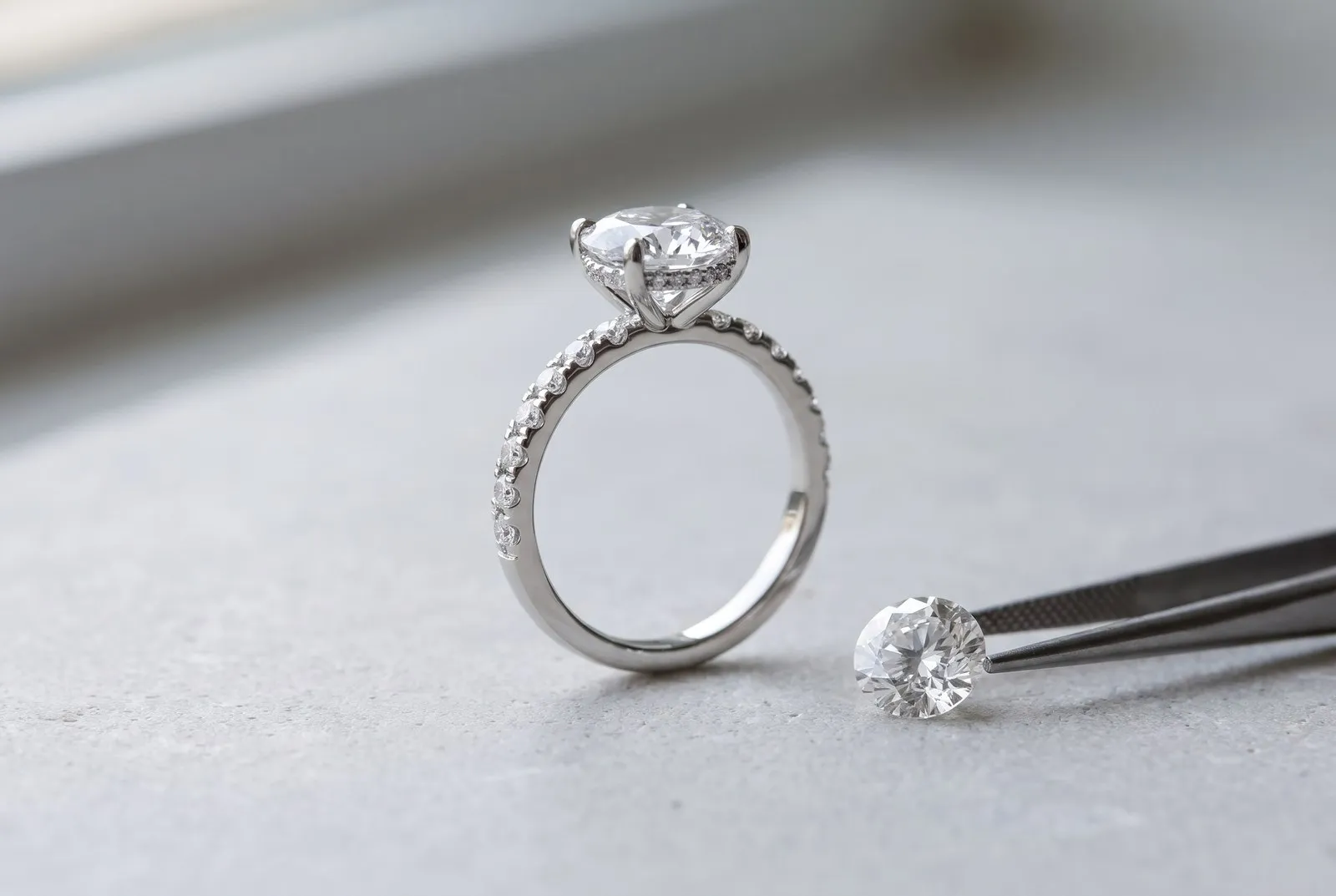
Pictured: a 1 carat round hidden halo setting in white gold beside a loose stone. Image created from the design.
1 carat lab-grown diamond prices by store
For the same size and grade, the store changes the price more than almost anything else. This is the median price of a round, F color, VS1 clarity lab-grown diamond, taken from each store’s stones of 1.00–1.49 carats and scaled to exactly 1 carat.
| Store | Certificate | Typical price | Stones compared |
|---|---|---|---|
| Whitemoon | IGI | $324 | 502 |
| Grown Brilliance | IGI | $347 | 720 |
| Brilliant Earth | IGI | $595 | 598 |
| Blue Nile | IGI | $657 | 25 |
| VRAI | VRAI report | $1,377 | 4 |
Prices change daily, and Blue Nile and VRAI had few stones at this exact grade, so treat those two as rough. Whitemoon’s 1 carat lab-grown diamonds come with an IGI or GIA report. Pick a setting in the Whitemoon ring builder to see the stones in stock; the builder also has a natural diamonds tab.
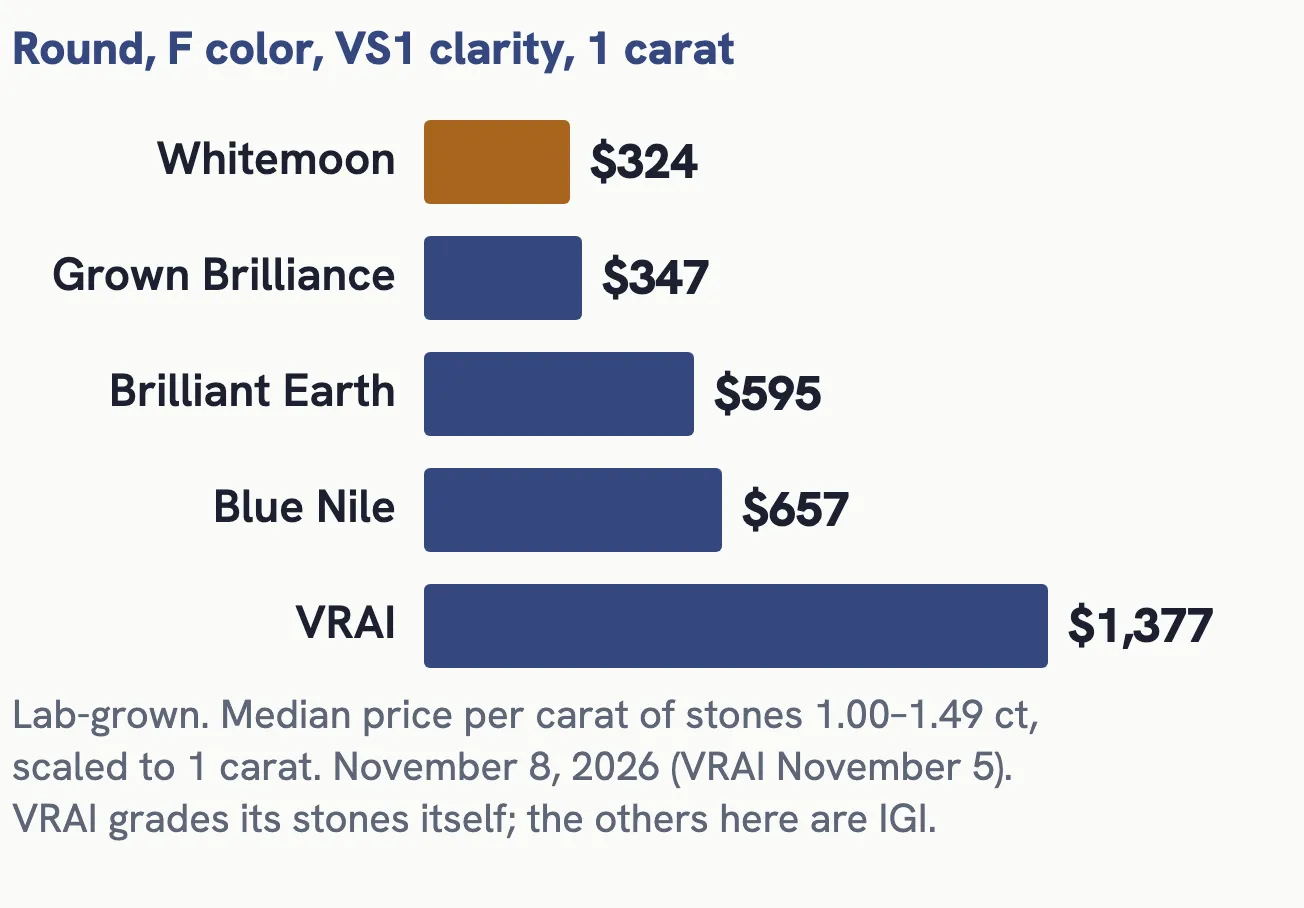
Round, F, VS1 lab-grown, scaled to 1 carat, November 8, 2026.
1 carat lab-grown vs natural diamond price
At Whitemoon’s prices, a natural 1 carat diamond costs about 12 to 17 times as much as a lab-grown one of the same color. The two share a crystal structure and chemistry, and the FTC’s Jewelry Guides define a diamond by that carbon crystal rather than by where it formed. Our guide to whether lab-grown diamonds are real diamonds covers the difference.
| Color | Natural, GIA, VS1 | Lab-grown at Whitemoon, IGI, VS1 |
|---|---|---|
| D | $5,608 | $336 |
| E | $5,417 | $332 |
| F | $5,245 | $324 |
| G | $4,520 | $300 |
| H | $3,808 | $312 |
Round, 1.00–1.49 carats scaled to exactly 1 carat. Natural: median of GIA-graded VS1 stones at Blue Nile, Brilliant Earth and Ritani together. November 8, 2026.
A gap this wide is fairly new. De Beers launched its Lightbox lab-grown brand in 2018 at a flat $800 a carat, then announced its closure in May 2025, saying wholesale prices had fallen 90% since 2018. Analyst Edahn Golan’s wholesale index is down 96% since 2018. Early in 2025, analyst Paul Zimnisky put an unbranded round 1 carat at about $845 lab-grown and $3,895 natural at US retail.
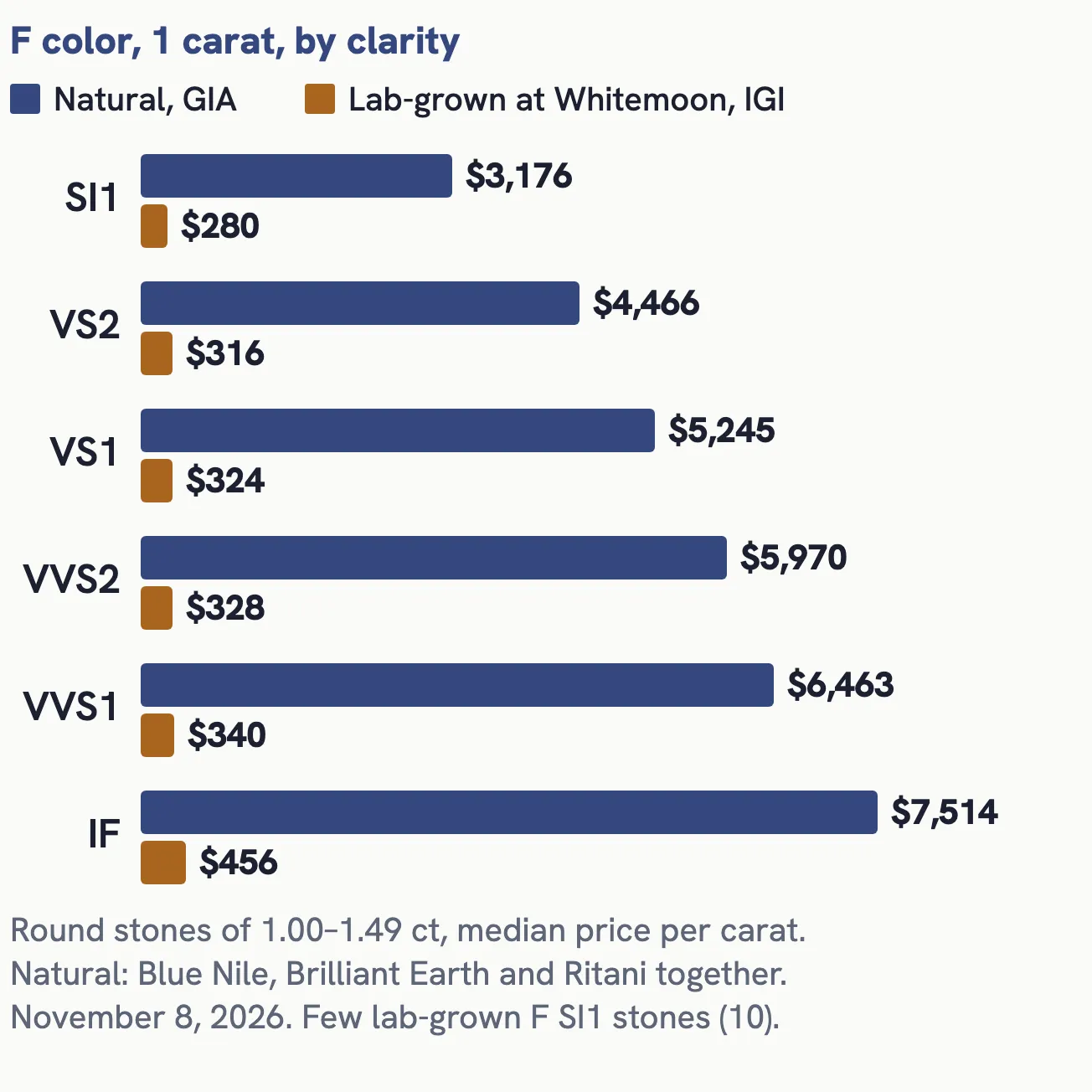
F color by clarity: natural against lab-grown at Whitemoon.
Why is a 1 carat diamond so expensive?
A natural 1 carat is expensive for three plain reasons.
- Cutting removes most of the rough. Bain’s industry report says most diamonds lose 50–60% of their weight in cutting and polishing, so a 1 carat stone starts as roughly 2 to 2.5 carats of rough.
- Bigger stones are rarer. GIA calls stones of 1 carat and up comparatively rare. You’ll also see “only 1 in a million diamonds reaches 1 carat”. The earliest version we could find is a 2005 sales column, with no data behind it, so we don’t repeat it as fact.
- People want that exact number. GIA’s term is “magic sizes”, and it gives one example of a D color round costing up to 20% more just over 1 carat than just under. Economists studying online prices found a 5–10% premium at 1 carat and put it down to buyers wanting the size others expect. The 1.00–1.04 carat bracket was still the best-selling natural center size in 2025.
Lab-grown stones are grown in a factory rather than mined, so rarity doesn’t set the price in the same way. In the stones we list, the price per carat of a natural round rises about 41% from 0.90–0.94 carats to 1.00–1.04 carats, for the same color and clarity. For lab-grown the same step is about 11%.
1 carat diamond price by shape
Natural rounds usually cost far more than most other shapes. Lab-grown prices at Whitemoon sit in a narrow band instead: $320 to $360 across all ten shapes at F VS1. Brilliant Earth’s lab-grown prices spread much wider, with ovals and pears well above rounds. Our diamond shapes guide explains how each one looks and wears.
| Shape | Typical size (mm) | Lab-grown, Whitemoon | Lab-grown, Brilliant Earth | Natural, Blue Nile |
|---|---|---|---|---|
| Round | 6.5 | $324 | $595 | $5,730 |
| Oval | 8.2 by 5.7 | $360 | $981 | $4,813 |
| Pear | 8.9 by 5.6 | $320 | $944 | $5,122 |
| Marquise | 10.4 by 5.3 | $360 | $916 | $6,315 |
| Cushion | 6.0 by 5.6 | $360 | $667 | $4,833 |
| Radiant | 7.1 by 5.0 | $324 | $686 | $4,708 |
| Emerald | 6.9 by 4.8 | $336 | $729 | $3,674 |
| Princess | 5.6 by 5.5 | $360 | $644 | $3,433 |
| Asscher | 5.6 by 5.6 | $352 | $663 | $3,168 |
| Heart | 6.3 by 7.0 | $360 | $636 | $3,346 |
F, VS1. Lab-grown IGI, natural GIA. Stones of 1.00–1.49 carats priced per carat and scaled to exactly 1 carat; median per store, November 8, 2026. Blue Nile listed only 4 natural cushions at this grade.
Elongated shapes look larger from above for the same weight: a 1 carat marquise is 10.4 mm long, against 6.5 mm across for a round. For the next size up, see our 1.5 carat diamond price guide. Long shapes can show a dark band across the middle, which our bow-tie guide explains. See 1 carat oval rings, 1 carat pear rings and 1 carat marquise rings.
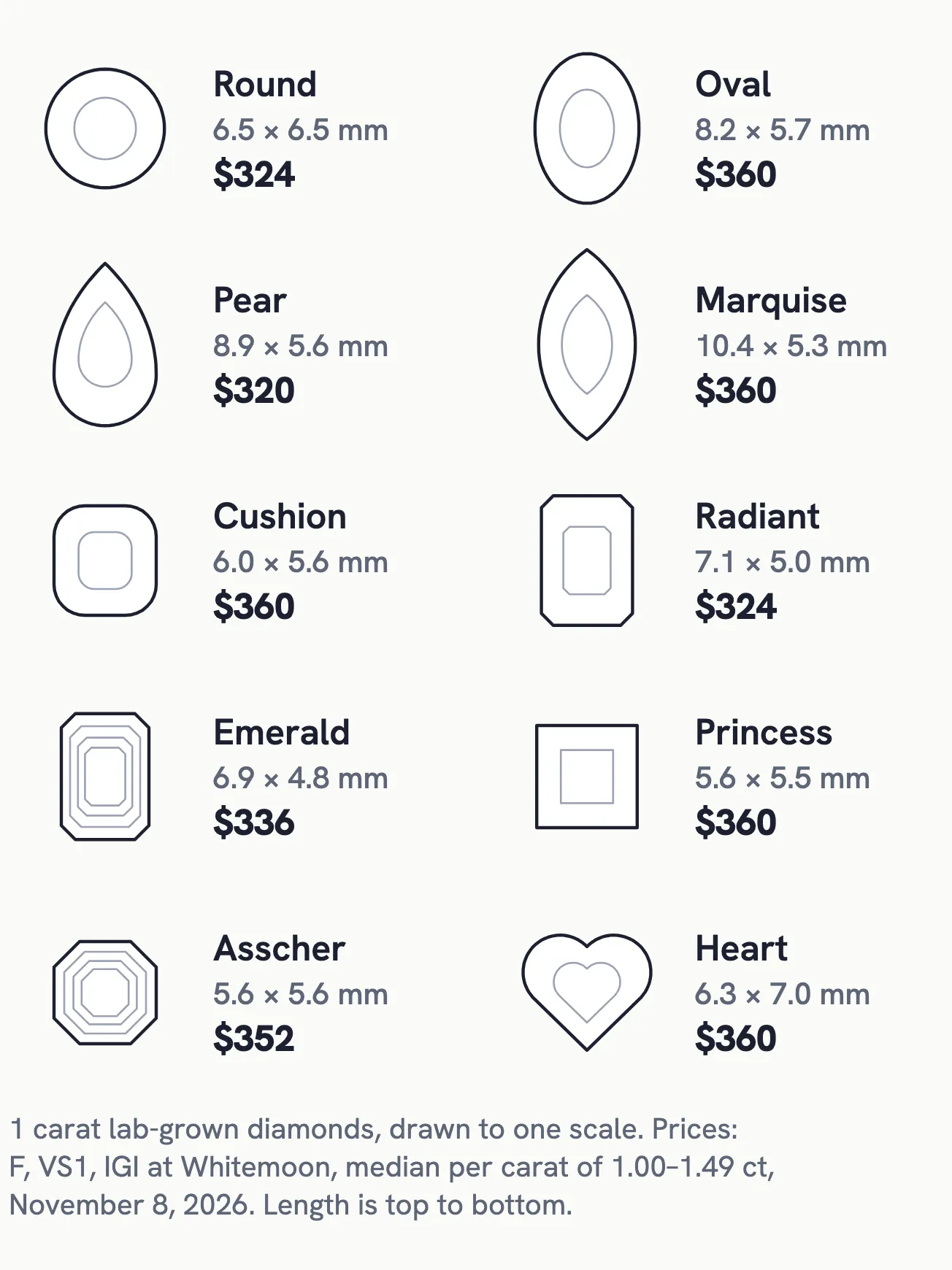
Every shape at 1 carat, to one scale, with its Whitemoon price.
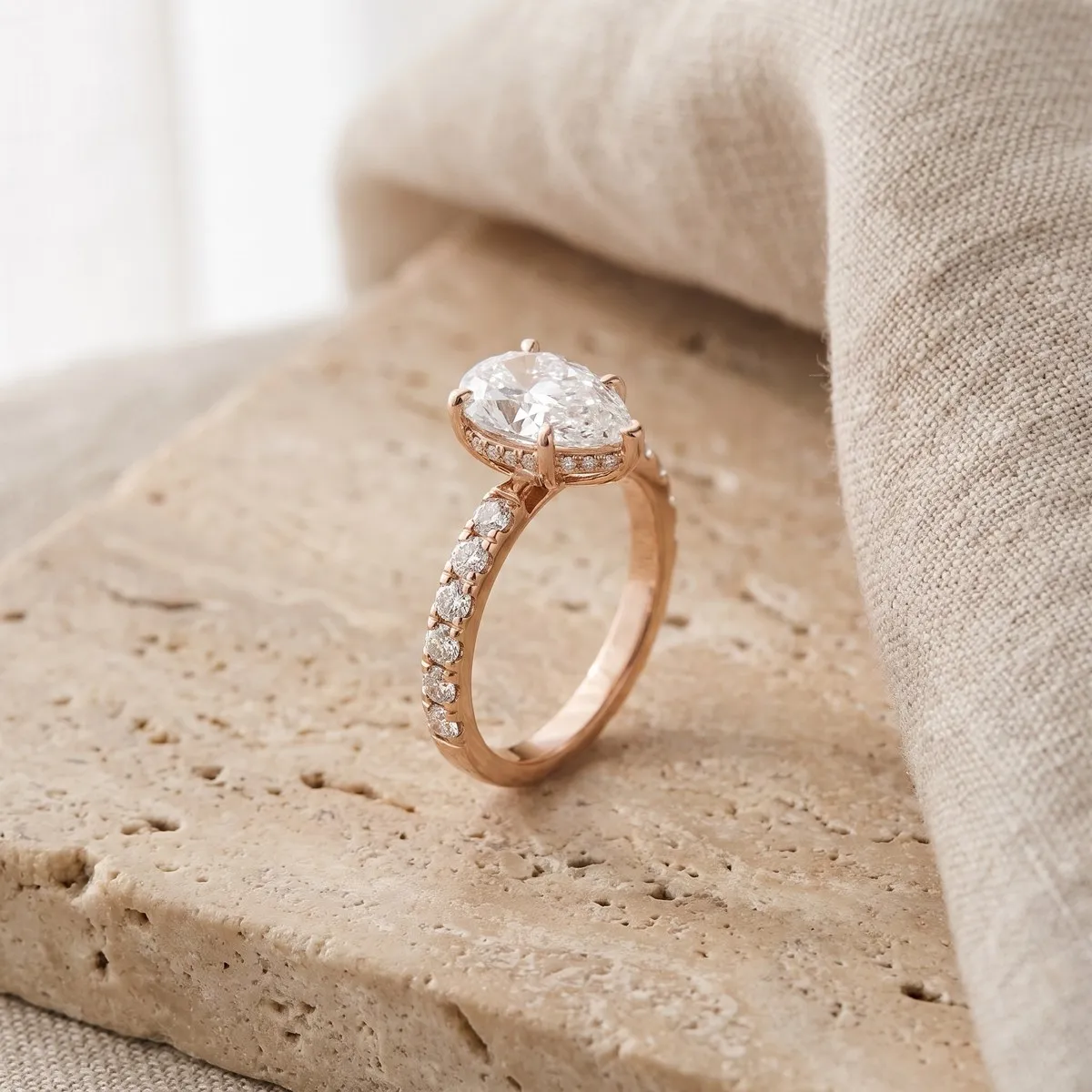
A 1 carat pear hidden halo ring in rose gold. Image created from the design.
What’s available at Whitemoon at 1 carat
Across every color and clarity, here is what a typical stone costs in each shape, and how many there are.
| Shape | Typical price | Stones available |
|---|---|---|
| Round | $344 | 27,563 |
| Oval | $368 | 9,582 |
| Pear | $340 | 4,479 |
| Marquise | $388 | 2,932 |
| Emerald | $340 | 2,329 |
| Radiant | $352 | 1,647 |
| Heart | $408 | 1,297 |
| Princess | $383 | 1,184 |
| Cushion | $369 | 1,076 |
| Asscher | $364 | 668 |
Lab-grown, white diamonds, 1.00–1.49 carats, priced per carat and scaled to exactly 1 carat. Whitemoon, November 8, 2026.
1 carat diamond price by color and clarity
On natural stones, grades are where the money goes. In F color, moving from VS2 to VVS1 adds about $2,000 on a natural 1 carat. On a lab-grown 1 carat at Whitemoon the same step adds $24. Only IF clarity costs noticeably more.
| Color | VS2 | VS1 | VVS2 | VVS1 | IF |
|---|---|---|---|---|---|
| D | $326 | $336 | $360 | $368 | $584 |
| E | $320 | $332 | $344 | $356 | $480 |
| F | $316 | $324 | $328 | $340 | $456 |
| G | $302 | $300 | $300 | $316 | $396 |
| H | $296 | $312 | $292 | $304 | – |
Round lab-grown diamonds at Whitemoon, IGI. Stones of 1.00–1.49 carats priced per carat and scaled to exactly 1 carat; median, November 8, 2026. Few stones sit in H color, so that row jumps around.
GIA says most diamonds down to VS2 or even SI1 have no inclusions easily seen with the unaided eye, and that many people can’t tell that stones down to G or H have any color. Those are general statements, not specific to 1 carat, and step cuts need more care: GIA suggests VS2 and G or better for emerald and asscher cuts. Our diamond clarity chart explains each grade. In our opinion, with lab-grown prices this close, it makes sense to buy the grade you’d like rather than the lowest you could accept.
Is a diamond just under 1 carat cheaper?
For natural diamonds, yes, and it’s the best-known saving in the trade. GIA itself suggests going slightly under a round number. A stone of 0.90–0.99 carats cost about $1,300 to $1,550 less than one of 1.00–1.09 carats at the three stores below, and a 0.90 carat round is only about 0.2 mm narrower than a 1 carat.
| Diamond | 0.90–0.99 carats | 1.00–1.09 carats | Difference |
|---|---|---|---|
| Natural, D–H, VS, GIA, Blue Nile | $3,018 | $4,531 | $1,513 |
| Natural, D–H, VS, GIA, Brilliant Earth | $2,480 | $4,030 | $1,550 |
| Natural, D–H, VS, GIA, Ritani | $2,489 | $3,799 | $1,310 |
| Lab-grown, F VS1, Whitemoon | $271 | $340 | $69 |
| Lab-grown, F VS1, Brilliant Earth | $555 | $560 | $5 |
Round. Median actual price, not scaled, November 8, 2026. Whitemoon had 9 stones under 1 carat at this grade, and Brilliant Earth had 24.
For lab-grown, the saving is small and the choice is thin. Among the rounds we list, there are about 12 times as many stones at 1.00–1.04 carats as at 0.95–0.99 carats. Unless you find a stone you like, there’s little reason to hunt below the line.
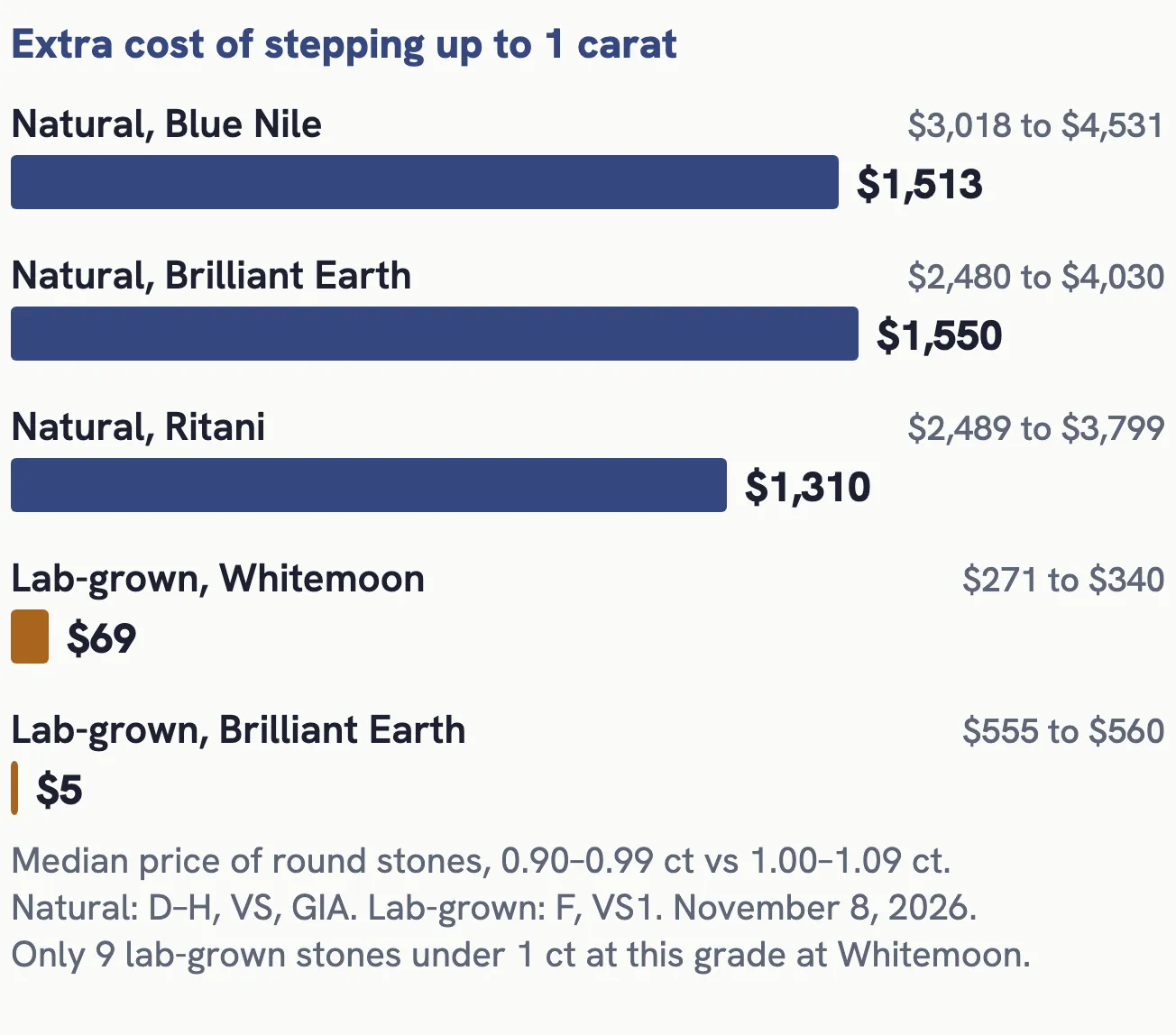
What the step up to 1 carat costs, natural against lab-grown.
How cut and certificate change the price
Cut grade barely moves the price of a 1 carat lab-grown diamond at Whitemoon, so an Ideal cut is an easy choice for a round. A GIA report costs more than an IGI one on the same grade.
| Round lab-grown diamond at Whitemoon | Typical price | Stones |
|---|---|---|
| F VS1, IGI, Excellent cut | $322 | 256 |
| F VS1, IGI, Ideal cut | $328 | 243 |
| E VVS2, IGI | $344 | 1,993 |
| E VVS2, GIA | $444 | 22 |
1.00–1.49 carats, priced per carat and scaled to exactly 1 carat. November 8, 2026. GIA’s current lab-grown document no longer gives letter grades, so read our comparison of IGI vs GIA before paying extra for one.
How much a 1 carat diamond ring costs
A ring costs the center stone plus the setting. At Whitemoon, 1 carat lab-grown diamond rings with the center already set started at $766 in gold and $1,116 in platinum on November 8, and our highest-priced 1 carat ring, a three-row pavé halo in platinum, was $4,139. If you build your own, gold settings start at $349 and you choose the center stone separately. Our engagement ring cost guide prices rings at every size up to 5 carats. Our diamond price chart covers every weight from a quarter carat to 10 carats.
With a natural center, the stone is most of the bill. The Natural Diamond Council’s sales data put the average natural engagement ring at $7,346 with a 1.16 carat center in 2025. That council promotes natural diamonds, and The Knot’s latest survey found 61% of couples chose a lab-grown center. Browse 1 carat lab-grown diamond rings, or narrow it down to round solitaires or platinum.
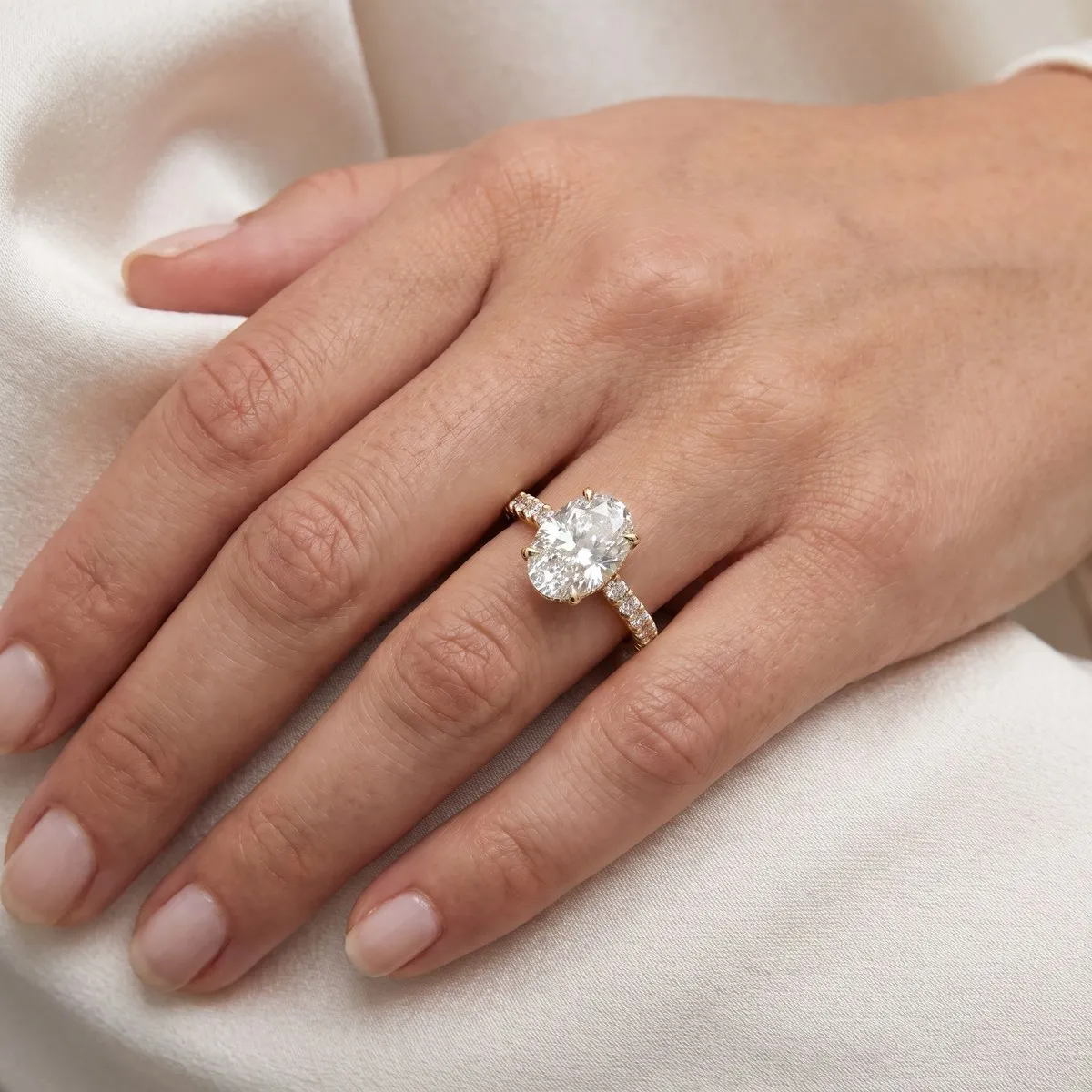
A 1 carat oval hidden halo ring in yellow gold. Image created from the design, not a size reference.
How big is a 1 carat diamond?
A carat is a weight, exactly 0.200 grams, and not a size. A well-cut 1 carat round measures about 6.4 to 6.5 mm across, and on a US size 6 finger it covers about two-fifths of the width. Our ring size chart has other sizes. GIA warns that a poorly cut stone can hide its weight in the depth, which is why a 1 carat can be as narrow as 5.7 mm.
Width grows much more slowly than weight. Doubling a diamond from 1 to 2 carats makes it only about 26% wider, though about 59% larger in face-up area.
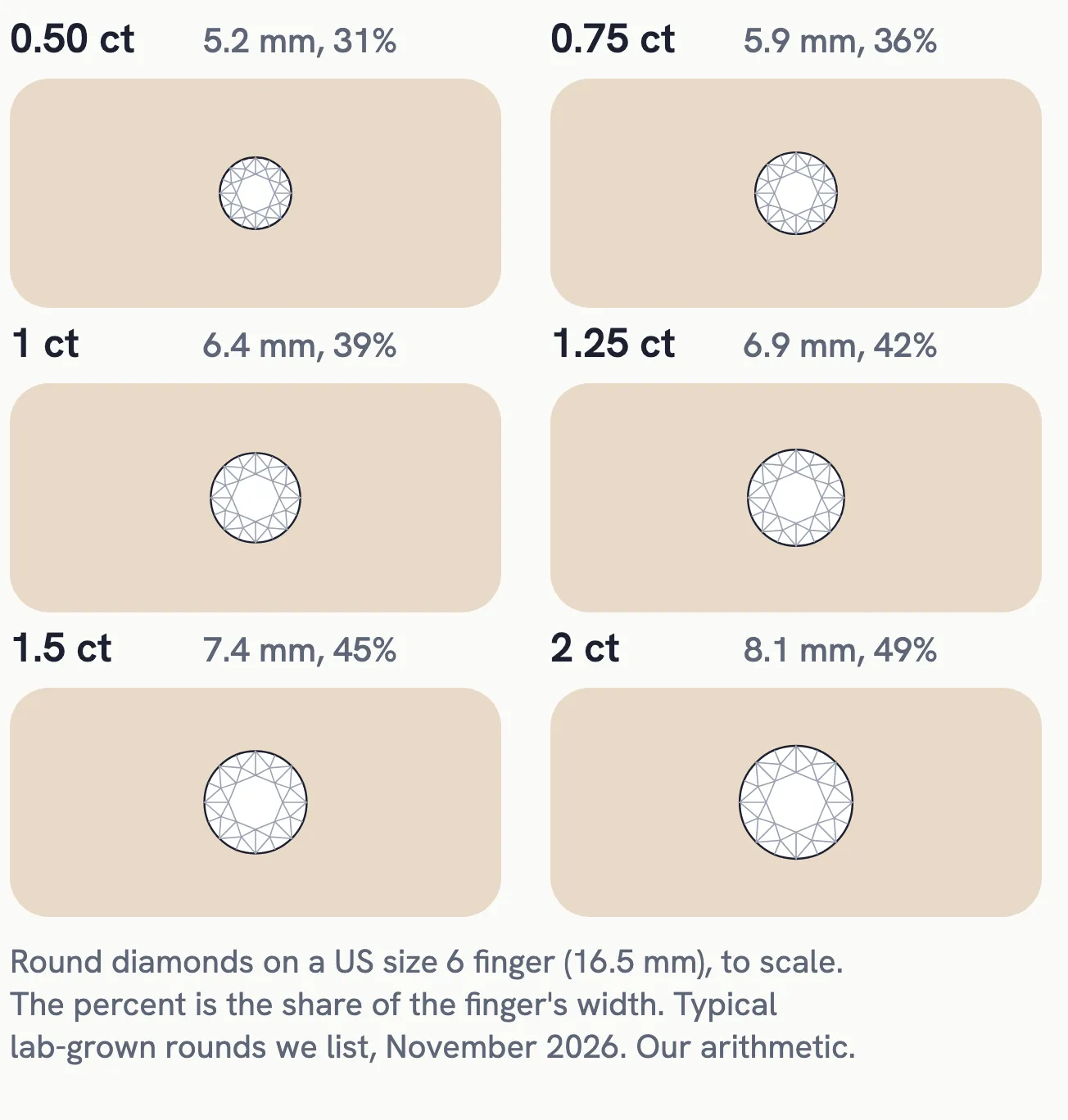
Round diamonds from 0.50 to 2 carats on a US size 6 finger, to scale.
1.25 carat diamond price and size
A 1.25 carat round is about 6.9 to 7.0 mm wide, roughly half a millimeter wider than a 1 carat, with about 16% more face-up area. It costs about $60 more as a lab-grown stone at Whitemoon, and $2,000 to $4,000 more as a natural one. We list far fewer of them: about 1,200 lab-grown rounds at 1.25–1.27 carats against about 8,800 at 1.00–1.02 carats.
| Round, F VS1, IGI | Lab-grown at Whitemoon | Lab-grown at Brilliant Earth |
|---|---|---|
| 1 carat | $324 | $595 |
| 1.25 carats | $385 | $703 |
| 1.5 carats | $468 | $1,373 |
| 2 carats | $672 | $1,837 |
Median price per carat scaled to the size shown. Stones of 1.25–1.49 carats for 1.25, and of each size up to half a carat larger for the others. November 8, 2026. Natural F VS1, GIA, at 1.25 carats: about $7,500 at Brilliant Earth and Ritani, $9,600 at Blue Nile. Our 2 carat diamond price guide covers that size in detail.
What a jeweler would pay for a 1 carat diamond
Expect well under retail, and no official figure exists. For a natural stone, sellers and buyers commonly estimate around a third to a half of today’s retail through a specialist, and less at a pawn shop. Those are estimates from people with a stake in the answer. Natural prices have fallen too, so don’t count on what you paid.
Lab-grown diamonds don’t hold their retail price, so buy one to wear and not as an investment. Worthy, an online resale service, says it doesn’t accept lab-grown stones at all. That makes the price you pay up front matter more: at $324 at Whitemoon and $595 at Brilliant Earth for the same grade on November 8, there’s less at stake from day one. Our Lifetime Upgrade gives you 100% of what you paid as credit toward a new lab-grown piece worth at least 1.5 times as much.
Shopping for a 1 carat lab-grown diamond at Whitemoon
Pick the shape first, since it changes the look far more than a grade or two changes the price. Then choose a setting, or start with a ring that has the center already set in the 1 carat gold rings collection. Most Whitemoon rings are made to order in about 10–15 days and ship free with insurance both ways, with 30-day returns on unworn pieces and one free resize within 60 days of delivery.
1 carat diamond questions
How much is a 1 carat lab-grown diamond?
About $320 to $1,400 for a round F VS1 stone at the stores compared above. At Whitemoon, most round 1 carat lab-grown diamonds cost between about $310 and $430 across grades, and a typical one costs about $344.
How much is a natural 1 carat diamond?
About $4,700 to $5,700 for a round F VS1 with a GIA report. Across all grades at Blue Nile, most round natural stones of 1.00–1.09 carats cost between about $2,400 and $7,500.
Is $600 for a 1 carat lab-grown diamond a fair price?
That depends on the grade and the store. On November 8, $600 was close to the typical price of a round F VS1 at Brilliant Earth, and well above the $324 at Whitemoon and $347 at Grown Brilliance. Compare stones of the same grade and report.
How much should you pay per carat for a lab-grown diamond?
At 1 carat, a round F VS1 ran from $324 to $1,377 per carat at the stores above. Price per carat doesn’t rise much with size at Whitemoon: the same grade was $336 per carat at 2 carats and also $336 at 3 carats.
How much is 1 carat in USD?
A carat is a unit of weight, so it has no fixed dollar value. One carat of gem diamond can cost about $300 or several thousand dollars, depending on whether it’s lab-grown or natural and on its grade.
How much does a 1 carat oval, pear or emerald cut diamond cost?
Lab-grown F VS1 at Whitemoon: oval $360, pear $320, emerald $336. Natural F VS1 at Blue Nile: oval $4,813, pear $5,122, emerald $3,674.
How much should I pay for a 1 carat diamond ring?
With a lab-grown center, 1 carat rings at Whitemoon ran from $766 to $4,139 on November 8, depending on the metal and design. With a natural center of a similar grade, expect the stone’s $4,700 to $5,700 plus the setting.
How big a diamond will $10,000 buy?
For a natural round F VS1 diamond, about 1.3 to 1.5 carats. For a lab-grown diamond of the same grade, well over 6 carats, since a 6 carat costs about $2,000 at Whitemoon.
Can a jeweler tell if a diamond is lab-grown or natural?
Not by eye. It takes lab equipment, and a basic tester can’t separate them. Our guide on how to tell if a diamond is real covers what each test can and can’t show.