
Bow-Tie Effect in Diamonds: What It Is and How to Spot It
A bow tie is a dark area across the middle of an oval, pear, marquise or heart diamond, shaped roughly like two triangles that meet at the center. It can look light gray or nearly black. It’s a reflection, not a flaw inside the stone, and most elongated brilliant diamonds show at least some. What matters is how strong it is: GIA’s observers generally disliked one that is broad, dark and stays dark as the stone moves, and they split on anything milder.
Customers often ask us whether a stone in our ring builder has one, and no grading report answers that. So we read GIA’s 2024 study of these shapes, checked the numbers on the lab-grown ovals we list, and looked at photos of 36 of them ourselves. The short version: the numbers on a report won’t tell you, but your eyes or a video will.
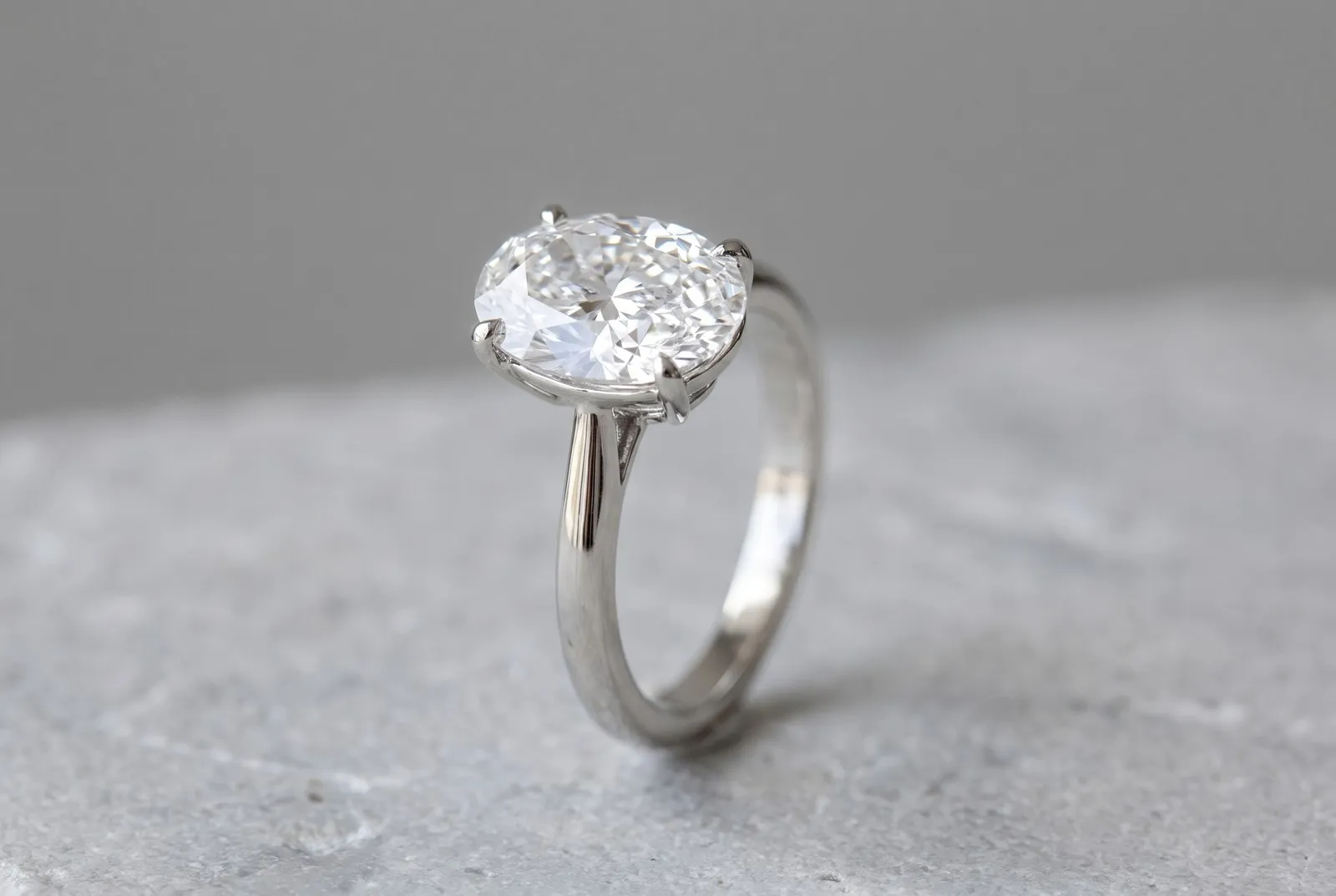
Pictured: an oval solitaire setting in white gold with a lab-grown diamond center. Image created from the design.
What is the bow-tie effect in a diamond?
It’s a pattern of contrast you see through the table, the large flat facet on top, running across the stone’s width. It can be slight or thick, broken into segments or one solid bar. Some stay dark as the stone moves, and others brighten. GIA’s guides describe two dark triangles joined at the center. It has nothing to do with clarity: GIA’s research paper treats it as a reflection, and its test stones ran from VVS1 down to I1.
The name is old. A 1982 Gems & Gemology report already put “bow-tie” in quotation marks and called it common in standard ovals and marquises. We couldn’t find who first used it.
Here are six lab-grown diamonds from our listings. Each pair has the same length-to-width ratio, or very nearly, which we come back to below.
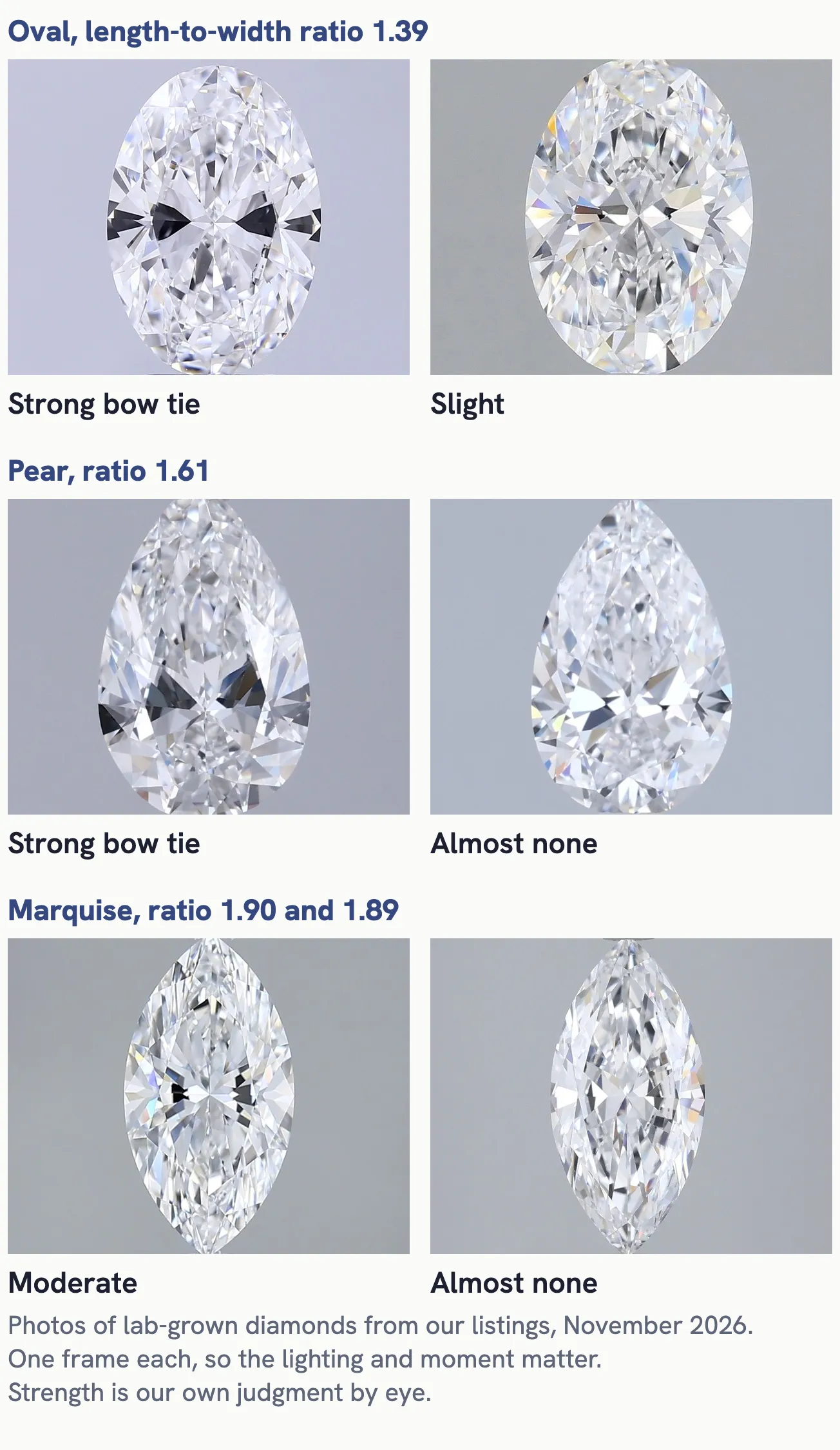
Same ratio, different look: lab-grown diamonds from our listings, November 2026.
What causes a bow tie?
GIA’s answer is your own head. Its oval diamond guide says the viewer’s head and shoulders block light from reaching the stone, and that the bow tie grows as your face gets closer. A footnote in the research paper makes a point we haven’t seen elsewhere: people who love the “hearts and arrows” look in a round tend to dislike the same kind of observer reflection in an oval, pear or marquise, where the trade calls it a bow tie.
The stone’s design decides how much of that reflection you get. The long outline itself tends to produce a bow tie, across most facet arrangements and a wide range of proportions. Pavilion main facets, the long facets on the underside, make it stronger when they sit across the width at the stone’s widest point, which cutters call the belly.
You’ll also read that a bow tie is light leaking out through the bottom of the stone. Some jewelers describe it that way, and it’s often stated as settled. We found no peer-reviewed optical study of the bow tie in diamond, so we’ll go with GIA’s explanation and note that the trade doesn’t fully agree.
Cutters have already changed course. Before 2014, more than half of the ovals sent to GIA had mains at the belly. By 2016 about 20% did, and by 2023 nearly 90% had none. A lot of older advice about bow ties comes from a time when ovals were cut differently.
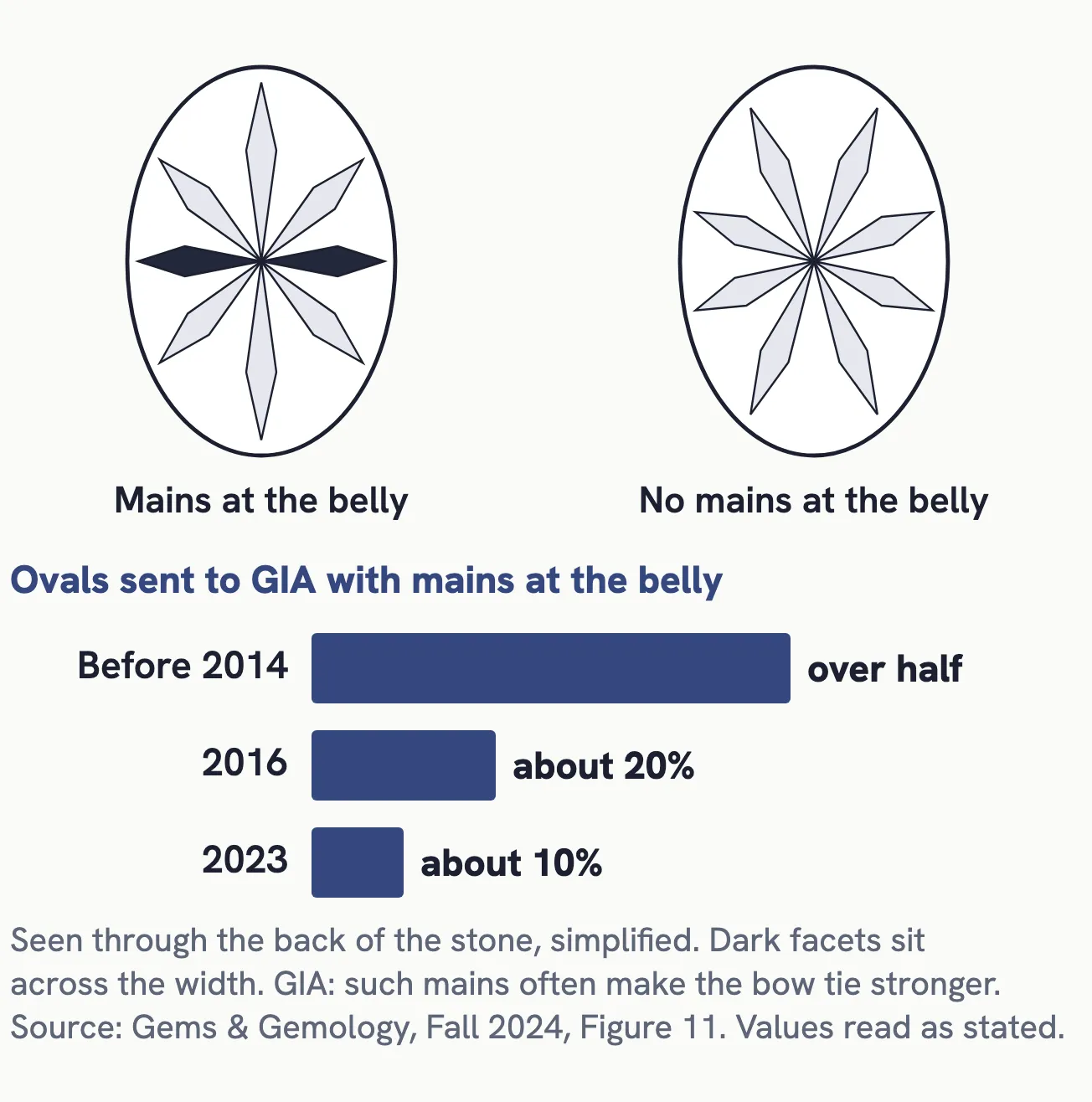
Most ovals sent to GIA no longer have mains at the belly.
Which diamond shapes get a bow tie?
Oval, pear and marquise are the three GIA studied and the three that IGI checks for it when grading cut. Beyond those, the evidence thins out quickly.
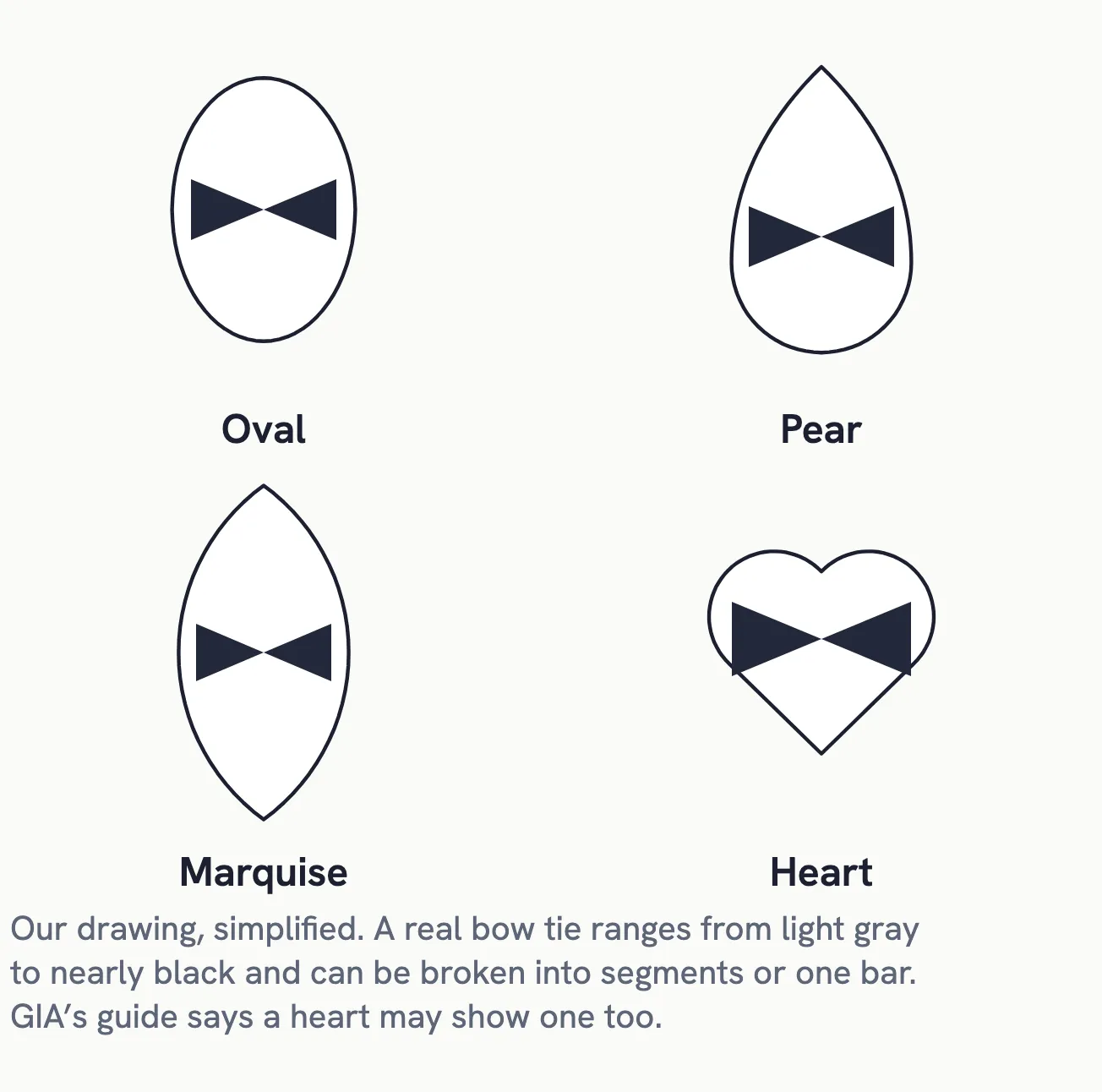
Where a bow tie sits on the four shapes most likely to show one.
| Shape | Bow tie? | What’s known |
|---|---|---|
| Oval | Yes | Studied by GIA. Most show some. |
| Pear | Yes | Darkens as the length-to-width gap and pavilion angles grow more extreme. |
| Marquise | Yes | GIA says one with none may look flat. |
| Heart | Can have one | GIA’s guide says so. Not in its 2024 study. |
| Radiant, long cushion | Some jewelers report it | Not covered by GIA’s study. |
| Emerald, Asscher | Not normally | Step cuts. GIA’s guide ties the bow tie to brilliant cuts. |
| Round | No | Shows arrows instead, a related reflection. |
Lab-grown diamonds should behave the same way. They’re the same material as mined diamonds, with the same light-bending power, so the same facets should give the same reflections. That’s our reasoning, not a test: GIA’s paper doesn’t say where its research stones came from, and we found no direct comparison. Our diamond shapes guide covers how each shape looks and wears.
Do all oval diamonds have a bow tie?
Nearly all show some, but the honest answer depends on the document. GIA’s buying guide says some degree is always there. GIA’s research paper says layouts with no mains at the belly can “minimize or eliminate” it, and one test oval had no sizable dark regions at all. Nobody has published a percentage. GIA’s team scored about 350 ovals in 2023 but reported how well they agreed with each other, not how many had strong bow ties.
So we looked for ourselves. We opened photos of 36 lab-grown ovals of 1 to 3 carats from our listings and judged each one by eye: 17 slight, 14 moderate, 5 strong, and none with no dark area at all. It’s one person’s view of one frame per stone, so treat it as a rough look.
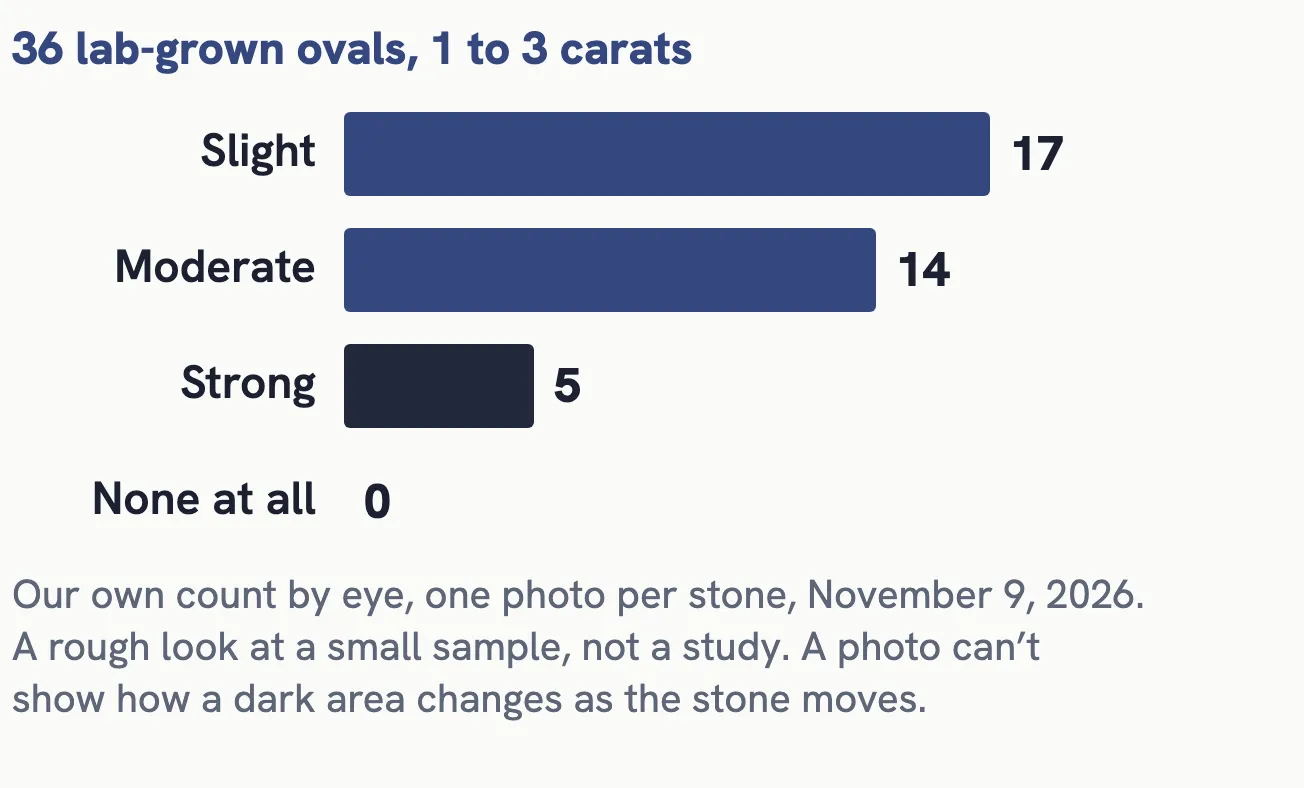
Our count of 36 lab-grown ovals, one photo each, November 9, 2026.
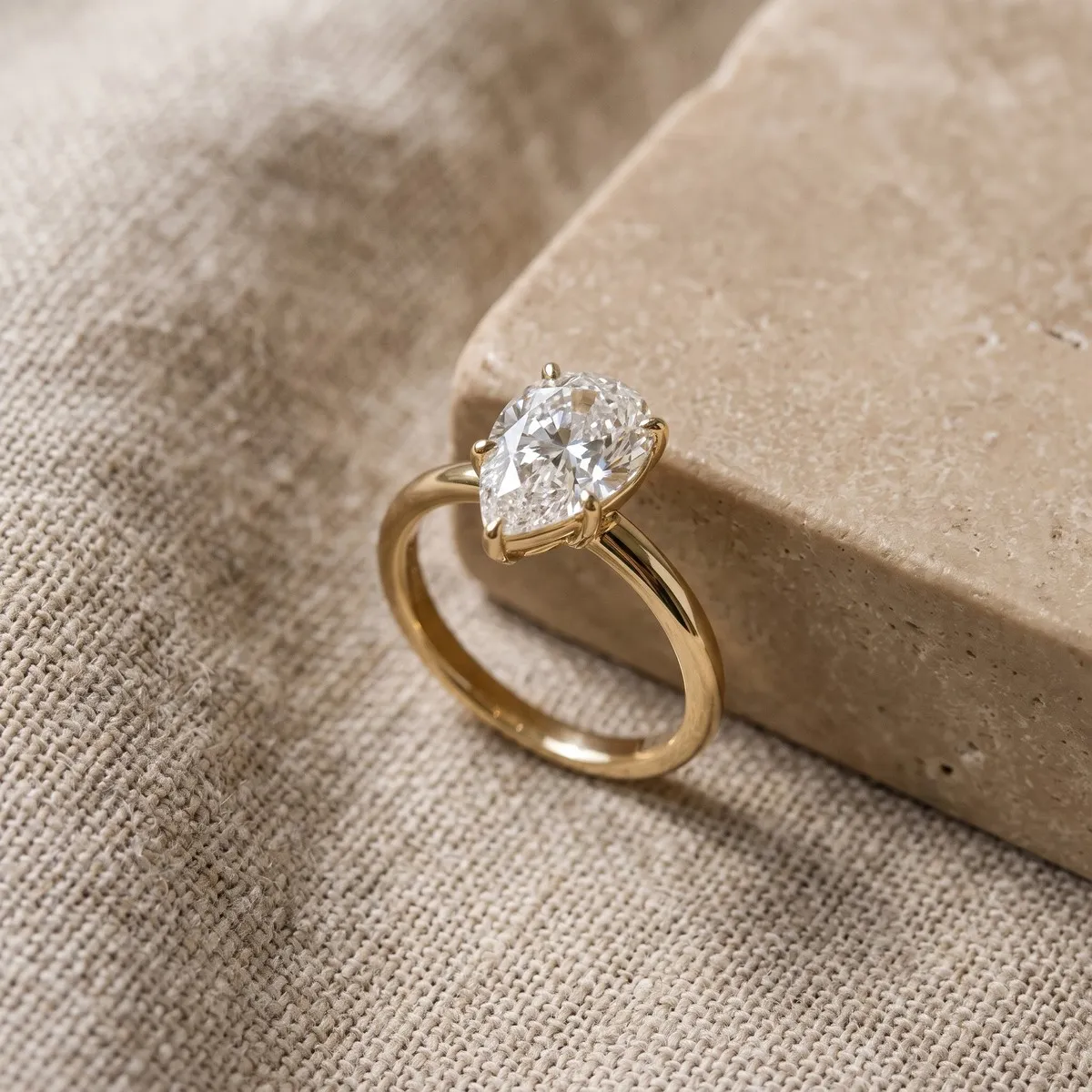
A pear solitaire setting in yellow gold with a lab-grown diamond center. Image created from the design.
Removing it completely isn’t free, either. GIA’s oval with no sizable dark regions was covered in tiny “crushed ice” sparkle, and it split observers more than any other oval in that figure: 83 of 167 rated it Excellent or Very Good, and 41 rated it Fair or Poor. That’s one stone, but GIA says more generally that stones dominated by crushed ice get the least agreement.
Can you spot a bow tie from the numbers on a report?
No, and this is where a lot of advice goes wrong. No report tells you how strong a stone’s bow tie is.
- GIA gives fancy shapes no cut grade today. It plans cut grades for oval, marquise and pear in 2027, with details due early that year. Whether they’ll include the bow tie hasn’t been announced.
- IGI does weigh it: its fancy cut grade, launched in 2022, names the bow tie on oval, marquise and pear. But it’s a gemologist’s judgment folded into one grade, with no separate line for it.
- Our listings: about 4 in 5 of the lab-grown ovals we list have no cut grade on the report at all.
Ratio, table and depth don’t settle it. Here are two ovals from GIA’s own study with nearly identical numbers and opposite results.
| Oval RD118 | Oval RD092 | |
|---|---|---|
| Length to width | 1.40 | 1.44 |
| Depth | 62.9% | 62.7% |
| Table | 55% | 54% |
| Bow tie, per GIA | Strong | No strong bow tie |
Our photos show the same thing. Our five strongest bow ties had ratios from 1.39 to 1.47, and stones with almost none sat in that same range. GIA does say ovals above 1.50 may show a stronger bow tie, but its own guide pictures a noticeable one at 1.48. In the end its paper concludes that fancy shapes need too many measurements for a simple proportion chart: 18 for a basic oval and 35 or more for a pear. A rule like “choose 58–63% depth to avoid a bow tie” has nothing behind it.
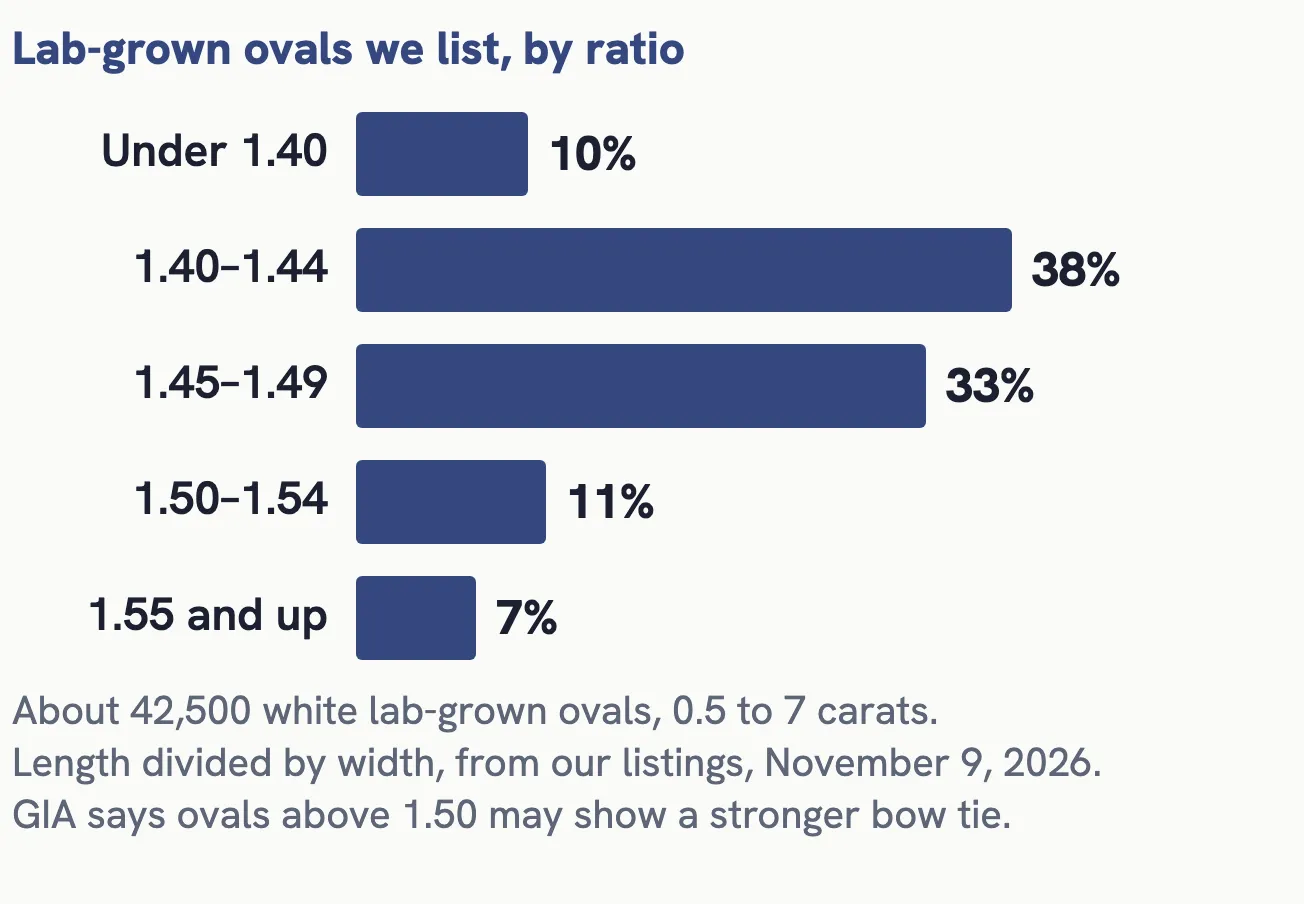
The ratios of the lab-grown ovals we list, November 9, 2026.
How to judge a bow tie
GIA’s observers looked at stones in a specific way, chosen because it seemed to represent the patterns most fairly. You can copy it in a store, and most of it on a video.
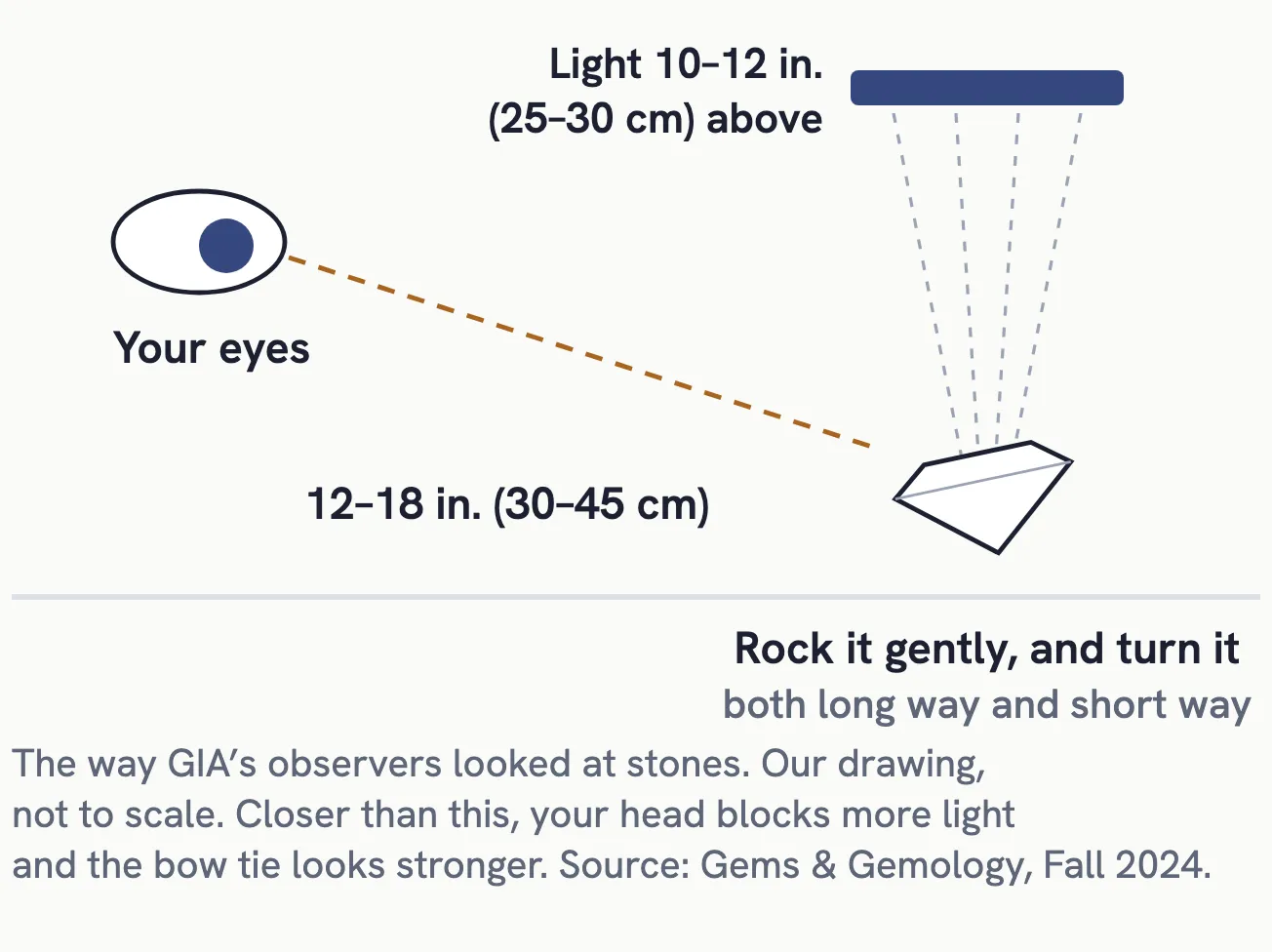
How GIA’s observers looked at stones.
- Hold it at normal distance, 12 to 18 inches from your eyes, with the light 10 to 12 inches above. Up close, your head blocks more light, so don’t judge from a loupe view or a macro photo. That last part is our advice, based on what GIA says about distance.
- Rock it gently, and turn it both the long way and the short way.
- Ask three questions. Is the dark area broad? Is it truly dark? Does it stay dark as the stone moves? Three yeses describe the kind GIA’s observers generally disliked.
- Prefer video to a photo. A photo can’t show whether the dark area changes.
- Try more than one light. GIA suggests viewing under several, including the kind where the ring will be worn.
- On an oval, ask where the mains sit. “No mains at the belly” is the one feature with GIA’s evidence behind it.
In the Whitemoon ring builder, each stone’s page shows its certificate and its ratio, table and depth. Some stones also have a photo or a 360° view, and some show only an outline. For a shape that can show a bow tie, we’d shortlist from the ones tagged 360°.
Bow tie, window or dark center?
Three other dark patterns get mistaken for a bow tie. One matters more.
| Pattern | What you see | Usual cause |
|---|---|---|
| Bow tie | Dark band across the width that can shift with motion | Reflection of the viewer, plus facet layout |
| Window | Washed-out, see-through center | Usually too shallow |
| Dark center or nailhead | The whole center looks dark | Usually too deep (described for rounds) |
| Fisheye | Gray ring around the table | Too shallow, the girdle reflecting (described for rounds) |
In GIA’s study, observers disliked windows far more consistently than bow ties. The four ovals it singled out for disliked windows were only about 40–48% deep. Most of the lab-grown ovals we list are about 60–64% deep, and depth does appear on the report, so this is one problem the numbers can warn you about.
Is a bow tie bad, and does it lower the price?
Not by itself. Even GIA’s trained team agreed less on bow tie strength than on windows or brightness, and observers could agree on what a pattern looked like and still disagree on whether it was attractive. Some people expect a slight one in an oval, and some want none. In our opinion, it’s worth skipping a strong one and not worth chasing zero.
On price, we found no published discount. GIA says only that ovals cut to minimize the bow tie “sell more easily”. Claims that a minimal bow tie costs 15–25% more come from one site’s illustration with no method. It would be hard to measure, because no report records it and no database can sort by it.
Two more claims we couldn’t support: that bigger stones show it worse, and that a halo or bezel hides it. GIA’s main observer study used stones under 1 carat and gave no finding on size, and we found no study of set stones. If it matters to you, ask to see the stone set before you decide.
Choosing an oval, pear or marquise at Whitemoon
Start with the shape, then compare a few stones on video instead of hunting for one perfect set of numbers. You can browse oval engagement rings, pear engagement rings and marquise engagement rings, then choose the center in the builder. Our guide to reading a diamond certificate explains what the report does cover. Most Whitemoon rings are made to order in about 10–15 days and ship free with insurance both ways, with 30-day returns on unworn pieces and one free resize within 60 days of delivery.
Bow tie diamond questions
What does a bow tie look like in a diamond?
Two dark triangles meeting at the center, running across the stone’s width. It can be a faint gray shadow or a nearly black bar.
Do all oval cut diamonds have a bow tie?
Most show some. Layouts with no mains at the belly can almost remove it, but no one has published a percentage. In our own look at 36 lab-grown ovals, every one showed some dark area and five were strong.
Is a bow tie in a diamond bad?
A broad, dark bow tie that stays dark as the stone moves is generally disliked. A slight one that shifts with motion is a matter of taste, and GIA says a marquise with none may look flat.
What should you avoid in an oval diamond?
A strong, persistent bow tie and a see-through window, which GIA’s observers disliked even more consistently. Lower-priority worries such as a slightly long or wide outline are mostly personal preference.
How do you avoid a bow tie?
Look at the stone. Watch a video or hold it about 12 to 18 inches away, rock it, and ask whether the dark area is broad, dark and persistent. On ovals, ask about mains at the belly. Ratio and depth won’t tell you.
Does a diamond certificate show a bow tie?
No. No GIA or IGI report we’ve seen has a line for it. IGI’s fancy cut grade does take it into account, but as part of one overall grade.
Do pear and marquise diamonds have a bow tie?
Yes, both can. GIA says most marquises show one. On the pears in our photos, it sits across the wider, rounded end rather than the stone’s exact middle.
Do lab-grown diamonds have a bow tie?
Yes. A bow tie comes from a stone’s shape and facets, and lab-grown diamonds are the same material as mined ones. The photos above are all lab-grown diamonds from our listings.