Diamond Shapes: Every Cut Explained, and Which Shape Is Best
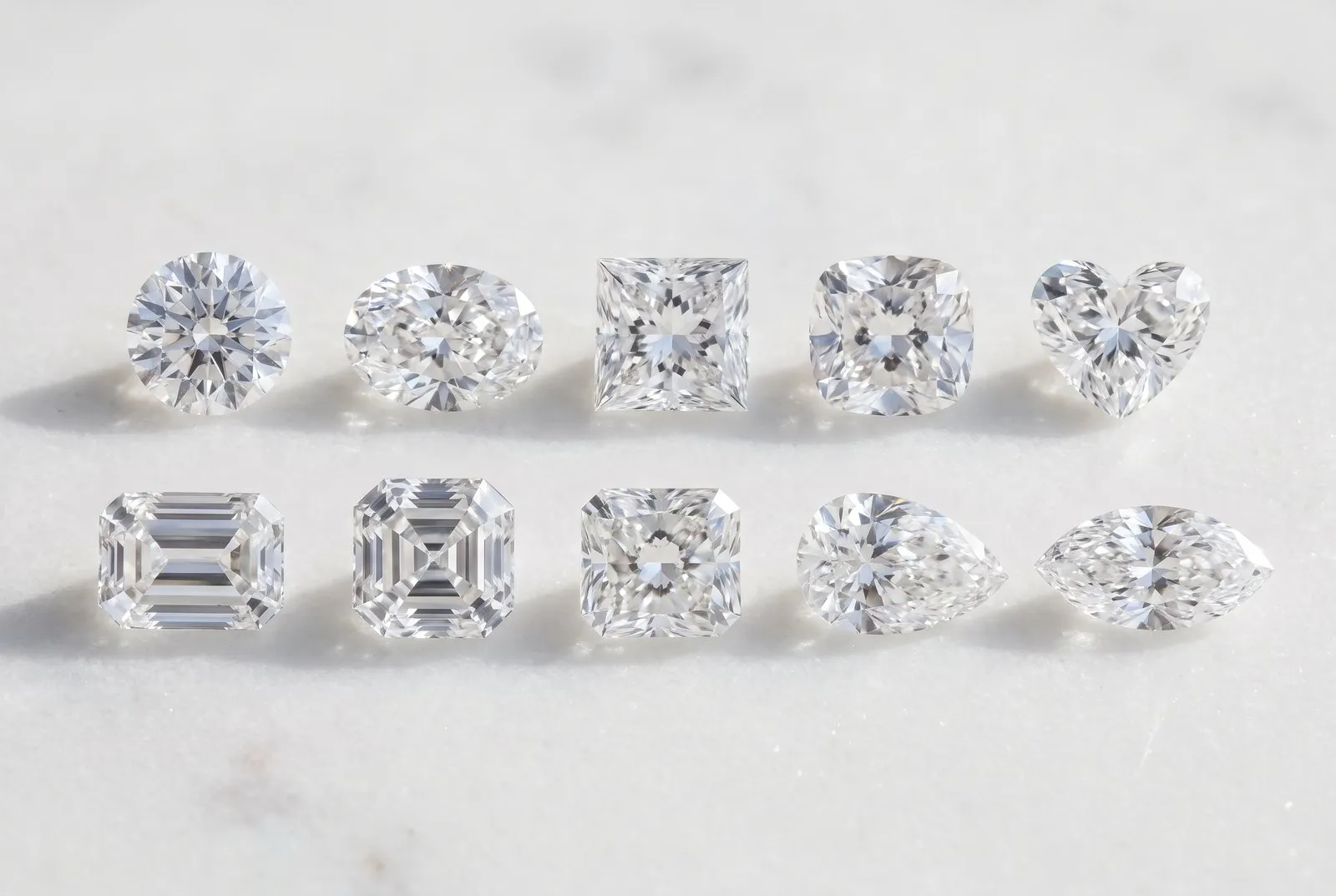
There are ten main diamond shapes: round, oval, princess, cushion, emerald, asscher, radiant, pear, marquise and heart. Round is still the most chosen for engagement rings, but only just: in the latest US data, oval is a percentage point behind. Which shape is “best” is mostly taste, but some differences can be measured, such as how big a stone looks for its weight, how much it sparkles, how well it hides flaws and how much it costs.
We sell all ten shapes as lab-grown diamonds, so keep that in mind. To keep this guide useful, we measured the stones in our own ring builder, compared prices, and checked the usual claims against GIA’s published research. Several of the most repeated claims about shapes turned out to have nothing behind them.
Pictured: the ten main diamond shapes. Illustrative image.
Diamond shapes chart
The chart shows the ten shapes at 1 carat, drawn to the same scale from the typical length and width of the lab-grown stones in our ring builder in November 2026. A 1 carat round is about 6.5 mm across, while a 1 carat marquise is over 10 mm long.
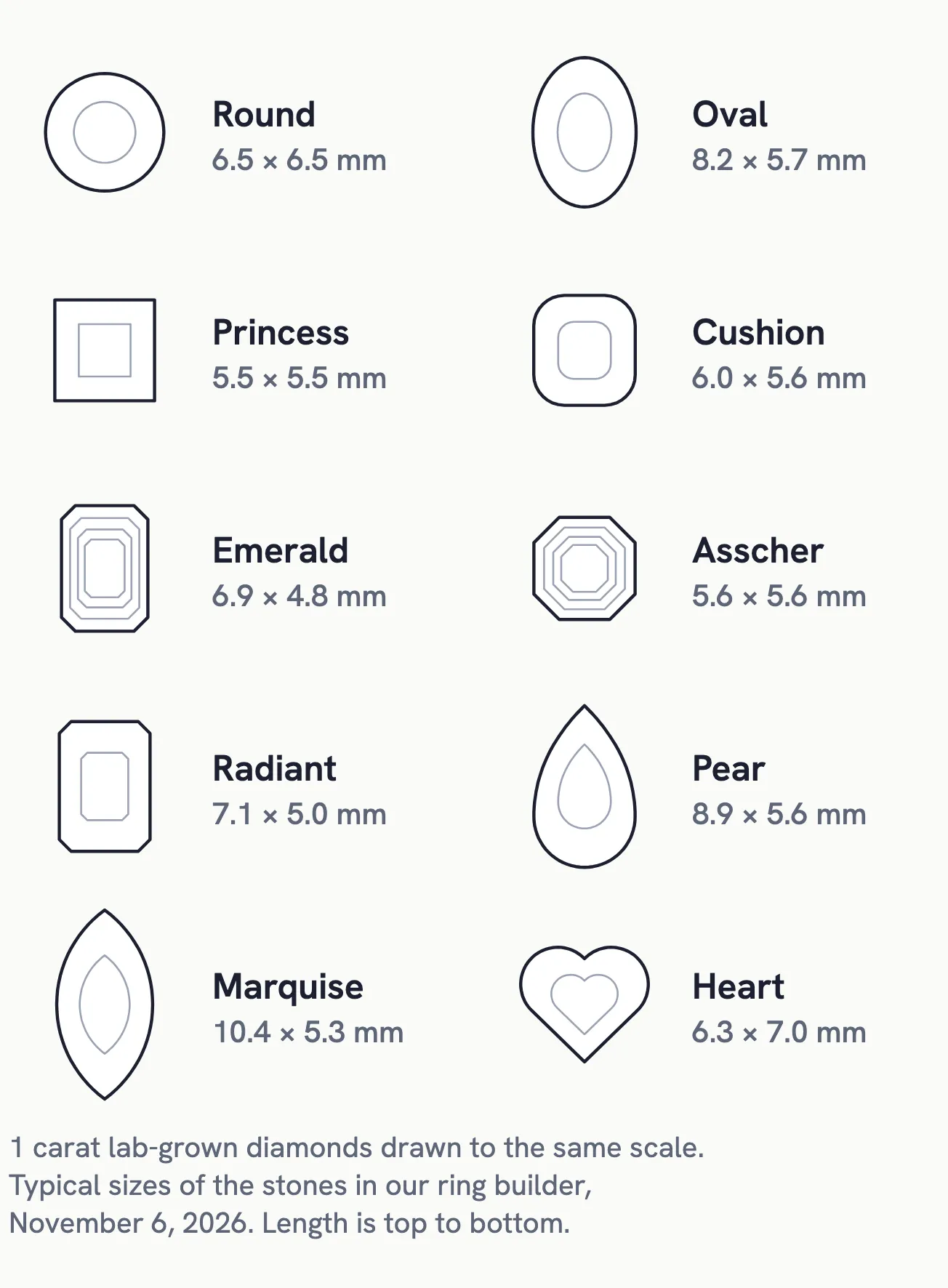
The ten shapes at 1 carat, drawn to scale from the stones in our ring builder.
Shape vs cut: what’s the difference?
People use “cut” for two different things, which is why “diamond cuts” and “diamond shapes” mean the same thing to most shoppers. Strictly, the shape is the outline you see from above, and the cut is the craftsmanship: how the facets are arranged and angled, which decides how the stone handles light. A grading report names both on one line, such as “Oval Brilliant” or “Cushion Modified Brilliant”.
Facet arrangements fall into two main families:
- Brilliant cuts have many triangle and kite-shaped facets radiating from the center, built for sparkle. Round, oval, pear, marquise and heart are brilliants, and princess, cushion and radiant are brilliant-faceted versions of square and rectangular outlines.
- Step cuts have long facets in rows, like stairs. Emerald, asscher and baguette are step cuts. They give broad flashes of light and a clear, open look rather than lots of small sparkle.
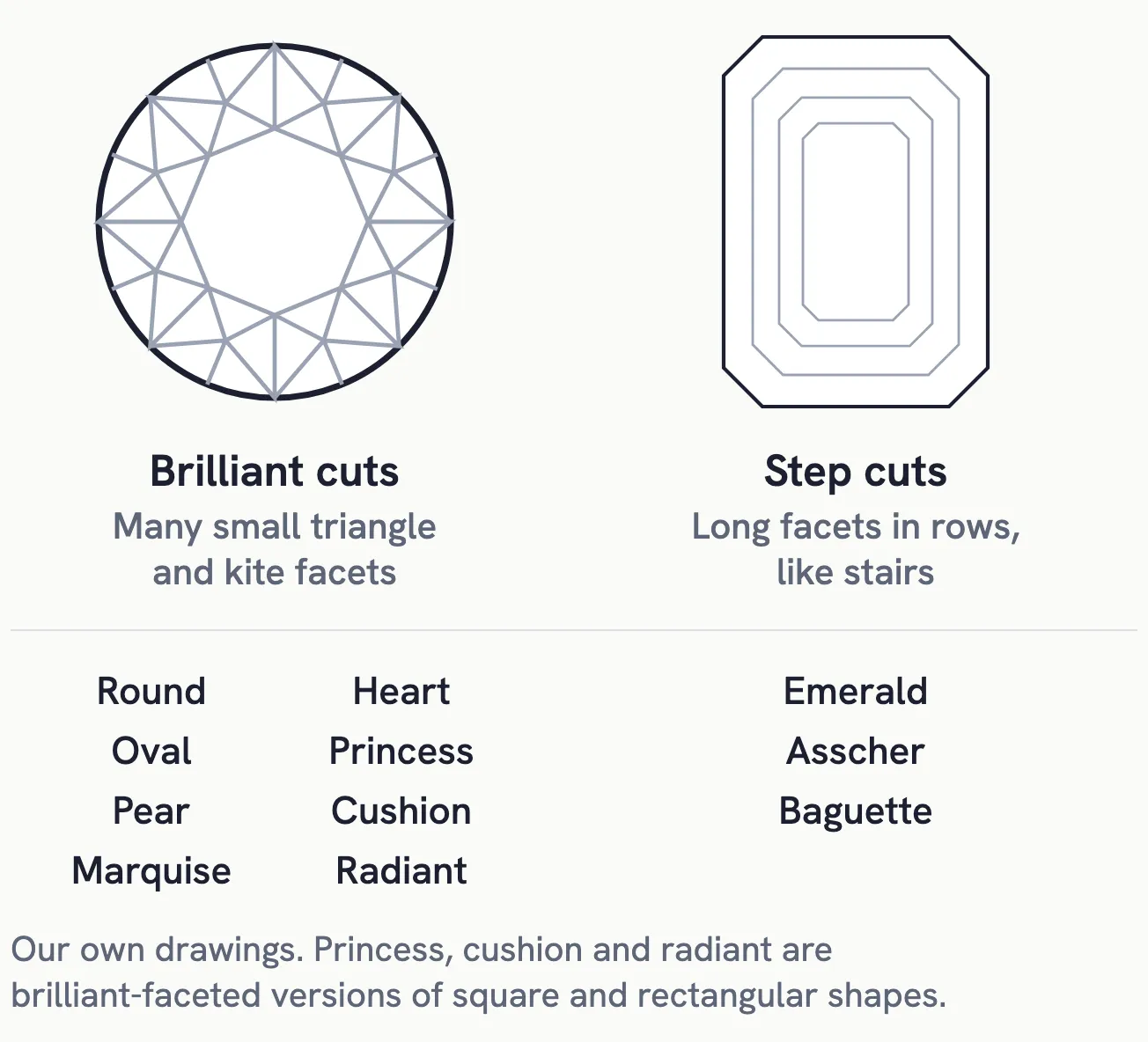
Brilliant cuts and step cuts. Our own drawings.
A cut grade is a separate thing. GIA grades cut from Excellent to Poor only for round brilliants, because only the round has a standard facet layout. Fancy shapes get grades for polish and symmetry instead. That’s changing: GIA has said it will start grading cut for marquise, oval and pear in 2027. IGI has offered cut grades for nine fancy shapes since 2022, but many of its reports still leave them off. Among the lab-grown stones in our ring builder, almost every round has a cut grade, against about one oval in five and fewer than one in ten marquise or radiant stones.
The ten diamond shapes
Round
The round brilliant is the shape built around sparkle, with 57 or 58 facets. Its modern proportions go back to Marcel Tolkowsky’s 1919 book Diamond Design, and to older round cuts before that. Its many facets help hide inclusions and a little color, and it has no points or corners to chip. See our round diamond rings.
Oval
An oval is a stretched round brilliant, and it’s now almost as popular. It looks larger than a round of the same weight, and its length makes the finger look longer. Most ovals show some bow tie, a darker band across the middle; more on that below. See our oval diamond rings.
Princess
The princess is a square brilliant with sharp corners. GIA credits Betzalel Ambar and Israel Itskowitz with creating it in 1981, not the 1961 date many guides give. It carries a lot of weight in its deep base, so it faces up smaller than most shapes of the same weight, and the corners need prongs or a bezel to protect them. See our princess cut rings.
Cushion
A cushion is a square or rectangle with rounded corners, like a pillow. It descends from the old mine cuts of the 1700s and 1800s; the Hope Diamond is one. Some cushions have large facets, and others have many small ones that give a “crushed ice” look. They come square or elongated. See our cushion cut rings.
Emerald
The emerald cut is a rectangular step cut with trimmed corners, named after the gem it was first used for. Its long, open facets give wide flashes and a calm, glassy look, but they also show inclusions and color more, so choose a higher clarity than you would in a round. See our emerald cut rings.
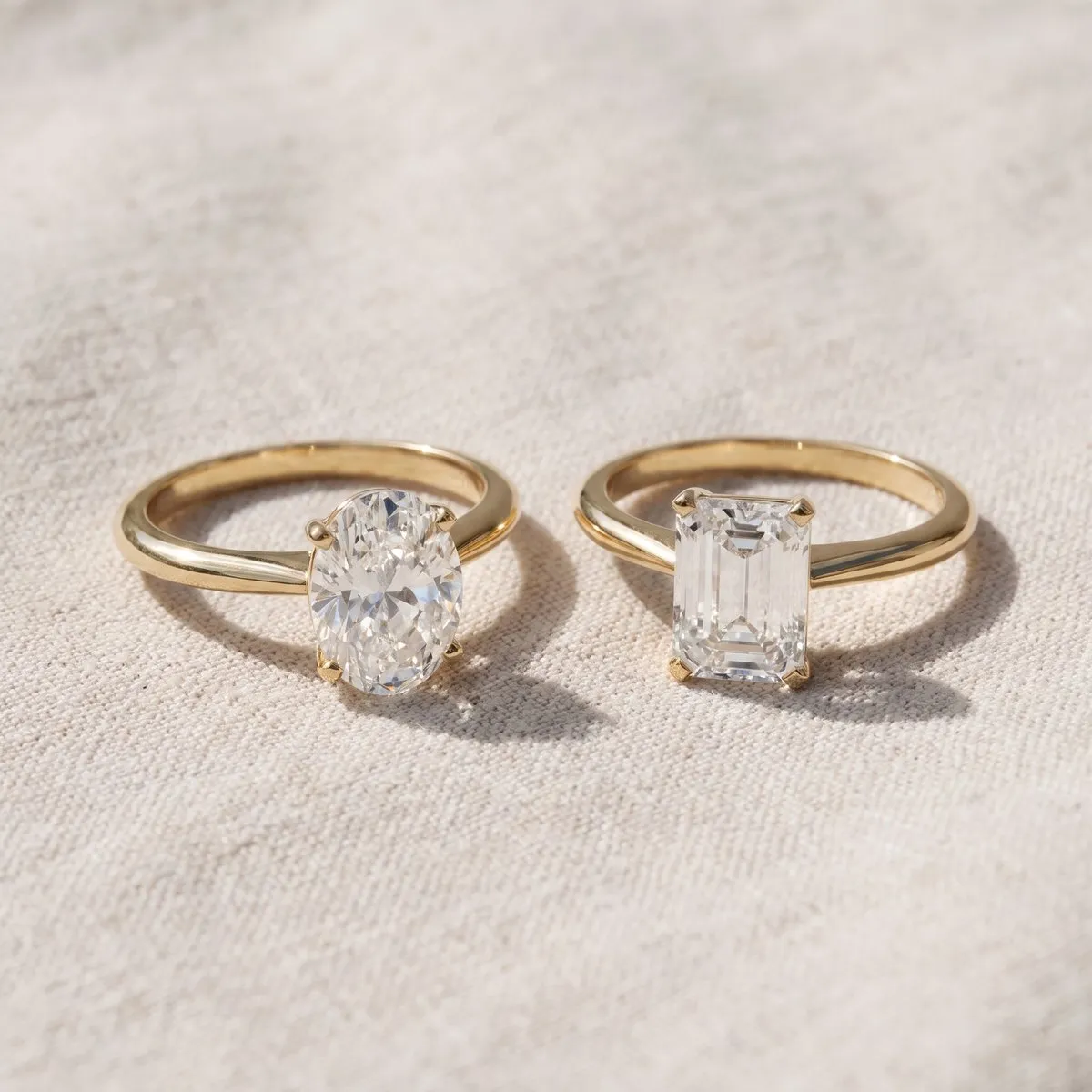
Oval and emerald cut lab-grown diamond solitaires in yellow gold. Image created from the rings’ designs.
Asscher
The asscher is a square step cut with deeply trimmed corners, which make it look almost octagonal. It was created by the Asscher family of Amsterdam in the early 1900s and became a favorite of the Art Deco years. Like the emerald cut, it shows inclusions readily. See our asscher cut rings.
Radiant
A radiant has the outline of an emerald cut with brilliant faceting, about 70 facets in GIA’s description. Henry Grossbard designed it in the 1970s. It hides inclusions well, and GIA calls it one of the most brilliant of the rectangular shapes. See our radiant cut rings.
Pear
A pear, or teardrop, is round at one end and pointed at the other. You’ll read that Lodewyk van Berquem invented it in 1475, but that’s legend: Antwerp’s diamond museum calls the best-known story about him, that he invented diamond polishing, a myth. The point needs a V-shaped prong or a bezel to protect it, and pears can show a bow tie. See our pear diamond rings.
Marquise
The marquise is a long boat shape with a point at each end. Legend links it to Louis XV and the shape of a mistress’s lips, but GIA treats that as legend too. It looks larger for its weight than any other shape, and both points need protection. Demand is rising: US searches for marquise engagement rings nearly doubled between October 2025 and August 2026. See our marquise diamond rings.
Heart
A heart is a brilliant cut with two lobes and a point. It needs good symmetry and a clear cleft to read as a heart, so GIA suggests half a carat or more. It’s the least common of the ten in our ring builder after the asscher. See our heart-shaped diamond rings.
Rose cut and other antique cuts
A rose cut has a flat base and a domed top covered in 12 or 24 triangular facets, a style from the 1500s. With no pointed base, it faces up large for its weight but gives soft flashes rather than bright sparkle, and it shows inclusions more. Old mine and old European cuts are the early forms of the cushion and the round, cut by hand with a small table and a tall crown. Baguettes are small rectangular step cuts, mostly used as side stones.
Which diamond shape looks biggest?
Two stones of the same carat weight can look quite different in size, because carat is weight and shape decides how much of that weight faces up. We measured the typical length and width of the 1 carat lab-grown diamonds in our ring builder and worked out the area each outline covers seen from above.
Marquise came out largest, about 16% more face-up area than a round of the same weight, followed by oval (about 11%), pear (about 7%) and radiant (about 5%). Asscher came out smallest, about 17% less than a round, with heart, princess, cushion and emerald in between. The marquise also has by far the longest outline: 10.4 mm end to end against 6.5 mm across a round.
Treat these as approximate. They come from the outline alone, and a stone cut deeper than usual hides more of its weight underneath. The shapes that look smallest are the ones cut deep: princess, asscher, cushion and emerald stones in our builder are typically 65% to 71% as deep as they are wide, against about 62% for rounds and ovals.
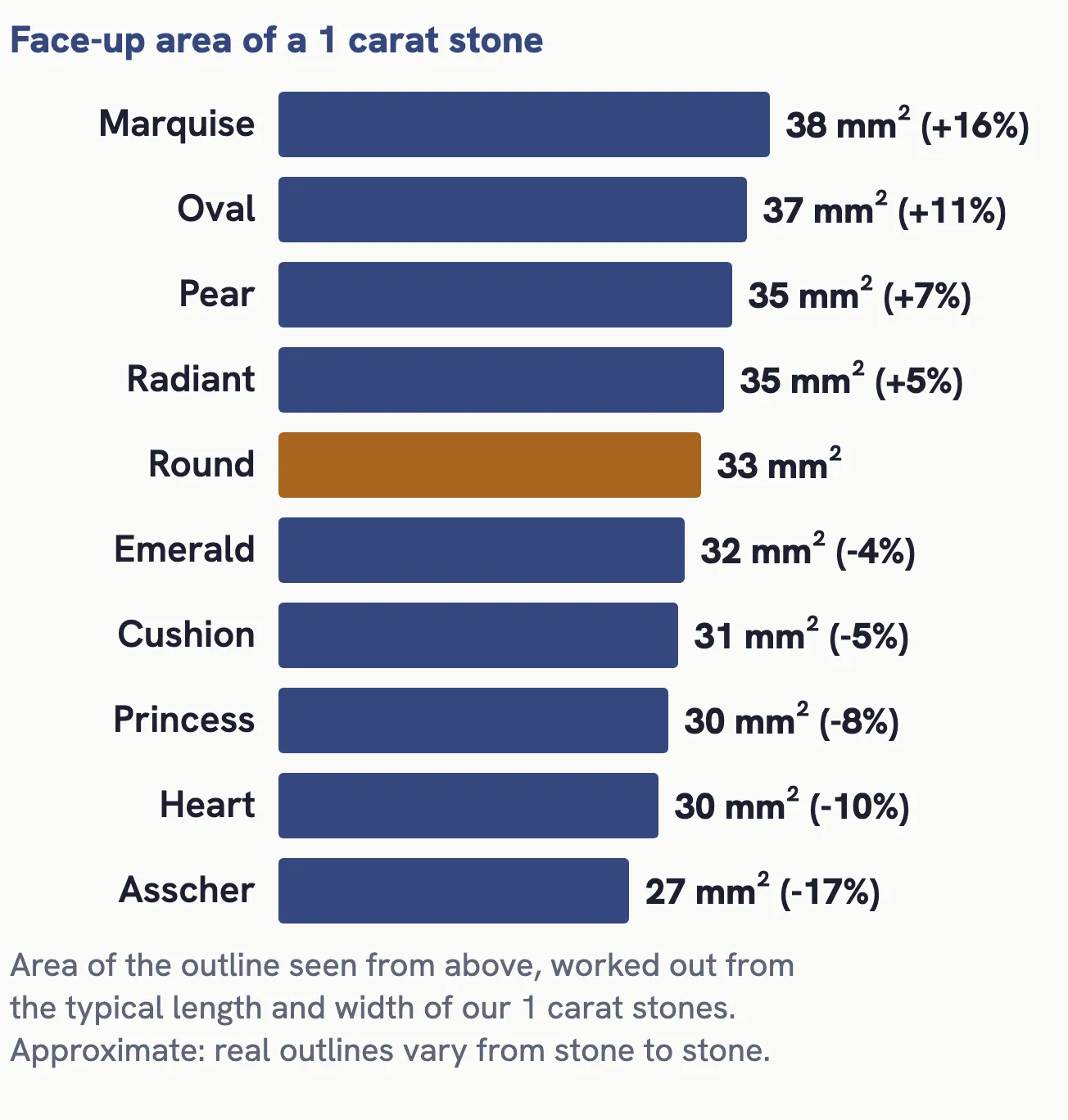
Face-up area by shape at 1 carat, worked out from our stones’ typical sizes. Approximate.
Which diamond shape sparkles the most?
The round brilliant, by design. It’s the shape whose facets were worked out to return as much light as possible, and the only one with a long-standing cut grade. Among fancy shapes, the brilliant-faceted ones, such as oval, pear, marquise, cushion, princess and radiant, sparkle more than the step cuts, which trade sparkle for broad flashes.
You’ll see claims that a radiant or cushion sparkles as much as a round, or more. We found no study that compares light return across shapes, so treat those as opinion. A well-cut fancy shape can be very lively, and GIA’s own research found that people disagree a lot about which fancy-shape patterns they like.
The bow-tie effect
Ovals, pears, marquises and hearts can show a bow tie: a dark, bow-shaped band across the middle of the stone where less light comes back. A faint one is normal and hard to see in a ring. A big, dark one that stays put as the stone moves is the thing to avoid. Cutters have been working on it: GIA found that by 2023 nearly 90% of the ovals it received used a facet layout that reduces the bow tie. No grading report rates the bow tie, so judge it from a video of the stone, or ask us about a specific stone before you order. Our guide to the bow-tie effect shows what to look for.
What is the most popular diamond shape?
Round, by a hair. In The Knot’s 2026 Real Weddings Study, which covers US couples married in 2025, 26% of engagement rings had a round center and 25% an oval. Emerald, pear, marquise and princess each had 8%, cushion and radiant 6% each, and every other shape shared about 5%.
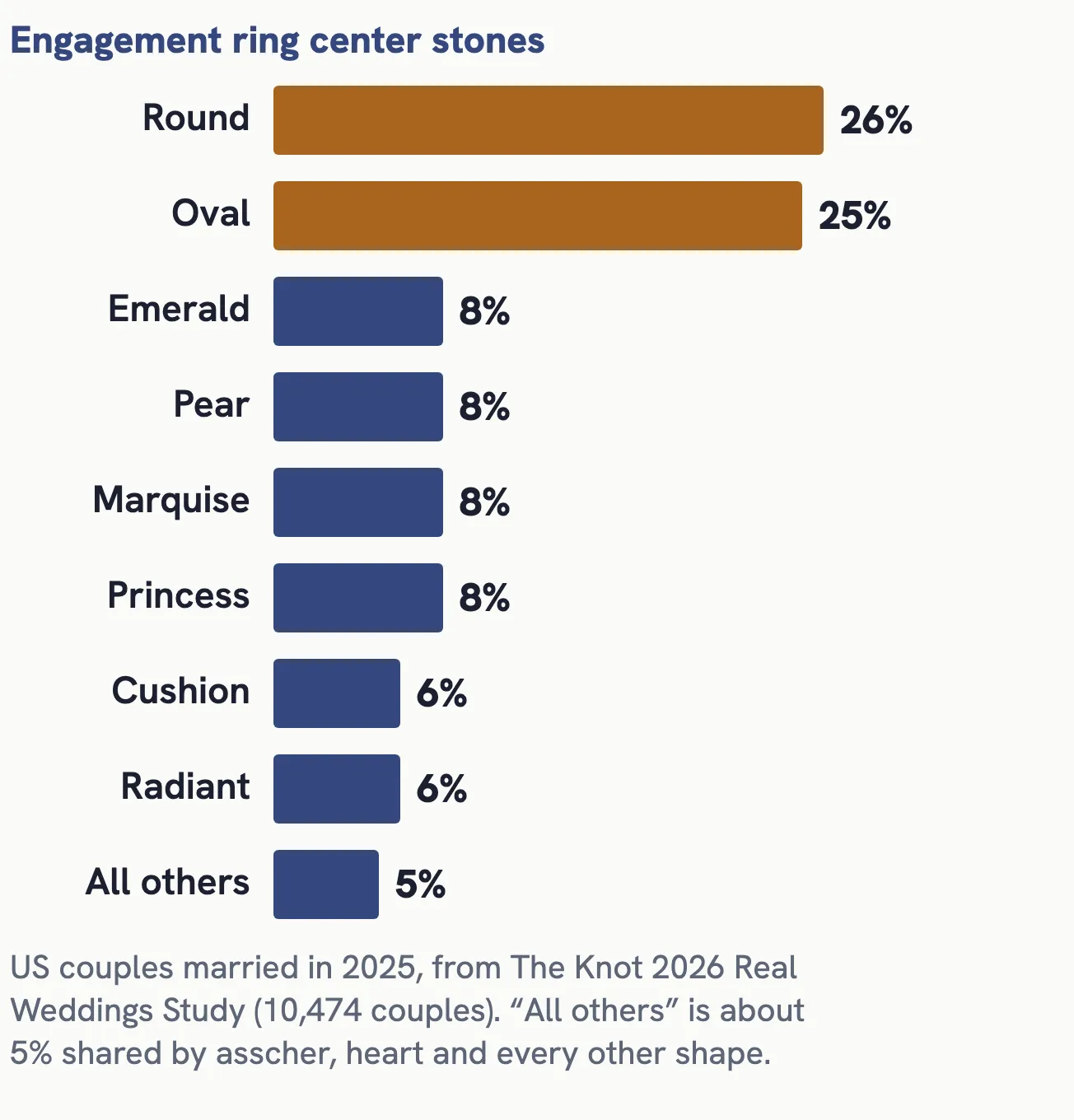
The most popular engagement ring shapes. The Knot 2026 Real Weddings Study.
The round’s lead has shrunk a lot. In The Knot’s 2019 study it had 47% to the oval’s 14%. Claims that ovals have now overtaken rounds, or that 60% to 75% of all diamonds are round, aren’t backed by any study we could find; the answer depends on what’s counted. Full data for 2026 weddings won’t be out until 2027.
What is the least popular or rarest diamond shape?
Among the ten main shapes, asscher and heart are the least chosen: neither is named separately in The Knot’s data, and they’re the two rarest shapes among the lab-grown stones in our ring builder, at about 1.5% and 1.9%. Princess is the one falling fastest, from 14% of engagement rings in The Knot’s 2019 study to 8% in its latest, and US searches for princess cut engagement rings fell by about 45% in the year to late 2026.
No laboratory ranks a “rarest shape”. The truly unusual ones are specialty cuts, such as kite, half moon, shield and trilliant, each well under 1% of the stones we list.
What is the prettiest, classiest or most timeless shape?
These are taste, and there’s no right answer. GIA’s 2024 study of oval, pear and marquise diamonds found that trained observers in the US, Belgium and Hong Kong disagreed widely about which outlines and patterns they liked. A few associations are well established, though:
- Most timeless: round. It has led every Knot study we found, and its modern form has been around for about a century.
- Classiest: emerald and asscher cuts are tied to the Art Deco era and read as elegant and restrained to many people.
- Most romantic: the heart, for obvious reasons, though any symbolism attached to a shape is marketing, not history.
Does shape change the price?
For natural diamonds, shape changes the price a lot. In Blue Nile’s November 5, 2026 listings, a 1 carat natural diamond with F color and VS1 clarity cost about $5,723 for a round, against $2,914 for a cushion, $3,166 for an asscher and $3,674 for an emerald cut. Only the marquise cost more per carat than the round in that sample. Rounds lose more of the rough crystal in cutting and are the most requested shape, which helps explain the gap.
For lab-grown diamonds, shape barely matters. The same grade at 1 carat cost between $320 and $360 in every shape in our ring builder on November 6, 2026, and the round was one of the least expensive. So with lab-grown stones you can choose the shape you like without paying much for it. Our 1 carat diamond price guide compares them across stores. Our 3 carat diamond price guide compares shapes at a larger size.
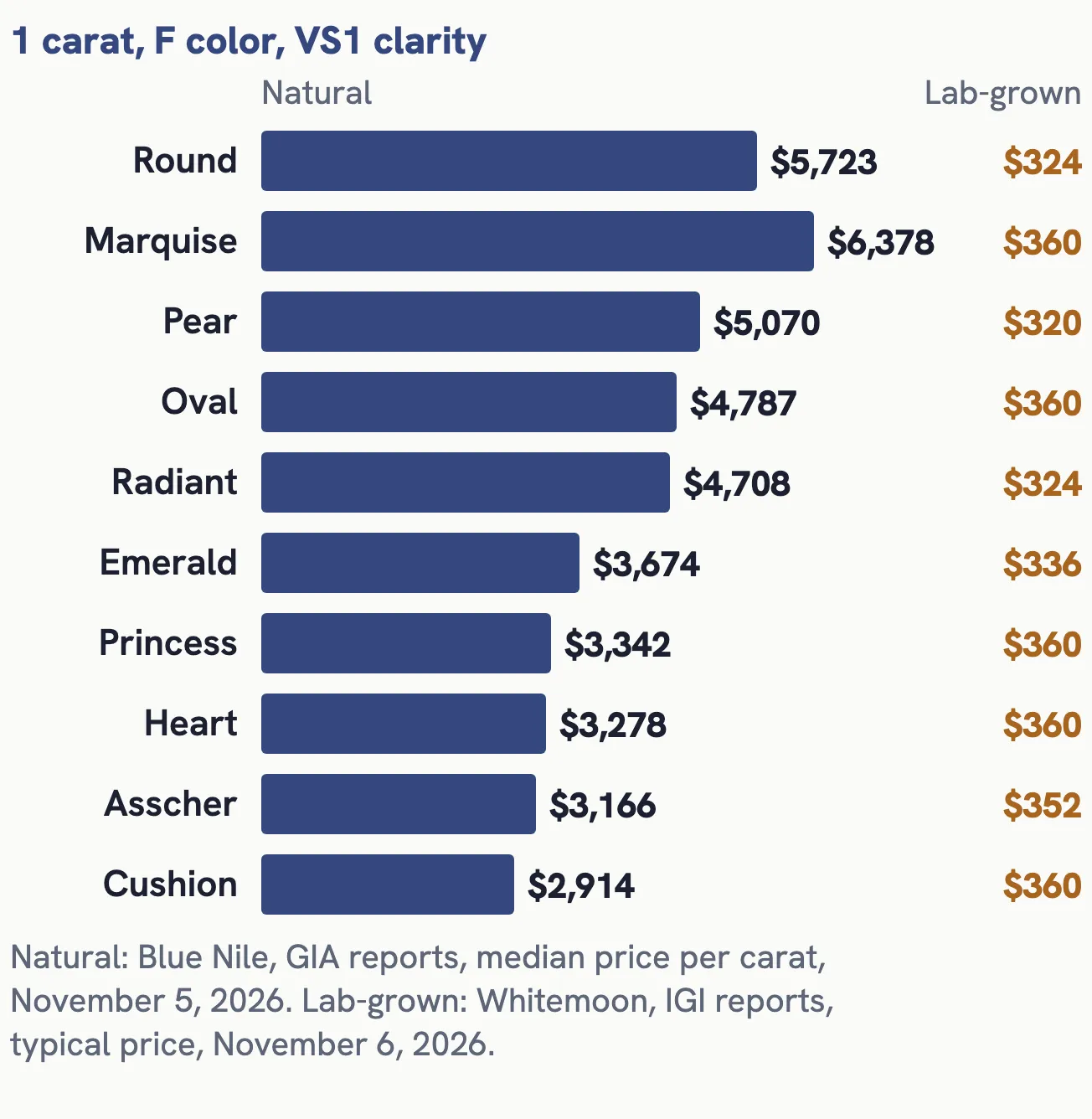
1 carat, F color, VS1 clarity. Natural: Blue Nile, GIA reports, November 5, 2026. Lab-grown: Whitemoon, IGI reports, November 6, 2026.
Length-to-width ratio
For long shapes, the ratio of length to width decides whether a stone looks slim or full. A ratio of 1.00 is perfectly square or round, and higher numbers are longer. Across the lab-grown stones in our ring builder, the typical ratios were:
- Oval: about 1.45, with most between 1.39 and 1.52.
- Emerald: about 1.45, with most between 1.40 and 1.54.
- Radiant: about 1.43, with most between 1.36 and 1.51.
- Pear: about 1.60, with most between 1.54 and 1.67.
- Marquise: about 1.98, with most between 1.90 and 2.07.
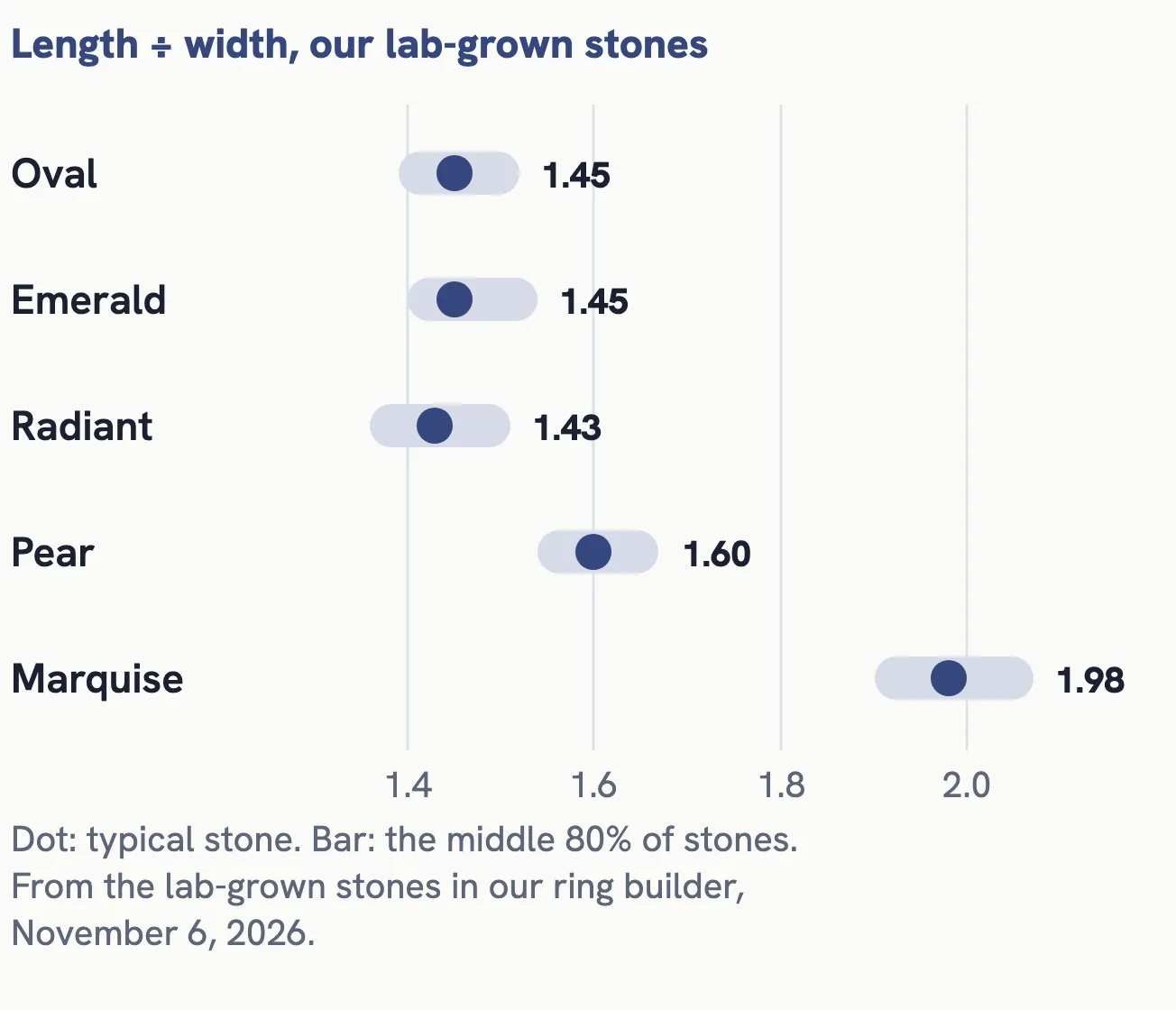
Typical length-to-width ratios of the lab-grown stones in our ring builder.
Cushions come in two families: square ones close to 1.0, and elongated ones around 1.25 to 1.42. Many guides name one “ideal” ratio, but GIA’s own publications give different ranges for ovals, and its research found people preferred longer ovals than most cutters make. No ratio is correct. A slimmer stone looks longer on the finger, and a wider one looks fuller, so pick the outline you like.
How to choose a diamond shape
Start with the look you like, because that’s what you’ll see every day. Then check the practical points:
- Most sparkle: round, then the other brilliant shapes. Step cuts trade sparkle for broad flashes and a clear, glassy look.
- Most size for the weight: marquise, oval and pear spread their weight over a longer outline.
- Hiding small marks: brilliant shapes hide inclusions better. In an emerald or asscher cut, choose a higher clarity grade; our diamond clarity chart shows which grades stay clean to the eye.
- Active hands: shapes without sharp points, such as round, oval and cushion, need the least protection. Points and corners do best under V-prongs or a bezel.
- Budget: with natural diamonds, a fancy shape usually costs less per carat than a round. With lab-grown diamonds, the price barely changes with shape.
If you can, look at the shapes on a hand before you decide. A shape that looks plain in a photo can look very different on the finger.
Diamond shapes at Whitemoon
Our ring builder offers all ten main shapes in lab-grown diamonds, each with an independent grading report, and natural diamonds too. You choose the setting, then the stone, so you can compare shapes in the same ring. See all our engagement rings, or the shape pages linked above.
Most Whitemoon rings are made to order in about 10–15 days and ship free with insurance both ways, with 30-day returns on unworn pieces and one free resize within 60 days of delivery.
Diamond shape questions
What are the different shapes of diamonds called?
The ten main shapes are round, oval, princess, cushion, emerald, asscher, radiant, pear, marquise and heart. Others include the rose cut, old mine, old European, baguette, trilliant, kite and half moon. GIA recognizes more than 40 categories of fancy shape.
What diamond shape is the most timeless?
Round. It has been the most chosen engagement ring shape in every study we found, and its modern form dates back about a century. Emerald and asscher cuts also have a long history, back to the Art Deco years.
What is the classiest diamond shape?
It’s a matter of taste, but emerald and asscher cuts are most often described that way, for their clean lines and Art Deco history. A round solitaire is the other classic choice.
Which diamond shape should I get?
Start with the shape you like most, then check how it fits your life: shapes with points need more protection, step cuts need higher clarity, and elongated shapes look bigger for the money. If you’re torn, try a round or an oval, the two most chosen shapes.
What is the most popular diamond shape in 2026?
The latest full data covers 2025 weddings: round 26% and oval 25%, a near tie. Marquise is the shape gaining fastest, in both trade reports and searches. Data for 2026 weddings arrives in 2027.
What is the least popular diamond shape?
Among the main ten, asscher and heart are chosen least, and princess is falling fastest. Cushion and radiant each had 6% of engagement rings in the latest US data.
What are some unique diamond shapes?
Antique cuts such as old mine, old European and rose cut, and specialty shapes such as kite, half moon, shield, hexagon and trilliant. Elongated cushions and long radiants are a quieter way to stand out.
Do diamond shapes have meanings?
Only in their names and history: oval comes from the Latin for egg, marquise is also called navette, or little ship, and the emerald cut is named after the gem it was first used for. Meanings like “round means eternity” are marketing, not tradition.