Diamond Price Chart: What a Diamond Costs by Carat
Prices last updated November 13, 2026. We recheck them every month. Other stores’ prices come from their listings on November 11.
A round lab-grown diamond at Whitemoon costs about $340 to $450 per carat at almost any size: about $340 for 1 carat, $740 for 2 carats, $1,190 for 3 and $1,920 for 5, in D to G color and VS clarity. A natural diamond of the same grade costs about $5,000 at 1 carat, $25,600 at 2, $60,900 at 3 and $176,800 at 5, because its price per carat climbs steeply with size.
We sell lab-grown diamonds, so this chart is built from stones listed for sale and not from a general price guide: about 250,000 lab-grown diamonds in our ring builder, from under a quarter carat to 30 carats, and about 520,000 natural diamonds with GIA reports listed at Blue Nile, Brilliant Earth and Ritani. The clearest thing the listings show is the price per carat. For a natural round it rises about 28 times between a quarter carat and 5 carats. Our 4 carat diamond price guide shows the gap at one of the larger sizes. For our lab-grown rounds it stays nearly flat.
Illustrative image: round diamonds from small to large.
Diamond price chart by carat
Each row is the median price of round diamonds in one grade band, D to G color and VS2 to VVS2 clarity, scaled to the exact weight shown.
| Carat | Width | Lab-grown at Whitemoon | Per carat | Natural, three stores | Per carat |
|---|---|---|---|---|---|
| 0.25 | 4.2 mm | $113 | $453 | $315 | $1,259 |
| 0.5 | 5.1 mm | $188 | $376 | $901 | $1,802 |
| 0.75 | 5.8 mm | $300 | $400 | $2,135 | $2,846 |
| 1 | 6.5 mm | $340 | $340 | $4,990 | $4,990 |
| 1.5 | 7.4 mm | $504 | $336 | $12,230 | $8,153 |
| 2 | 8.1 mm | $744 | $372 | $25,557 | $12,778 |
| 2.5 | 8.8 mm | $920 | $368 | $38,288 | $15,315 |
| 3 | 9.3 mm | $1,187 | $396 | $60,871 | $20,290 |
| 3.5 | 9.8 mm | $1,443 | $412 | $83,266 | $23,790 |
| 4 | 10.2 mm | $1,598 | $400 | $111,924 | $27,981 |
| 5 | 11.0 mm | $1,916 | $383 | $176,789 | $35,358 |
| 6 | 11.7 mm | $2,208 | $368 | $205,483 | $34,247 |
| 7 | 12.4 mm | $2,800 | $400 | $268,454 | $38,351 |
| 8 | 13.0 mm | $3,264 | $408 | – | – |
| 10 | 14.0 mm | $5,520 | $552 | – | – |
Round, D–G color, VS2–VVS2 clarity. Stones from each weight up to half a carat heavier (up to the next trade weight class under 1 carat), priced per carat and scaled to the exact weight; median. Natural: GIA-graded stones at Blue Nile, Brilliant Earth and Ritani together, November 11, 2026. Whitemoon November 13. The natural figures at 6 and 7 carats rest on 18 and 13 stones. At 8 and 10 carats the three stores listed only 4 and 3 natural rounds in this band, too few for a figure.
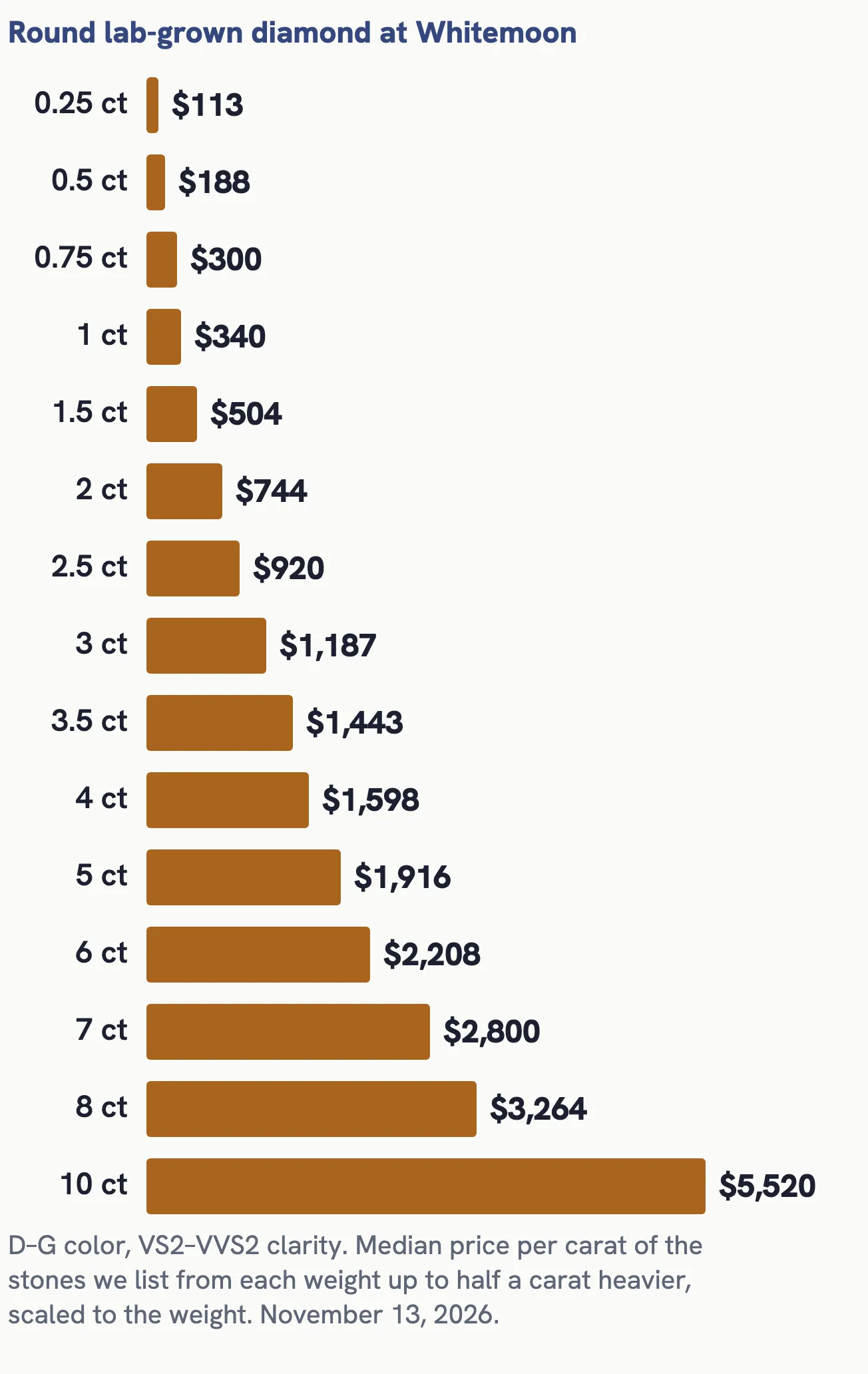
Lab-grown diamond prices by carat at Whitemoon, November 2026.
Across every grade, the 36 natural rounds of 8 carats listed had a median price of about $193,000, and the 22 of 10 carats about $432,000. Widths are the median of well-cut rounds in the listings.
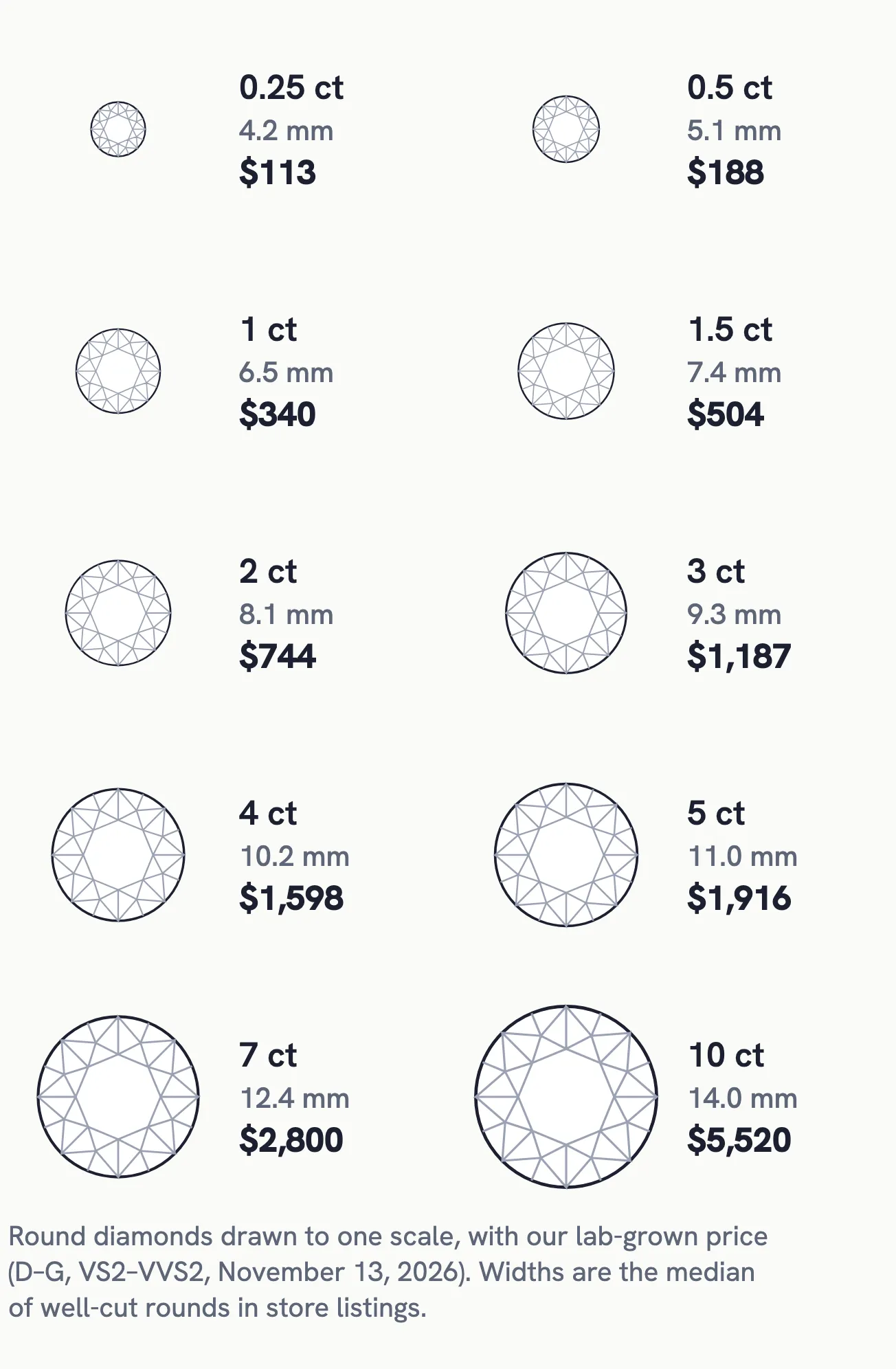
Round diamonds from a quarter carat to 10 carats, to one scale.
Each size has its own guide with prices by shape, color and clarity: 1 carat, 1.5 carats, 2 carats, 3 carats and 5 carats. Those guides follow one exact grade, F color and VS1 clarity, so their figures sit a little below the ones here.
What is a diamond’s price per carat?
It’s the stone’s price divided by its weight, and a carat is 0.2 grams. Turn it around and the total is the per-carat price times the weight. As an example, a 1.50 carat stone at $4,000 per carat costs $6,000.
The trade quotes diamonds this way because the per-carat price isn’t fixed. GIA explains that a larger natural diamond is rarer, so its price rises faster than its weight. In the chart above, a natural 2 carat costs about five times as much as a natural 1 carat, not twice.
Lab-grown diamonds are grown to size in a factory, so a bigger one isn’t scarce in the same way. Our 2 carat lab-grown price is about 2.2 times our 1 carat price, close to the weight itself.
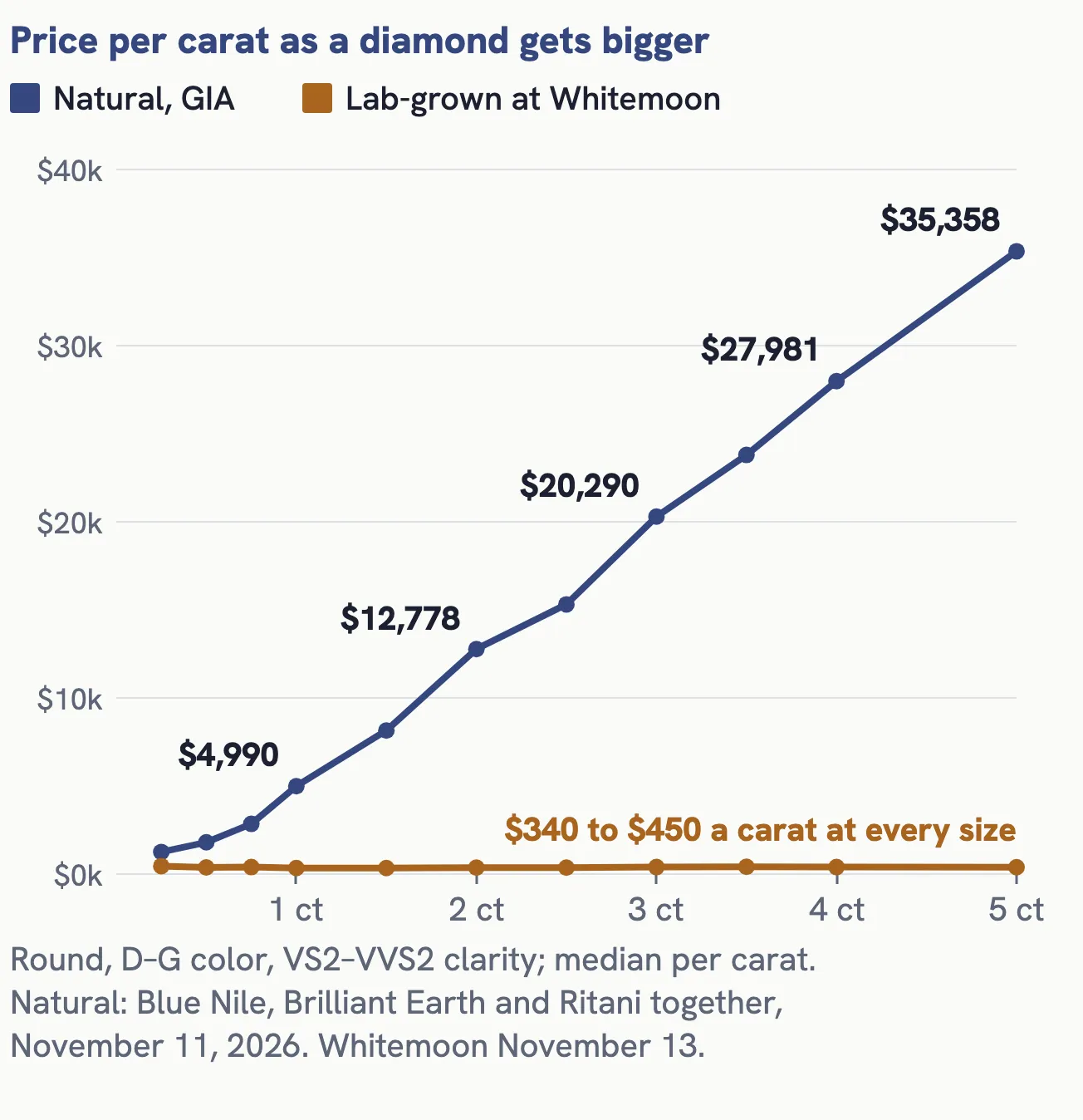
Price per carat: natural climbs with size, lab-grown stays flat.
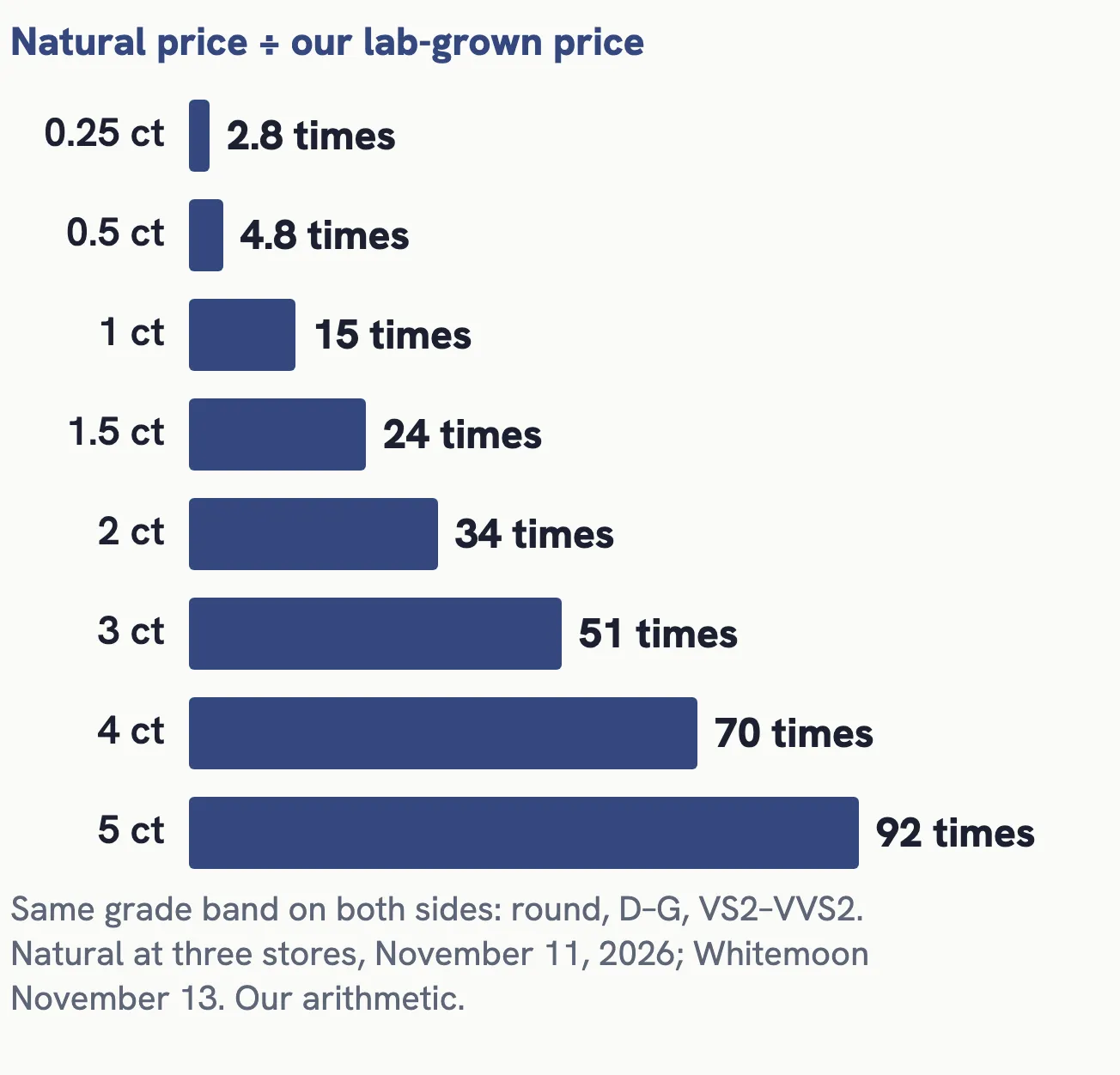
The gap between natural and lab-grown widens with size.
Why the price per carat jumps at whole and half carats
Natural diamonds are priced in weight classes. The trade’s main price list, published by Rapaport, groups rounds into bands such as 0.50–0.69, 0.70–0.89, 0.90–0.99, 1.00–1.49, 1.50–1.99, 2.00–2.99, 3.00–3.99, 4.00–4.99 and 5.00–5.99 carats. A stone that crosses into the next band is priced from a higher line. The listings we compared show it.
| Weight line | Natural, just under | Natural, at the line | Change | Whitemoon lab-grown, just under | At the line |
|---|---|---|---|---|---|
| 0.50 carat | $1,270 | $1,573 | +24% | $400 | $364 |
| 1.00 carat | $2,904 | $3,864 | +33% | $336 | $344 |
| 1.50 carats | $5,397 | $6,251 | +16% | $336 | $336 |
| 2.00 carats | $9,337 | $10,110 | +8% | $364 | $375 |
| 3.00 carats | $13,363 | $16,367 | +22% | $356 | $400 |
Median price per carat of round stones in the tenth of a carat below each line and the tenth starting at it. Natural: F–H color, VS1–VS2, GIA, three stores, November 11, 2026. Whitemoon: D–F, VS1–VVS2, November 13. The natural figure just under 3 carats rests on 9 stones.
The list has no band starting at 2.50 carats, and the listings agree: natural rounds were $12,699 a carat just under 2.50 and $12,599 at it. So a “2.5 carat premium” isn’t built into the trade’s pricing the way the 1, 1.5, 2 and 3 carat lines are. Our 2.5 carat diamond price guide shows what the listings do at that weight.
For a natural diamond, that makes a stone just under a line a real saving, as long as you can find one. Cutters keep stones at the line whenever they can. Our lab-grown prices barely step at any line, so there’s little reason to hunt under one with us.
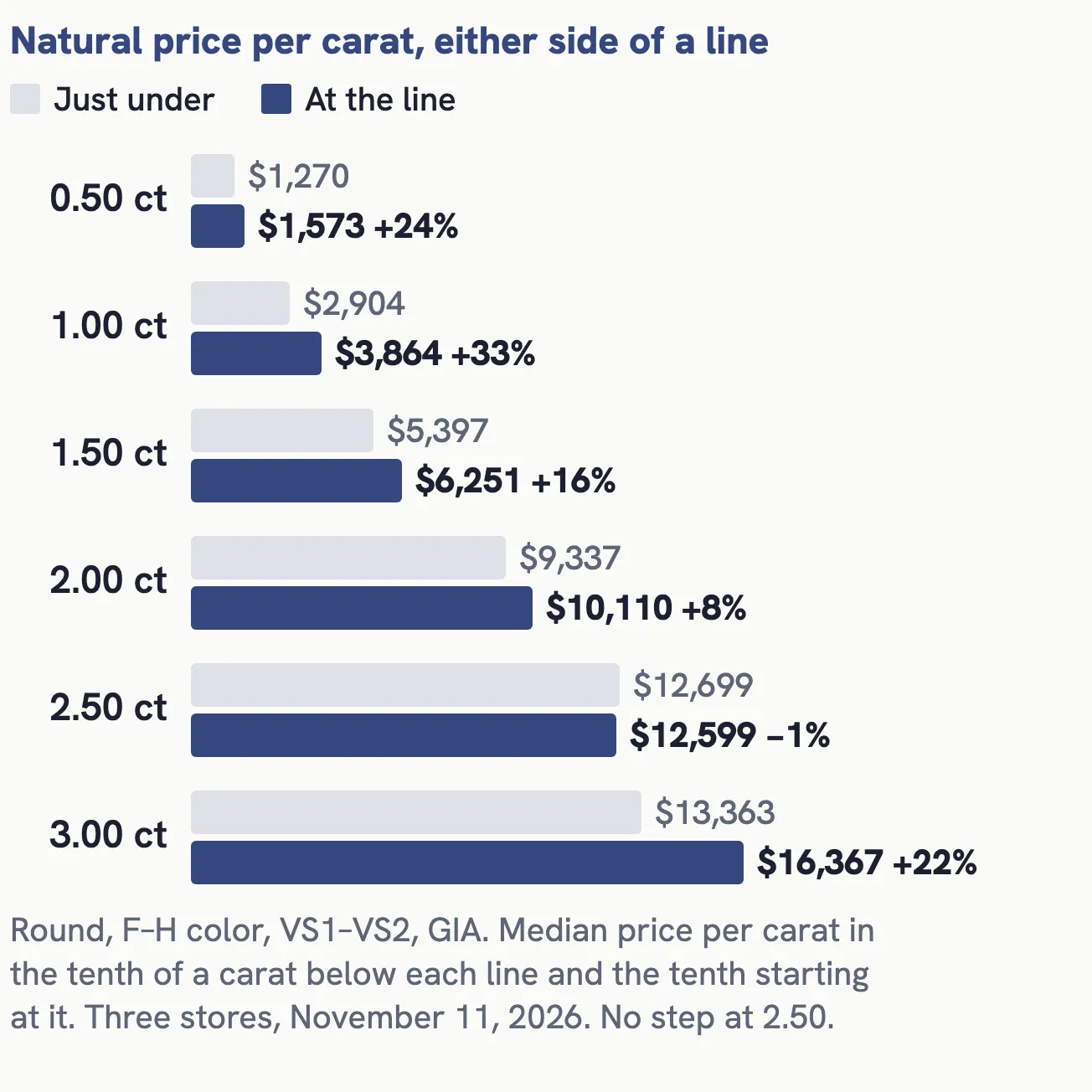
Natural price per carat steps up at the trade’s weight lines.
Lab-grown diamond price chart by store
Lab-grown prices differ more from store to store than from grade to grade. This is one exact grade, a round F color VS1 stone with an IGI report, at the stores we compared that were priced above us.
| Carat | Whitemoon | Grown Brilliance | Brilliant Earth |
|---|---|---|---|
| 1 | $324 | $347 | $553 |
| 2 | $672 | $956 | $1,817 |
| 3 | $1,008 | $1,530 | $3,884 |
| 5 | $1,836 | $2,550 | $5,613 |
Median price per carat of each store’s stones from that weight up to half a carat heavier, scaled to the exact weight. Other stores November 11, 2026; Whitemoon November 13. Blue Nile listed few IGI stones at this grade: its 1 carat figure was $656 and its 5 carat figure $5,403.
Prices have fallen fast. Analyst Edahn Golan puts the wholesale price of a 1 carat lab-grown diamond at about $1,800 per carat in mid-2018 and about $80 in mid-2026. That’s a trade price between businesses, not a store price, and it explains why lab-grown charts from even two years ago read high. Our guide to whether lab-grown diamonds are worth it covers what the fall means for buyers.
Natural diamond prices over 10, 20 and 50 years
There’s no public record of retail diamond prices going back decades. What exists are trade indexes of asking prices between dealers, and they tell a consistent story.
- The last four years. Rapaport’s index for 1 carat natural diamonds fell 10.7% in 2022, about 21% in 2023, 23.1% in 2024 and 9.9% in 2025. By our arithmetic that’s about half over four years. Its 3 carat index held up far better, rising 0.3% in 2025.
- Twenty years. The IDEX polished diamond index started at 100 in July 2004 and stood at 96.6 in November 2024, below where it began, before counting inflation.
- Fifty years. A 2019 Bain report said polished diamond prices had risen about 250% over the previous 50 years and rough prices about 450%. It doesn’t say whether those figures are adjusted for inflation.
In September 2026 De Beers, which mines natural diamonds, said natural prices were 20% to 30% below their pandemic highs and stabilizing. So a chart that shows diamond prices only rising is leaving out the last few years.
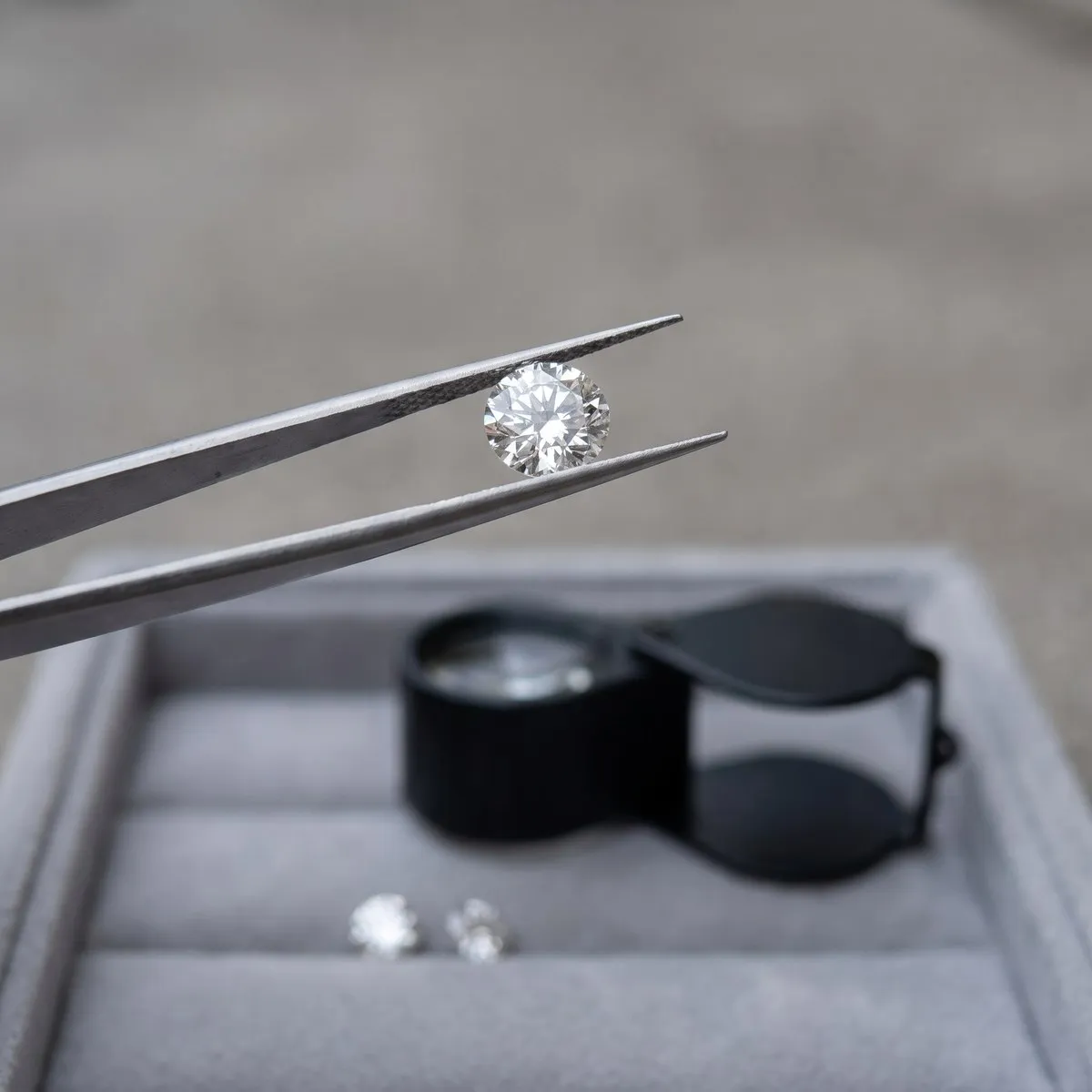
Illustrative image.
Is there a GIA or Rapaport diamond price chart?
GIA doesn’t publish one. It grades diamonds, and its own FAQ says it doesn’t appraise them or put a value on its reports. Pages titled “GIA price chart” are stores’ own prices arranged by GIA grades.
The Rapaport Price List is real, though it isn’t public. Martin Rapaport first published it in 1978, and it’s now updated weekly for subscribers in the trade. It gives prices in hundreds of dollars per carat by weight band, color and clarity, for rounds and pears only. Rapaport describes the figures as high cash asking prices, a starting point for negotiation, and dealers trade at discounts or premiums to them. So even a genuine copy doesn’t show what stones sell for.
The list covers natural diamonds only. In April 2026 Rapaport made it formal policy that its pricing serves natural stones, so there’s no Rapaport lab-grown price list. For lab-grown diamonds, the listed prices of the stores themselves are the best chart there is.
What changes a diamond’s price besides carat?
Color, clarity, shape, cut and the grading report all move the price. On a natural diamond each one moves it by hundreds or thousands of dollars. On our lab-grown stones the same steps move it by tens. Here’s a 1 carat stone.
| 1 carat diamond | Natural, GIA | Lab-grown at Whitemoon, IGI |
|---|---|---|
| Color D, VS1, round | $5,623 | $336 |
| Color G, VS1, round | $4,514 | $300 |
| Color J, VS1, round | $2,564 | – |
| Clarity VVS1, F, round | $6,463 | $340 |
| Clarity VS2, F, round | $4,471 | $316 |
| Clarity SI2, F, round | $2,556 | – |
| Oval, F VS1 | $4,550 | $360 |
| Emerald cut, F VS1 | $3,620 | $336 |
| Princess cut, F VS1 | $3,342 | $360 |
| Cushion cut, F VS1 | $2,832 | $360 |
Stones of 1.00–1.49 carats priced per carat and scaled to exactly 1 carat; median. Natural: three stores together, November 11, 2026. Whitemoon November 13. We list almost no lab-grown stones in J color or SI2 clarity. For comparison, a round F VS1 was $5,271 natural and $324 at Whitemoon.
- Color and clarity. Dropping from D to J saves about $3,000 on a natural 1 carat, and from VVS1 to SI2 about $3,900. Our diamond color chart and clarity chart show what each grade looks like.
- Shape. GIA says rounds usually cost the most, because they’re the most popular and more of the crystal is lost in cutting, while princess, radiant and cushion cuts cost less per carat. In the natural listings a cushion was about 46% below a round. Our lab-grown shapes sat within $40 of each other. See the diamond shapes guide.
- Cut. For our 1 carat lab-grown rounds, an Ideal cut was $328 and an Excellent cut $322. Nearly every round we list has one of those two grades.
- Report. The few lab-grown stones we list with a GIA report cost more than the same grade with an IGI report: $444 against $344 at E VVS2. Our IGI vs GIA comparison explains the difference.
How big a diamond does a budget buy?
Because a natural diamond’s price per carat rises with size, doubling the budget buys much less than double the weight. With lab-grown it buys close to double.
| Budget for the stone | Natural round, F VS1 | Lab-grown round at Whitemoon, F VS1 |
|---|---|---|
| $1,000 | About 0.5 carat | Just under 3 carats |
| $2,500 | About 0.8 carat | About 6 to 7 carats |
| $5,000 | Just under 1 carat | About 9 carats |
| $10,000 | About 1.3 carats | Over 10 carats |
| $20,000 | About 1.8 carats | – |
The largest weight whose median listed price fits the budget. Natural: GIA, three stores, November 11, 2026. Whitemoon November 13, where a 10 carat F VS1 round was about $5,250.
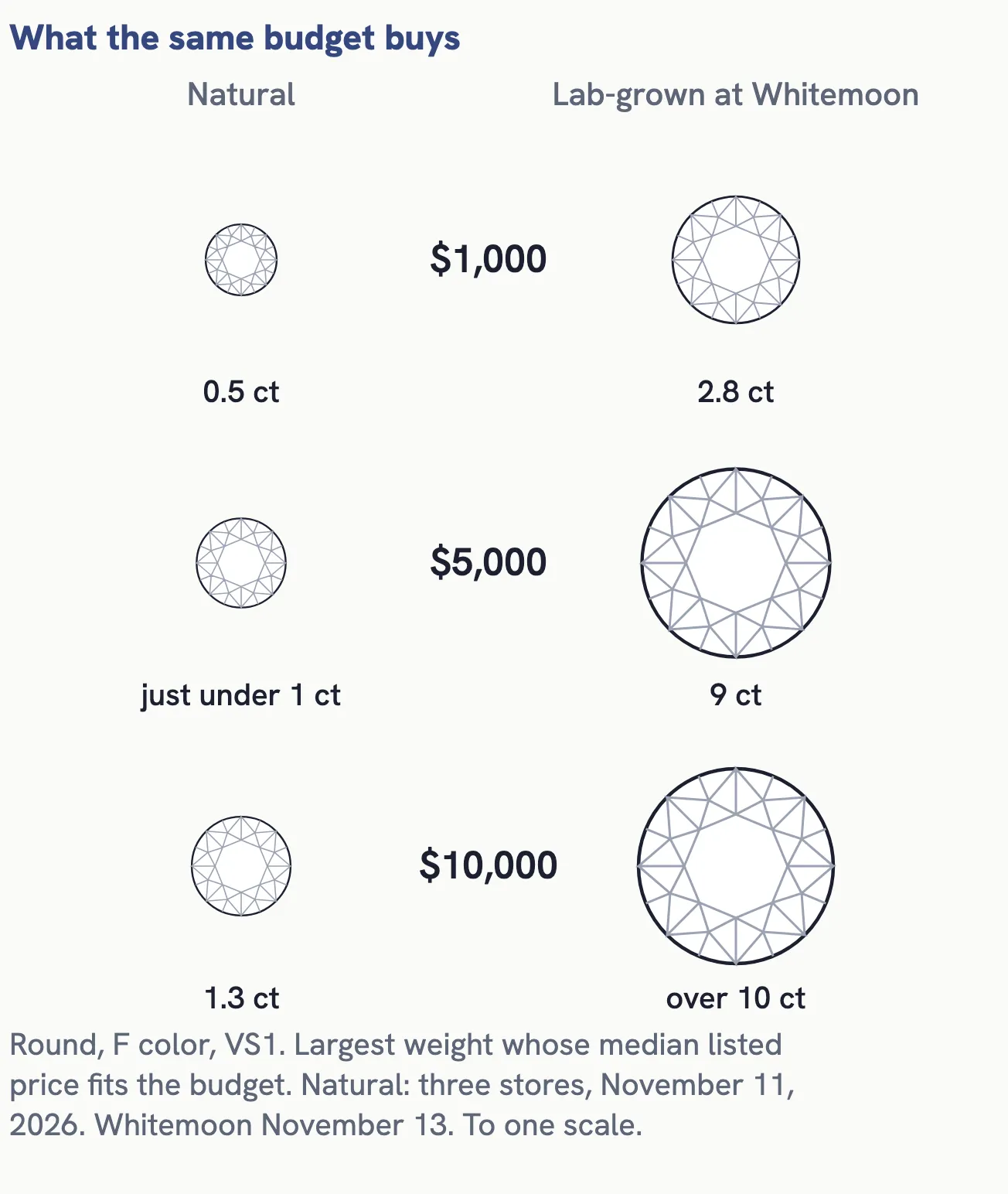
What the same stone budget buys, to scale.
A budget is usually for the whole ring, so leave room for the setting. Our gold settings start at $349, and our engagement ring cost guide breaks down what couples spend.
From loose diamond to finished ring
These are Whitemoon rings with a lab-grown diamond center already set, on November 13, 2026. The typical price is the median across the gold rings at that size.
| Center stone | Gold rings from | Typical gold ring | Platinum rings from |
|---|---|---|---|
| 1 carat | $686 | $836 | $1,116 |
| 1.5 carats | $835 | $1,055 | $1,265 |
| 2 carats | $1,037 | $1,267 | $1,467 |
| 3 carats | $1,523 | $1,833 | $1,953 |
| 4 carats | $1,901 | $2,211 | $2,331 |
| 5 carats | $2,684 | $2,994 | $3,114 |
Browse them by size: 1 carat, 2 carat, 3 carat, 4 carat and 5 carat rings. To choose the stone yourself, pick a setting in the ring builder and each lab-grown diamond shows its report details. Most Whitemoon rings are made to order in about 10–15 days and ship free with insurance both ways, with 30-day returns on unworn pieces and one free resize within 60 days of delivery.
What does an uncut diamond cost per carat?
An uncut diamond is called rough. Kimberley Process figures for 2025 put world rough output at 98.8 million carats worth $9.23 billion, which works out to about $93 a carat. The average hides a huge range. Rough from DR Congo averaged about $5 a carat, while rough from Lesotho averaged about $331.
That average mixes tiny and industrial-grade stones with gem crystals, so it says nothing about the rough behind a 1 carat gem. Cutting also removes a lot: a Bain industry report says most diamonds lose 50–60% of their weight on the way to a polished stone. Nobody in the trade prices diamonds per gram. A gram is 5 carats, and a gram of small stones is worth far less than one 5 carat stone.
What a diamond is worth when you sell it
A price chart shows what stores ask, not what a buyer will pay you. There’s no official resale price for any diamond, so expect well under retail.
Lab-grown diamonds don’t hold their retail price, so buy one to wear and not as an investment. Worthy, an online resale service, says it doesn’t accept lab-grown stones. That makes the price you pay up front matter more: at $672 at Whitemoon and $1,817 at Brilliant Earth for the same 2 carat grade, there’s less at stake from day one. Our Lifetime Upgrade gives you 100% of what you paid as credit toward a new lab-grown piece worth at least 1.5 times as much.
Diamond price questions
How much is a carat of diamonds?
For a round stone in D to G color and VS clarity, 1 carat cost about $340 lab-grown at Whitemoon on November 13, 2026, and about $5,000 natural at three stores on November 11.
What is the price per carat of a lab-grown diamond?
At Whitemoon it ran from about $340 to $450 a carat for rounds between a quarter carat and 8 carats, and about $550 a carat at 10 carats.
How much is a diamond?
It depends on size and origin more than anything else. Our typical lab-grown rounds ran from $113 for a quarter carat to $5,520 for 10 carats. Natural rounds of the same grade ran from $315 for a quarter carat to about $268,000 for 7 carats.
How big a diamond will $10,000 buy?
A natural round of about 1.3 carats at F VS1, going by listed prices on November 11, 2026. In lab-grown at Whitemoon it would cover a 10 carat round of the same grade with money left over.
How many carats is a $5,000 diamond?
Just under 1 carat for a natural round at F VS1, or about 1.2 carats if you accept a lower color and clarity. In lab-grown at Whitemoon, $5,000 buys about 9 carats.
How big is a $20,000 diamond?
About 1.8 carats for a natural round at F VS1, which is about 7.9 mm across.
Are diamonds worth more now than 10 years ago?
Natural diamonds, no. The trade’s 1 carat index roughly halved between 2022 and 2025 after rising in 2021. Lab-grown prices have fallen much further over the same period.
What is the trend in diamond prices?
Down since early 2022 for natural diamonds, with larger stones holding up better than 1 carat stones, and down far more for lab-grown. De Beers said in September 2026 that natural prices were stabilizing.
What is the Rapaport Diamond Report?
It’s the trade’s weekly list of asking prices for natural diamonds, published since 1978 and sold by subscription. It’s a benchmark for dealers to negotiate from, not a list of selling prices.
What is the most affordable diamond shape?
In the natural listings we compared, cushion, asscher and heart shapes cost the least per carat at 1 carat, roughly 40% to 46% below a round. At Whitemoon the lab-grown shapes were within $40 of each other.
What is an uncut diamond called?
A rough diamond. World rough averaged about $93 a carat in 2025, though that figure mixes industrial-grade stones with gems.
Are the diamonds at Costco real?
Yes. Costco’s buying guide says it sells only natural, untreated diamonds of at least I color and VS2 clarity, with a GIA report on center stones of 1 carat and up.
How much would a jeweler pay for a 1 carat diamond?
Much less than its retail price, and there’s no fixed share. Get more than one offer before selling a natural stone, and note that some buyers don’t take lab-grown diamonds at all.