
Diamond Color Chart: Colorless vs Near-Colorless Grades and Which to Buy
A diamond color chart grades white diamonds from D, which is colorless, to Z, which has a light yellow or brown tint. GIA groups the 23 grades into five bands: colorless (D–F), near colorless (G–J), faint (K–M), very light (N–R) and light (S–Z). Most people can’t see color in a G or H once it’s set, and GIA suggests G or H or better for white gold or platinum.
We sell lab-grown diamonds, so we priced every grade from stones listed for sale on November 8 and 11, 2026, and counted how many of each grade are listed. Two things stand out. Color moves the price of a natural diamond by thousands of dollars but a lab-grown one by tens, and almost all lab-grown diamonds are graded D to F, while natural ones spread across the scale.
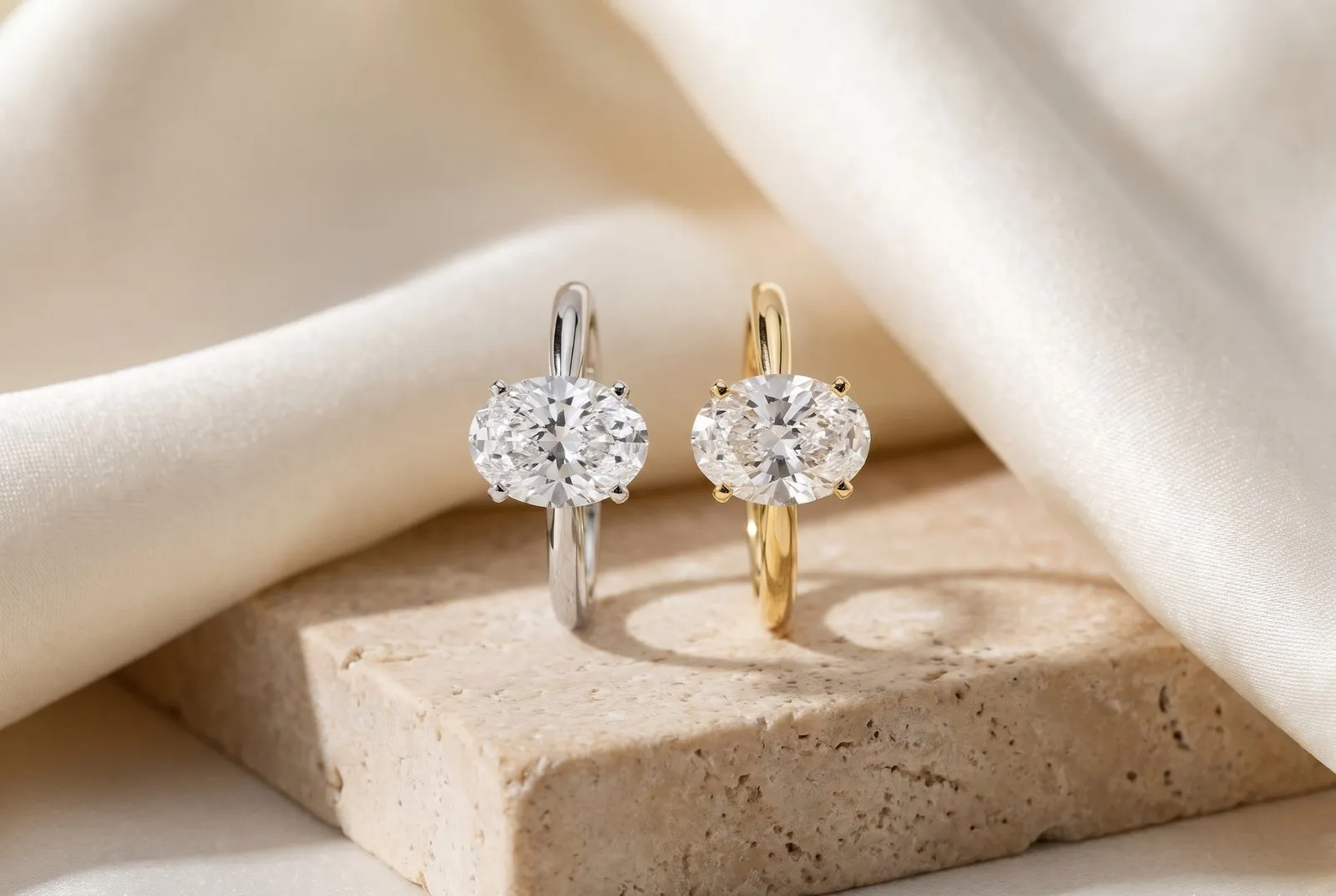
Pictured: the same oval solitaire setting in white gold and yellow gold with lab-grown diamond centers. Image created from the design.
The diamond color chart, D to Z
Each letter is a narrow range of color, not a single point, and two stones with the same grade aren’t identical. GIA’s own descriptions, in plain terms:
| Grades | Group | What GIA says |
|---|---|---|
| D, E, F | Colorless | The rarest and most chemically pure |
| G, H, I, J | Near colorless | Color often unseen except by trained graders |
| K, L, M | Faint | Still hard for an untrained eye to see |
| N to R | Very light | Color visible in larger stones |
| S to Z | Light | Color visible in many sizes |
Group names and descriptions from GIA’s guide to diamond color from D to Z, paraphrased.
The American Gem Society used a number scale instead, from 0 for colorless to 10, in half steps: D is 0, G is 1.5 and J is 3.0. AGS closed its grading lab at the end of 2022, but you’ll still see those numbers on older reports.
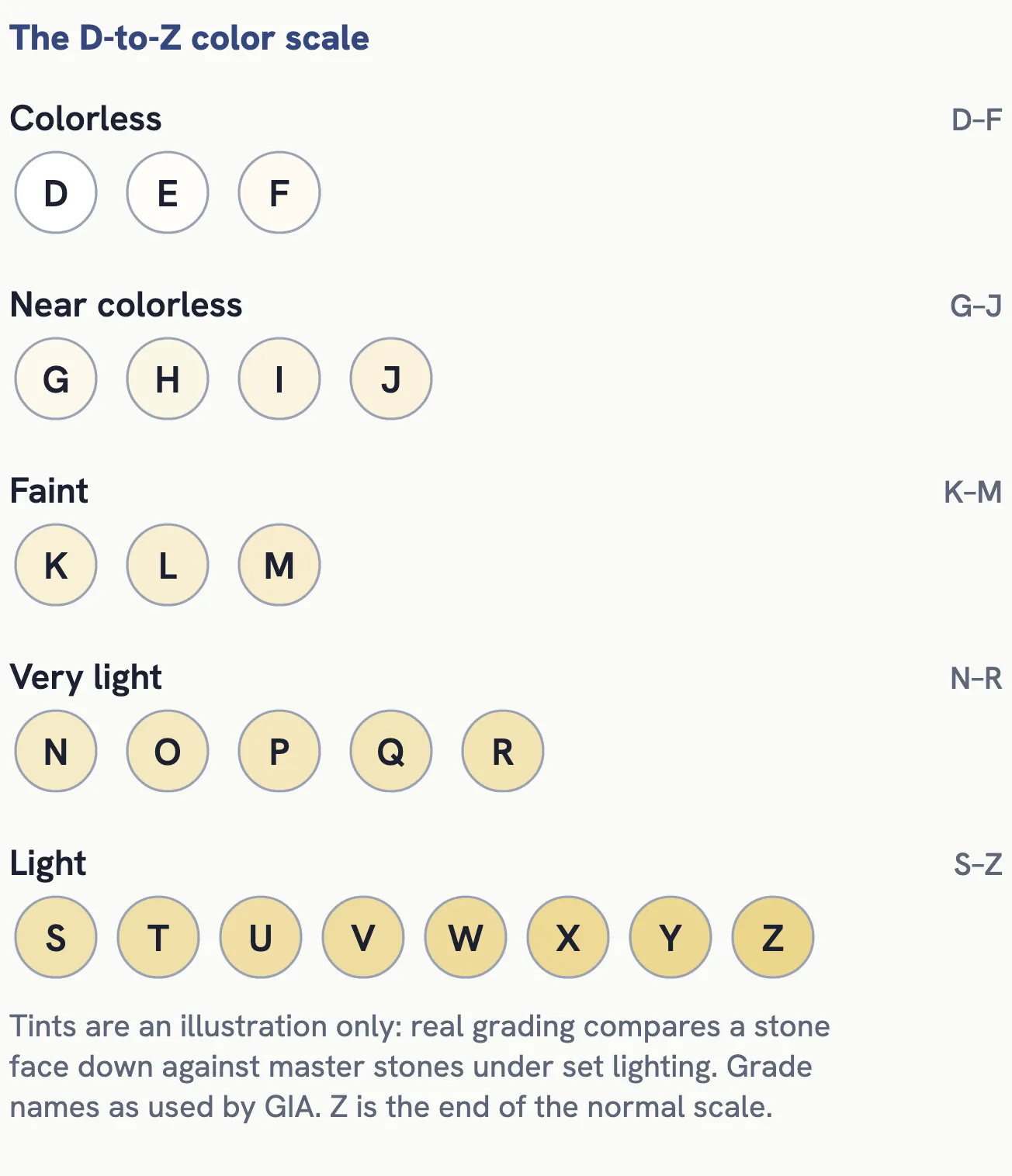
The color scale and its five groups. Tints are an illustration only.
How diamond color is graded
Grading color is careful, slow work. GIA’s published method, described in Gems & Gemology, goes like this:
- The diamond is graded loose, never in a setting, because the metal around it changes how its color looks.
- It sits table-down on a white tray, so the grader looks through the back of the stone instead of at the sparkle on top.
- It’s compared with masterstones, round diamonds of known color, under daylight-type lamps in a neutral box.
- At least two or three graders judge each stone independently, and they have to agree.
Each masterstone marks the least-colored edge of its grade, so a stone that matches the G master, or has a little more color but less than the H master, is a G. There’s no D master: anything with less color than the E master is a D. Even skilled graders repeat their own results to within about a fifth of a grade, which shows how fine the steps are.
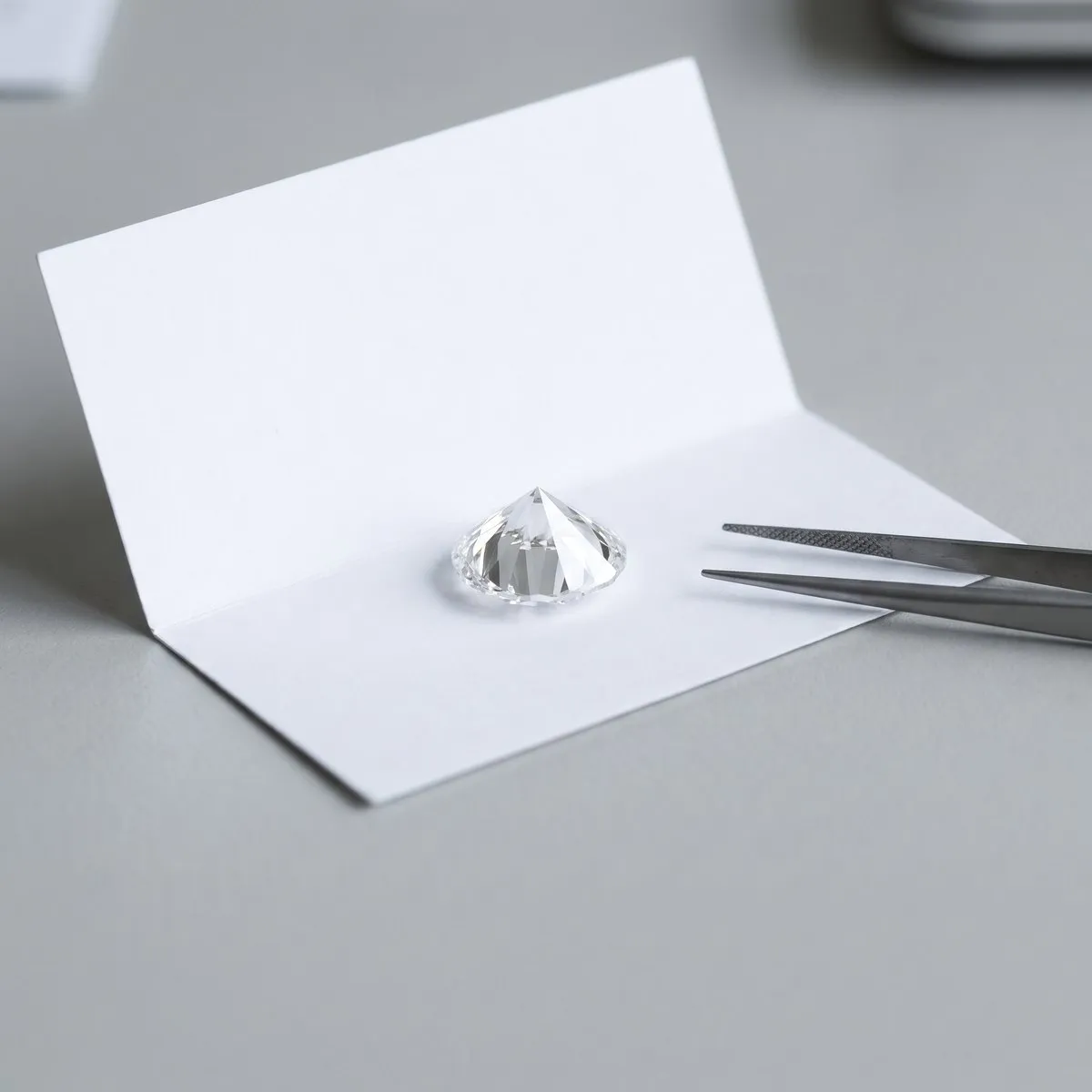
Diamonds are color graded table-down against white. Illustrative image.
Where the letters came from
GIA introduced the D-to-Z scale in 1953. It started at D to break cleanly with older systems that used grades like A and AA, or names such as River, Wesselton, Cape and Jager, which meant different things to different dealers. “Blue white” was misused so often that the FTC still restricts it: the term is unfair under its Jewelry Guides if the stone shows any color other than blue in daylight. It isn’t a grade.
Colorless vs near colorless: can you see the difference?
Usually not, once the diamond is set. GIA’s graders found that untrained observers commonly see no difference between E, F and G masterstones, or between I and J, even loose and side by side under lab lighting. GIA says that set and worn, the difference between a D and a G is unlikely to be easy to see, and that color starts to become noticeable at about J, K or L against very white metal such as platinum.
What you pay for in a colorless grade is rarity, not something you’ll notice on the hand. That doesn’t make D pointless: some people like knowing their stone is at the top of the scale. It means color is a place where you can choose freely.
Diamond color chart with prices
For a natural diamond, each step down the scale saves real money. For a lab-grown one, it barely changes the price.
| Color | Natural, GIA, VS1 | Lab-grown at Whitemoon, IGI, VS1 |
|---|---|---|
| D | $5,608 | $336 |
| E | $5,417 | $332 |
| F | $5,245 | $324 |
| G | $4,520 | $300 |
| H | $3,808 | $312 |
| I | $3,252 | – |
| J | $2,564 | – |
1 carat round. Natural: median of GIA-graded stones at Blue Nile, Brilliant Earth and Ritani together, November 8, 2026. Lab-grown: Whitemoon, November 11. Stones of 1.00–1.49 carats priced per carat and scaled to 1 carat. We had too few I and J stones to price.
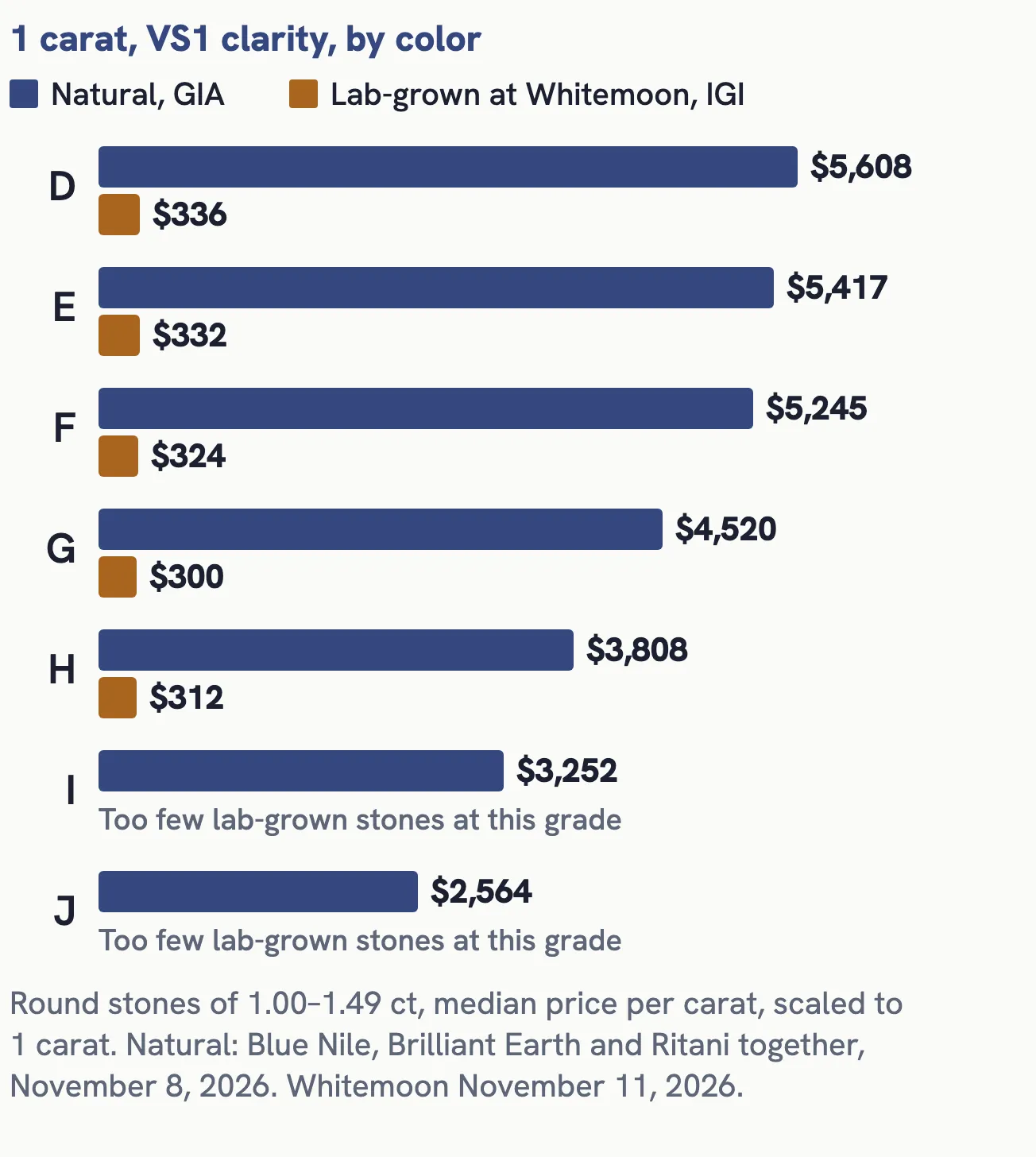
1 carat by color: natural against lab-grown at Whitemoon.
A natural J costs less than half of a natural D of the same size and clarity. At 2 carats the spread is wider still: about $29,650 for a natural D VS1 against $12,739 for a J. Our lab-grown 2 carat VS1 rounds ran from $760 in D to about $590 in G and H, so even at that size the whole colorless-to-near-colorless range is a few hundred dollars. Our 1 carat and 2 carat price guides break this down by shape and clarity too.
Is G color a good diamond?
Yes, by GIA’s own guidance. G is the top of the near-colorless group, and GIA says most people can’t tell a G has any color unless it sits next to a much higher grade. It describes G and H as a good balance of a colorless look and value, and both are within its suggestion of G–H or better for white metal.
G vs H color
GIA doesn’t compare the two directly, and adjacent grades are hard to tell apart even for trained eyes. Choose G over H where color shows more: emerald and asscher cuts, the points of pears, marquises and hearts, and large stones. For a round of a carat or two in a white metal, either is a safe choice by GIA’s guidance.
E vs G color
The difference is rarity and price, not something you’ll see. For a natural 1 carat VS1, E cost about $900 more than G in the listings we compared. For our lab-grown stones it was $32.
How shape, size and metal change what you see
The grade is set face-down on a loose stone, but you see the diamond face-up in a ring. Three things change how much color shows:
- Shape. Rounds hide color best. GIA notes that step cuts such as emerald and asscher show body color more, and that the tips of pears, marquises and hearts can look darker. It suggests going up a grade for those shapes, and higher still for emerald and asscher cuts of 2 to 3 carats and up.
- Size. Larger stones show more color. GIA’s example: a small J or K can look nearly colorless, while a 3 carat J or K shows clear color.
- Metal. White gold and platinum make warmth easier to see. Yellow and rose gold hide it, so GIA says G or lower works well there, though a D to F diamond in yellow gold will pick up some warmth from the metal.
Our guide to diamond shapes covers how each one looks, and the gold karat guide compares the metals.
Lab-grown diamond color
Lab-grown diamonds use the same D-to-Z letters on IGI reports, but they bunch at the top of the scale. Of the round lab-grown diamonds of 1.00–1.49 carats we list, 68% are D, 21% E and 9% F, and fewer than 3% are G or below. Natural diamonds of the same size listed at three large stores spread much more evenly, with G, H and I each at 14–16%.
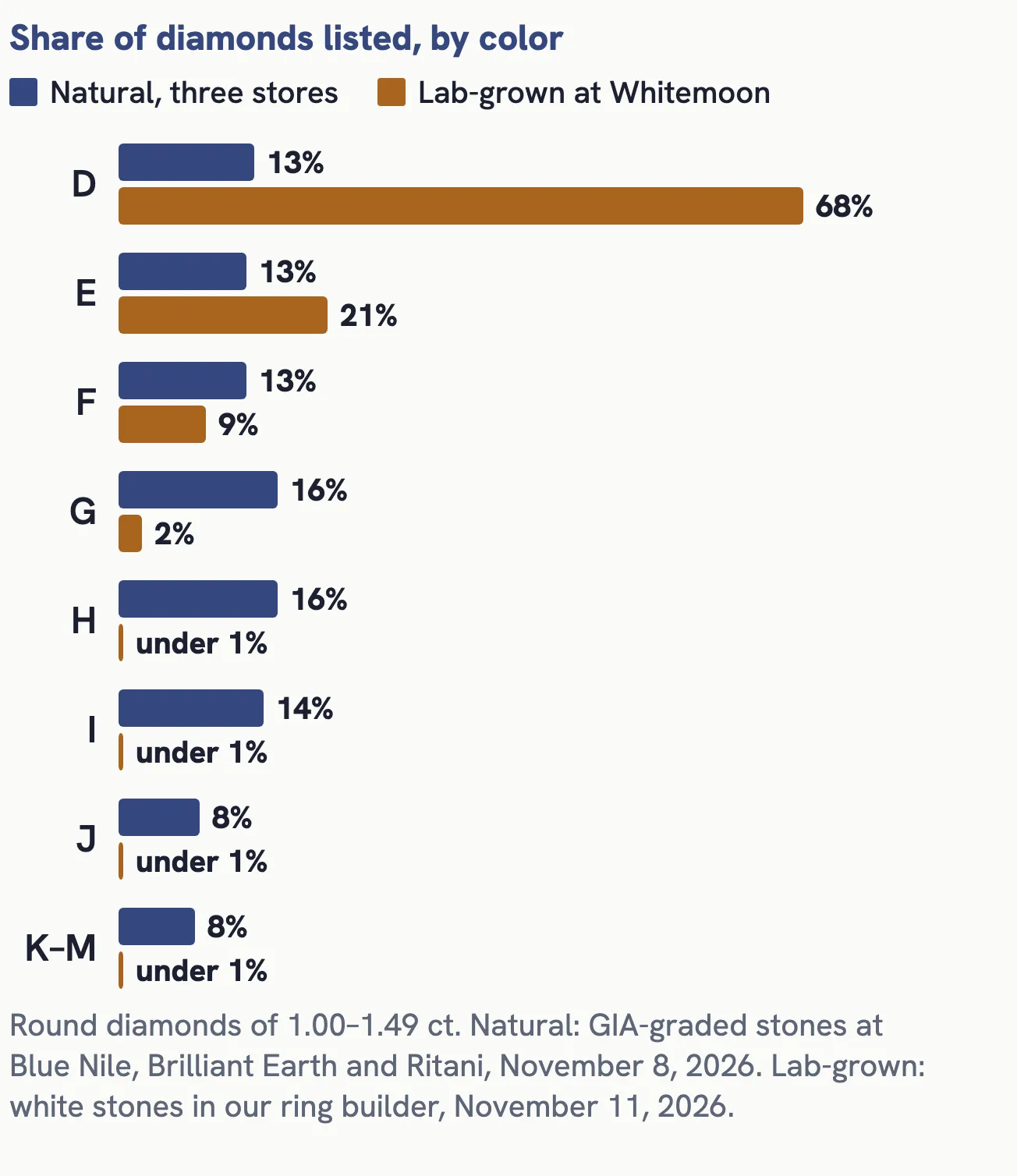
Lab-grown diamonds bunch at the top of the scale.
GIA sees the same pattern: since 2022, 95% of lab-grown stones it graded were D to F. That’s not “always D”, though. E is the most common grade GIA sees for lab-grown stones, and lab-grown diamonds in J color exist.
- Many reach high colors through treatment. GIA reported in 2024 that about 80% of CVD-grown stones it had seen were HPHT-treated after growth to improve their color. IGI reports say either “As Grown” or that there are indications of post-growth treatment, so read that line.
- GIA no longer gives lab-grown stones a color grade. Since October 1, 2025, its lab-grown reports say only “Premium” or “Standard”, so an E and a J can both read “Standard”. IGI still gives a full D-to-Z grade. Our comparison of IGI vs GIA explains what that means for you.
Does fluorescence affect diamond color?
Sometimes, and not always for the worse. GIA’s 1997 study found that average observers saw no consistent effect from blue fluorescence, and strong blue was often seen as slightly better color face-up. GIA notes that strong fluorescence can lower the value of a natural D to F stone but can help one of I color and below. Color is graded before fluorescence is checked, so the graders don’t know it when they assign the letter.
Beyond Z: fancy colored diamonds
A yellow or brown diamond with more color than the Z master becomes a fancy color, graded face-up on a separate scale where stronger color is worth more. Pink, blue and green diamonds leave the D-to-Z scale much sooner. Our blue diamond price guide shows how those grades are priced. Our guide to colored diamonds covers every fancy color.
How to judge color when you buy
You can borrow a few of the graders’ habits, even shopping online:
- Start with the report. Check the letter on an IGI report, or Premium or Standard on a new GIA lab-grown report. Our guide on how to read a diamond certificate shows where to find it.
- Look against white. Graders use a white tray because a white background shows pale color best. They also look through the back of the stone to avoid the sparkle, so a side view in a video tells you more about color than a face-up photo.
- Check the light. Warm indoor light makes any diamond look warmer, and strongly fluorescent stones can look different in daylight and under lamps.
- Picture it in your metal. A stone that looks icy on a white background may look warmer in yellow gold, and the reverse.
- Look at the points. On pears, marquises and hearts, color gathers at the tips, so judge those rather than the middle.
Which diamond color should you buy?
In our opinion, for a natural diamond, G or H in white metal and H to J in yellow or rose gold gives the best value, moving up a grade for step cuts, pointed shapes and stones over 2 carats. For a lab-grown diamond, the price gap is small enough to choose the color you like, and D to F costs so little more that there’s little reason to go lower. Our diamond clarity chart covers the other grade on the report, and you can filter by color in the Whitemoon ring builder.
Most Whitemoon rings are made to order in about 10–15 days and ship free with insurance both ways, with 30-day returns on unworn pieces and one free resize within 60 days of delivery.
Diamond color questions
What is the best to worst diamond color?
D is the least color, then E, F, G and so on down to Z, which has a light yellow or brown tint. “Best” here means rarest and most colorless, not most beautiful.
What is a G color diamond?
The highest near-colorless grade. Most people can’t see color in a G once it’s set unless they compare it with a much higher grade.
Is G color a good diamond?
Yes. GIA describes G and H as a good balance of colorless look and value, and suggests G–H or better for white gold and platinum.
Which color diamond is better, H or G?
G has slightly less color, but the two are hard to tell apart. Pick G for emerald and asscher cuts, pointed shapes and large stones; either works for most rounds.
Which diamond is better, E or G?
E is rarer and costs more, but untrained observers commonly can’t tell E, F and G apart even side by side.
Is G VS1 a good diamond?
Yes. G is near colorless and VS1 is very slightly included, a combination that looks clean and colorless to most people. A lab-grown 1 carat round G VS1 cost about $300 at Whitemoon on November 11, 2026.
Which diamond color costs the least?
On the D-to-Z scale, the more color, the lower the price, so a natural J costs far less than a D. For lab-grown diamonds the spread is small.
Does diamond color matter in yellow gold?
Less. Yellow gold hides warmth, so G or lower works well, but a colorless D to F stone will look a little warmer in yellow gold.
Are lab-grown diamonds always D color?
No. Most are D to F, but E is the most common grade GIA sees, and lower colors exist. Many reach high colors through treatment after growth.