
10K vs 14K vs 18K Gold: Which Karat Is Best?
For most jewelry, 14K gold is the best balance: it’s hard enough for daily wear, holds its color, tarnishes less than 10K and costs less than 18K. Choose 18K if you want a deeper yellow, more gold in the piece and the best resistance to tarnish, especially if your skin reacts to cheaper metals. Choose 10K if price matters most and you don’t mind a paler color and more polishing. All three are real gold and all three are hard enough for rings. It’s 22K and 24K that are too soft for diamond settings.
We make our gold jewelry in 10K, 14K and 18K, so we have no reason to push one over another, and we’ll show you what each karat adds on our own product pages. We also went back to the metallurgy tables written for the World Gold Council, the FTC’s rules and the gold price on November 6, 2026, because several things most guides repeat about karats turn out to be wrong.
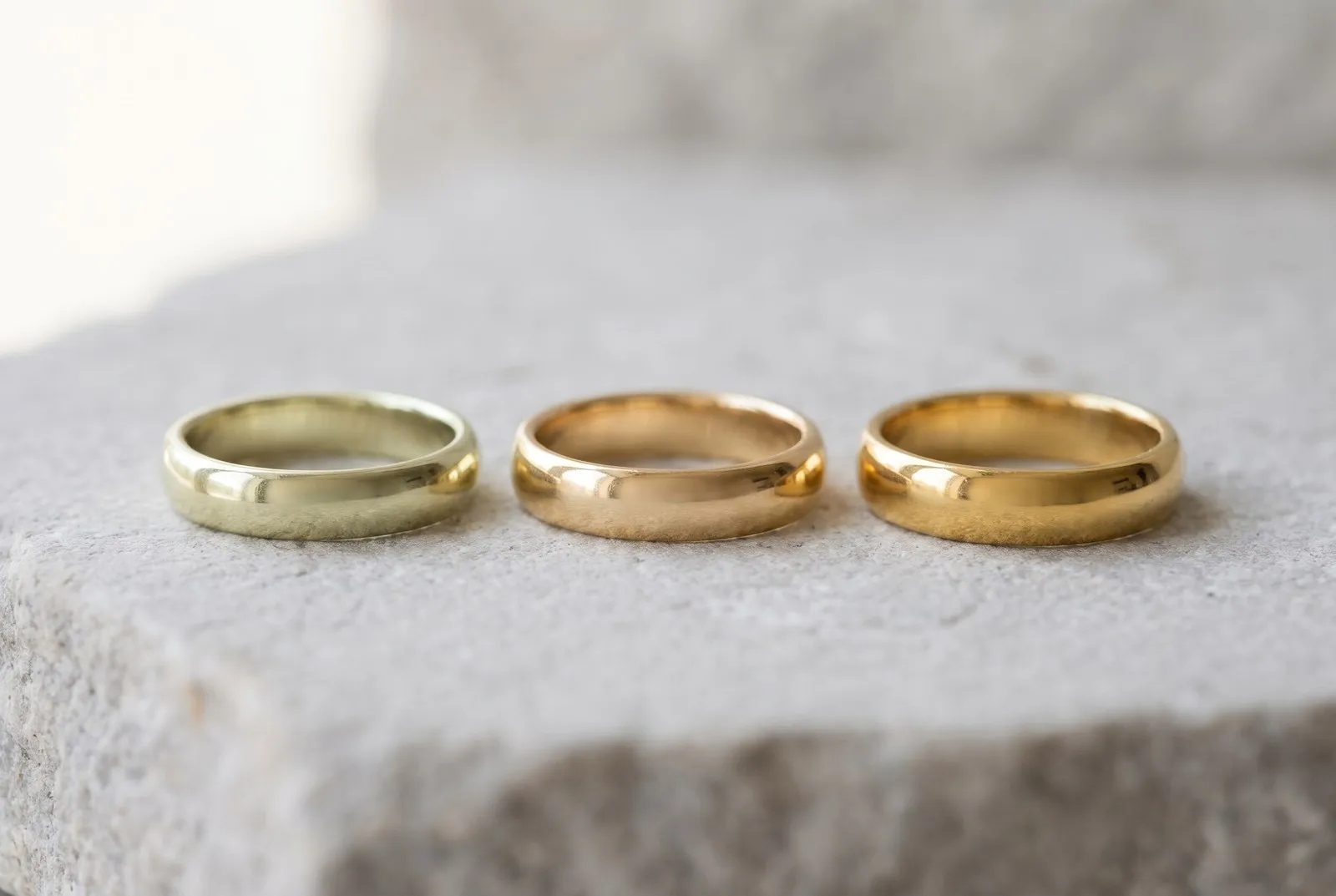
Pictured: plain gold bands in three shades of yellow, from pale to rich. Illustrative image.
What do 10K, 14K and 18K mean?
A karat is one twenty-fourth. Pure gold is 24 karat, so 18K gold is 18 parts gold and 6 parts other metal by weight, 14K is 14 parts gold and 10 parts other metal, and 10K is 10 parts gold and 14 parts other metal. In percentages that’s 75% for 18K, 58.3% for 14K and 41.7% for 10K. The rest is usually silver, copper and a little zinc in yellow and rose gold, and nickel or palladium in white gold. Those other metals decide the color and the hardness.
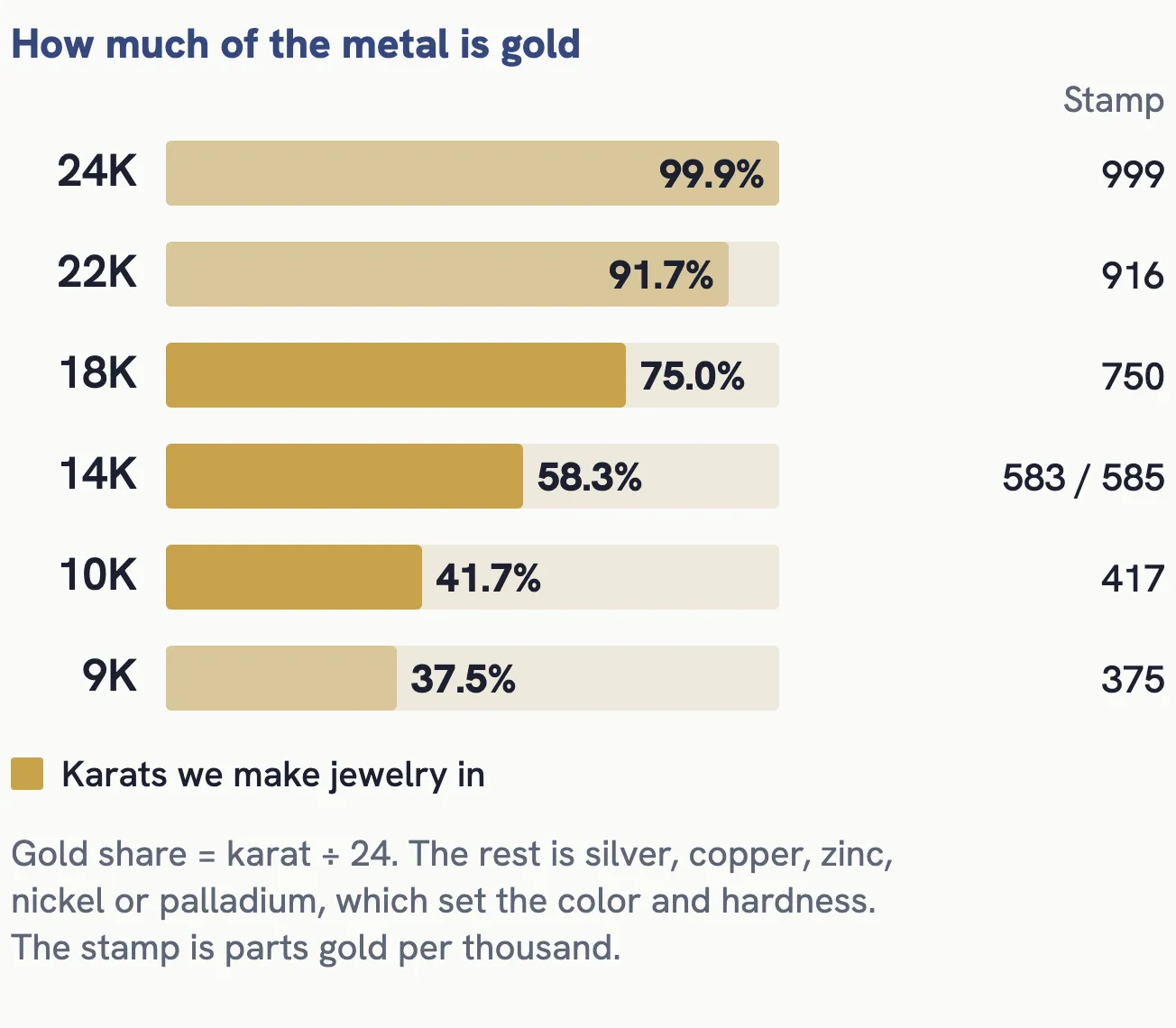
How much of each karat is gold, with its stamp.
The number stamped inside a piece says the same thing in parts per thousand: 750 for 18K, 585 for 14K and 417 for 10K. You’ll see 585 rather than 583 on most 14K because 585 is the international standard figure, used by the UK assay offices and India’s hallmarking rules, among others. Both mean 14K.
In the US the stamp has to be honest. Under the National Gold and Silver Stamping Act, a gold piece may test at most 3 thousandths below its stamp, or 7 thousandths when the whole piece is melted down with its solder. Anyone who stamps the karat must also stamp their registered trademark or name right beside it. The FTC’s jewelry guides add that plain “gold” means 24K: anything less has to carry its karat, as in “14K gold”.
10K vs 14K vs 18K gold at a glance
- 10K (417): 41.7% gold. The palest yellow of the three. The karat where tarnish shows up most. Costs the least of the three.
- 14K (585): 58.3% gold. A clear, medium yellow. Tarnishes only occasionally. The karat most US buyers chose in a 2016 survey.
- 18K (750): 75% gold. The richest yellow. Rarely tarnishes and resists chlorine damage best of the three. Holds about half again as much gold as 14K in the same design, so it costs the most.
Is 10K gold real gold?
Yes. 10K is real karat gold, and in the US it can be sold as “10K gold”. Many guides say 10K is the lowest karat that can legally be called gold in the US. That was the FTC’s advice until August 16, 2018, when the Commission dropped the 10K threshold. Today any karat may be called gold as long as the karat is shown right before the word, and the guides themselves give “9 Karat Gold” as an acceptable example. The 10K minimum now applies only to the gold layer on plated, gold-filled and vermeil pieces.
Other countries draw the line in different places. In the UK the lowest legal gold standard is 9 carat (375), and 10K isn’t one of the UK standards at all. Germany allows jewelry to be stamped at any fineness, which is why 8K (333) is common there. India hallmarks 14K to 24K, and trade press reported in July 2025 that 9K had been added.
Does 10K gold tarnish?
It can. Pure gold doesn’t tarnish, but the silver and copper mixed into it can. In an article produced with the World Gold Council, metallurgist Christopher Corti says tarnish is seen mainly in 8K to 10K gold, only occasionally in 14K and 18K. The dark film comes from sulfur in the air and in some foods, salty sweat, perfume, hair spray and cleaning chemicals, and body chemistry varies from person to person. A polishing cloth or a jeweler’s polish removes it. Our white gold vs silver guide compares tarnish on both metals.
There’s a simple reason the line falls where it does. Gold atoms are much heavier than silver or copper atoms, so a karat percentage by weight overstates how much of the metal’s surface is gold. We worked it out from the alloy recipes in Corti’s tables: standard 18K yellow is about 55 gold atoms in every 100, 14K about a third and 10K only about a fifth. A classic finding in gold research is that alloys resist tarnish when about half their atoms or more are gold, and 18K is the lowest common karat that reaches it.
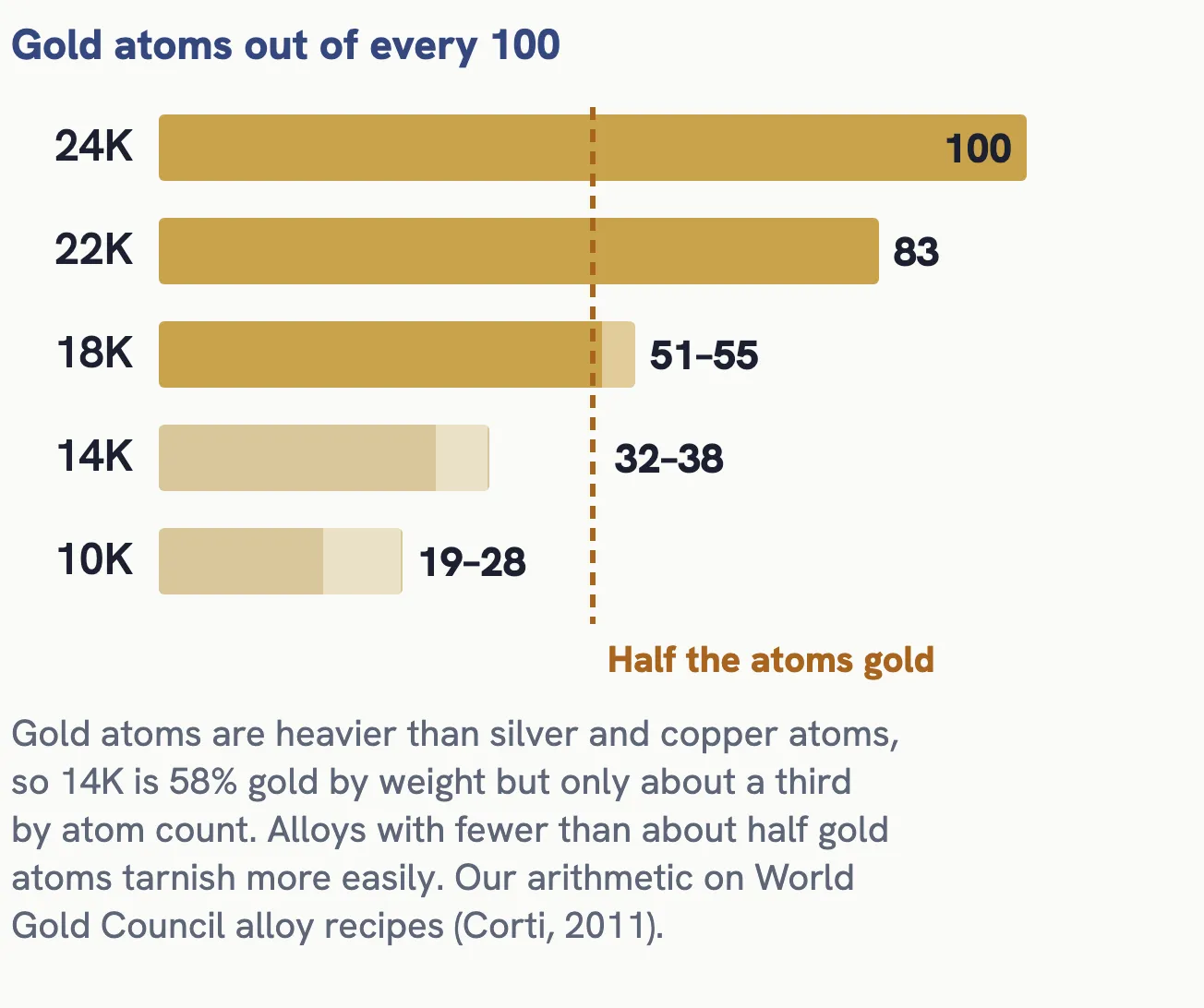
Gold atoms in every 100, by karat. Our arithmetic on World Gold Council alloy recipes.
Two other marks get blamed on cheap gold. Green marks are usually blamed on copper reacting with sweat. Black marks can be tarnish rubbing off, or what dermatologists call black dermographism: makeup and sunscreen, especially zinc oxide, rub tiny metal particles off the jewelry. A 2026 case report in Cutis says gold is the metal most often involved, and that the marks are harmless and stop when the product and metal stop touching.
14K vs 18K gold: which is better?
Both are good choices for an engagement ring or a band you’ll wear every day. Our wedding band guide compares the styles. The differences:
- Color: standard 18K yellow is a deeper, warmer yellow than 14K, because there’s more gold and less silver and copper diluting it. Within any karat the jeweler’s recipe can push the shade greener or redder, so two brands’ 14K can differ a little.
- Hardness: in the World Gold Council’s tables, annealed 14K yellow measures about 190 on the Vickers scale and 18K yellow about 150. Worked metal is harder, about 210 to 225 for 18K. Both are many times harder than pure gold at 20 to 30.
- Gold content: 18K is 75% gold against 58.3%, and it’s also denser, so the same design weighs more. One ring holds about 53% more gold in 18K than in 14K.
- Tarnish and chlorine: 18K tarnishes less. A 2005 study in Gold Bulletin found that even 18K can crack in household chlorine solutions, but far more slowly than lower karats are reported to. Take any gold ring off for bleach, pools and hot tubs.
- Price: 18K costs more, but the gap on a finished piece is smaller than the gold gap. The price section below has our numbers.
So, in our opinion, 14K suits most people and most budgets, and 18K is worth it if you love a rich yellow, want the best tarnish resistance or have sensitive skin.
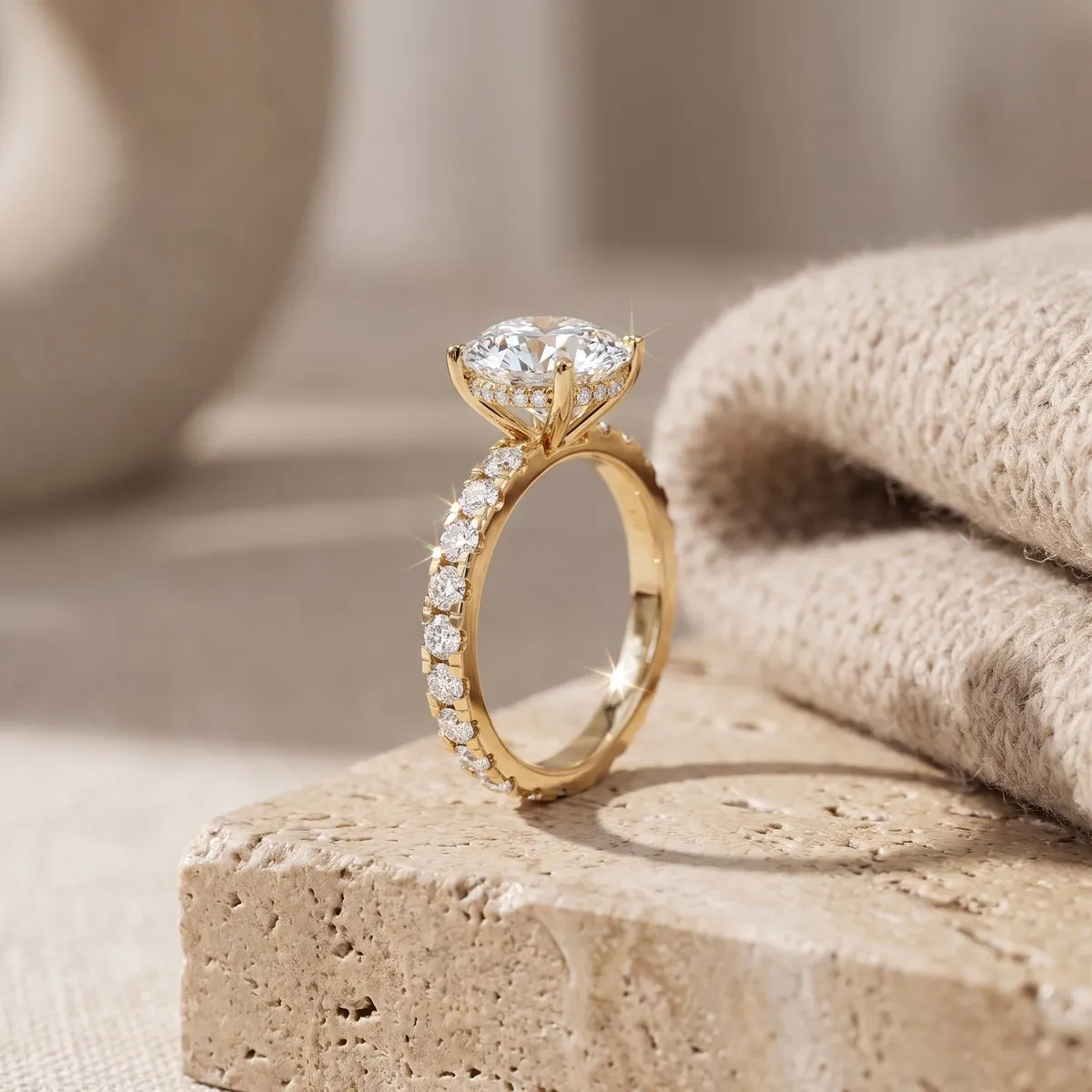
A round hidden halo setting in yellow gold. Image created from the design.
Which gold karat is the most durable?
Many guides say the lower the karat, the harder the gold, so 10K must be the toughest. That’s only half right. Going from 24K down to 18K makes a huge difference: pure gold measures about 20 to 30 on the Vickers scale when annealed, 22K about 52 to 70, and 18K yellow about 150, five to seven times harder than pure gold. Below 18K the karat stops predicting hardness. In Corti’s 2011 tables, 9K and 10K white golds measure 85 to 160, no harder than 14K and 18K nickel white golds, and we couldn’t find a published figure for 10K yellow at all. The exact recipe and how the metal was worked and heated matter more than the karat.
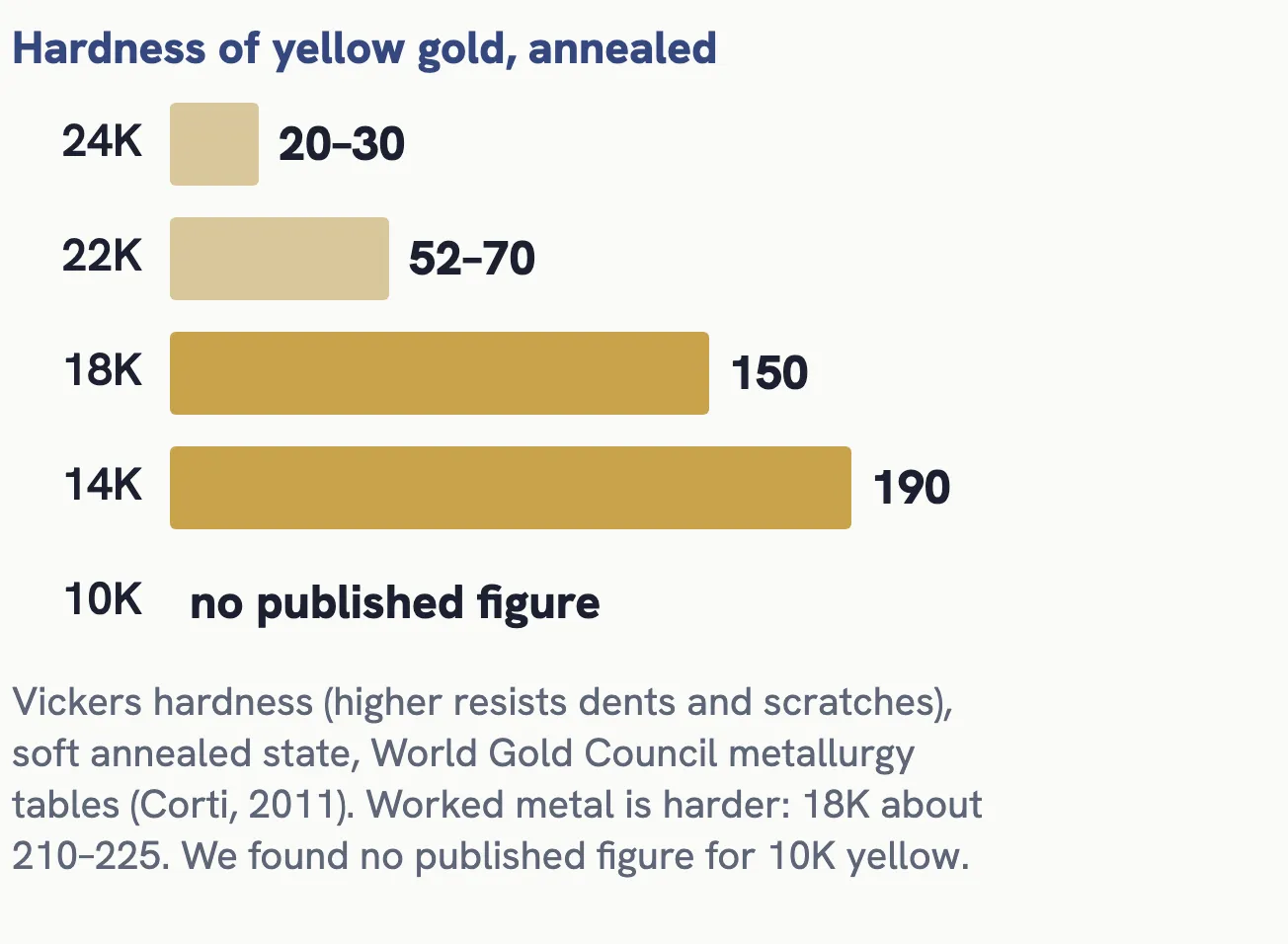
Hardness by karat, annealed. World Gold Council metallurgy tables.
Hardness isn’t the only kind of durability either. Lower karats tarnish more and are more prone to cracking in chlorine. Every karat scratches with wear, and in our view any ring’s prongs are worth checking about once a year.
What about 22K and 24K gold?
24K is fine gold, and in practice it ranges from 99.0% to 99.99% depending on the market: the UK has 990 and 999 standards, and India’s top hallmark grade is 995. Corti, writing for the World Gold Council, calls the usual 99% to 99.5% gold too soft for most jewelry purposes, prone to scratching and wear. 22K (916) is harder but still soft next to 14K or 18K, and it’s the traditional karat in India.
White gold can’t be 24K or 22K. Whitening metals have to make up a real share of the alloy, so white gold tops out at 21K, and the white gold you’ll find in stores is 10K, 14K or 18K.
9K and 8K gold: are they real gold?
Yes, both are real karat gold, with less of it. 9K is 37.5% gold, stamped 375, and it’s the traditional everyday karat in the UK as well as its lowest legal standard. 8K is 33.3% gold, stamped 333, and is legal on jewelry in Germany. In the US both may now be sold as gold with the karat shown. Few Americans buy them: in a 2016 World Gold Council survey of 2,000 US women, only 1% of recent gold-jewelry buyers had bought 9K. They tarnish more than 14K or 18K, and we don’t make jewelry in either.
White gold and rose gold by karat
White gold is gold alloyed with whitening metals, usually nickel or palladium, and many white golds still have a faint yellow tint. That’s why most are plated with rhodium for a bright white finish, which wears thin over the years and can be replated. Our guide to what rhodium plating is covers how the coating goes on and what replating costs. Every Whitemoon piece gets free cleaning and inspection at our New York atelier for life, and our 3-Year and 5-Year Whitemoon Care plans include rhodium replating.
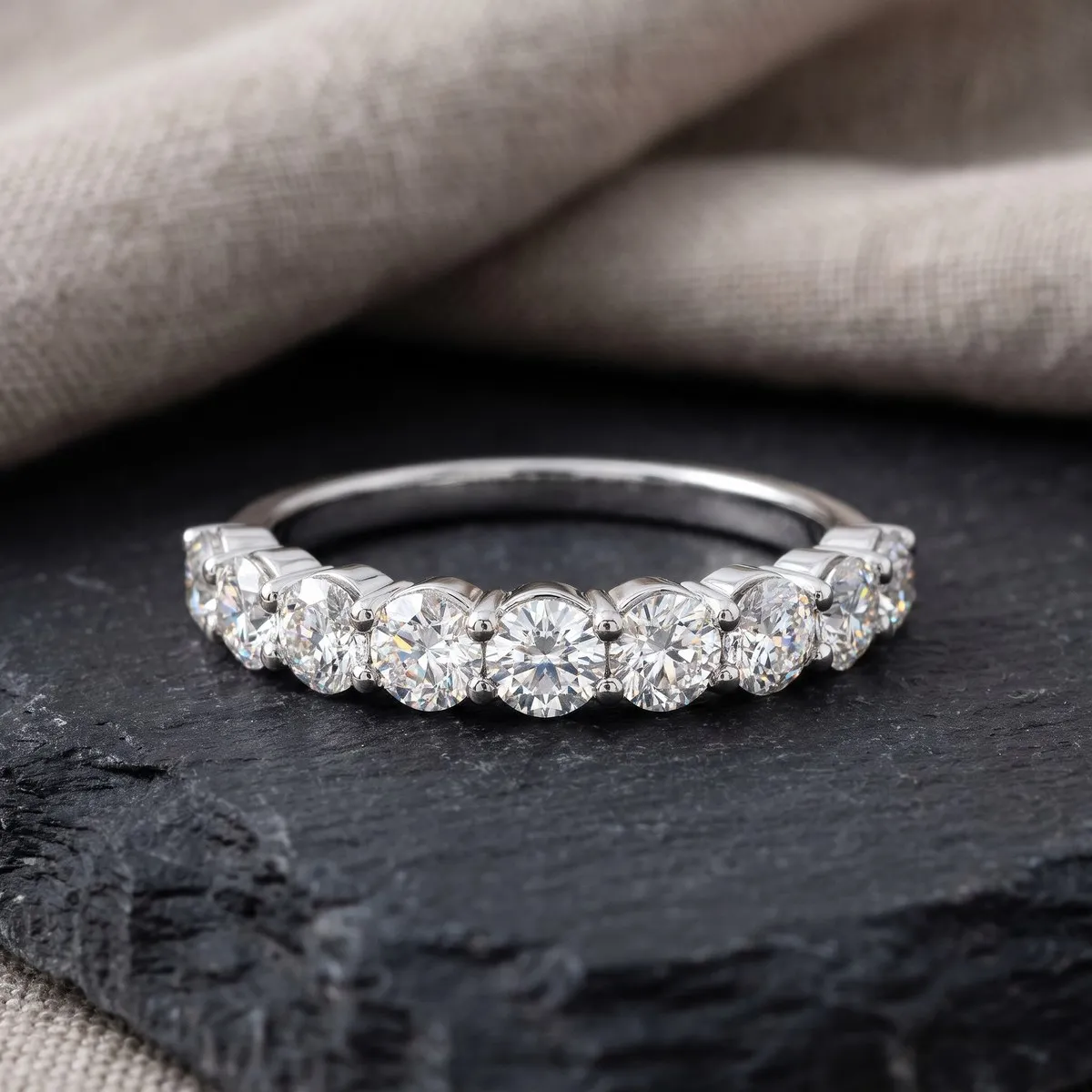
A white gold half eternity band with lab-grown diamonds. Image created from the design.
Nickel matters if your skin reacts to it. Our guide to buying diamond earrings online covers which metals and earring backs to ask about. A 2019 review of 28 studies put nickel allergy at about 11.4% of the general population, the most common contact allergy. In gold, nickel is found in white gold alloys. The standard yellow and rose gold recipes in Corti’s tables contain silver, copper and zinc, not nickel. So if you’re allergic, yellow or rose gold is the safer choice, or ask us about a white gold piece before you order. Many guides say 10K causes allergies because it has more nickel, but that only applies to nickel white golds, not yellow 10K.
Rose gold gets its color from copper, and the lower the karat, the more copper there’s room for, so 10K and 14K rose can look pinker than 18K rose. You can see our rose gold engagement rings, white gold rings and yellow gold rings side by side.
How much does karat change the price?
Start with the gold itself. On November 6, 2026, gold traded at $4,045.35 an ounce, about $130 a gram. At that price the gold in one gram of metal is worth about $98 in 18K, $76 in 14K and $54 in 10K.
A ring is a fixed shape, not a fixed weight, and 18K is denser than 14K, which is denser than 10K. Take a band that weighs 4 grams in 14K. The same band weighs about 4.8 grams in 18K and 3.5 grams in 10K, and holds about $465, $303 and $192 worth of gold. That’s our arithmetic from the gold price and standard alloy densities, not a store price.
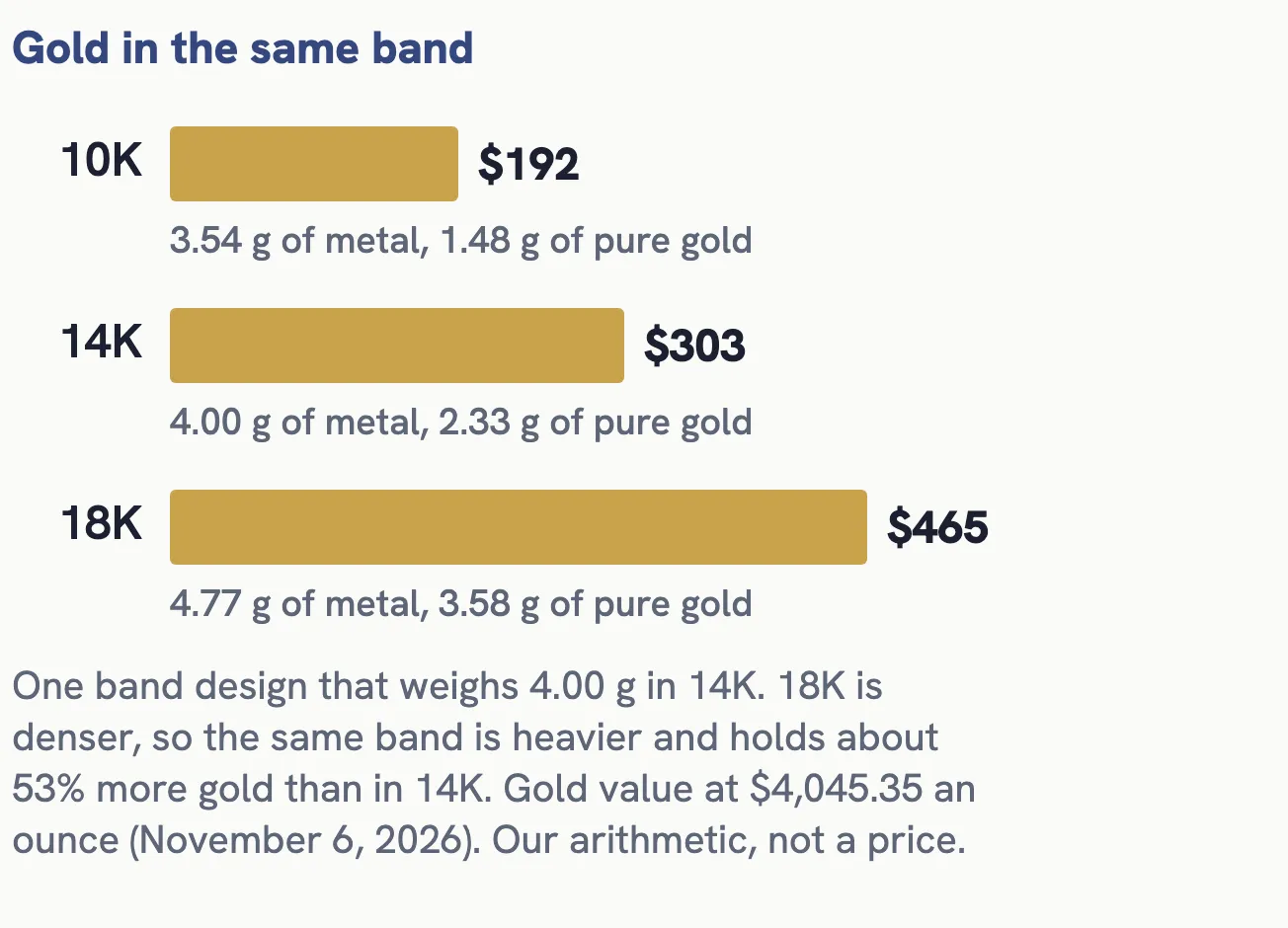
Gold in the same band in each karat, at the November 6, 2026 gold price.
On a finished piece only the metal changes with the karat; the diamonds and the design stay the same. So the price gap between karats is smaller than the gap in gold content alone. Here’s what our own product pages showed on November 7, 2026. 10K is the price you see first, and the gold purity picker adds the difference:
- Round hidden halo ring setting: $469 in 10K, plus $140 for 14K or $280 for 18K.
- Princess cut three stone ring setting: $619 in 10K, plus $239 for 14K or $498 for 18K.
- Half eternity band with lab-grown diamonds: $555 in 10K, plus $268 for 14K or $547 for 18K.
- Round lab-grown diamond solitaire studs, 0.5 carat total: $377 in 10K, plus $145 for 14K or $300 for 18K.
- Tennis necklace with 7 carats of lab-grown diamonds: $3,782 in 10K, plus $709 for 14K or $2,592 for 18K.
On these pieces 14K added 19% to 48% to the 10K price and 18K added 60% to 99%.
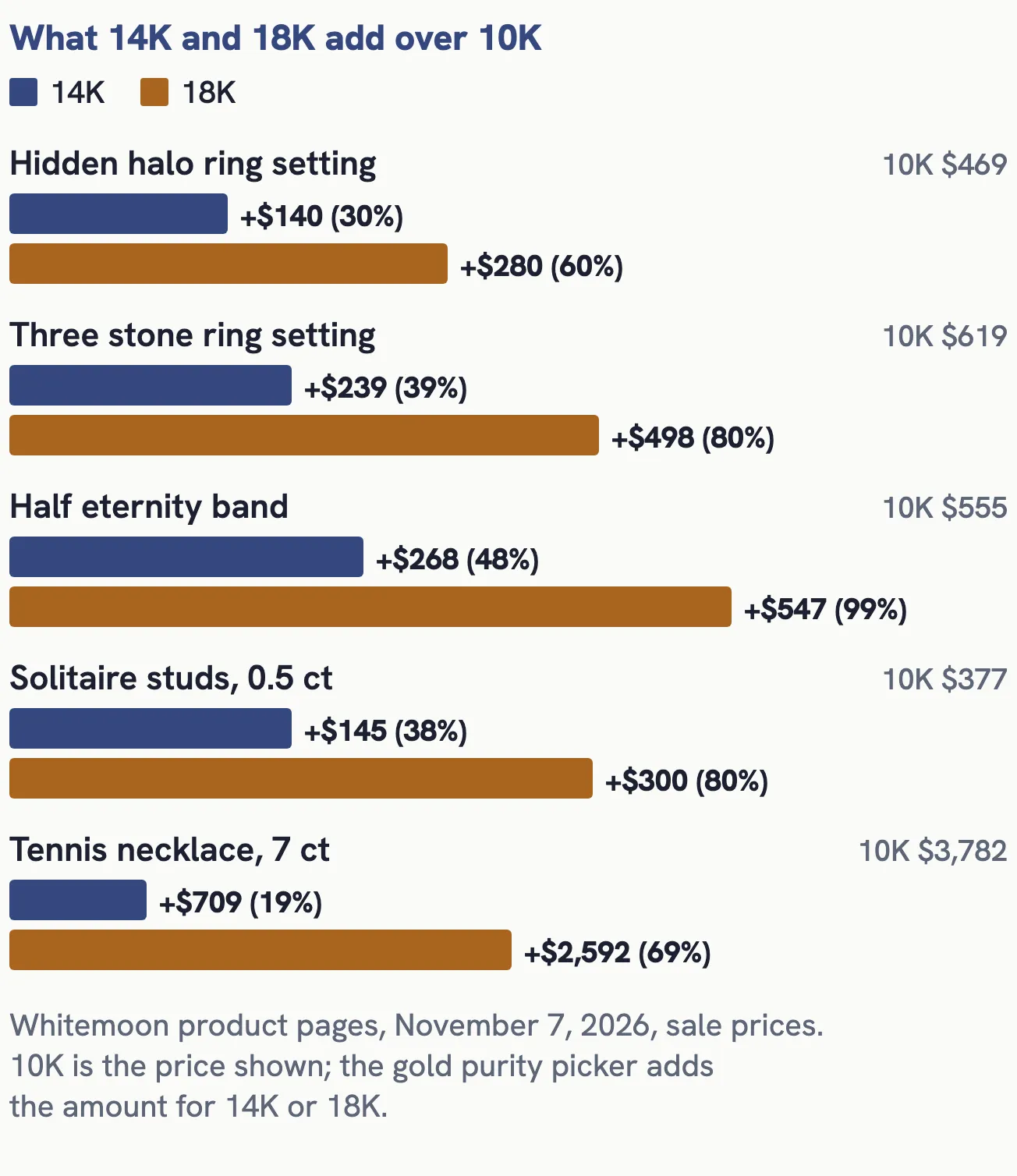
What 14K and 18K add on five Whitemoon pieces, November 7, 2026.
If you ever sell gold for scrap, the buyer pays for the weight of pure gold only, and usually only part of its melt value. The diamonds and the work that went into the piece add nothing at a scrap counter.
Which karat should you choose?
Some data first. In the 2016 World Gold Council survey, 46% of US women who had bought gold jewelry in the past year chose 14K, 22% chose 18K and 15% didn’t know which karat they had bought. For engagement rings, The Knot’s 2026 study of couples married in 2025 found yellow gold in 39% of rings, white gold in 35% and platinum in 13%. It doesn’t report karats.
Our suggestions, which are opinion:
- Engagement rings and wedding bands: 14K for most people. 18K if you want the richest yellow, the most gold or have sensitive skin. 10K if the budget is tight. Our guide to affordable engagement rings covers other ways to bring the price down. All three hold diamonds well. See our gold engagement ring settings and gold lab-grown diamond wedding bands.
- Earrings: a post sits inside the piercing, so if your ears are sensitive choose 14K or 18K yellow or rose gold. The solitaire studs we checked in our gold lab-grown diamond stud earrings come in 10K, 14K or 18K.
- Chains and bracelets: 14K is the usual balance, and 10K keeps a heavy chain affordable. Take them off for pools and hot tubs. In our gold lab-grown diamond necklaces, the tennis necklace we checked comes in 10K, 14K or 18K, and the tennis bracelet we checked comes in 10K or 14K. Our tennis bracelet guide shows what 14K adds at each carat weight.
- 22K and 24K: for coins, bars and plain cultural pieces, not for diamond rings.
Whatever karat you pick, Whitemoon jewelry is made to order in about 10–15 days and ships free with insurance both ways, with 30-day returns on unworn pieces. If you’re choosing a ring, our ring size guide helps you get the size right the first time, and our guide to cleaning a diamond ring at home covers gentle care for any karat.
Gold karat questions
Will 10K gold tarnish?
It can. Tarnish shows up mostly in 8K to 10K gold, because more than half the metal is silver and copper, which react with sulfur, sweat and chemicals. 14K tarnishes only occasionally and 18K rarely. A polishing cloth removes it.
Is 10K gold worth buying?
If price matters most, yes. It’s real gold, sold as 10K gold, and plenty hard for daily wear. The trade-offs are a paler yellow and more tarnish than 14K or 18K, and less gold for the money if you ever sell it.
Is 14K gold better than 10K gold?
For most jewelry, yes: it holds 40% more gold per gram, has a richer color and tarnishes less. It isn’t clearly softer or harder; the alloy recipe matters more than the karat at that level. 10K costs less.
Is 14K or 18K gold better for jewelry?
Both are good. 14K is a little harder in lab tests on annealed metal and costs less. 18K has a deeper yellow, about half again as much gold in the same design, and better resistance to tarnish and chlorine. 18K is not too soft for an engagement ring; 22K and 24K are.
Does 18K gold look more yellow?
Yes. Standard 18K yellow gold is a deeper, warmer yellow than 14K or 10K, because more gold and less silver and copper are in the mix. 10K is the palest of the three.
Why is 14K gold so cheap?
It isn’t cheap, it’s just 58.3% gold. Its gold is worth about $76 a gram against about $130 for pure gold at the November 6, 2026 price. It was also the karat US buyers chose most in a 2016 World Gold Council survey, so it’s widely made.
How pure is 14 karat gold?
14K gold is 14 parts in 24 gold, or 58.3% by weight. It’s usually stamped 585, the international standard figure, and the rest is silver, copper and zinc, or nickel or palladium in white gold.
Is white gold 24 karat?
No. White gold is gold mixed with whitening metals and can’t be made above 21K. Most white gold jewelry is 10K, 14K or 18K, and it’s usually plated with rhodium for a bright white finish.
What color is 100% pure gold?
Pure gold is a rich, warm yellow. Gold and copper are the only pure metals that aren’t white or gray, which is why every metal added to gold except copper makes it paler.
What is the highest karat gold?
24 karat, which is fine gold. Depending on the market it’s sold at 99.0% to 99.99% gold and stamped 990, 995, 999 or 999.9. It’s too soft for most jewelry with stones.