
Ring Size Guide: Ring Size Chart and How to Measure at Home
To find your ring size, measure the inside of a ring that fits, or the distance around the base of your finger, then match it to the chart below. A US size 7 is 17.3 mm across the inside and 54.4 mm around. One full size is only 0.8 mm across, so measure twice, at different times of day, before you order.
We make rings from US 3 to US 13, in quarter sizes, and a ring that fits matters more to us than which method you use. Below are the full chart, a printable sizer, the ways to measure at home, what changes your size, and what to do when you’re buying for someone else. Where popular sizing advice has no evidence behind it, we say so.
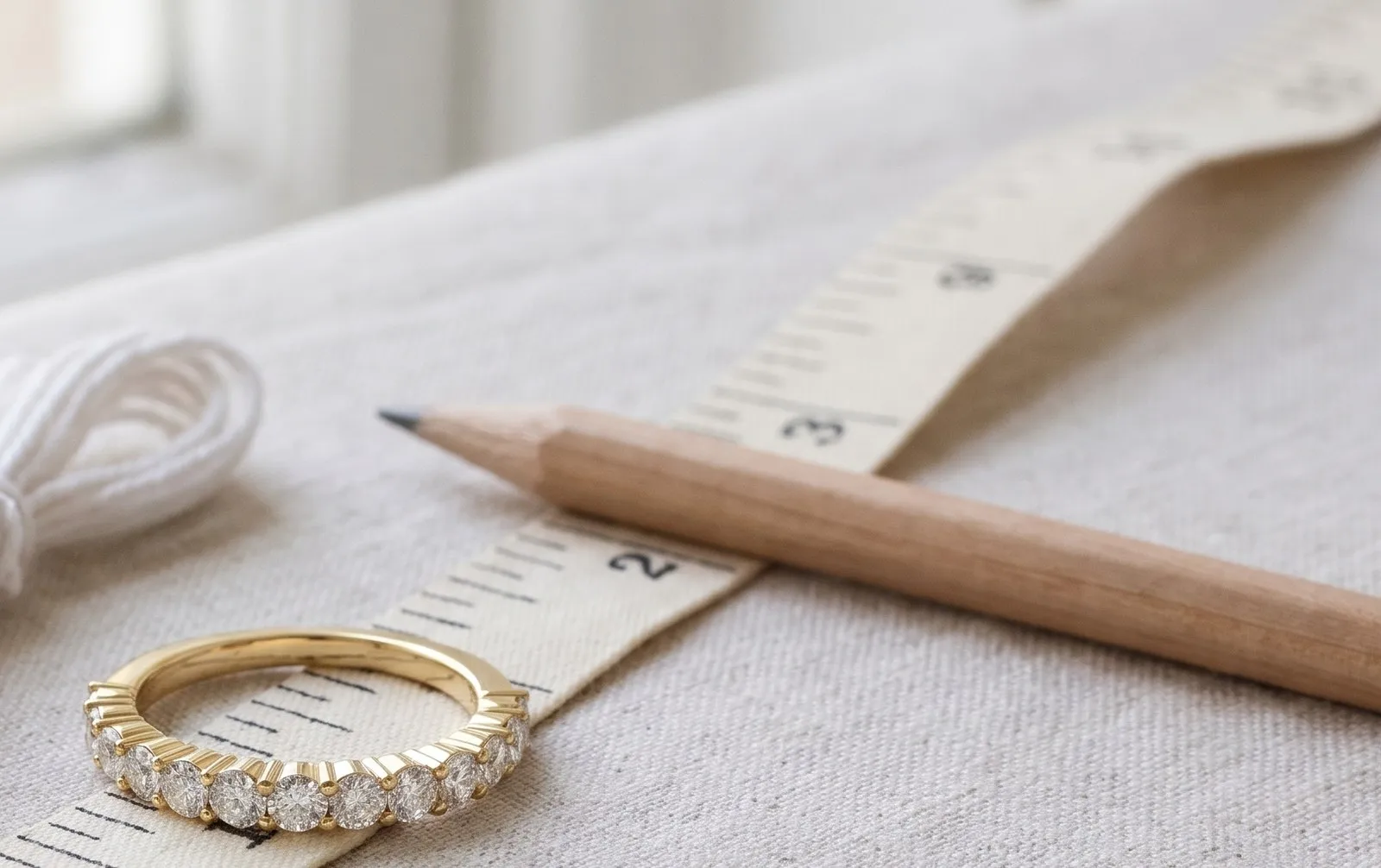
Pictured: a lab-grown diamond band in yellow gold with a measuring tape. Image created from the ring’s design.
Ring size chart
Diameter and circumference are inside measurements in millimeters. A ring’s size is about the hole, not the metal.
| US and Canada | Diameter (mm) | Circumference (mm) | UK and Australia | EU | Japan |
|---|---|---|---|---|---|
| 3 | 14.1 | 44.2 | F | 44 | 4 |
| 3½ | 14.5 | 45.5 | G | 45 | 5 |
| 4 | 14.9 | 46.8 | H | 47 | 7 |
| 4½ | 15.3 | 48.0 | I | 48 | 8 |
| 5 | 15.7 | 49.3 | J½ | 49 | 9 |
| 5½ | 16.1 | 50.6 | K½ | 51 | 10 |
| 6 | 16.5 | 51.9 | L½ | 52 | 12 |
| 6½ | 16.9 | 53.1 | M½ | 53 | 13 |
| 7 | 17.3 | 54.4 | N½ | 54 | 14 |
| 7½ | 17.7 | 55.7 | O½ | 56 | 15 |
| 8 | 18.1 | 57.0 | P½ | 57 | 16 |
| 8½ | 18.5 | 58.3 | Q½ | 58 | 18 |
| 9 | 18.9 | 59.5 | R½ | 60 | 19 |
| 9½ | 19.4 | 60.8 | S½ | 61 | 20 |
| 10 | 19.8 | 62.1 | T½ | 62 | 21 |
| 10½ | 20.2 | 63.4 | U½ | 63 | 22–23 |
| 11 | 20.6 | 64.6 | V½ | 65 | 24 |
| 11½ | 21.0 | 65.9 | W½ | 66 | 25 |
| 12 | 21.4 | 67.2 | X½ | 67 | 26 |
| 12½ | 21.8 | 68.5 | Z | 68 | 27 |
| 13 | 22.2 | 69.7 | Z½ | 70 | 29 |
One US size is 0.81 mm across and 2.55 mm around, and a quarter size is 0.20 mm across and 0.64 mm around. Sizes keep going past 13: a US 14 is 23.0 mm across and 72.3 mm around, and a US 15 is 23.8 mm and 74.8 mm. Men’s and women’s rings use the same scale, so a size 8 is the same hole whoever wears it.
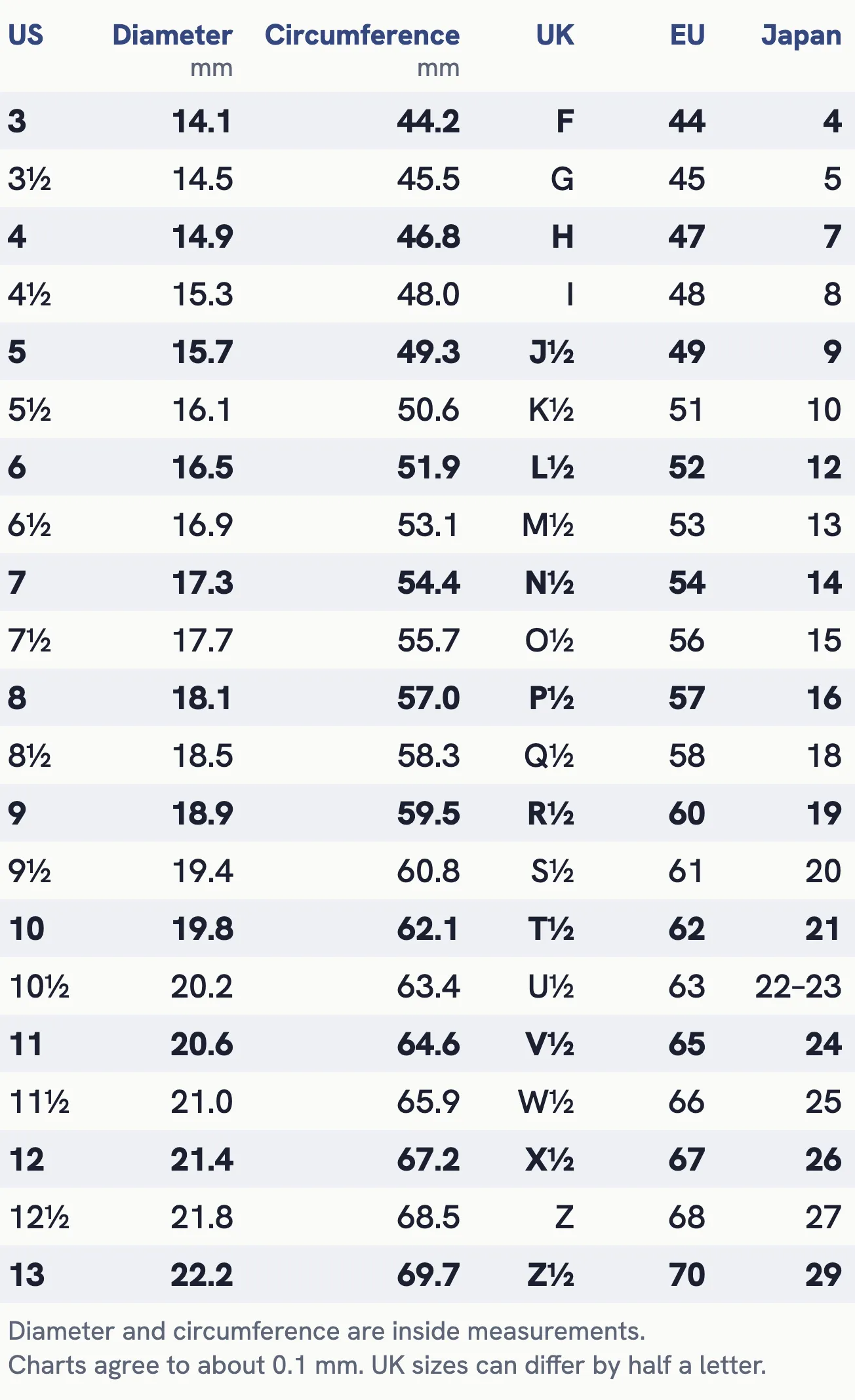
The same chart as a picture, to save to your phone.
How to use a printable ring sizer
A printable sizer is a sheet of actual-size circles, often with a paper strip to cut out. Print it at 100% or “Actual size”, never “Fit to page”. Scale matters more than you’d think: at 97%, a size 7 circle reads about 6.4, more than half a size off, and you wouldn’t notice by eye. So check the sheet against a ruler or a bank card, which measures 85.6 by 54 mm, before you trust it. If the sheet has no ruler on it, don’t use it.
Set a ring that fits on the circles. The inner edge of the ring should line up with the edge of the circle. If it falls between two, use the larger.
How to measure your ring size at home
No one has published a comparison of home methods, so labels such as “the most accurate” are guesses. What we can do is work out how much each mistake costs, and the chart below shows it in ring sizes. The lesson is that a small slip matters, which is why we’d use two methods if you can.
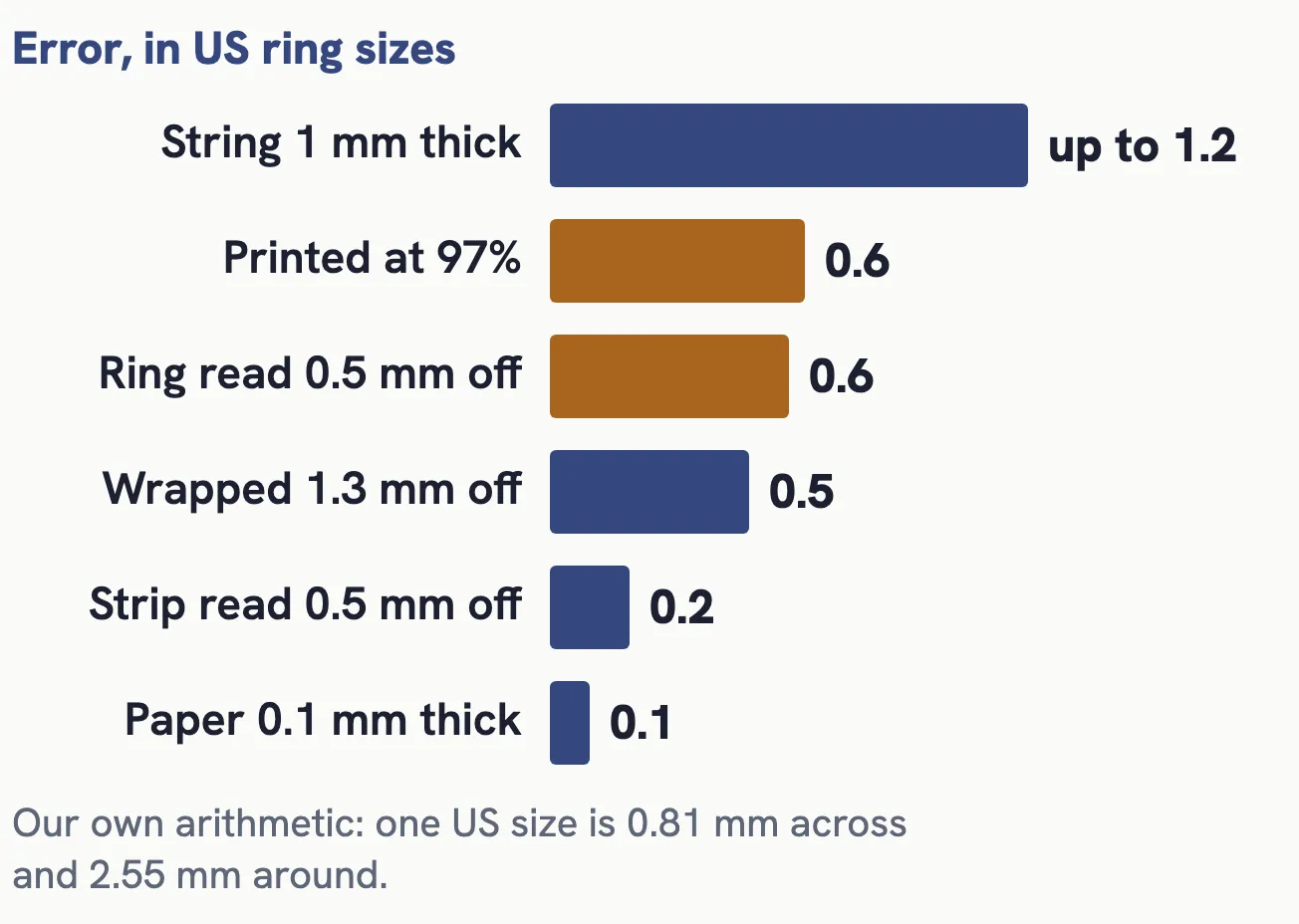
How much small slips cost, in US ring sizes. Our own arithmetic.
Measure a ring that already fits
- Choose a ring that fits the finger you’re sizing, and that you can get on and off comfortably.
- Set it on the printed circles, or measure across the inside with calipers.
- Match the result to the diameter column.
A plain ruler is the weak version of this method, since a reading 0.5 mm off is more than half a size. Also, a thin ring’s size doesn’t carry over directly to a wide band.
Wrap a strip of paper around your finger
- Cut a thin strip about as wide as the band you plan to buy.
- Wrap it around the base of the finger, snug but not tight, and mark where it meets.
- Lay it flat, measure to the millimeter, and match it to the circumference column.
- Check that a ring that size would still pass your knuckle.
- Repeat later in the day.
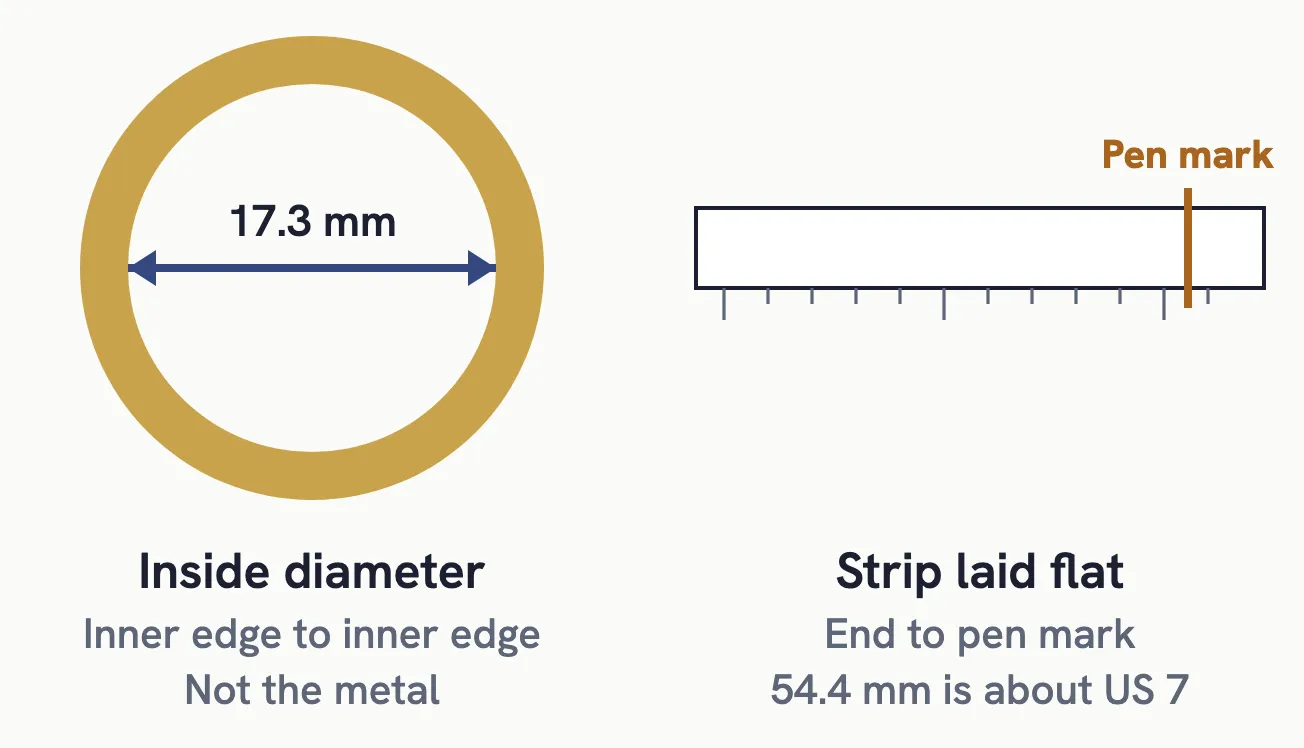
Measure the hole, not the metal, or the strip from end to mark.
Paper beats string. String stretches and squashes, and a string 1 mm thick can add up to about 3 mm to the reading, or more than a full size. We found no measured figure for how much string stretches, so we can’t tell you how much to allow for it. If string is all you have, use the thinnest you can find and measure twice.
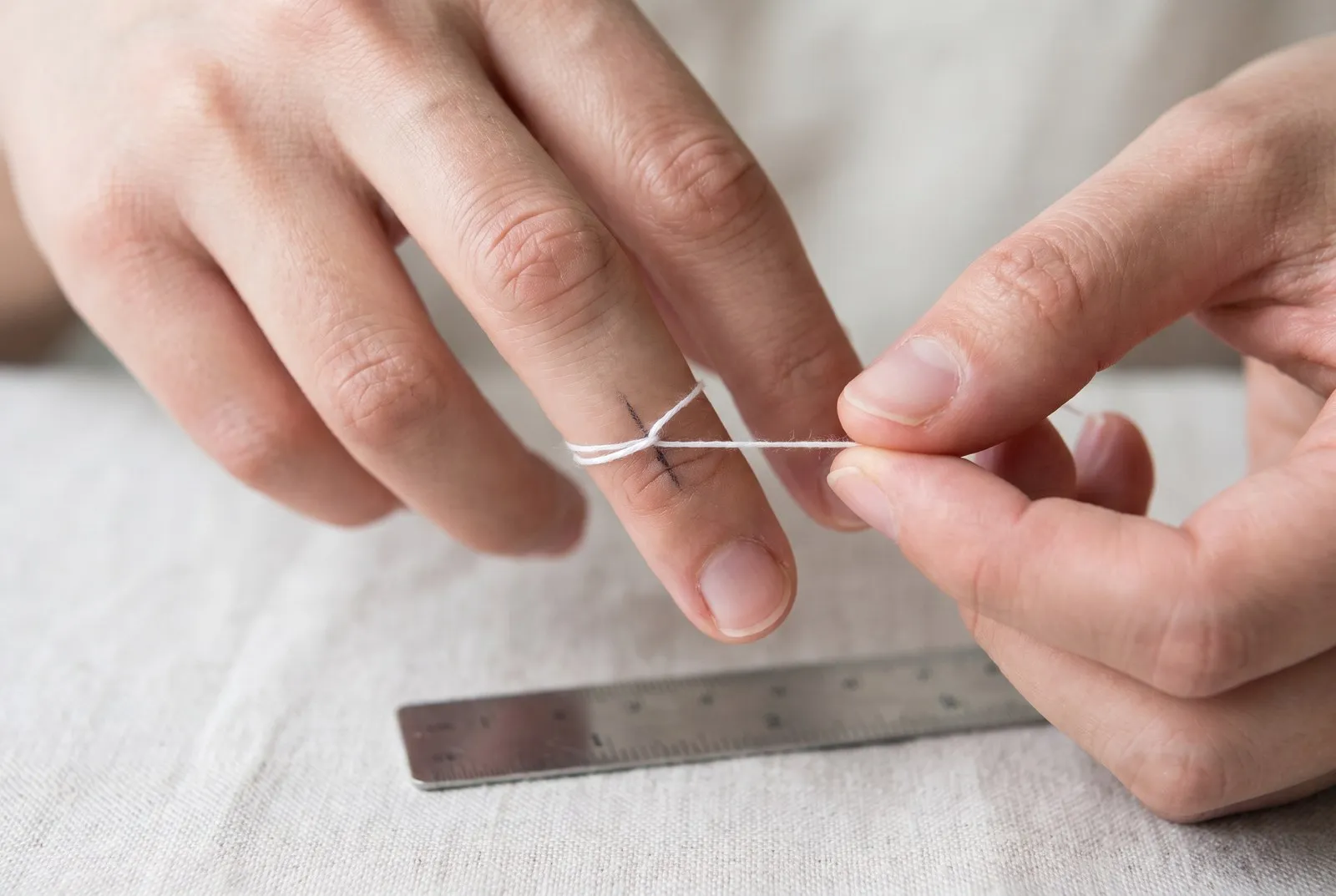
Measuring with string works, but string can stretch. Illustrative image.
Use a ring sizer or see a jeweler
A plastic sizer or a set of sizing rings lets you feel the fit, which a chart can’t do. Try one close to the width of the ring you’ll wear, and wear it for a while if you can. A jeweler can size you on the spot, though two jewelers can read a finger a little differently, for reasons we come to below.
What changes your ring size?
Your size isn’t fixed. These are the things that move it, and how much is known about each.
- Time of day. Many guides say fingers are largest at night. The one study we found points the other way: in 36 healthy adults, hands were largest on waking, and their volume had fallen 4.3% by evening. By our arithmetic, that’s about half a ring size. It’s a small study that measured whole hands, so don’t treat it as final. It’s still a good reason to measure more than once, and a ring sized at night may feel snug in the morning.
- Heat, cold, exercise and salt. Heat and exercise can swell fingers, and cold can shrink them. The NHS lists salty food among the causes of swelling. We couldn’t find a reliable figure for any of these, including the common claim that cold shrinks a finger by a full size. Avoid measuring when you’re very hot or very cold.
- Pregnancy. Swollen fingers are common in pregnancy, so it’s usually better to wait, or to size for now and resize later. The NHS says to call your midwife or doctor right away about sudden swelling of the face, hands or feet.
- Your dominant hand. You’ll often read that it’s half a size larger. The one measurement we found, on 224 workers, put right-handers’ right index finger just 0.3 mm larger around, which is about an eighth of a size. Left-handers showed no difference. Our guide to which hand a wedding ring goes on covers the rest. Size the finger you’ll wear the ring on anyway.
- Weight. Many people find their rings change with their weight, but we found no study and no sound rule of thumb for pounds per size. If your weight has changed a lot, measure again.
- Body type. We found no study linking finger size to body size, and women’s orders spread from size 3 to above 10. Measure rather than guess from how someone looks.
- Knuckles. A ring has to pass the knuckle, then sit at the base. If your knuckle is much larger, measure both and choose a size between them. Sizing beads or a spring insert can stop a ring spinning once it’s on.
How does band width change your ring size?
A wider band covers more of your finger, so it feels tighter. Our wedding band guide explains band widths and weights. Beyond that there’s no standard, and published rules start anywhere from 5 mm to 10 mm. A common starting point is half a size up for a band of about 6 mm or wider, but the better answer is to try a sizer as wide as the band. How wide is 6 mm? About the height of three stacked nickels.
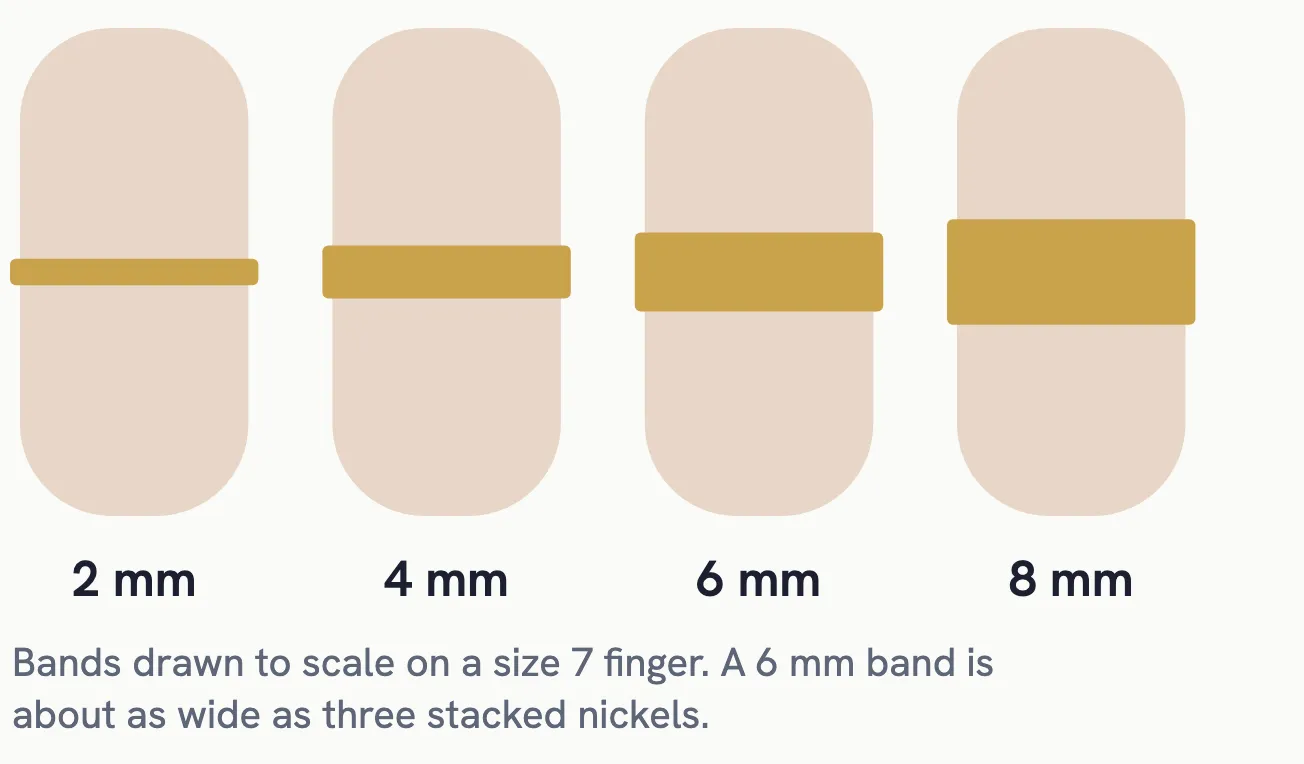
Band widths to scale on a size 7 finger.
Comfort-fit bands, which are domed inside, often come with advice to go down a little. Bench jewelers disagree about it, so ask whoever is making the ring. Our ring pages show the band width where there’s a choice, so check it before you settle on a size. If you’ll wear two rings together, our guide to stacking a band with a solitaire helps with the pairing.
What is the most common ring size?
Retailers report 6 or 7 for women and 9 or 10 for men. That’s order data from individual stores, and we found no national survey.
| Source | Women | Men | What it’s based on |
|---|---|---|---|
| My Irish Jeweler | 7 | 10 | 5,000 random orders, 2019 |
| Foreverings | 7–7½ | 10–10½ | One year of orders, number not given |
| Blue Nile | 6 | 9 | Not given |
So a size 7 isn’t big for a woman, and a size 8 isn’t huge. In Foreverings’ orders, more than a third of women bought an 8 or above. Don’t use these figures as a guess unless you have to, because they describe a store’s customers and not your finger.
What do ring sizes look like?
A size 7 hole is slightly smaller than a US dime. A dime matches about US 7¾, a penny about US 9, a nickel about US 11¾ and a quarter about US 15½. That’s useful for picturing a size, though not for measuring one.
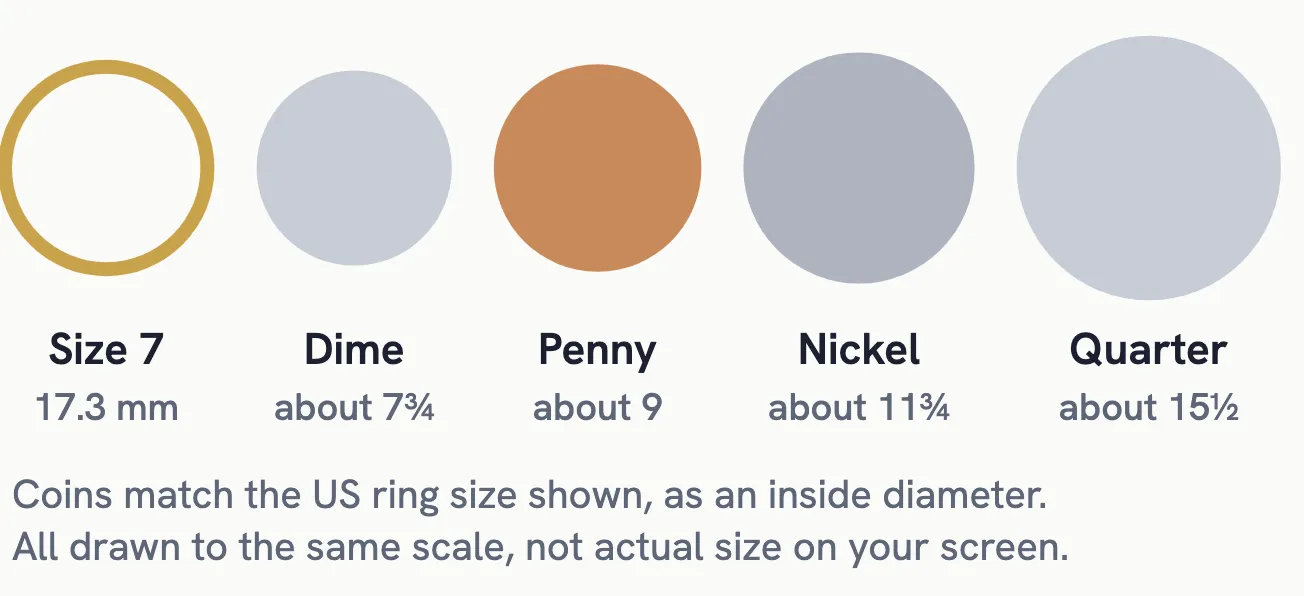
What ring sizes look like next to US coins, drawn to the same scale.
Ring size conversions
The chart above converts US sizes to the main international scales, and a few notes help when you’re comparing charts.
- EU. The EU figure comes from ISO 8653: it’s the inside circumference, rounded to the nearest millimeter.
- Italy, Spain and Switzerland. These commonly use the circumference minus 40, so a 54.4 mm ring is about a 14.
- Germany and the Netherlands. These commonly use the inside diameter in millimeters.
- UK. Charts can differ by half a letter, mostly at the small and large ends.
- Japan. Our column follows Japan’s own scale, which starts at 13 mm for size 1 and adds a third of a millimeter per size. Many US charts run up to two sizes low above a US 8.
- Smart rings. Brands such as Oura use their own scale, so don’t order jewelry from a smart-ring size.
Why two jewelers can give you different sizes
The US scale is a convention more than a specification. In 1921 the US Bureau of Standards looked into it and couldn’t find the dimensions printed anywhere. The sizes lived in tapered gauges, often copied from one another, and gauges in one city differed by about a third of a size. Shops also read a ring against the gauge in different ways.
We found no published US standard since, so every chart, ours included, follows an accepted pattern. Respected charts agree to about 0.1 mm across US 3 to 13, which is about an eighth of a size.
How to find someone’s ring size in secret
- Borrow a ring. Take one they wear on the right finger, ideally the same hand, then set it on the printed circles and put it back.
- Trace it. Trace the inside with a sharp pencil, or press it into soap, or photograph it flat beside a ruler. A thick pencil line adds width, and an extra 0.5 mm across is more than half a size.
- Ask around. A friend or relative may know, or can ask without giving you away. A jeweler they’ve used may have the size on file.
- Use your own finger. Trying their ring on your own finger gives a rough idea at best.
- If you still don’t know. Choose a design that’s easy to resize and a middle size as a starting point. A full eternity band is a poor choice for a surprise, and a slim promise ring is an easier one.
Can a ring be resized?
Most plain metal rings can go up or down a size or two. To go down, a jeweler removes a small section and solders the band closed, and to go up, they add metal or stretch a plain band slightly. There’s no trade standard for how far is safe, but three or four sizes can start to strain the design. Some rings are harder.
| Ring | Can it be resized? |
|---|---|
| Full eternity band | Usually remade, because there’s no plain metal to cut |
| Tension setting | Avoid it, since the band’s pressure holds the stone, so these are usually remade |
| Tungsten | No, it’s too hard |
| Titanium | Very difficult |
| Channel-set band | Harder and riskier, since stones can shift |
| Pavé band | Possible with care, though stones can loosen |
| Silver | Some jewelers will and some won’t, so ask |
Ring sizes at Whitemoon
You can choose any size from US 3 to US 13 in quarter sizes on our engagement rings and wedding bands, and the menu has a “Don’t know my size” option if you’re stuck. Under our refund policy, a ring within one size is resized, and a bigger change means remaking it in about 10–15 days, which counts as your free resize. Full eternity bands have no plain section, so for them the free resize is a remake. Our ring resizing guide explains how resizing works and what it costs. Most Whitemoon rings are made to order in about 10–15 days and ship free with insurance both ways, with 30-day returns on unworn pieces and one free resize within 60 days of delivery.
Ring size questions
How would I measure my ring size?
Set a ring that fits on a printed sizer, or wrap a paper strip around the base of your finger and read the circumference in millimeters. Then match it to a size chart. Do it twice, at different times of day, and go with the larger if you land between sizes.
Can I see an actual ring size chart on my screen?
Only if the page first calibrates to your screen, for example by matching a box to a bank card. Otherwise, circles on a screen aren’t true to size: a browser’s “inch” isn’t a real inch, and on a 120 dpi laptop, for example, everything shows at about 0.8 scale. That makes a size 7 circle look more like a size 3. Print a sizer instead.
Is size 7 a big ring size for a woman?
No, it’s in the middle. Stores that publish order data usually report 6 or 7 as the most common women’s size, and plenty of women wear larger.
What’s the most common ring size for a female?
Retailers report size 6 or 7. The best-documented figure comes from a jeweler’s 5,000 random orders, where 7 came first and about half of women’s orders fell between 6 and 8. There’s no national survey, so treat it as a rough guide.
How much bigger is a size 8 ring than a 7?
A size 8 is 0.81 mm wider across the inside and 2.55 mm longer around, or about 5% bigger. That small a change is easy to feel on a finger.
What does a size 7 ring look like?
The hole is 17.3 mm across, slightly smaller than a US dime at 17.9 mm. If you want to see it at actual size, print our sizer at 100%.
Is a size 8 ring huge?
No. Plenty of women wear an 8 or larger, and it’s below the usual men’s sizes. Size ranges also vary by brand, so a store that stops at 9 is setting a limit of its own.
Does ring size change with weight?
It can, but we found no study that measures how much and no reliable rule for pounds per size. Reports range from a change after a few pounds to none after many, and a large knuckle can keep a ring on even when the base of the finger slims down. If your weight has changed a lot, measure again.
What is the smallest ring size?
The US scale starts at 0, but most jewelers sell adult rings from about US 3. We offer US 3 to US 13.