
Which Finger Does a Wedding Ring Go On? (And Which Hand)
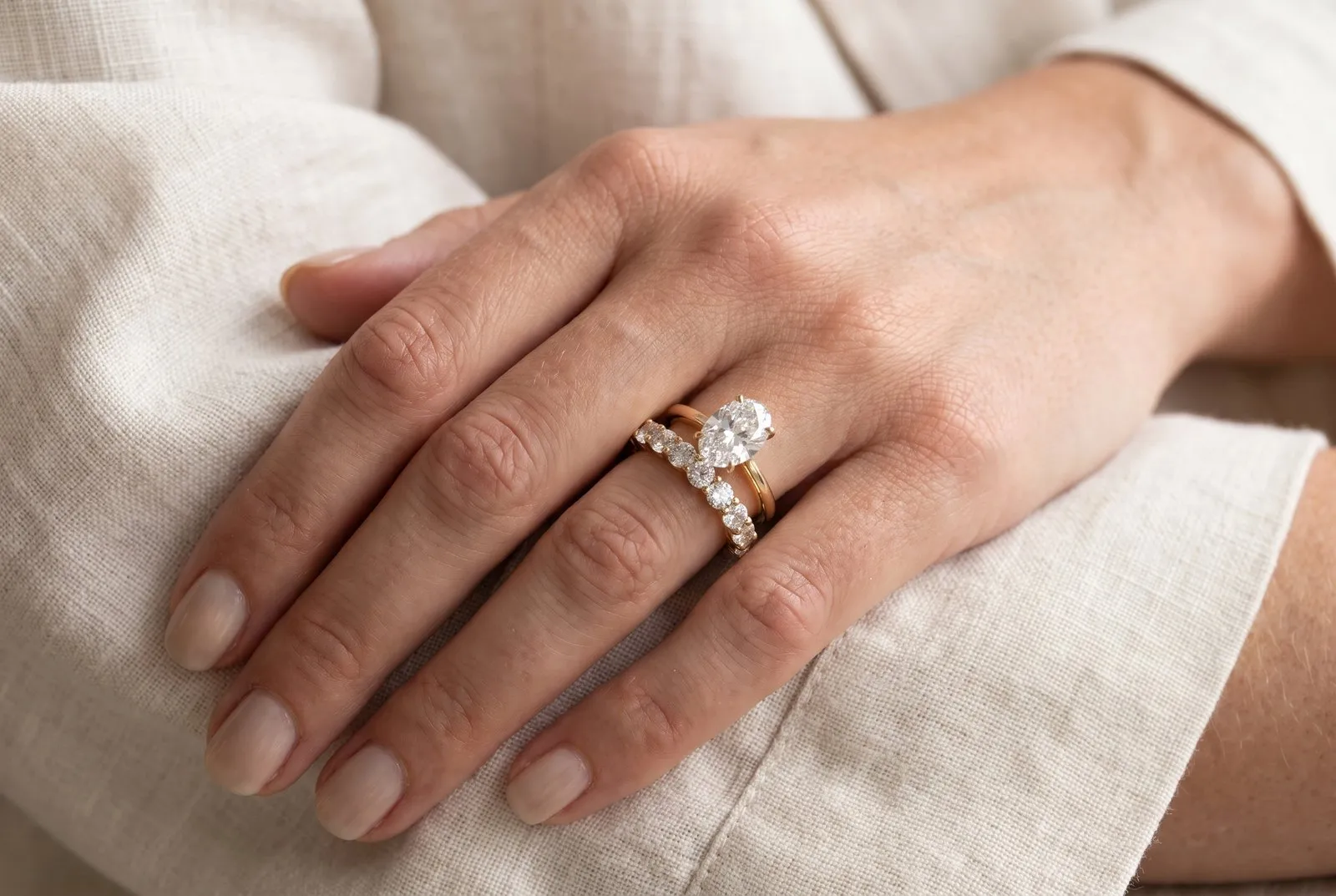
In the US, the UK, Canada and Australia, a wedding ring goes on the fourth finger of the left hand, the one between the middle finger and the little finger. Men wear it on the same finger as women. In Germany, Austria, Poland, Russia, most of Spain and the Orthodox churches, the custom is the same finger on the right hand. No law sets either one: it’s custom, and you can wear yours wherever suits you.
We sell wedding bands, so keep that in mind. We also went back to the old sources behind the usual “vein to the heart” story, and it turns out to be told wrong almost everywhere. Below is which finger and which hand, why, how the left hand became the rule in English weddings, men’s rings, the order of the engagement ring and the band, and what to do when the ring finger doesn’t suit you.
Pictured: an oval lab-grown diamond solitaire and a half eternity band in yellow gold, on the left ring finger. Image created from the rings’ designs.
Which finger is the ring finger?
The ring finger is the fourth finger if you count the thumb, or the third if you don’t, which is why older texts call it both. It sits between the middle finger and the little finger. The Romans called it anularis, the ring finger, and also medicinalis, the medicine finger.
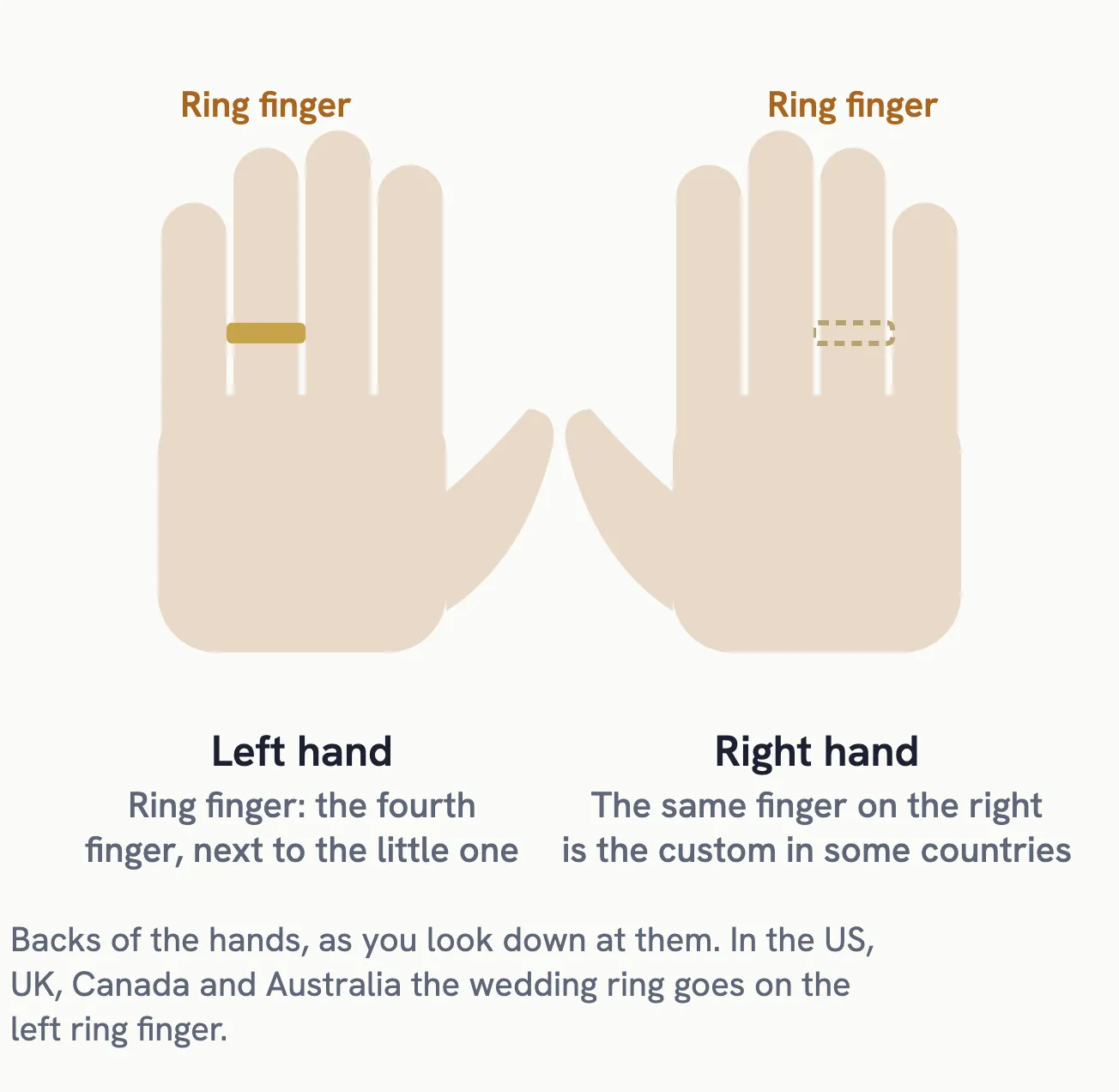
The ring finger is the fourth, next to the little finger.
Left hand or right hand?
It depends on where you are and, sometimes, on your faith. The clearest cases:
- Left hand: the US, UK, Canada and Australia. The Catholic wedding rite also puts the ring on the bride’s left hand. In Brazil an engagement ring is worn on the right and moves to the left at the wedding. In Spain, Catalonia and Valencia use the left.
- Right hand: Germany, Austria, Poland and Russia, and most of Spain, where the engagement ring is also worn on the right until the wedding. In the Orthodox churches, the priest places the rings on the right hands of the bride and groom, though many Orthodox Christians in the US switch to the left.
- Jewish weddings: the groom places a plain ring on the bride’s right index finger. Many brides move it to the ring finger afterward.
Lists of countries online disagree with each other, often without sources. The Netherlands, Belgium, India and several South American countries are reported both ways, and in India the custom varies by region and family. Poland and Spain are mostly Catholic yet use the right hand, so the rule that “Catholics wear it on the left” doesn’t hold everywhere.
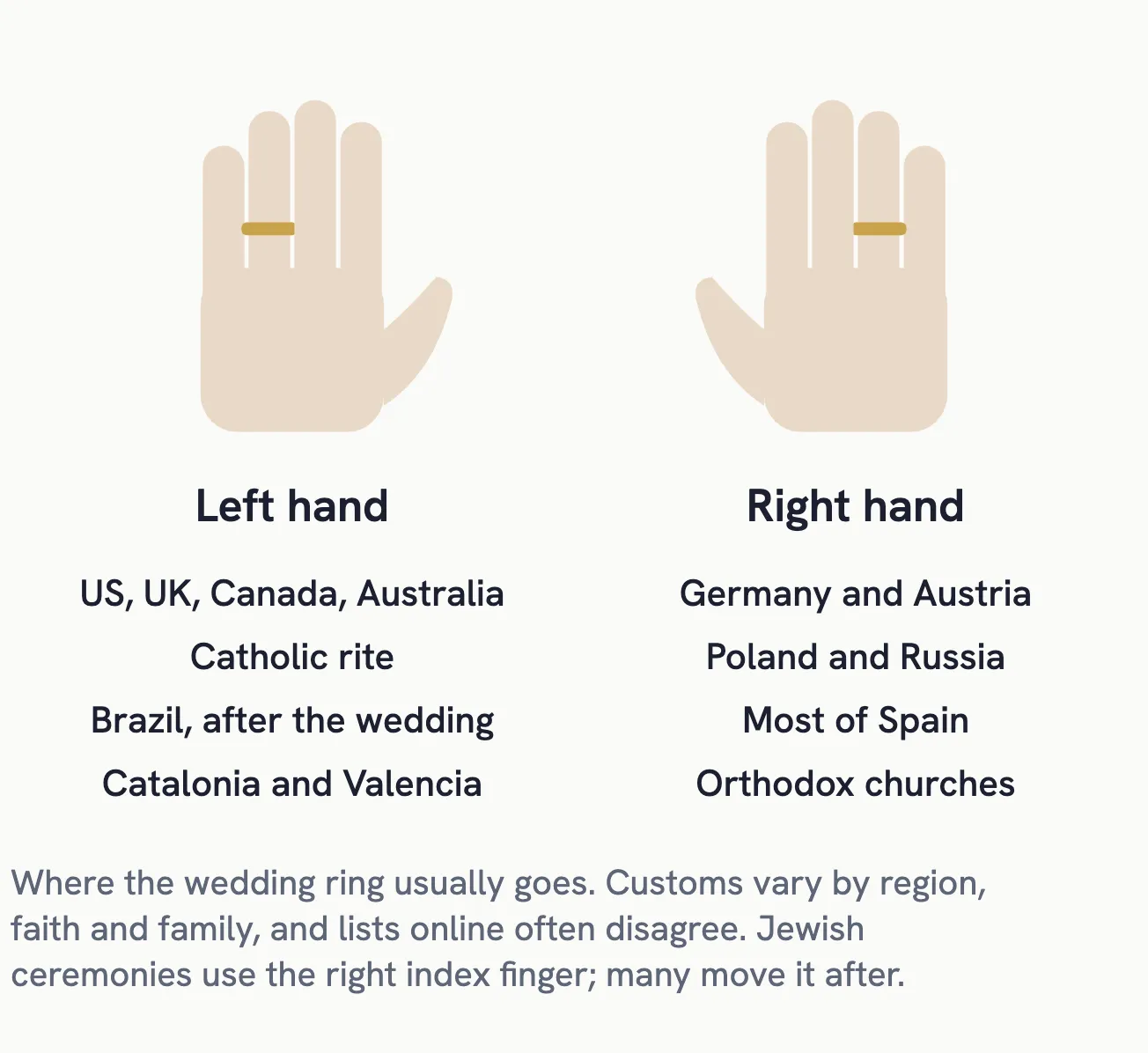
Where the wedding ring usually goes. Only places with good sources are listed.
Why the left hand? The vein to the heart story
You’ll often read that the ancient Romans or Egyptians wore wedding rings on the left ring finger because a vein, the vena amoris, ran straight from it to the heart. The two ancient writers usually credited don’t quite say that.
Aulus Gellius, writing around AD 170, says the Greeks and many Roman men wore a ring on the left finger next to the little finger, because Egyptian anatomists had found a fine nerve running from that finger to the heart. Macrobius, around AD 430, repeats the nerve story and then offers a plainer reason: once rings carried costly engraved stones, people moved them off the busy right hand onto the idle left so the stones wouldn’t break. Neither writer mentions weddings at all.
The wedding link and the vein come later. In the early 600s, Isidore of Seville wrote that the bride’s ring goes on the fourth finger because a vein runs from it to the heart, and church law repeated it from around 1140. The Latin name came last: the English lawyer Henry Swinburne called it vena amoris, “love’s vein”, in a book written before he died in 1624 and printed in 1686.
As anatomy, it doesn’t hold. Every finger’s veins drain into the same network on the back of the hand and up the arm, and every vein returns blood to the heart. No finger has a special line to it.
How the left hand became the rule
Medieval English weddings didn’t name the left hand. In the old rites of Salisbury, York and Hereford, the groom placed the ring on the bride’s thumb, then the next finger and the next, saying “in the name of the Father, and of the Son, and of the Holy Ghost”, and left it on the fourth finger at “Amen”. In the Salisbury rite he was holding her right hand while he did it. According to a 1917 history of rings, medieval French services mostly used the bride’s right hand too.
The first English rite we found that names the left hand is the 1549 Book of Common Prayer, which tells the man to put the ring “upon the fourth finger of the woman’s left hand”. The 1662 Prayer Book kept it, and that shaped the custom across the English-speaking world. Nobody recorded why the hand changed.
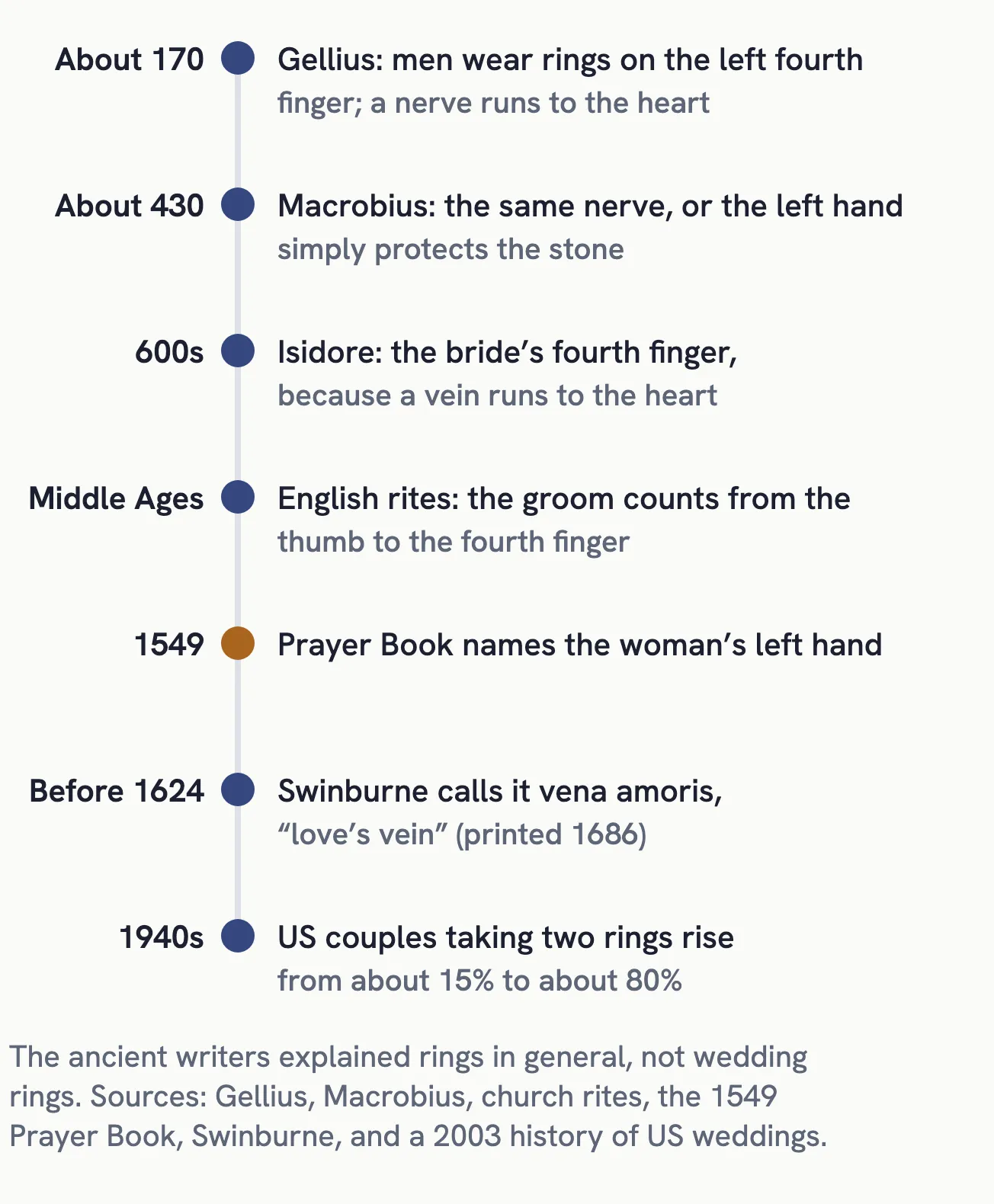
How the ring finger story grew, from the sources themselves.
Which finger do men wear a wedding ring on?
The same finger as women in each tradition: the left ring finger in the US and UK, and the right in Germany, Austria and the Orthodox churches.
Men’s wedding rings are newer than most people think. Our guide to wedding band types has a section on men’s bands. The 1662 Prayer Book gave a ring to the woman only, and in the US wedding rings were long worn by wives alone. A 2003 history of the men’s ring, summarized by JSTOR Daily, found that about 15% of US couples used two rings at the end of the Depression and about 80% by the late 1940s, helped by wartime marriages and a push by jewelers after a 1926 campaign for men’s engagement rings failed.
Men still wear one less often than women. In a 2011 UK survey, 91% of married women and 63% of married men said they wear a wedding ring. We found no recent US figure.
Some faiths have their own guidance. In Islamic teaching, for example, men are discouraged from wearing a ring on the middle or index finger, and many Muslim men choose a band in silver or another metal rather than gold.
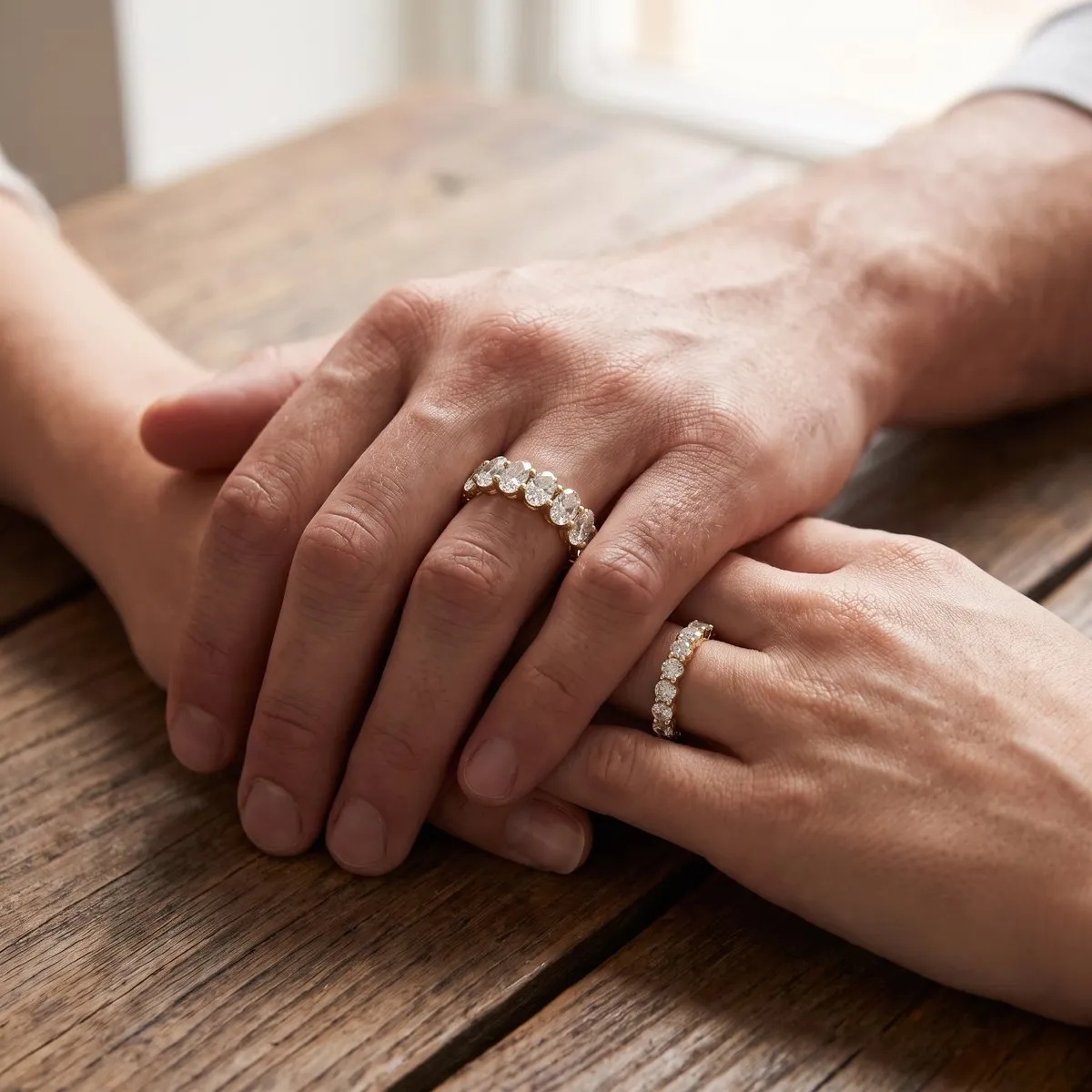
Pictured: two lab-grown diamond wedding bands in yellow gold. Image created from the bands’ designs.
Engagement ring and wedding band: which goes first?
The usual US etiquette advice runs like this: before the ceremony, move the engagement ring to the right hand so the left ring finger is free. The band goes on during the vows, and afterward the engagement ring goes back on the left, above the band. That leaves the band nearest the hand, which is often explained as keeping it “closest to the heart”.
That reason leans on the same vein story, and we found no historical rule behind the order. Jewelers themselves call it personal preference. Practical points matter more:
- Band first is the classic look, and the engagement ring sits above it.
- Engagement ring first puts the band on top, where it can help hold the engagement ring in place.
- Soldering the two together stops them spinning and rubbing, but both then have to be resized together, and it’s harder to wear one alone.
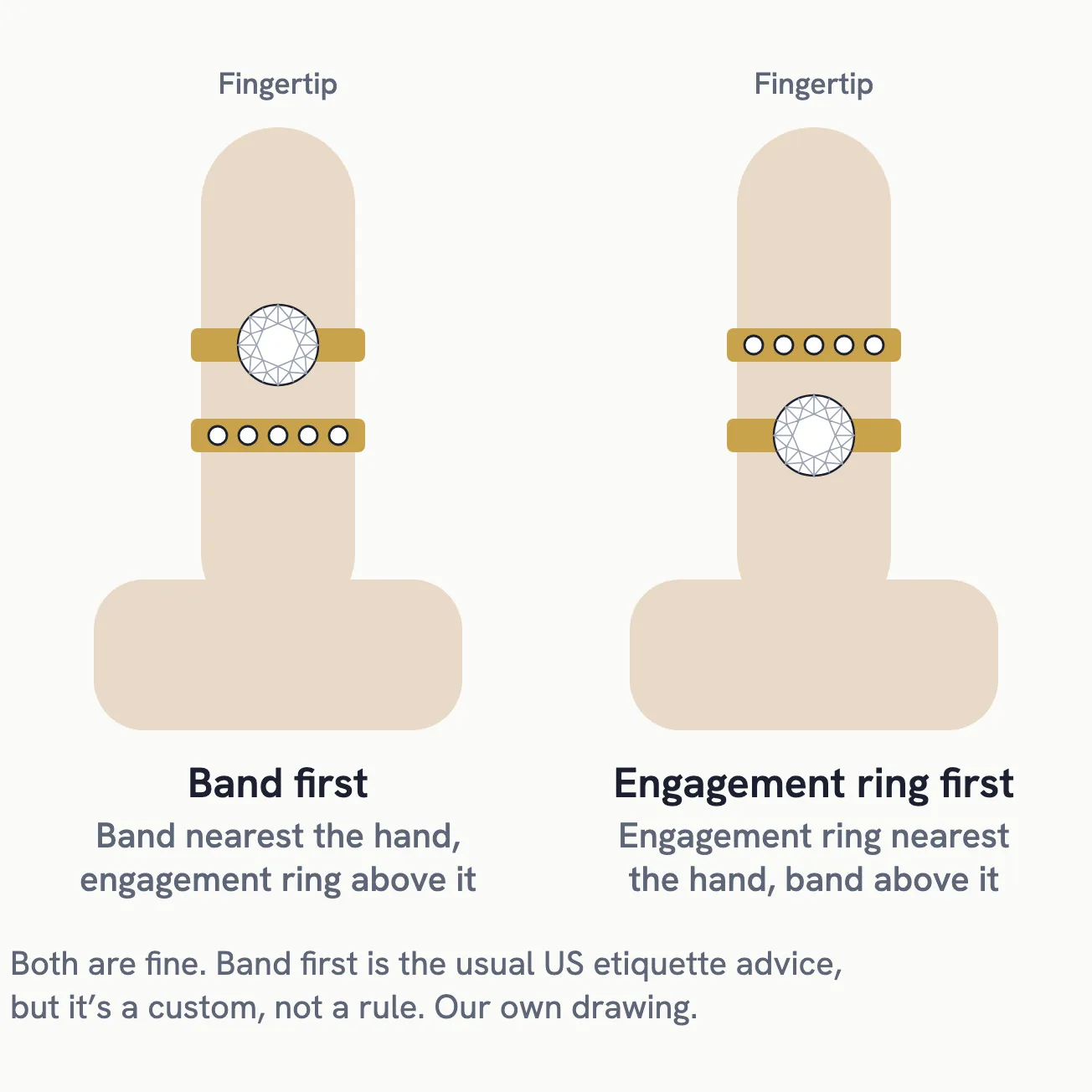
Two ways to wear them. Both are fine.
Our guide to stacking a wedding band with a solitaire shows how different bands sit against an engagement ring.
Can you wear them on different hands?
Yes. Nothing forbids it, and in some countries it’s the custom at some stage: in Brazil and most of Spain the engagement ring sits on the right before the wedding, and Jewish brides receive the ring on the right index finger. Some people simply prefer one ring on each hand, so the rings don’t rub and each one shows.
When the ring finger doesn’t suit you
You don’t have to wear a wedding ring on the ring finger at all. A few common reasons to choose differently:
- You’re left-handed. Some left-handers wear the ring on the right, which is the idle-hand reasoning Macrobius gave 1,600 years ago.
- Your work. US safety rules bar rings and other conductive jewelry near exposed live electrical parts, and many UK hospitals allow staff in patient care one plain band with no stones.
- Sport and climbing. A ring caught on something can cause a serious injury called ring avulsion. At one German hand center, the ring finger was involved in 89% of 87 recorded cases, mostly from accidents outside work, and climbing a fence was linked to the worst. Take rings off for climbing, the gym and work with machinery.
- Wear it on a chain when a ring isn’t practical. Some nurses, electricians and athletes do.
Swelling and arthritis
People with arthritis can wear rings, though knuckles that swell or enlarge make fit harder. Jewelers’ usual fixes are a ring sized to pass over the knuckle with small sizing beads inside to stop it spinning, or a hinged band that opens. On a bad day, wear the ring on another finger or on a chain. Our guide to soldering rings together covers joining a ring to its band.
If a ring gets stuck on a swollen finger, raise your hand, cool it and use soap or lotion. Get help quickly if the finger turns numb, tingly, blue or very painful: emergency rooms, fire departments and many jewelers can cut a ring off. That includes hard metals like tungsten, which can be removed with the right tools, despite the common myth.
What a ring on the right hand means
Officially, nothing. A wedding ring on the right hand may mean the wearer comes from a right-hand country or the Orthodox church, or is protecting the ring or a sore finger. Some widowed or divorced people move their ring to the right hand, but that’s one custom among several, not etiquette. Before same-sex marriage became legal across the US in 2015, some couples wore commitment rings on the right hand, and many moved them to the left once they could marry.
A diamond on the right hand often says nothing about marriage at all. The idea of the “right-hand ring”, a diamond a woman buys for herself, came from a De Beers advertising campaign launched in 2003.
Sizing a ring for your ring finger
Measure the finger and hand you’ll actually wear the ring on. The difference between hands is usually small: the one study we cite in our ring size guide found about an eighth of a size between right-handers’ two index fingers. Measure more than once, at different times of day, and use the guide’s chart in millimeters.
Wedding bands at Whitemoon
Our lab-grown diamond wedding bands come in US sizes 3 to 13 in quarter sizes, and if you don’t know the size you can choose “Don’t know my size” when you order. There’s a range of men’s lab-grown diamond wedding bands too, and eternity bands with stones all the way around. A full eternity band can’t simply be stretched or cut down, so its free size change means remaking the band. Our ring resizing guide explains why. If you’re still deciding on the ring that comes first, see our engagement rings, or our guide to promise rings for a ring before either.
Most Whitemoon rings are made to order in about 10–15 days and ship free with insurance both ways, with 30-day returns on unworn pieces and one free resize within 60 days of delivery.
Wedding ring finger questions
Do I put my wedding ring on my left or right hand?
In the US, UK, Canada and Australia, the left. In Germany, Austria, Poland, Russia, most of Spain and the Orthodox churches, the right. It’s custom, not law, so wear it on whichever hand suits you.
Which hand do you propose on?
In the US and UK, you slip the engagement ring onto your partner’s left ring finger. In Brazil and most of Spain the engagement ring goes on the right hand instead.
What does it mean if I put my wedding ring on my right hand?
Nothing official. In right-hand countries it’s simply normal. Elsewhere it may mean you’re protecting the ring, have a sore or swollen finger, are left-handed, or prefer it there.
Which hand is the engagement ring on?
In the US, the left ring finger. On the wedding day many brides move it to the right hand for the ceremony, then wear it above the band afterward. In other countries it varies, and it’s worn on the right in Brazil and most of Spain until the wedding.
Why do girls wear their engagement ring on their right hand?
Usually because of where they’re from: in several countries the engagement ring or the wedding ring goes on the right. Others do it during the wedding ceremony, after a divorce or loss, for comfort or safety, or because it’s a fashion ring rather than an engagement ring.
Can you wear an engagement ring and a wedding band on different hands?
Yes. No rule forbids it, and it keeps the rings from rubbing against each other. In some countries the two rings are on different hands for part of the engagement.
Which finger is forbidden to wear a ring?
There’s no general rule. The only real one we found is religious: in Islamic teaching, men are discouraged from wearing a ring on the middle or index finger. Lists of “forbidden” fingers elsewhere are folklore.
Can people with arthritis wear rings?
Yes. A ring sized to pass the knuckle with sizing beads inside, or a hinged band, makes it easier. Take rings off early when fingers swell, and get help if a stuck ring makes a finger numb or blue.
Which finger is the ring finger for men?
The same as for women: the fourth finger, between the middle and little fingers, on the left hand in the US and UK and the right in countries that use the right.
What hand does a wedding ring go on in America?
The left ring finger, for both spouses. Some Orthodox Christians in the US keep the right hand, and Jewish couples often move the ring from the right index finger to the left ring finger after the ceremony.
Do you stop wearing your engagement ring once you’re married?
No. Many people keep wearing it with the wedding band, usually on the same finger. Some save it for occasions and wear the band alone day to day. Our guide to engagement rings vs wedding rings covers whether you need both. It’s your choice.