
Types of Wedding Bands: Styles, Carats and How to Match Your Engagement Ring
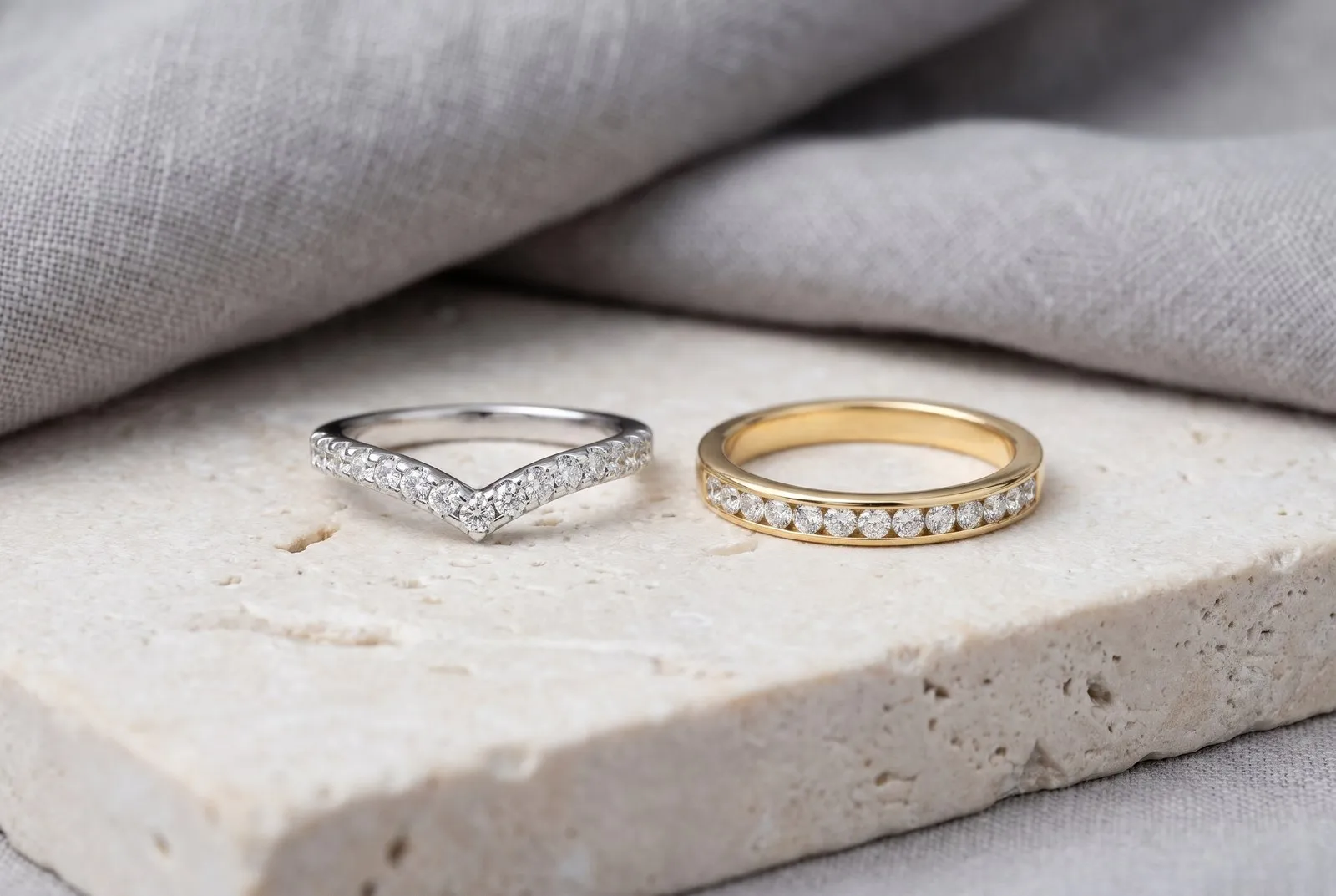
The main types of wedding bands are plain metal bands, diamond bands such as eternity, half eternity, pavé, channel-set and bezel-set styles, shaped bands that curve around an engagement ring, and add-ons such as ring jackets and wraps. Which one suits you depends on the engagement ring it sits beside, how hard you are on your hands, and how much sparkle you want.
We make lab-grown diamond wedding bands, so we counted our own range on November 12, 2026: 425 designs, sorted by style, by the total diamond weights each one comes in, and by price. This guide pairs those numbers with GIA’s definitions and care notes, and says plainly where a common “rule” has nothing behind it.
Pictured: a pavé chevron band in white gold and a channel-set half eternity band in yellow gold, both with lab-grown diamonds. Image created from the designs.
Types of wedding rings and bands at a glance
| Type | What it is | Good to know |
|---|---|---|
| Plain band | Metal only, in a flat, domed or ridged shape | The easiest to resize and to wear with anything |
| Half eternity | Diamonds across the top half of the band | Plain metal at the back, so it can usually be resized |
| Full eternity | Diamonds all the way around | Very hard to resize; usually remade in a new size |
| Pavé | Small diamonds set close together, held by tiny beads or prongs | Lots of sparkle; needs a check now and then |
| Channel set | A row of diamonds between two metal walls | Smooth edges, suited to daily wear |
| Bar set | Each diamond held between upright metal bars | Secure, with the stones’ sides a little more exposed |
| Bezel set | A thin metal rim around each diamond | The best protection against chips |
| Curved or contour | A band that bends around the engagement ring’s center | Closes the gap a straight band can leave |
| Chevron | A band that dips into a V | Made for pointed shapes such as pear and marquise |
| Ring jacket or wrap | A band, or pair of bands, the engagement ring sits inside | Names vary by seller, so look at the shape |
In our own range, half eternity is by far the most common style, and many designs fit more than one row of this table. Browse them all in lab-grown diamond wedding bands.
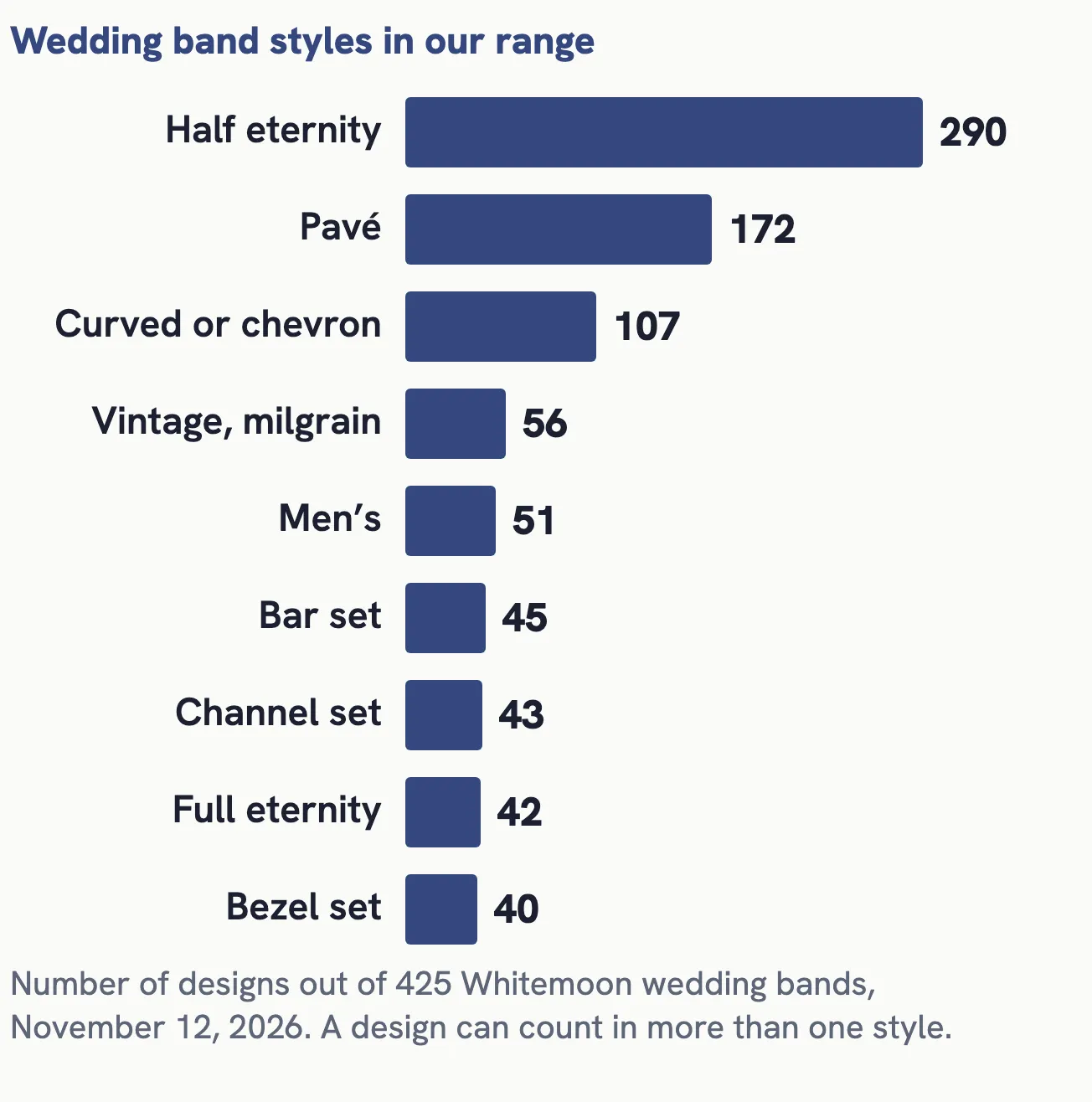
How many of our 425 band designs fall in each style.
Plain band shapes: flat, D-shape, court and knife edge
A plain band is described by its cross-section, the shape you’d see if you cut through it. No gem lab or standards body defines these names, but jewelers use them consistently.
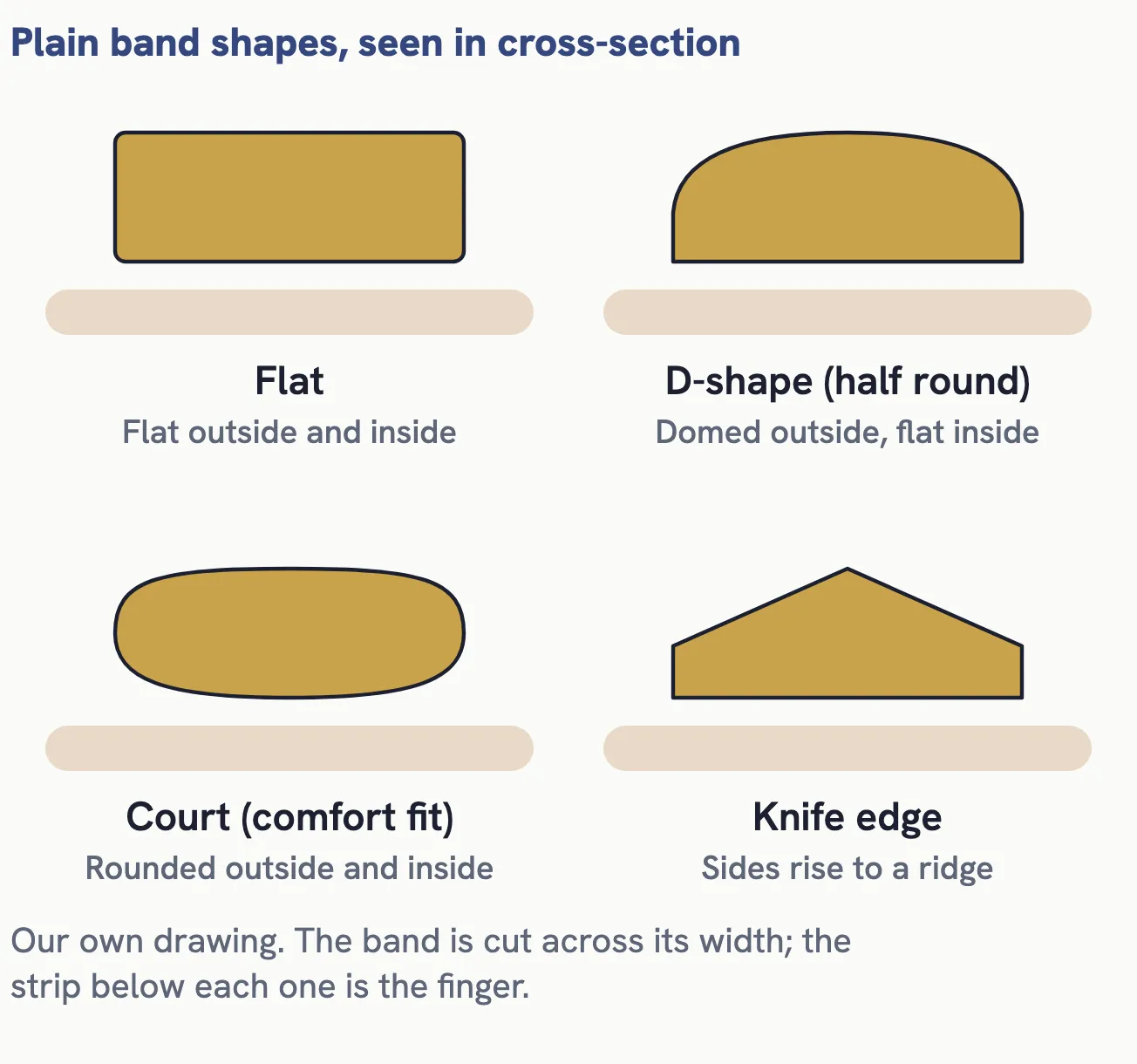
Four plain band shapes, cut across the band.
- Flat: flat outside and inside, with squared edges.
- D-shape (often “half round” in the US): domed outside, flat inside.
- Court (the UK name) or comfort fit (the US name): rounded on the inside, so it slides over the knuckle more easily. Comfort fit describes the inside only; the outside can be any shape.
- Knife edge: two sides rising to a ridge along the top.
Diamond band settings and how they wear
The setting is how the diamonds are held, and it decides how a band stands up to daily wear. GIA’s guide to ring settings gives these notes.
- Bezel: excellent protection for a stone’s edges, smooth and unlikely to catch, though it lets in slightly less light. See bezel set wedding bands.
- Channel: durable and suited to daily wear, and less likely to catch than prong-set stones. See channel set wedding bands.
- Bar: good security, with the stones slightly more open to knocks. See bar set wedding bands.
- Pavé: a continuous sparkling surface that needs occasional maintenance. See pavé wedding bands.
GIA adds that channel, pavé and bar bands are harder to resize than plain ones. “Shared prong”, where each prong holds two neighboring stones, and “French pavé” are trade terms with no formal definition, so ask to see a close-up before you rely on the name.
Eternity vs half eternity bands
An eternity band has diamonds around the entire band; a half eternity band has them across the top only. Either is a classic milestone gift, as our diamond anniversary gift guide explains. The practical difference is sizing. GIA says an eternity ring “can be very difficult” to resize, because there’s no plain metal to cut or add to. At Whitemoon a full eternity band is remade in the new size instead. Our ring resizing guide lists the other rings that are hard to resize.
That’s one reason half eternity dominates: 290 of our 425 designs are half eternity and 42 are full eternity. A full eternity band also carries far more diamond. Our half eternity designs typically come in 0.25 to 0.50 carats total, and our full eternity designs in about 2.25 to 4.75 carats. See eternity bands.
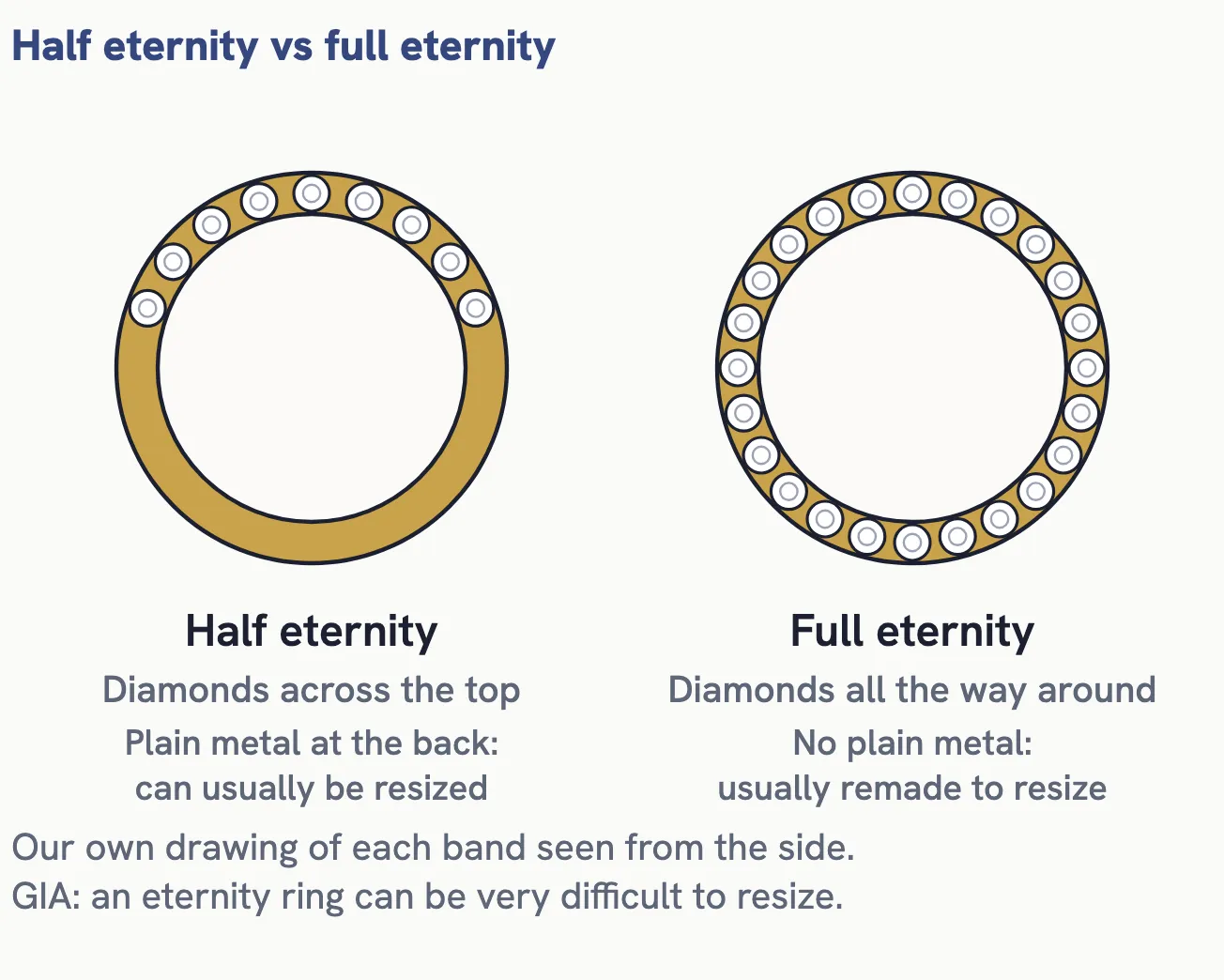
Half eternity and full eternity, seen from the side.
Curved, contour and chevron bands
A straight band sits flush against an engagement ring only if the ring’s center is set high enough to clear it. With a low-set center, a halo or a basket, a straight band leaves a gap. A curved or contour band bends around the center to close it, and a chevron band dips into a V. We have 107 curved, contour and chevron designs; see curved wedding bands and chevron wedding bands.
A gap isn’t a fault. Some people like the look, and it was the usual one before contour bands were common. The only way to know how two rings sit is to try them together, or to compare both from the side.
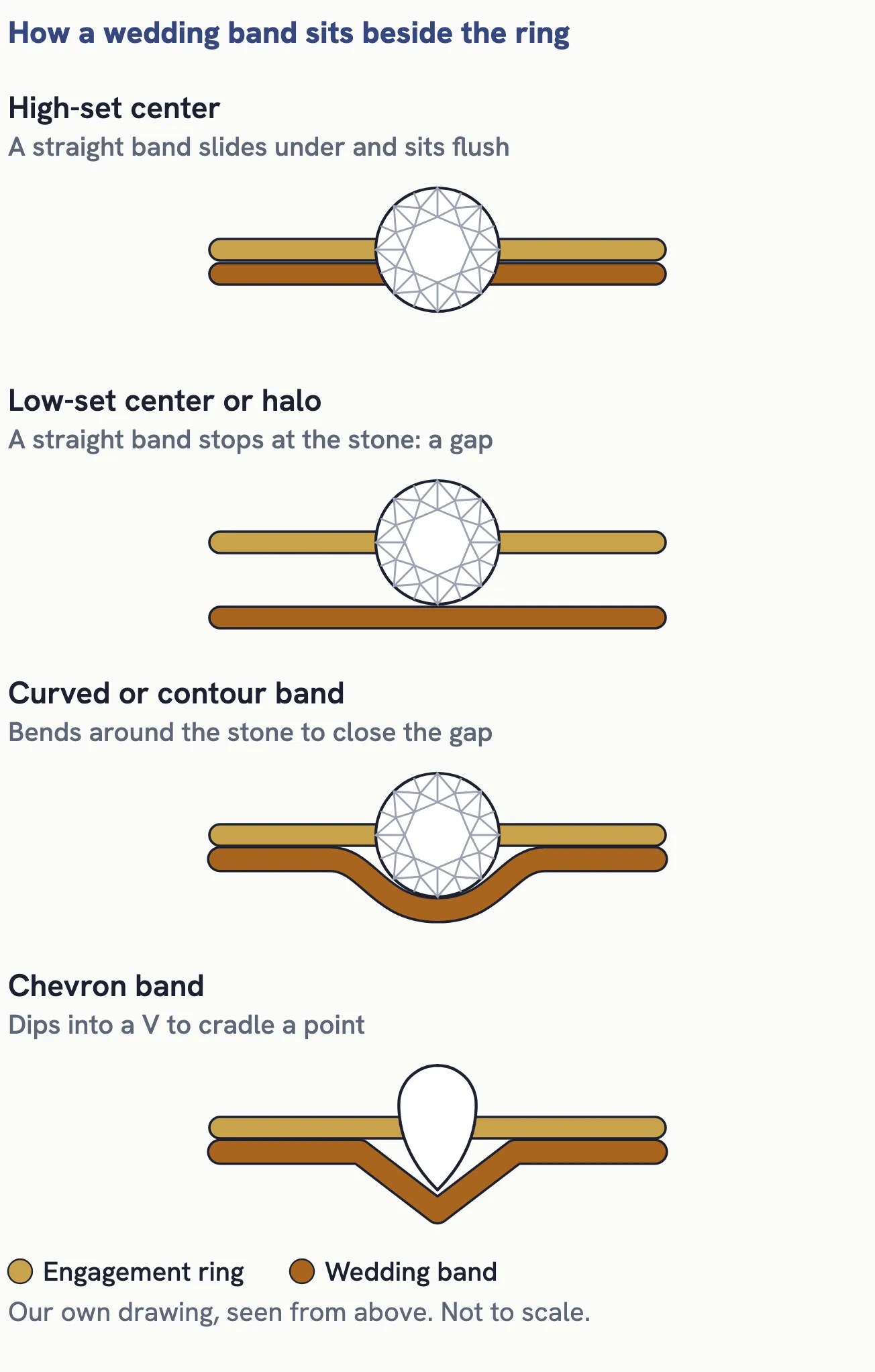
Why some rings need a curved or chevron band.
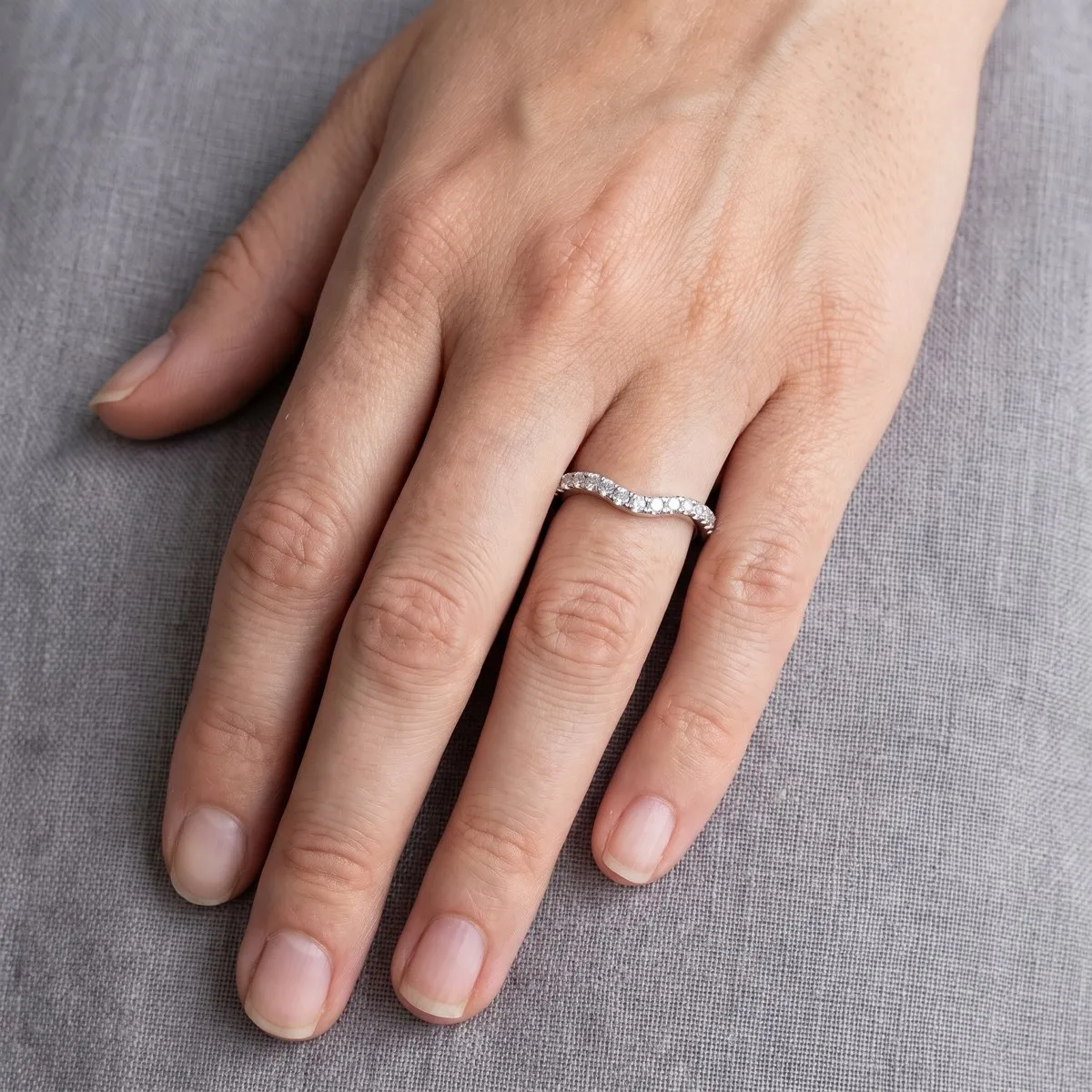
A curved pavé wedding band in white gold, worn alone. Image created from the design.
What is a ring jacket?
A ring jacket is usually two bands joined at the back, with a space between them that the engagement ring slides into. A wrap is a single band that curves around one side of the center stone. “Ring guard” and “ring enhancer” are used for both. None of the four has a standard definition and sellers swap the names, so go by the shape in the photo and not the word.
The idea is old. The Royal Collection holds a keeper ring that George III gave Queen Charlotte on their wedding day in 1761, worn beside her wedding ring to keep it in place. Today’s jackets do a different job: they frame an engagement ring and add diamonds to it.
How to match a wedding band to your engagement ring
GIA’s advice is simple: make sure the two silhouettes match and the rings fit together, and let the band complement the ring instead of competing with it. For a large solitaire it suggests a thin, detailed band. Beyond that, no lab or study gives rules for particular ring styles, so the table below is our own view from fitting bands to rings.
| Engagement ring | Band that usually fits | Why |
|---|---|---|
| High-set solitaire | Straight band, plain or half eternity | The center clears the band, so it sits flush |
| Low-set solitaire, halo or basket | Curved or contour band | The center blocks a straight band |
| Pear or marquise | Chevron band | The V cradles the point |
| Three stone or toi et moi | Wide, shallow curve, or a straight band with a gap | The row of stones is long, so a tight curve won’t clear it |
| Split shank | Contour band, or a jacket | The split is wide at the top and pushes a straight band away |
| Princess cut | Straight or softly curved band that doesn’t touch the corners | Pointed corners are the part of the stone most open to chipping |
Our guide to stacking a band with a solitaire shows more pairings.
Do the metals have to match?
No. GIA says a single metal gives a cohesive set while mixed metals give a more modern look. In The Knot’s 2017 study, 90% of couples bought bands that didn’t match each other.
You’ll often read that a platinum ring wears down a gold band because platinum is harder. The hardness figures don’t support that: common platinum alloys are softer than 14K gold. Any two rings worn together rub and wear a little, whatever they’re made of, and diamonds on one ring can scratch the metal of the other. Our ring soldering guide charts the hardness of each metal.
How many carats should a wedding band have?
There’s no right number. Carat weight on a band is a total: GIA defines total carat weight as the weight of all the diamonds in a piece added together. Because the stones are small, a 1 carat total band costs far less than a single 1 carat diamond.
Of the 380 Whitemoon band designs that offer a choice of weight, the most common options are 0.50 carats (227 designs), 0.35 carats (194) and 0.25 carats (167). About a quarter offer 1 carat, and 32 offer 2 carats. In white gold, going from 0.25 to 0.50 carats typically adds about $270, and from 0.50 to 1 carat about $300.
In our opinion, the useful question is how the band looks beside the engagement ring. A band of 0.25 to 0.50 carats total reads as a fine line of sparkle next to a 1 to 2 carat center; a band of 1 carat or more starts to share the attention. On labels, the FTC’s weight rule says a decimal weight should be accurate to the last digit shown, while a fraction such as “1/2 carat” is approximate and the seller should state the range it covers.
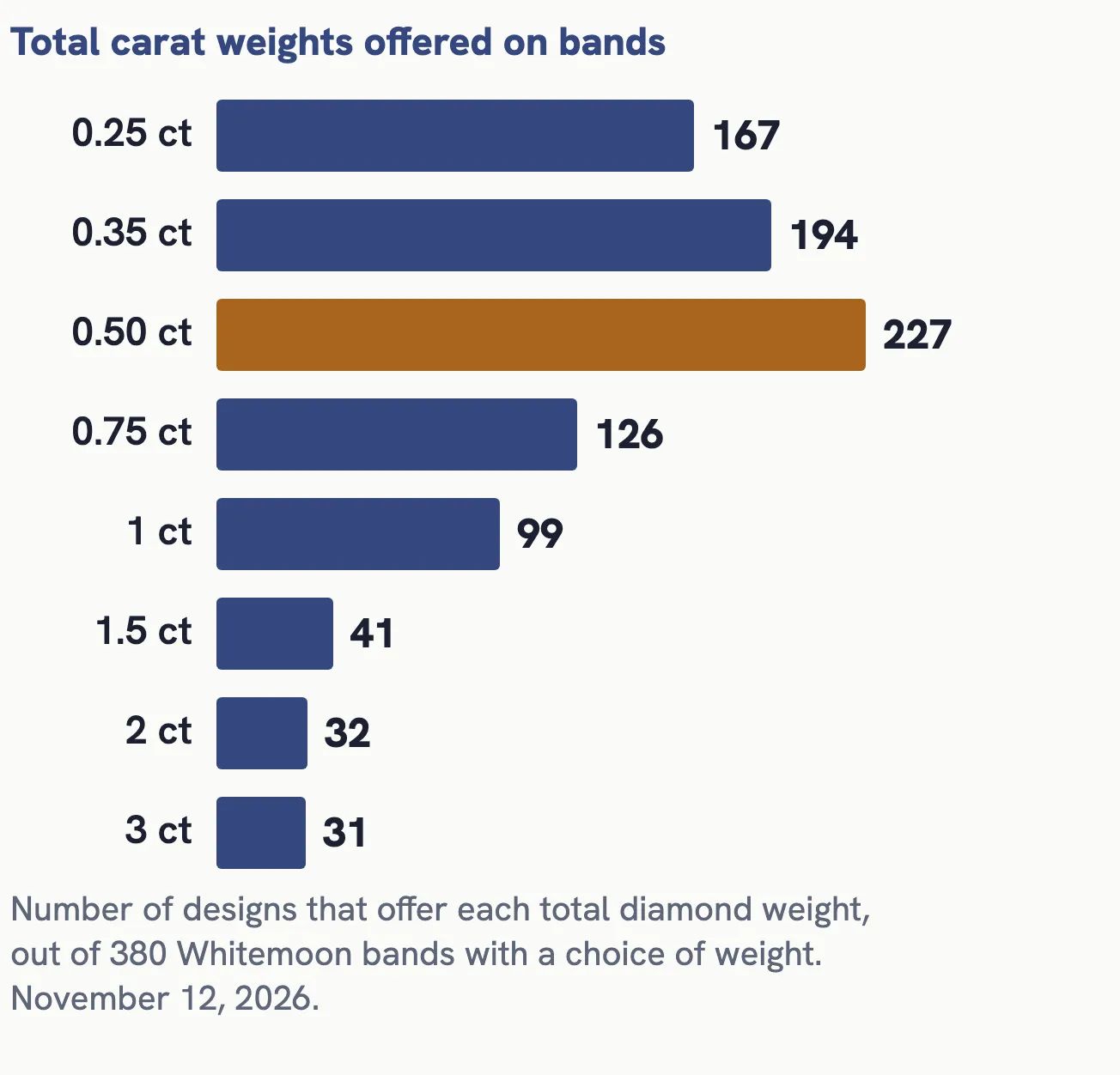
The total weights our bands come in.
Men’s wedding bands
In the US, men’s wedding bands are a 20th-century custom. A history of the men’s ring, summarized by JSTOR Daily, found that about 15% of couples used two rings at the end of the Depression and about 80% by the late 1940s.
For a band that will take knocks, GIA’s advice on men’s bands is that bezel and channel settings protect the stones, that a single bezel-set diamond is the most durable choice, and that the more active the wearer, the simpler the band should be. It also notes that tungsten and some other alternative metals are hard to resize or to cut off in an emergency.
On popularity, be wary of undated claims. Tungsten led The Knot’s surveys of grooms in 2015 and 2017, at about 30%, and we found no reliable newer split. We make 51 men’s designs in gold, platinum and Silvadium, our tarnish-resistant sterling silver, mostly pavé and bar set; the typical one costs about $1,170 in white gold. See men’s lab-grown diamond wedding bands.
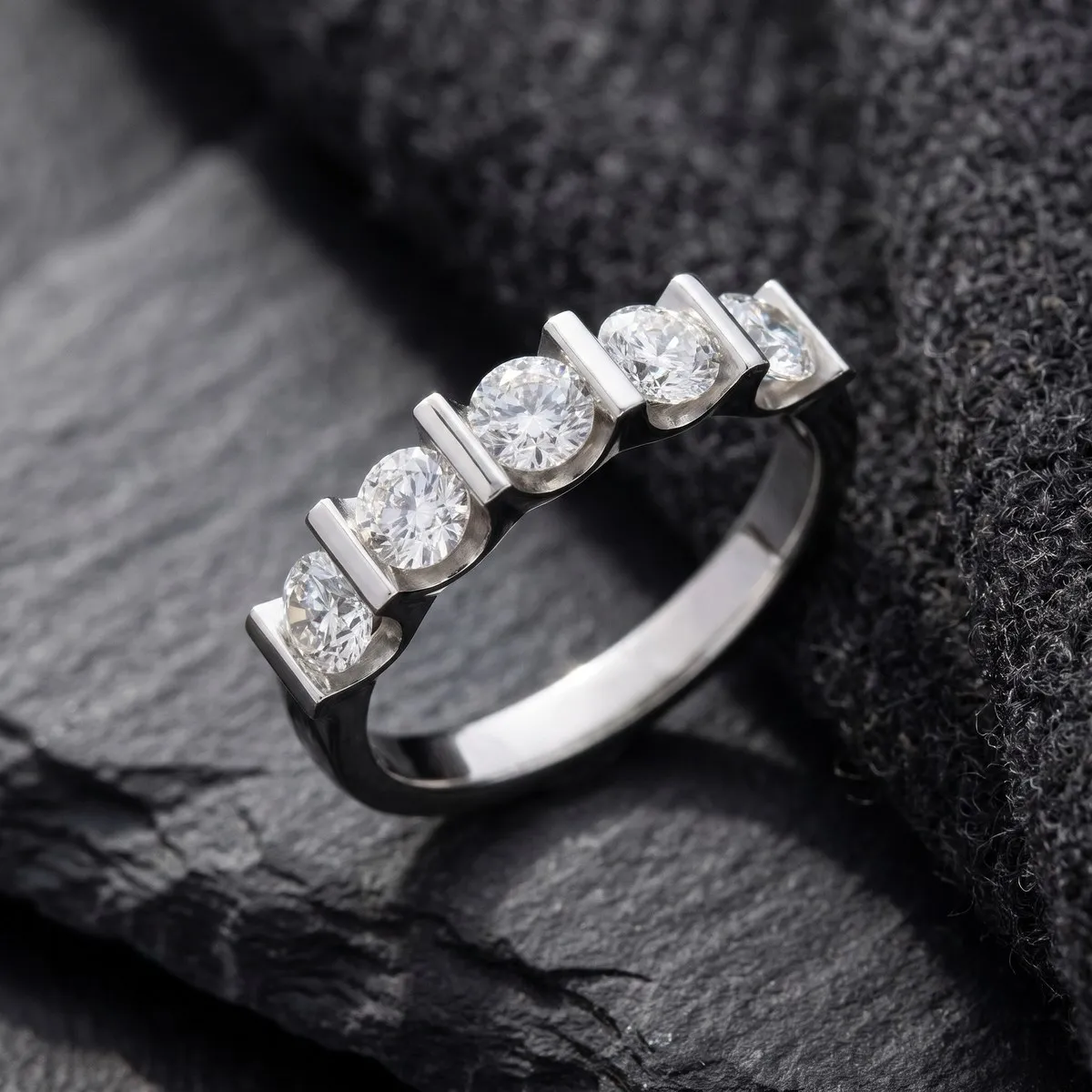
A men’s five stone bar-set band in white gold. Image created from the design.
Wedding band trends in 2026
The best dated source we found is Rapaport Magazine’s September 2026 report, which quotes jewelers and sales analysts.
- More spent on each band. Analyst Edahn Golan put the average band at just under $1,500 and diamond-set bands at about $2,500, with spending up 16–18% in a year even as fewer bands sold.
- Yellow gold. Stuller, a large US jewelry supplier, said yellow gold was over 55% of its band sales by units, with 14K the top karat.
- Eternity styles. Stuller’s bridal manager said fully set eternity bands are pulling prices up.
- Stacks and wider bands. Jewelers described stacks spreading across both hands, and some couples choosing wider styles once kept for anniversaries.
You’ll also see “chunky” cigar and dome bands called the trend of the year. Jewelers do report interest in wider gold bands, but we found no sales figures behind the claim.
Width, weight and how much gold is in a band
Width is taste, not a rule. GIA’s only notes are that a thicker band makes a center stone look smaller, and that wide bands fit more snugly and usually need to be a bit larger. Our ring size guide explains how to measure.
Weight follows from size and metal. By our arithmetic, using Stuller’s metal densities, plain bands weigh about this much.
| Plain band | 14K gold | 18K gold | Platinum |
|---|---|---|---|
| 2 mm wide, size 7 | 1.8–2.3 g | 2.2–2.8 g | 3.0–3.8 g |
| 3 mm wide, size 7 | 2.9–3.7 g | 3.5–4.5 g | 4.8–6.1 g |
| 5 mm wide, size 10 | 6.3–8.0 g | 7.5–9.5 g | 10.3–13.1 g |
| 6 mm wide, size 10 | 8.4–10.7 g | 10.0–12.8 g | 13.8–17.6 g |
Estimates for bands 1.5 to 2 mm thick; the low figure is a rounded profile and the high figure a flat one. Real bands vary with shape and finish.
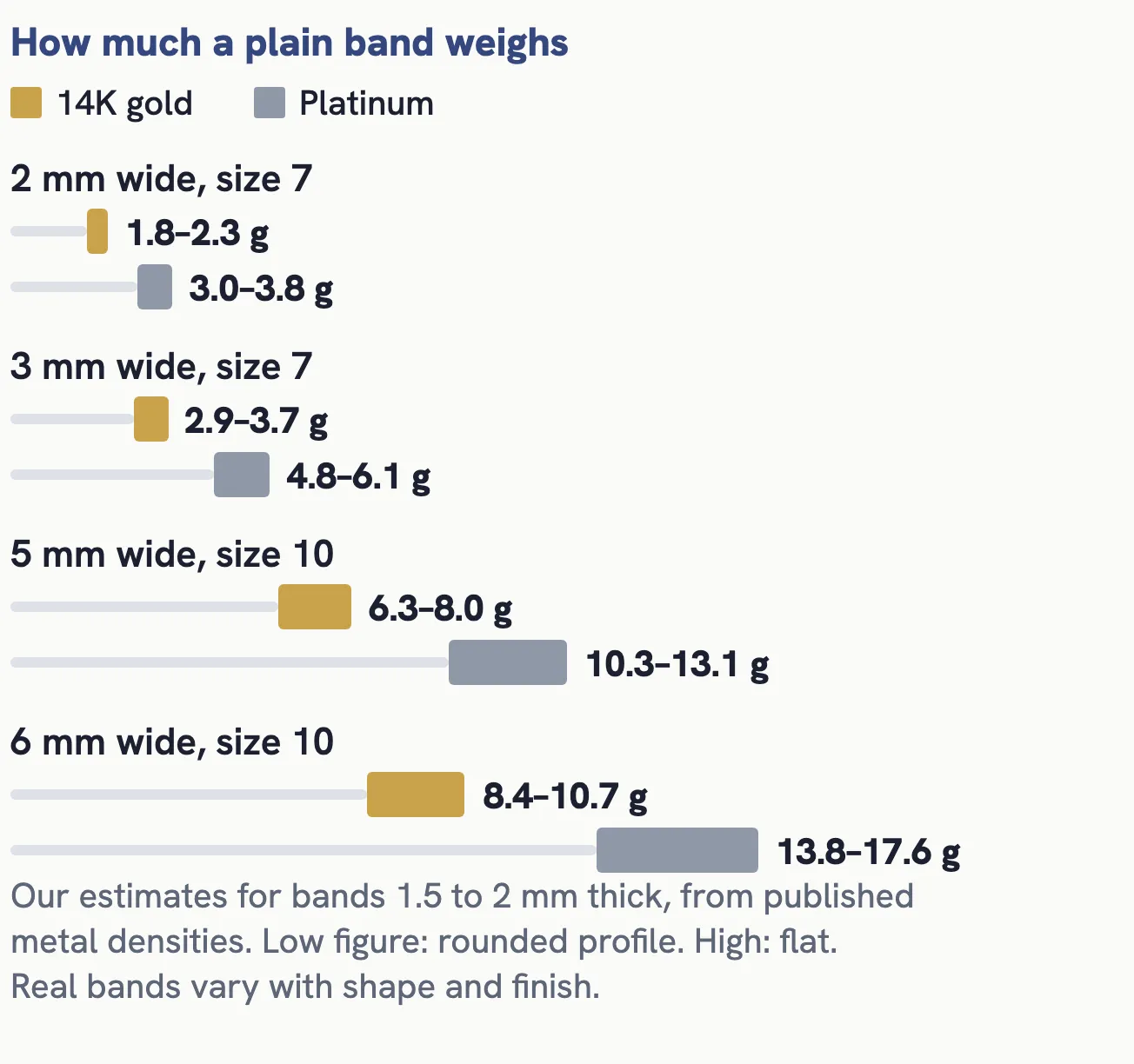
Estimated weight of a plain band by width and metal.
So 4 grams is about normal for a 3 mm gold band and light for a man’s band, and 7 grams is heavy for a slim band but ordinary for a 5 to 6 mm one. A 14K band is 58.3% gold (see our gold karat guide), which puts roughly 1 to 2 grams of pure gold in a slim 14K band and about 4 to 6 grams in a 5 to 6 mm one.
What lab-grown diamond wedding bands cost at Whitemoon
On November 12, 2026, the typical Whitemoon wedding band started at $256 in Silvadium, $732 in gold and $1,319 in platinum, at the design’s lowest diamond weight. By style, in white gold:
| Style | Designs | Typical starting price, white gold |
|---|---|---|
| Bezel set | 40 | $665 |
| Curved, contour or chevron | 107 | $686 |
| Half eternity | 290 | $706 |
| Pavé | 172 | $707 |
| Channel set | 43 | $877 |
| Full eternity | 42 | $946 |
| Bar set | 45 | $1,034 |
| Men’s | 51 | $1,167 |
Median of each design’s starting price. A design can count in more than one row. Our comparison of white gold and silver explains the gap between metals.
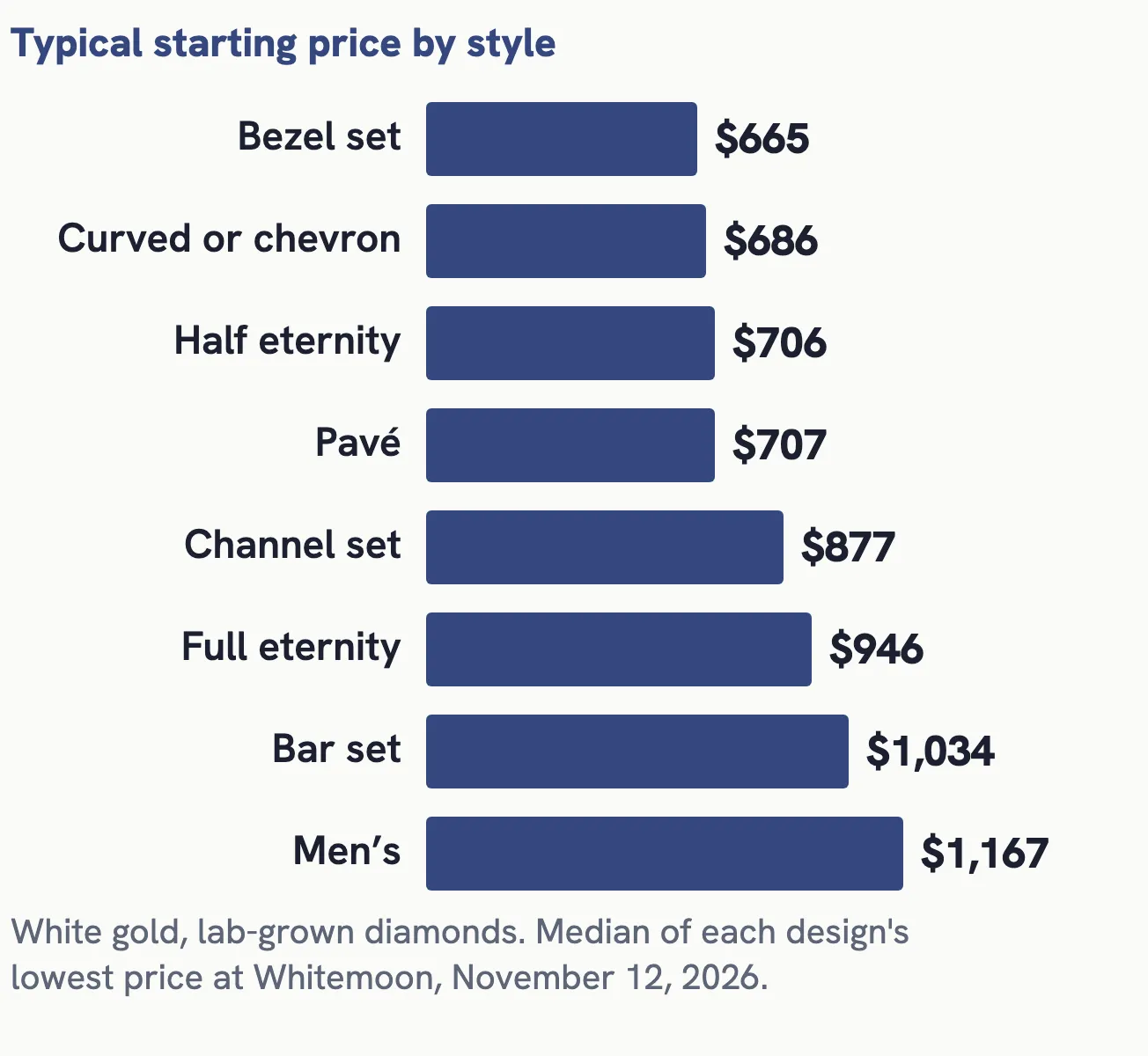
Typical starting price by style, November 12, 2026.
Most Whitemoon rings are made to order in about 10–15 days and ship free with insurance both ways, with 30-day returns on unworn pieces and one free resize within 60 days of delivery.
Wedding band questions
What are the different types of wedding rings?
Plain bands, diamond bands (eternity, half eternity, pavé, channel, bar and bezel set), shaped bands (curved, contour and chevron), and jackets or wraps that an engagement ring sits inside.
What is a ring jacket?
Usually two joined bands with a space between them for the engagement ring. Sellers also call it a guard, enhancer or wrap, so check the shape.
What wedding band goes with a split shank ring?
Often a contour band or a jacket, because the split is wide at the top and holds a straight band away from the ring. Try the two together before you decide.
What wedding band goes with a three stone or toi et moi ring?
A band with a wide, shallow curve, or a straight band worn with a small gap, since the row of stones is too long for a tight curve to clear.
What wedding band matches a princess cut engagement ring?
A straight or softly curved band that sits clear of the stone’s corners. Channel-set princess cut bands echo the square shape.
What carat should I get for a wedding band?
There’s no standard. The most common choices in our range are 0.25 to 0.50 carats total, enough for a line of sparkle without competing with the engagement ring.
Is 4 grams heavy for a ring?
Not for a gold band about 3 mm wide, which weighs roughly 3 to 4 grams in 14K. It would be light for a man’s 6 mm band.
How much gold is in a typical wedding band?
By our estimate, about 1 to 2 grams of pure gold in a slim 14K band and about 4 to 6 grams in a 5 to 6 mm 14K band.
What is the most popular wedding band for a man?
The last reliable survey split we found is The Knot’s 2017 study, where tungsten led at 29%. In 2026, jewelers told Rapaport that yellow gold is coming back.
What is the most timeless wedding ring style?
No data settles it. In our opinion a plain band or a slim half eternity band dates the least, because neither depends on a trend.
Can you have different color wedding bands?
Yes. Mixed metals are a matter of taste, and most couples don’t buy matching bands.
What are the trends for wedding bands in 2026?
Jewelers report more yellow gold, more fully set eternity bands, stacks of several rings and wider bands, according to Rapaport Magazine in September 2026.
Can an eternity band be resized?
Rarely. GIA calls it very difficult, so a full eternity band is usually remade in the new size.