
White Gold vs Sterling Silver: Which Is Better?
White gold is gold mixed with whitening metals and usually plated with rhodium for a bright white finish. Sterling silver is at least 92.5% silver, usually with copper. White gold is harder, rarely tarnishes and holds far more metal value. Silver costs much less and weighs less, but it tarnishes and dents more easily. For an engagement ring worn every day, white gold is the safer choice. For earrings, pendants and fashion pieces, silver works well.
We sell both: white gold in 10K, 14K and 18K, and Silvadium, our tarnish-resistant sterling silver. So we priced the same 40 wedding band designs in every metal we offer on November 11, 2026, and checked the claims competitors repeat against metallurgy and dermatology sources. A white gold band cost about three to four times its Silvadium twin, though in 14K it held about 60 times the metal value.
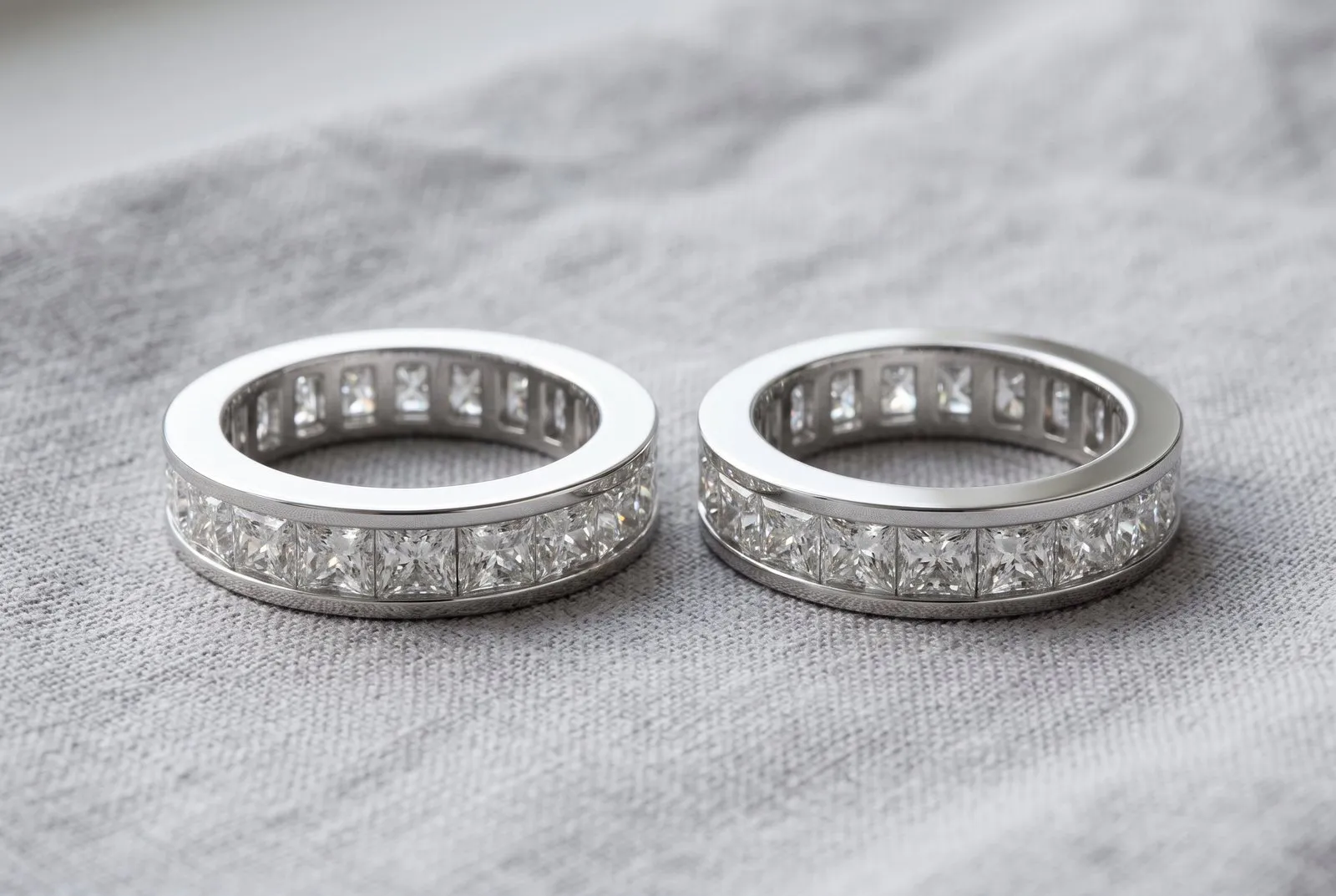
Pictured: the same channel-set eternity band in white gold and in Silvadium, our tarnish-resistant sterling silver. Image created from the design.
What’s the difference between white gold and silver?
| 14K white gold | Sterling silver | |
|---|---|---|
| What it is | 58.3% gold plus whitening metals | At least 92.5% silver, usually plus copper |
| Finish | Usually rhodium-plated | Polished, sometimes plated |
| Changes over time | Plating wears, showing a warmer tone | Tarnishes yellow to black |
| Hardness | About twice as hard as cast sterling | Softer; dents and scratches more easily |
| Weight | About 21% heavier for the same design | Lighter |
| Our typical band price | $671 in 10K, $988 in 14K | $249 in Silvadium |
Hardness and weight from the sources in the sections below. Band prices: median of 40 Whitemoon designs sold in every metal, November 11, 2026.
What’s in white gold?
White gold is karat gold, so 14K white gold is 58.3% gold by weight and 18K is 75%, the same as yellow gold. The rest is metals that bleach gold’s color, mainly nickel or palladium, with copper, zinc and sometimes silver. A metallurgy reference by Christopher Corti explains that these alloys often keep a faint yellowish or grayish tint, which is why most white gold is plated with rhodium, a bright white metal from the platinum family.
Does white gold contain silver? Sometimes. Palladium white golds often do, and one 14K recipe in Corti’s tables is about a third silver. Nickel white golds, the main kind in the United States, usually contain none.
What’s in sterling silver?
Sterling is at least 925 parts silver in 1,000. Pure silver is too soft for most jewelry, so the rest is usually copper, which hardens it. “Tarnish-resistant” silvers add small amounts of other metals to slow tarnish. Silvadium is the tarnish-resistant sterling silver we use.
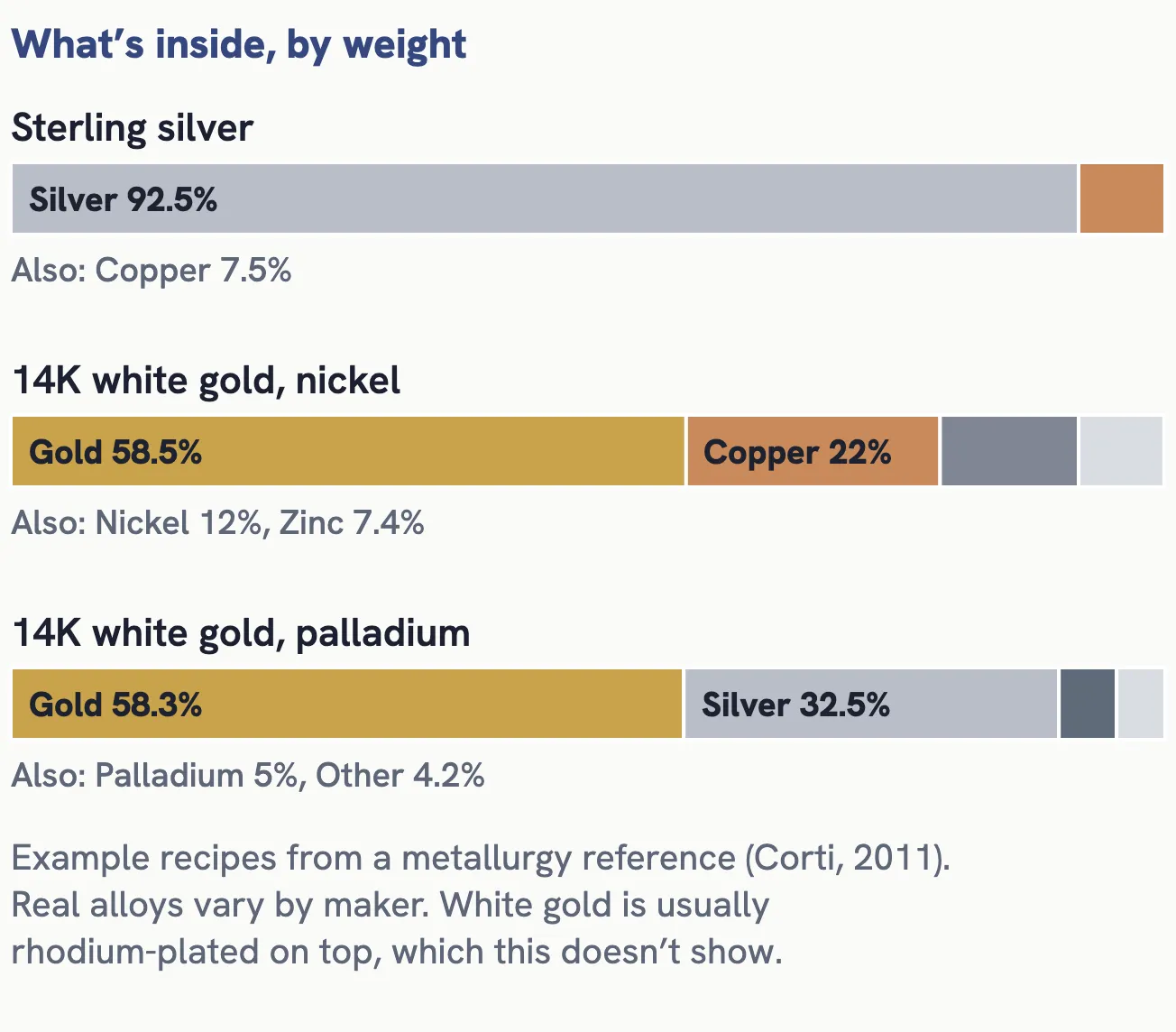
Example recipes. White gold is usually rhodium-plated on top.
Is white gold real gold? Is sterling real silver?
Yes to both. White gold is karat gold: a 14K white gold ring is 58.3% gold by weight, exactly like a 14K yellow gold ring, with different metals making up the rest. Sterling is solid silver by law, not a plating, as long as it meets the 92.5% minimum. What isn’t solid is jewelry described as gold-plated, silver-plated or vermeil, which is a thin layer over another metal.
What the labels mean
US rules are strict about both metals, so the stamp and the wording tell you a lot.
- Sterling requires at least 92.5% silver under the FTC’s Jewelry Guides. A lower-grade alloy may be called silver only with its number shown, such as “800 silver”. Silver-plated pieces can never be stamped sterling.
- White gold follows the gold rules: the karat must appear, as in “14K white gold”.
- Rhodium plating must be disclosed. The FTC says it’s deceptive to leave it out on precious metal jewelry, and its own examples are rhodium-plated white gold and silver.
- Stamps to look for: 14K or 585, 18K or 750, and 10K or 417 for white gold; 925, S925 or Sterling for silver. A US quality stamp has to be accompanied by the maker’s trademark.
Does white gold tarnish? Does silver?
White gold rarely tarnishes. The FTC lists gold of 10K and up among metals that may be called corrosion resistant, and rhodium doesn’t tarnish. What changes is the plating: it slowly wears away, and the slightly warmer metal underneath starts to show. GIA says white gold may need re-plating every few years. Re-plating is part of our 3-Year and 5-Year Whitemoon Care plans.
Silver does tarnish. The Canadian Conservation Institute explains that sulfur gases in the air, especially hydrogen sulfide, form a film of silver and copper sulfide. A very thin film looks yellow, then brown or blue, and above about 100 nanometers it looks black. Humid air speeds it up, and sterling tarnishes faster than pure silver because of its copper.
- Anti-tarnish alloys slow it but don’t stop it. An alloy maker’s review of 25 years of such silvers found tarnish on sterling can be delayed but not completely avoided.
- Rhodium on silver helps until it wears, after which the silver underneath can tarnish unevenly.
- Storage matters. Keep silver dry, ideally in a closed pouch or box, away from rubber bands and wool. Tarnish comes off with a silver polishing cloth.
Which is stronger, white gold or silver?
White gold, by a wide margin for rings. Hardness measures how well a metal resists dents and scratches. Sterling silver as cast or annealed measures about 60 to 76 on the Vickers scale, while 14K white gold measures about 100 to 160, according to Corti’s tables. Most rings start as castings, so a silver ring is roughly half as hard as a 14K white gold one. Worked silver, as in wire and chain, is harder, close to the softer white golds.
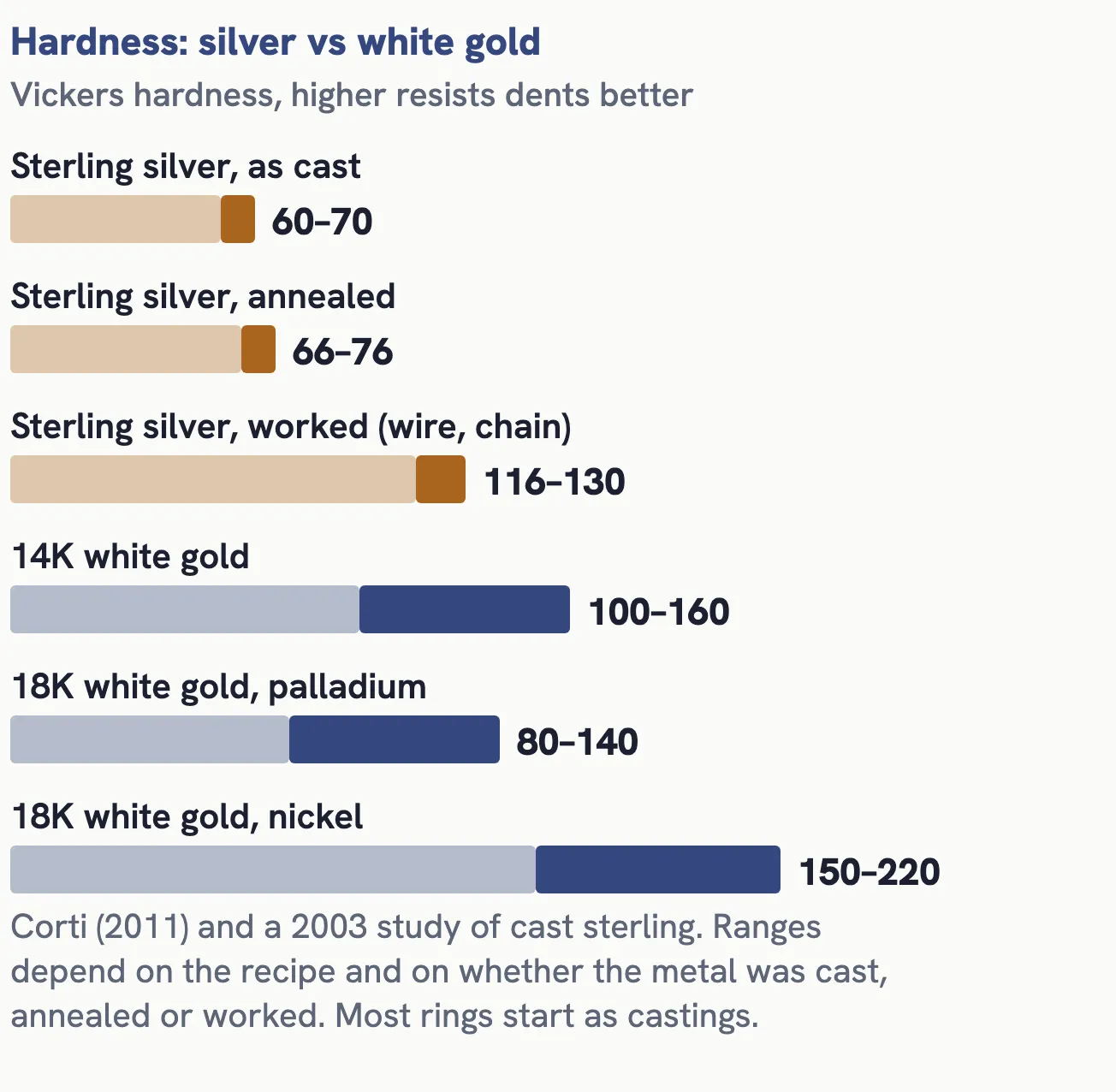
Cast silver is about half as hard as 14K white gold.
GIA says silver scratches and dents more easily and is rarely used for engagement rings or wedding bands. We found no study measuring prong wear by metal. We set lab-grown diamonds in Silvadium across our range, but in our opinion a valuable center stone worn daily belongs in a harder metal that keeps its prongs in shape longer.
Why does white gold cost more than silver?
Mostly the gold. On November 10, 2026, gold traded at about $4,078 an ounce and silver at about $52, so an ounce of gold cost as much as 78 ounces of silver. Gold is also scarcer: the US Geological Survey estimates world mines produced about 3,300 tonnes of gold in 2025 against 26,000 tonnes of silver.
By our arithmetic, a gram of 14K gold held about $76 of gold that day, and a gram of sterling about $1.56 of silver. White gold is also denser, so the same design in 14K white gold holds roughly 60 times the metal value of sterling.
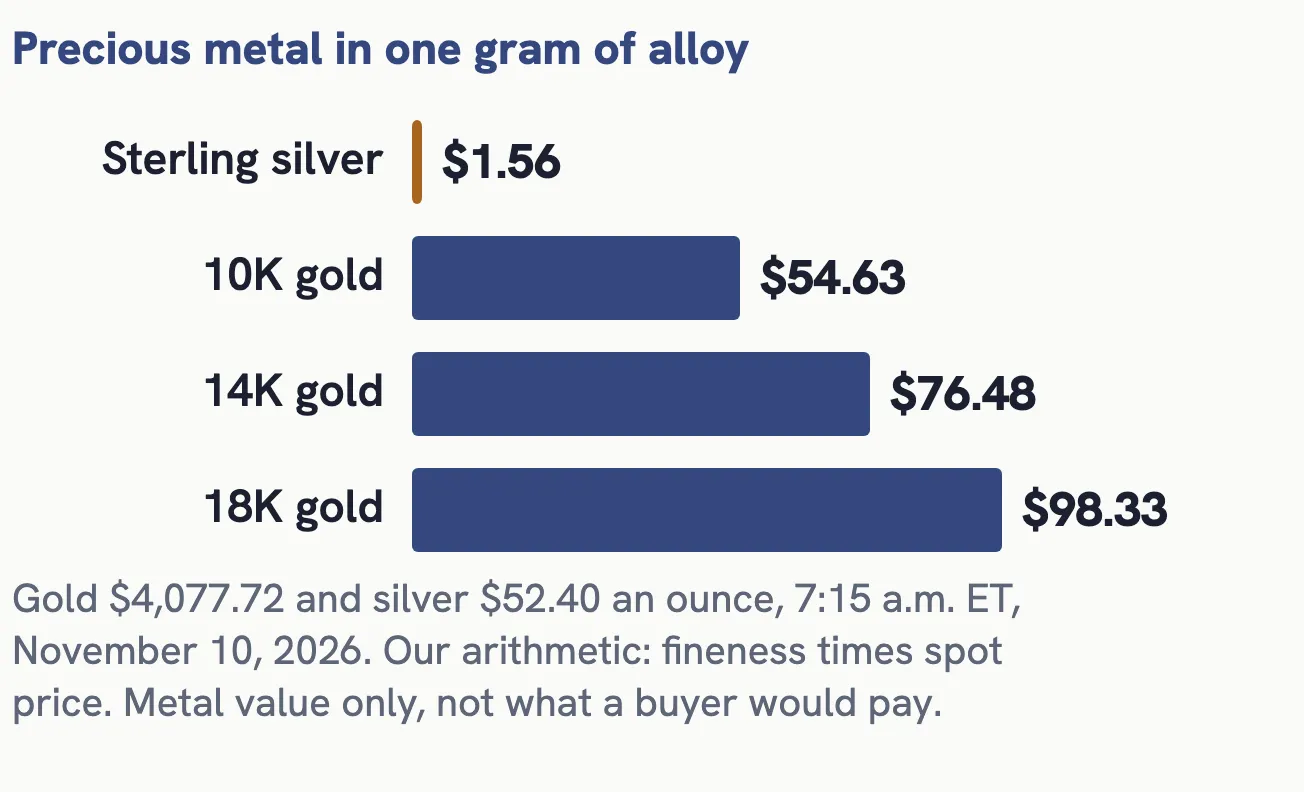
Metal value per gram at November 10, 2026 prices.
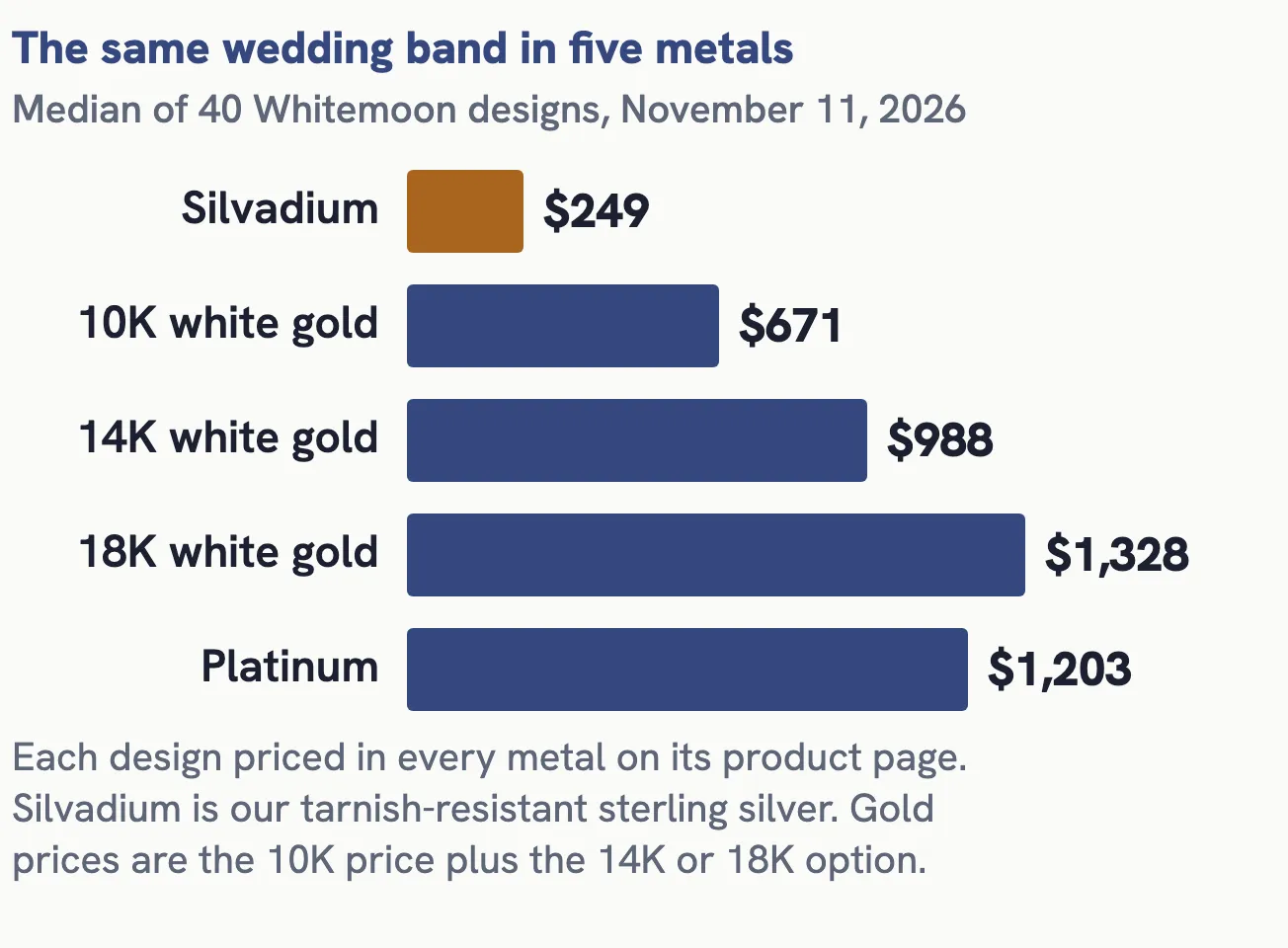
The same bands in every metal we offer, November 11, 2026.
Yet our white gold bands didn’t cost 60 times as much. The diamonds, setting work and making are the same in both metals, so the metal is only part of the price. Across 308 wedding band designs we sell in Silvadium, white gold and platinum, the typical price was $254 in Silvadium, $722 in 10K white gold and $1,307 in platinum. The channel-set eternity band pictured at the top is $899 in Silvadium and $1,569 in 10K white gold, with 14K adding $327 and 18K $655.
Where platinum fits
Platinum is the third white metal. Plain “platinum” in the US means at least 95% platinum under the FTC’s Guides, and it’s naturally white, so it doesn’t need rhodium. It isn’t harder than white gold: Corti puts common platinum alloys at about 60 to 135 on the Vickers scale, annealed. It tends to bend and push aside rather than wear away. In our band data, platinum’s typical price of $1,203 sat between 14K and 18K white gold.
White gold, silver and sensitive skin
Nickel is the usual problem. It’s the most common contact allergen, affecting about 11% of people in a 2019 review of 28 studies, and the American Academy of Dermatology puts it at more than 18% in North America. Earrings are among the most common sources of exposure.
- Nickel white gold is common in the United States. Rhodium plating acts as a barrier while it lasts, and palladium white gold is usually nickel-free.
- Standard sterling is silver and copper, and the AAD lists pure sterling silver among metals people with a nickel allergy can usually wear.
- Black marks on skin from silver are generally put down to tarnish rubbing off, and they wash away.
If you have a known allergy, ask what a specific alloy contains before you order, whichever metal you choose.
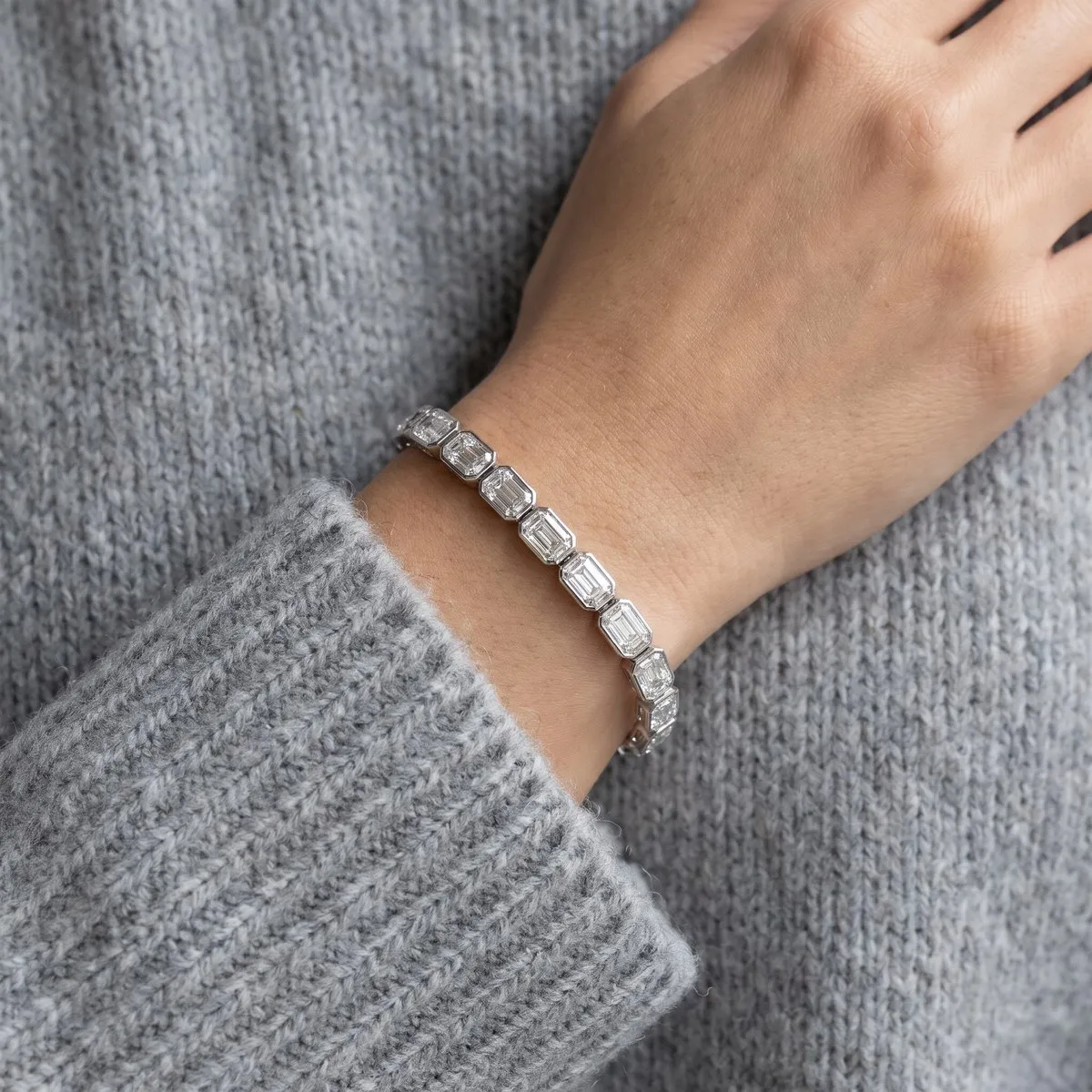
An emerald cut bezel tennis bracelet in Silvadium. Image created from the design.
Metal value and resale
Gold keeps meaningful metal value; silver keeps very little. At November 10 prices, a 3 gram band held about $4.70 of silver in sterling, while the same design in 14K white gold, about 3.6 grams, held about $278 of gold, by our arithmetic. A buyer pays only a share of that. Silver also swings harder: it peaked above $121 an ounce in January 2026, according to the Silver Institute, and was about 57% below that on November 10.
Don’t buy either for resale, though. The diamonds in a piece don’t add to its scrap value, and lab-grown diamonds don’t hold their retail price, so buy jewelry to wear.
How to care for white gold and silver
- Clean both gently. Warm water, a little mild dish soap and a soft brush work for either metal and for the diamonds in them. Our guide to cleaning a diamond ring at home goes step by step.
- Take them off for chlorine. Pools, hot tubs and bleach are hard on both: chlorine can crack gold alloys under stress, and it tarnishes silver.
- Store silver dry and closed. A small pouch or a lidded box slows tarnish; a silver polishing cloth removes what forms.
- Re-plate white gold when it looks warm. Any jeweler can do it. Rhodium on silver wears the same way.
- Have prongs checked. GIA suggests checking prongs regularly on any ring, and softer metals make it more important.
How to tell white gold from silver
- Check the stamp, usually inside a ring or on an earring post or clasp: 14K, 585, 18K or 750 for white gold; 925 or Sterling for silver.
- Feel the weight. The same design weighs about 21% more in 14K white gold and about 40% more in 18K.
- Don’t rely on looks. Unplated silver is a softer gray-white, but rhodium-plated silver and rhodium-plated white gold look the same, GIA notes.
- Skip the magnet test. Neither metal is magnetic, so a magnet can’t tell them apart.
Our guide on how to tell if a diamond is real covers the stones.
Which should you choose?
In our opinion:
- Engagement ring or wedding band worn daily: 14K white gold, or platinum, for the hardness. Our gold karat guide compares 10K, 14K and 18K.
- Earrings, pendants and tennis pieces: Silvadium is a sensible, lighter choice, and it suits large earrings especially. See sterling silver lab-grown diamond earrings and tennis bracelets.
- A first ring on a budget: silver costs about a third as much, but expect to polish it and to see dents sooner.
- Heirloom pieces: gold keeps its metal value and wears better over decades.
Browse white gold wedding bands or sterling silver wedding bands, many of them the same designs.
Whitemoon jewelry is made to order in about 10–15 days and ships free with insurance both ways, with 30-day returns on unworn pieces.
White gold vs silver questions
Is white gold better than silver?
For rings worn every day, usually yes: it’s harder, rarely tarnishes and holds far more metal value. Silver wins on price and weight.
Can you tell the difference between silver and white gold by looking at it?
Not reliably once both are rhodium-plated. Check the stamp and the weight instead.
Does white gold contain silver?
Sometimes. Palladium white golds often contain silver; nickel white golds usually don’t.
Does white gold turn yellow over time?
The rhodium plating wears, and the slightly warmer metal underneath starts to show. Our rhodium plating guide shows what that looks like and what three jewelers charge to renew it. Re-plating restores the white finish.
Which is more expensive, white gold or silver?
White gold. Our wedding bands typically cost about three times as much in 10K white gold as in Silvadium, and about four times as much in 14K.
What’s stronger, silver or white gold?
White gold. Cast 14K white gold is roughly twice as hard as cast sterling silver.
Does white gold tarnish like silver?
No. Gold of 10K and up resists corrosion, and rhodium doesn’t tarnish. Silver tarnishes from sulfur in the air.
Why buy white gold instead of silver?
For durability on a ring you’ll wear daily, lower upkeep, and lasting metal value.