
What Is Rhodium Plating?
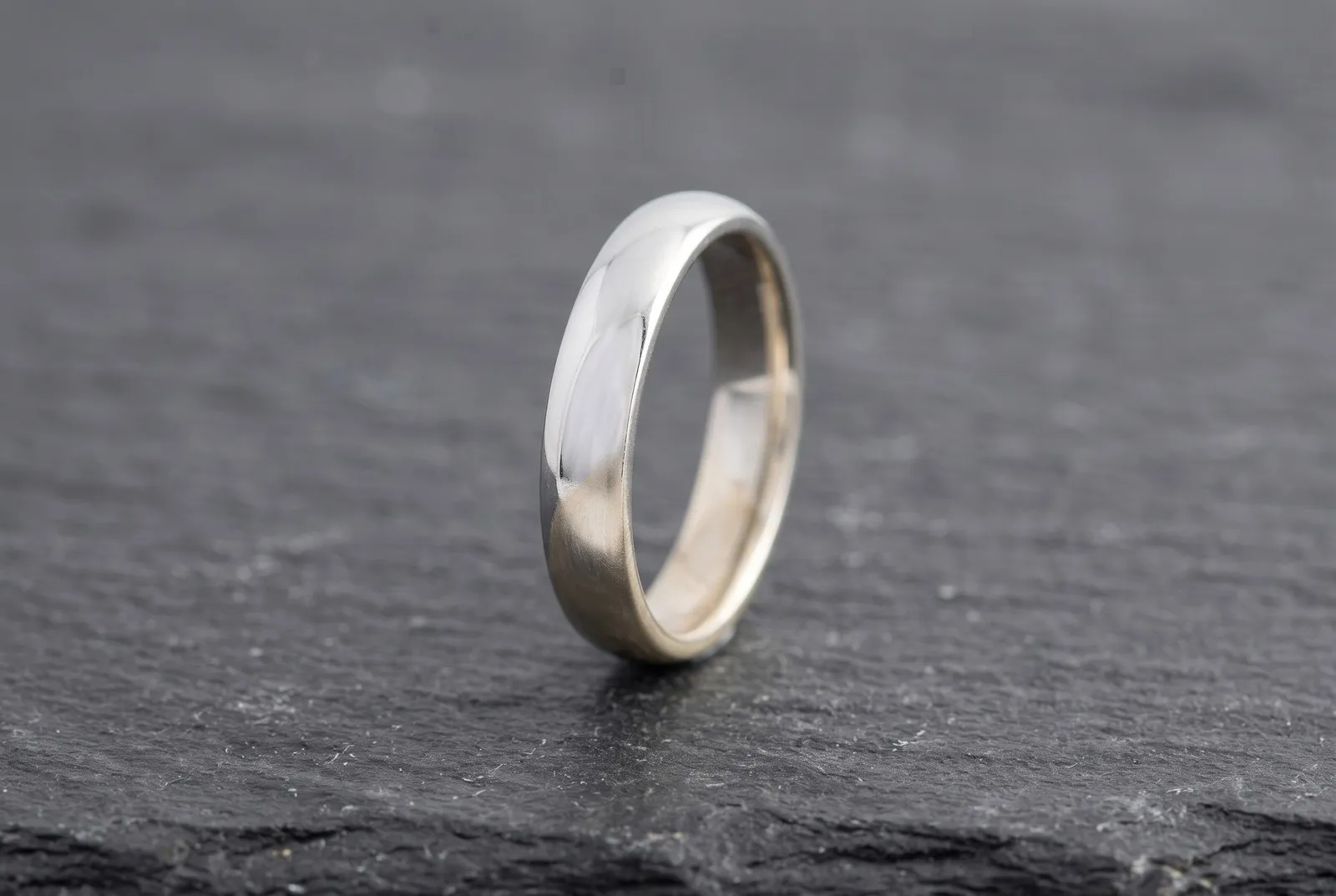
Rhodium plating puts a thin layer of silvery rhodium on jewelry. On a white gold ring, it can give a warmer alloy a cool white finish. A cream-colored patch on the palm side of the band may be the gold showing through. A jeweler can renew the coating if you want that bright white surface back.
Illustrative image: a warmer patch where a white gold band meets the palm.
At Whitemoon, we make wedding bands and engagement-ring settings with lab-grown diamond accents. We compared the same designs in five metals, checked what three US jewelers charge for replating and looked at what the work involves for a two-tone or engraved ring. We also checked a plating lab’s ring measurements and dermatologists’ findings on nickel.
Why is white gold plated with rhodium?
White gold starts with gold mixed with whitening metals, often nickel or palladium. The karat tells you how much gold is in the alloy. Two plated rings of the same karat can look alike in the case yet reveal different shades if the finish wears thin.
Metallurgist Christopher Corti describes a yellow-brown cast in some nickel white golds that contain copper. Palladium can give gold a good white color, though alloys with less of it can still look warm. Our guide to gold karats explains what changes between 10K, 14K and 18K.
In 2005, Steven Henderson and Dippal Manchanda proposed a trade guide for grading unplated white gold. They measured polished samples with a yellowness index. Higher readings meant the alloy looked more yellow.
| Unplated white gold | Yellowness index | Suggested finish |
|---|---|---|
| Grade 1, good white | Below 19.0 | White enough to leave bare |
| Grade 2, reasonable white | 19.0–24.5 | Plating optional |
| Grade 3, off-white | 24.5–32.0 | Plate for the intended white appearance |
| Outside the white grades | Above 32.0 | Outside the guide’s definition of white gold |
Grades 2 and 3 meet at 24.5 in the published table, and the measurements have tolerances. If you’re choosing a ring, ask to see a sample of its bare alloy. That’s the shade you may see if wear exposes the gold.
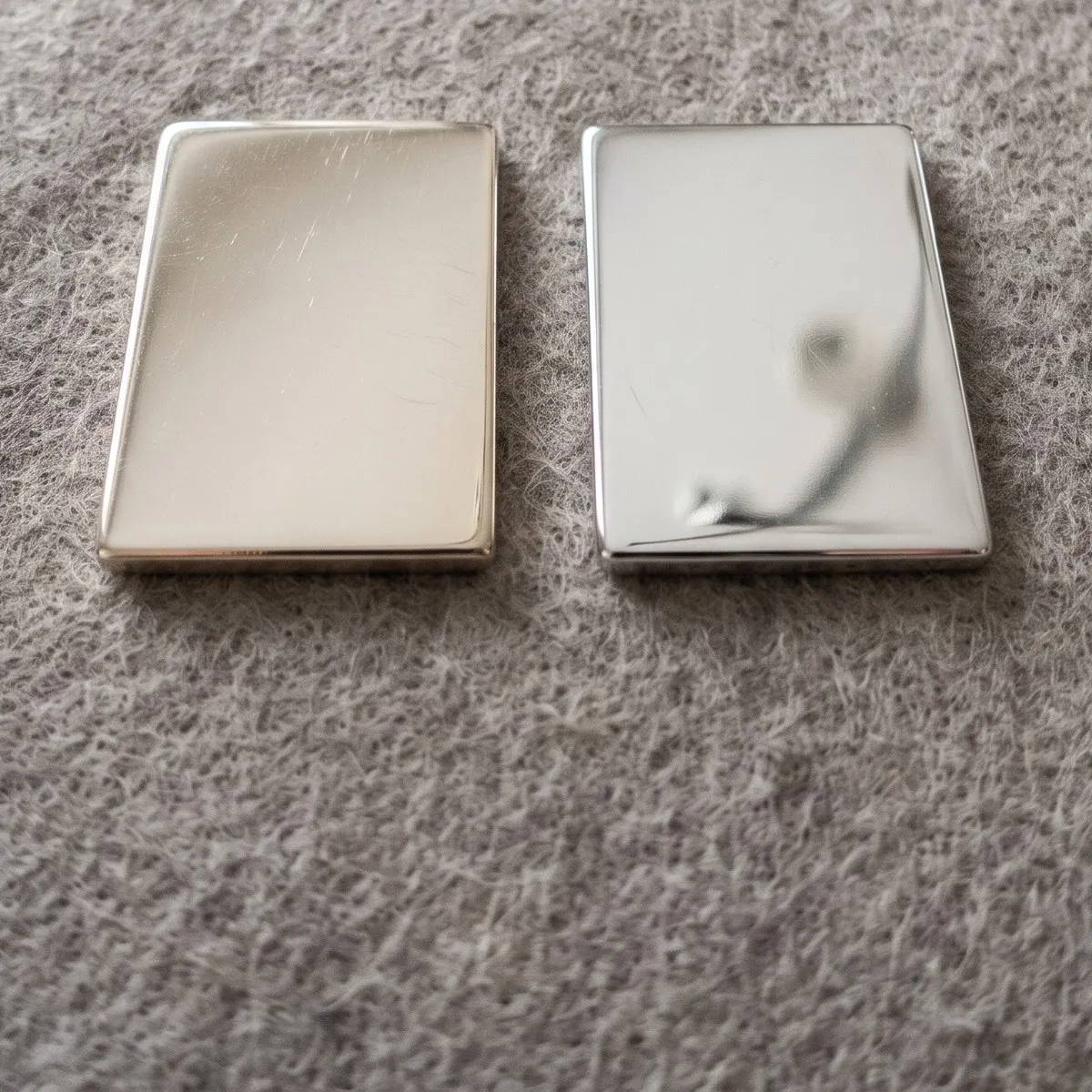
Illustrative image: comparing a bare white gold sample with a rhodium-finished sample in the same light.
How does a jeweler plate a ring?
A fresh coat follows the contours of the metal, so a deep scratch can still show through. The jeweler inspects the setting, refinishes the areas you agreed on, and cleans and rinses the piece. Oil or leftover polishing compound can interfere with the coating.
In the plating bath, the ring connects to the negative side of an electrical circuit. Direct current deposits dissolved rhodium onto the exposed metal. The jeweler then rinses the piece and checks the finish. Some designs have another layer of metal beneath the rhodium.
Neil Bell of Red Sky Plating measured a 14K solitaire. Its coating averaged about 0.20 microns, but individual spots measured about 0.15–0.68 microns. The thickest was at a prong tip. The whole ring gained 1.3 milligrams of rhodium in Bell’s plating experiment.
“Flash” means a very light coat. One patent describes a 0.05-micron flash over silver plating. Corti gives about 0.5 microns as a usual thickness for plating gold jewelry. A finish described simply as “rhodium plated” gives you no particular thickness to count on.
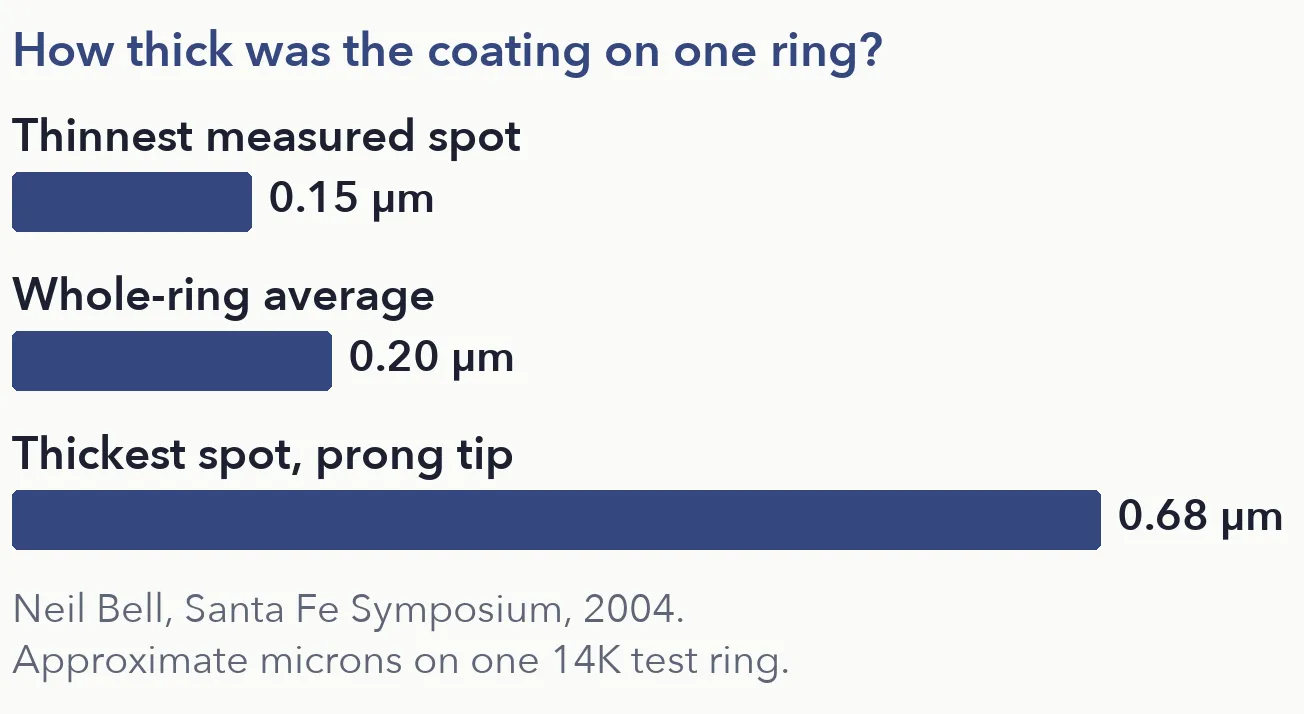
A prong tip had more than three times the whole-ring average on Bell’s test ring. Values are rounded to hundredths of a micron.
Can the jeweler plate just the prongs?
Yes. Stuller describes using a plating pen for small areas such as prongs. A jeweler can also mask the yellow parts of a two-tone ring to preserve their color. Black rhodium is a deliberate finish, too. Umicore makes a pen solution for applying a dark gray or black detail. Show the jeweler exactly which areas you want to keep bright, yellow or dark.
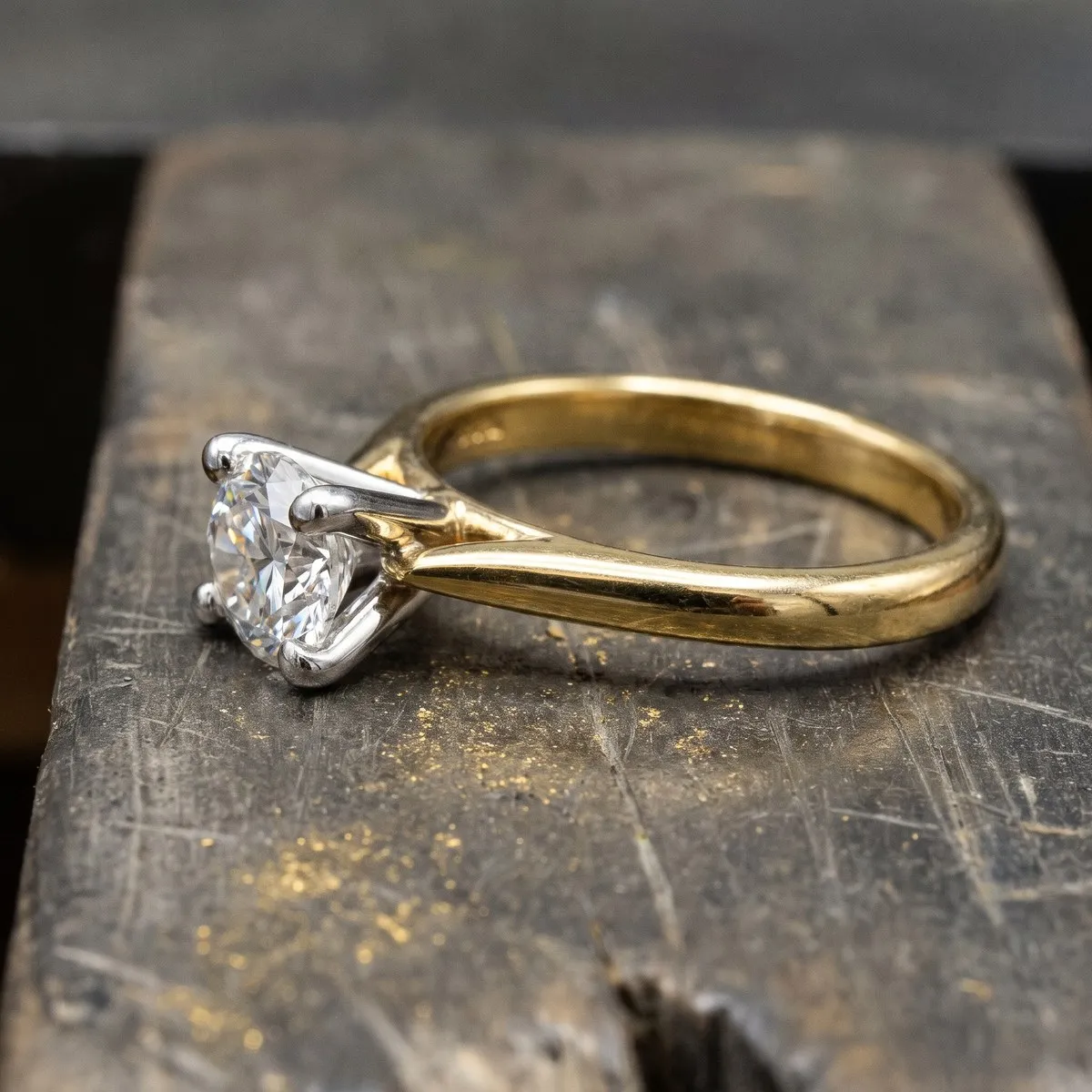
Illustrative image: bright white prongs and a yellow gold band show the two finishes to identify before a repair.
Why does a plated ring change color?
Look at where the color changes. A ring rubs against the things you grip and against a band worn beside it. Warm patches on the palm side suggest thinning rhodium on white gold. A pendant that rarely rubs against anything may keep its coating longer.
The Gemological Institute of America (GIA) says white gold may need replating every few years. Stuller advises looking for warmth or dullness where the ring rubs. There’s no measured interval in months that predicts when you’ll see the alloy on your ring.
Rhodium resists corrosion. On plated sterling silver, however, exposed silver can darken as sulfur compounds in the air reach it, as the Canadian Conservation Institute explains. Soap or lotion can also leave a film on intact plating. A jeweler can check a dark patch before polishing it.
Color alone is a poor guide to wear. In a 2022 test on silver-alloy plates, Francéclat found that a rhodium-ruthenium finish looked like its plain rhodium reference but held up better under abrasion. Those were accelerated lab tests on flat samples. They give no dependable way to convert test hours into months of wearing a ring.
Can you swim, shower or use an ultrasonic cleaner?
Jewelers of America advises taking jewelry off before showering, applying lotion or getting into a pool or hot tub. Shower products can leave a dull film. Hoover & Strong found that prolonged exposure to chlorinated solutions damaged some white gold settings. Its tests measured setting damage and give no count of swims before the plating wears off.
Follow the maker’s cleaning directions for the finish and the stones. FINER specifies a soft dry cloth for its plated jewelry. Stuller uses ultrasonic cleaning at the bench before plating. If an inherited ring has a fracture-filled diamond, tell the jeweler before cleaning. GIA says steam, acid and some cleaning methods can damage the filling.
For an engraved ring, ask how much polishing the service includes. FINER explains that repeated polishing can soften lettering and brighten brushed areas. Point out an inscription or row of tiny beads before a full refinish. Have the jeweler record which details you want preserved.
What does rhodium replating cost?
Three US repair menus checked on November 19, 2026, show how the price changes with the work included.
- Fire & Ice Goldsmithing estimated $45 for a women’s white gold ring and $55 for a men’s white gold ring.
- Siebke Hoyt Jewelers listed $50 for one ring, $70 for two soldered rings and $90 for three or more soldered rings. Each soldered-set price covers the set.
- Allan Jewelers listed $59.99 per ring for in-store rhodium plating.
If you’re resizing a ring with white prongs and a yellow band, ask whether the quote includes renewing the white area and protecting the yellow gold. Billig Jewelers includes replating in its plain white gold band resize. A two-tone ring needs its own quote.
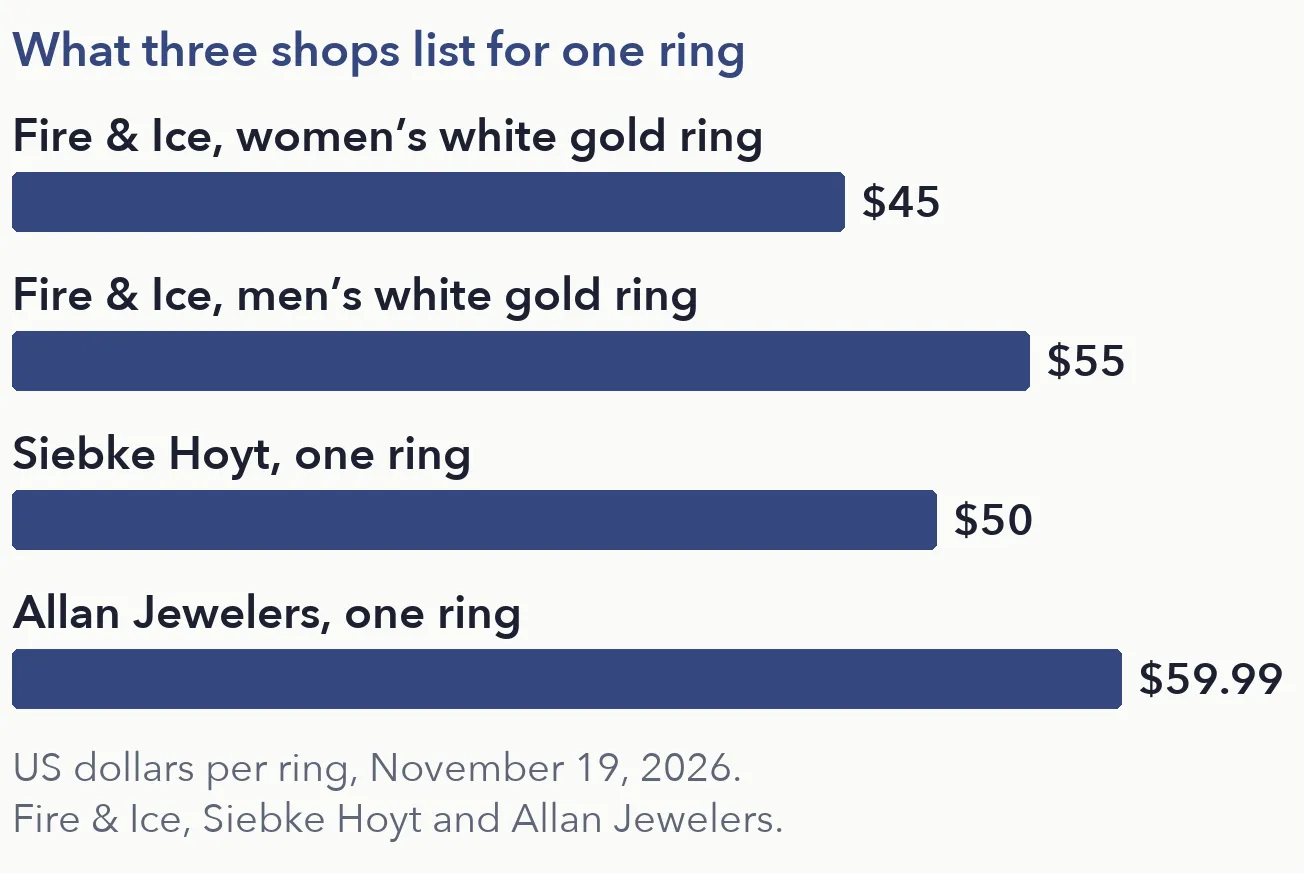
Each price covers a single ring. Fire & Ice uses separate women’s and men’s categories. Siebke Hoyt lists soldered sets separately.
At Whitemoon, white gold replating is included only with 3-Year Care, 5-Year Care and Lifetime Care. Free Forever excludes replating. When you send a ring for this service, you pay for insured shipping both ways.
Before another jeweler works on your Whitemoon ring, contact us with your order number, a description and photos. Under section 06 of our Terms, outside work is excluded, and having the piece altered elsewhere ends our care coverage for it.
What does the choice of metal cost at Whitemoon?
At Whitemoon, we rhodium-plate only white gold. You’ll see that finish on our white gold princess-cut settings and our white gold domed shared-prong band. We do not plate Silvadium, yellow gold, rose gold or platinum. Silvadium is our tarnish-resistant sterling silver.
Prices last updated November 19, 2026. The finished half eternity band has nine round lab-grown diamonds. Band prices in the table are for 0.35 carat total. The sculpted-leaf setting includes two lab-grown diamond accents weighing 0.06 carat total. In the builder, you choose the princess-cut center next. Its price is added to the setting price, and the finished ring goes into your cart as one item.
| Metal | Finished band, 0.35 ct total | Setting only, 0.06 ct total accents |
|---|---|---|
| Silvadium sterling silver | $224 | $129 |
| 14K white gold | $762 | $583 |
| 14K yellow gold | $762 | $583 |
| 14K rose gold | $762 | $583 |
| Platinum | $1,135 | $1,719 |
For the same nine-stone band on November 19, 2026, platinum cost $303 more than 14K white gold at 0.25 carat total ($916 versus $613). At 0.35 carat total the difference was $373. At 0.50 carat total it was $392 ($1,219 versus $827). Those are upfront differences. How often you’d want to renew a white gold finish is a separate, personal decision.
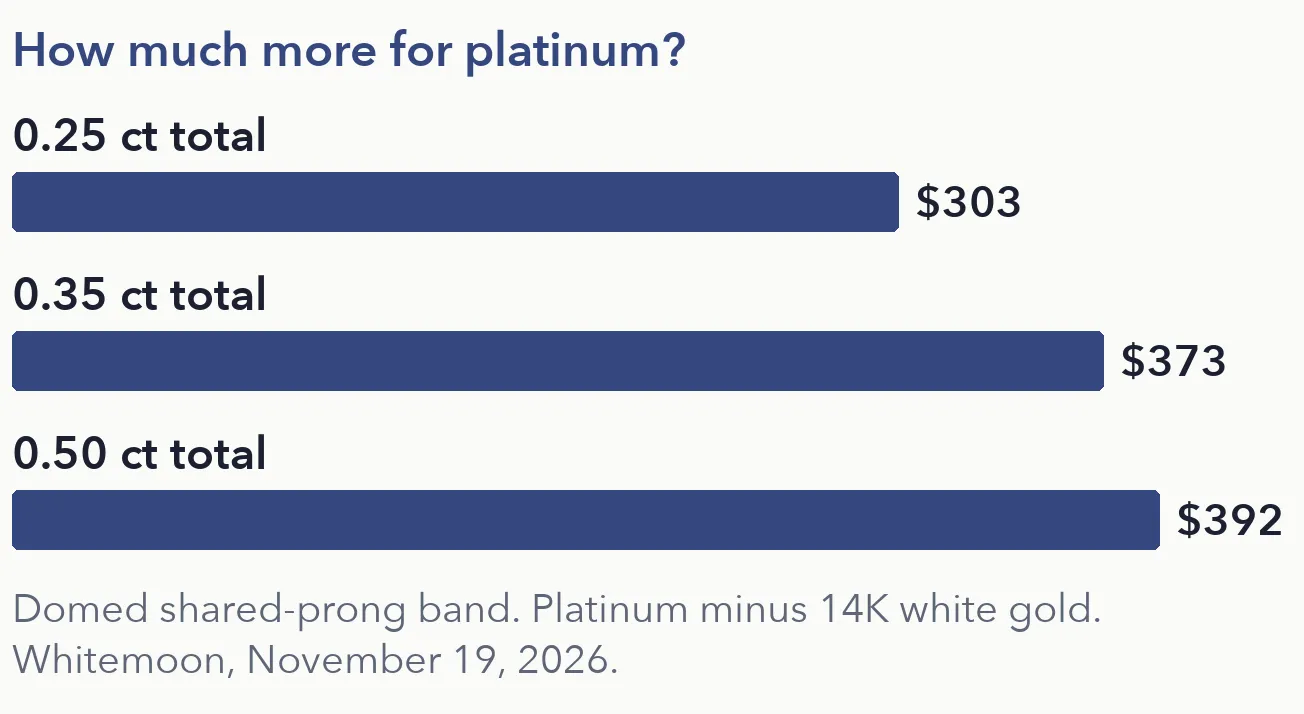
For each total weight, the bars show how much more the platinum version of the same half eternity band cost than the 14K white gold version on November 19, 2026.
Browse white gold half eternity bands for a cool plated finish or Silvadium half eternity bands for sterling silver. If you like a gray-white metal that takes on a patina as it wears, browse our platinum wedding bands.
Does a rhodium finish tell you what a piece is made of?
A brass cuff and a sterling silver cuff can share the same rhodium finish. In the US, sterling means at least 925 parts of silver per thousand in the metal underneath. Our guide to white gold and silver shows what to look for as each surface wears.
Gold vermeil has its own US definition. It requires a sterling silver base with gold of at least 10K on all significant surfaces, reasonable durability and a thickness equivalent to at least 2.5 microns of fine gold throughout. Rhodium directly over sterling gives you rhodium-plated silver.
Where should you see the finish disclosed? Under §23.7 of its Jewelry Guides, the US Federal Trade Commission considers it unfair or deceptive to omit a rhodium layer on an item marked or described as precious metal. The World Jewellery Confederation’s 2026 trade guidance calls for naming the coating on online listings, labels and packaging. If the listing says only “white gold,” ask the seller for the finish in writing.
Under section 5(5)(d) of the UK Hallmarking Act 1973, rhodium added to already hallmarked gold, silver, platinum or palladium may be up to 2 microns thick at any point. That limit applies after hallmarking. The mark itself doesn’t tell you how thick the coating is.
Will a pawn shop buy plated gold?
Tell the buyer which metal is on top. Salinas Pawn and Northern Nevada Coin decline gold-plated items. A rhodium-plated 14K gold ring still has a karat gold body for a buyer to assess. Clark Pawners also distinguishes pieces someone might buy for the design. There’s no standard payout.
Can you react to jewelry with a rhodium coating?
The American Academy of Dermatology identifies nickel as a common cause of allergic contact dermatitis. DermNet explains that intact rhodium can separate skin from nickel in a white gold alloy. As the coating wears, contact can resume.
In a 2024 earring case report, Garcia-Nunez and colleagues described a patient who developed earlobe dermatitis and tested positive to rhodium chloride. The earring was reported to be nickel-free. Such reports were scarce in the literature we checked. No study we found measured the rate among jewelry wearers.
The European Chemicals Agency’s entry for nickel gives a limit of 0.5 micrograms per square centimeter per week for nickel released by parts of rings in direct, prolonged skin contact. A non-nickel coating on those parts must keep release within that limit for at least two years of normal use. That EU requirement measures nickel release. It makes no prediction about how long a ring will stay bright white.
Where does rhodium come from, and why is it expensive?
The Royal Society of Chemistry lists rhodium as element 45, symbol Rh. William Hyde Wollaston discovered it in 1803 while separating metals in crude platinum. Its name refers to the rose color of a solution of its salts. The metal itself is hard, silvery and reflective.
Rhodium occurs with other platinum-group metals and in copper-nickel ores, including deposits in Ontario. Johnson Matthey attributed about 81% of world primary rhodium supply in 2025 to South Africa. That year, vehicle exhaust catalysts accounted for about 85% of total rhodium demand. Rhodium helps those catalysts reduce nitrogen oxides.
Johnson Matthey’s May 2021 report links the price spike that March to recovering vehicle production and disrupted shipments after a South African processing outage. Heraeus and SFA recorded a high of $29,800 per troy ounce. Umicore’s morning quote on November 16, 2026, was $9,000 per troy ounce. A jeweler’s price for renewing a ring also covers preparing and finishing it.
Whitemoon jewelry is made to order in about 10–15 days and ships free with insurance both ways, with 30-day returns on unworn pieces.
Common questions about rhodium plating
What is rhodium?
Rhodium is a hard, silvery metal in the platinum group. Jewelers use it to give a piece a bright, corrosion-resistant surface.
What is white gold plated with?
Jewelers often finish white gold with rhodium. Some white gold alloys are white enough to wear bare.
Is rhodium plating good quality?
Plating can give a ring a bright white finish, but it tells you little about the metal underneath or how well the setting is made. Ask which metal forms the body and what care the finish needs.
What are the disadvantages of rhodium plating?
The color can become uneven where a ring rubs against other surfaces. There can be a charge to restore the finish, especially when the ring also needs refinishing.
How much does it cost to rhodium plate a white gold ring?
On November 19, 2026, Fire & Ice estimated $45 for a women’s white gold ring and $55 for a men’s. Siebke Hoyt listed $50 for one ring, $70 for two soldered together and $90 for a soldered set of three or more. Each set price covers all the rings in that set.
How fast does rhodium plating wear off?
GIA says white gold may need replating every few years. A change of color where your ring rubs tells you more about its condition than the date you bought it.
What wears off rhodium plating?
Day-to-day rubbing and abrasive polishing gradually remove the surface layer. Soap and lotion can leave a dull film even where the coating remains intact.
Can you shower with rhodium plated jewelry?
Jewelers of America advises taking jewelry off for a shower because products can leave residue. A dull finish after a shower can be a sign of buildup.
Should you rhodium plate white gold?
If the maker offers a bare finish, ask to see the alloy in the same light as a plated sample. In our view, plating is worth choosing if you prefer the cooler white and are comfortable renewing it when wear shows.
Which is better, gold or rhodium?
For the body of a ring, karat gold gives you a choice of colors throughout the metal. For a bright white surface, you can have rhodium on that same ring.
What is rhodium used for?
Its largest use is in vehicle exhaust catalysts. Other uses include chemical catalysts, reflective mirrors and jewelry plating.
Where is rhodium found?
It occurs with other platinum-group metals and in certain ores that also yield copper and nickel. South Africa was the largest primary supplier in Johnson Matthey’s 2025 figures.
How long does rhodium plating take before a wedding?
Ask the shop for a pickup date when you book. On November 19, 2026, Studio Jewelers in Lakeland, Florida, offered same-day plating by appointment, while Billig Jewelers in Marlton, New Jersey, listed one week for a ring.
How can you tell if a piece of jewelry is rhodium plated?
Look for the finish on the receipt or in the maker’s description. A warmer patch on white gold can suggest worn plating, but color alone cannot identify rhodium. If the paperwork is missing, a jeweler can examine the surface and a lab can test for a coating with X-ray fluorescence, as GIA’s lab note on plated jewelry explains.