
Wedding Bands for a Solitaire: Five Ways to Stack Them
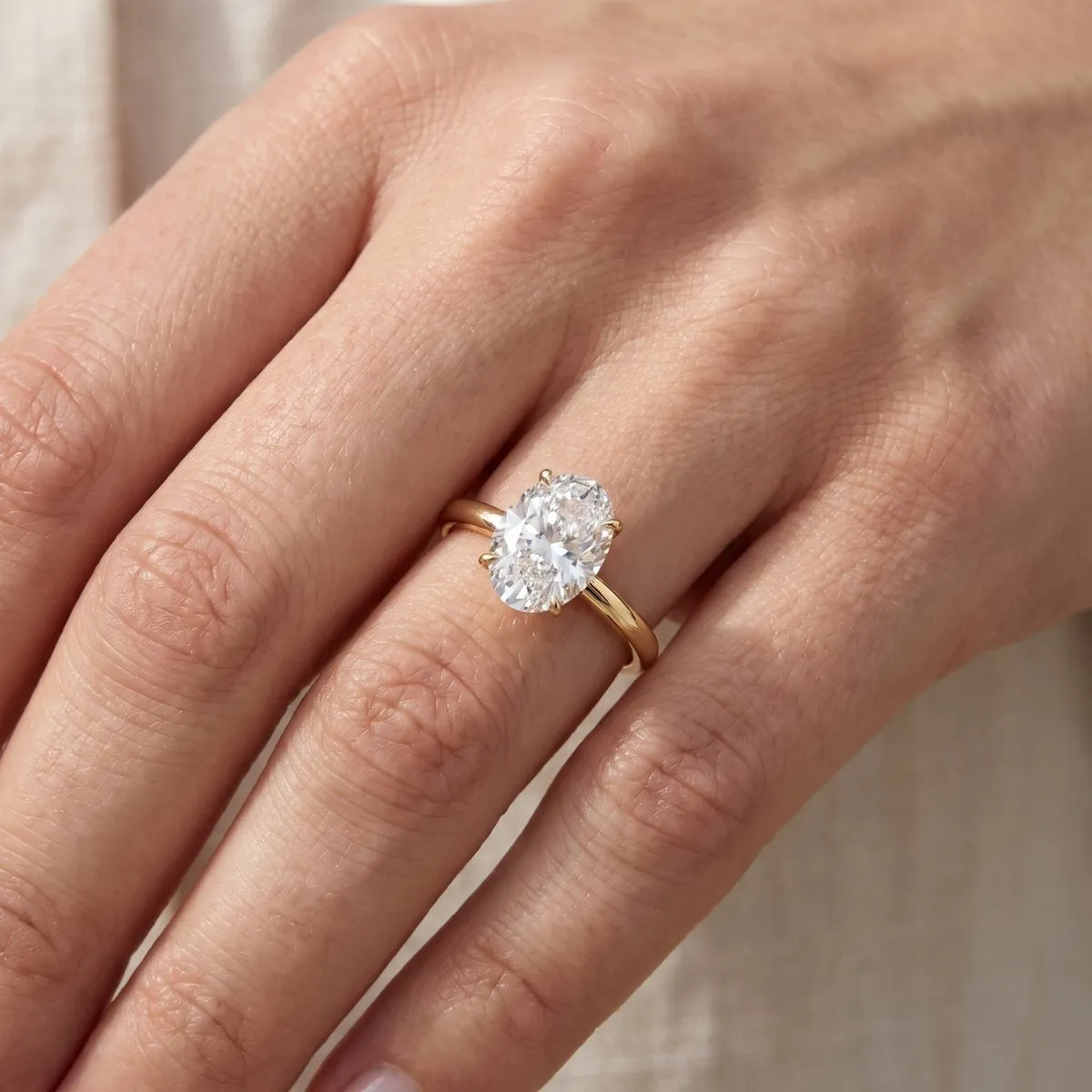
The best wedding band for a solitaire depends on how high the center stone sits. If there is room under the head, a straight band can rest right against it. If the head sits low, a curved or contour band follows its shape and closes the gap. Our guide to wedding band types shows each style in diagrams. Keep the band about as wide as the solitaire’s shank, or a little thinner, and the two will read as one ring.
A solitaire has one stone and a simple shank, which leaves more room to play than almost any other engagement ring. Here are five ways to stack a band with it, from a quiet matched pair to mixed metals, followed by a guide to each center shape and how to check the fit before you order.
Start by looking at your solitaire from the side
The side view decides which bands will fit. Hold the ring at eye level with the band level. If the head rises clear of the shank, with open space under the stone, a straight band can slide beneath it and sit flush. If the head sits low or rests right on the shank, a straight band will stop against the prongs and leave a small gap.
That gap isn’t a fault. Plenty of people like the small space a straight band leaves, and the choice comes down to taste. It only helps to know before you buy. A low basket or bezel head usually calls for a curved band, while a raised or cathedral head gives you the widest choice. Whitemoon’s solitaire engagement rings include both kinds, on bare, pavé and twisted shanks.
1. The matched pair: a straight band in the same metal
A straight band in the same metal and a similar width is the simplest stack, and it suits almost any solitaire with a raised head. A plain metal band keeps all the attention on the center. A slim row of small lab-grown diamonds adds some sparkle without competing with it, and round lab-grown diamond wedding bands are the easiest place to start.
Width does most of the work here. Most Whitemoon engagement ring shanks measure about 1.8 to 2.5 mm, so a band at or just under that width looks balanced. A much wider band can make the center seem smaller. Wearing the same metal also means both rings age at a similar rate.
2. The curved band: follow the shape of the head
A curved band, also called a contour band, dips in the middle to follow the head, so the two rings touch with no gap. A gentle arc suits a low-set round or oval center. A sharper V, called a chevron, suits pear and marquise centers, whose points leave an obvious space above a straight band. Browse curved lab-grown diamond wedding bands or chevron wedding bands to see the range of shapes.
The curve has to suit the ring. Too shallow and the band won’t clear the head; too deep and you see space at the sides. Compare the dip with the width of your head, and if you are unsure, a slightly deeper curve still looks intentional when worn alone. A strongly shaped band does tie you to that pairing, which is worth knowing if you may change your engagement ring later.
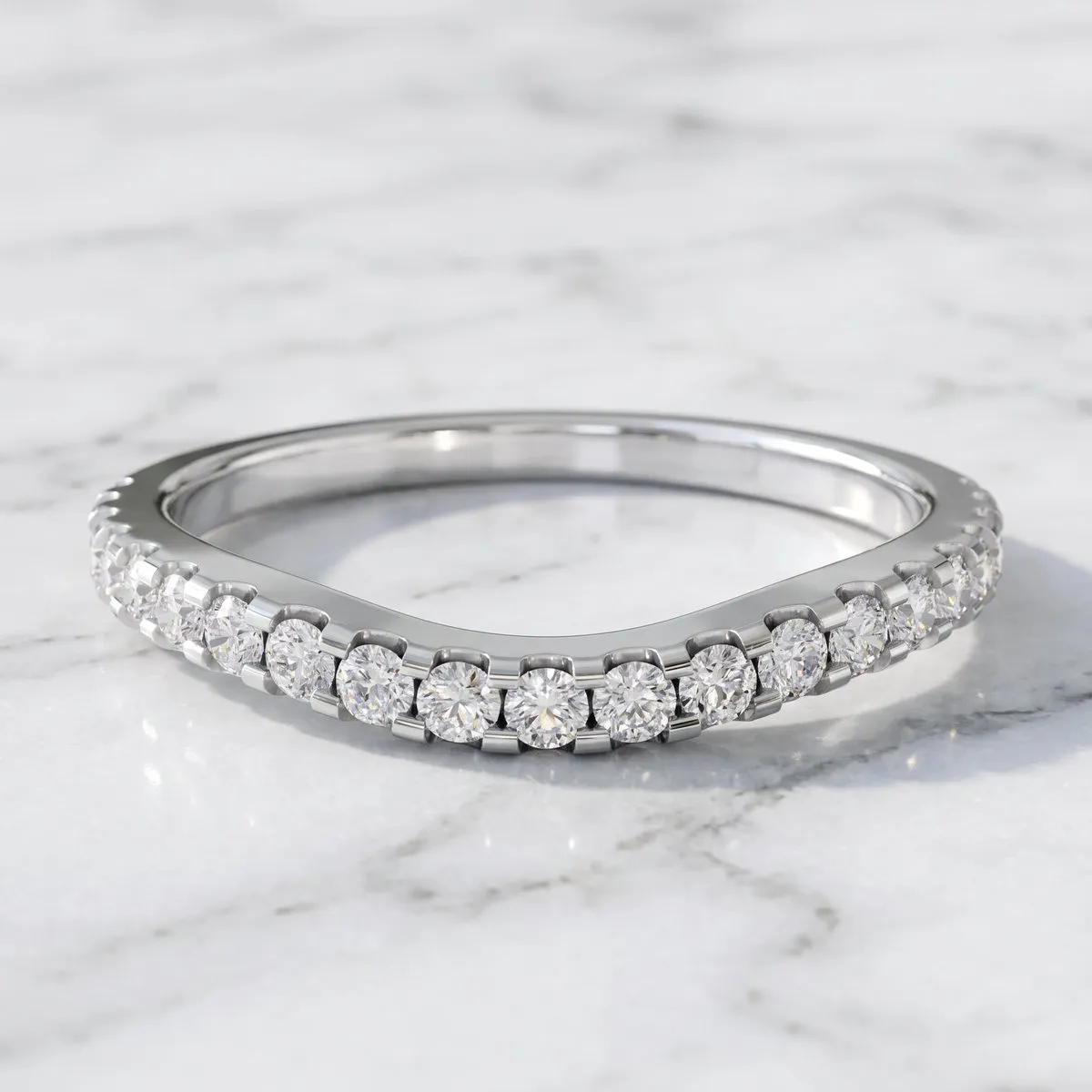
A slim curved half eternity band in platinum. The dip makes room for a low center. Image created from the band’s design.
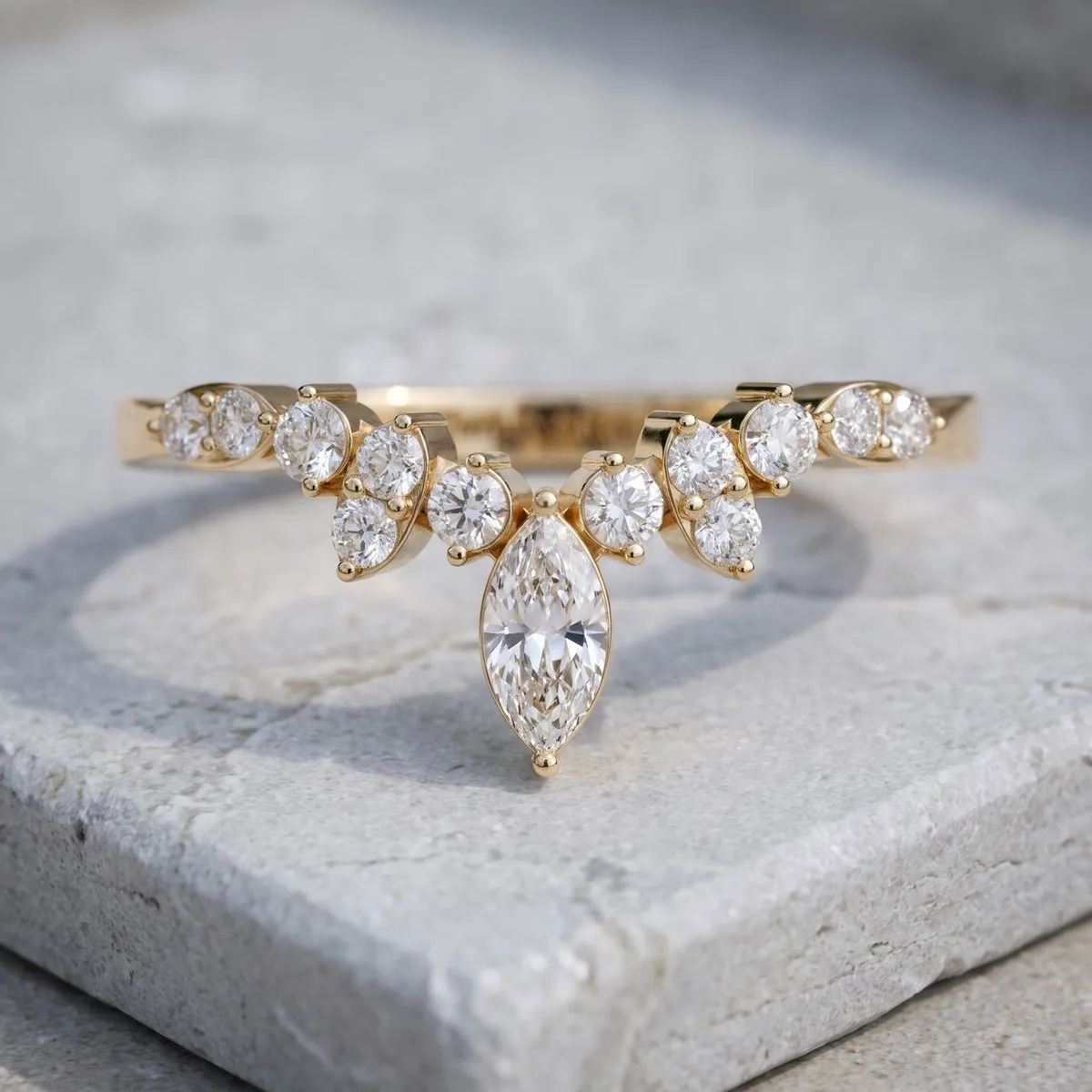
A yellow gold chevron band with a marquise at its point, shaped to sit around a pear or marquise center. Image created from the band’s design.
3. The line of light: pavé, half eternity or full eternity
A row of small stones beside a solitaire turns one point of light into a line. Lab-grown diamond pavé wedding bands and half eternity bands set stones across the top and leave the palm side plain, so they stay comfortable and can be resized. Full lab-grown diamond eternity bands circle the finger with stones and look the same from every angle, though changing the size means remaking the band. Soldering a band to your engagement ring has a similar catch, as our ring soldering guide explains.
Keep the band’s stones well below the center in size so the solitaire stays the focus. Larger stones also raise the band, so check how it sits against your ring. A band of the same stone shape as the center, such as emerald cut stones beside an emerald cut solitaire, reads as a deliberate set.
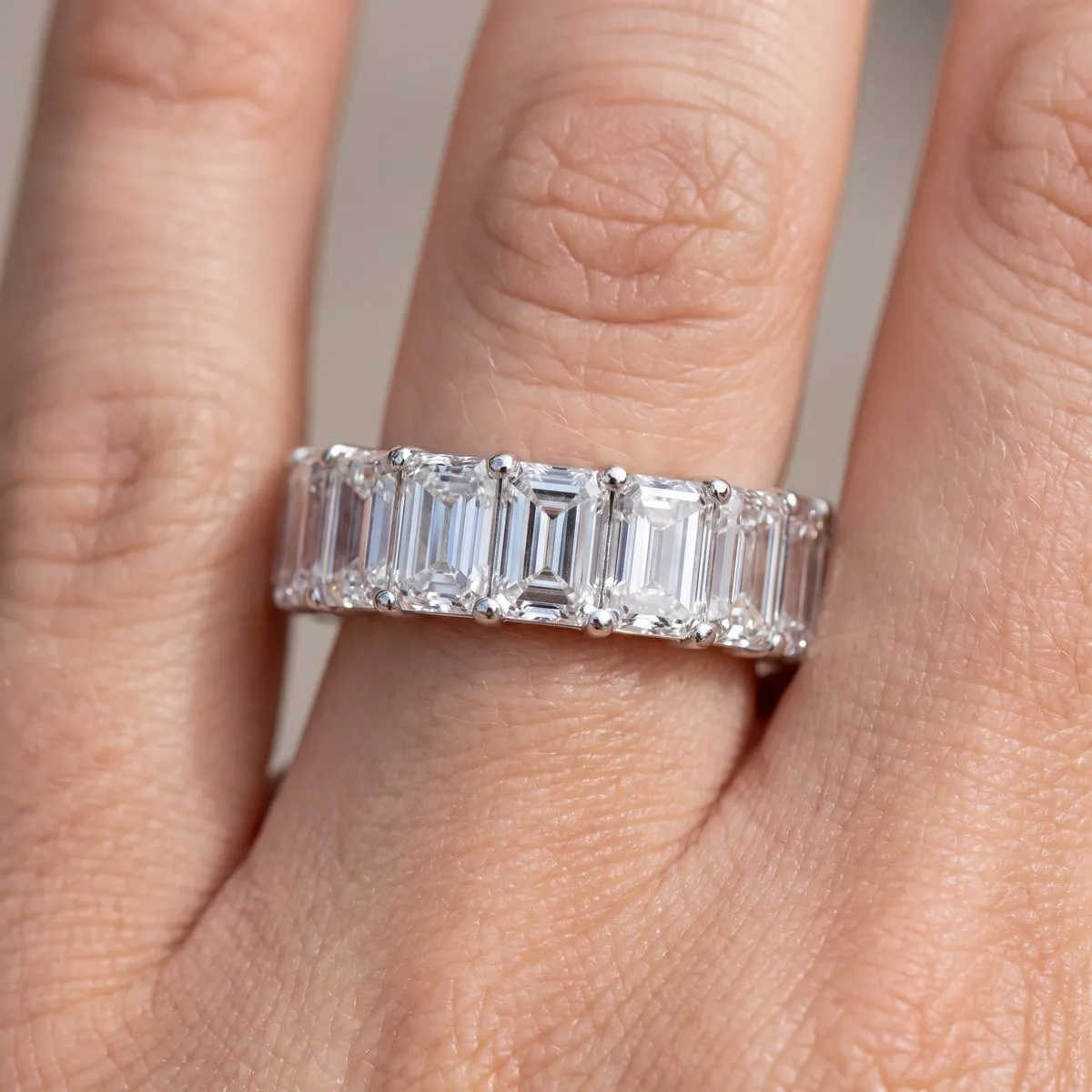
A full eternity band of emerald cut lab-grown diamonds in platinum. Image created from the band’s design.
4. Mixed metals: pair two colors on purpose
A wedding band doesn’t have to match the engagement ring’s metal. Yellow gold beside platinum, or rose gold beside white gold, is a common look, and it makes rings easier to add over the years because nothing has to match exactly. If you’re also choosing a karat, our 10K vs 14K vs 18K gold guide compares color and wear. Go for clear contrast. Yellow against white reads as a choice, while two whites that differ slightly can look like a mismatch.
There is one trade-off. Metals rub against each other, and the softer one shows wear first. White gold is usually plated with rhodium, and rubbing can wear that plating sooner. Our guide to rhodium plating explains how the finish wears and what renewing it costs. If you want a pair that ages evenly, stay with one metal. If you like the contrast, wear the rings knowing they may need polishing, and consider platinum lab-grown diamond wedding bands as the white half of a gold stack.
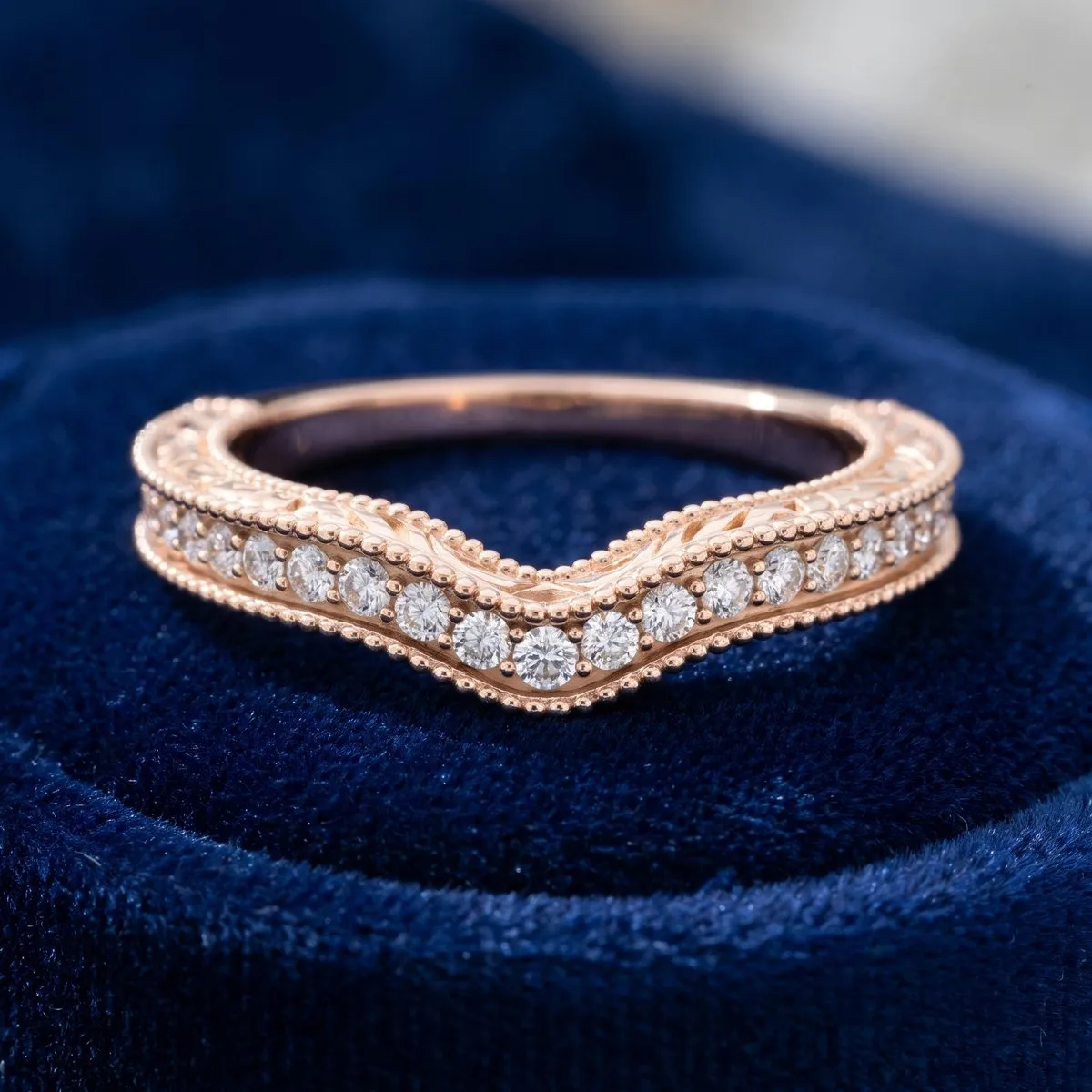
A rose gold chevron band, one way to add a second metal to a white gold or platinum stack. Image created from the band’s design.
5. The open stack: leave a space, or wear a band on each side
A band on the next finger, or on the far side of the solitaire, frames the center instead of crowding it. Rings on separate fingers don’t rub at all, so this is the gentlest option for a mixed-metal pair.
Two bands, one above the solitaire and one below, make a symmetrical stack. It suits slim bands best, because the total width adds up quickly. Many people start with one band and add the second later, for an anniversary or another milestone.
Which wedding band suits each solitaire shape?
Match the band’s lines to the center’s outline. Round and oval centers take almost anything, while pointed and square ones benefit from a more considered choice. Use this as a starting point, then check the height of your head.
| Center shape | Bands to try | Why it works |
|---|---|---|
| Round | Straight pavé or shared-prong row; a gentle curve on a low head | Round stones in the band echo the center |
| Oval | Gentle curve; straight if the head is raised | A slim band keeps a long center in proportion |
| Emerald, Asscher | Straight channel-set, baguette or emerald cut wedding bands | Straight lines match the long step facets |
| Princess, cushion, radiant | Straight pavé or channel-set row | A squarish outline sits well beside a straight edge |
| Pear | Curved or chevron band | The dip makes room for the rounded end or point |
| Marquise | Chevron or open-front band | A V fills the space beside the points |
| Heart | Gentle curve or thin straight band | A simple band lets the outline read clearly |
How to check the fit before you buy
A stack should be tried as a stack, because two or three rings on one finger feel tighter than one. Some people go up a quarter size for a stack, so try the rings together before you settle on a size. Our ring size guide shows how to measure.
- Add up the widths. Two 2 mm rings make a 4 mm stack, about the width of a wide band on its own.
- Check the profile. Compare the side view of your ring with the band’s curve, or bring the ring along if you visit.
- Plan for wear. Diamonds can scratch metal, so a pavé band can slowly mark a plain band beside it. Have the prongs on both rings checked about every six months.
- Clean them apart. Stacks trap more soap and lotion than a single ring. Our guide on how to clean a diamond ring covers pavé and every metal.
- Know the resize terms. A ring within one size is resized, and a bigger change is remade in about 10–15 days. Full eternity bands are always remade.
If you are still choosing the center, read how to read a diamond certificate before you compare stones. Most Whitemoon rings are made to order in about 10–15 days and ship free with insurance both ways, with 30-day returns on unworn pieces and one free resize within 60 days of delivery.
Wedding ring stack questions
What is a wedding ring stack?
A wedding ring stack is the set of rings worn together on one finger, usually an engagement ring, a wedding band and sometimes an anniversary or eternity band added later. Our guide to the difference between an engagement ring and a wedding ring explains what each one marks. Our guide to which finger a wedding ring goes on covers the order they go on. The rings can match, or they can mix metals and shapes. A solitaire is a popular starting point because its single stone and slim shank leave room for other bands.
What are the rules for stacking rings?
There are no fixed rules, only a few guidelines that help. Keep the band’s width at or below the engagement ring’s shank, keep its stones smaller than the center, and choose a curve if the head sits low. Try the rings together before you settle on a size, because a stack feels tighter than a single ring.
Are stacked rings still in style?
Yes. Stacked rings remain a popular way to wear bridal jewelry, partly because a stack can grow over time. Many people add a band for an anniversary or another milestone instead of replacing anything. Slim bands, a second metal or a single contrasting stone shape all work, so a stack can stay simple and still feel personal.
What is the best wedding band for a solitaire engagement ring?
For most solitaires, a slim straight band in the same metal is the simplest match, provided the head sits high enough for the two to touch. For a low-set stone, a curved band closes the gap. If you want more sparkle, a half eternity row of small lab-grown diamonds adds light and can still be resized.
Why do some engagement rings pair better with curved bands?
Low-set stones, wide heads and pointed shapes such as pear and marquise leave a space above a straight band, because the head or the point reaches down to the shank. A curved band dips around that space so the rings sit together. A ring with a high head has room underneath, so a straight band fits without any curve.
Does a wedding band have to match the engagement ring?
No. The metal, style and stones can all differ, and contrast can look deliberate. Keep one thing in common, such as the width or the stone shape, so the stack looks planned. The one practical reason to match is wear: rings of different metals rub at different rates, so the softer one may show marks sooner.
Can you wear wedding bands on both sides of an engagement ring?
Yes. One band above and one below the solitaire makes a symmetrical stack that frames the center. It works best with slim bands, because the total width adds up and the finger will feel it. Try the three rings together, and consider going up slightly in size if the stack feels tight.