
Best Place to Buy Diamond Earrings, Necklaces and Tennis Bracelets Online
There’s no single best place to buy diamond earrings, a necklace or a tennis bracelet online. The best place is the store that tells you exactly what you’re getting, meaning how many stones, how much each one weighs, what grade and who graded it, prices it without an invented “was” price, and takes it back if you change your mind. On those tests the stores differ more than their ads suggest.
We sell lab-grown diamond jewelry, so we have a side in this. To keep it useful we read the product and policy pages of 11 jewelers on November 13, 2026, and we name stores only where we saw the page ourselves. Two findings stood out. One store used the same “1.00 ctw” label for a pair of studs with 2 diamonds and a pair with 22. And for the same kind of lab-grown stud, prices at the stores we compared ran from $507 to $910.
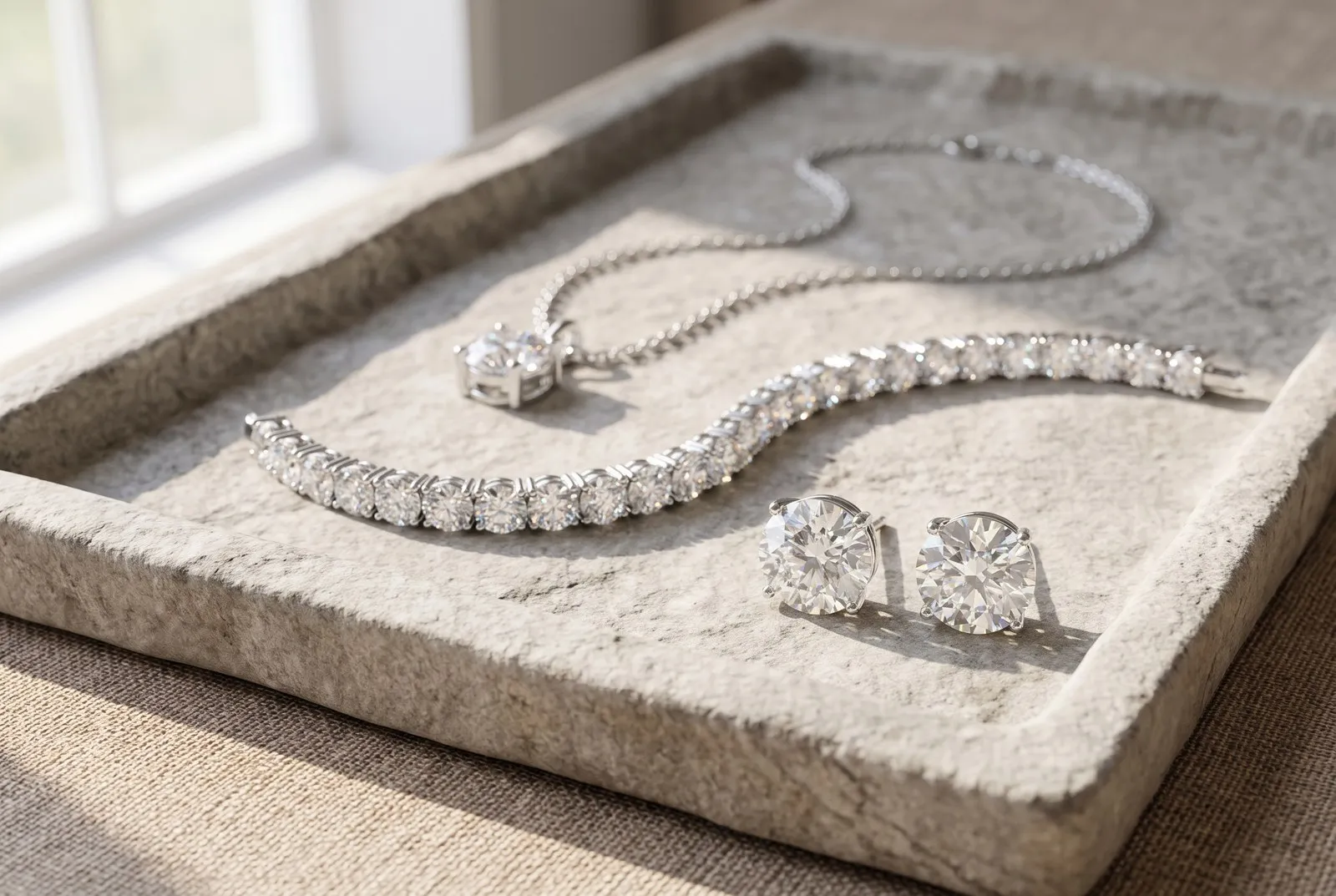
Pictured: solitaire studs, an in-line tennis bracelet and a solitaire pendant in white gold with lab-grown diamonds. Image created from the designs.
What makes a store a good place to buy diamond jewelry online?
Use the same six checks for any store, including ours.
- Stone count and weight. The page should say how many diamonds are in the piece and the weight of the main ones, not only a total.
- Grades with a name behind them. “Average” or “minimum” color and clarity is the store’s own description. A grading report comes from a named lab such as GIA or IGI and has a number you can look up.
- Lab-grown or natural, stated plainly. The FTC’s Jewelry Guides require a lab-grown diamond to be described as one.
- Metal and fittings. Karat, the type of earring back or clasp, and the chain or bracelet length.
- The price you pay. Compare it with other stores’ prices for the same thing, not with a crossed-out price.
- The return terms. How many days, counted from when, and what’s excluded.
Our guide to where to buy an engagement ring covers payment protection and order rules that apply to any online jewelry purchase.
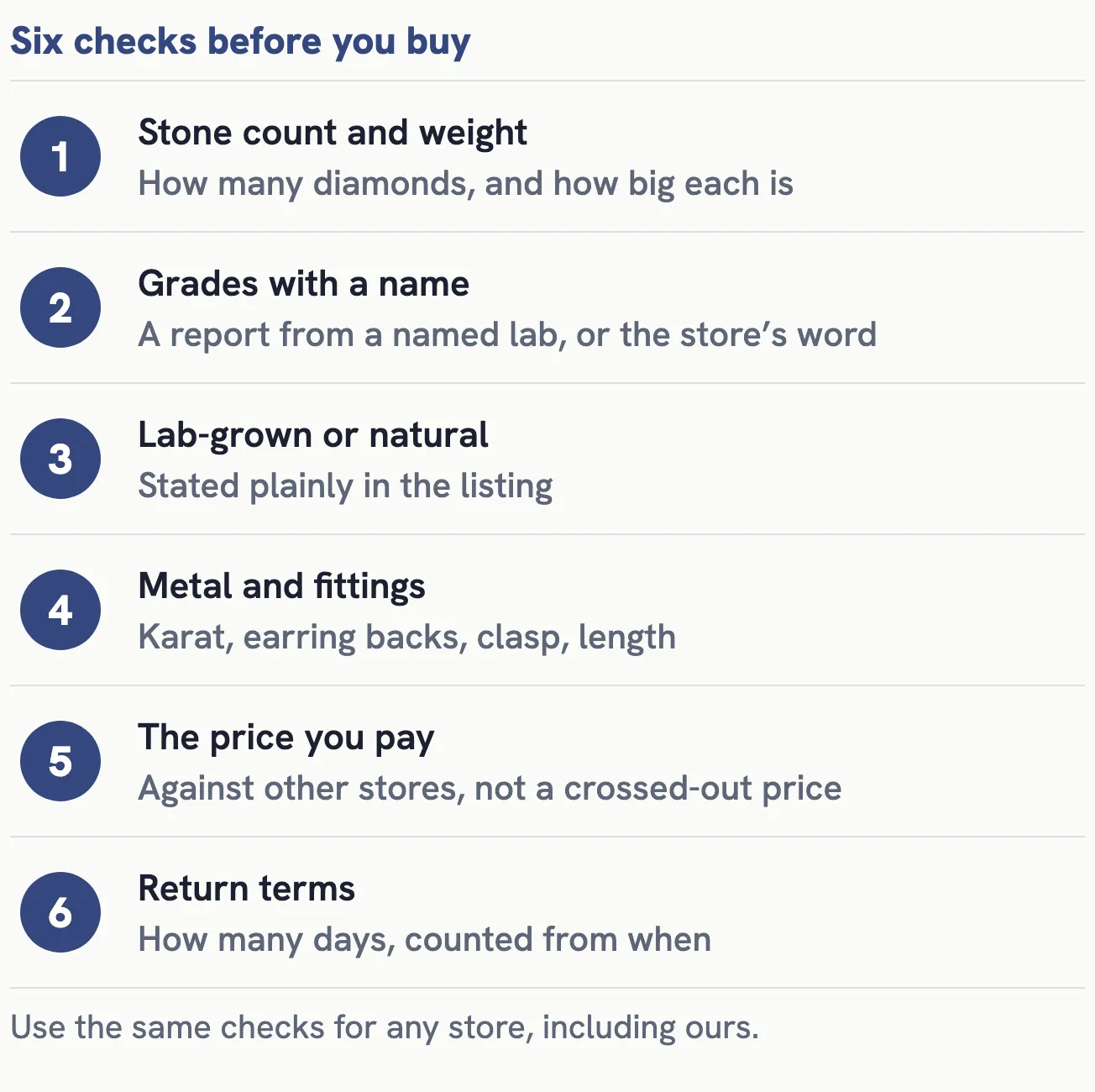
The same six checks work for any store.
Where is the best place to buy diamond stud earrings?
Studs look simple, which is why the listings need a careful read. Three things decide what you get: what the carat figure means, what grades the stones are, and how the earrings are held in the ear.
What “1 carat” studs really means
Almost every store sells studs by total carat weight, written ctw or ct. tw. A 1 ctw pair is two stones of about half a carat each. The FTC’s weight rule says a diamond’s weight mustn’t be misrepresented, though it doesn’t define total weight, so the label is a trade convention.
That leaves room for surprises. On Costco’s site on November 13, a pair of “1.00 ctw” studs with two diamonds was $1,999.99, and another “1.00 ctw” pair had 22 diamonds, small centers ringed by smaller stones, at $1,199.99. Both labels are accurate. They’re very different earrings, and the page’s “total number of diamonds” line is what tells them apart.
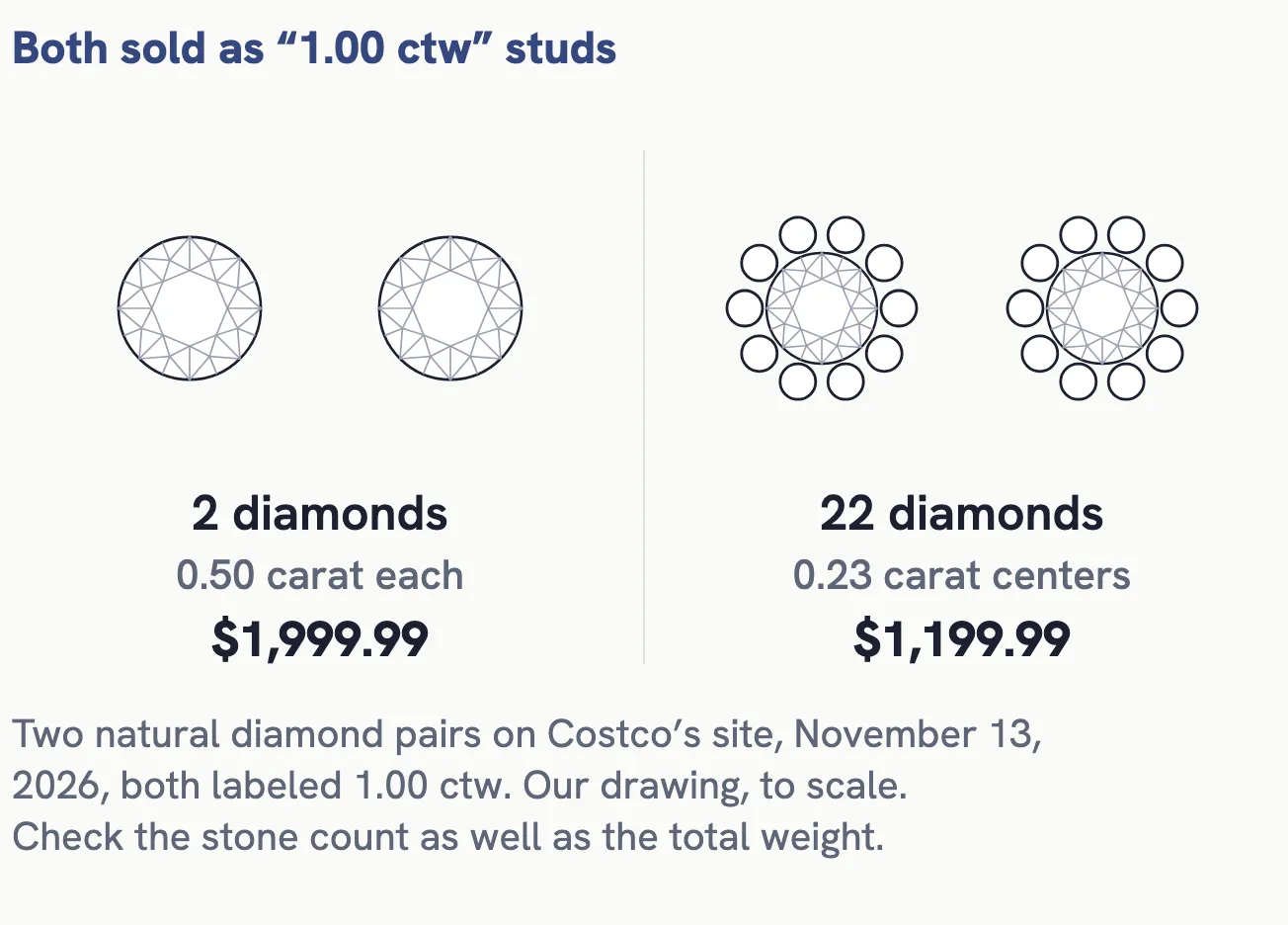
Same total weight, very different earrings.
Fractions are approximate too. Blue Nile’s 1 ct. tw. studs link to a chart showing that pair can weigh anywhere from 0.95 to 1.11 carats, which is the kind of range the FTC rule asks stores to disclose.
| Pair, total weight | Each stone | Width of each stone |
|---|---|---|
| 0.5 ctw | 0.25 carat | 4.10 mm |
| 1 ctw | 0.5 carat | 5.15 mm |
| 1.5 ctw | 0.75 carat | 5.87 mm |
| 2 ctw | 1 carat | 6.47 mm |
| 3 ctw | 1.5 carats | 7.43 mm |
Round stones. Widths as VRAI lists them for its own studs, read November 13, 2026; other well-cut rounds are within about 0.1 mm.
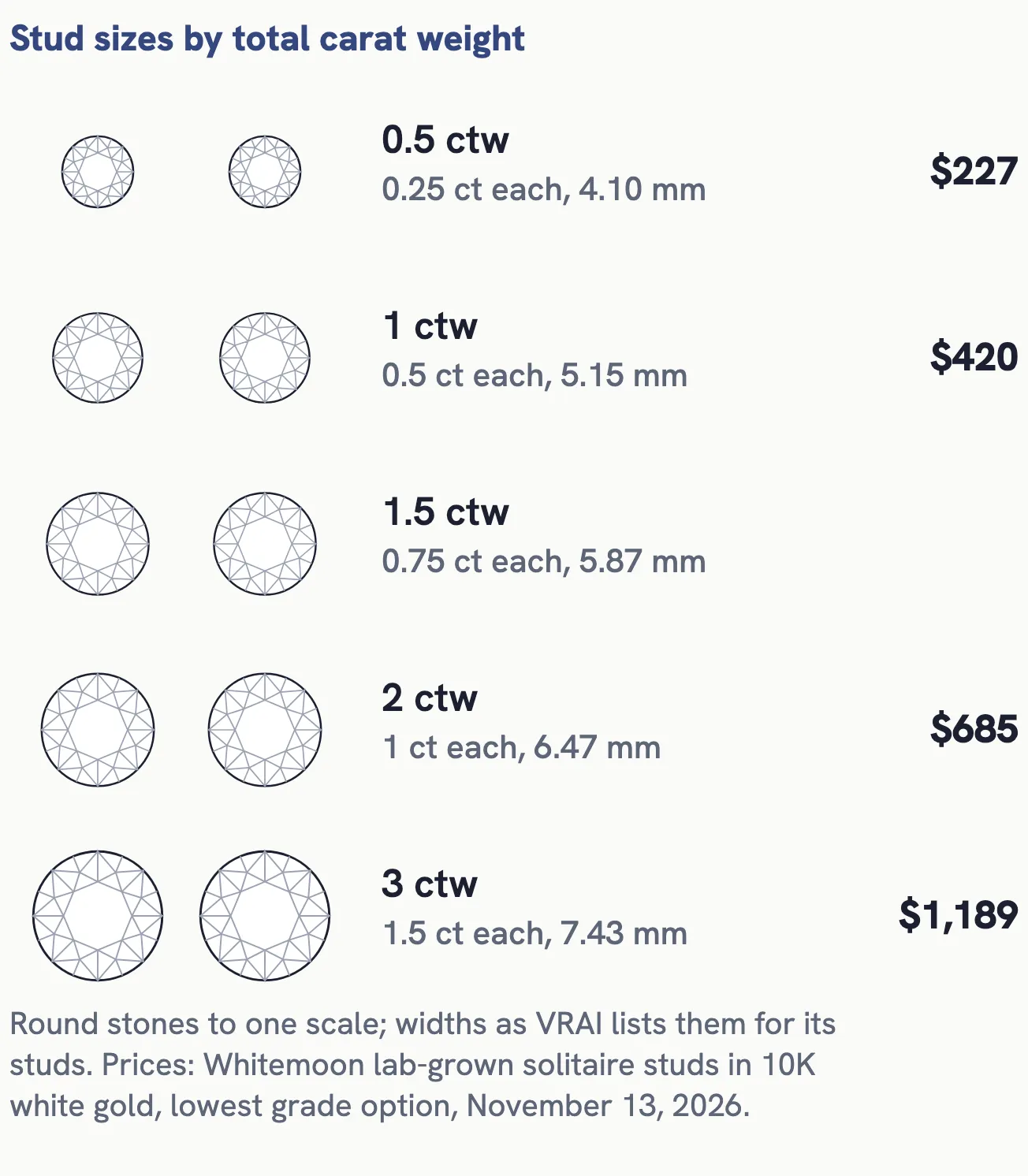
Stud sizes to scale, with Whitemoon’s 10K gold prices.
Diamond stud earring prices by store
These are round, four-prong, lab-grown solitaire studs in white gold, read on each store’s site on November 13, 2026. The grades differ a little, so we show them.
| Store | Grade stated | 1 ctw | 2 ctw |
|---|---|---|---|
| Whitemoon, 14K | F–G, VS–SI at 1 ctw; G, VS2 at 2 ctw | $507 | $792 |
| Blue Nile, 14K | Average F–G, VS2–SI1 | $546 | $1,038 |
| VRAI, 14K | G–J, SI or better | $850 | $1,650 |
| Brilliant Earth, 18K | Average F/G, VS | $895 | $1,595 |
| Kay, 14K | F, VS2 | $909.99 | – |
Blue Nile’s prices were after an automatic 40% discount from $910 and $1,730, and Kay’s after 30% off $1,299.99. Brilliant Earth’s studs are 18K; ours in 18K were $597 and $902. Prices change often, and several stores had holiday offers running.
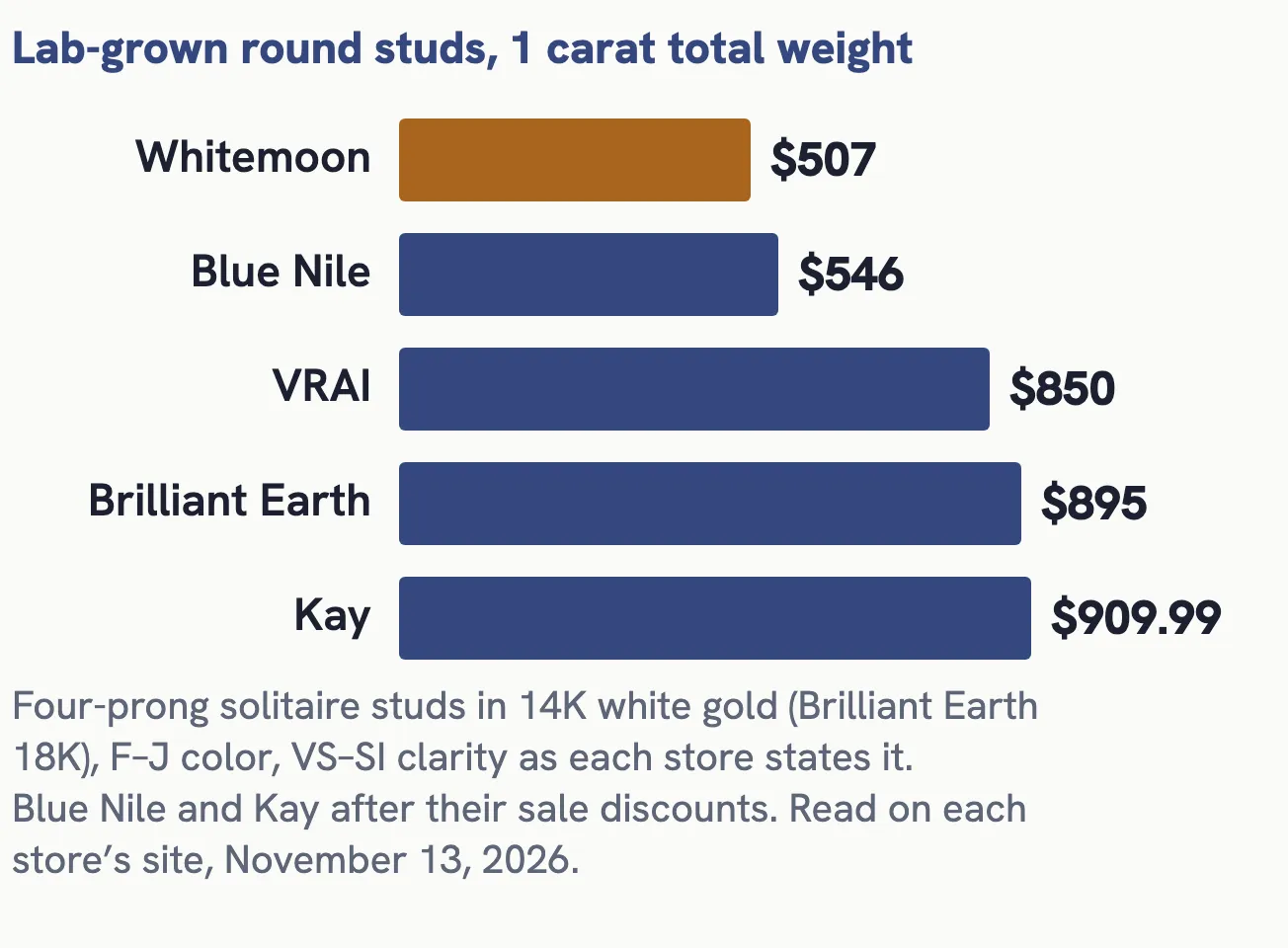
1 ctw lab-grown studs by store, November 13, 2026.
Natural diamond studs cost several times as much, and grade drives most of the spread. For 1 ctw in white gold that day: $1,999.99 at Costco in I color and VS2 clarity, $1,995 at Brilliant Earth for an average G/H color and SI clarity in 18K, and $3,213 at Blue Nile for an average H–I color and I1 clarity after 15% off.
Grades and reports on studs
Most studs are sold on the store’s word. Blue Nile lists an average color and clarity for the pair. Brilliant Earth’s 2 ct. tw. lab-grown studs say each pair comes with an IGI report, while its 1 ct. tw. pairs don’t mention one. Costco gives a GIA report only for center diamonds of 1 carat and up, which the stones in 1 or 2 ctw studs aren’t. Kay’s lab-grown studs are described as independently certified without naming the lab.
None of that is wrong. It just means that if a report matters to you, look for a listing that names the lab and gives a report number for each stone. Our guide to diamond grading labs explains what the reports cover.
Settings, backs and metal
A four-prong basket is the usual setting, with three-prong “martini” and bezel styles as alternatives. The back matters more than most buyers expect. BriteCo, a jewelry insurer, ranks push backs as the least secure and screw backs and locking backs among the most secure.
Stores ship different backs by default: locking backs at Blue Nile and Brilliant Earth, screw backs at Kay, push backs at VRAI. Our guide to earring types and backs explains how each kind of back works. Our round solitaire studs come with screw backs or push backs at the same price.
If your ears react to jewelry, the American Academy of Dermatology notes that earrings are among the most common causes of nickel allergy and suggests metals such as 18K yellow gold or platinum. Some white gold alloys contain nickel, so ask before you buy. Our gold karat guide explains the alloys.
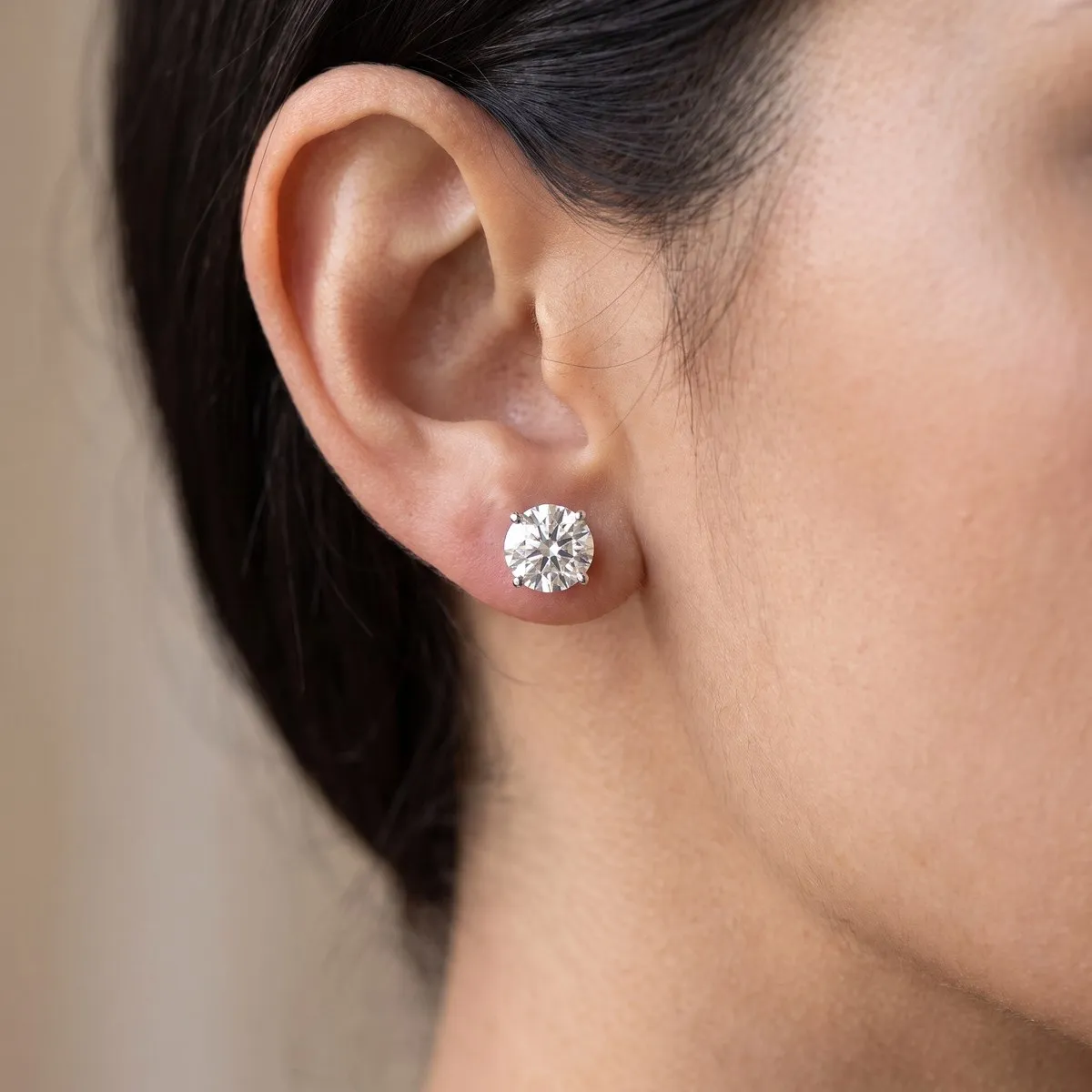
A round solitaire stud in white gold. Image created from the design.
Where is the best place to buy a diamond necklace or pendant?
For a solitaire pendant the checks are the same as for studs, plus the chain.
- Length. Check how the store measures it. Sixteen and 18 inches are the common lengths, and our necklace length chart shows where each one sits.
- Chain and clasp. Look for the chain’s width and the clasp type in the listing. A fine chain suits a small stone and can look thin under a large one.
- The stone. One carat in a pendant is a single stone, so the weight means what it says. Ask for the report if the stone is large.
- Engraving. Engraved or personalized pieces are final sale at most stores we read.
At Whitemoon on November 13, a round solitaire pendant in 10K white gold was $501 with a half carat lab-grown diamond, $682 with 1 carat and $1,068 with 2 carats. See lab-grown diamond pendants and necklaces.
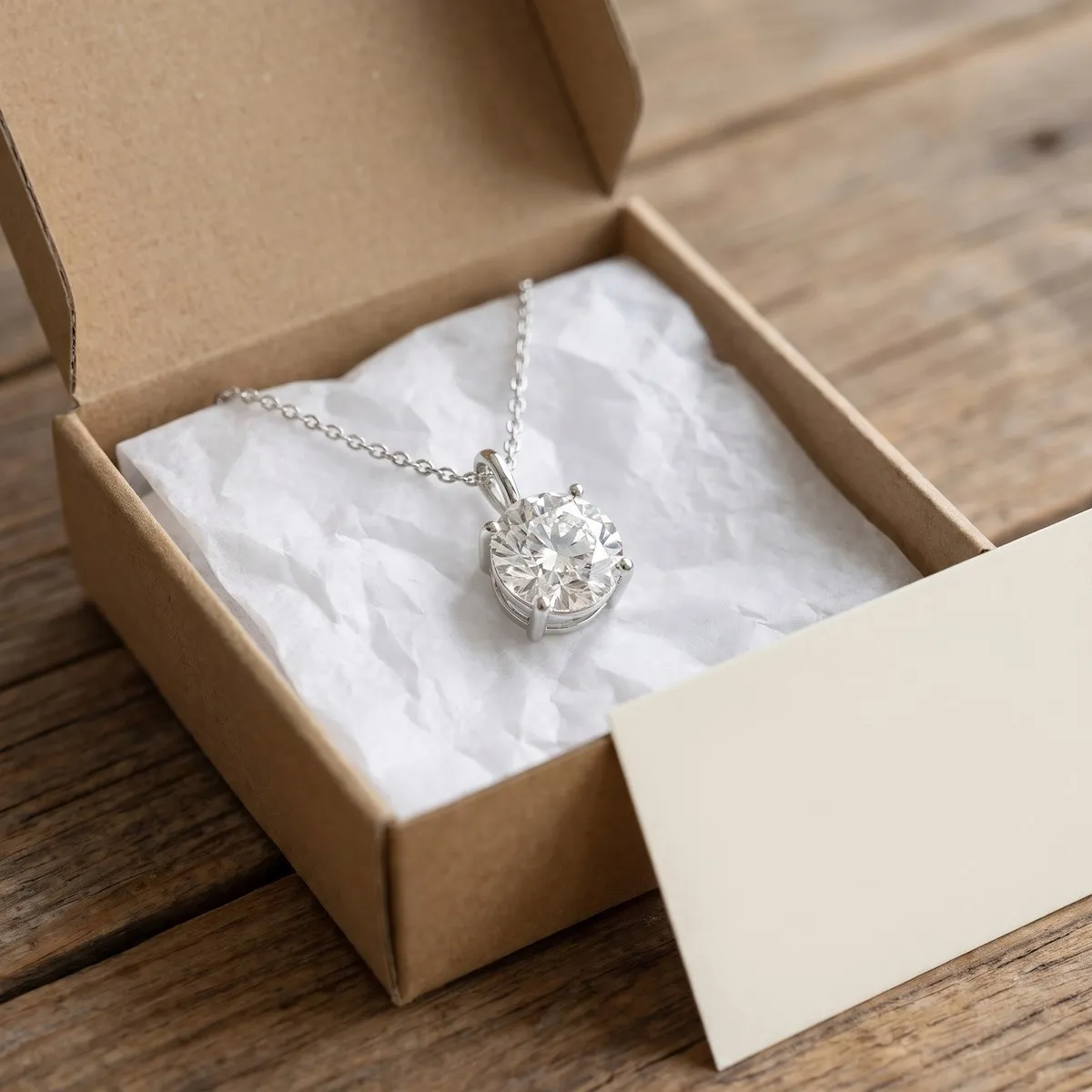
A round solitaire pendant in white gold. Image created from the design.
Where is the best place to buy a diamond tennis bracelet?
A tennis bracelet is sold by total weight spread over dozens of small stones, so the stone count and the build matter as much as the carat figure.
- Stone count. The same total weight can be, for example, 40 larger stones or 60 smaller ones. Ask for the count and the size of each.
- Clasp. Look for a box clasp with a safety catch, which GIA recommends.
- Length. Measure the wrist and add about half an inch to an inch. Several stores’ return policies we read cover ring resizing and say nothing about changing a bracelet’s length, so get it right when ordering.
- Metal. On a lab-grown bracelet the gold is a large share of the price. Compare like with like on karat.
At Whitemoon on November 13, an in-line bracelet of round lab-grown diamonds in 10K white gold was $1,327 at 2 carats total weight, $1,690 at 3 carats and $2,186 at 5 carats, and $3,001 at 5 carats in 14K. Our tennis bracelet guide goes through sizing, clasps and care, and the bracelets are in lab-grown diamond tennis bracelets.
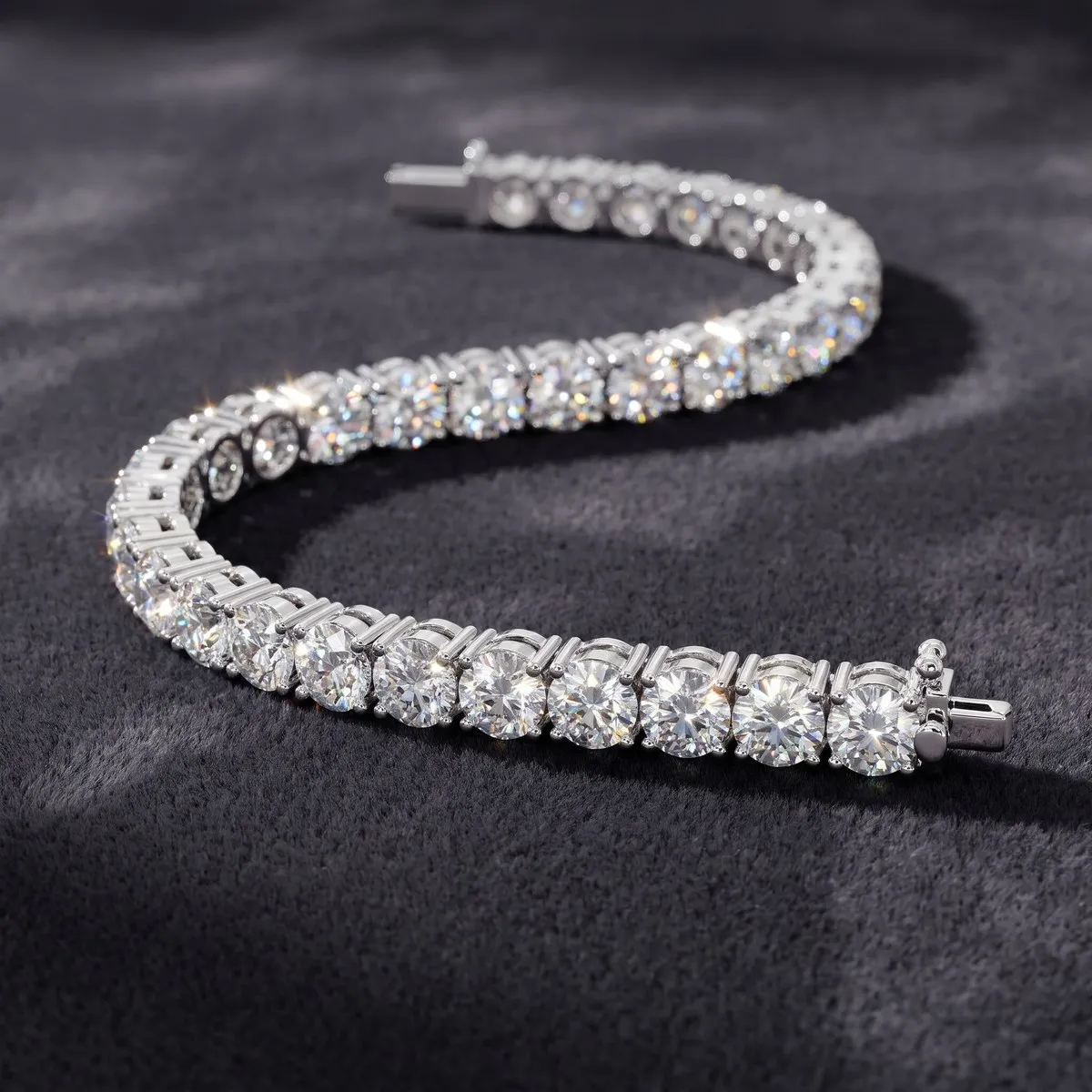
An in-line tennis bracelet in white gold, showing the box clasp. Image created from the design.
Where to buy a diamond wedding band
The main thing to check is resizing. A band with stones all the way around has no plain section to cut, so it usually can’t be resized the normal way. Our full eternity bands can be adjusted within one size, and anything more means a remake. Our wedding band styles guide compares the designs, and the bands are in lab-grown diamond wedding bands.
Returns and warranties: what the fine print says
Thirty days is the usual window, though the clock starts at different moments and a few terms are easy to miss.
| Store | Return window | Worth knowing |
|---|---|---|
| Blue Nile | 30 days from shipment | Lifetime warranty only on items of $1,000 or more |
| Brilliant Earth | 30 days from when the order is available | Only rings can be resized |
| Tiffany & Co. | 30 days from purchase | Gift recipients get an exchange or store credit |
| Kay | 30 days from shipment | Engraved and altered pieces excluded |
| VRAI | 30 days from delivery | $50 fee on refunded made-to-order jewelry |
| Mejuri | 30 days from delivery | Earrings used for a piercing appointment can’t be returned |
Policy pages read November 13, 2026. Several stores extend the window for holiday orders. All of them require the piece to be unworn, and none of the stores above refuses earrings as a category.
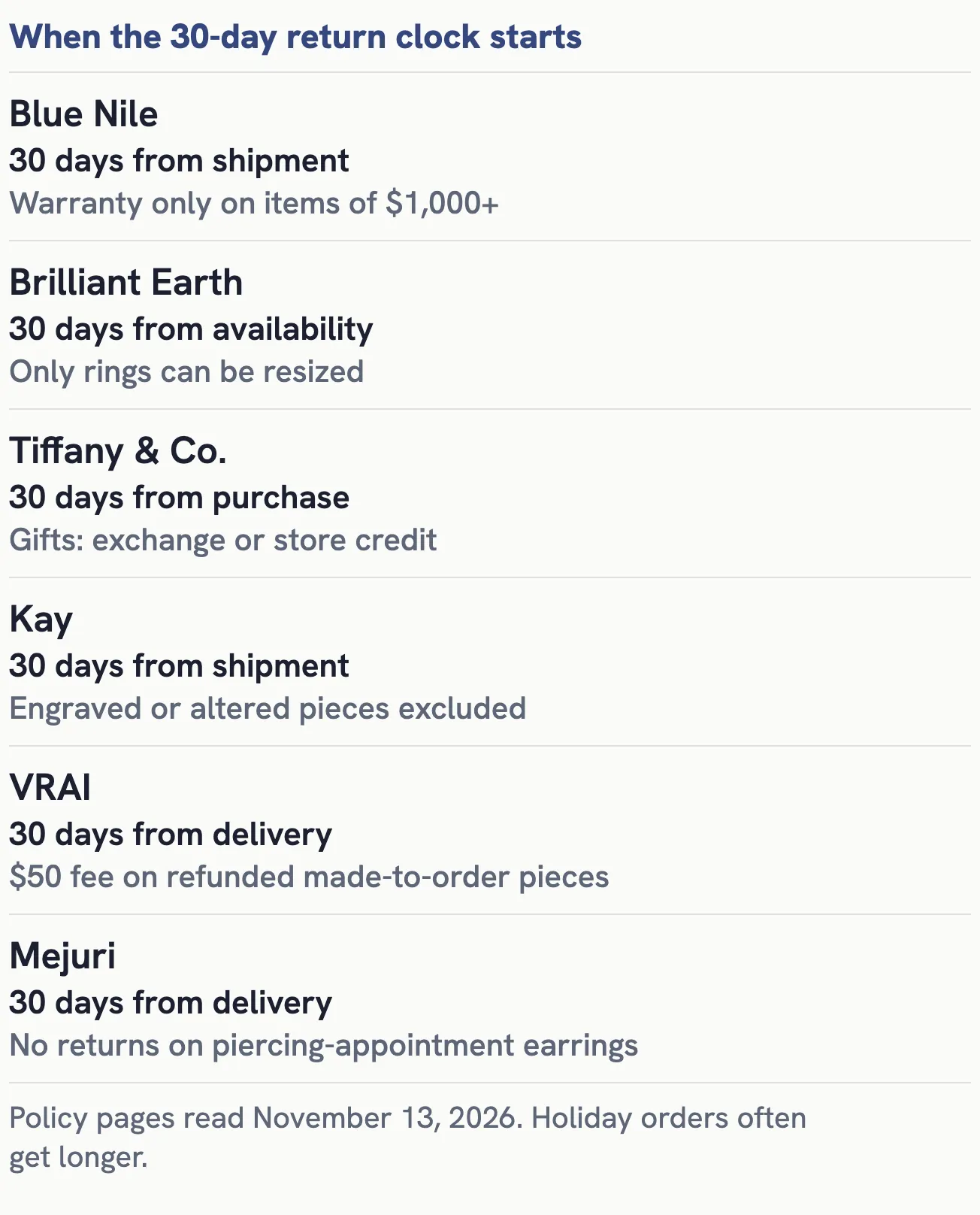
Thirty days, counted from different moments.
Read the warranty as closely as the return policy. Jared’s lifetime guarantee on diamonds requires an inspection at a Jared store every six months, which is hard to keep up if you bought online and live far from one.
Who has the best deal on diamond earrings?
A deal is only real if the “was” price was. The FTC’s pricing guide says a former price should be one the item was actually offered at, openly and for a reasonable time, and that a price set high just to be marked down is a false bargain.
In jewelry, a sale is close to the normal state. On November 13 we saw automatic discounts of 15% to 40% at Blue Nile and 30% to 57% at Kay. Kay listed two pairs of studs with the same name and the same $2,999.99 reference price, one at 30% off and one at 57% off. Shoppers have filed lawsuits alleging inflated reference prices at Zales and at Signet’s brands. Those are allegations, and we found no rulings.
So ignore the percentage. Write down the stone count, weight, grade and metal, then compare the price you’d pay with two other stores’ prices for the same thing.
Is Costco a good place to buy diamond studs?
It can be, if what it sells is what you want. Costco says all its diamonds are natural and untreated, and its studs come in a narrow range of grades, mostly I color and VS2 clarity. It doesn’t sell lab-grown diamonds, its studs of 1 or 2 carats total weight don’t come with a GIA report, and you need a membership, $65 a year at the basic level. Costco doesn’t publish its markup on jewelry, so any figure you see quoted for it is a guess.
Which brand is best for diamond jewelry?
There’s no objective answer, and we’d be wary of any page that names one. What can be measured is size and brand value. Signet, which owns Kay, Zales and Jared, estimates the US jewelry and watch market at about $63 billion and its own share at 8.5%. Brand Finance valued the Tiffany brand at $8.6 billion in 2026.
A brand name costs money. Tiffany’s solitaire studs in platinum were $1,450 for 0.22 carat total weight on November 13. In our opinion that price buys design, service and the name on the box, none of which appears on a grading report. Whether that’s worth it is a personal call.
Lab-grown or natural for earrings and bracelets?
Both are diamonds under the FTC’s rules. Lab-grown costs much less, which matters most in pieces with many stones or two matched ones. Analyst Edahn Golan found that lab-grown pieces were 20.5% of diamond jewelry units sold by US specialty jewelers in 2025.
Lab-grown diamonds don’t hold their retail price, so buy one to wear and not as an investment. Paying less up front leaves less at stake: $507 at Whitemoon against $850 to $910 at three of the stores above for 1 ctw lab-grown studs. Our Lifetime Upgrade gives you 100% of what you paid as credit toward a new lab-grown piece worth at least 1.5 times as much. Our guide to whether lab-grown diamonds are worth it goes deeper.
Buying diamond jewelry from Whitemoon
Hold us to the same six checks. Our product pages state the number of stones, the total weight options, the color and clarity you choose, the gold karat and the type of back. Our diamonds are lab-grown. Browse stud earrings or all lab-grown diamond earrings. Whitemoon jewelry is made to order in about 10–15 days and ships free with insurance both ways, with 30-day returns on unworn pieces.
Diamond jewelry buying questions
What is the best place to buy diamond earrings?
The store whose listing states the stone count, weight, grade and metal, whose price holds up against two others for the same thing, and whose return window you’ve read. No store is best for everyone.
Where is the best place to buy diamond stud earrings?
Compare like for like. For 1 ctw lab-grown studs in white gold on November 13, 2026, we were $507 and the four other stores compared above ran from $546 to $909.99.
Who sells the best lab-grown diamond stud earrings?
There’s no ranking we’d trust. Check whether the stones come with a named lab’s report, which back is fitted and what the return terms are.
Who has the best deal on diamond stud earrings?
Ignore the discount percentage and compare final prices for the same weight, grade and metal. Sale prices were the norm at several stores when we checked.
How much do good diamond earrings cost?
For 1 ctw round studs in white gold on November 13, 2026: about $500 to $900 lab-grown and about $1,300 to $3,200 natural at the stores we read, depending on grade.
What is the best carat size for diamond stud earrings?
It’s a matter of taste. A 1 ctw pair has stones a little over 5 mm wide, and a 2 ctw pair about 6.5 mm. Stores disagree on which size sells most.
Why are Costco diamonds so cheap?
Costco doesn’t publish its jewelry margins, so nobody outside the company can say for sure. Its range is narrow: natural diamonds in a few fixed grades.
Where can I buy legit diamond earrings?
From any seller that states whether the diamonds are natural or lab-grown, gives the grades and takes returns. For stones large enough to have a report, check the number on the lab’s website.
Where is the best place to buy a diamond necklace?
One that states the stone’s weight and grade, the chain length and width and the clasp, and lets you return it. Engraved pieces usually can’t be returned.
Where is the best place to buy a diamond tennis bracelet?
One that gives the stone count and total weight, uses a clasp with a safety catch and offers the length you need, since many stores won’t adjust it later.
Which website is the best for buying diamond jewelry?
No site wins on everything. Use the six checks above and compare two or three stores for the exact piece you want.
What is the best brand for diamond jewelry?
That’s opinion, not fact. Brand rankings measure a name’s market value, not the quality of a given pair of earrings.