
Where to Buy an Engagement Ring: Online vs In-Store and How to Pick a Jeweler You Can Trust
There’s no single best place to buy an engagement ring. We found no study showing that one kind of seller, online or in a store, is cheaper or safer across the board. In The Knot’s 2026 study, 64% of couples bought the ring in person and about a third bought it online. The right place is any jeweler that gives you a grading report you can check yourself, return and resize terms in writing, a stated delivery date, and a way to pay by credit card.
We’re an online jeweler, so read this knowing where we stand: Whitemoon sells lab-grown diamond rings, made to order. For this guide we read the return pages of five large jewelers on November 12, 2026, the FTC’s rules for online orders and Signet’s latest annual report, and we compared the listed price of the same diamond grade at several stores.
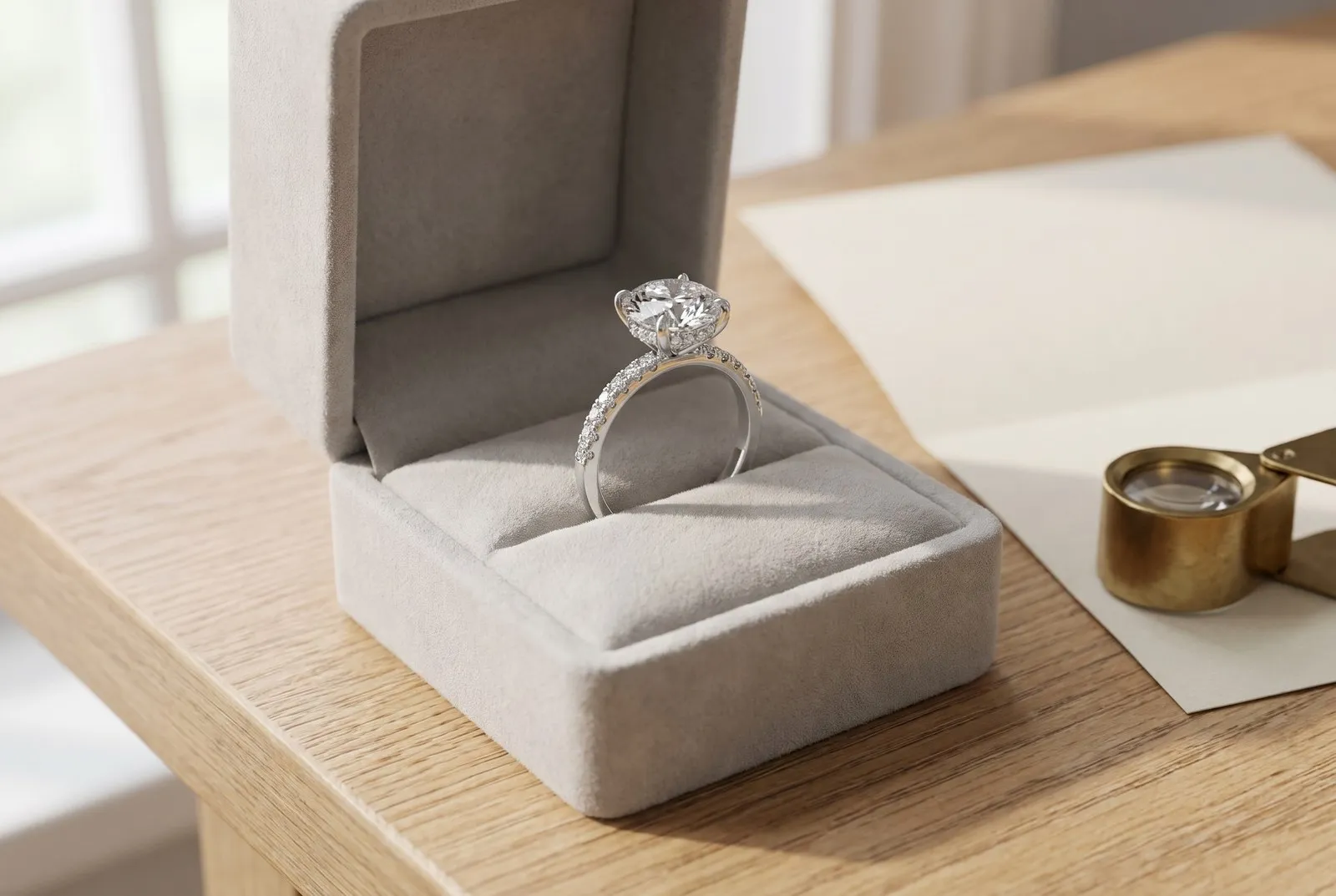
Pictured: a round solitaire setting with a pavé band in white gold. Image created from the design.
Where do most people buy engagement rings?
Mostly in person, still. The Knot’s 2026 Real Weddings Study surveyed 10,474 US couples married in 2025. It found that 64% bought the engagement ring in person, and JCK’s report on the same study says one-third bought online.
- The person proposing visited two retailers and looked at 10 rings, on average.
- 57% started researching more than six months before proposing.
- 79% of the people receiving the ring had a say in choosing it.
- 61% of rings had a lab-grown center stone.
The study surveys a wedding website’s own users, so treat it as a good guide and not a census.
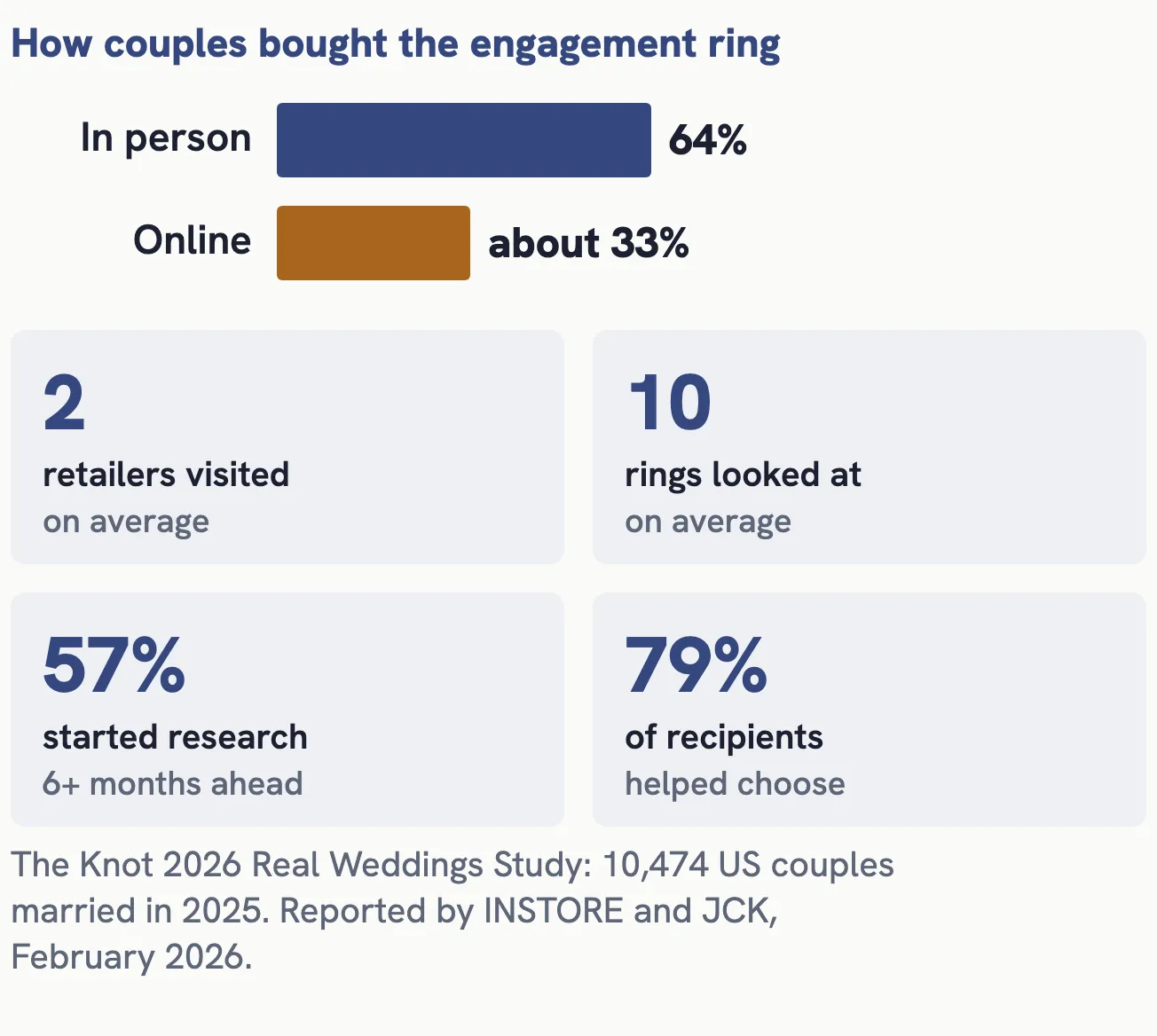
How couples married in 2025 bought the ring.
Is it better to buy an engagement ring online or in a store?
Each has real advantages, and neither is safer by default. What protects you is the paperwork, which you can get either way.
| In a store | Online | |
|---|---|---|
| What you see | The ring or stone itself, on your hand, in different light | Photos, video and the grading report; the ring arrives later |
| Selection | What that store stocks or can call in | Often thousands of stones, each listed with its report |
| Price | Differs from store to store | Differs just as much; see the price table below |
| Help | Face to face, and the same person for repairs | By phone, chat or video; repairs go by insured post |
| If it’s wrong | Take it back, under the store’s written terms | Send it back, under the store’s written terms |
| Legal fallback | Your receipt and card dispute rights | The same, plus the FTC’s shipping rule |
One old argument for buying online no longer holds: it doesn’t avoid sales tax. Since the Supreme Court’s 2018 decision in South Dakota v. Wayfair, states can require online sellers to collect it.
The main kinds of jewelers
- Independent local jewelers. You deal with the same person before and after the sale and can see stones in hand. Prices, paperwork and return terms differ from shop to shop, so ask for all three in writing.
- National chains. Signet owns Kay, Zales, Jared and Blue Nile, with 2,238 US stores at the end of January 2026. Its annual report calls Kay the largest specialty jewelry brand in the US by sales. Chains make financing easy: 42% of Signet’s eligible North American sales used credit, a lease or a pay-later plan. Read those terms as carefully as you look at the ring.
- Online diamond retailers. Blue Nile started in 1999, and Signet bought it in 2022 for $360 million. James Allen, still recommended in older buying guides, no longer runs as its own store: JCK reported in March 2026 that Signet was closing the site, and on November 12 its address sent visitors to Blue Nile.
- Luxury houses. Tiffany, Cartier, Harry Winston and Graff sell the name and the service along with the ring. On November 10, 2026, Tiffany’s site listed its platinum Tiffany Setting with a 2.00 carat H VS1 diamond at $55,000. A natural round diamond of that grade with a GIA report had a median price of about $19,700 at three online stores the next day, for the stone alone.
- Warehouse clubs. Costco says it sells natural, untreated diamonds only, at VS2 clarity and I color or better. Center stones of 1.00 carat and up come with a GIA report; smaller ones get a description written by Costco’s own gemologist.
- Custom and made-to-order jewelers. You get the exact size, metal and stone you asked for. The trade-off is the wait, and at most stores a custom or engraved piece can’t be returned.
- Vintage, estate and pawn. Older rings can be good value, but a stone in an old mounting often comes without a grading report, so ask for an independent appraisal before you pay.
- Marketplaces. eBay’s Authenticity Guarantee sends jewelry sold for $500 or more to GIA, which checks it against the listing before it ships. That’s a check of the listing, not a grading report.
Does the store change the price of the same diamond?
Yes, more than most people expect. We compared one grade, a round 1 carat diamond of F color and VS1 clarity, using the median listed price at each store.
| Round, 1 carat, F, VS1 | Store | Typical price | Stones compared |
|---|---|---|---|
| Natural, GIA report | Ritani | $4,679 | 320 |
| Natural, GIA report | Brilliant Earth | $5,278 | 246 |
| Natural, GIA report | Blue Nile | $5,719 | 480 |
| Lab-grown, IGI report | Whitemoon | $324 | 502 |
| Lab-grown, IGI report | Grown Brilliance | $347 | 714 |
| Lab-grown, IGI report | Brilliant Earth | $553 | 533 |
| Lab-grown, IGI report | Blue Nile | $656 | 24 |
Stones of 1.00–1.49 carats, priced per carat and scaled to exactly 1 carat. Other stores’ listings November 11, 2026; Whitemoon November 12. Blue Nile listed only 24 lab-grown stones at this exact grade, so treat that figure as rough.
For the natural stone, the highest store was 22% above the lowest. For lab-grown, the gap was about double. The grade on the report was the same in every row, so compare the exact grade before you choose a store.
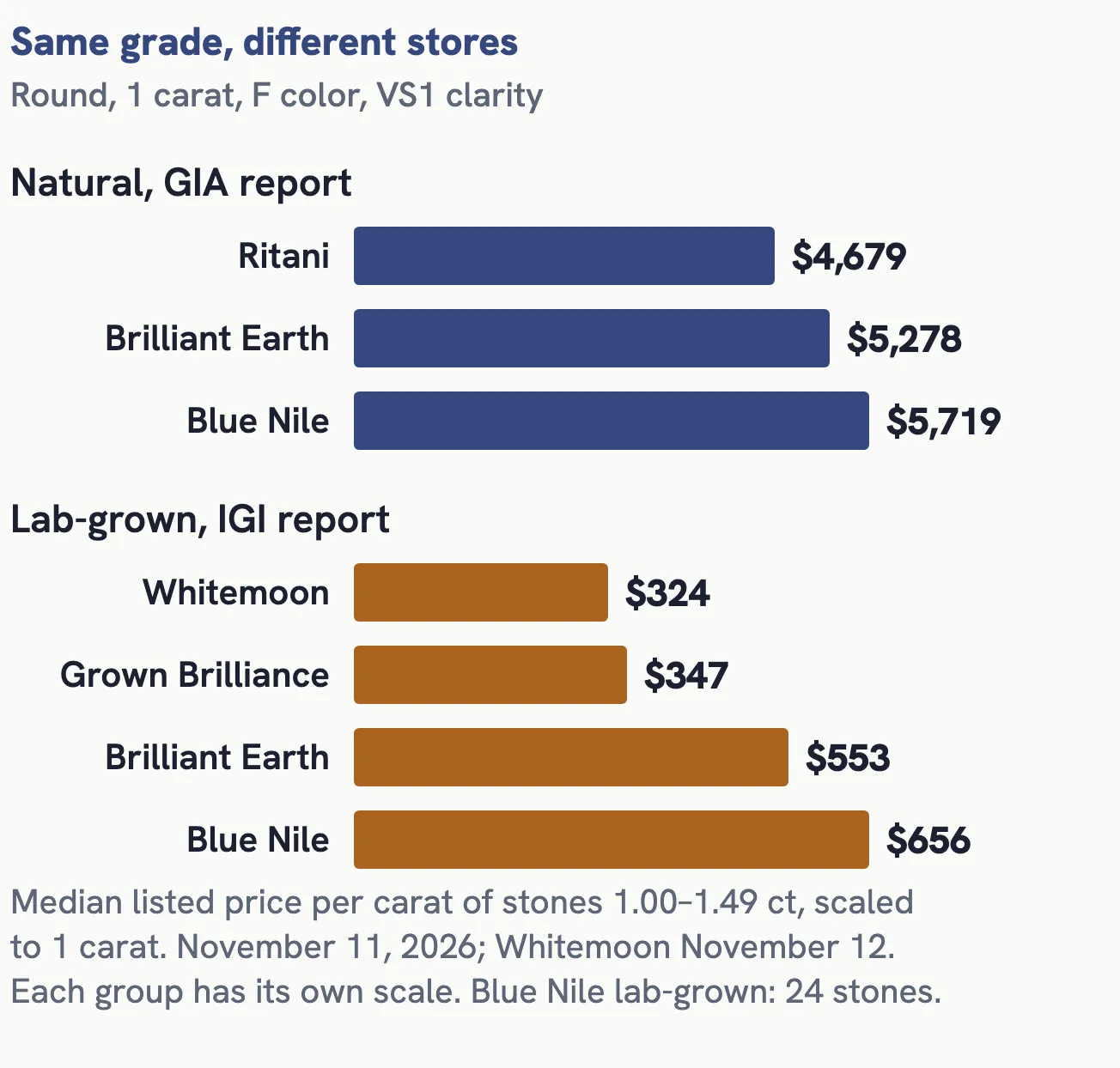
The same grade at different stores, November 2026.
Can you trust online jewelry stores?
You can trust the ones that put their terms in writing, and US rules give you a fallback when a seller doesn’t keep them.
- Shipping. Under the FTC’s mail and internet order rule, a seller must ship within the time it states, or within 30 days if it states none. If it’s going to be late, it has to offer you the choice to cancel, and the refund is due within seven working days. Store credit doesn’t count as a refund.
- Card disputes. A charge for goods not delivered as agreed is a billing error under federal credit rules. You have 60 days from the first statement that shows the charge to dispute it in writing, and the card issuer must resolve it within 90 days.
- Reviews. An FTC rule in force since October 21, 2024 bans fake and paid-for reviews and “independent” review sites run by the seller. In our view, a page of nothing but five-star reviews is a reason to look for reviews somewhere else.
- The stone itself. Look up the report number on GIA’s Report Check or IGI’s site before you pay, and check that the weight and measurements match the listing.
A made-to-order ring takes time, and the shipping rule covers that too: a seller that states a making time needs a reasonable basis for it, and you can cancel if it slips.
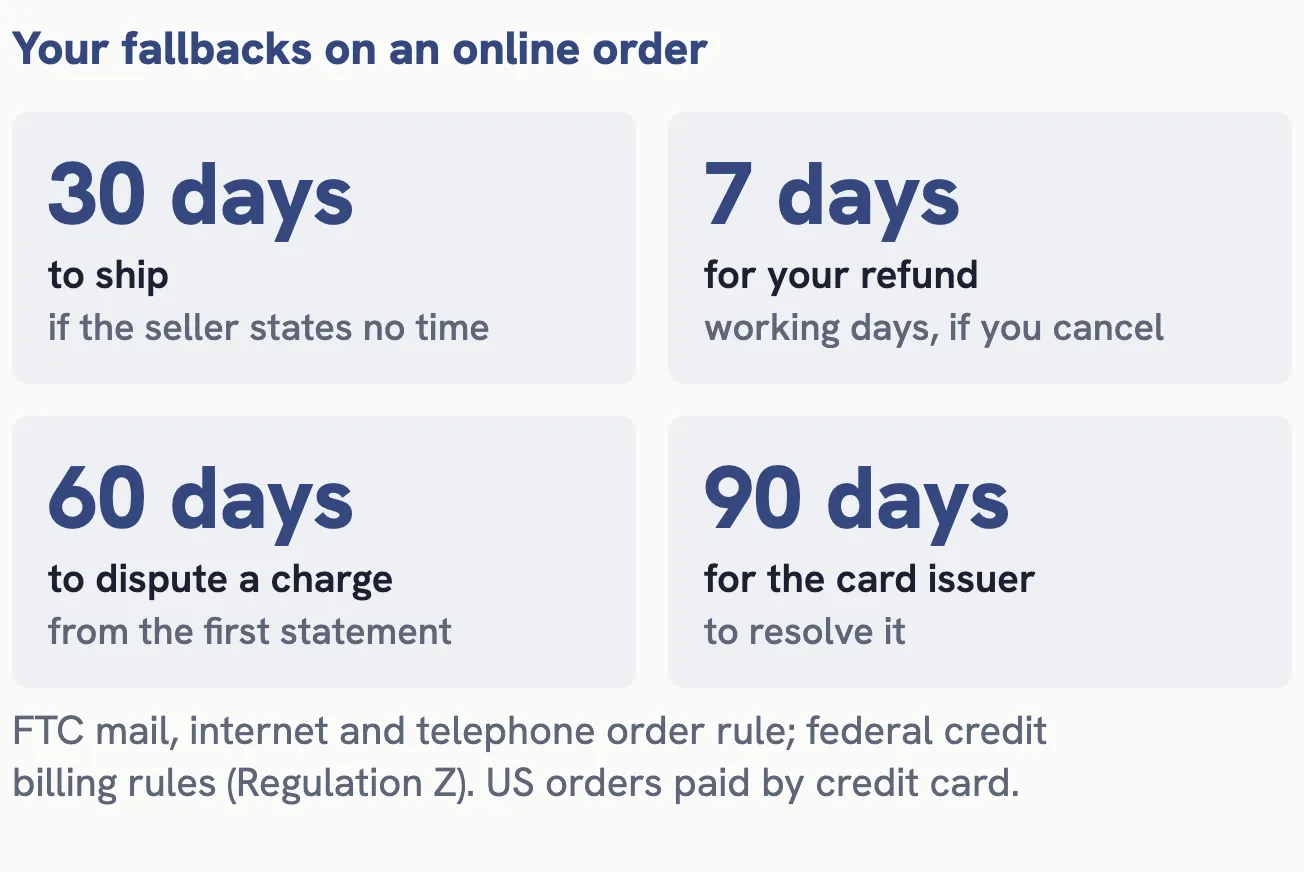
Your fallbacks on an online order in the US.
How to check a jeweler before you buy
- Ask which lab graded the stone. A grade means little without a known lab behind it. In 2014 the trade network RapNet stopped listing diamonds graded by EGL, citing “misrepresentation of diamond quality”. Our IGI vs GIA comparison covers the two labs you’ll see most.
- Know what the report doesn’t say. GIA says a grading report “does not indicate a diamond’s monetary value”. An appraisal estimates what a ring would cost to replace, and that figure is usually above the price paid, so it doesn’t prove you got a bargain.
- Get the return terms in writing. Find out which day the clock starts and what’s excluded. The table below shows how much this varies.
- Ask about resizing. How many times, how many sizes, and for how long. Our ring size guide helps you get it right the first time.
- Check that the business exists. Look for a street address and a phone number, and search the company in its state’s business registry, which is free.
- Read ratings for what they are. The BBB says its letter grade doesn’t count customer reviews and “is not a guarantee”. Jewelers of America members pledge each year to a code of practice; it’s a pledge, and its page describes no audit.
- Pay by credit card, and keep the receipt. It should show the weight in decimals, “lab-grown” or “natural”, the metal and karat, and the report number and lab.
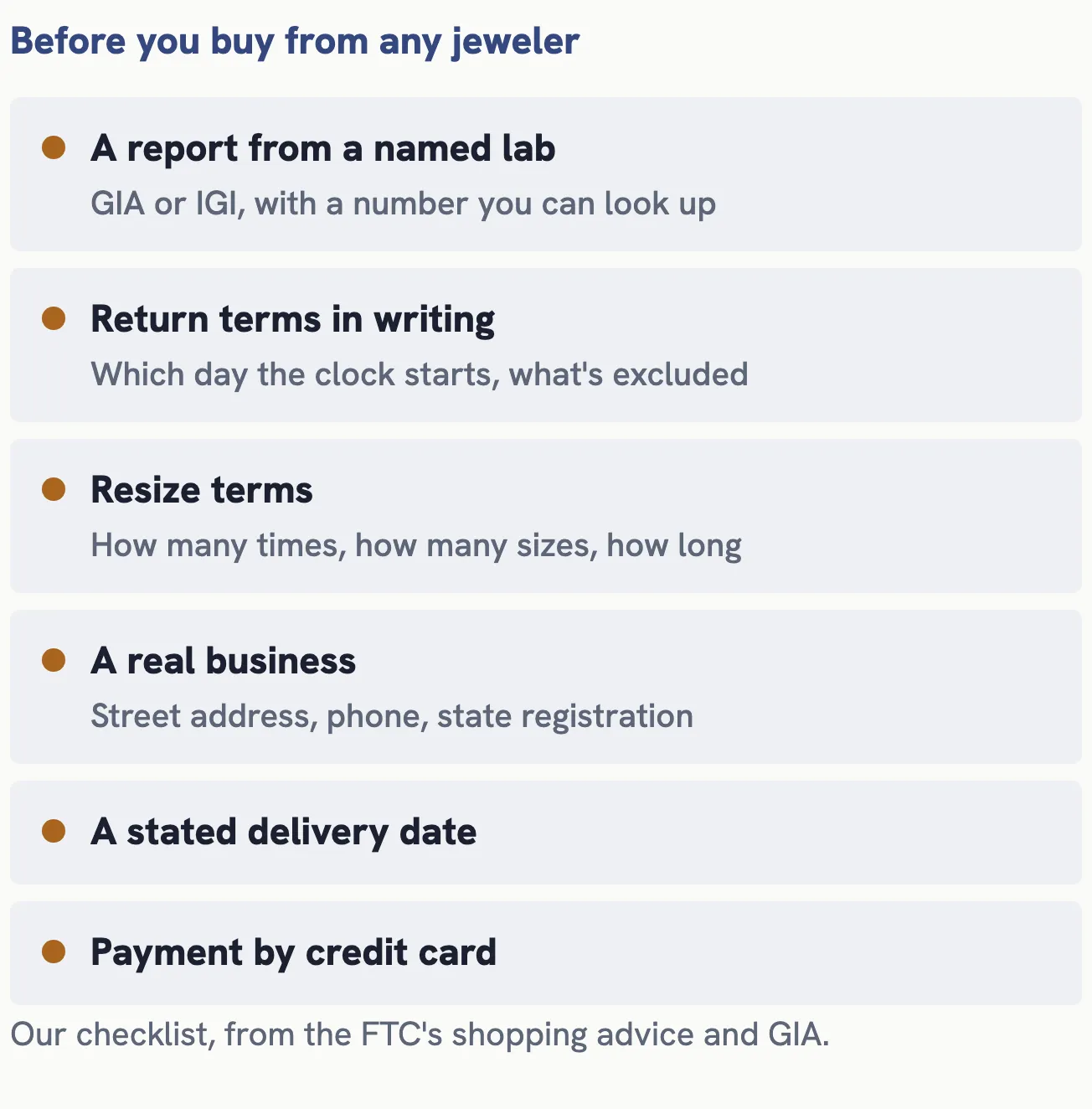
What to check before you buy from any jeweler.
Return and resize policies at six jewelers
We read each store’s own policy page on November 12, 2026. Policies change, so check again before you order.
| Store | Return window | Clock starts | Not returnable, or fees | Free resizing |
|---|---|---|---|---|
| Blue Nile | 30 days | When it ships | Engraved, custom and resized pieces | Once, up to two sizes, within 6 months |
| Brilliant Earth | 30 days | When the order is ready to ship or collect | Custom designs and resized rings; $40 to remove engraving | Once within 60 days |
| VRAI | 30 days | On delivery | Custom and engraved pieces; a $300 fee on a refunded engagement ring | Once, up to one size |
| Kay | 30 days, exchanges 60 | When it ships | Engraved and custom pieces | Not stated on the returns page |
| Costco | No day limit stated for diamonds | – | Special-order pieces; diamonds over 1 carat need their original papers | Not stated |
| Whitemoon | 30 days | On delivery | Engraved pieces, custom commissions and earrings once the seal is broken; no restocking fee | Once within 60 days of delivery |
Three patterns stand out. Every store excludes custom or engraved pieces, or charges for them, so ask before you add an engraving. A “30-day” window can start on three different days. Our guide to buying diamond earrings, necklaces and bracelets online compares the same terms for other jewelry. And fees don’t always sit under the word “restocking”: VRAI’s is called a recycling fee and is waived if you take store credit.
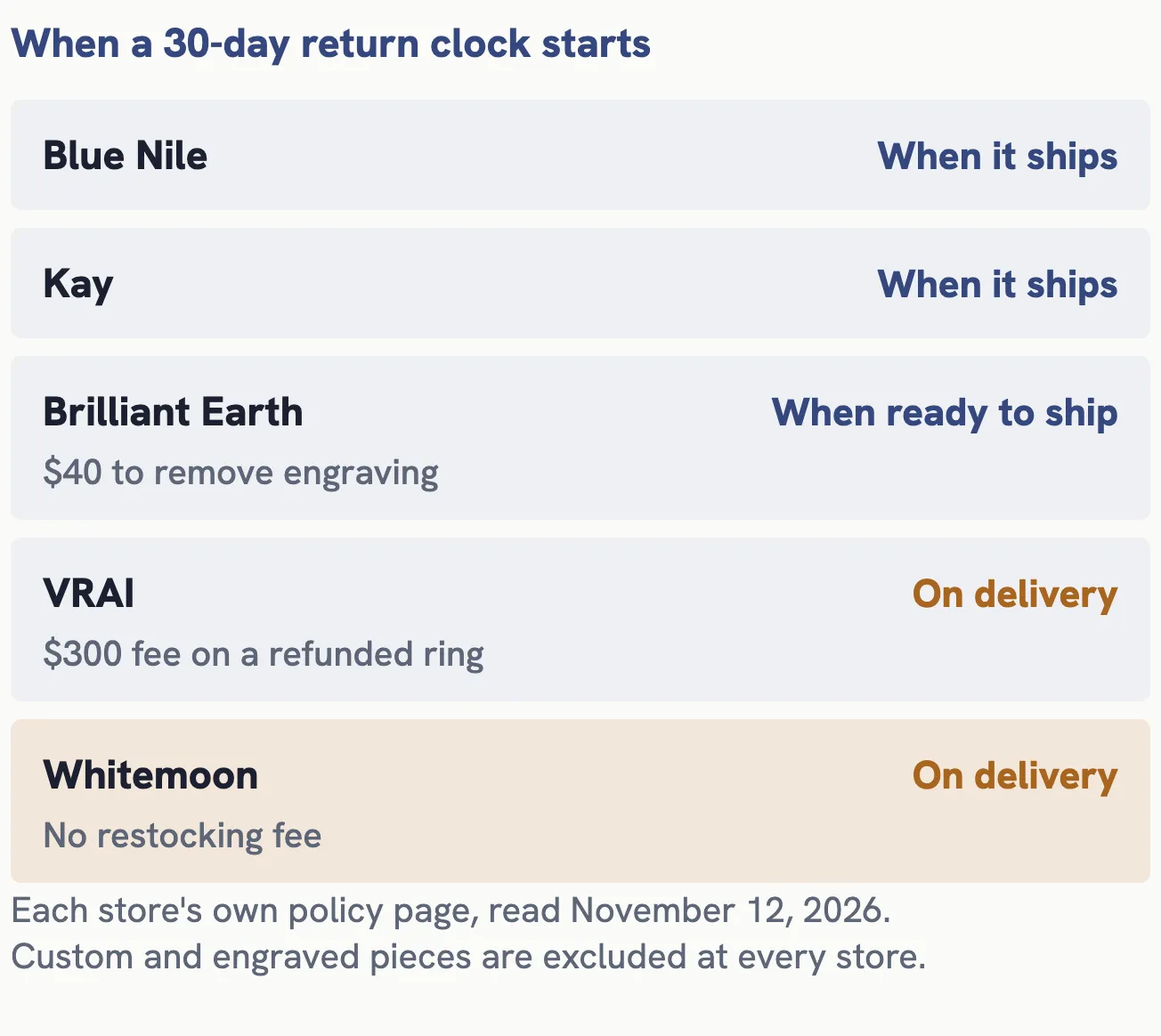
When the return clock starts at five jewelers, read November 12, 2026.
Where not to buy an engagement ring
No kind of store is bad by nature. These are the situations with a documented record of trouble.
- Far from home, in a hurry. In 2024 Alaska sued a jeweler across from the cruise docks in Ketchikan, alleging it sold imported, man-made “gold nuggets” as local gold. The case settled in March 2026 for $60,000. If you buy on a trip, buy only with a report you can verify and return terms that work from home.
- A grade with no lab named. “Certified” means nothing until you know who certified it and can look the report up.
- Store credit you didn’t plan on. In 2019 the Consumer Financial Protection Bureau and New York penalized Sterling Jewelers, then the owner of Kay and Jared, $11 million over store-card accounts opened without customers’ consent. The bureau has also warned about deferred-interest promotions, where missing the payoff date brings interest back to the day of purchase.
- Anyone who won’t write it down. A promise about returns, resizing or an upgrade is only as good as the page it’s printed on.
Where to buy a lab-grown diamond engagement ring
Not every big name sells them. Costco sells natural diamonds only, and JCK reports that Signet is repositioning Blue Nile as a luxury brand built around natural diamonds, though it still lists lab-grown stones. Our guide to whether lab-grown diamonds are worth it covers price, quality and resale. Three checks matter more for lab-grown than for natural.
- The wording. The FTC’s Jewelry Guides say “laboratory-grown” or a similar term should sit right with the word diamond. It should be on the product page, the receipt and the report. Our guide to whether lab-grown diamonds are real diamonds explains the terms.
- The price. As the table above shows, the same lab-grown grade cost about twice as much at one store as at another.
- The upgrade terms. Lab-grown diamonds don’t hold their retail price, so ask what credit the store gives if you trade up later, and get it in writing.
For what rings cost at every size, see our engagement ring cost guide and our guide to affordable engagement rings.
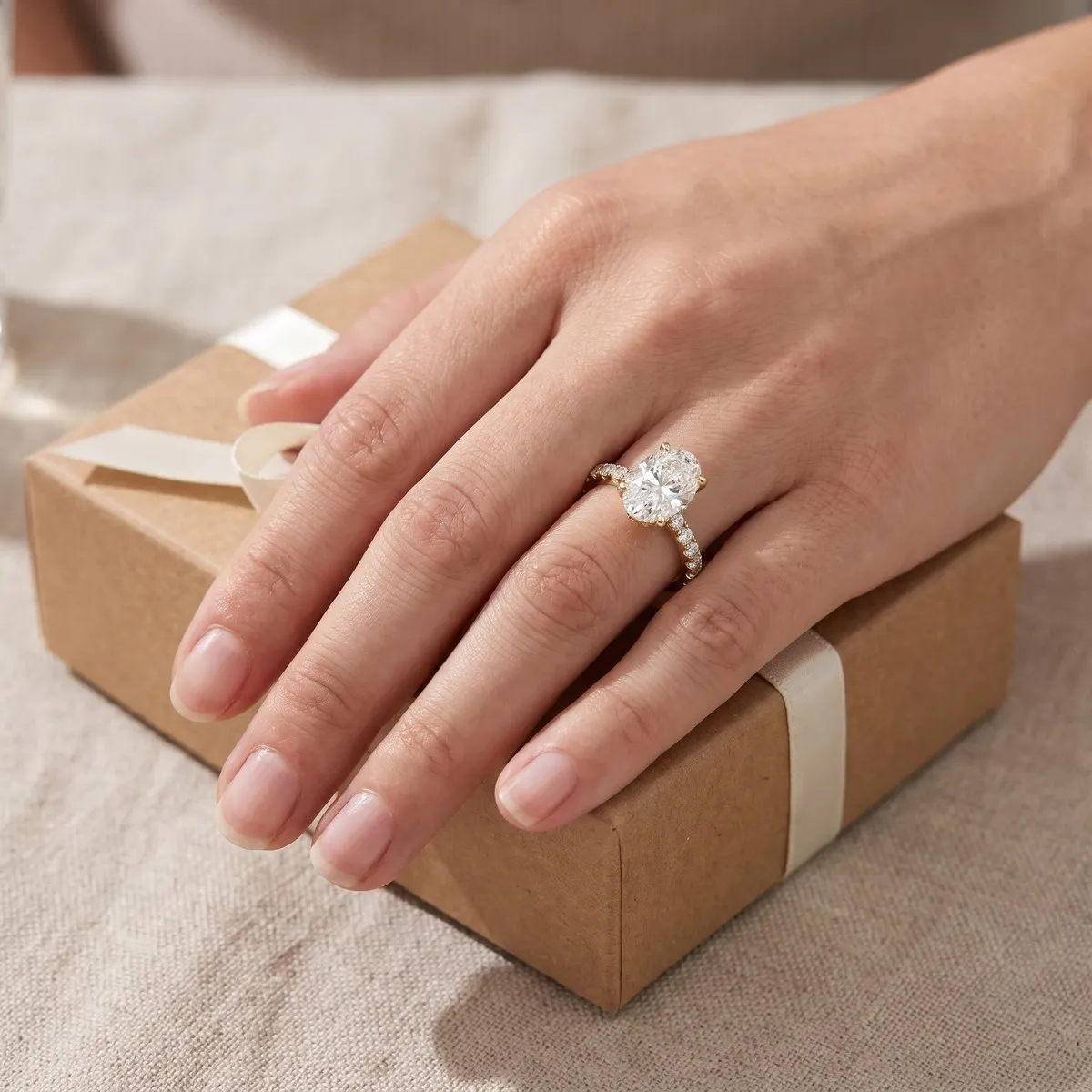
A 1.5 carat oval lab-grown diamond ring with a hidden halo in yellow gold. Image created from the design.
Who buys the wedding bands?
By tradition each side buys the other’s. The Emily Post Institute says the groom’s side pays for the bride’s engagement and wedding rings and the bride’s side pays for the groom’s ring, and that today any way of sharing the cost is fine. Our guide to wedding band types explains the styles. In our opinion it’s easiest to buy the band where you bought the engagement ring, since the metal color and the fit against the ring can be matched; see our wedding bands. Our guide to engagement rings vs wedding rings covers how the two are worn together.
After you buy: insurance
A standard homeowners or renters policy often caps jewelry theft at about $1,000 to $2,000 and doesn’t cover a ring that’s simply lost, according to the Insurance Information Institute. Adding the ring to your policy by name, or buying a separate jewelry policy, usually needs an appraisal. Jewelers Mutual, an insurer, puts the cost at 1% to 2% of the ring’s value a year, about $43 to $86 on a $4,300 ring by our arithmetic.
Buying an engagement ring from Whitemoon
We sell online and make each ring to order, so here’s how we measure up against our own checklist. Every center diamond comes with an IGI or GIA report, and you pick the stone yourself in the ring builder, lab-grown or natural. Sales tax is worked out at checkout, and every parcel is insured and needs a signature. Our address is 1177 Sixth Avenue, New York, and you can call, email or book a video consultation from the contact page.
Most Whitemoon rings are made to order in about 10–15 days and ship free with insurance both ways, with 30-day returns on unworn pieces and one free resize within 60 days of delivery. Start with our engagement rings.
Questions about where to buy an engagement ring
What is the best place to buy an engagement ring?
No kind of seller is best for everyone. Choose a jeweler that gives you a report from a known lab, written return and resize terms, a stated delivery date and the option to pay by credit card.
Can you trust online jewelry stores?
Yes, if the stone has a report you can look up and the terms are in writing. The FTC’s shipping rule and credit card dispute rights back you up if a seller doesn’t deliver.
Where not to buy an engagement ring?
Avoid any sale where you can’t verify the stone or return it from home, such as a rushed purchase on a trip, and any seller who won’t name the grading lab.
Which brand is best for engagement rings?
A brand name adds to the price but doesn’t change the grade on the report. Compare the same grade across stores first, then decide what the name is worth to you.
Where do rich people buy engagement rings?
The top of the market is served by luxury houses such as Tiffany, Cartier, Harry Winston and Graff, and by auction houses. Tiffany’s site listed 2 carat Tiffany Setting rings from $48,900 on November 10, 2026. Our guide to Tiffany engagement ring prices compares them with lab-grown alternatives.
Why is Blue Nile so much cheaper?
In its 2015 annual report, Blue Nile said it listed suppliers’ diamonds without buying them first, had no store costs and accepted lower margins. That was a decade ago. In our November 11 comparison it had the highest price of the three stores for a natural 1 carat F VS1.
What is the most reputable jewelry company?
There’s no official ranking. A BBB grade isn’t a guarantee and doesn’t count customer reviews, so judge a jeweler by its paperwork and written terms.
Who pays for the wedding bands?
Traditionally each partner’s side buys the other’s ring. Today couples split it however suits them.
Does the man buy his own wedding ring?
Not by tradition: the Emily Post Institute has the bride’s side buying the groom’s ring. Many couples now pay for both bands together.
Where can I buy a lab-grown diamond engagement ring?
From jewelers that list lab-grown stones with an IGI or GIA report, online or in a store. Check that the words “lab-grown” appear on the receipt and the report.