
Are Lab-Grown Diamonds Worth It? Cost, Value, Pros and Cons
For most people buying a diamond to wear, yes. A lab-grown diamond is an actual diamond, and at the stores we compared it costs about 90% less than a natural one of the same grade. It isn’t worth it if you want a stone that keeps its value: lab-grown diamonds don’t hold their retail price, and the big resale services won’t buy them.
We sell lab-grown diamonds, and our ring builder also lists natural ones, so weigh our view with that in mind. For this guide we compared the listed price of the same grade at Whitemoon and three other stores on November 11 and 12, 2026, read analysts’ price data and the resale buyers’ own pages, and listed the real downsides alongside the benefits.
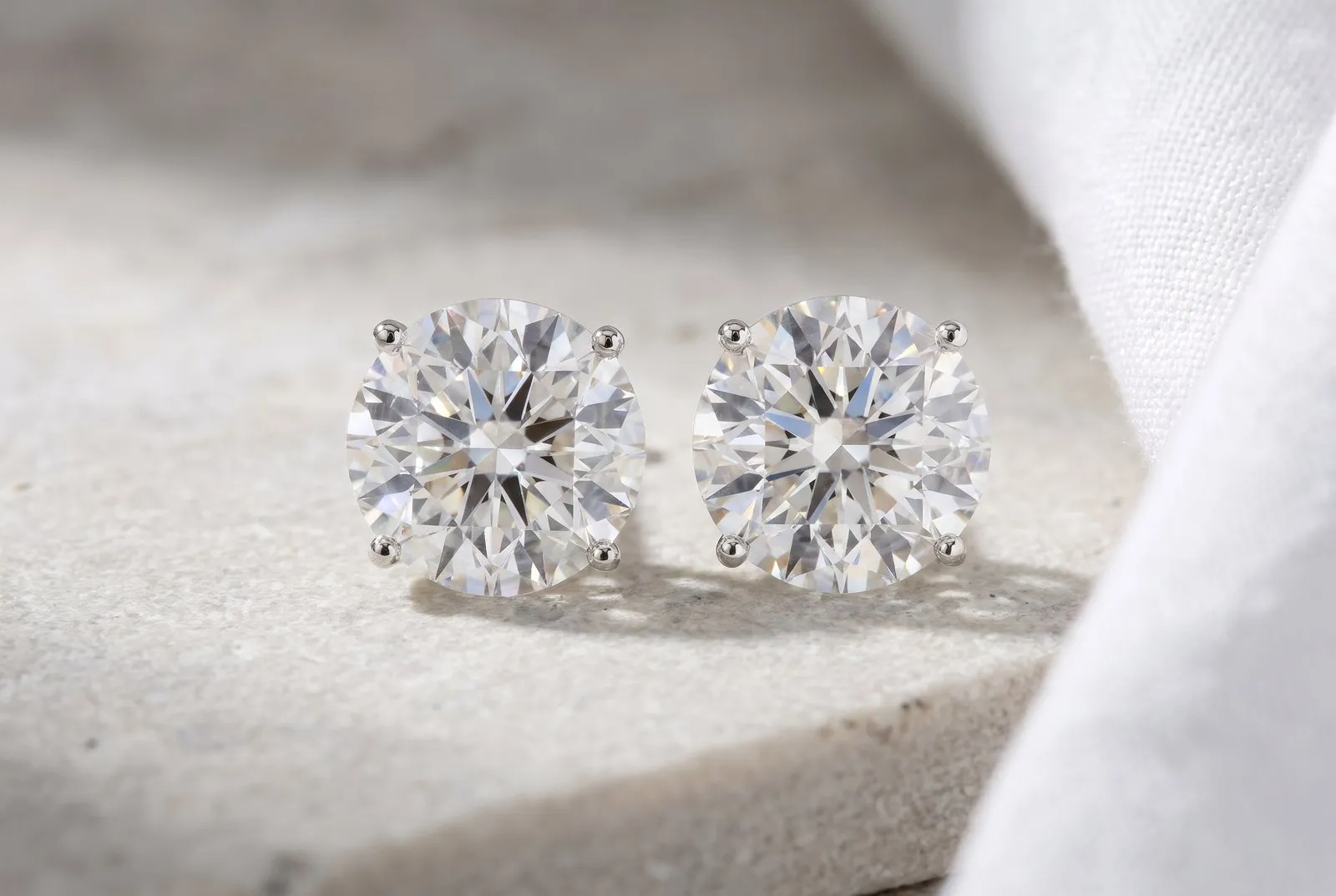
Pictured: round lab-grown diamond stud earrings in white gold. Image created from the design.
How much cheaper are lab-grown diamonds?
The bigger the stone, the wider the gap. Our diamond price chart shows the gap at every size. This table compares one grade, a round diamond of F color and VS1 clarity, at seven weights.
| Weight | Natural, GIA report | Lab-grown at Whitemoon, IGI report | Natural costs |
|---|---|---|---|
| 0.5 carat | $910 | $178 | 5 times as much |
| 1 carat | $5,271 | $324 | 16 times |
| 1.5 carats | $12,656 | $468 | 27 times |
| 2 carats | $27,137 | $672 | 40 times |
| 3 carats | $66,404 | $1,008 | 66 times |
| 4 carats | $115,187 | $1,440 | 80 times |
| 5 carats | $177,160 | $1,836 | 96 times |
Median price per carat, scaled to each weight. Natural: GIA-graded stones at Blue Nile, Brilliant Earth and Ritani together, November 11, 2026; Whitemoon November 12. The natural figures from 3 carats up rest on 7 to 16 stones, and our half carat figure on 19, so treat those as rough.
Our prices sit at the low end, so here’s the same test inside one store. At Brilliant Earth on November 11, a 1 carat F VS1 round was $5,278 natural and $553 lab-grown, 90% less. At 2 carats it was $26,395 against $1,817, 93% less. That matches analyst Edahn Golan’s sales data for 2025: about 82% less at 1 carat and 89% less at 2 carats.
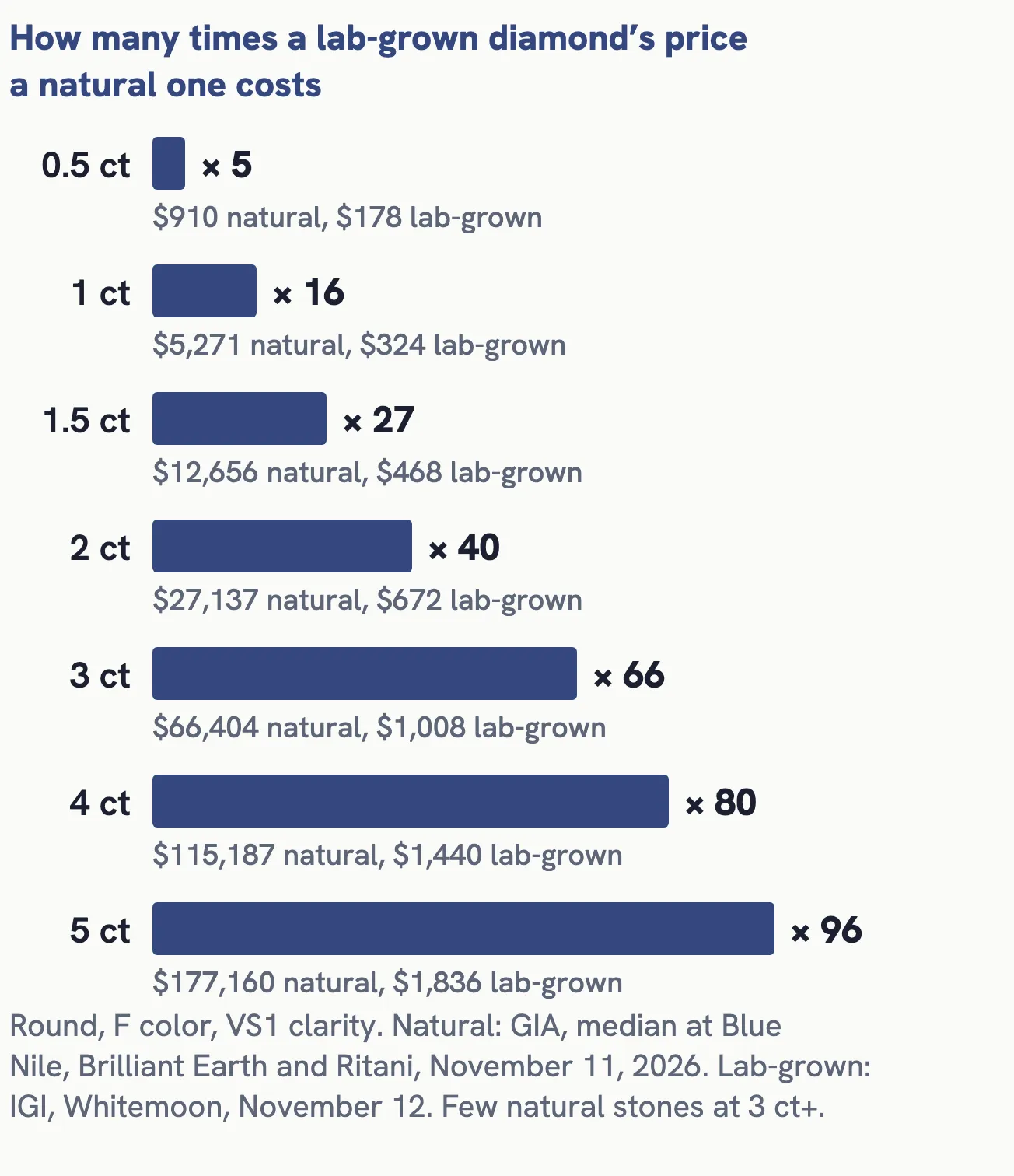
The gap widens with size.
How much does a lab-grown diamond cost?
It depends heavily on the store. This is the median price of a round F VS1 lab-grown diamond with an IGI report at four stores.
| Store | 1 carat | 2 carats |
|---|---|---|
| Whitemoon | $324 | $672 |
| Grown Brilliance | $347 | $956 |
| Brilliant Earth | $553 | $1,817 |
| Blue Nile | $656 | $1,694 |
Other stores November 11, 2026; Whitemoon November 12. Blue Nile listed 24 stones at this grade at 1 carat and 4 at 2 carats, so its figures are rough. Our 1 carat and 2 carat price guides break these down by shape, color and clarity.
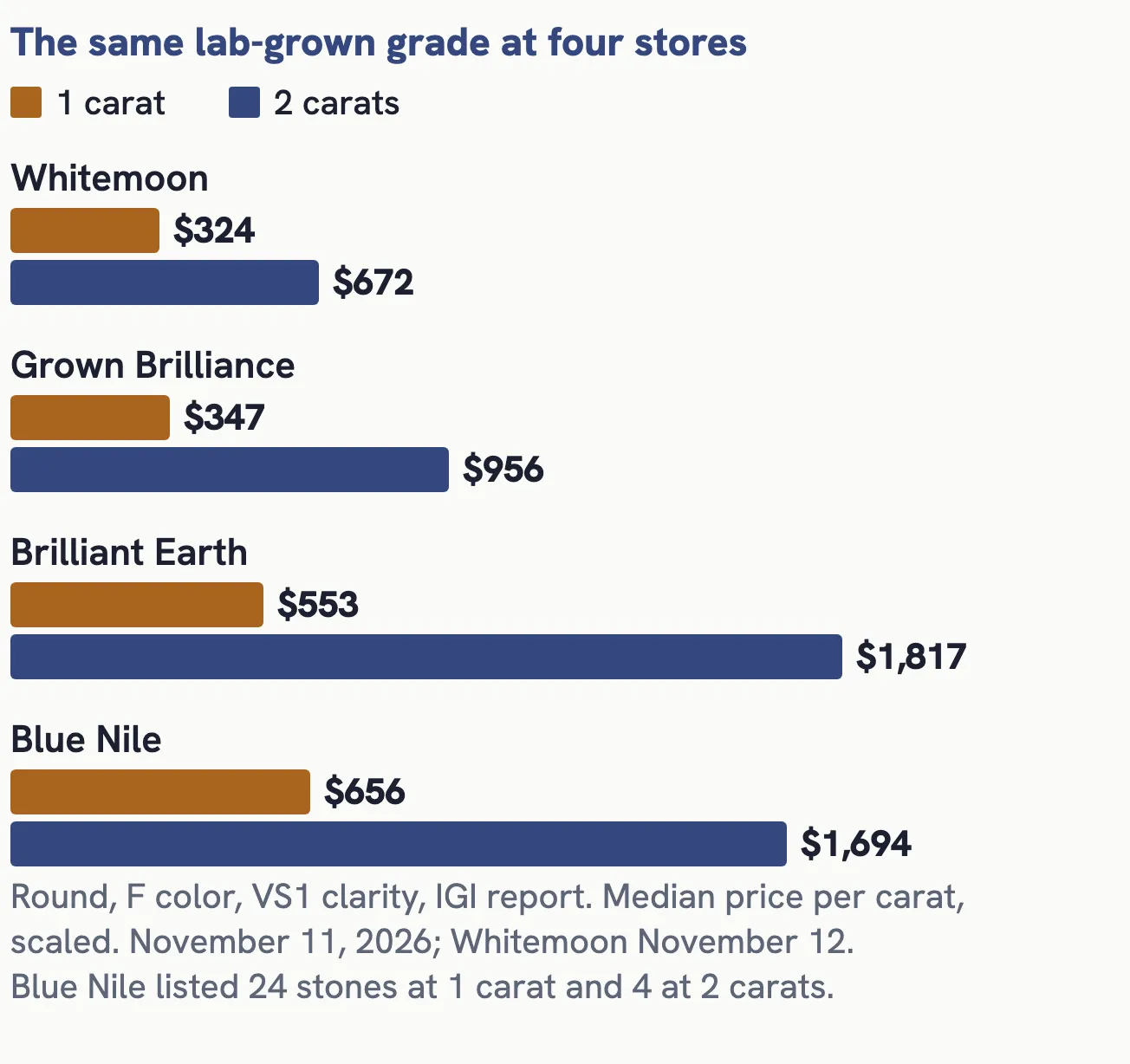
The same lab-grown grade at four stores, November 2026.
What does a budget buy?
In the natural listings we compared, $5,000 bought a round of about 1 carat at F VS1, or about 1.1 to 1.2 carats at G VS2. $10,000 bought about 1.4 to 1.5 carats. In lab-grown at Whitemoon, a 5 carat round F VS1 cost about $1,840 and a 6 carat about $2,020. Put another way, about $2,000 bought a natural round of 0.9 carats in H color and SI1 clarity, or a 6 carat lab-grown round in F VS1. Our engagement ring cost guide adds the setting.
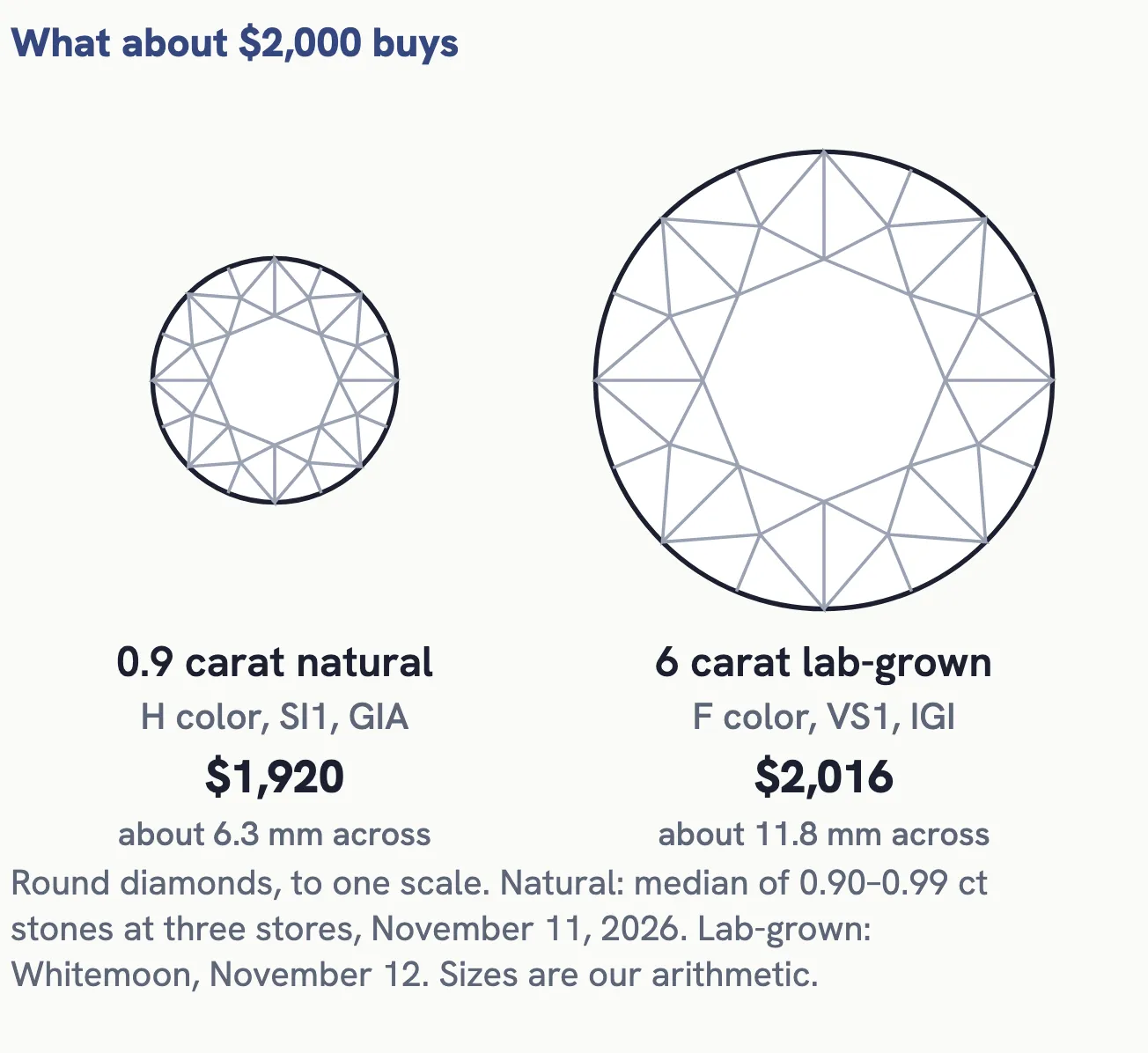
What about $2,000 buys, to scale.
Why are lab-grown diamonds so much cheaper?
Because they’re made in factories that keep getting better at it, and supply has grown faster than demand. Golan puts the wholesale price of a 1 carat lab-grown diamond at about $1,800 a carat in mid-2018 and about $80 a carat in mid-2026.
The retail gap opened up over the same years. The figures below come from different analysts and samples, so read them as snapshots and not one continuous series.
| When | 1 carat lab-grown, priced below natural by | Source |
|---|---|---|
| Mid-2018 | About 45% | Paul Zimnisky, via National Jeweler |
| January 2020 | 35% | Edahn Golan, via National Jeweler |
| September 2022 | About 76% | Paul Zimnisky, via National Jeweler |
| Early 2025 | About 78% | Paul Zimnisky, via CNBC |
| 2025 | About 82% | Edahn Golan |
De Beers’ own lab-grown brand shows the same arc. Lightbox launched in 2018 at $800 a carat, and in May 2025 De Beers announced it would close it, with its chief executive saying lab-grown prices had fallen more than 90% since launch.
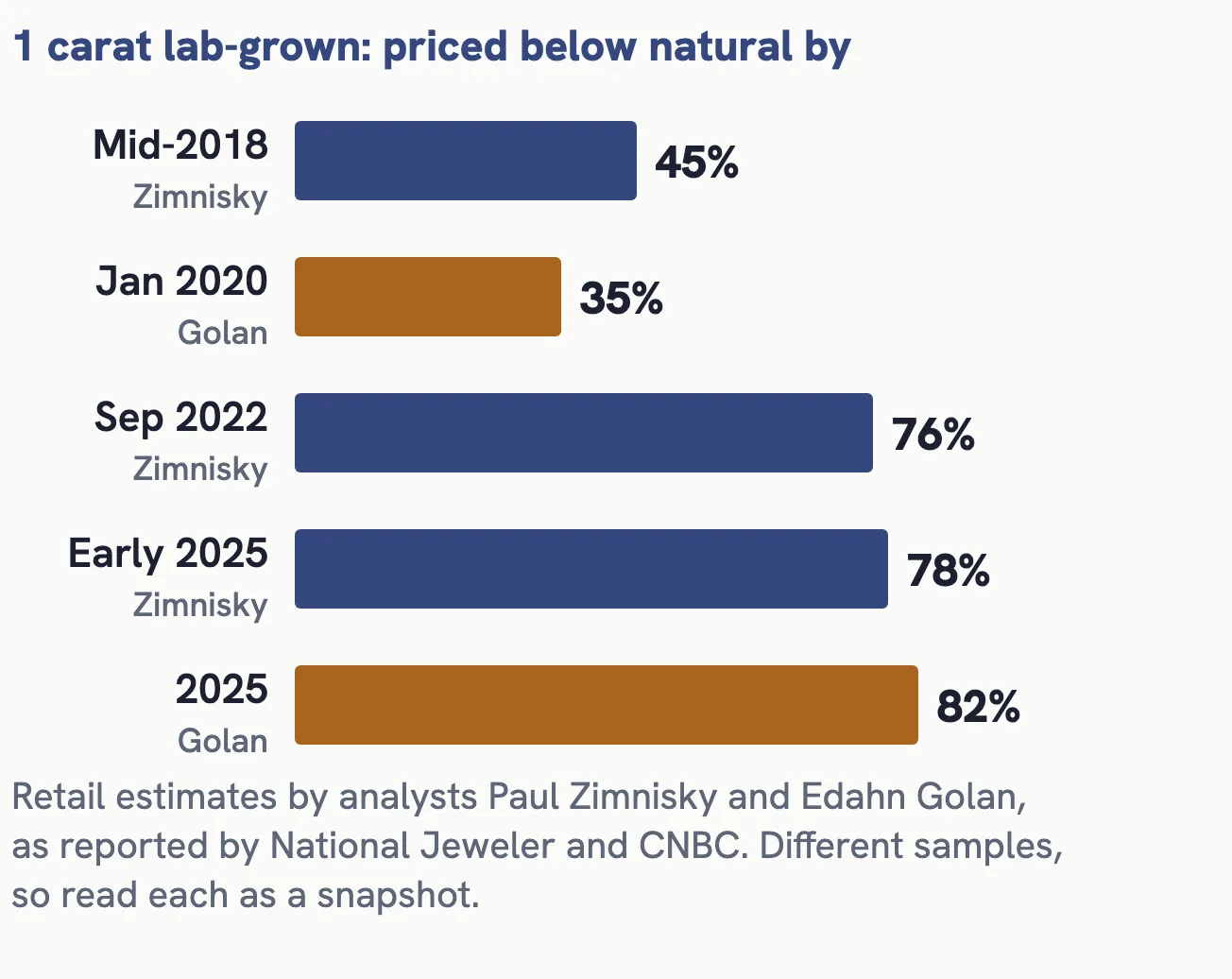
Analysts’ estimates of the retail gap at 1 carat.
Why are lab-grown diamonds still expensive at some stores?
Retail prices have fallen more slowly than wholesale ones. Golan says the typical retail markup on a loose lab-grown diamond is now 250–300%. That’s why the same grade cost $324 at one store and $656 at another in our comparison, and why it pays to compare the exact grade and weight before you buy.
Are lab-grown prices still falling?
More slowly. Golan’s wholesale index was down 10% on the year in the third quarter of 2026, with rounds of 1 to 3 carats up about 2% on the quarter, and he said it was too early to call a bottom. So a stone you buy today may sell new for a little less next year.
Are lab-grown diamonds good quality?
They’re the same material. The FTC’s Jewelry Guides define a diamond by its carbon crystal, and GIA says lab-grown diamonds have essentially the same chemical composition, crystal structure and physical properties as natural ones. Hardness is the same, so they wear the same. Our guide to whether lab-grown diamonds are real diamonds covers the terms in detail.
Grades run high. Of the lab-grown diamonds of 1 to 3 carats we list, 95% are D, E or F color and 94% are VS1 clarity or better. GIA sees the same pattern across the market, which is why since October 2025 its lab-grown reports say only “Premium” or “Standard” instead of giving letter grades. IGI still gives full grades; our IGI vs GIA comparison explains the difference.
Two things are worth knowing about how they’re made:
- Growth method. About 78% of the white lab-grown diamonds we list were grown by CVD and 21% by HPHT. Neither is better by itself; judge the stone by its report.
- Treatment. In a 2024 GIA study, about 80% of the CVD diamonds sent to GIA had been heat-and-pressure treated after growth to improve their color. The treatment is permanent and an IGI report states it, so it matters only if you’d prefer an as-grown stone.
Can a jeweler tell? Not by eye or with a loupe. GIA says only a gem lab with advanced equipment can confirm a diamond’s origin, and a standard diamond tester reads both kinds as diamond. The report and the laser inscription on the stone’s edge say which it is.
Do lab-grown diamonds hold their value?
No. Lab-grown diamonds don’t hold their retail price, so buy one to wear and not as an investment. Here’s what we found on November 12, 2026:
- Worthy, an online resale service, lists lab-grown diamonds of any shape and size among the things it doesn’t accept.
- myGemma, formerly WP Diamonds, lists lab-grown diamonds under “We do not buy”.
- Jewelers Mutual, an insurer, says lab-grown diamonds “typically do not appreciate over time” and that on resale you won’t get close to what you paid.
Natural diamonds aren’t a safe store of value either, though they do have an established resale market. Rapaport’s trade price index for 1 carat natural diamonds fell 23% in 2024 and another 10% in 2025. And in a test De Beers itself ran in New York’s diamond district, described in JCK in 2015, offers for natural stones averaged “15 to 20 cents of the retail dollar”.
What changes with lab-grown is how much is at stake. At $324 for a 1 carat F VS1 at Whitemoon, against about $5,300 for a natural stone of the same grade, far less money is tied up from day one. If you think you’ll want a bigger stone later, ask about trade-up terms before you buy. Our Lifetime Upgrade gives you 100% of what you paid as credit toward a new lab-grown piece worth at least 1.5 times as much.
Why do some jewelers dislike lab-grown diamonds?
Mostly for business reasons, and trade reporting documents three of them.
- Stock loses value on the shelf. JCK reported in April 2026 that US retailers’ lab-grown inventory had grown from under a tenth of sales in 2020 to nearly half, while prices kept falling.
- Each sale brings in fewer dollars. Signet’s chief executive said in March 2024 that shoppers were becoming aware that lab-grown prices were falling, and blamed lower sale values on discounting.
- Pressure from the trade. A 2023 Rapaport report quoted jewelers who kept lab-grown stock out of sight, and one who was berated by a supplier for carrying it.
The big names are split. Cartier’s chief executive said in 2022 that lab-grown diamonds “raise their own issues”, and De Beers decided to close its lab-grown brand. Pandora said in 2021 that mined diamonds would no longer be used in its products, and Signet sells both. In our opinion a jeweler’s dislike tells you about that jeweler’s business. It says nothing about the stone, which is diamond either way.
Are lab-grown diamonds tacky? Who buys them?
We found no credible survey on whether people see lab-grown diamonds as tacky, and none that splits buyers by income. What exists is sales and survey data on how many couples choose them. In The Knot’s Real Weddings Study, the share of engagement rings with a lab-grown center stone went from 12% for couples married in 2019 to 36% in 2022, 46% in 2023, 52% in 2024 and 61% in 2025.
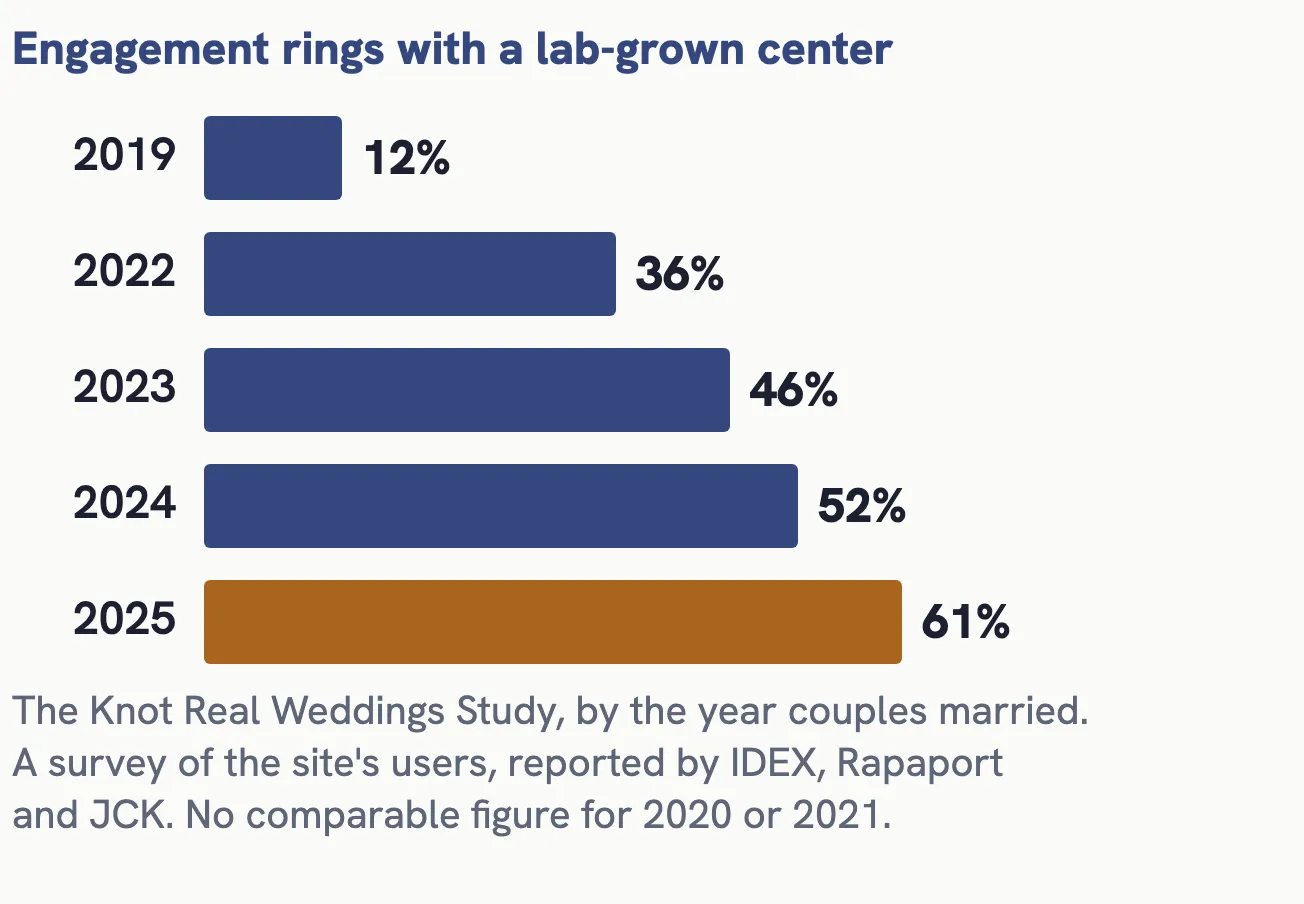
Share of engagement rings with a lab-grown center, by wedding year.
Those buyers got more stone for less money: the average lab-grown center in the 2025 group was 2.0 carats in a $4,300 ring, against 1.6 carats and $7,000 for natural. In our opinion, a choice six in ten couples now make is hard to call unusual. Whether it feels right is personal, and some people value a stone that formed in the earth. That’s a fair reason to choose natural.
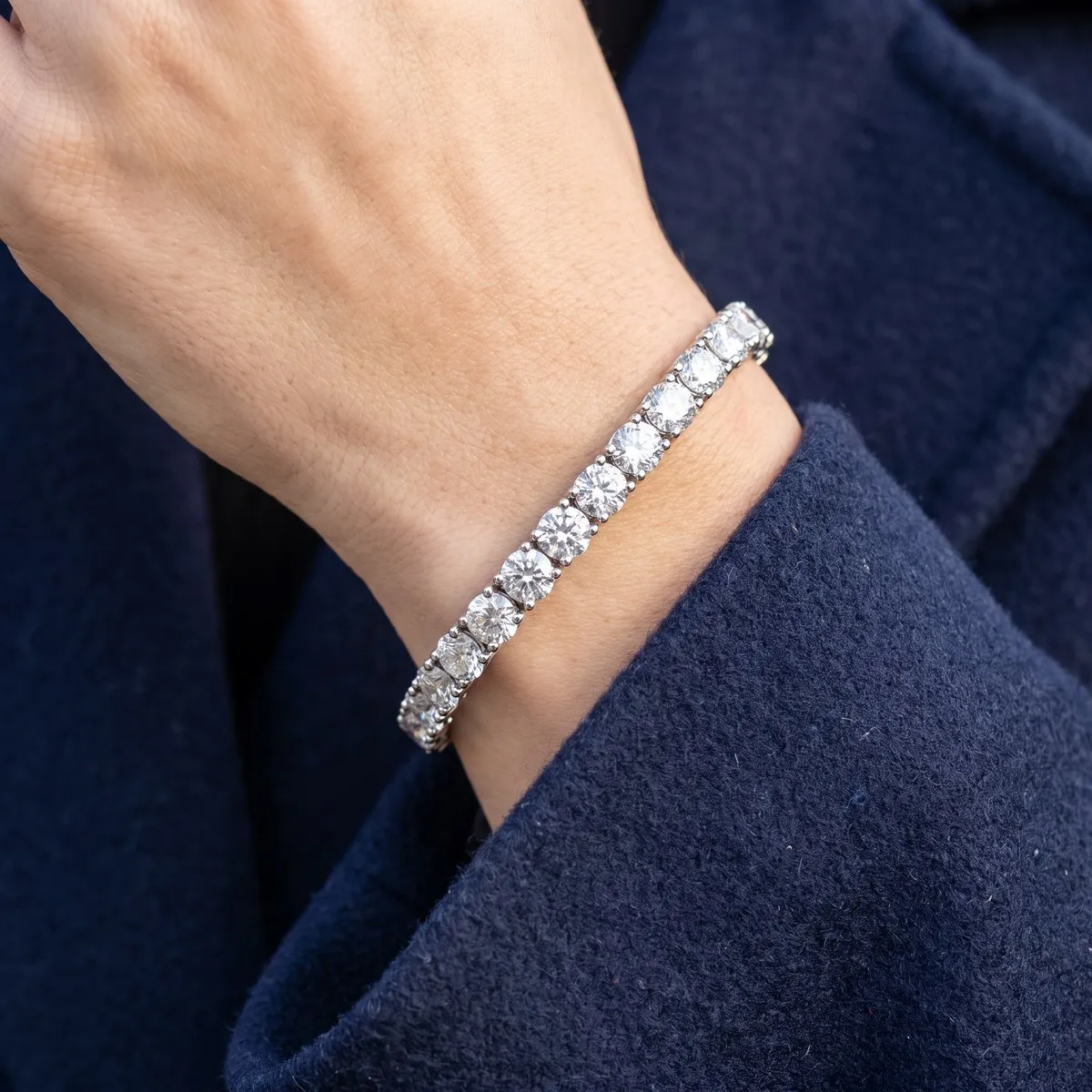
A round lab-grown diamond tennis bracelet in white gold. Image created from the design.
Pros and cons of lab-grown diamonds
The pros
- An actual diamond, with the same hardness and sparkle as a natural one of the same grade.
- About 80–90% less at retail, and more for large stones.
- A bigger or higher-grade stone for the same budget.
- Not mined, so it falls outside the conflict diamond question.
- Full color, clarity and cut grades on an IGI report, with the origin laser-inscribed on the stone.
The cons
- It doesn’t hold its retail price, and the main resale services won’t buy it.
- New prices may keep drifting down, so the same stone could cost less next year.
- Trade-in terms are often tougher. Brilliant Earth’s upgrade program asks for a new lab-grown stone worth at least twice the old one, against 1.5 times for natural.
- No rarity. If a stone’s natural origin matters to you or to the person wearing it, lab-grown won’t give you that.
- GIA no longer gives letter grades on lab-grown stones, so a GIA report tells you less than an IGI one.
- “Eco-friendly” claims are hard to check. In 2019 the FTC warned eight sellers about unsupported environmental claims. A lab-grown diamond’s footprint depends mostly on what powers the factory; our carbon guide has the numbers.
- An old insurance appraisal can overstate what a replacement would cost now, so update it.
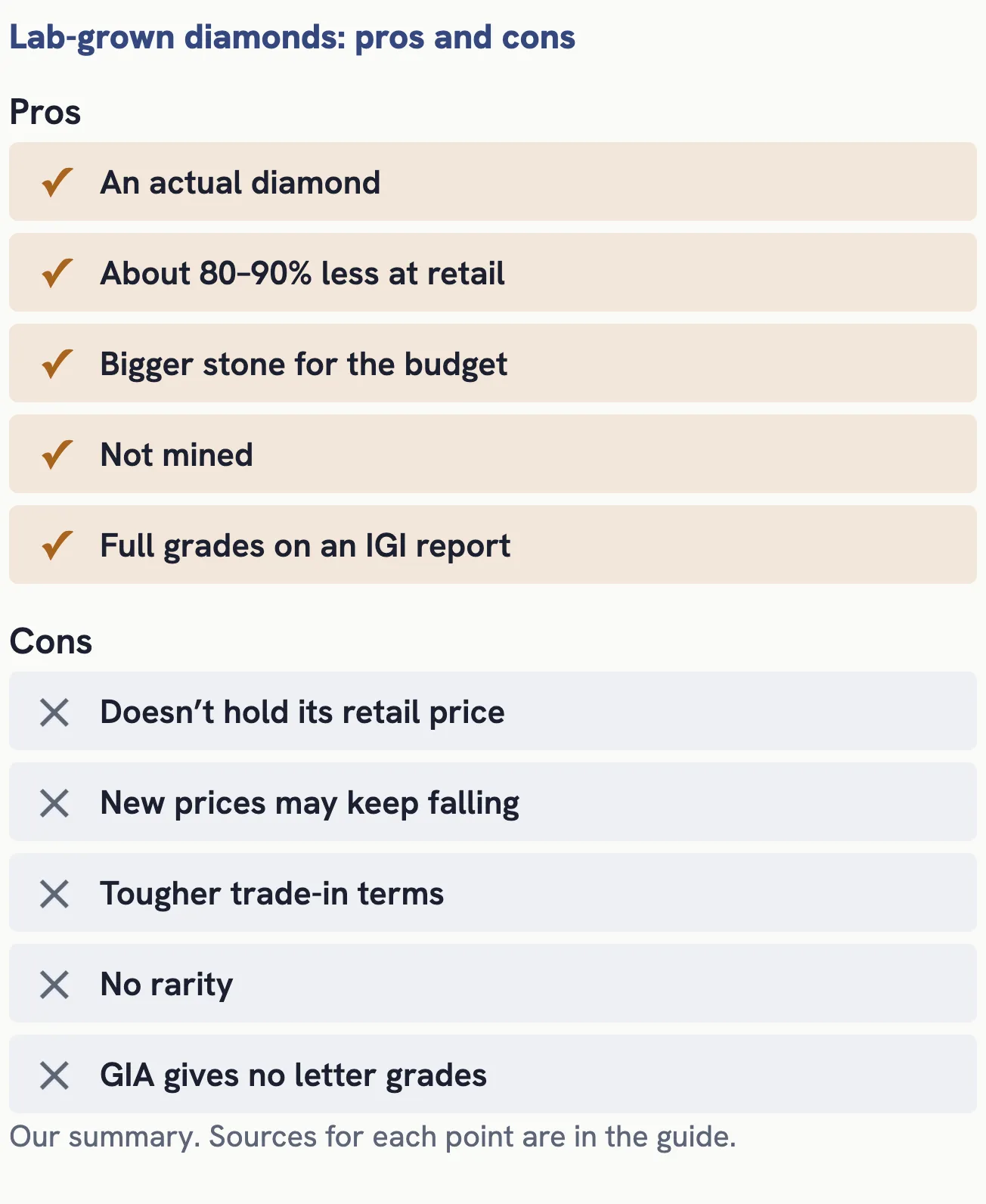
The short version.
Where to buy lab-grown diamonds
Buy from a jeweler that gives you an IGI or GIA report you can look up by number, puts “lab-grown” on the receipt, and states its return and upgrade terms in writing. Then compare the same grade and weight across stores, since the spread is wide. Our guide to where to buy an engagement ring lists what to check with any jeweler.
At Whitemoon you choose the stone yourself in the ring builder, and each one shows its report. The same value holds beyond rings: see engagement rings, lab-grown diamond stud earrings and lab-grown diamond tennis bracelets. Whitemoon jewelry is made to order in about 10–15 days and ships free with insurance both ways, with 30-day returns on unworn pieces.
Our view
This is opinion. If you’re buying a diamond to wear and enjoy, lab-grown is worth it: you get the same material and a better grade for a fraction of the money, and less of your money is exposed if tastes or prices change. If you want something rare, or you care about what the stone might fetch one day, choose natural and accept the price, knowing that natural diamonds also resell for well under retail. Either way, buy the stone for what it is on the day you buy it.
Lab-grown diamond questions
Are lab diamonds worth the money?
Yes, if you’re buying to wear. You get an actual diamond for roughly a tenth of the natural price at the same grade. They aren’t worth it as an investment.
Are lab-grown diamonds cheaper?
Yes. At Brilliant Earth on November 11, 2026, a 1 carat F VS1 round was 90% less lab-grown than natural, and analysts put the 2025 gap at about 82%.
How much is a 1 carat lab diamond worth?
New, a round F VS1 with an IGI report cost $324 at Whitemoon on November 12, 2026, and $347 to $656 at three other stores. It won’t hold that price if you sell, and the main resale services don’t buy lab-grown stones.
How much is a 2 carat lab-grown diamond worth?
New, $672 at Whitemoon for a round F VS1 and $956 to $1,817 at the other stores compared.
Why do jewelers hate lab-grown diamonds?
Not all do. Those who object mostly cite business reasons: stock that loses value, smaller sales and trade-ins they can’t resell.
Can a jeweler tell if a diamond is lab or natural?
Not by looking. It takes a gem lab’s equipment, or reading the laser inscription and report that disclose the origin.
Can a pawn shop tell a lab-grown diamond?
A standard diamond tester can’t, since it reads both as diamond. A buyer who checks the inscription or the report number will see that it’s lab-grown.
Do lab diamonds last as long?
Yes. They’re the same material with the same hardness, and need the same care as any diamond.
Are Tiffany diamonds lab or natural?
Natural, by its own account. Since 2019 Tiffany has told customers where each newly sourced diamond was mined.
How many carats is a $5,000 diamond?
In natural, about 1 carat at F VS1 or 1.1 to 1.2 carats at G VS2 in November 2026. In lab-grown, $5,000 is more than we charge for a 6 carat round F VS1.
How big a diamond will $10,000 buy?
About 1.4 to 1.5 carats in a natural round of F VS1 or G VS2 grade. In lab-grown it’s far more than the price of the stone at any size we list in that grade, so the budget goes to the setting.
Are diamonds losing value?
Trade prices for natural diamonds fell each year from 2022 to 2025, and lab-grown prices fell much further. Neither should be bought as a store of value.
What are the cons of lab diamonds?
They don’t hold their retail price, new prices may keep falling, trade-in terms are tougher, there’s no rarity, and GIA’s grading is limited.