
Lab-Grown vs Mined Diamonds: What the Environmental Studies Show
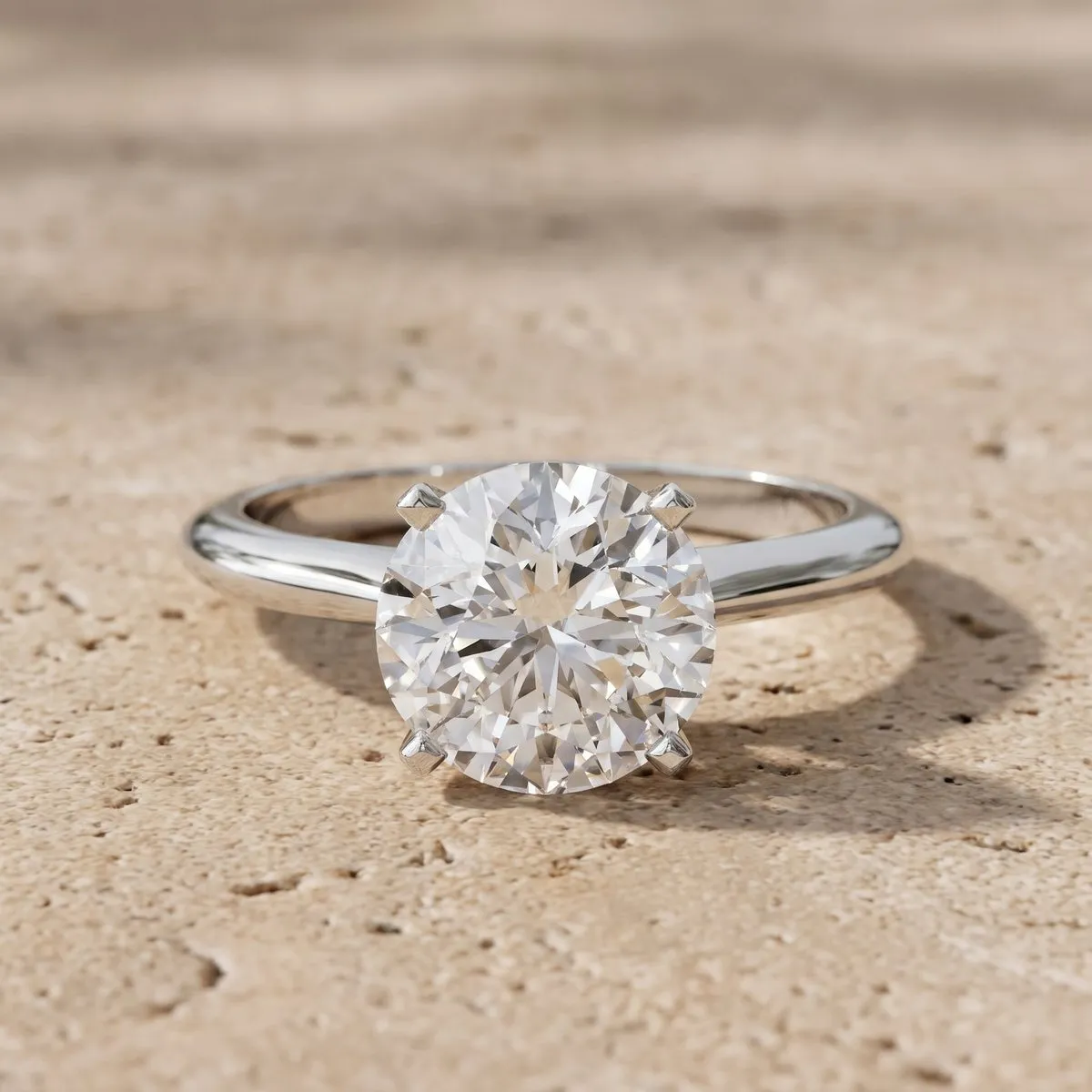
Lab-grown diamonds are not automatically better for the environment than mined diamonds. Our guide to whether lab-grown diamonds are worth it covers price, quality and resale. Published estimates put a mined diamond at about 29 to 160 kg of CO2 equivalent (CO2e) per carat and a lab-grown diamond at about 13 to 511 kg, so either one can come out ahead on carbon. A lab-grown diamond skips the mine, while its footprint depends mostly on the electricity that grows it.
Those figures come from studies with different methods, and many were paid for by someone with a stake in the result. This guide sets out what each one measured, who funded it and where it falls short, then shows how to judge a green claim from any jeweler. Whitemoon doesn’t publish a carbon figure for its own stones, so this guide makes no claim about them.
Lab-grown vs mined diamonds: what the studies measured
The carbon studies disagree by a wide margin, and no single one settles the comparison. All figures below are per carat, as published or as reported in the trade press. Their scopes differ, so the rows aren’t directly comparable.
| Source | Paid for by | Mined, kg CO2e | Lab-grown, kg CO2e |
|---|---|---|---|
| Frost & Sullivan, 2014 | Unclear; an analyst said it was done for the lab-grown trade association | 57 | 0.028 grams, on clean energy |
| S&P Trucost, 2019 | Diamond Producers Association, a group of large miners | About 160 | About 511 |
| Chalmers University, 2020 | Swedish research foundations | 29 | Not studied |
| Imperial College London researcher, 2021 | Skydiamond, a lab-grown producer | 57–160 | Not the focus |
| Sphera, reported 2023 | Not stated in the report we read | Not given | About 17 on renewable power; about 260 on a coal-heavy grid |
| Pandora study, 2026 | Pandora, a jeweler selling lab-grown diamonds | Not measured | 12.58, on renewable electricity |
Frost & Sullivan, 2014
This report is the source of the often-repeated claim that mined diamonds have about seven times the impact of grown ones. JCK, a jewelry trade magazine, found that it drew on one CVD producer in Singapore, said nothing about HPHT production and carried a note telling readers not to rely on it for marketing. Frost & Sullivan removed it from its website after JCK’s article ran. A 2024 paper in Humanities and Social Sciences Communications still quotes its per-carat numbers, the source of the first row above, to project that lab-grown diamonds could cut the industry’s emissions, so that projection inherits the same weakness.
S&P Trucost, 2019
The Diamond Producers Association, whose members are among the largest miners, paid for this study. It put its members’ mining at about 160 kg per polished carat and estimated lab-grown production at about 511 kg. The lab-grown number rested on limited public information, and JCK described that conclusion as tentative. The mining number left out about a quarter of world production and the small-scale sector. Saleem Ali, a University of Delaware professor of energy and the environment, questioned its energy and emissions estimates and noted that it skipped exploration and mine closure.
Chalmers University of Technology, 2020
Researcher Anna Furberg ran a screening life cycle assessment of natural diamonds, funded by the Adlerbertska Research Foundation and Mistra, a Swedish environmental research foundation. It found about 29 kg CO2e per carat as a global average, with electricity behind about 80% to 99% of each environmental impact it studied. A screening study uses a limited set of inputs, and this one left out the environmental effects of artisanal mining. Its largest finding concerned people: about 1.3 days of life lost per carat, with 97% of that from accidents in artisanal mining. Our guide to conflict-free diamonds covers labor and the Kimberley Process.
Imperial College London researcher, 2021
Skydiamond, a UK lab-grown producer, commissioned this review of published mining data. It gives 57 to 160 kg CO2e per carat and 0.48 to 7.3 cubic meters of water per carat. Because it collects other people’s numbers, including the two reports above, it shares their limits. Its country table also lists far higher figures for some single mines, up to about 1,500 kg at one South African open pit. One mining expert interviewed for the report said data is scarce because the industry isn’t used to transparency.
Sphera and Pandora figures for lab-grown stones
Rapaport, a diamond trade publication, reported Sphera’s measurements in 2023: as little as about 17 kg per polished carat for a CVD stone from a producer on renewable energy, and about 260 kg from a facility in India, where the grid relies heavily on coal. In 2026 Pandora published 12.58 kg for one polished carat from its suppliers, covering raw materials through cutting and polishing, verified by EY under limited assurance. All of its suppliers use renewable electricity backed by renewable energy certificates or similar instruments. These figures describe specific suppliers, so they can’t stand in for lab-grown diamonds in general.
Where a mined diamond’s footprint comes from
A mined diamond’s footprint comes from moving rock and powering the mine and plant. The Imperial review gives 250 to 1,750 tons of earth extracted per carat. Electricity and diesel drive the carbon figure, and the rest of the impact shows up on the land and in the water around the site.
- Land: The Imperial review records a footprint of about 1,400 hectares at Canada’s Ekati mine, with lakes drained and streams lost. Members of the Diamond Producers Association, in turn, reported protecting more than 260,000 hectares, about three times the land they use.
- Water: A 2018 field study in northeastern Angola found rivers and lakes to be the most affected part of the ecosystem, with pollution, silted streams and changed river courses, along with deforestation and soil loss.
- People: Risk is concentrated in small-scale artisanal mining, as the Chalmers study found.
Mines differ greatly by type, location and power source, so a global average hides a lot. Open-pit, underground, alluvial and marine mining each disturb the environment in different ways.
Where a lab-grown diamond’s footprint comes from
A lab-grown diamond’s footprint comes mostly from electricity. Both HPHT (high pressure, high temperature) and CVD (chemical vapor deposition) run equipment for days or weeks while the crystal forms, and the stone is then cut and polished. On Sphera’s figures, a stone grown on a coal-heavy grid can carry about 15 times the footprint of one grown on renewable power.
The other inputs are less documented. JCK reported in 2019 that little was known about lab-grown producers’ energy use and even less about their water use. Miners also point out that reactors and equipment rely on mined materials, and they object to “mining-free” wording for that reason. Without a mine, the land and waste rock figures above don’t apply in the same way, though published data on a grower’s full use of land and water is thin.
Are lab-grown diamonds sustainable or ethical?
Neither word has a single agreed test, so treat both with caution, whoever uses them. In 2019 the Federal Trade Commission sent warning letters to sellers of lab-grown and simulated diamonds over claims such as “eco-friendly” and “sustainable”, and it reminded marketers that they need a reasonable basis for any environmental claim. Its Green Guides advise against broad environmental benefit claims, because advertisers can rarely back up every meaning a shopper might take from them.
Third-party standards don’t offer a shortcut at the moment. SCS Global Services retired SCS-007, its diamond sustainability standard, effective September 1, 2026, saying the market conditions to support it never developed. Companies already certified can use their certification until it expires.
On ethics, a lab-grown diamond avoids risks tied to mining, including the artisanal mining accidents behind most of the health impact in the Chalmers study. The Kimberley Process, the main scheme for conflict diamonds, covers rough stones used by rebel groups to finance war, and critics say that definition is too narrow. The carbon studies above don’t measure working conditions where diamonds are grown, cut or polished, so “ethical” needs evidence for the specific supply chain, whichever kind of stone you choose.
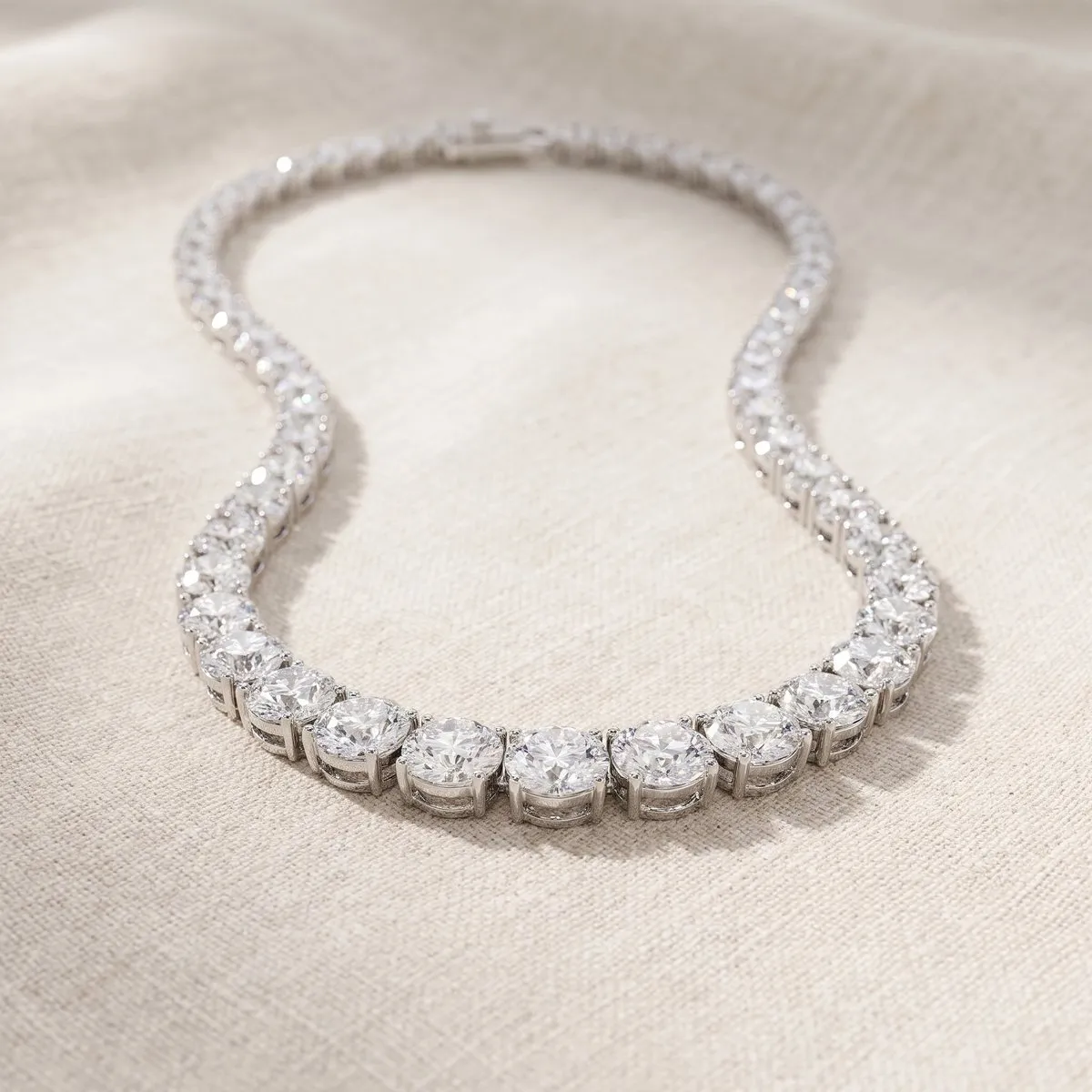
A graduated lab-grown diamond tennis necklace in white gold. Image created from the necklace’s design.
What to ask any jeweler
A claim with a number, a stated scope and a named checker tells you more than one word on a label. These are fair things to ask any seller, including us.
- Where was this diamond grown or mined, and by which method?
- What powered it, and was that power generated on site or matched with certificates?
- Is there a carbon figure, which stages does it cover, and who checked it?
- Who paid for the study behind the claim?
- Does the grading report state the stone’s origin? Our guide on how to read a diamond certificate shows where to look.
How else lab-grown and mined diamonds differ
The environmental record is one difference among several, and price is usually the largest. Both are diamonds with the same crystal structure and chemistry; one was grown in a lab and the other formed underground. Our guide to whether lab-grown diamonds are real diamonds explains the rest.
| Compare | Lab-grown diamond | Mined (natural) diamond |
|---|---|---|
| Origin | Grown in a lab, by HPHT or CVD | Formed underground, then mined |
| Price | Far lower for the same size and grade | At least 10 times as much at 3 carats, at the stores we compared |
| Resale | Doesn’t hold its retail price | Usually well below the retail price |
| Grading | IGI letter grades, or a GIA Premium or Standard class | GIA or IGI letter grades |
See our 3 carat diamond price guide for the figures behind the price row, with the dates they were checked.

Round lab-grown diamond studs in yellow gold. Image created from the earrings’ design.
Shopping for lab-grown diamond jewelry at Whitemoon
If you decide on lab-grown, the shape, grade and setting are the choices that remain. Start with engagement rings or lab-grown diamond wedding bands. For everyday pieces, see lab-grown diamond stud earrings, lab-grown diamond tennis bracelets and lab-grown diamond necklaces. Most Whitemoon rings are made to order in about 10–15 days and ship free with insurance both ways, with 30-day returns on unworn pieces and one free resize within 60 days of delivery.
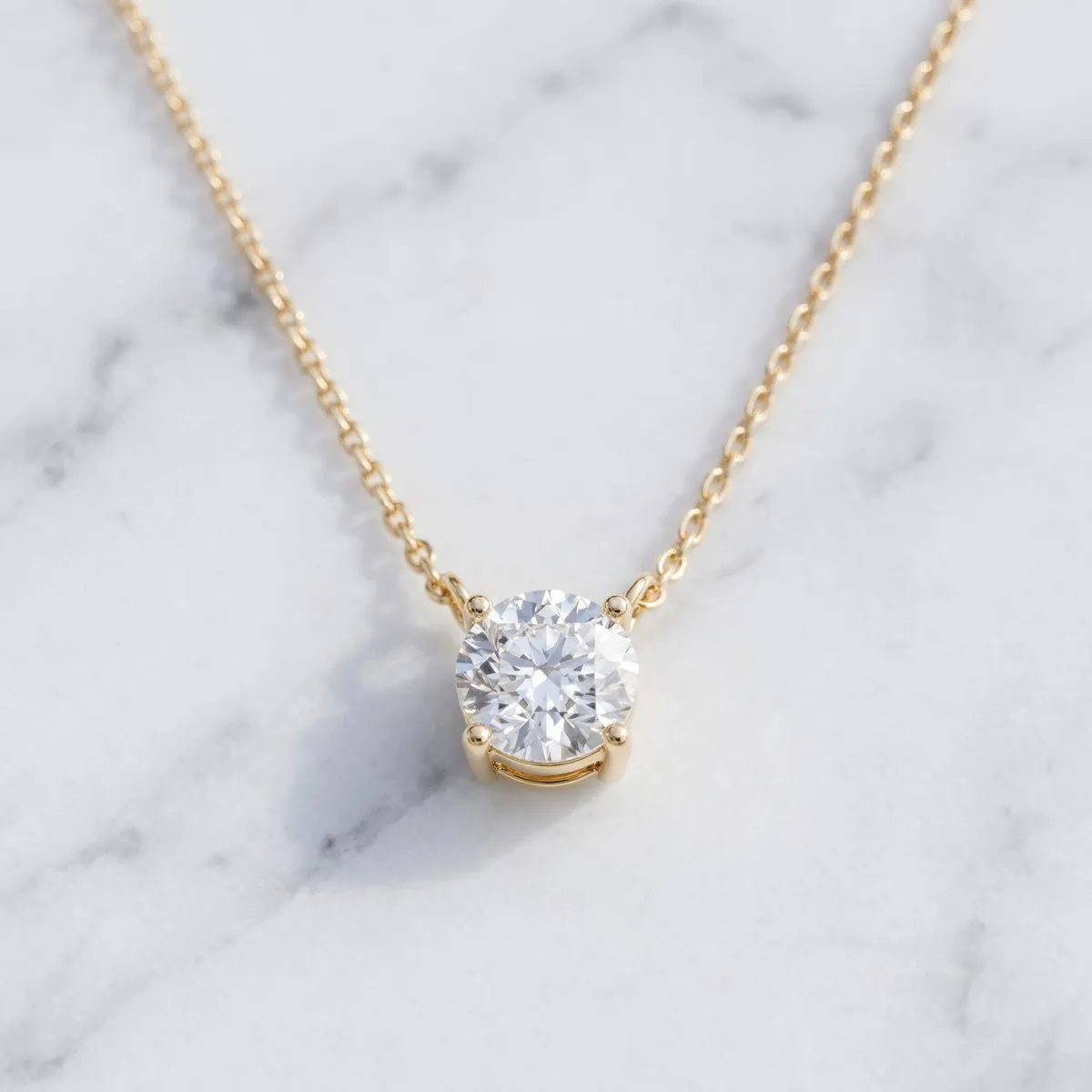
A round lab-grown diamond solitaire pendant in yellow gold. Image created from the necklace’s design.
Lab-grown vs mined diamond questions
Are lab-grown diamonds better for the environment?
Sometimes. A lab-grown diamond needs no mine, so it avoids the digging and waste rock of mining, while its carbon footprint depends on the electricity used. Published figures run from about 13 kg of CO2e per carat on renewable power to about 511 kg in a study paid for by miners, against estimates of 29 to 160 kg for mined diamonds.
Are lab-grown diamonds sustainable?
The word has no agreed test, and the FTC warns sellers against broad claims like it. What you can check is specific: which power source grew the stone, what its measured footprint is, which stages that figure covers and who verified it. A diamond grown on coal-heavy power and one grown on renewable electricity are very different cases.
Are lab-grown diamonds more ethical?
They avoid some mining risks, including the artisanal mining accidents that one Swedish study found behind most of natural diamonds’ health impact. They aren’t automatically free of other concerns, because the published carbon studies don’t measure conditions where stones are grown and cut. Ask any seller what it knows about its own supply chain, and whether anyone outside the company has checked it.
What is the downside to a lab-grown diamond?
Resale is the main one. Lab-grown diamonds don’t hold their retail price, and prices shift, so buy one to wear and not as an investment. Paying less up front leaves less at stake. Energy use also varies widely between growers and is often undisclosed, so a general green claim tells you little. A clear grading report and a fair return policy matter more than any label.
What are the negative impacts of diamond mining?
Large mines move hundreds of tons of earth per carat, burn diesel and use electricity, and can change the land, lakes and rivers around them, with effects that vary widely by site. Small-scale artisanal mining carries serious safety risks for workers. Mining also brings jobs and income to producing regions, which belongs in any fair comparison.
Are natural diamonds or lab-grown diamonds better?
Neither is better in every way. Both are diamonds with the same crystal structure. Lab-grown diamonds usually cost far less for the same size and grade, while natural diamonds are rarer and tend to hold more of their resale value, though still well below retail. Environmental results depend on the mine or the grower, so decide which factor matters most to you.