
Conflict-Free Diamonds, Blood Diamonds and the Kimberley Process
Conflict diamonds, often called blood diamonds, are rough diamonds sold by rebel groups to pay for wars against governments. That’s the UN’s definition from 2000. Since 2003 the Kimberley Process has required certificates for rough diamonds traded between its members, and its own estimate puts conflict diamonds at under 0.1% of production. But the definition leaves out violence by governments, child and forced labor, and where a polished stone came from, so “conflict-free” proves less than it sounds.
We sell lab-grown diamonds, which aren’t mined, so they fall outside the Kimberley Process altogether. For cost and value, see are lab-grown diamonds worth it. That makes it all the more important to be precise. We went back to the UN resolution, the Kimberley Process’s own pages, US law, the FTC and the human rights groups that have studied the trade, and we say plainly what we can and can’t tell you about our own stones.
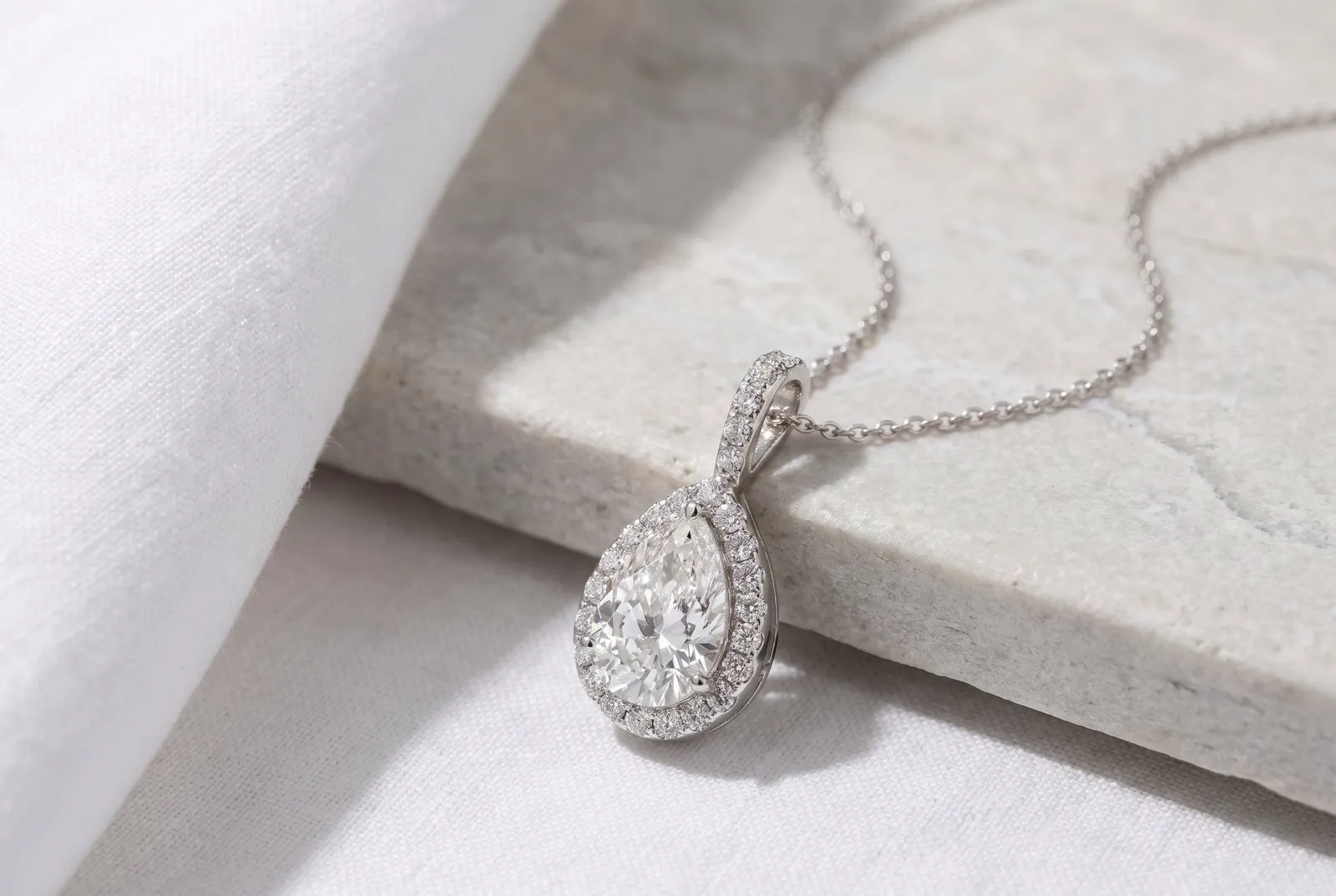
Pictured: a pear-shaped lab-grown diamond halo pendant in white gold. Image created from the design.
What are conflict diamonds?
The UN General Assembly defined them on December 1, 2000, as rough diamonds used by rebel movements to fund military action against legitimate governments. Three words carry the weight: rough, rebel and government. The same resolution said the vast majority of the world’s rough diamonds come from legitimate sources.
The term grew out of the civil wars of the 1990s:
- Angola. Global Witness estimated that the rebel group UNITA earned at least $3.72 billion from diamonds between 1992 and 1998. The UN Security Council put sanctions on UNITA diamonds in June 1998.
- Sierra Leone. A UN panel estimated the RUF rebels’ diamond income at $25 million to $125 million a year, more than enough to keep fighting. Most of the stones left through neighboring Liberia, which came under a UN diamond ban in 2001.
- The Democratic Republic of Congo and Côte d’Ivoire are also named in the Kimberley Process’s history, and Côte d’Ivoire was under a UN diamond embargo from 2005.
“Blood diamonds” is the press and campaigners’ name for the same thing. The 2006 film Blood Diamond, set in Sierra Leone, came out nearly four years after the Kimberley Process began.
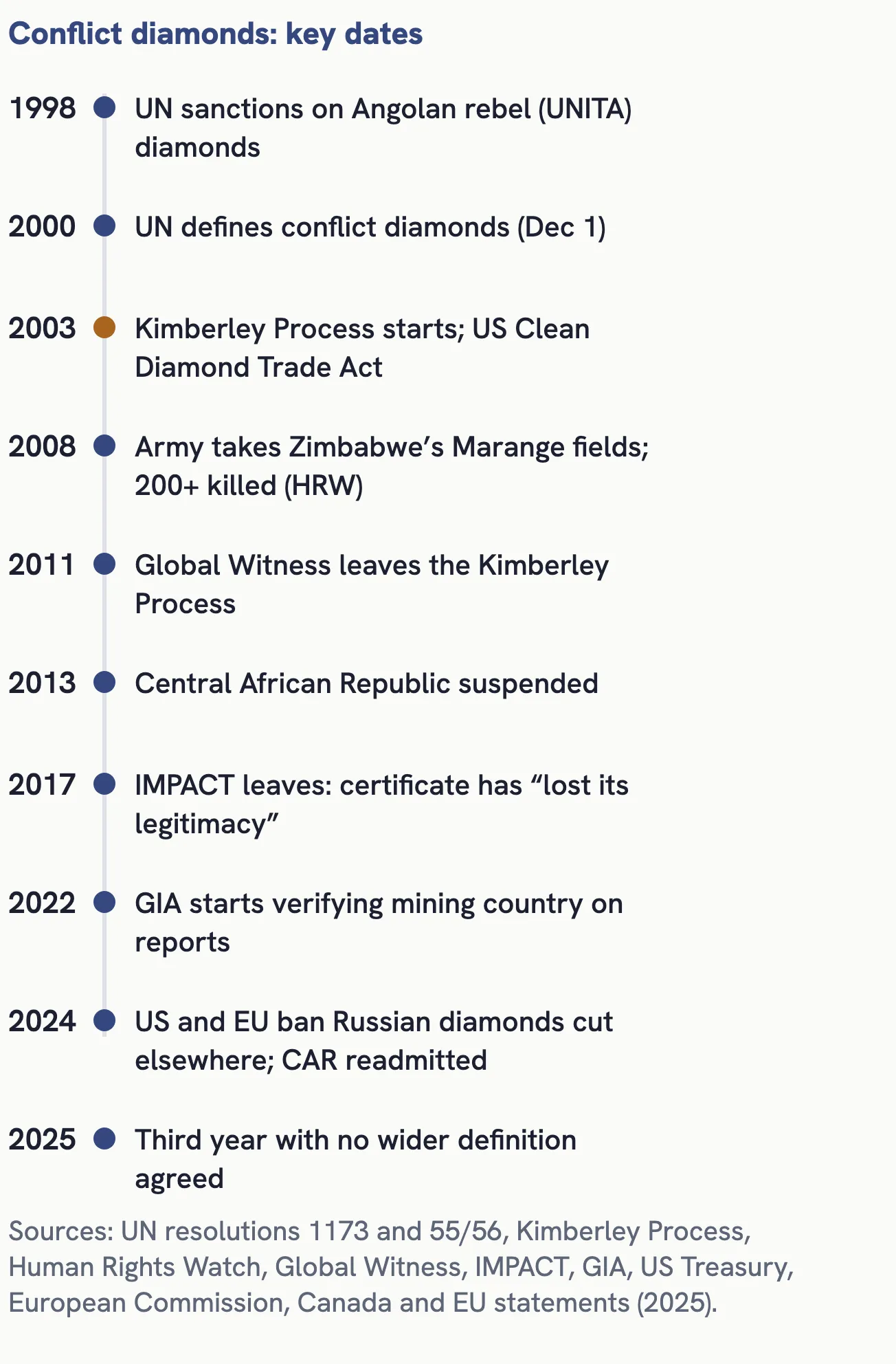
Key dates in the conflict diamond story.
How common were blood diamonds, and are they still sold?
Nobody has one agreed number, and the famous percentages are all from the 1990s. The industry used about 4%, which Partnership Africa Canada later calculated as 3.7% of 1999 rough production by value. Global Witness put it at up to 15% in the mid to late 1990s, and Partnership Africa Canada’s own range was 7–14%.
Later figures are far lower. Partnership Africa Canada put 2005 at 0.1–0.2% of the trade, and the Kimberley Process’s FAQ says under 0.1%, though that page is undated and its wording refers to 2006. All of these use the narrow rebel-funded definition, so a low number doesn’t mean every other problem has gone away.
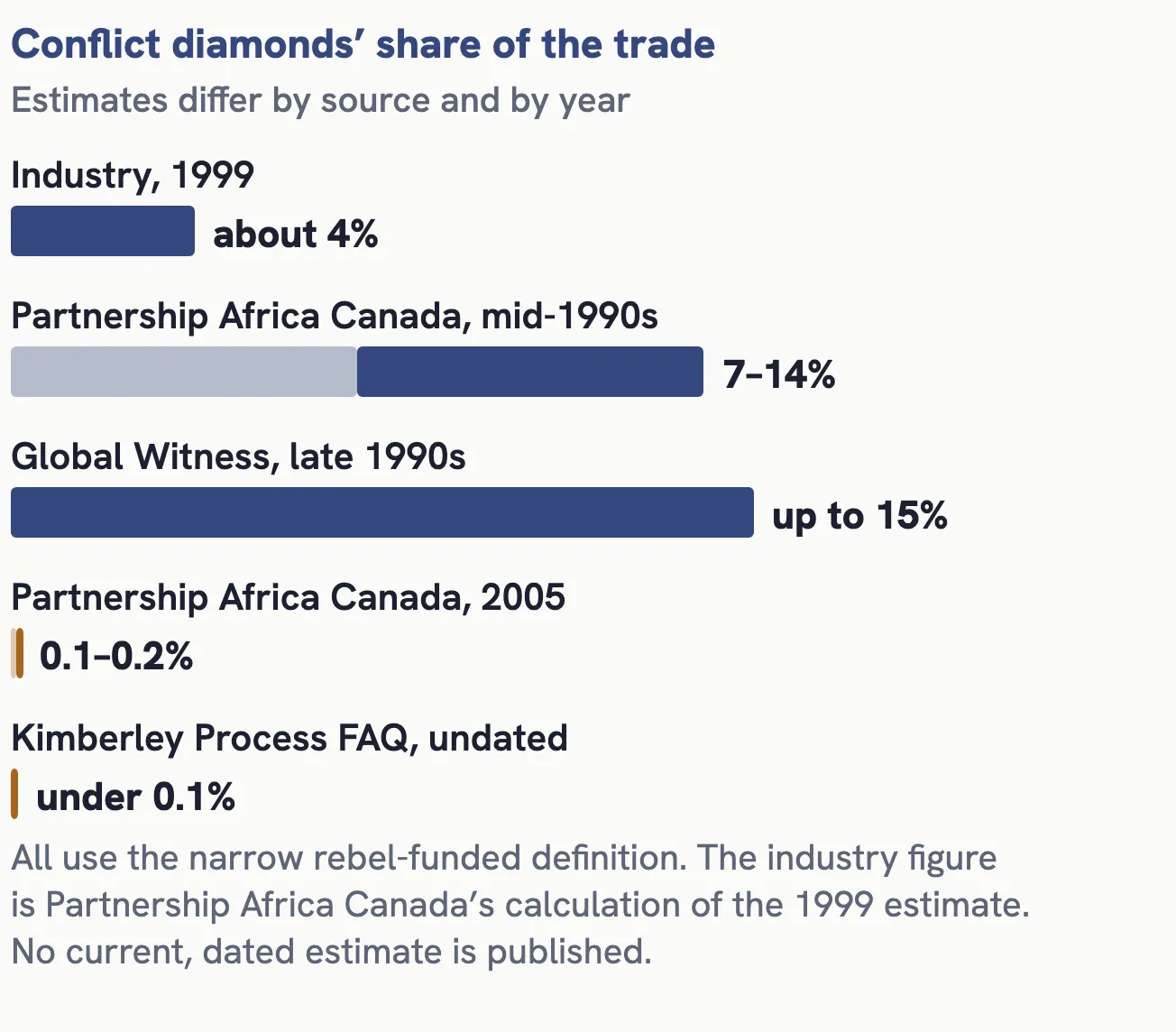
Estimates differ by source and by year.
How the Kimberley Process works
The Kimberley Process Certification Scheme began in January 2003. Its rules are simple:
- Members may trade rough diamonds only with other members.
- Every rough diamond shipment must travel with a Kimberley Process certificate.
- Each country enforces this through its own laws and shares trade statistics.
As of November 2026 it has 60 participants representing 86 countries, with the European Union counted as one, covering 99.8% of world rough production. That 99.8% is the members’ share of mining, not a measure of how much is conflict-free. The Kimberley Process says it doesn’t certify individual jewelers, and that there’s no scientific consensus yet on testing where a single stone came from, so the system runs on paperwork.
What the Kimberley Process doesn’t cover
Because the definition covers only rebels and only rough diamonds, some of the trade’s worst episodes fell outside it.
- Zimbabwe’s Marange fields. Human Rights Watch reported that the army killed more than 200 people when it took over the fields in late 2008, and documented forced labor. Those were government forces, so not “conflict diamonds” by the definition.
- Global Witness walked out in December 2011 after the Kimberley Process approved exports from Marange, saying the scheme had failed.
- IMPACT, formerly Partnership Africa Canada, left in December 2017, saying the certificate had “lost its legitimacy”.
- Labor. The US Labor Department lists diamonds from Angola, the Central African Republic, the Democratic Republic of Congo, Guinea, Liberia and Sierra Leone as produced with child labor, and those from Angola and Sierra Leone with forced labor, as of September 2024.
Members have tried to widen the definition. In November 2025, for the third year running, they couldn’t agree. Canada and the EU want violence by governments to count, and Canada said Russia blocked discussion of its diamond revenue funding the war in Ukraine. The Central African Republic, suspended in 2013, was fully readmitted in November 2024.
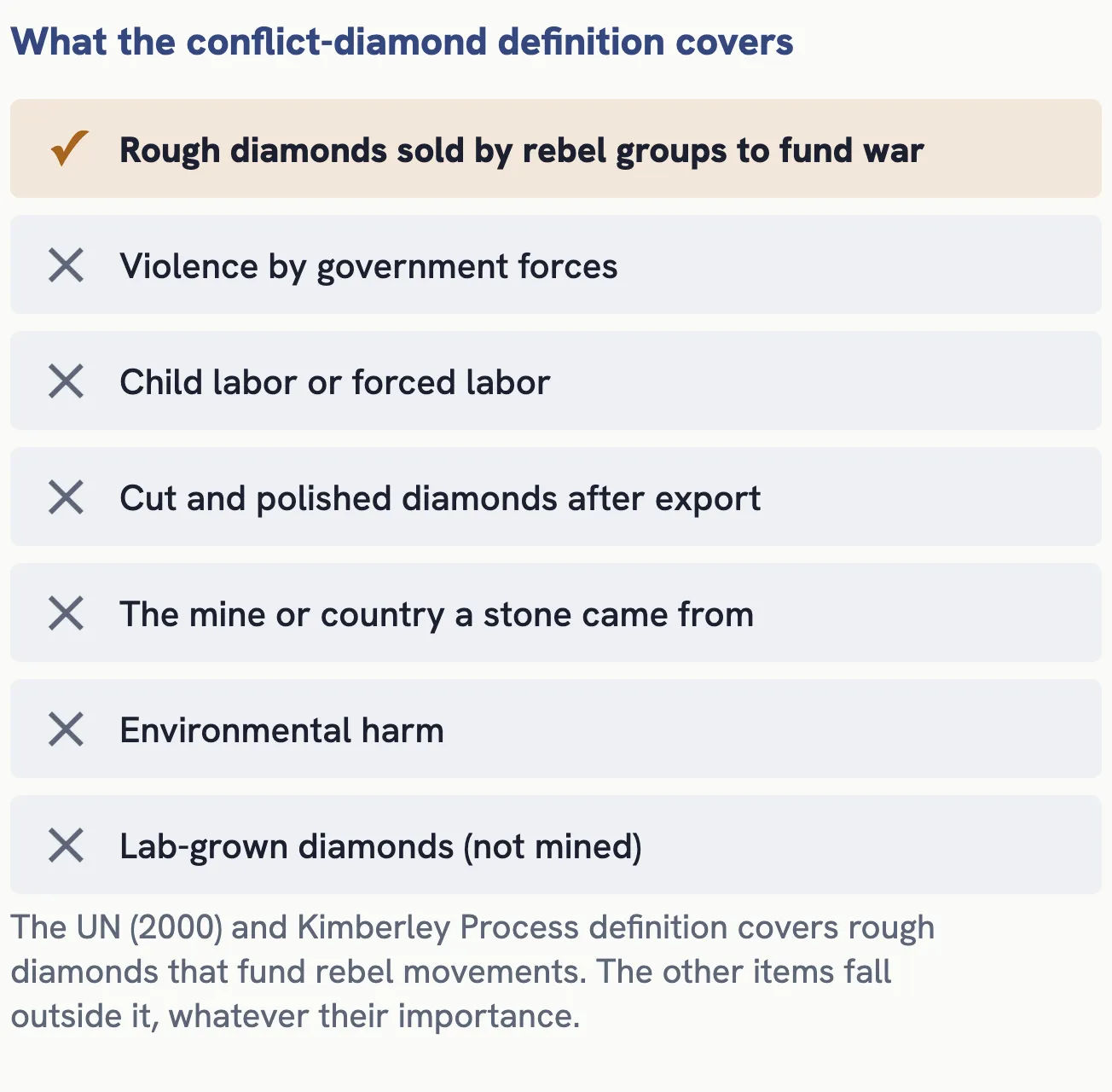
What the definition covers, and what it leaves out.
Are blood diamonds illegal in the US?
The US rules focus on rough diamonds at the border. The Clean Diamond Trade Act of April 2003 bans importing or exporting any rough diamond not controlled through the Kimberley Process. Cut diamonds and jewelry fall outside that law, and we found no federal law aimed specifically at reselling a polished conflict diamond. That isn’t legal advice, but it shows how much rests on the industry’s own paperwork once a stone is cut.
Russia shows that origin rules can reach further. Since March 2024, the US has banned Russian-origin diamonds of a carat and up even when they were cut in another country, and from September 2024 the threshold dropped to half a carat. The EU’s ban, from September 2024, also covers Russian lab-grown diamonds. The EU calls Russian diamonds about a third of world production.
What “conflict-free” and “ethically sourced” mean on a label
Usually, a jeweler’s “conflict-free” means the stone came through Kimberley Process trade and every seller since put the industry’s warranty statement on the invoice. The World Diamond Council’s System of Warranties asks companies to confirm the diamonds come from legitimate sources not involved in funding conflict. It names no mine or country, and companies check their own compliance in a yearly self-assessment.
“Ethically sourced” has no legal definition. In 2018 the FTC declined to define “ethical” or “conflict free”, but it said sellers must be able to back up what buyers reasonably understand those words to mean. That applies to lab-grown sellers too.
A few programs go further for natural diamonds:
- GIA Source Verification, launched in July 2022, shows the country of mining for natural diamonds on GIA’s report check, based on audited documents from manufacturers.
- Single-origin programs such as CanadaMark track a stone from a named mine with a laser-inscribed number.
- Blockchain records such as De Beers’ Tracr log each step a stone takes, but a record is only as good as the data entered at the start.
Is diamond origin getting easier to trace?
Slowly. Until 2025, a Kimberley Process certificate could describe a parcel simply as “mixed origin”, so it told buyers nothing about the country. Since March 2025, the EU has required certificates naming the countries of mining for imports of mixed-origin natural rough of half a carat and up, according to the Antwerp World Diamond Centre. A wider G7 tracing system has been postponed several times and wasn’t mandatory as of January 2026.
- The World Diamond Council’s revised warranty adds human rights, labor, anti-money-laundering and anti-corruption principles to the old conflict pledge.
- The Kimberley Process set up a permanent secretariat in Botswana in 2024, and the UAE tested digital certificates the same year.
- India chairs the Kimberley Process in 2026, with its annual meeting in New Delhi from November 30 to December 4. Whether the definition finally widens will be known after that.
Where lab-grown diamonds fit
Lab-grown diamonds are grown in factories, not mined, so they can’t be conflict diamonds under the UN and Kimberley Process definition. Our guide to whether lab-grown diamonds are real diamonds explains how they’re made. In 2025, the world grew about 69.4 million carats of gem-quality lab-grown diamonds, against 98.8 million carats of natural rough mined, according to analyst Edahn Golan. India grew about 8% more than China and polishes almost all of them, and the US buys about 73%.
“Not mined” is a narrower claim than “ethical”, though. The FTC warned several lab-grown sellers in 2019 that broad claims like “eco-friendly” or “sustainable” need evidence, and energy use varies widely with each factory’s power source, as our look at the carbon studies shows. So here’s what we can tell you about the lab-grown diamonds we sell:
- They’re grown, not mined, so the Kimberley Process doesn’t apply to them.
- Each center stone in our ring builder comes with an IGI or GIA report, and IGI reports state the growing method. Of the white lab-grown stones of 0.9 carats and up we list, about 78% are CVD-grown and 21% HPHT-grown.
- We don’t publish factory-level records for each stone, so we don’t describe them as “100% ethical” or “sustainable”.
Questions to ask any jeweler
The Kimberley Process itself says a reputable business should be able to answer the first three. The rest follow from the sources above.
- How can you be sure your jewelry doesn’t contain conflict diamonds?
- Do your suppliers use the System of Warranties?
- Can I see your policy on conflict diamonds?
- Is this diamond natural or lab-grown? The FTC requires that to be disclosed clearly.
- For a natural diamond, which country was it mined in, and what document shows it?
- When you say “conflict-free” or “ethical”, what standard do you mean, and what evidence backs it?
- For a lab-grown diamond, what does the grading report say about how it was grown?
Global Witness put the case simply when it left the Kimberley Process: consumers “have a right to know what they’re buying, and what was done to obtain it.”
Our view
In our opinion, the Kimberley Process did real good against the rebel-funded trade it was built for, but a “conflict-free” label alone tells you little about labor, government abuses or a stone’s origin. If those matter to you, ask for evidence about the specific stone, or choose a lab-grown diamond, which takes mining out of the question. Browse our lab-grown diamond earrings or necklaces, or start a ring in the ring builder.
Whitemoon jewelry is made to order in about 10–15 days and ships free with insurance both ways, with 30-day returns on unworn pieces.
Conflict-free diamond questions
What is a conflict-free diamond?
Usually, one that came through Kimberley Process trade with an industry warranty on each invoice. That rules out rough diamonds that funded rebel wars, but it doesn’t name a mine or cover labor or abuses by governments.
Are blood diamonds still a thing?
Under the narrow rebel-funded definition, the Kimberley Process puts them at under 0.1% of production, an old and undated figure. Abuses outside that definition, such as forced labor, are still reported.
Are blood diamonds legal in the US?
Importing rough diamonds without Kimberley Process certificates is banned, and so are Russian-origin diamonds. We found no federal law aimed specifically at reselling a polished conflict diamond. This isn’t legal advice.
How do you know if your diamond is conflict free?
Ask the seller for its policy, whether its suppliers use the System of Warranties, and, for a natural stone, documented country of origin, such as GIA Source Verification. Lab-grown diamonds aren’t mined, so the question doesn’t arise in the same way.
Why are they called conflict diamonds?
Because rebel groups in Angola, Sierra Leone and elsewhere sold them to pay for wars in the 1990s. The UN adopted the term in 2000.
Are any diamonds ethically sourced?
“Ethically sourced” has no legal definition, so it depends on what a seller means and can prove. Single-origin programs and documented mining country give more assurance than a general claim.
Are lab-grown diamonds conflict-free?
They can’t be conflict diamonds under the UN definition, because they aren’t mined. Broader claims about labor or the environment depend on the factory and need evidence.