
How Much Does an Engagement Ring Cost? Average Prices by Carat
Prices last updated November 9, 2026. Other stores’ prices were read November 8.
The average engagement ring in the US cost $4,600 in 2025, according to The Knot’s survey of couples: $4,300 with a lab-grown center and $7,000 with a natural one. Where you buy changes the price too, as our guide to where to buy an engagement ring shows. Store sales data put them further apart, at about $2,450 for lab-grown and about $7,350 for natural. Medians are rarer and lower. The last ones we could find were $2,111 for 2021 and $1,900 in a 2019 poll.
We sell engagement rings, so here is what ours cost too. On November 9, lab-grown diamond rings with the center set started at $766 for 1 carat, $1,117 for 2 carats and $1,603 for 3 carats in gold. Our 1.5 carat diamond price guide covers the size between the first two. We read the price of every ring on those pages that day, compared the same setting across five metals, and went back to the sources behind the 3-month rule, which turned out to be weaker than most guides suggest.
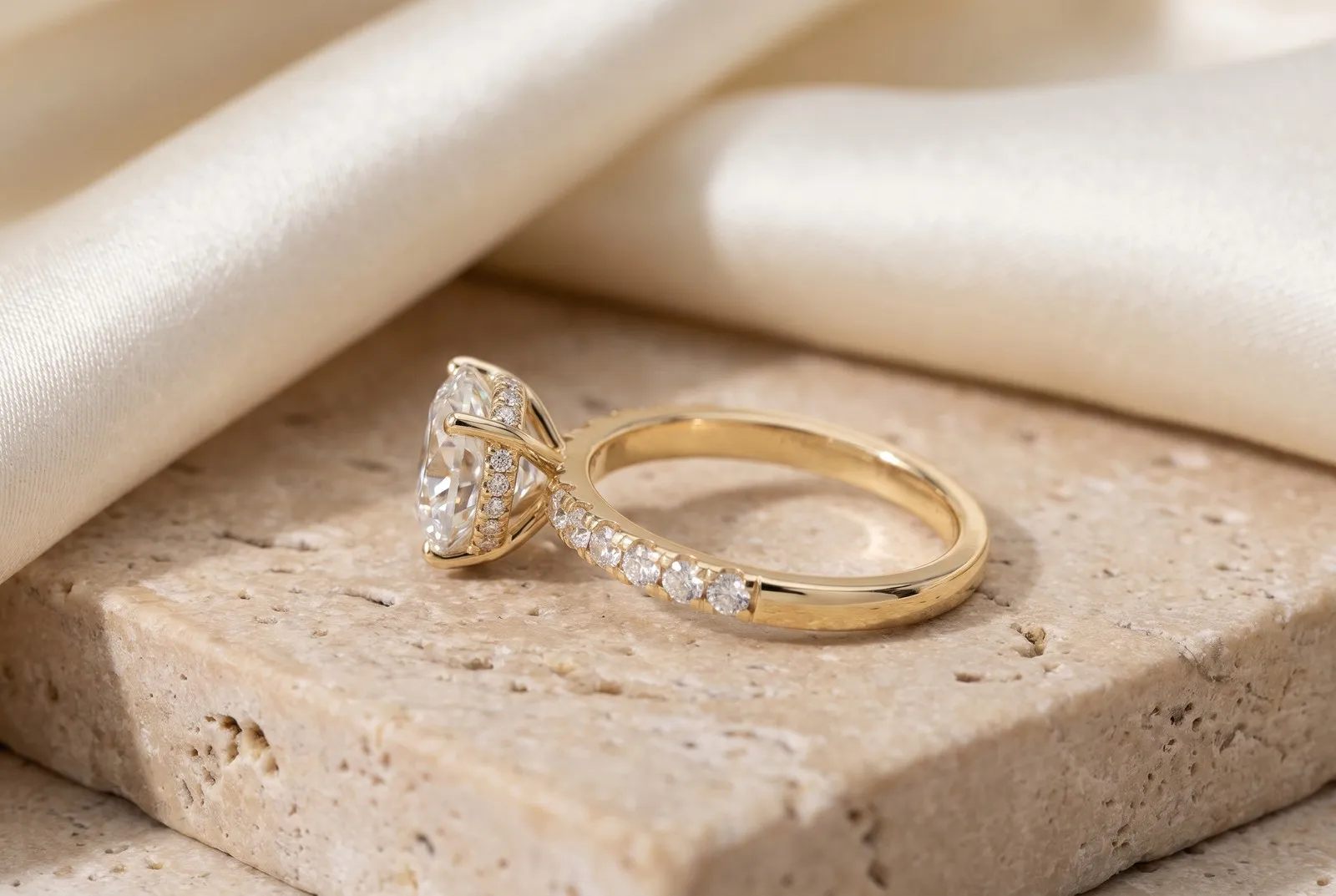
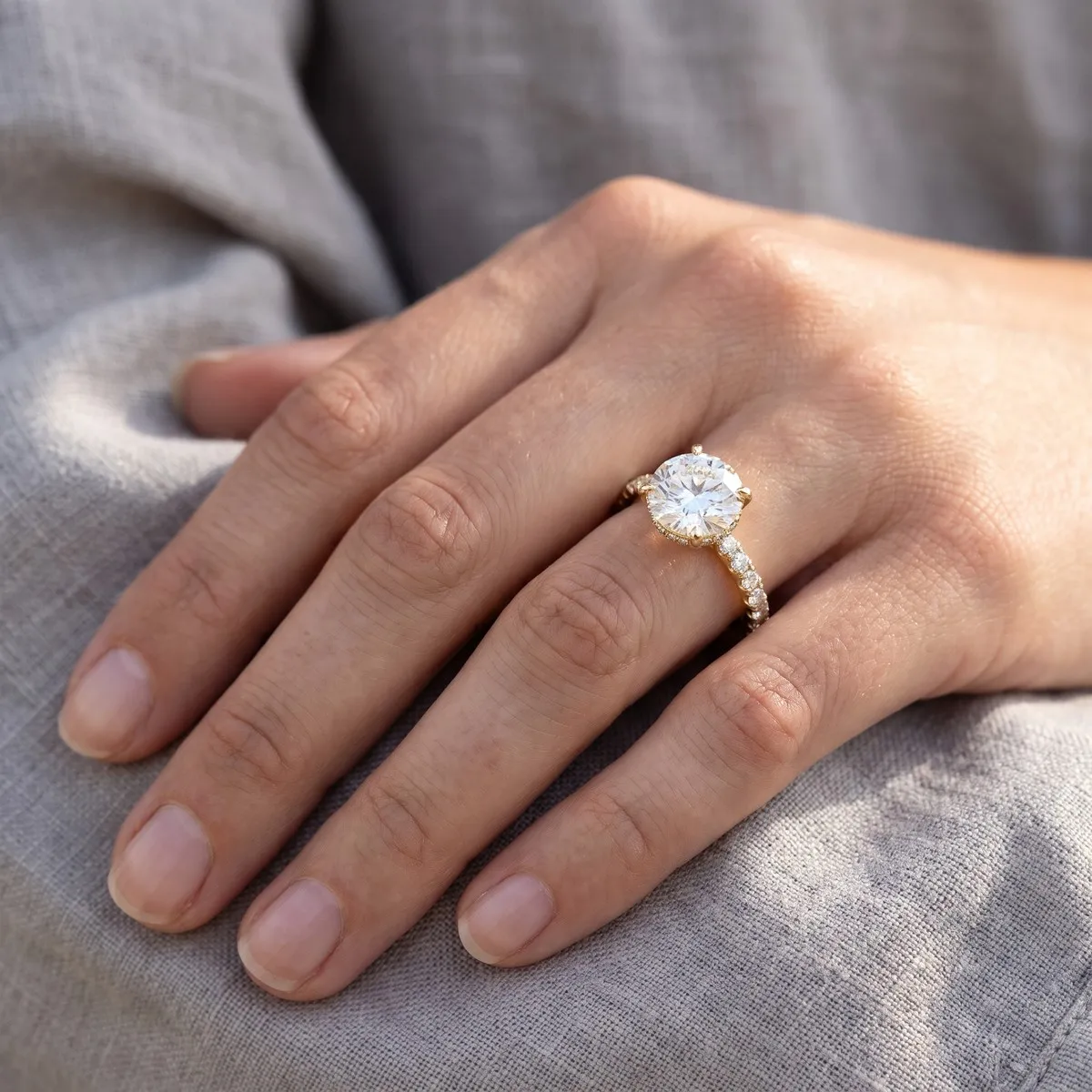
Pictured: a round hidden halo setting in yellow gold with a lab-grown diamond center. Image created from the design.
What is the average cost of an engagement ring in 2026?
Every “average” you read measures something different, so it helps to know whose number it is. These are the latest we could find, all for 2025 unless noted.
| Source | What it measures | Lab-grown | Natural | All rings |
|---|---|---|---|---|
| The Knot | Survey, 10,474 couples married in 2025 | $4,300 | $7,000 | $4,600 |
| Edahn Golan | Sales at US specialty jewelers | $2,448 | – | – |
| Natural Diamond Council | Sales at about 2,500 specialty jewelers | – | $7,346 | – |
| Plumb Club | 2025 survey, household income $75,000 or more | – | – | $5,493 |
| GIA | Summary of industry sources, June 2025 | – | – | Generally $5,000–$7,500, many under $3,000 |
Two cautions. Surveys rely on what couples remember, and The Knot’s respondents use a wedding site, so they aren’t a random sample of buyers. And the sources can disagree about the same year: The Knot’s natural figure fell about 8% in 2025, while the Natural Diamond Council’s sales figure rose about 9%. That council promotes natural diamonds. So name the source whenever you quote a number.
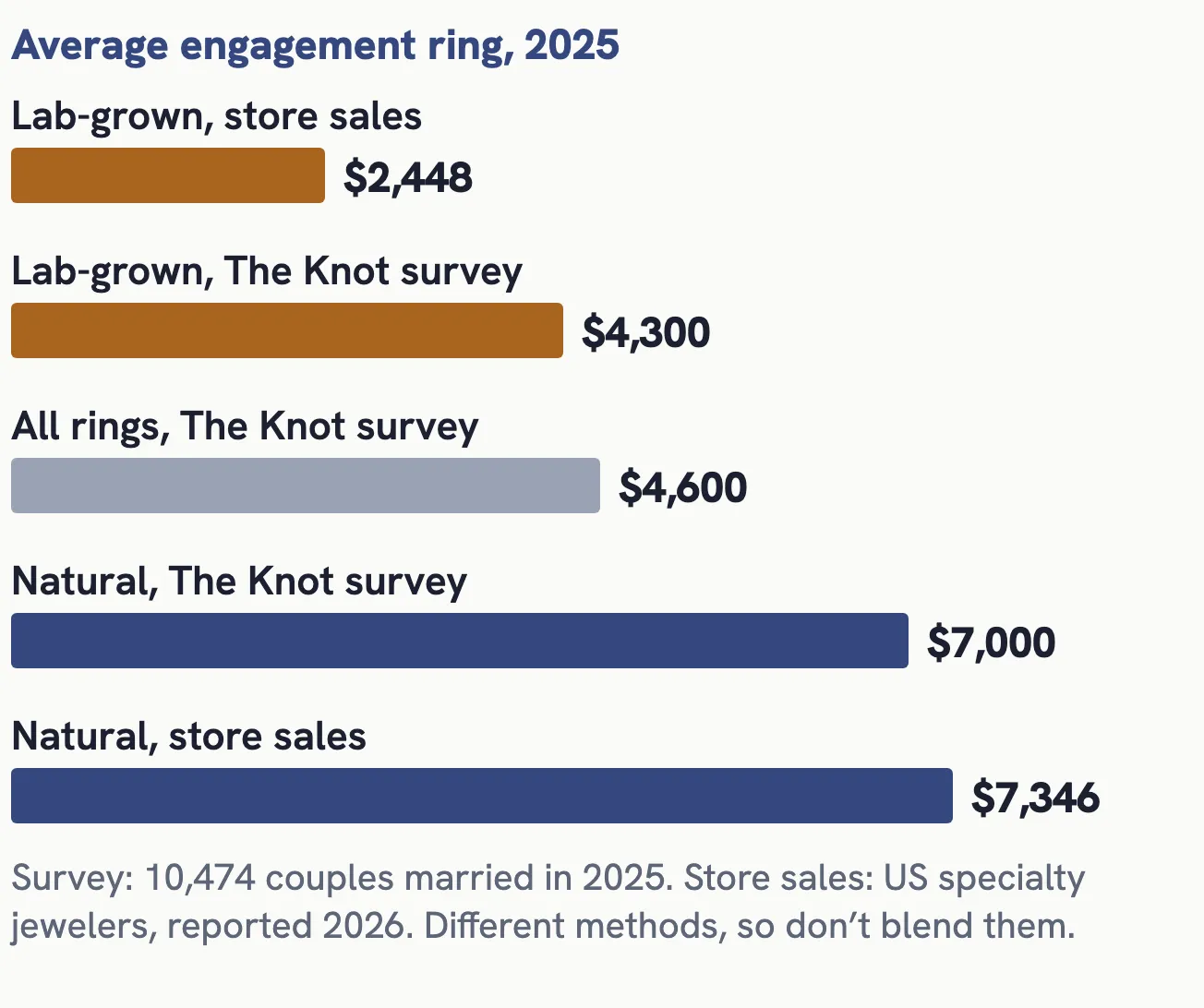
One year, five averages, depending on who’s counting.
The median is what a middle buyer pays, and it runs well under the average because a few large rings pull the average up. The Wedding Report estimated $3,603 average and $2,111 median for 2021. A 2019 poll for The New York Times found a $1,900 median across all past purchases, and only 7% had spent over $10,000.
Are engagement rings getting less expensive?
In The Knot’s survey, yes: down from $6,000 in 2021 to $4,600 in 2025, about 23%, even as the average reported carat weight rose from 1.5 to 1.9. Rings with a lab-grown center went from 12% in 2019 to 61% in 2025. Analyst Edahn Golan’s wholesale index for lab-grown diamonds is down 96% since 2018, so most of that fall went into bigger stones rather than smaller bills.
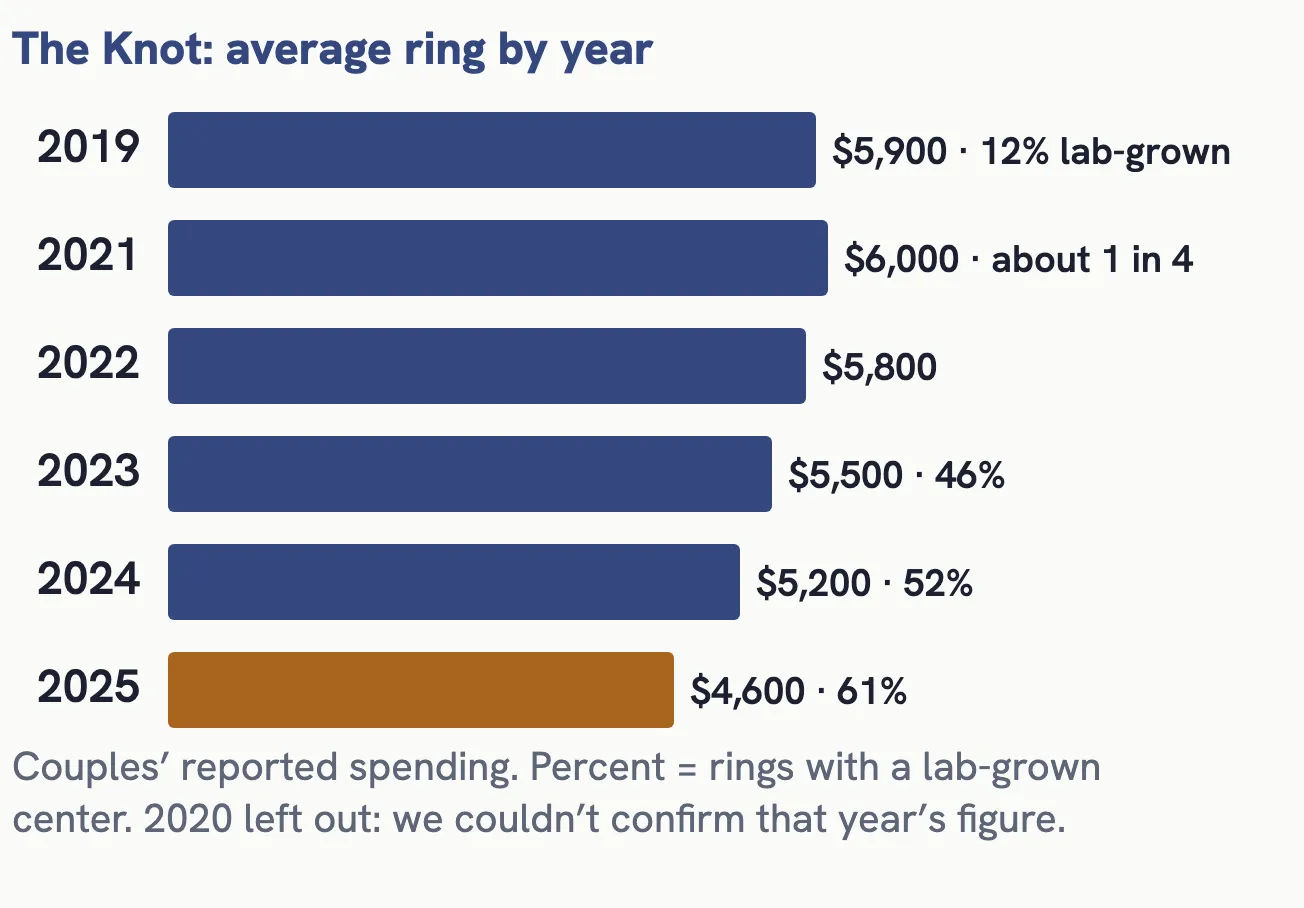
The Knot’s average has fallen as lab-grown centers spread.
How much does an engagement ring cost by carat?
No industry body publishes ring prices by carat, and the tables you’ll find elsewhere are usually the seller’s own. So here are ours, read from all 360 rings at each center weight on November 9. These rings come with a lab-grown diamond center already set.
| Center | Gold, starts at | Gold, typical | Platinum, starts at | Highest |
|---|---|---|---|---|
| 1 carat | $766 | $931 | $1,116 | $4,139 |
| 1.5 carats | $915 | $1,165 | $1,265 | $4,434 |
| 2 carats | $1,117 | $1,377 | $1,467 | $4,753 |
| 3 carats | $1,603 | $1,978 | $1,953 | $5,462 |
| 4 carats | $1,981 | $2,376 | $2,331 | $6,265 |
| 5 carats | $2,764 | $3,159 | $3,114 | $7,163 |
Typical is the median of the 270 gold rings at each weight. Carat here means the center stone. Highest is a platinum ring with a three-row pavé halo.
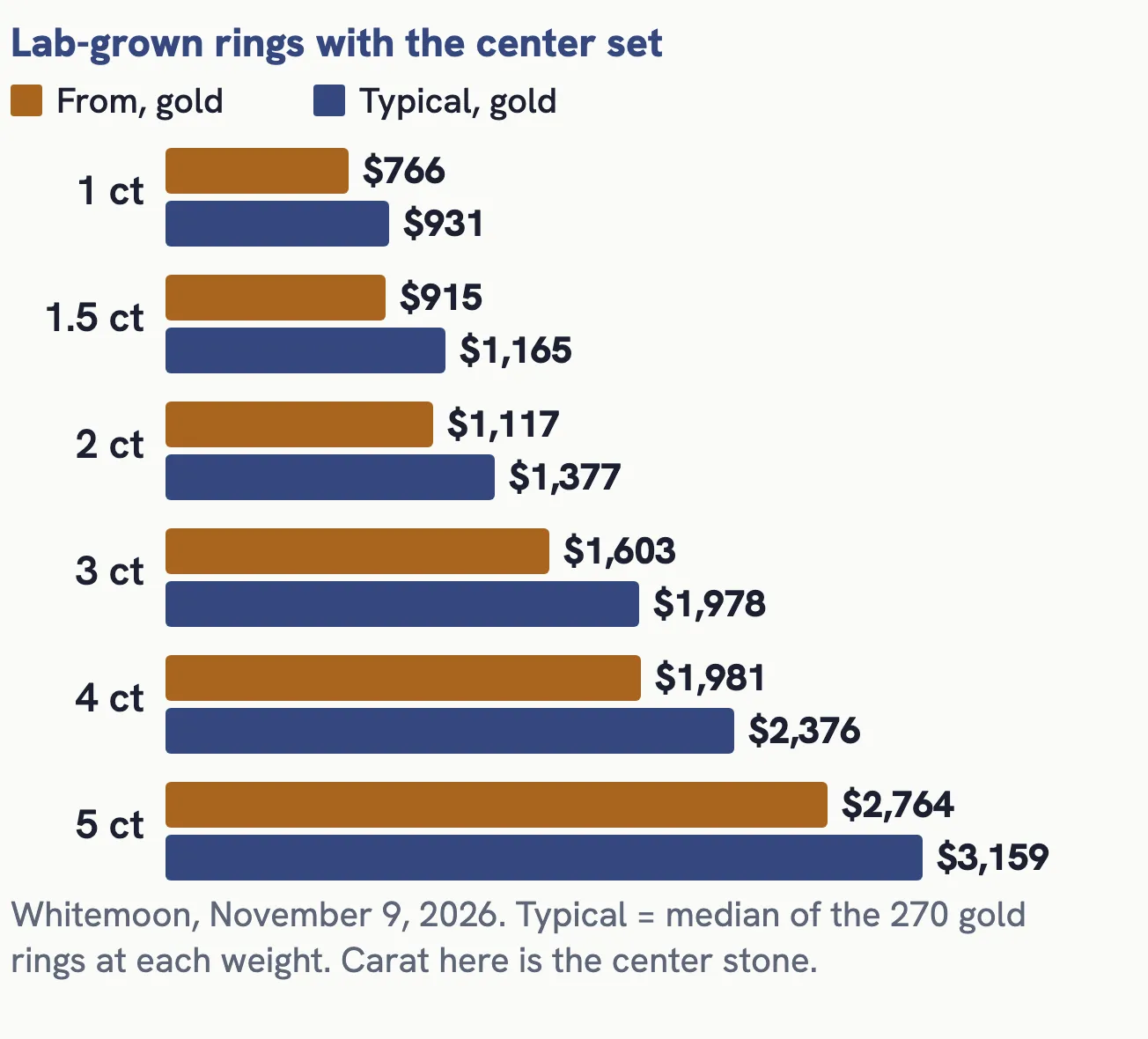
Gold rings with a lab-grown center at Whitemoon, November 9, 2026.
A round hidden halo ring in rose gold. Image created from the design, not a size reference.
How much of the price is the stone?
That depends almost entirely on whether it’s lab-grown or natural. For the same round, F color, VS1 clarity stone, the gap is about 16 times at 1 carat and over 30 times at 2 carats at the stores below.
| Round, F, VS1 | Lab-grown, Whitemoon | Lab-grown, Grown Brilliance | Lab-grown, Brilliant Earth | Natural, GIA, three stores |
|---|---|---|---|---|
| 1 carat | $324 | $347 | $595 | $4,672–$5,730 |
| 1.5 carats | $468 | $640 | $1,372 | $11,340–$13,494 |
| 2 carats | $672 | $956 | $1,836 | $23,980–$28,488 |
| 3 carats | $1,008 | $1,530 | $3,624 | About $65,500–$66,400 |
Median price per carat, scaled to the size, from stones up to half a carat larger. Natural stores: Blue Nile, Brilliant Earth and Ritani. At 3 carats, the natural range is Ritani and Blue Nile, with few stones. Our price guides for 1 carat and 3 carat diamonds go deeper by shape and grade.
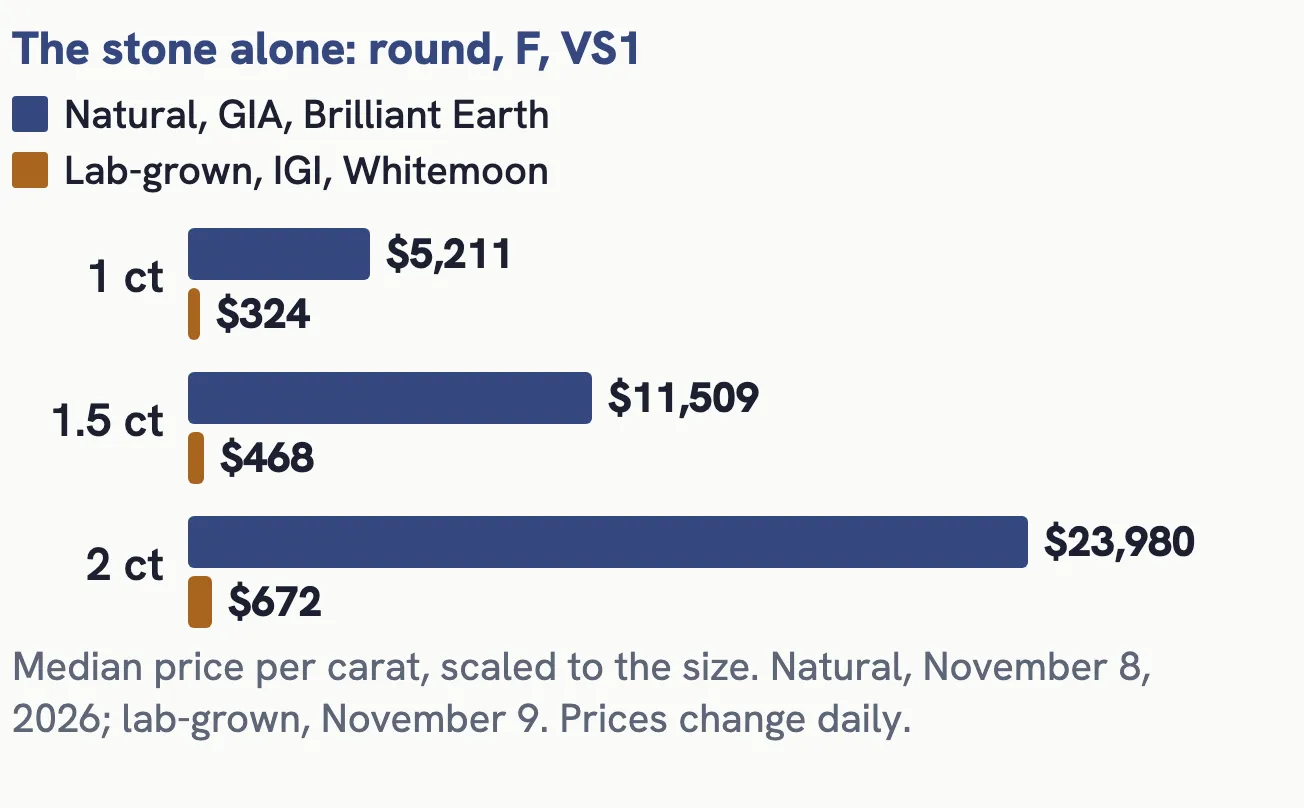
The stone alone, natural against lab-grown.
How much does a ring setting cost?
Whitemoon settings without the center start at $349 in 10K gold, the typical one is $989, and half cost $1,000 or less. That’s from about 3,600 gold settings on our pages on November 9. Metal moves the price more than most people expect. Here is one design, a hidden halo with a pavé band, and the median of 33 round designs we picked at random.
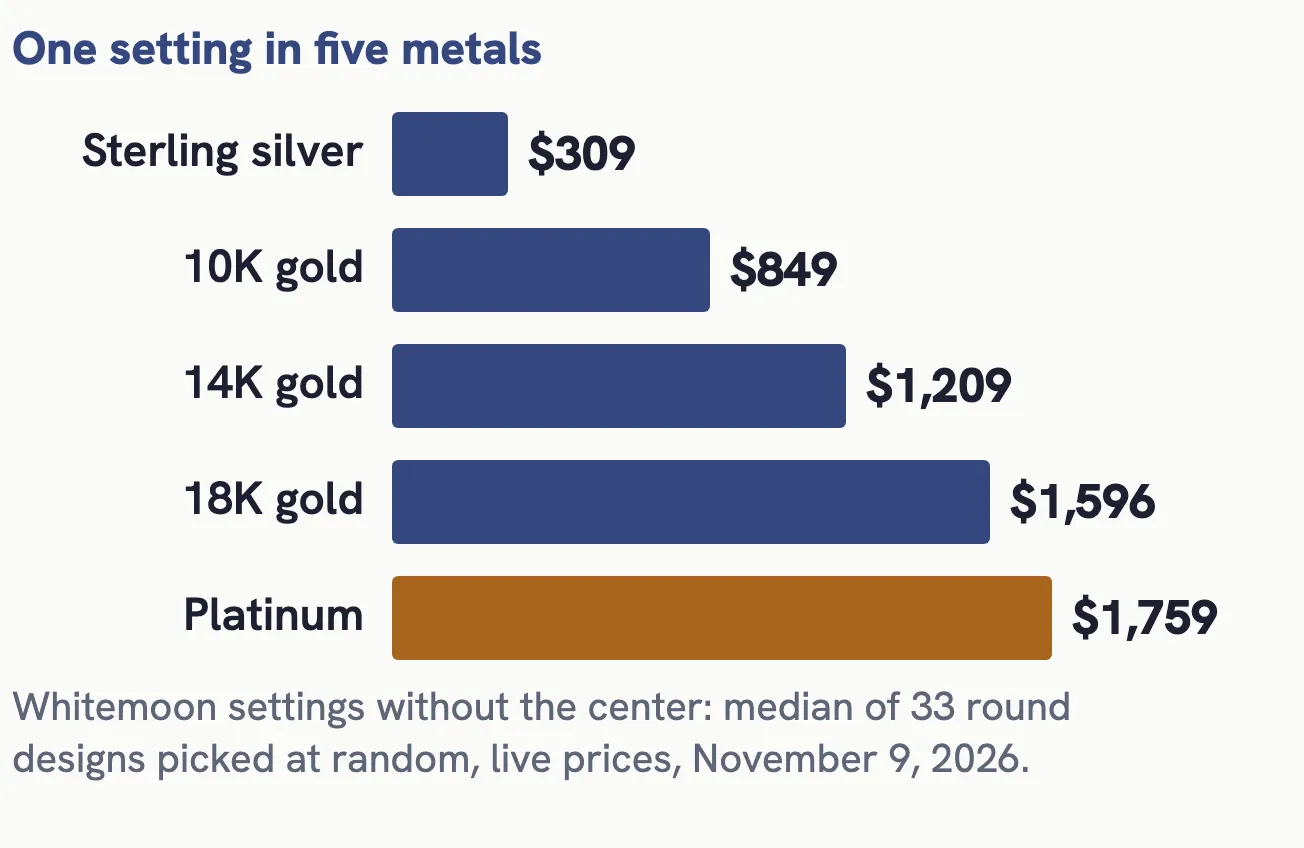
The same settings in five metals, November 9, 2026.
| Metal | Hidden halo, pavé band | Median of 33 designs |
|---|---|---|
| Sterling silver | $179 | $309 |
| 10K gold | $469 | $849 |
| 14K gold | $609 | $1,209 |
| 18K gold | $749 | $1,596 |
| Platinum | $819 | $1,759 |
How much should a platinum setting cost?
Expect to pay more than 14K gold. GIA says platinum usually costs the most, and on our own settings it’s about $480 more than 14K at the median and about $160 more than 18K. But most guides give a reason that’s out of date: that the metal itself costs more. At spot prices on November 8, platinum was about $1,550 an ounce and gold about $4,118.
By our arithmetic, a ring that weighs 5 grams in 14K gold holds about $387 of gold. The same ring in 95% platinum weighs about 7.7 grams and holds about $366 of platinum. In 18K it weighs about 6 grams and holds about $596 of gold. Densities vary by alloy and metal prices move daily, so treat those as rough figures. Where platinum still costs more, jewelers point to its weight and harder casting and finishing. We couldn’t find published labor figures to test that.
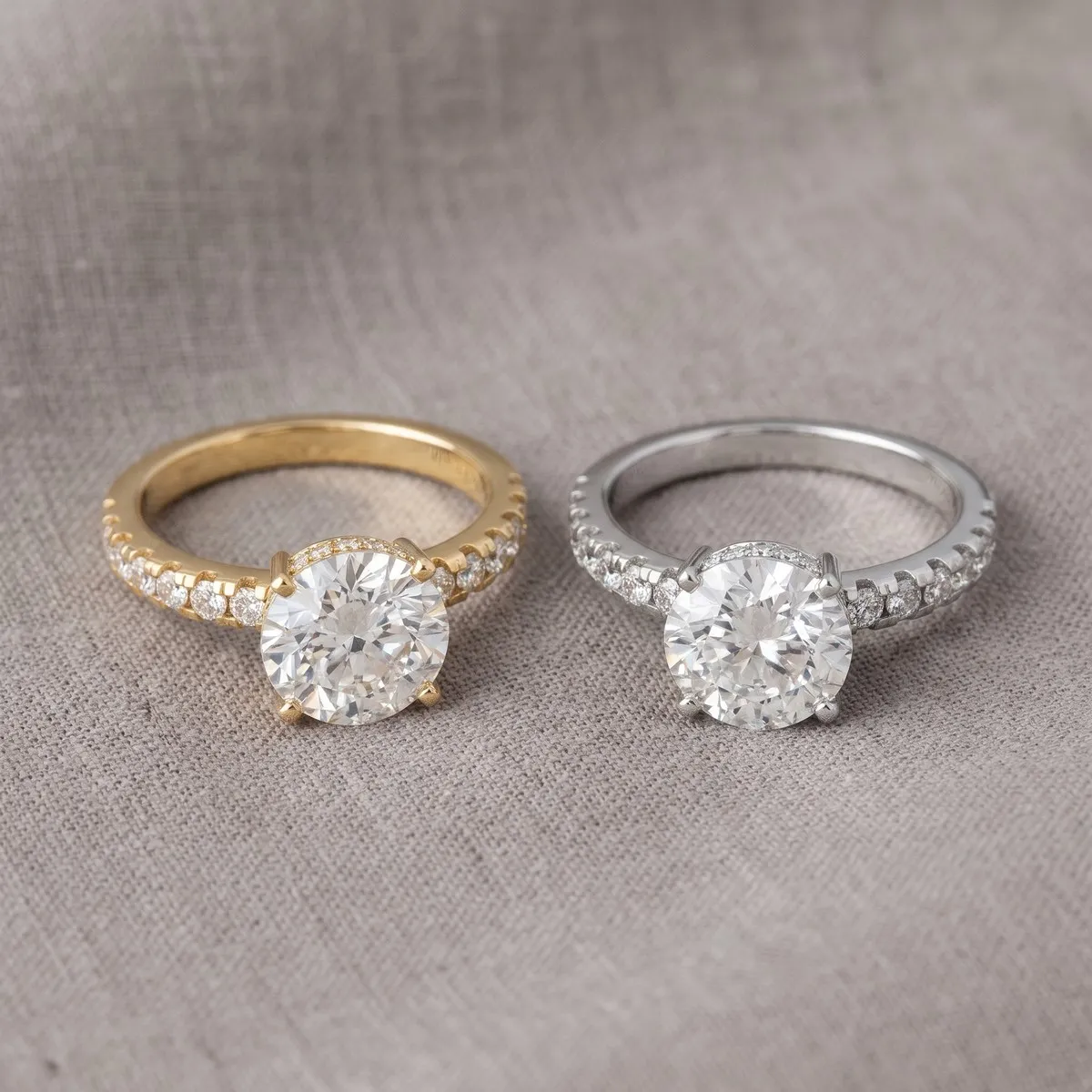
The same hidden halo design in yellow gold and platinum. Image created from the design.
What is the 3-month rule for rings?
It’s the idea that a ring should cost three months’ salary. It came from diamond advertising, not from financial advice, and GIA itself calls it largely outdated. Sources disagree on the dates. Al Jazeera describes early De Beers ads suggesting one month’s pay and a two-month line by the 1980s. A JCK columnist places it in the 1990s, and notes it never said whether salary meant before or after tax. We couldn’t find an original ad with a salary figure, so we won’t give you a date.
Almost nobody’s spending matches it. Two months of median US full-time pay is about $10,560, more than double The Knot’s average. The 2019 poll found the typical buyer spent about 4% of pre-tax income, roughly two weeks’ pay. In a 2026 poll for Chime, 24% of married or engaged adults said they or their partner spent three months’ salary, though that’s self-reported from a banking app’s poll.
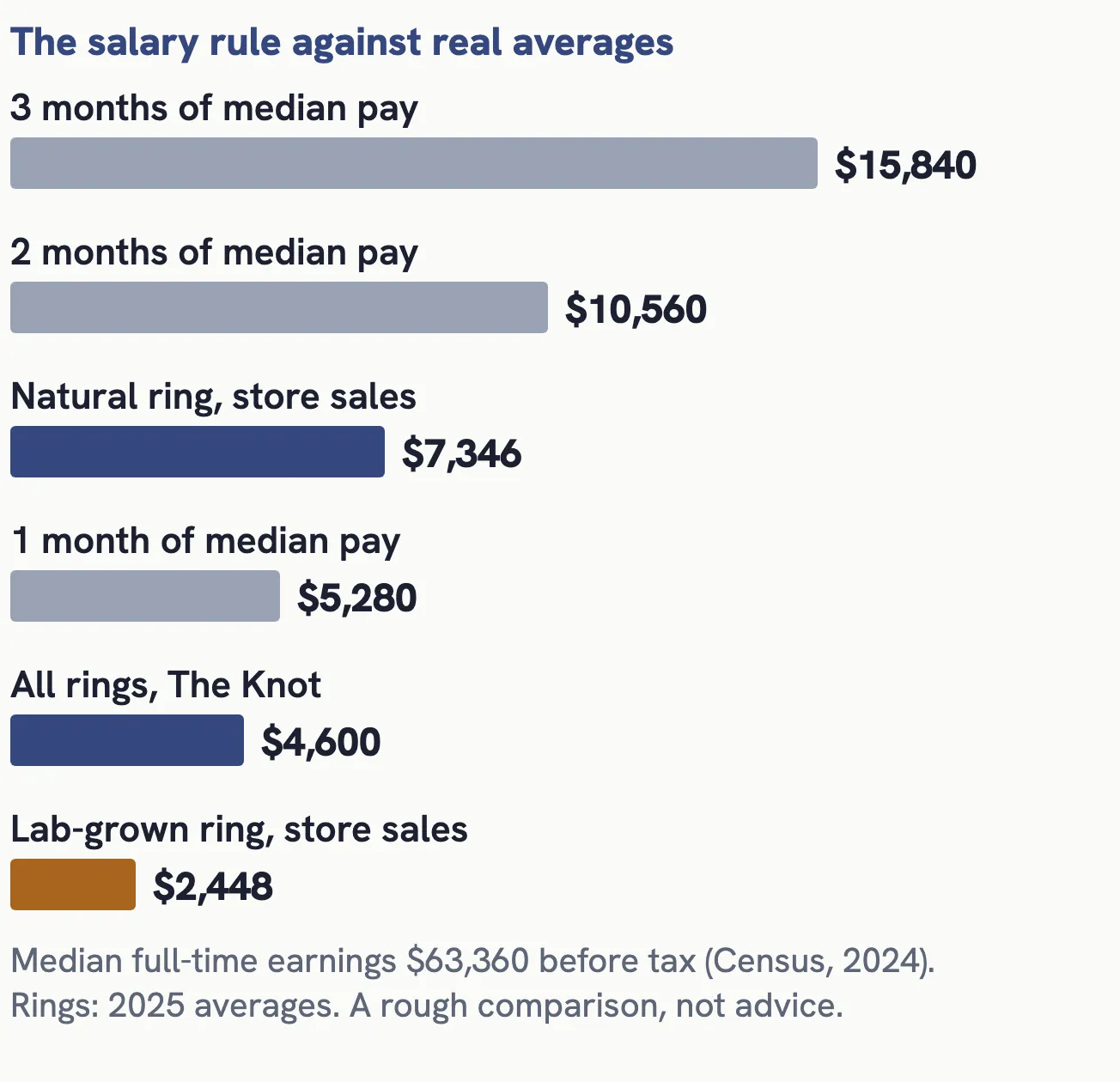
The salary rule against what rings actually cost.
How much should I spend on an engagement ring if I make $100,000?
There’s no standard, and we won’t invent one. We found no primary source for a “right” share of income, only lender and retail blogs with no evidence behind them. Here is what the old rules work out to, as arithmetic and not advice. It’s before tax, and it ignores your savings and debts.
| Annual pay | 4% (2019 poll) | 1 month | 2 months | 3 months |
|---|---|---|---|---|
| $50,000 | $2,000 | $4,167 | $8,333 | $12,500 |
| $63,360 (median) | $2,534 | $5,280 | $10,560 | $15,840 |
| $100,000 | $4,000 | $8,333 | $16,667 | $25,000 |
| $200,000 | $8,000 | $16,667 | $33,333 | $50,000 |
| $300,000 | $12,000 | $25,000 | $50,000 | $75,000 |
Our suggestion is to start from the cash you can part with, then decide what size and metal fit. Spending more doesn’t buy a stronger marriage, either. One 2015 economics study of over 3,000 ever-married Americans found that higher ring and wedding spending tended to go with shorter marriages. It shows a link, not a cause, and the authors say so.
Costs beyond the ring
- Sales tax. The average combined US rate is 7.53%, about $346 on a $4,600 ring. It depends on where the ring ships.
- Insurance. Standard homeowners policies often limit jewelry theft to about $1,000 to $2,000, and may not cover a ring you lose. Jewelers Mutual has quoted 1–2% of the value a year, and BriteCo 0.5–1.5%, so about $43 to $86 a year on a $4,300 ring at the first rate. Lab-grown diamonds are insurable. Our Whitemoon Care page explains how theft and loss cover works with our insurance partner; we don’t sell policies ourselves.
- Appraisal. CNBC Select puts one at $50 to $200, redone every three to five years. Lab-grown prices keep moving, so an old appraisal can run high, and you could pay premiums on more than a replacement would cost.
- Rush orders. GIA mentions $400 to $600. Our rings are made to order in about 10–15 days, so order early if you have a date in mind.
- Interest. Many store cards use deferred interest: miss the payoff date and interest is charged back to the day you bought. On $4,600 at 25% for a year, that’s up to about $1,150. Compare total paid, not the monthly figure. Our builder shows an option of four interest-free payments with Klarna.
Resale: buy it to wear
Lab-grown diamonds don’t hold their retail price, so buy one to wear and not as an investment. Paying less up front leaves less at stake: at 2 carats on these dates, $672 at Whitemoon, $956 at Grown Brilliance and $1,836 at Brilliant Earth for the same grade. Our Lifetime Upgrade gives you 100% of what you paid as credit toward a new lab-grown piece worth at least 1.5 times as much.
Pricing a ring at Whitemoon
Decide the size and metal first, since those two choices set most of the bill. Then browse engagement ring settings and pick your center in the ring builder, which shows the running total. If you want to keep the total down, our guide to 10K vs 14K vs 18K gold explains what each karat changes. Our guide to affordable engagement rings covers where to look. Most Whitemoon rings are made to order in about 10–15 days and ship free with insurance both ways, with 30-day returns on unworn pieces and one free resize within 60 days of delivery.
Engagement ring cost questions
How much should an engagement ring cost?
Whatever you can comfortably pay. There’s no rule. As a reference, The Knot’s 2025 average was $4,600 and GIA says many couples spend under $3,000.
Is $1,000 too cheap for an engagement ring?
No. GIA says no particular price is required for a good ring, and in a 2025 survey 37% of buyers with household income of $75,000 or more spent $2,500 or less. At $1,000, a 10K gold solitaire setting plus a lab-grown center of nearly 2 carats fit the budget at our November 9 prices.
Is $3,000 too little for an engagement ring?
No. GIA says many couples spend under $3,000, and it’s above the $2,448 sales average for lab-grown rings. At Whitemoon on November 9, $3,000 covered a typical 4 carat gold ring with a lab-grown center, at $2,376, with money left over. Our 4 carat diamond price guide breaks that size down by shape and grade.
Is $5,000 a good price for an engagement ring?
It’s close to the average, a little above The Knot’s $4,600. It buys a large lab-grown ring, or about a 1 carat natural stone in a simple gold setting.
How many carats is a $10,000 engagement ring?
With a natural round F VS1 stone and a $1,000 setting, about 1.2 to 1.4 carats at the stores above. With a lab-grown center, $10,000 is more than any 5 carat ring on our pages cost on November 9; the highest was $7,163. Our 5 carat diamond price guide breaks that size down by shape and grade.
How much should I insure my ring for?
Usually its appraised replacement value, so ask for a current appraisal and read how your insurer settles a claim. Replacement generally means like for like, a lab-grown diamond for a lab-grown diamond.
What is the average size of an engagement ring?
About 1.9 carats in The Knot’s 2025 survey, with lab-grown at 2.0 and natural at 1.6. Sales data show natural centers at 1.16 carats and loose lab-grown stones at 2.26. A survey figure may include side stones.
Is a 2 carat ring considered big?
It’s about average for a lab-grown center today, and well above average for a natural one. A round 2 carat stone is about 8.1 mm wide, roughly half the width of a US size 6 finger. Our 2 carat diamond price guide prices one by shape and grade.