
How Much Is a 4 Carat Diamond? Prices by Shape
Prices last updated November 14, 2026. We recheck them every month. Other stores’ prices come from their listings on November 11.
At the stores compared below, a round 4 carat lab-grown diamond of F color and VS1 clarity costs about $1,440 to $4,150: $1,440 at Whitemoon, $2,040 at Grown Brilliance, $4,028 at Blue Nile and $4,150 at Brilliant Earth. A natural 4 carat diamond of the same grade costs about $115,000, roughly 80 times our price.
We sell lab-grown diamonds, so these figures come from stones listed for sale and not from a general price chart: about 9,700 lab-grown stones of 4.00–4.49 carats in our ring builder, plus the other stores’ listings. Two things stood out at this size. A natural diamond costs about $19,000 more once it reaches 4.00 carats, while ours costs about $160 more. And on our stones only D color and VVS1 clarity cost noticeably more; E, F and G sit within about $170 of each other.
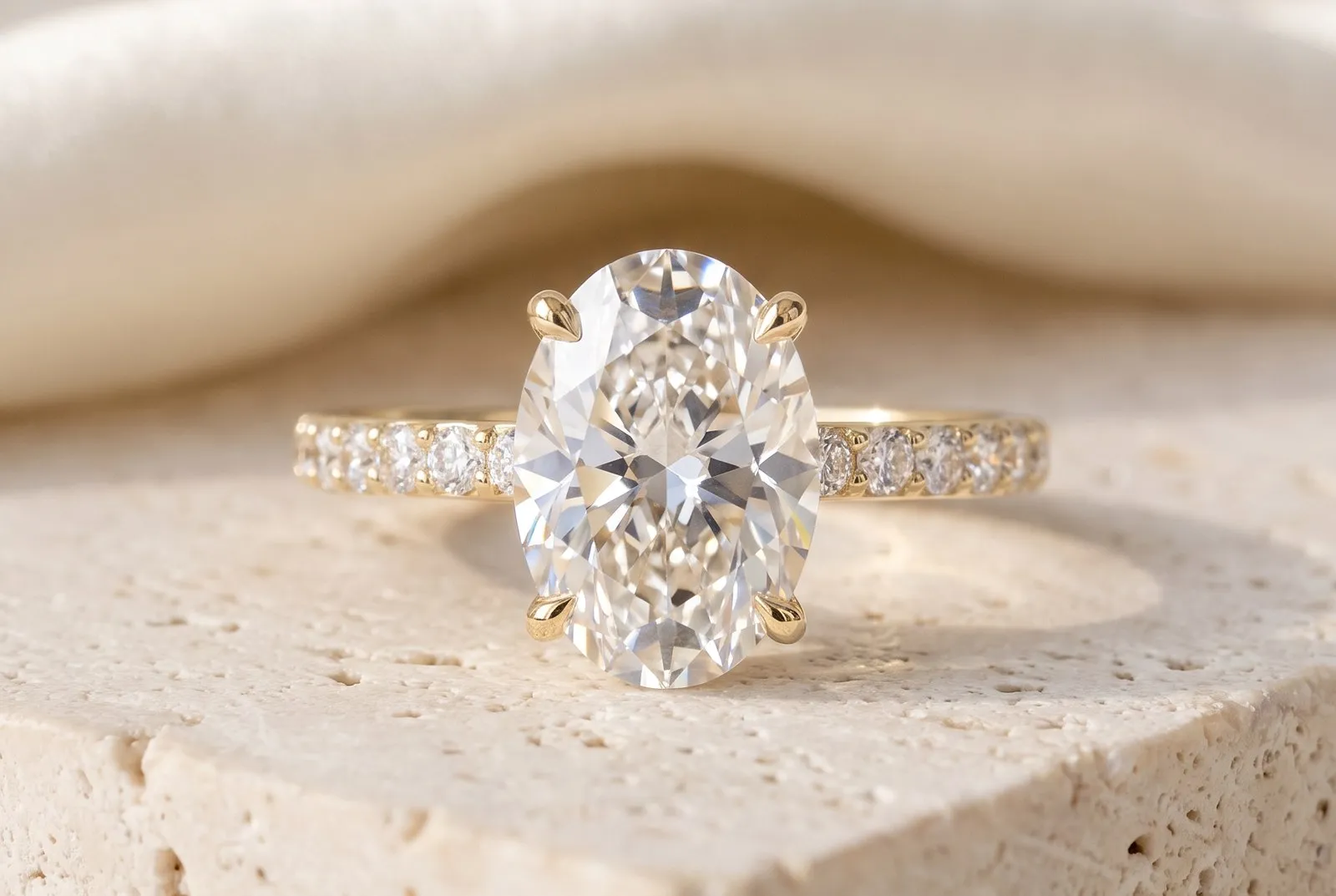
Pictured: a 4 carat oval solitaire with a pavé band in yellow gold, with a lab-grown diamond center. Image created from the design.
How much is a 4 carat diamond worth?
It depends first on whether it’s natural or lab-grown, and then on the store. This is the median price of a round, F color, VS1 clarity lab-grown diamond, taken from each store’s stones of 4.00–4.49 carats and scaled to exactly 4 carats.
| Store | Report | Typical price | Stones compared |
|---|---|---|---|
| Whitemoon | IGI | $1,440 | 233 |
| Grown Brilliance | IGI | $2,040 | 460 |
| Blue Nile | IGI | $4,028 | 7 |
| Brilliant Earth | IGI | $4,150 | 165 |
Other stores November 11, 2026; Whitemoon November 14. Blue Nile listed only 7 stones at this exact grade, so read its figure as rough. Prices move every day as stones sell and new ones are listed.
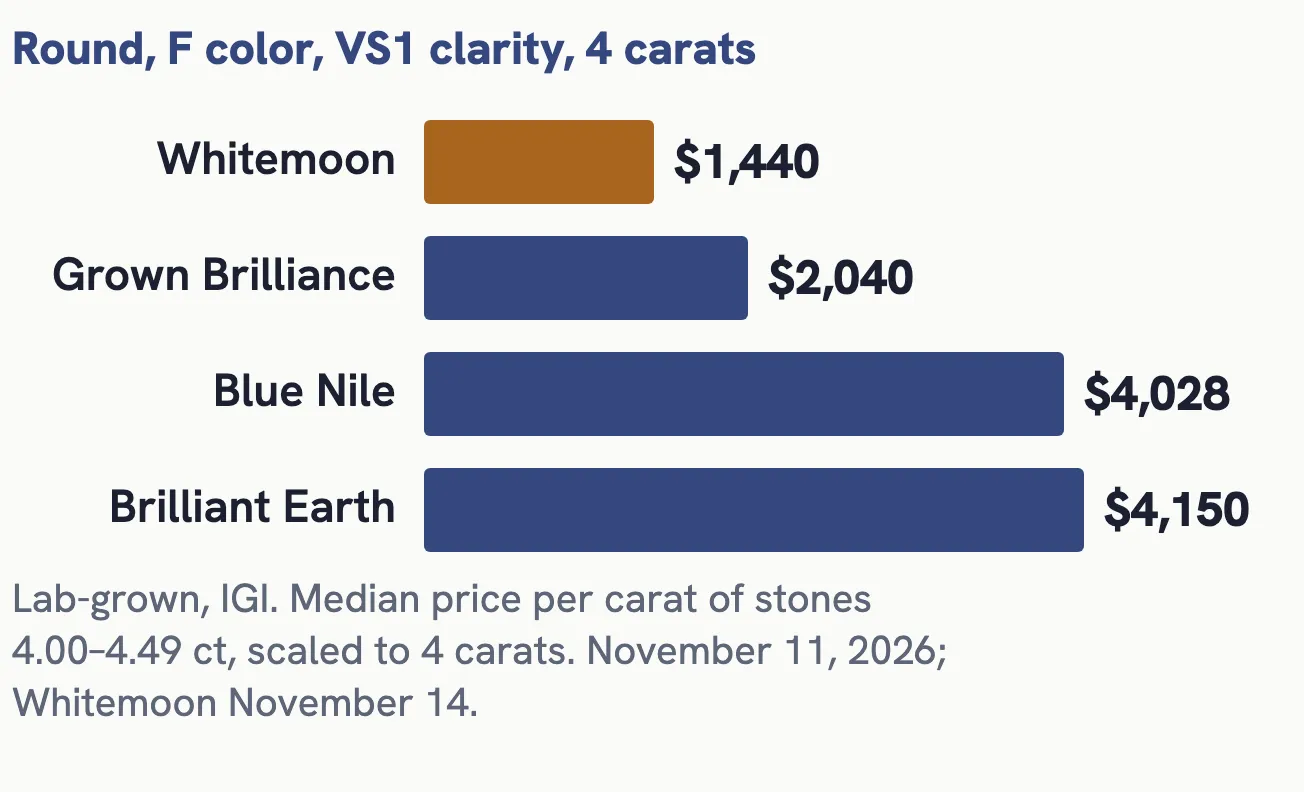
Round, F, VS1 lab-grown, scaled to 4 carats, November 2026.
Across every color and clarity, eight in ten of our round 4 carat lab-grown diamonds cost between about $1,310 and $2,000, and the typical one costs $1,598. To see the stones themselves, pick a setting in the Whitemoon ring builder; each stone shows its report details.
4 carat lab-grown vs natural diamond price
A natural 4 carat costs about 67 to 81 times as much as a lab-grown one of the same color at our prices. Both are diamonds under the FTC’s Jewelry Guides, which define a diamond by its carbon crystal and not by where it formed. Our guide to whether lab-grown diamonds are worth it weighs the two.
| Color | Natural, GIA, VS2–VVS2 | Lab-grown at Whitemoon, IGI, VS1 |
|---|---|---|
| D | $142,010 | $1,904 |
| E | $124,942 | $1,551 |
| F | $112,501 | $1,440 |
| G | $100,916 | $1,382 |
| H | $76,735 | $1,152 |
| I | $59,920 | – |
| J | $51,651 | – |
Round, 4.00–4.49 carats scaled to exactly 4 carats. Natural: median of GIA-graded stones at Blue Nile, Brilliant Earth and Ritani together, November 11, 2026, 22 to 61 stones per color. The three stores listed only 13 natural rounds at exactly F VS1, with a median of $115,187, so the natural column groups three clarity grades. Our H figure rests on 9 stones, and we list almost no lab-grown rounds below H at this size.
On a natural stone, color is a big lever: dropping from D to J saves about $90,000. On our lab-grown stones the whole run from D to H spans about $750, and D costs about $460 more than F. Our diamond color chart explains what each letter means.
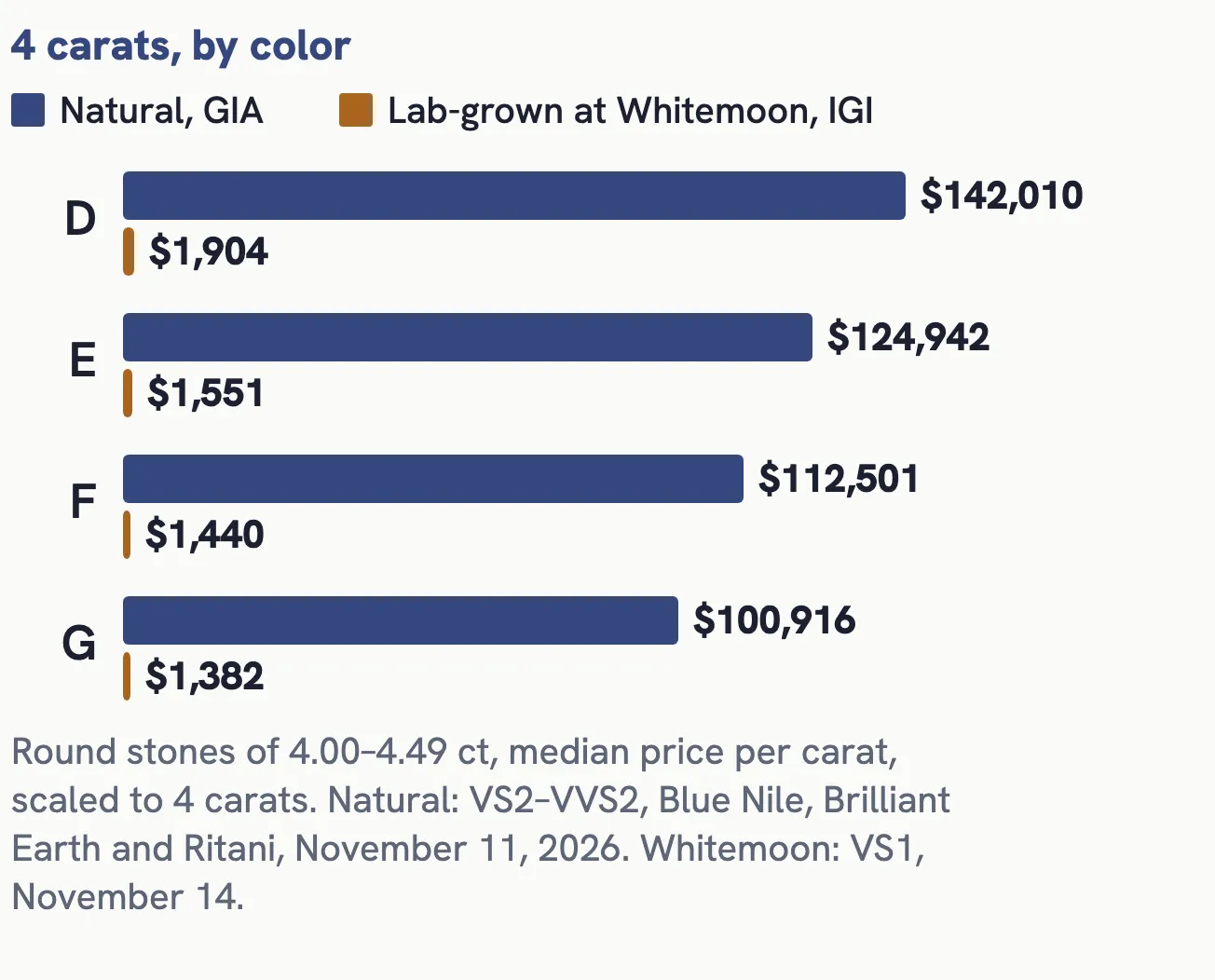
By color: natural against lab-grown at Whitemoon.
Why a 4 carat costs so much more than a 2 or 3 carat
For natural diamonds, the price per carat rises with size, so the total climbs much faster than the weight. Here’s one grade band, D to G color and VS2 to VVS2 clarity, at six weights.
| Weight | Natural, GIA | Lab-grown at Whitemoon |
|---|---|---|
| 1 carat | $4,990 | $340 |
| 2 carats | $25,557 | $744 |
| 3 carats | $60,871 | $1,187 |
| 4 carats | $111,924 | $1,598 |
| 5 carats | $176,789 | $1,916 |
| 6 carats | $205,483 | $2,208 |
Round. Median price per carat of stones from each weight up to half a carat heavier, scaled to the weight. Natural: three stores together, November 11, 2026; Whitemoon November 14. The natural 6 carat figure rests on 18 stones. Our diamond price chart has every size from a quarter carat to 10 carats.
Four times the weight of a 1 carat multiplies the natural price by about 22 and ours by about 4.7. Two things drive the natural curve:
- Big rough is scarce. Bain’s industry report says most diamonds lose 50–60% of their weight in cutting, so a 4 carat stone starts as roughly 8 to 10 carats of rough. In 2025 De Beers’ buyers reported shortages of large rough. Nobody publishes a reliable “one in so many” figure for a 4 carat.
- 4.00 is a price line. The trade’s price list has separate bands for 3.00–3.99 and 4.00–4.99 carats, so a stone that reaches 4.00 is priced from a higher line.
Large natural stones have also held their price better than small ones lately. Rapaport’s 3 carat index rose 0.3% in 2025 while its 1 carat index fell 9.9%; there is no 4 carat index. Lab-grown stones are grown to size in a factory, so a bigger one isn’t rare in the same way. GIA examined a lab-grown diamond of 34.59 carats in 2023.
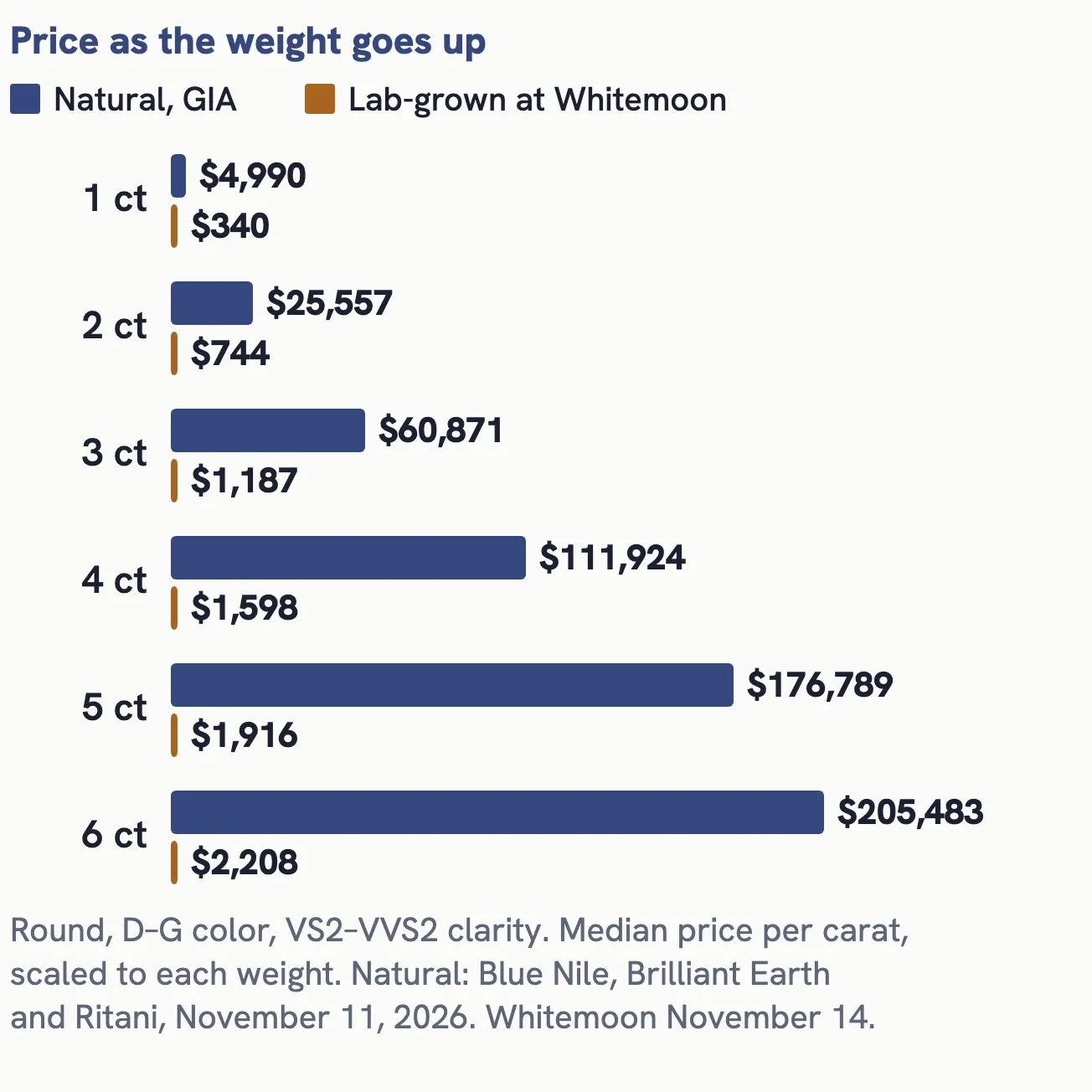
The same grade band from 1 to 6 carats.
Is a diamond just under 4 carats cheaper?
For a natural diamond, yes. In the listings we compared, natural rounds of 3.50–3.99 carats cost about a fifth less than rounds of 4.00–4.49 carats in the same grades.
| Round diamond | 3.50–3.99 carats | 4.00–4.49 carats | Difference |
|---|---|---|---|
| Natural, D–H, VS2–VVS2, GIA, three stores | $80,964 | $100,136 | $19,172 |
| Lab-grown, E–F, VS1–VVS2, Whitemoon | $1,470 | $1,630 | $160 |
Median actual price, not scaled. Natural November 11, 2026, 141 stones under the line and 184 over it; Whitemoon November 14.
The difference in size is hard to see. By our arithmetic a 3.90 carat round is about 0.09 mm narrower than a 4.00, and in the listings a 3.50 carat round is about 0.4 mm narrower. The catch is supply. The three stores listed 33 natural rounds of 3.90–3.99 carats against 608 of 4.00–4.09, since cutters keep a stone at 4.00 whenever they can. If you’re buying natural, a 3.5 to 3.8 carat stone is where the saving is.
For lab-grown at Whitemoon the step is about $160, and we list 30 times as many rounds at 4.00–4.09 carats as at 3.90–3.99, so there’s little to gain by hunting under the line with us.
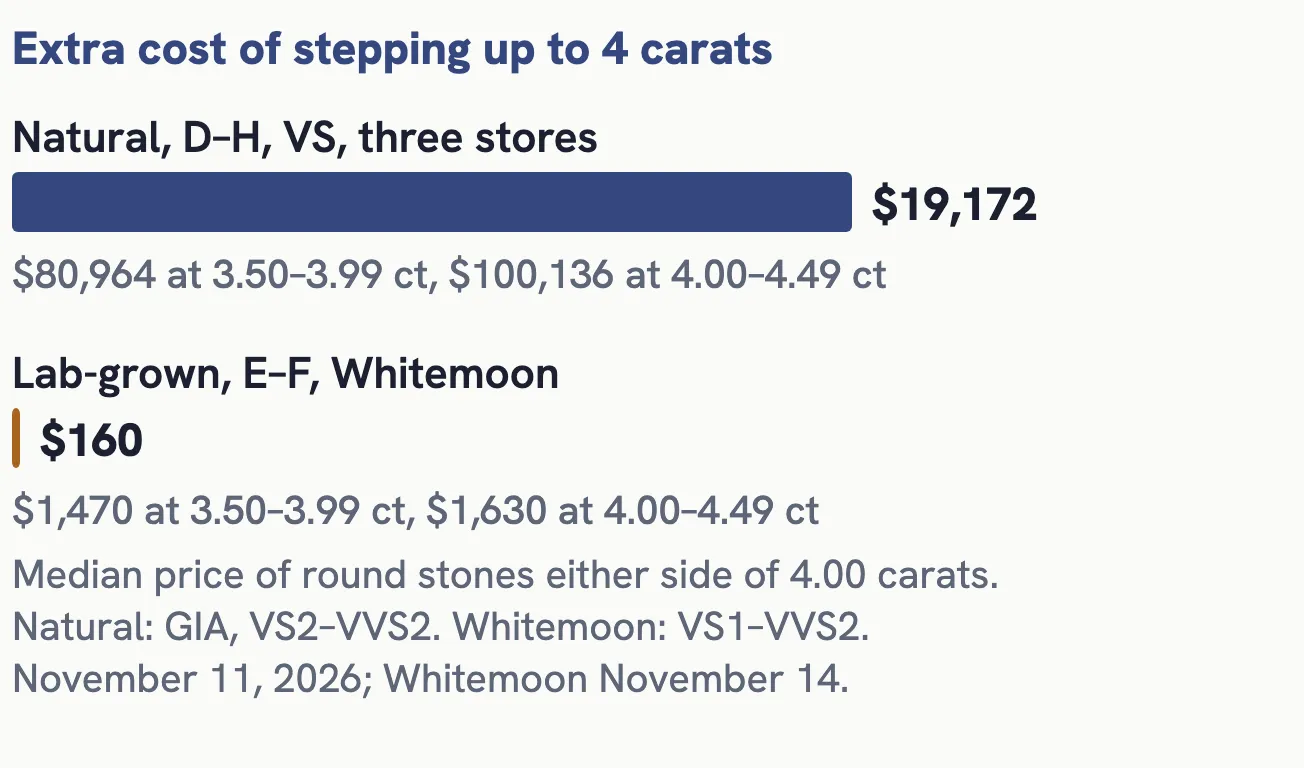
What the step up to 4 carats costs.
4 carat diamond price by shape
At Whitemoon, lab-grown prices sit in a narrow band across all ten shapes, from $1,296 for an emerald cut to $1,792 for a heart at F VS1. Natural prices spread much wider, and a round or marquise costs the most. Our diamond shapes guide shows how each one looks and wears.
| Shape | Typical size (mm) | Lab-grown, Whitemoon | Lab-grown, Grown Brilliance | Lab-grown, Brilliant Earth | Natural, three stores |
|---|---|---|---|---|---|
| Round | 10.2 | $1,440 | $2,040 | $4,150 | $111,924 |
| Oval | 12.8 by 9.0 | $1,504 | $2,118 | $4,843 | $94,753 |
| Pear | 14.0 by 8.9 | $1,358 | $2,040 | $4,765 | $101,504 |
| Marquise | 16.4 by 8.3 | $1,440 | $2,040 | $5,257 | $116,061 |
| Cushion | 10.9 by 8.4 | $1,536 | $2,119 | $5,639 | $87,581 |
| Radiant | 11.2 by 7.9 | $1,402 | $2,118 | $4,866 | $93,254 |
| Emerald | 10.7 by 7.5 | $1,296 | $2,040 | $3,863 | $93,287 |
| Princess | 8.7 by 8.6 | $1,435 | $2,118 | $7,244 | $78,384 |
| Asscher | 8.8 by 8.7 | $1,598 | – | $3,863 | $73,114 |
| Heart | 9.8 by 11.0 | $1,792 | $2,118 | $4,048 | $85,135 |
Lab-grown: F, VS1, IGI. Natural: GIA, D–G color, VS2–VVS2, three stores together. Stones of 4.00–4.49 carats priced per carat and scaled to exactly 4 carats; median, November 11, 2026, Whitemoon November 14. Sizes are the median of 4.00–4.09 carat stones in the listings, length first. We had 9 heart, 11 princess and 15 asscher stones at this grade, Grown Brilliance listed 7 heart and 9 princess stones, and the natural princess figure rests on 16 stones, so read those as rough.
4 carat round and oval diamond prices
A round is the shape we list most, at $1,440. A 4 carat oval costs $1,504 at Whitemoon and looks larger from above, about 12.8 by 9.0 mm against 10.2 mm for the round. Ovals can show a dark band across the middle, which our bow-tie guide explains. Natural, an oval was about $17,000 less than a round in the same grades. See 4 carat round rings and 4 carat oval rings.
4 carat emerald, radiant and cushion cut prices
At Whitemoon a 4 carat emerald cut costs $1,296, a radiant $1,402 and a cushion $1,536 at F VS1, against about $93,000, $93,000 and $88,000 natural. Most cushions listed at this size are elongated. See 4 carat emerald cut rings, 4 carat radiant cut rings and 4 carat cushion cut rings.
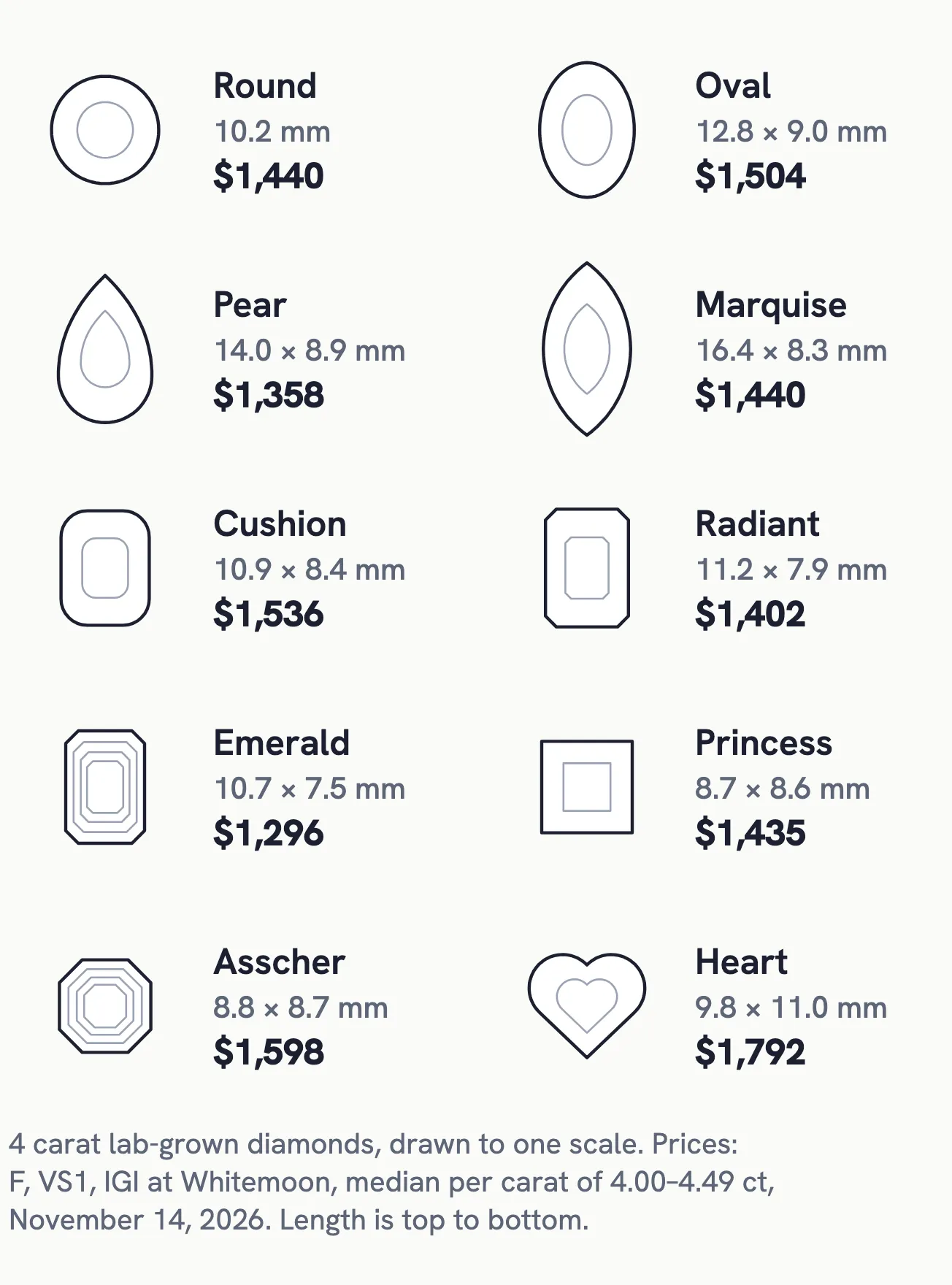
Every shape at 4 carats, to one scale, with its Whitemoon price.
What’s available at Whitemoon at 4 carats
| Shape | Typical price, all grades | Stones available |
|---|---|---|
| Round | $1,598 | 3,670 |
| Oval | $1,728 | 2,034 |
| Emerald | $1,600 | 750 |
| Radiant | $1,600 | 747 |
| Marquise | $1,776 | 713 |
| Pear | $1,600 | 632 |
| Cushion | $1,840 | 598 |
| Princess | $1,408 | 214 |
| Asscher | $1,680 | 170 |
| Heart | $1,744 | 143 |
Lab-grown white diamonds, 4.00–4.49 carats, priced per carat and scaled to exactly 4 carats. Whitemoon, November 14, 2026.
4 carat diamond price by color and clarity
At 1 carat, our lab-grown prices barely change with grade. At 4 carats two grades do cost more: D color and VVS1 clarity.
| Color | VS2 | VS1 | VVS2 | VVS1 |
|---|---|---|---|---|
| D | $1,760 | $1,904 | $2,640 | $5,024 |
| E | $1,424 | $1,551 | $1,661 | $2,560 |
| F | $1,336 | $1,440 | $1,504 | $2,000 |
| G | $1,361 | $1,382 | $1,184 | $1,872 |
Round lab-grown diamonds at Whitemoon, IGI. Stones of 4.00–4.49 carats priced per carat and scaled to exactly 4 carats; median, November 14, 2026. About six in ten of the rounds we list at this size are E color, and about six in ten are VVS2. We had 10 stones at D VS2 and 9 at G VVS1, so those figures are rough. The few internally flawless stones cost about $6,400 and up.
| Clarity, 4 carats | Natural, GIA, D–G | Lab-grown at Whitemoon, IGI, F |
|---|---|---|
| SI2 | $61,687 | – |
| SI1 | $76,763 | $1,504 |
| VS2 | $96,030 | $1,336 |
| VS1 | $116,876 | $1,440 |
| VVS2 | $135,902 | $1,504 |
Round, 4.00–4.49 carats scaled to 4 carats. Natural: Blue Nile, Brilliant Earth and Ritani together, November 11, 2026, 32 to 56 stones per grade. We had only 9 F SI1 stones.
Grades matter more to the eye at this size. GIA’s advice for a round of 3 carats or more is to consider a higher color grade and VS2 clarity or better, because color and inclusions are easier to see in a large stone. It adds that emerald and asscher cuts show both more readily than brilliant cuts. Our diamond clarity chart explains each grade. In our opinion, with E to G and VS2 to VVS2 priced this close together on lab-grown stones, there’s little reason to go below them at 4 carats.
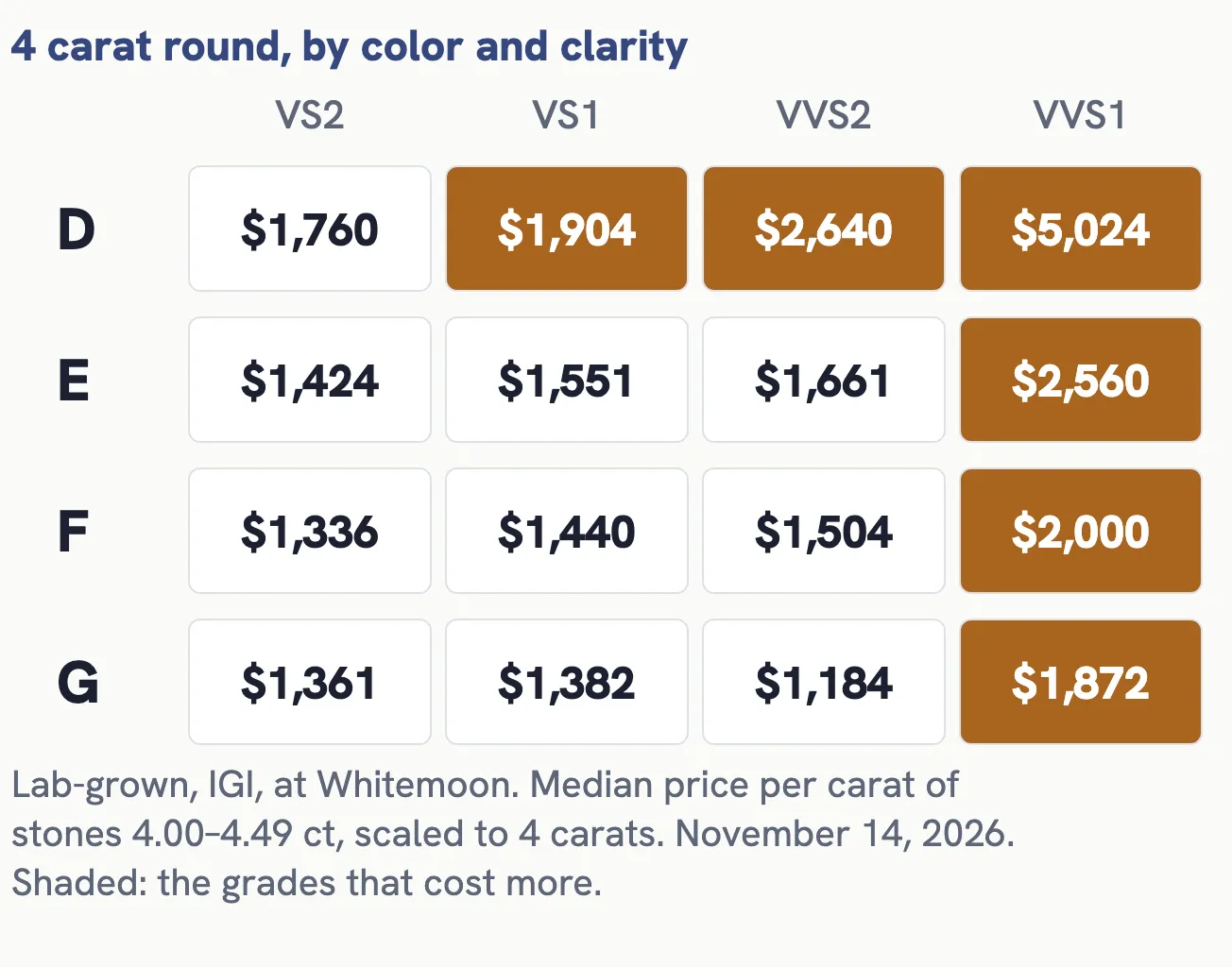
At 4 carats, D color and VVS1 clarity are the grades that cost more.
How cut and certificate change the price
Cut grade doesn’t change the price of a 4 carat lab-grown round at Whitemoon: Ideal and Excellent cuts were both about $1,590 in E to F color and VS1 to VVS2 clarity. GIA gives a cut grade only to round brilliants, so for an oval, emerald or pear you judge the cut from the measurements, the polish and symmetry grades and the stone’s video.
Nearly all of our 4 carat stones have an IGI report, 9,587 of 9,671. The six E VVS2 rounds we listed with a GIA report were about $4,500 against $1,661 with an IGI report. GIA’s current lab-grown report doesn’t give letter grades, so read our comparison of IGI vs GIA before paying extra for one. The report also states how the stone was grown. GIA notes that most colorless lab-grown diamonds made by the CVD method are heat-treated after growth to improve their color.
How much a 4 carat diamond ring costs
A ring costs the center stone plus the setting. At Whitemoon on November 14, rings with a 4 carat lab-grown diamond center already set started at $1,901 in gold and $2,331 in platinum. The typical gold ring was $2,211, and the highest-priced, a halo with a three-row pavé band in platinum, was $6,265. If you build your own, gold settings start at $349, so a $1,440 round F VS1 stone in one comes to about $1,789.
With a natural center, grade moves the price a long way. On November 13, 2026, Costco’s site listed platinum solitaires with a 4.00 carat I color, VS2 round at $58,999.99, a 4.02 carat I color, VS1 round at $74,999.99 and a 4.01 carat G color, VS2 round at $96,999.99. Tiffany’s online selector stopped at 2.78 carats on November 14, with prices up to $137,500, so it publishes no 4 carat price.
Auctions give another reference point. A ring with a 4.19 carat emerald cut diamond of F color and SI2 clarity sold for $32,000 at Bonhams in Los Angeles in May 2025, and one with a 4.10 carat round of G color and VS2 clarity sold for AU$83,640 at Bonhams in Sydney that August. Auction prices aren’t store prices, though they show how far grade moves a natural 4 carat.
Browse 4 carat lab-grown diamond rings, or narrow it to solitaire, gold or platinum. Our engagement ring cost guide compares ring prices at every size up to 5 carats.
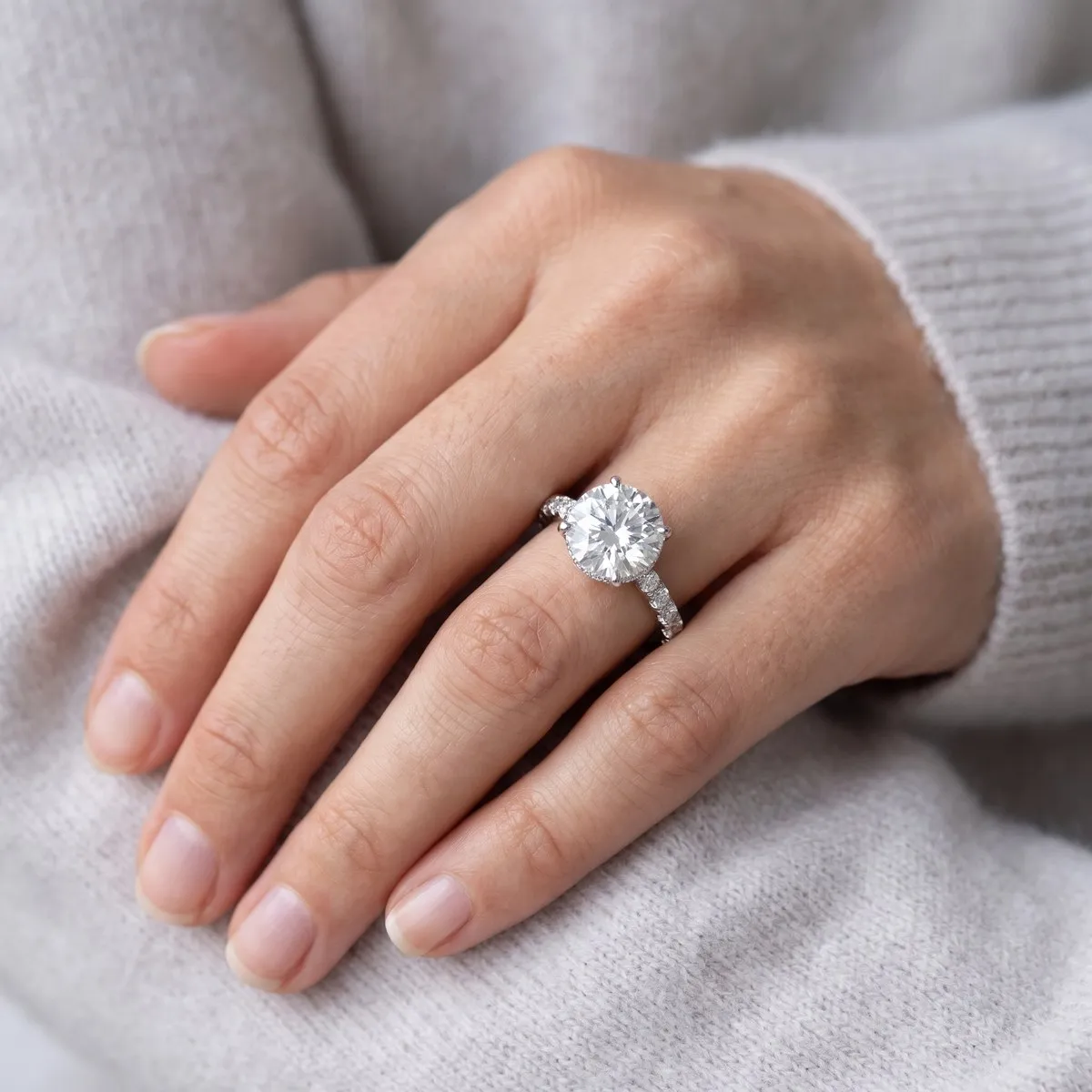
A 4 carat round with a hidden halo and pavé band in white gold. Image created from the design.
How big is a 4 carat diamond?
A carat is a weight, 0.2 grams, so a 4 carat diamond weighs 0.8 grams. Well-cut rounds of 4.00–4.09 carats in the listings measure about 10.2 mm across and 6.3 mm deep. On a US size 6 finger, about 16.5 mm wide, that covers a little over 60% of the width. Our ring size chart has other sizes.
Size grows more slowly than weight. By our arithmetic, a 4 carat round is about 1.6 times as wide as a 1 carat and has about 2.5 times the face-up area, not four times. It’s about 10% wider than a 3 carat, and a 5 carat is about 8% wider again.
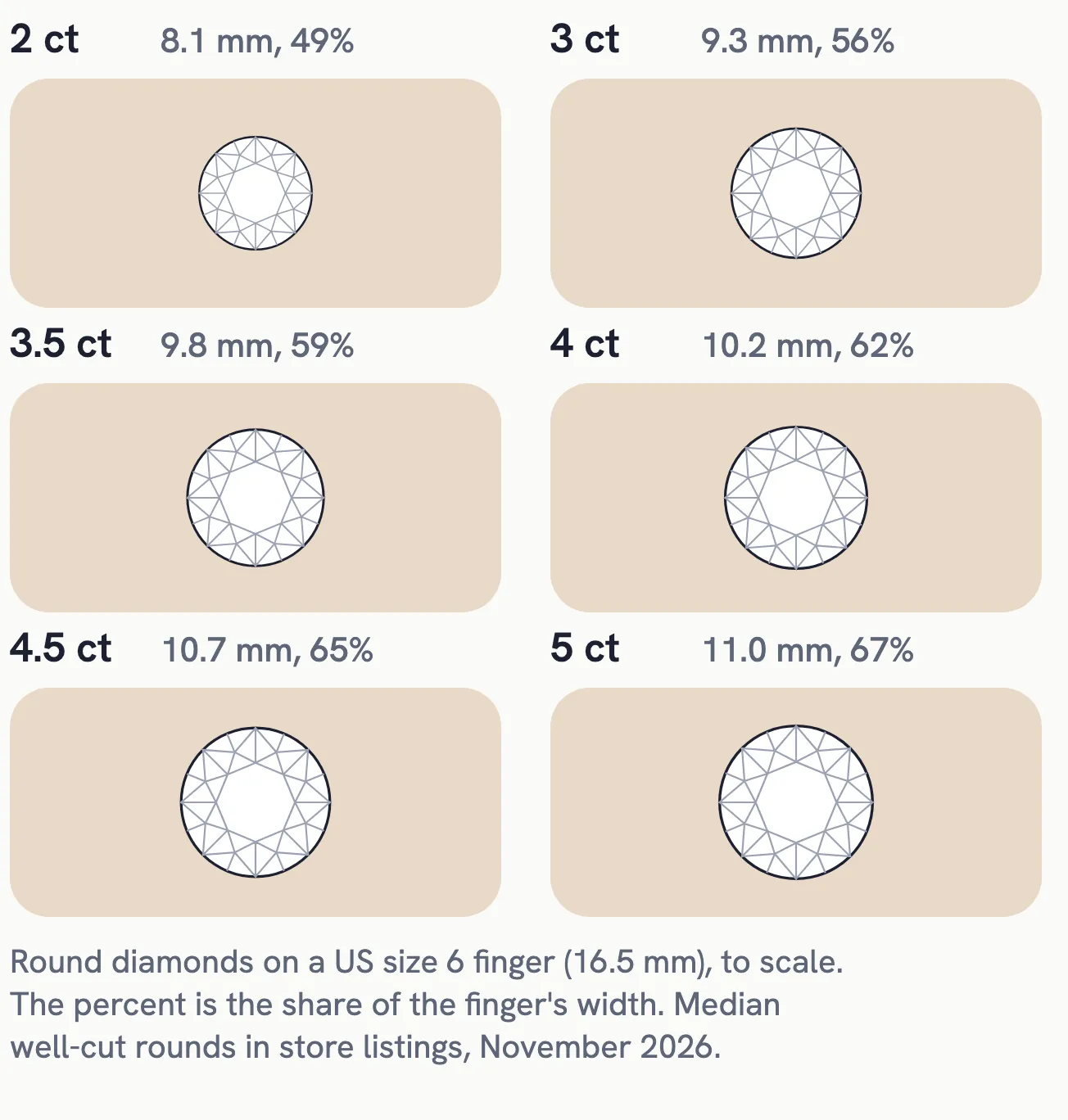
Round diamonds from 2 to 5 carats on a US size 6 finger, to scale.
Is 4 carats considered big?
Yes. The Knot’s 2026 study put the average lab-grown center at 2.0 carats and the average natural one at 1.6, so a 4 carat is about twice the usual lab-grown center. It’s a size that shows up on well-known hands: the jeweler who made Britney Spears’ 2021 engagement ring told National Jeweler its center was a 4 carat round, and Normani’s 2025 ring has a 4 carat oval, according to its jeweler. Neither jeweler said whether the stone was natural or lab-grown.
4 carat vs 3 carat and 5 carat
A 4 carat round is about 0.9 mm wider than a 3 carat and about 0.8 mm narrower than a 5 carat. At Whitemoon the step from 3 to 4 carats costs about $430 at F VS1, $1,008 against $1,440, and the step from 4 to 5 about $400. In natural the step from 3 to 4 carats costs about $51,000 in the grade band above. Our 3 carat and 5 carat price guides have the same tables for those sizes.
How much is a 4.5 carat diamond?
At Whitemoon, a round lab-grown F VS1 stone of 4.50–4.99 carats works out to $1,579 at exactly 4.5 carats, and the typical round of 4.50–4.74 carats, across all grades, was listed at $1,780. The same grade was $2,295 at Grown Brilliance and $5,160 at Brilliant Earth. Natural rounds in D to G color and VS2 to VVS2 clarity came to about $144,000 at 4.5 carats, on 22 stones.
The trade’s price list has no line at 4.50; one band runs from 4.00 to 4.99 carats. A 4.5 carat round is about 10.7 mm across, roughly 0.4 mm wider than a 4 carat. For a natural example, Costco listed a 4.50 carat H color, VVS1 round in platinum at $124,999.99 on November 13, 2026.
Setting and wearing a 4 carat diamond
A stone this size sits higher and wider on the hand, so the setting does more work. GIA’s guide to settings says the larger the stone, the more prongs it needs, and that V-shaped prongs protect the points of pear, marquise, princess and heart shapes. Six prongs give a backup: GIA notes that if one prong breaks on a four-prong ring the stone can fall out, while with six it’s more likely to stay.
Diamond is the hardest gem, yet it can still chip from a sharp knock, especially at a thin edge or a point. Take the ring off for sport, gardening and heavy housework, and have the prongs checked about twice a year.
4 carats or 4 carats total weight?
Check whether a listing says “ct” or “ctw”. Total carat weight adds up every diamond in the piece, and several small stones cost far less than one large one. Costco’s site showed the difference on November 13: a platinum band of natural diamonds adding up to 5.00 carats was $4,999.97, against $58,999.99 for its ring with a single 4.00 carat stone.
The same holds for lab-grown. At Whitemoon on November 13, round solitaire stud earrings of 4 carats total weight, 2 carats in each ear, started at $1,225. Under the FTC’s weight rule, a decimal weight should be accurate to the last digit shown.
Insuring a 4 carat ring
Jewelers Mutual says ring insurance typically costs 1% to 2% of the ring’s value a year. By our arithmetic that’s about $22 to $44 a year on a $2,211 lab-grown ring and $590 to $1,180 a year on a $58,999.99 natural one. Quotes vary by ZIP code and deductible. Lab-grown prices have been falling, so keep the appraisal current and don’t insure for more than a replacement would cost.
What a 4 carat diamond is worth when you sell it
Expect well under retail for any diamond. There’s no official resale price, so don’t count on getting back what you paid.
Lab-grown diamonds don’t hold their retail price, so buy one to wear and not as an investment. Worthy, an online resale service, says it doesn’t accept lab-grown stones. That makes the price you pay up front matter more: at $1,440 at Whitemoon and $4,150 at Brilliant Earth for the same grade, there’s less at stake from day one. Our Lifetime Upgrade gives you 100% of what you paid as credit toward a new lab-grown piece worth at least 1.5 times as much.
Shopping for a 4 carat lab-grown diamond at Whitemoon
Start with the shape, since it changes the look far more than a grade changes the price. Then pick a setting in the builder, or choose a ring with its center already set from the 4 carat collection. Most Whitemoon rings are made to order in about 10–15 days and ship free with insurance both ways, with 30-day returns on unworn pieces and one free resize within 60 days of delivery.
4 carat diamond questions
How much should a 4 carat diamond cost?
A round F VS1 lab-grown stone cost $1,440 at Whitemoon on November 14, 2026, and $2,040 to $4,150 at the three other stores compared. A natural stone of the same grade cost about $115,000.
How much is a 4 carat lab-grown diamond?
Across all grades, a typical round 4 carat lab-grown diamond at Whitemoon cost about $1,598 on November 14, 2026, and most cost between $1,310 and $2,000.
How much is a 4 carat natural diamond?
At retail, natural rounds of 4.00–4.49 carats with a GIA report had a median price of about $59,000 across all grades at three stores on November 11, and most cost between about $37,000 and $115,000.
How much is a 4 carat diamond ring?
At Whitemoon, rings with a 4 carat lab-grown center ran from $1,901 to $6,265 on November 14, depending on metal and design. With a natural center, the stone alone is usually $37,000 or more.
Is a 4 carat diamond big enough?
It’s about twice the average lab-grown engagement center of 2.0 carats. A 4 carat round is about 10.2 mm across and covers a little over 60% of the width of a US size 6 finger.
Is 4 carat too much for an engagement ring?
That’s a matter of taste and of how you use your hands. A stone this size sits high, so many people choose six prongs or a lower basket, and take the ring off for sport and heavy work.
How much is a 4 carat oval diamond?
$1,504 for a lab-grown F VS1 oval at Whitemoon and $4,843 at Brilliant Earth. Natural ovals in D to G color and VS clarity were about $95,000.
How many carats is a $10,000 engagement ring?
With a natural diamond, roughly a 1.2 to 1.5 carat center in a simple setting. At Whitemoon, lab-grown rings with a 4 carat center started at $1,901 on November 14.
How big of a diamond can I get for $20,000?
In natural, about 2 carats at mid grades: Costco listed a 2.00 carat I color, VS2 round solitaire at $15,999.99 and a 3.00 carat one at $32,999.99 on November 14, 2026. In lab-grown at Whitemoon, $20,000 is more than any ring in our 4 carat collection costs.
Can a jeweler tell if a diamond is lab or natural?
Not by eye or with a loupe; it takes laboratory instruments. The grading report states it, and the report number is usually laser-inscribed on the stone’s edge. Our guide to lab-grown diamonds explains how they’re identified.
Will a diamond hold its value?
Expect to sell any diamond for well under its retail price. Lab-grown diamonds don’t hold their retail price, so buy one to wear and not as an investment.