
Where to Find Affordable Engagement Rings
Prices last updated November 9, 2026. Other stores’ prices were read November 8.
You can find an affordable engagement ring at online made-to-order jewelers, mall chains, warehouse clubs and secondhand sellers. Which place suits you depends on what you want in the ring, not on the type of store, since no independent data ranks them on price. Our guide to where to buy an engagement ring compares the kinds of sellers and their return terms. What saves the most money is the stone: a lab-grown center costs a small fraction of a natural one of the same grade, and a plain solitaire in 10K or 14K gold keeps the rest of the bill down.
We sell lab-grown diamond rings online, so read this knowing that. To keep it concrete, we built rings in our own builder and read our ring prices on November 9: a 10K white gold solitaire with a 0.33 carat round lab-grown diamond came to $448, and the same setting with a round 1 carat F VS1 stone comes to about $673. We also went through what the FTC and GIA tell shoppers to check, and what’s actually documented about Costco, Kay and pawn shops.
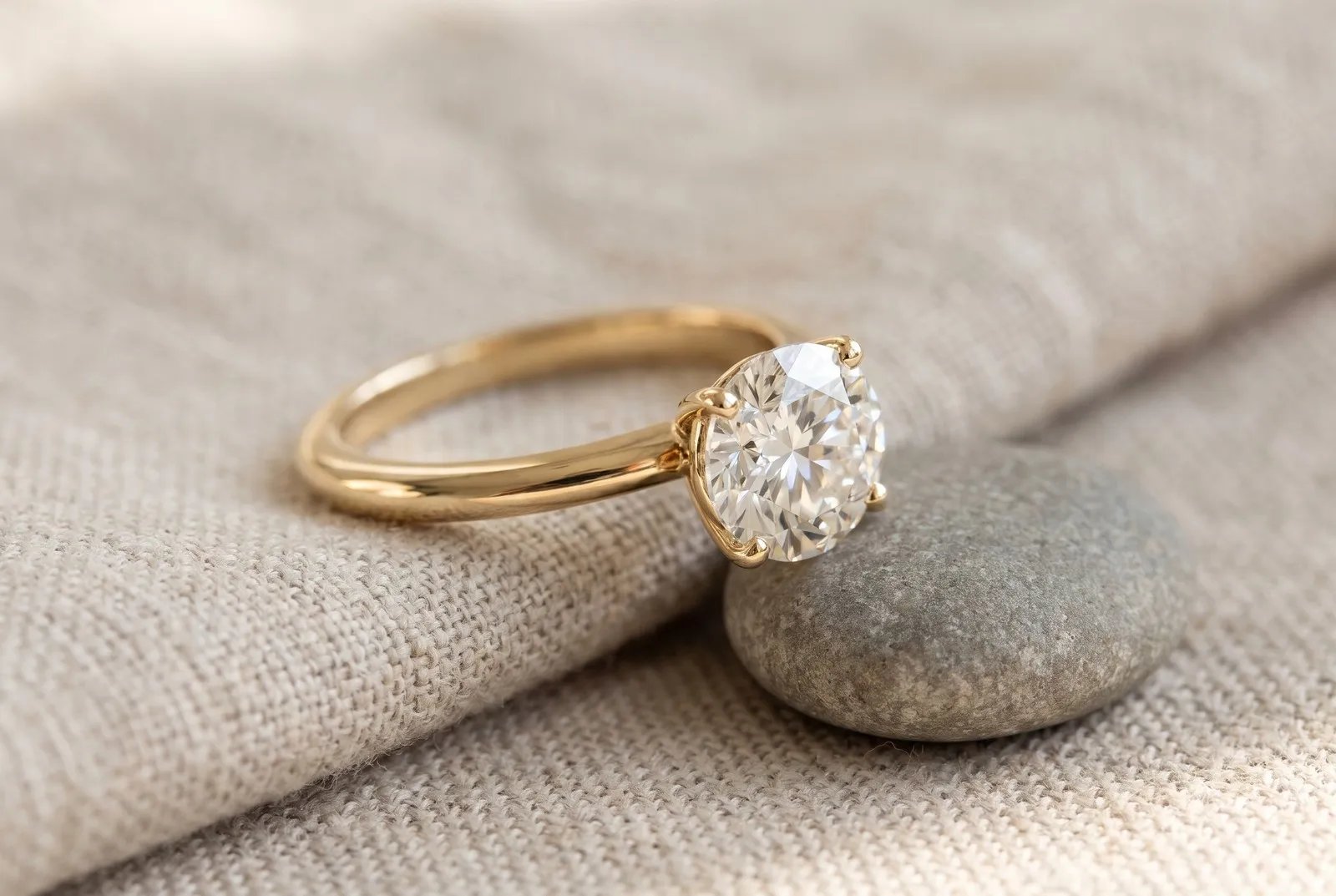
Pictured: a round solitaire setting in yellow gold with a lab-grown diamond center. Image created from the design.
What counts as an affordable engagement ring?
There’s no official definition. GIA says no particular price is required for a good ring, and that a simple one can cost well under $500. So it’s relative, and these reference points may help. Each counts something different, so don’t blend them.
- $2,448: average lab-grown ring sold at US specialty jewelers in 2025, by analyst Edahn Golan’s count. That’s about a third of the natural average.
- $4,600: The Knot’s 2025 average, as reported by more than 10,000 couples.
- $2,111: The Wedding Report’s median for 2021, the most recent sales-based median we could find.
Our guide to how much an engagement ring costs goes through these figures and what each one measures.
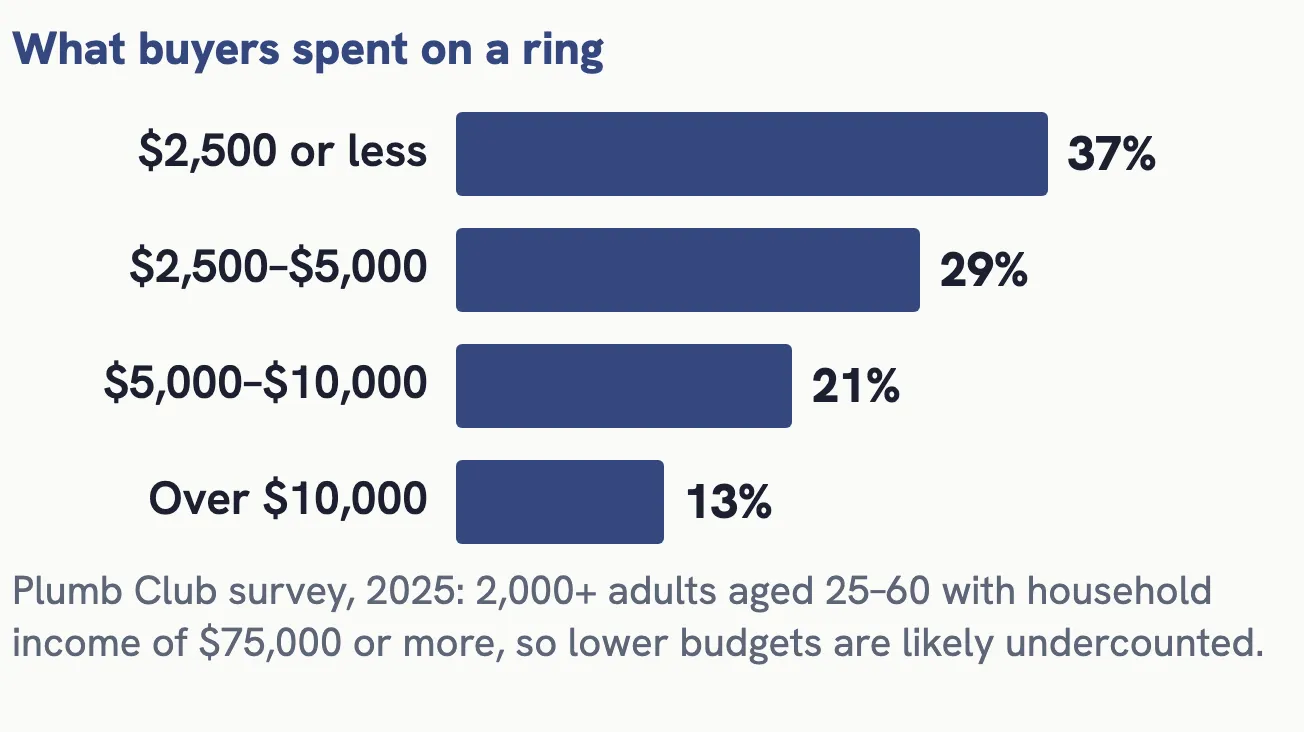
A 2025 survey of buyers with household income of $75,000 or more.
Where to find affordable engagement rings
Here is what each kind of seller offers and what to watch for. We’re not ranking them on price: we found no study that compares them like for like.
| Where | What you get | Check first |
|---|---|---|
| Online, made to order | Wide choice of settings and loose stones, mostly lab-grown | Lab report, video of the stone, return terms |
| Mall chains | In-person service and financing | Exact specs, financing terms |
| Warehouse clubs | A small, fixed range | Natural or lab-grown, return rules |
| Pawn, estate, vintage | Mostly natural stones, one of a kind | Report number, independent check, returns in writing |
| Marketplaces | Many small sellers | Seller history, what the listing promises |
Online jewelers
GIA’s advice for buying online is to choose a stone with a lab report and 360-degree views, and to confirm returns first. Stores that compare on those terms can still differ a lot: the same lab-grown grade cost nearly three times as much at one store as at another on these dates.
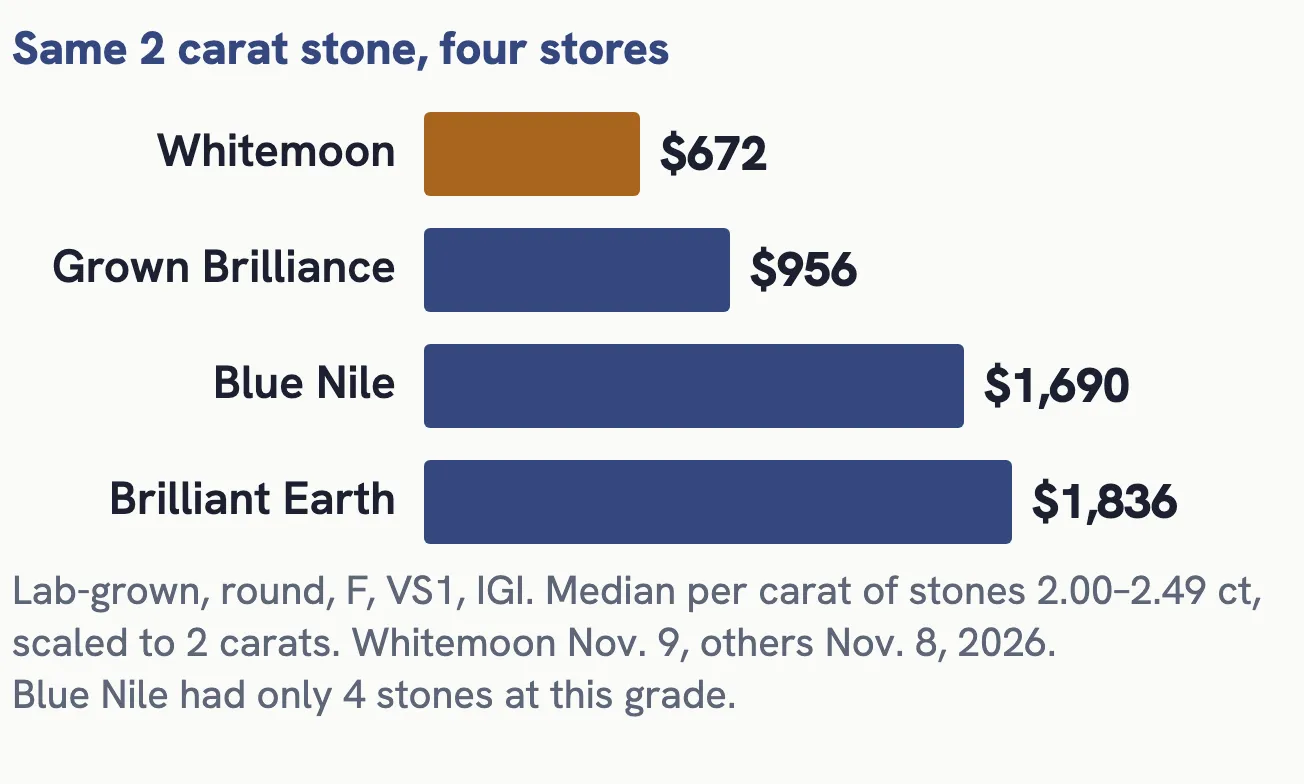
The same grade at four stores, November 8 and 9, 2026.
Older guides often send budget shoppers to James Allen. Its owner, Signet, ended it as a stand-alone site in March 2026.
Costco
People ask why Costco’s diamonds are so inexpensive, and Costco publishes no markup or explanation we could find. The “14% markup” you may see quoted comes from a commentator, and price comparisons conflict: one source says Costco is far below local jewelers and an affiliate site says online sellers beat it. What’s documented is the buying guide:
- It sells natural, untreated diamonds only, so a Costco ring isn’t a like-for-like comparison with a lab-grown one.
- Minimum clarity is VS2 and minimum color is I. The cut range is wide, from Good to Excellent.
- Center stones of 1 carat or more come with a GIA report. Under 1 carat, you get a description from a Costco gemologist.
- Returning a stone of 1 carat or more takes all the original paperwork.
Those minimums are decent. The stone itself still needs checking, because grades alone won’t tell you how it looks.
Kay and other mall chains
In February 2025, Kay added a lab-grown collection priced from $1,999.99 to $3,999.99. We haven’t checked current prices. Financing is a big part of how chains sell: Kay’s parent Signet reported that 42% of its eligible North American sales used credit, lease or pay-later plans in its latest fiscal year. That makes the terms worth reading.
Pawn shops, estate and vintage
Supply is good. Rapaport reported in March 2026 that Baby Boomer estate sales are feeding the secondary market. Be careful with old paperwork, though: the same report describes a $12,000 appraisal against an offer of about $1,500 from diamond suppliers for a comparable stone. Ask for the report, confirm its number with the lab, get an independent look, and get return terms in writing. We found no regulator guidance specific to buying from pawn shops, so that’s our advice rather than a rule.
Etsy and other marketplaces
Etsy’s purchase protection covers an item that differs significantly from its listing, but you’d have to show that, which usually takes a jeweler or a lab. In 2019, the FTC warned eight online jewelry marketers about misleading claims on lab-made stones and simulants. We found no data on how often this goes wrong.
How far does your budget go?
This is where the choice of stone shows up. Take one 10K gold solitaire setting at $349 and spend the rest of the budget on the biggest round F VS1 center you can buy.
| Budget | Lab-grown center, Whitemoon | Natural center, GIA, three stores |
|---|---|---|
| $1,000 | About 1.9 carats | About 0.4 carat |
| $2,000 | About 4.5 carats | About 0.7 carat |
| $3,000 | 6 carats or more | About 0.8 carat |
| $5,000 | 6 carats or more | About 1 carat |
Natural prices are medians at Blue Nile, Brilliant Earth and Ritani. Bigger isn’t the only way to use the savings. Many people would rather put the difference into a better metal or a more detailed setting, or simply spend less.
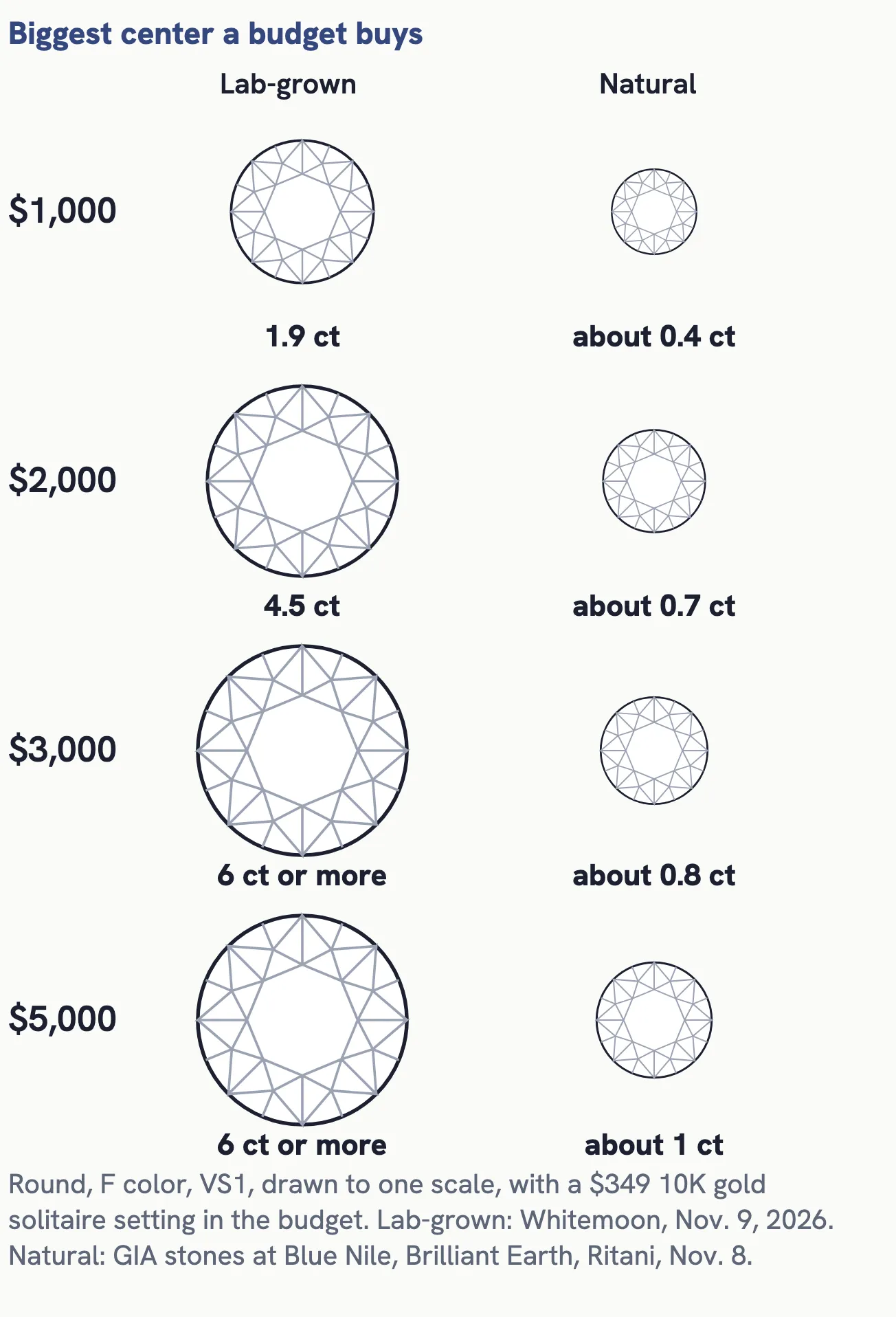
What each budget buys, drawn to one scale.
Rings under $500 and under $1,000
These exist, with trade-offs. Here are examples from our own pages on November 9.
| Ring | Setting | Lab-grown center | Total |
|---|---|---|---|
| Sterling silver solitaire, 0.33 ct | $99 | $99 | $198 |
| 10K gold solitaire, 0.33 ct | $349 | $99 | $448 |
| Sterling silver solitaire, 1 ct F VS1 | $99 | $324 | $423 |
| 10K gold solitaire, 1 ct F VS1 | $349 | $324 | $673 |
| Set 1 carat hidden halo, pavé band, gold | Included | Included | $766 |
| 10K gold solitaire, 2 ct F VS1 | $349 | $672 | $1,021 |
The 0.33 carat stone is one we picked in the builder, D color, VVS2, IGI. The 1 and 2 carat prices are typical for that grade, and stones change daily.
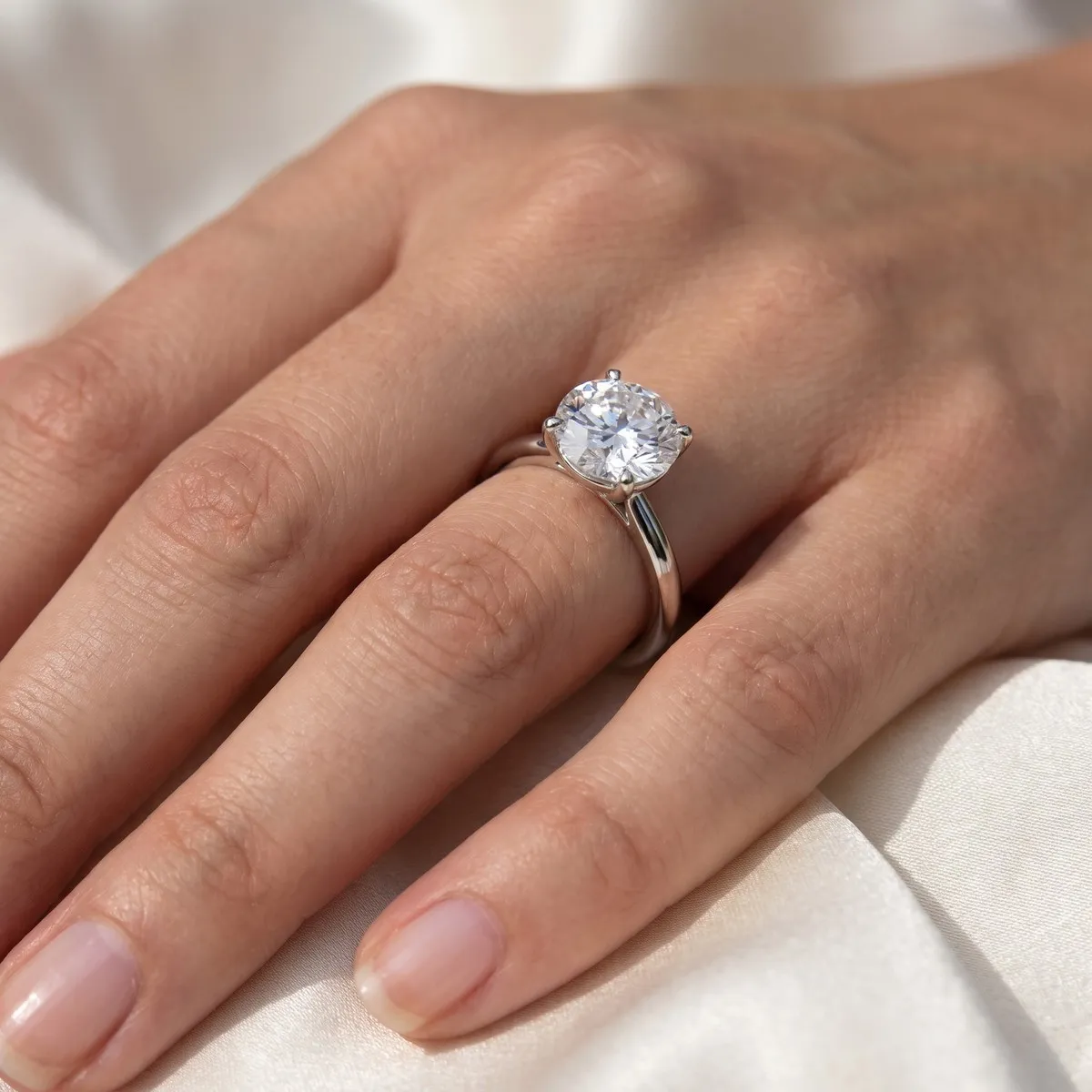
A round solitaire setting in white gold. Image created from the design, not a size reference.
Where the savings really are
- Choose lab-grown. It’s the largest single saving by far. The two are the same material; our guide to whether lab-grown diamonds are real diamonds explains the difference.
- Keep the style simple. In 10K gold, our settings start at $349 for a solitaire, $469 for a hidden halo and $579 for a three stone.
- Drop a karat. The same hidden halo setting costs $469 in 10K, $609 in 14K and $749 in 18K. Our 10K vs 14K vs 18K guide covers what you give up, which is less than most people expect in hardness and more in color.
- Be careful with silver. Our silver settings start at $99 and use Silvadium, a tarnish-resistant sterling silver. Sterling silver is softer than gold, though, and we found no study of how silver prongs hold up. In our opinion it suits a travel ring or a tight budget, and prongs need checking more often on a ring worn every day.
- Don’t overpay for grades on natural stones. GIA says most VS and SI stones have no eye-visible inclusions, though SI varies by stone. On lab-grown, the saving is small: F VS1 to F SI1 saved $44 at 1 carat on November 8, against about $2,000 on natural.
- Buy under a whole carat, on natural. GIA calls 0.50 and 1.00 carats “magic sizes” and suggests going slightly under. This mostly doesn’t carry over to lab-grown, as our 1 carat diamond price guide shows.
- Pick a shape that looks bigger. Lab-grown prices barely change by shape at Whitemoon, and a 1 carat marquise is 10.4 mm long against 6.5 mm across for a round. Our diamond shapes guide compares them. GIA notes a halo or cluster can also make a center look larger, though nobody has measured by how much.
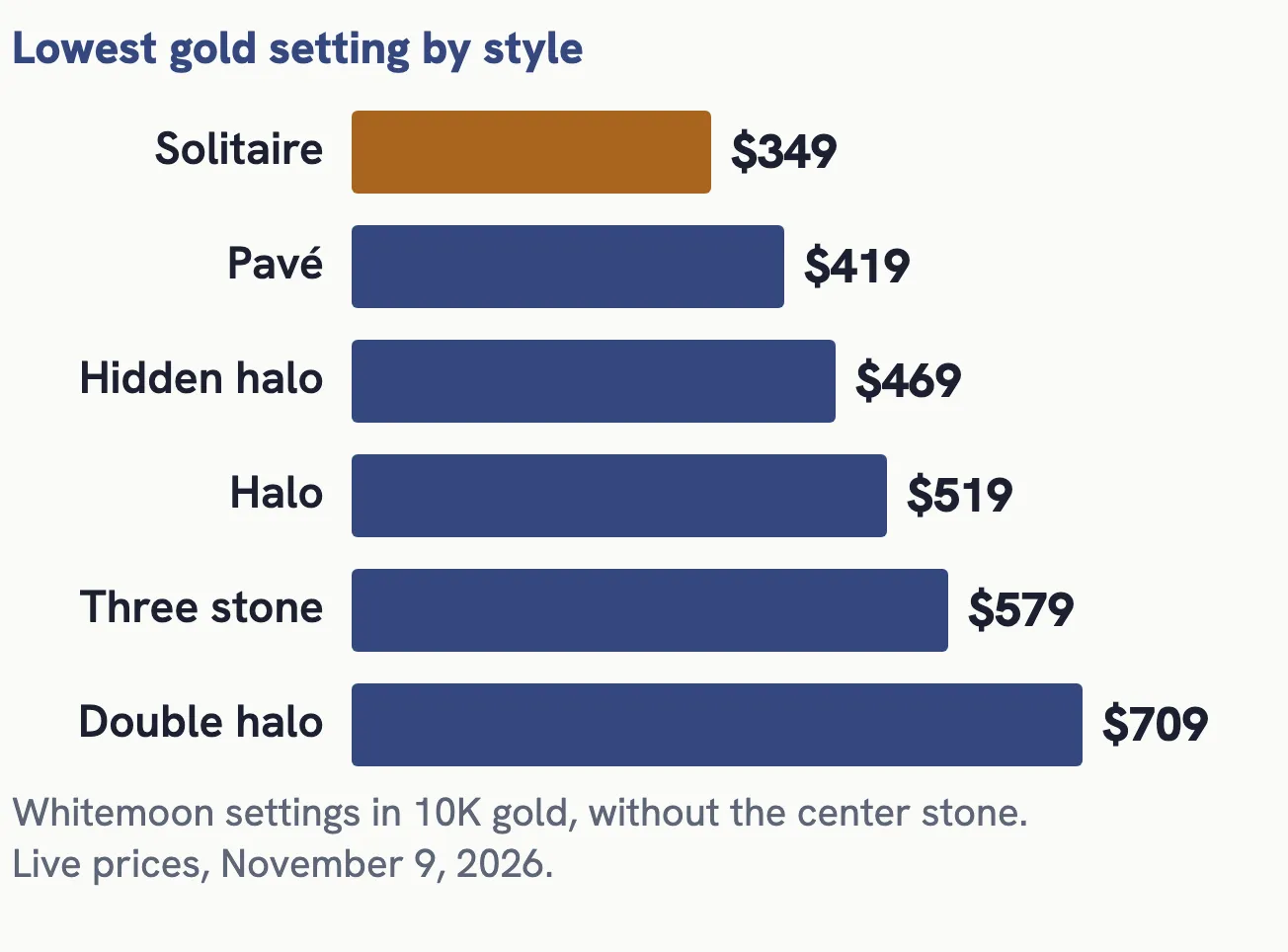
Where each style starts in 10K gold, November 9, 2026.
How to check quality at a lower price
A low price should still come with clear facts. This list draws on the FTC’s shopping advice and Jewelry Guides, plus GIA.
- Who graded it? Ask for the report and confirm the number on the lab’s site. A report describes the stone. It isn’t a guarantee and gives no dollar value.
- What’s the exact weight? A decimal must be accurate to its last digit, while a fraction like “1/2 ct” isn’t exact, so ask for the range. “Ctw” means total weight, so check the center stone’s weight too.
- Is it clearly lab-grown or natural? A lab-made stone’s name should carry the qualifier right before the gem word.
- What metal, exactly? Look for the karat and for words such as plated, filled or vermeil. Rhodium plating should be disclosed, too.
- How does it look? GIA suggests viewing a stone in daylight, shade and indoor light, because stores use strong spotlights. Online, ask for video.
- What are the terms? Get the return window, any fee and any resizing terms in writing, and save the page if you buy online.
- What’s the final price? Compare final prices on identical specs rather than the percentage off. Jewelry has no standard list price, and an appraisal above what you paid doesn’t prove a bargain: appraisals usually state retail replacement cost, a median of 1.39 times the sale price in one insurer’s data.
Is it okay to get a less expensive engagement ring?
Yes, by the evidence we could find. A well-known 2015 study by Francis-Tan and Mialon found no support for the idea that spending more makes a marriage last. Its clearest ring result is modest and only in men: spending $2,000 to $4,000 went with about 1.3 times the divorce rate of spending $500 to $2,000. It’s a correlation, and under-$500 rings also showed higher risk among recently married women, so it doesn’t mean a smaller ring protects anyone.
The salary rule that makes people feel they’re underspending came from diamond advertising. In practice, this is rarely a solo decision: in The Knot’s latest study, 79% of recipients took part in choosing the ring. A budget talk is normal.
Financing a ring
Paying over time can make an affordable ring expensive. Many store-card offers use deferred interest: miss the payoff date, and interest runs back to the day you bought. By our rough arithmetic, a $4,000 ring on a 12-month offer at 25%, with $400 left at the end, could add about $590 at once. Get the regular rate and end date in writing. Our ring builder shows an option of four interest-free payments with Klarna.
Is there a best month to buy?
We found no good evidence for one. Retail blogs name January, July, September and the holidays, and they contradict each other. Advertised Black Friday discounts can look large, but with no standard list price, there’s nothing to test them against. Lab-grown wholesale prices have also moved unevenly: in the second quarter of 2026, 1 carat rounds rose 1% while 2 carats fell 20%. Waiting for a sale matters less than comparing specs.
Resale: buy it to wear
Lab-grown diamonds don’t hold their retail price, so buy one to wear and not as an investment. A lower price up front leaves less at stake: for a round F VS1 at 2 carats on these dates, $672 at Whitemoon, $956 at Grown Brilliance and $1,836 at Brilliant Earth. Our 2 carat diamond price guide compares every shape at that size. Our Lifetime Upgrade gives you 100% of what you paid as credit toward a new lab-grown piece worth at least 1.5 times as much.
Affordable engagement rings at Whitemoon
Start with solitaire settings, then choose your center in the ring builder, which shows the running total. Or pick a ring with the center already set from 1 carat gold rings, or browse sterling silver settings. Most Whitemoon rings are made to order in about 10–15 days and ship free with insurance both ways, with 30-day returns on unworn pieces and one free resize within 60 days of delivery.
Affordable engagement ring questions
What is the most affordable engagement ring?
Generally a small lab-grown diamond in a plain solitaire setting, in sterling silver or 10K gold. On November 9, that combination came to $198 in silver and $448 in gold at Whitemoon. We can’t speak for every store.
How much is considered a cheap engagement ring?
There’s no official line. As a guide, in a 2025 survey 37% of buyers with household income of $75,000 or more spent $2,500 or less, and the average lab-grown ring at specialty jewelers was $2,448.
Is it okay to get a cheap engagement ring?
Yes. GIA says no particular price is required for a good ring. Check that the facts are clear: who graded the stone, its exact weight and the metal’s karat.
Where can I buy cheap but good quality rings?
Anywhere that gives you a lab report, a decimal weight, a stated karat and written returns, and lets you see the stone on video or in person. Those matter more than the kind of store.
Why are Costco diamonds so cheap?
Costco doesn’t publish a reason or a markup. Thin margins and a narrow, fixed range are the usual explanations, and price comparisons conflict. Its diamonds are natural, so compare them only with other natural stones.
Are Costco wedding rings good quality?
Its stated minimums are VS2 clarity and I color, with a GIA report at 1 carat and above. Those are decent, but check the individual stone, since the cut range is wide.
Does Kay Jewelers have affordable engagement rings?
It added lab-grown rings at $1,999.99 to $3,999.99 in February 2025. Check current prices, and read the financing terms if you use them.
What is the least expensive month to buy an engagement ring?
We found no good evidence for any month. Compare final prices on the same specs instead of waiting for a date.
What is the best website to buy rings online?
We found no independent ranking backed by data, and many review sites earn commissions from the stores they rank. We’re a store too, so judge any site by its lab reports, stone videos, written returns and whether you can reach a person.