
Why Is It Called a Tennis Bracelet? History, Meaning and Cost
The name comes from Chris Evert, who wore diamond line bracelets on court from the late 1970s. She says one fell off during a US Open match in 1978, that play stopped while it was looked for, and that she told reporters it was her tennis bracelet. Nobody has produced a report from 1978, though, and the earliest known use of the name is 1985, so how it really started isn’t documented.
We make tennis bracelets, so we checked the story against dated sources and read the price of nearly 60 designs we sell. The date most guides give, 1987, can’t be the origin: The New York Times was already using the name that July, weeks before that year’s Open. Below is the record, what the bracelet means, what it costs by carat, why it breaks and how to wear it.
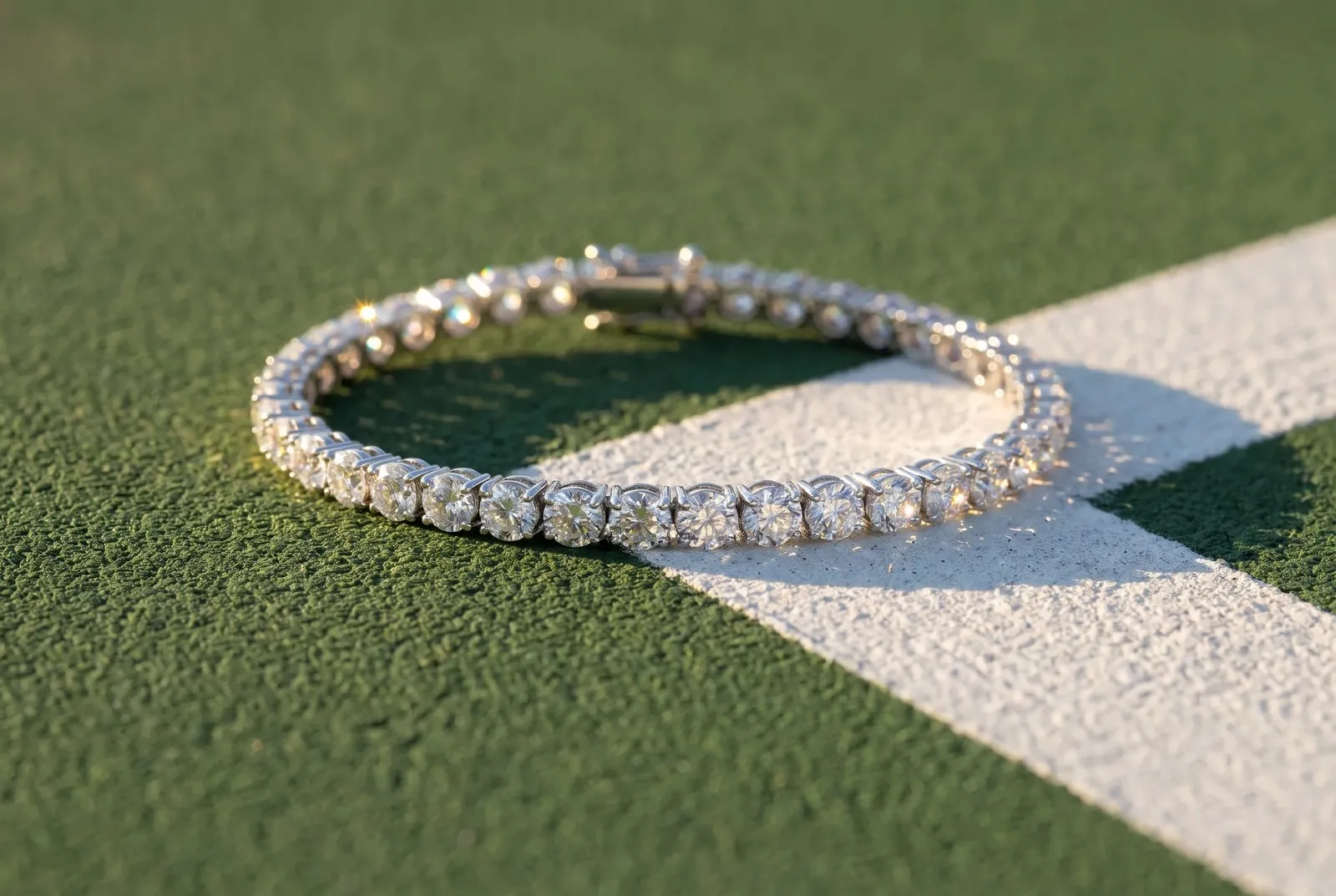
Pictured: a round prong tennis bracelet in white gold. Image created from the design, on an illustrative court.
Why is it called a tennis bracelet?
Evert’s own account is the core of the story. In 2022 and again on a 2023 podcast, she described the clasp breaking, the bracelet landing on court, play being halted while they looked for it in the alley, and telling the press it was her tennis bracelet. Her publicist told jewelry writer Marion Fasel it was an early round of the 1978 Open. That’s a memory told decades later, and her own jewelry line now uses the date too, which is worth knowing but no reason to doubt her.
What can be dated is the name in print. Merriam-Webster gives 1985 as its first known use and says it found no reports of such an incident in 1978.
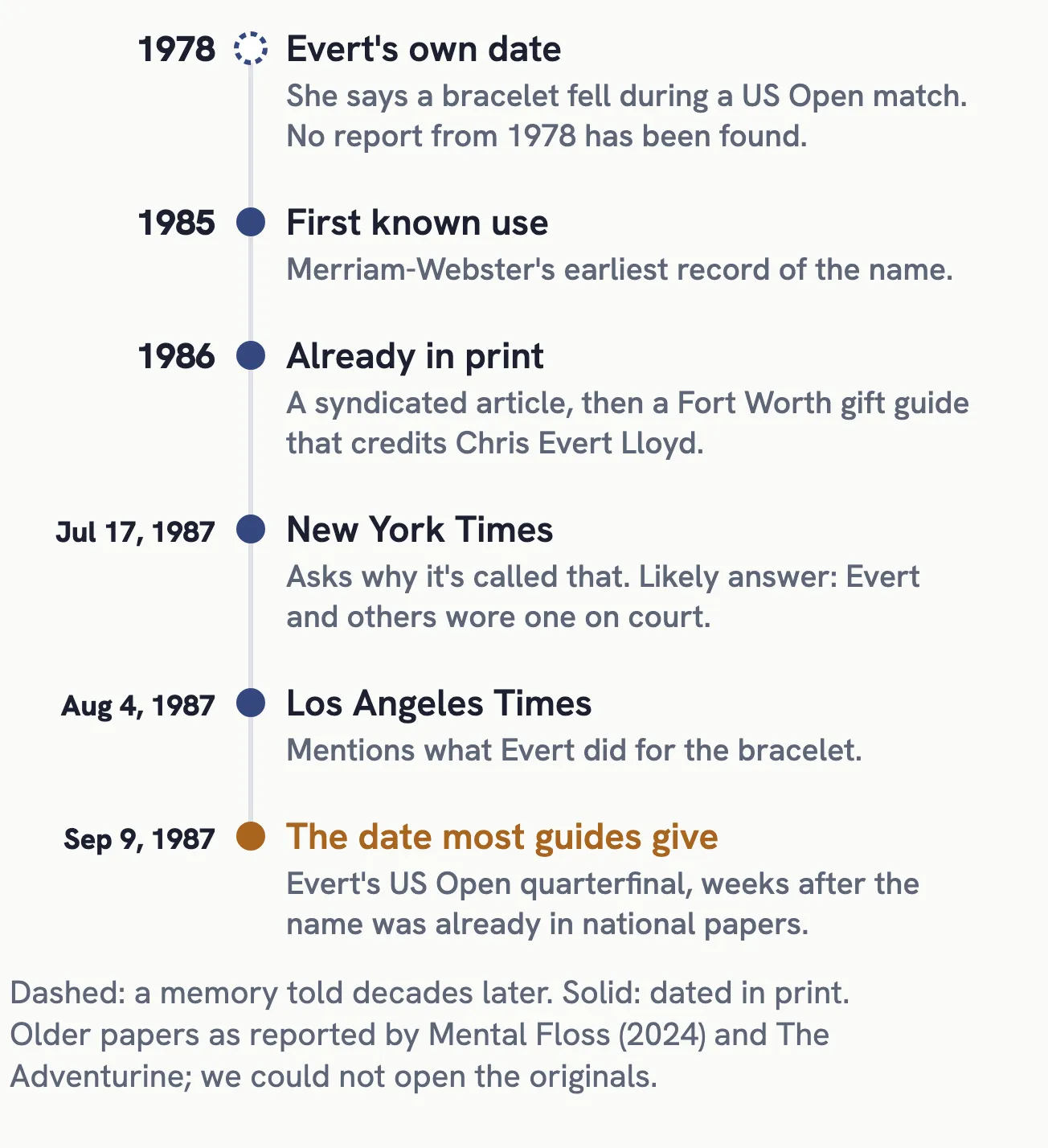
The name in print, from Evert’s memory of 1978 to the date most guides give.
The 1987 version is everywhere, including GIA’s blog and Sotheby’s, but neither gives a source. Mental Floss traced the name to a 1986 syndicated article, a December 1986 gift guide that credits Evert, and a New York Times piece of July 17, 1987. Evert’s last match at that year’s Open was a quarterfinal on September 9, and a report from that week doesn’t mention a bracelet. Fasel’s theory is that someone simply swapped the digits of 1978. It’s a nice idea, and only a theory.
What we couldn’t confirm
- The opponent. No real source names one. The name that circulates, Lori McNeil, is simply who beat Evert in the 1987 quarterfinal.
- A long rally or a close match. Neither is in Evert’s own words.
- A sales boom. Many guides claim jewelers were flooded with requests, but none gives a figure, and Mental Floss found no firm record.
- The maker. Jewelry trade accounts credit George Bedewi. Evert doesn’t name a maker in anything we read, and we found no account of him from before 2016.
What it was called before
Before the new name, this style was an eternity bracelet or a diamond line bracelet. The style itself is far older: a Cartier line bracelet from about 1925, a continuous row of about 4.30 carats of old brilliant-cut diamonds in platinum, sold at Bonhams in 2023 for £14,080.
What jewelry do tennis players wear?
Plenty, and more every year. The New York Times reported in May 2026 that tennis has no regulations about jewelry, even at Wimbledon. What it does have is a rule about things that fall. Under USTA guidance for US play, the first time something a player controls falls and stops play, the point is replayed. After that, the player loses the point.
- Chris Evert launched her own tennis bracelet collection with Monica Rich Kosann only in 2022.
- Serena Williams started her own jewelry line in 2019, including a tennis bracelet.
- Aryna Sabalenka wore over $400,000 of jewelry in her first match of the 2026 US Open.
- Mirra Andreeva’s beaded bracelet snapped mid-match at Wimbledon in 2026, and she and the ball kids gathered the beads.
What does a tennis bracelet symbolize?
Nothing documented. We found no museum, historian, gem lab or trade body that gives it a traditional meaning, and the retail pages that say eternity, love or success cite nothing. The older name, eternity bracelet, does suggest an unbroken line, but that’s an inference. For Evert it was personal: the Times reported it made her feel confident on court. It means what the person wearing it, or giving it, decides.
How much should a tennis bracelet cost?
It depends more on the metal and the design than most people expect. Here is one of our classic designs, with round lab-grown diamonds in individual prongs, at F–G color and VS–SI clarity.
| Total carat weight | Silver | 10K gold | 14K gold |
|---|---|---|---|
| 3 carats | $1,016 | $2,186 | $2,762 |
| 5 carats | $1,394 | $2,564 | $3,140 |
| 7 carats | $1,772 | $2,942 | $3,518 |
| 10 carats | $2,339 | $3,509 | $4,085 |
| 15 carats | $3,284 | $4,454 | $5,030 |
Whitemoon prices read on the product page, November 8, 2026.
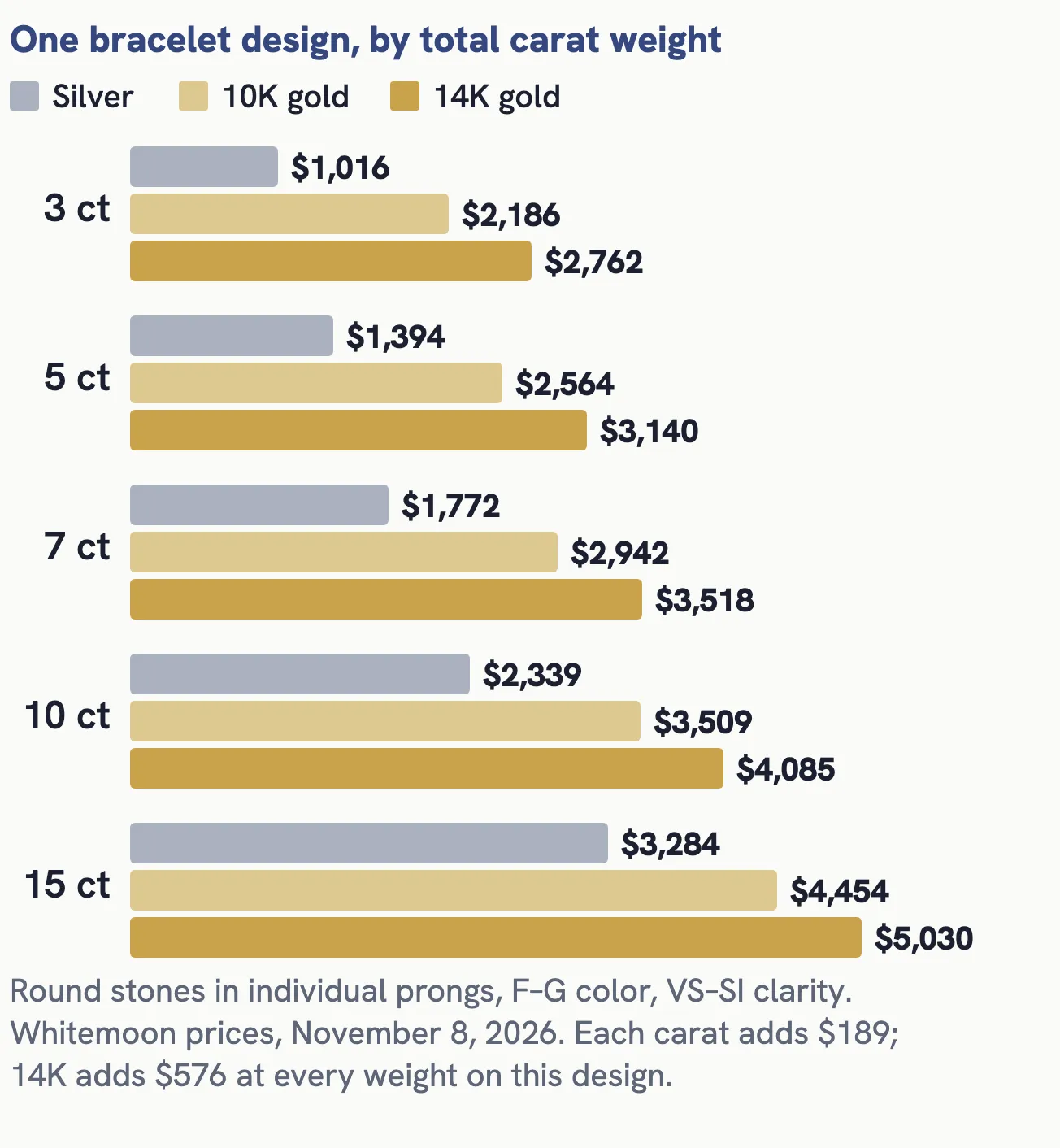
One design by carat weight and metal. Whitemoon, November 8, 2026.
The surprise is how little the stones add. On this design each extra carat costs $189, so five times the diamond weight costs only about twice the price in 10K gold. Moving from silver to 10K gold adds $1,170 at every weight, and 14K adds another $576. Choosing E–F color and VVS–VS clarity adds $243 at 3 carats and $1,215 at 15 carats. With lab-grown stones, the metal and the making are a big share of the bill.
Design matters just as much. This is the spread across all our tennis bracelets.
| Total carat weight | Silver, typical | 10K gold, typical | 10K gold, lowest to highest |
|---|---|---|---|
| 3 carats | $1,436 | $3,476 | $1,556–$6,416 |
| 5 carats | $1,899 | $3,974 | $2,424–$6,794 |
| 7 carats | $2,327 | $4,742 | $2,802–$7,476 |
| 10 carats | $2,894 | $5,309 | $3,369–$9,834 |
| 15 carats | $3,879 | $6,269 | $4,314–$10,779 |
Median and range across our designs at their base grade, November 8, 2026. Heavier settings such as bezels and frames sit at the top of the range. In gold, our tennis bracelets come in 10K or 14K.
Like-for-like prices elsewhere are hard to find. On November 8, VRAI listed its petite classic tennis bracelet from $2,550 and its medium from $3,550, with no total carat weight on the listing. We couldn’t find comparable natural listings that day, so we don’t print a natural figure. See all lab-grown diamond tennis bracelets, gold designs, or Silvadium, a tarnish-resistant sterling silver.
How many carats should a tennis bracelet be?
The total weight decides how big each stone looks, because the bracelet’s length stays the same. In a 7-inch line, 3 carats means stones of about 2.3 mm, and 15 carats means about 4.9 mm.
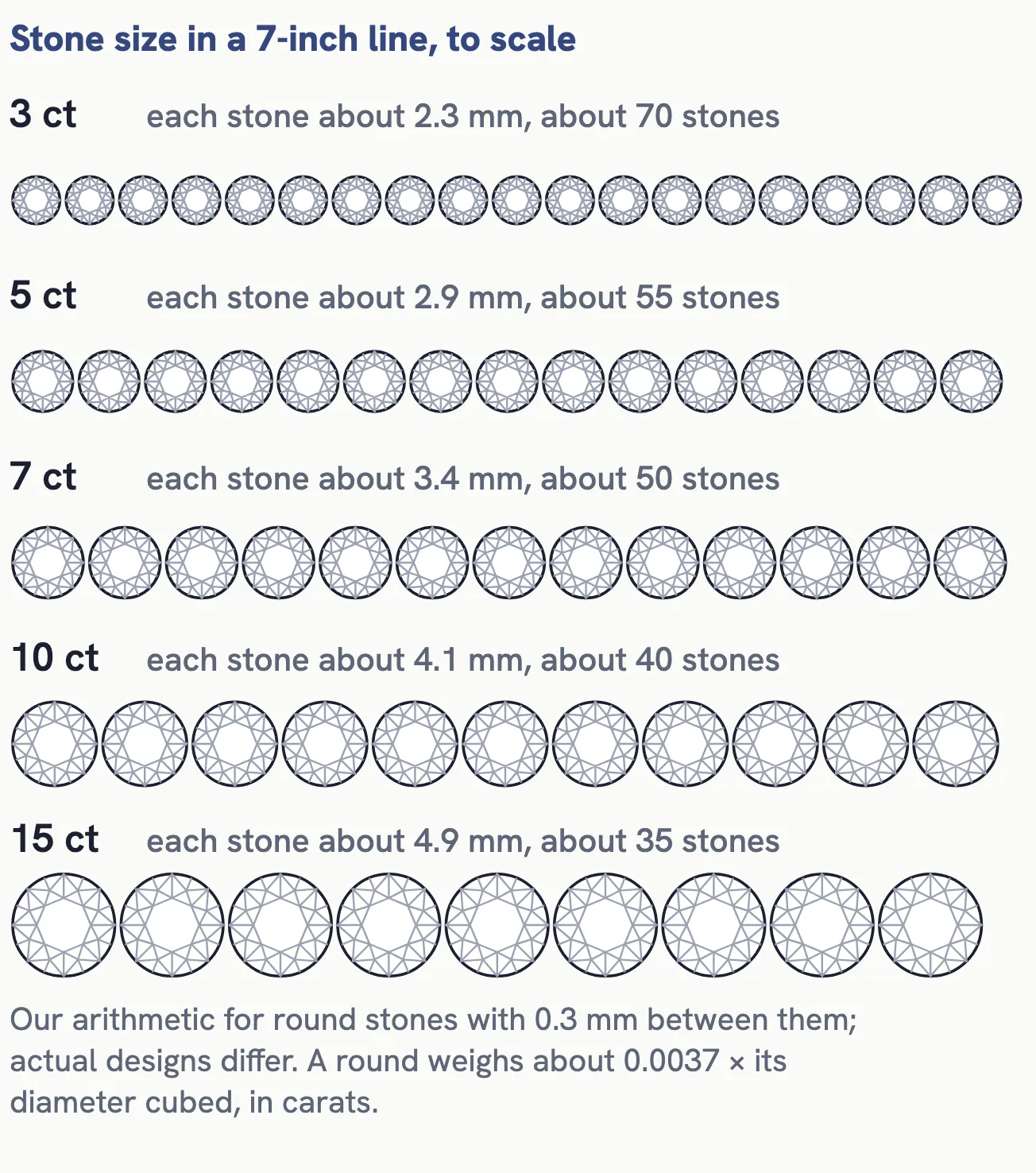
Stone size by total carat weight, to scale. Our arithmetic.
In our opinion, 3 to 5 carats is the everyday range: visible without being loud, and easy to stack. At 7 to 10 carats each stone stands out on its own, and it reads as a statement piece. Above that you’ll feel the weight. Since each carat adds relatively little to the price, it’s worth choosing the size you actually want. For a matching line at the neck, see tennis necklaces and our necklace length chart.
Why tennis bracelets break, and what to do
A tennis bracelet is dozens of separate settings joined by small hinged links, closed by one clasp. Our guide to where to buy a tennis bracelet online lists what to check before ordering. That’s what lets it flex, and also why it has so many places to wear. We found no published failure rates, so what follows comes from jewelers and GIA. If you landed here over a broken Lokai or Pura Vida bracelet, those are silicone and string, and none of this applies.
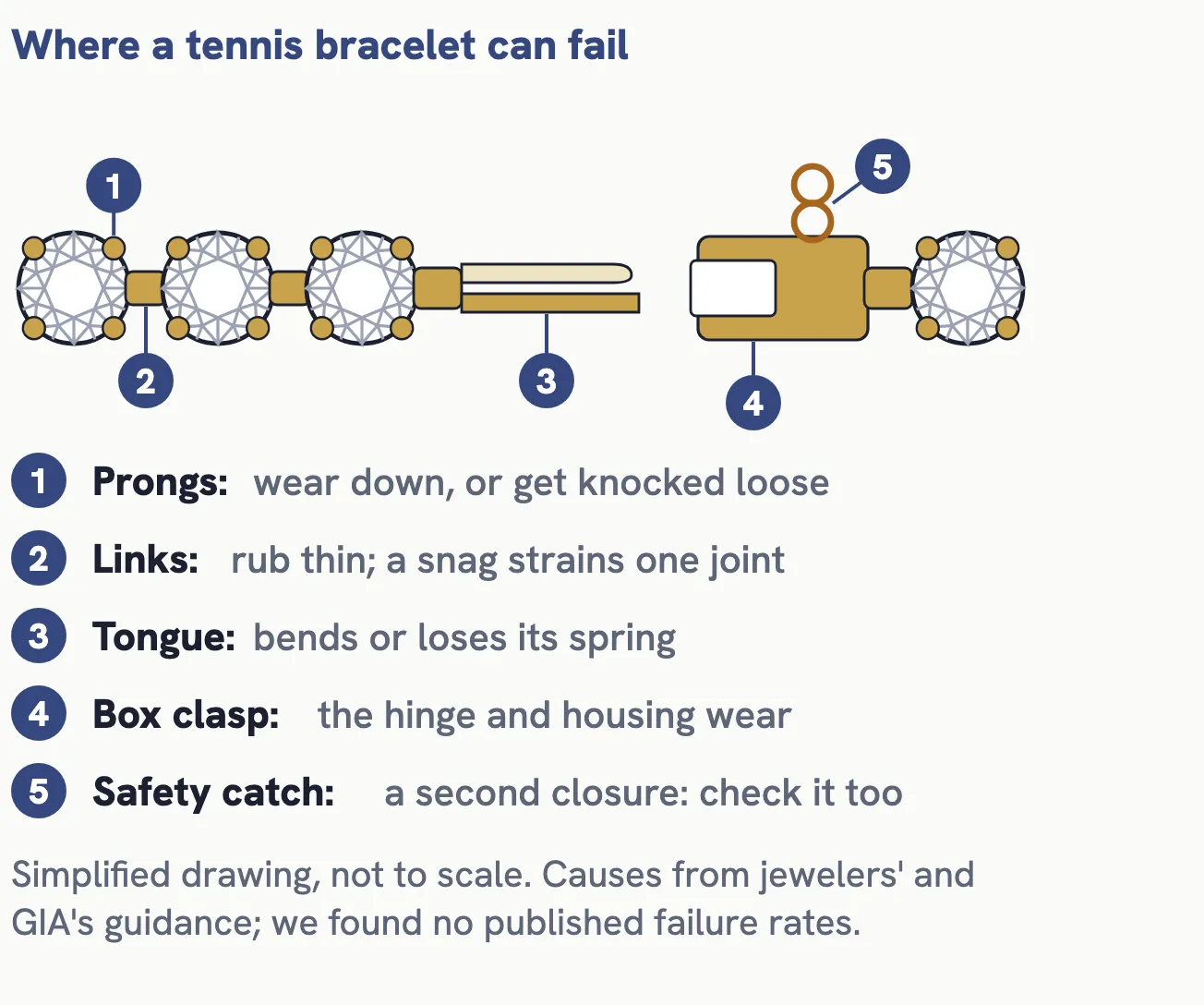
The parts that wear, and what happens to them.
- Check it regularly. GIA recommends a safety catch and regular checks of the clasp and mountings. Stop wearing it if you hear a rattle, see a bent prong, or the clasp feels soft.
- Keep it out of harm’s way. Take it off for workouts and heavy work, and seat the clasp without forcing it. Chlorine can erode setting alloys, so remove it before swimming.
- Be careful with ultrasonic cleaners. GIA warns they can shake stones loose and chip diamonds set next to each other, which is exactly how this bracelet is built. Leave that to a jeweler.
- Get a quote before you assume the worst. Jewelers’ own price lists run from under $100 for simple link work to several hundred dollars for a new box clasp, and no trade body publishes a standard figure.
At Whitemoon, every piece comes with repair or replacement of any manufacturing fault, plus cleaning, inspection and routine prong tightening at our New York atelier for as long as you own it. Accidental damage needs a paid care plan, bought with the piece at 6%, 10% or 18% of the price. Most repairs take 7–14 business days. Work by an outside jeweler isn’t covered, so call us first.
How to wear a tennis bracelet
Most people like it with a little movement. Retail sizing guides usually suggest your wrist measurement plus 1/2 to 1 inch, so a 6-inch wrist takes about 6.5 to 7 inches. Measure with a strip of paper just below the wrist bone. Our bracelets are made to order in your length, from 4 to 10 inches on the designs we checked, and if the length is off we’ll remake it once for free within 60 days of delivery.
There’s no rule about which wrist. Blue Nile says most people pick their non-dominant wrist, and a 1986 article described it as worn on the watch wrist, the hand that doesn’t hold the racket. Metal and stones can scratch each other, so some jewelers suggest the opposite wrist from a watch, or a small gap between them. You can wear one daily as long as you keep up the checks above. To clean it, GIA suggests warm water, mild soap and a soft toothbrush, and our home cleaning guide has the details.
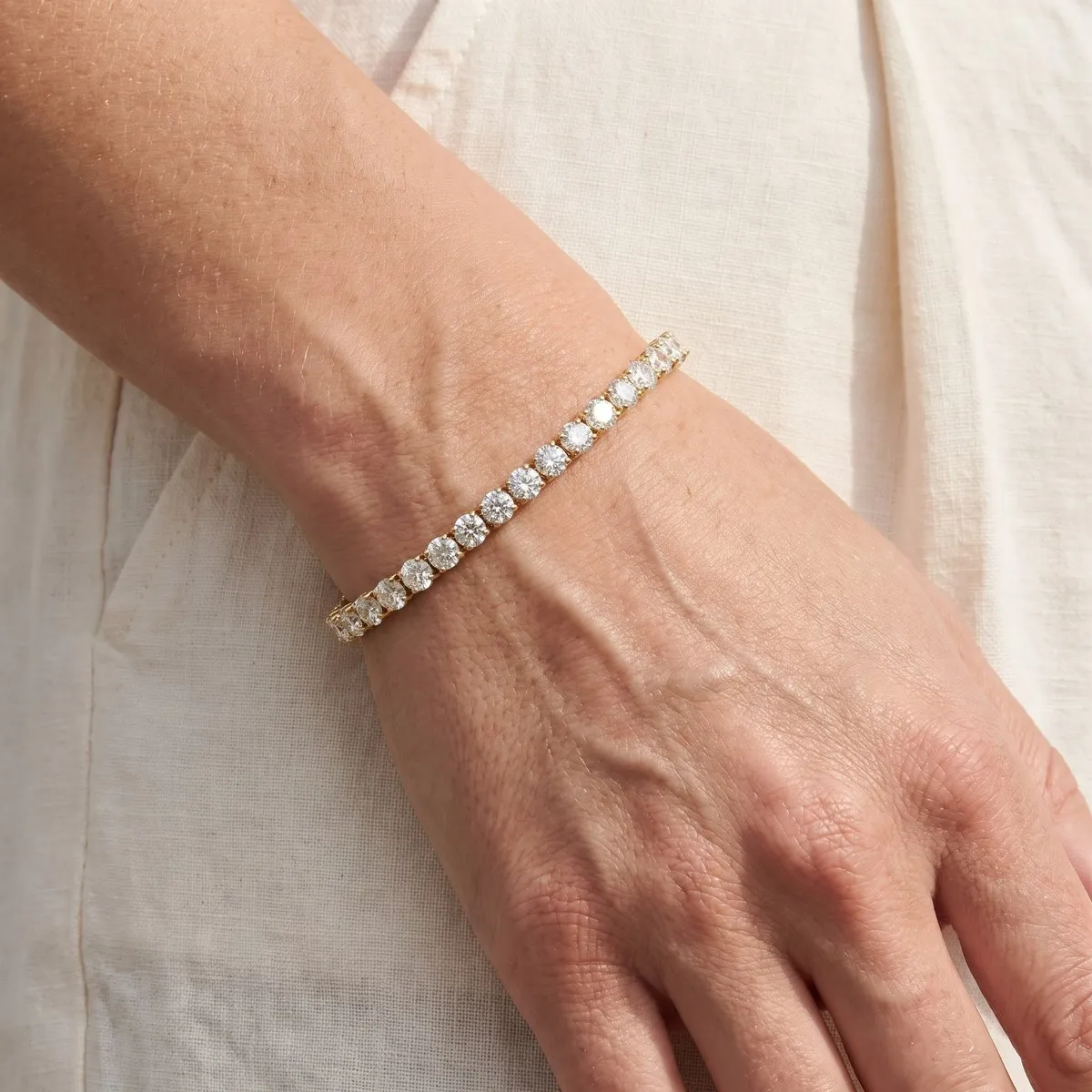
A round prong tennis bracelet in yellow gold, worn with a little slack. Image created from the design.
Are tennis bracelets still in style?
Yes, though no one publishes a market-wide sales series, so we won’t claim growth. The evidence we can date: US searches for “tennis bracelet” ran from about 110,000 to 246,000 a month over the year to September 2026, peaking in December (search data as of October 2026). 1stDibs reported tennis bracelet orders up 11% in 2023 on its own site. And brands keep building lines around players, as Glossy reported in July 2026.
Tennis bracelet styles and shapes
The classic is a row of round stones in four prongs, and historian Elizabeth Doyle told the Times the name now covers other settings too. Of our 57 gold designs, 48 use round stones, four emerald cuts and three princess cuts. Twenty-one have prong in the name, 14 bezel and four cluster. Bezels wrap each stone in metal, so they sit smoother and protect the edges, while prongs show more of the stone. Try bezel tennis bracelets or emerald cut tennis bracelets.
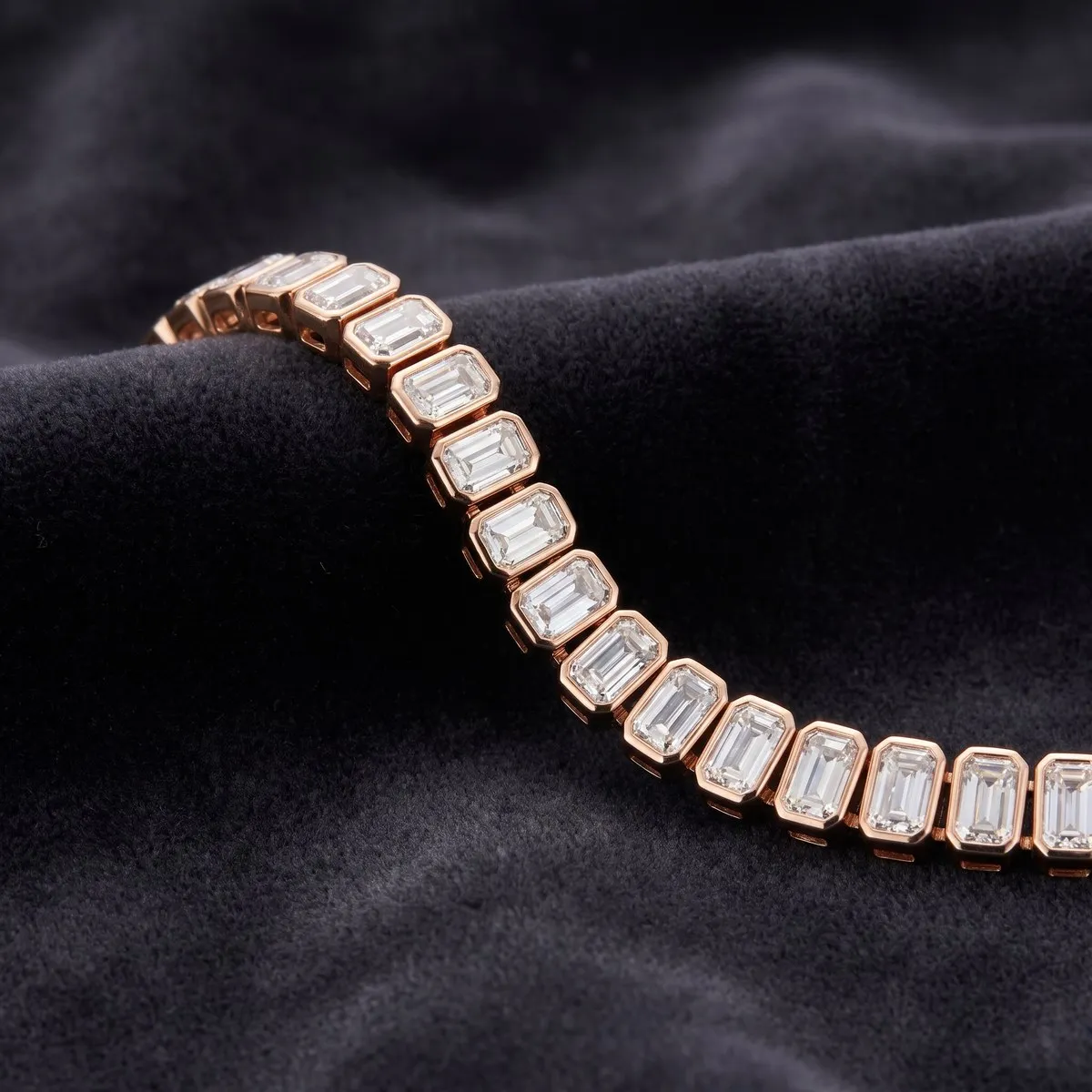
An emerald cut bezel tennis bracelet in rose gold. Image created from the design.
No single bracelet of this style is established as the most famous or most expensive. The record bracelet prices you’ll see online are for other types. Evert’s is the famous one, and it’s famous as a story, with no firmly documented maker, weight or current owner.
Do tennis bracelets hold their value?
Don’t buy one expecting to. We found no neutral study of resale, and the percentages online come from sellers. Natural diamonds have fallen too: analyst Paul Zimnisky put wholesale natural prices about 50% below their early 2022 highs in August 2026. Lab-grown diamonds don’t hold their retail price, so buy a lab-grown bracelet to wear and not as an investment. Our Lifetime Upgrade gives you 100% of what you paid as credit toward a new lab-grown piece worth at least 1.5 times as much.
Ordering a tennis bracelet from Whitemoon
Choose the metal, then the total carat weight, then the length, or leave the size as “Don’t know” and we’ll help you find it. Whitemoon jewelry is made to order in about 10–15 days and ships free with insurance both ways, with 30-day returns on unworn pieces.
Tennis bracelet questions
Why do they call it a tennis bracelet?
Because of Chris Evert, who wore diamond line bracelets on court and says one broke during a US Open match in 1978. The name is in print from 1985, and how it really started isn’t documented.
Did Chris Evert find her tennis bracelet?
Her retellings describe play stopping while it was looked for in the alley. We found no report from the time, so we can’t confirm how the search ended.
What is tennis jewelry?
A continuous line of matched stones, each in its own setting. A tennis necklace is the same idea at the neck, and the name comes from the bracelet.
Why are tennis bracelets so expensive?
Each one has dozens of stones, each with its own setting and link. On our classic design, gold adds $1,170 over silver at any weight, and each carat of lab-grown diamonds adds $189. Natural stones cost far more per carat, so they make up more of a natural bracelet’s price.
How much is a 2 carat tennis bracelet?
We have one design at 2 carats: $697 in silver and $1,577 in 10K gold on November 8, 2026. Most of our designs start at 3 carats.
How much should a 10 carat tennis bracelet cost?
At Whitemoon on November 8, 2026, a typical 10 carat lab-grown diamond design was $2,894 in silver and $5,309 in 10K gold, and the lowest-priced 10K design was $3,369.
How much is a 14K tennis bracelet worth?
The price depends on carat weight and design. On our designs, 14K added between $523 and $2,708 over 10K at 3 carats, and about $1,085 is typical. Lab-grown diamonds don’t hold their retail price, so buy it to wear.
How can you tell if a tennis bracelet is real?
Read the metal stamp, then ask a jeweler to test a sample of stones across the piece, including any that look different. Small stones usually have no report of their own. Our guide on how to tell if a diamond is real covers each test.
Which wrist should a tennis bracelet be worn on?
Either. There’s no rule, though many people choose their non-dominant wrist.