
Types of Earrings and Earring Backs, Explained
The main types of earrings are studs, hoops and huggies, drops and dangles, and pieces that climb or wrap around the ear: climbers, cuffs and jackets. They stay in with one of a handful of backs: push backs (also called friction or butterfly backs), screw backs, locking backs, or backs built onto the earring, such as a hinged hoop, a lever back or an omega clip. Jewelers of America rates screw and locking backs as the most secure and push backs as the least.
We make lab-grown diamond earrings to order in most of these styles, so we wrote this as a plain reference. The definitions come from GIA, Jewelers of America and early patents; the health points from dermatologists and the Cleveland Clinic; and we checked every earring on our own site on November 17, 2026 to see which backs each one comes with.
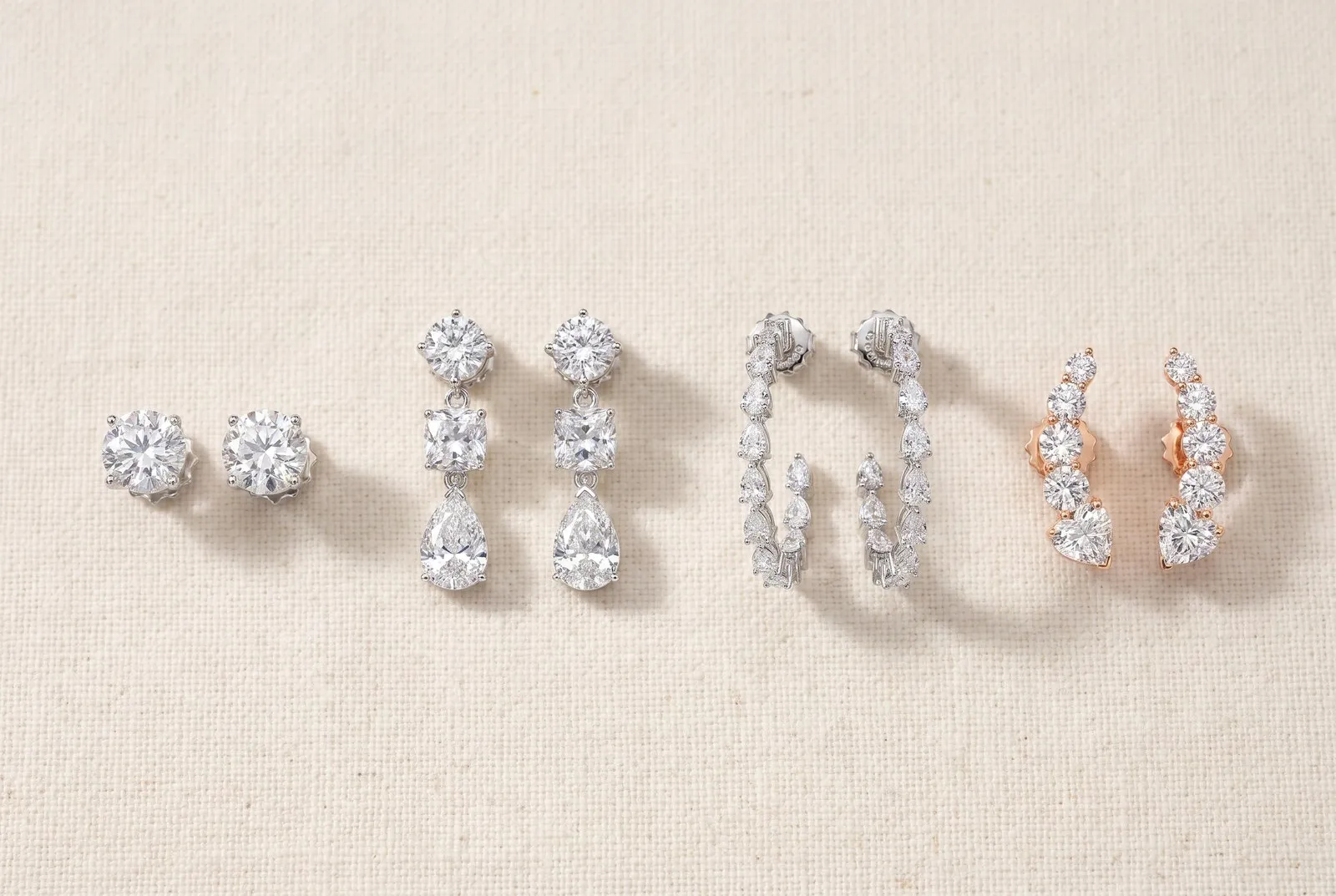
Illustrative image: studs, drops, hoops and climbers, left to right.
Types of earrings
| Type | What it is |
|---|---|
| Stud | One piece on a straight post that sits on the front of the lobe, held by a separate back |
| Hoop | A ring or part-ring that passes through the piercing and closes on itself |
| Huggie | A small hoop that hugs the lobe instead of hanging away from it |
| Drop | Hangs a short way below the lobe and moves a little |
| Dangle | Hangs lower and swings freely |
| Chandelier | Several drops hanging from one piece |
| Climber or crawler | Starts at the lobe and runs up the edge of the ear |
| Ear cuff | Wraps the rim of the ear, usually with no piercing |
| Ear jacket | A stud in front plus a second piece behind the lobe on the same post |
| Threader | A fine chain or wire pulled through the piercing |
| Clip-on | Grips an unpierced lobe with a hinged clip |
“Studs, hoops and drops” is the most common simple split, but there is no official list of earring types; trade and retail names overlap. Browse our lab-grown diamond earrings to see most of these styles.
Studs
A stud is the simplest earring and the most worn. GIA’s guide to diamond studs describes the main settings: prongs show the most of the stone, a bezel rim protects it best, and a halo of small diamonds makes a smaller center look bigger. An illusion setting sets a small diamond in a polished white-metal head so it reads larger; GIA dates it to the Depression of the 1930s. Cluster studs group several small stones into one shape. See stud earrings, halo earrings and cluster earrings.
Hoops and huggies
A huggie is a hoop small enough to sit snug against the lobe, so it barely moves. There’s no size standard: most sellers put huggies under about 15 mm across and call anything larger a hoop. Most fine hoops close with a hinge that snaps into place, which keeps them on better than an open wire. See hoop earrings and huggie earrings.
Drops, dangles and chandeliers
Many sellers use “drop” and “dangle” for the same thing; where they differ, a drop hangs close and a dangle swings. GIA says the chandelier name dates from the 1920s, for the likeness to a chandelier, and that earlier versions were called girandoles. See drop earrings.
Climbers, cuffs and jackets
A climber, also sold as a crawler, goes in the lobe like a stud and follows the curve of the ear upward; every source we found uses the two names for the same thing. Climbers are made as mirrored pairs. An ear cuff hooks over the rim of the ear without a piercing, and a jacket adds a second piece behind the lobe that peeks out below it. See ear climbers.
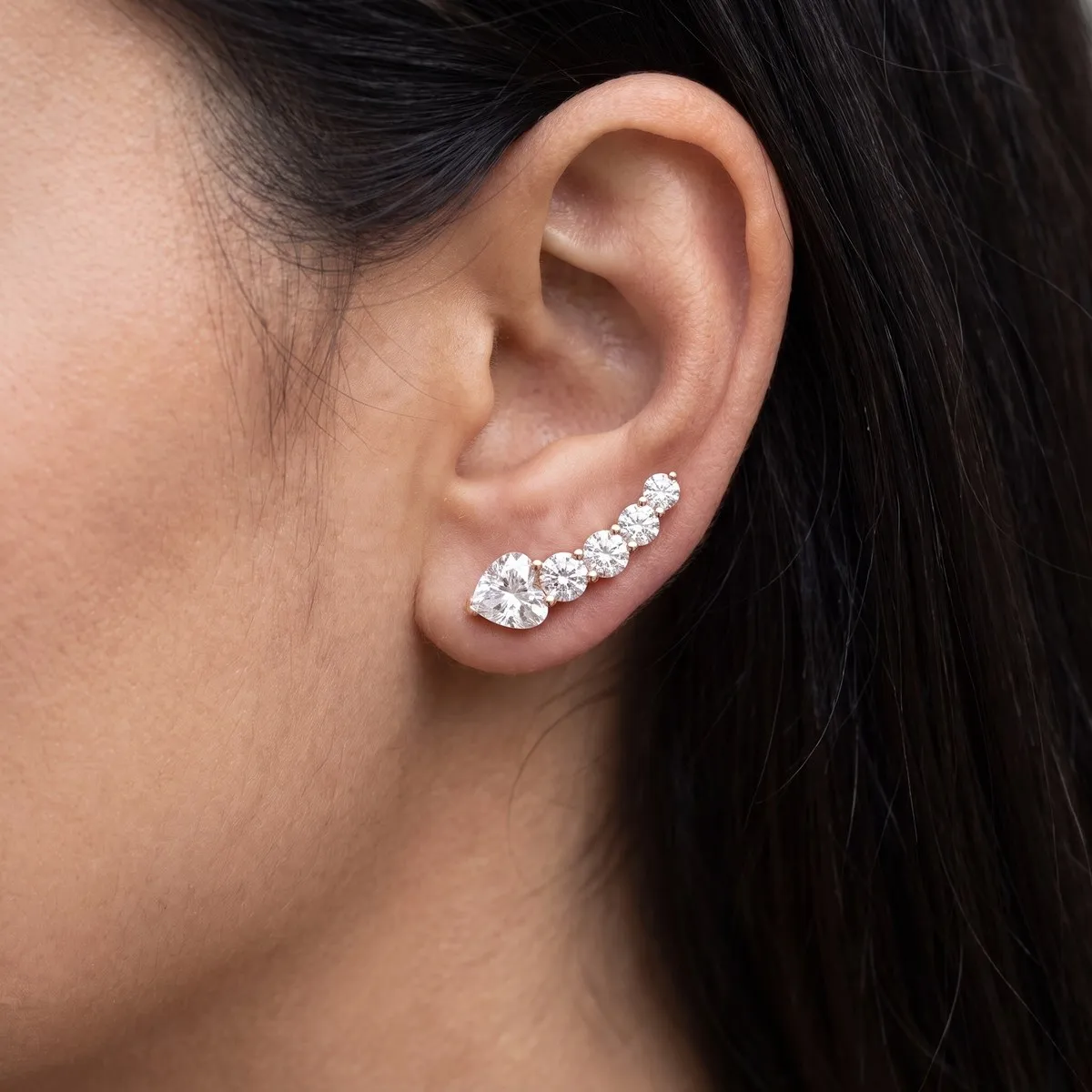
Illustrative image: an ear climber.
Clip-on and screw-on earrings
Earrings for unpierced ears came first in the patent record. A screw-on fitting, which tightens a padded disc against the lobe, was patented in 1894, and a spring clip that grips the ear without slipping in 1934. A screw-on earring is not the same as a screw back, which holds a stud in a pierced ear. Whitemoon doesn’t make clip-on or screw-on earrings.
Types of earring backs
| Back | How it works | Security, per Jewelers of America |
|---|---|---|
| Push, friction or butterfly back | A small disc whose curled springs grip a notch on the post | Medium |
| Screw back | The post is threaded and the back screws on | High |
| Locking back (La Pousette, Guardian) | Pinch two tabs to slide it on; let go and it locks onto a grooved post | High |
| Latch back | A hinged wire on the earring snaps into a catch | Medium-High |
| Lever back | An ear wire closed by a hinged lever behind the lobe | Medium-High |
| Omega back | A post plus a hinged loop that presses lightly on the back of the lobe | Medium-High |
| Flat back | A fixed disc behind the ear; the front screws or presses into the post | Not rated |
| Hook (French wire) | An open curved wire with no lock | Not rated |
Source: Jewelers of America’s earrings guide, as read November 17, 2026.
Two names cause confusion. Push, friction and butterfly backs are the same back. And “French” means two different things: a French wire is an open hook, while a French clip is the omega back.
Push backs
The most common back. They’re quick to put on and take off, but the grip comes from the spring tension of the two curls, and it weakens with wear. GIA says they usually give less protection from loss than screw or locking backs.
Screw backs
A screw back only works on a threaded post, so you can’t put one on just any earring; a jeweler can usually fit a threaded post instead. GIA notes that threaded posts are thicker than standard ones, which some people find less comfortable, and screw backs take longer to fasten. To put one on, hold the front of the earring still, set the back straight on the post and turn it clockwise until it’s snug, without forcing it; forcing it can damage the threads.
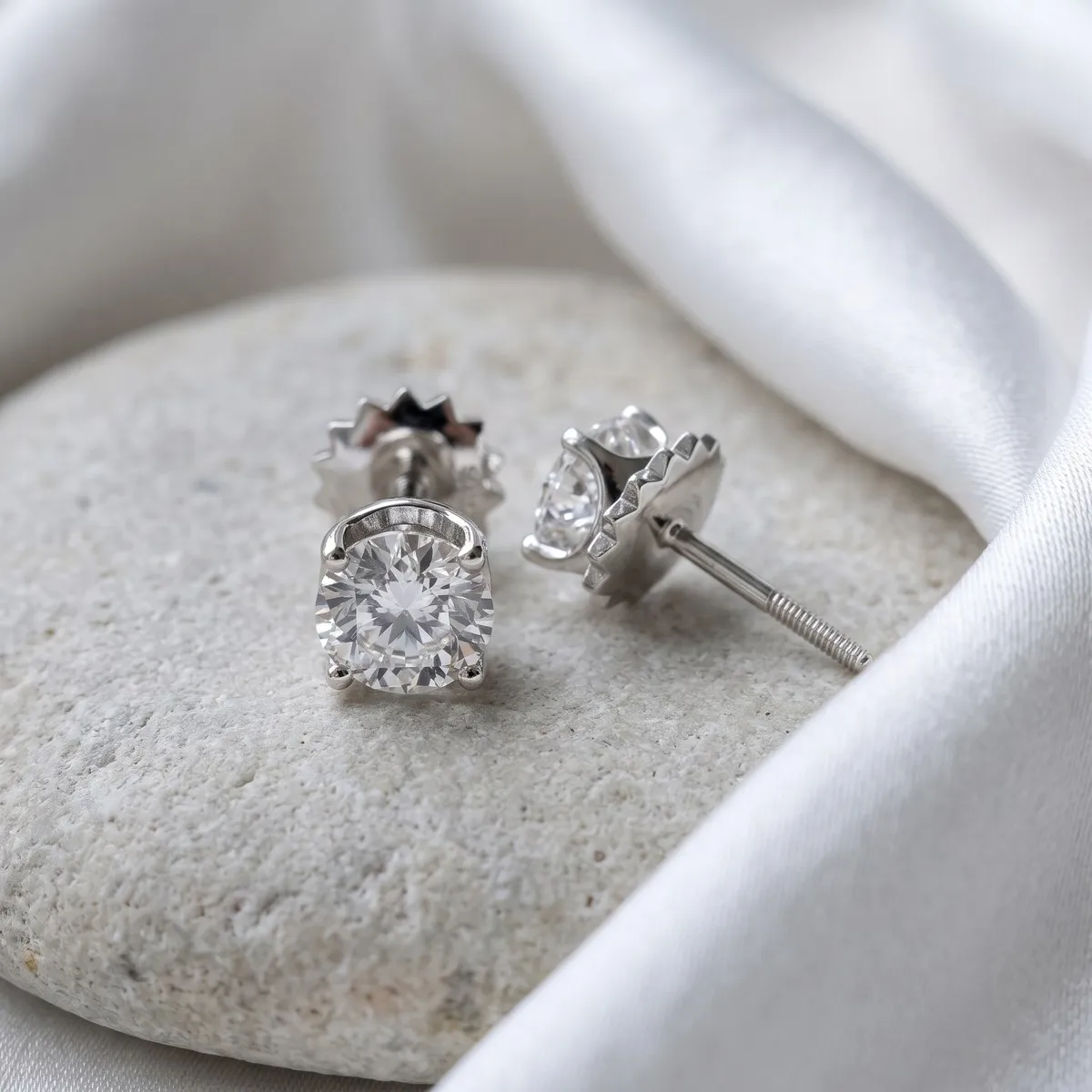
Illustrative image: stud earrings with screw backs on threaded posts.
Locking backs
Locking backs, sold under names such as La Pousette and Guardian, grip a groove or notch on the post and open only when you squeeze two tabs. They need a post made for them, and the tabs can be hard to squeeze with stiff fingers.
Backs built onto the earring
Lever backs, latch backs, hinged hoops and omega backs are part of the earring, so there is no separate back to drop. The omega’s loop also helps hold a heavier earring upright.
Flat backs
A flat disc sits behind the ear and the front piece screws in from the front or presses in. They sit flush, which is why they’re common in cartilage piercings and second or third holes.
Which earring backs don’t fall out?
No back is guaranteed, but the sources agree on the order: screw and locking backs first, backs built onto the earring next, and push backs last. GIA names screw and locking backs together as the two most secure, so there’s no clear winner between them.
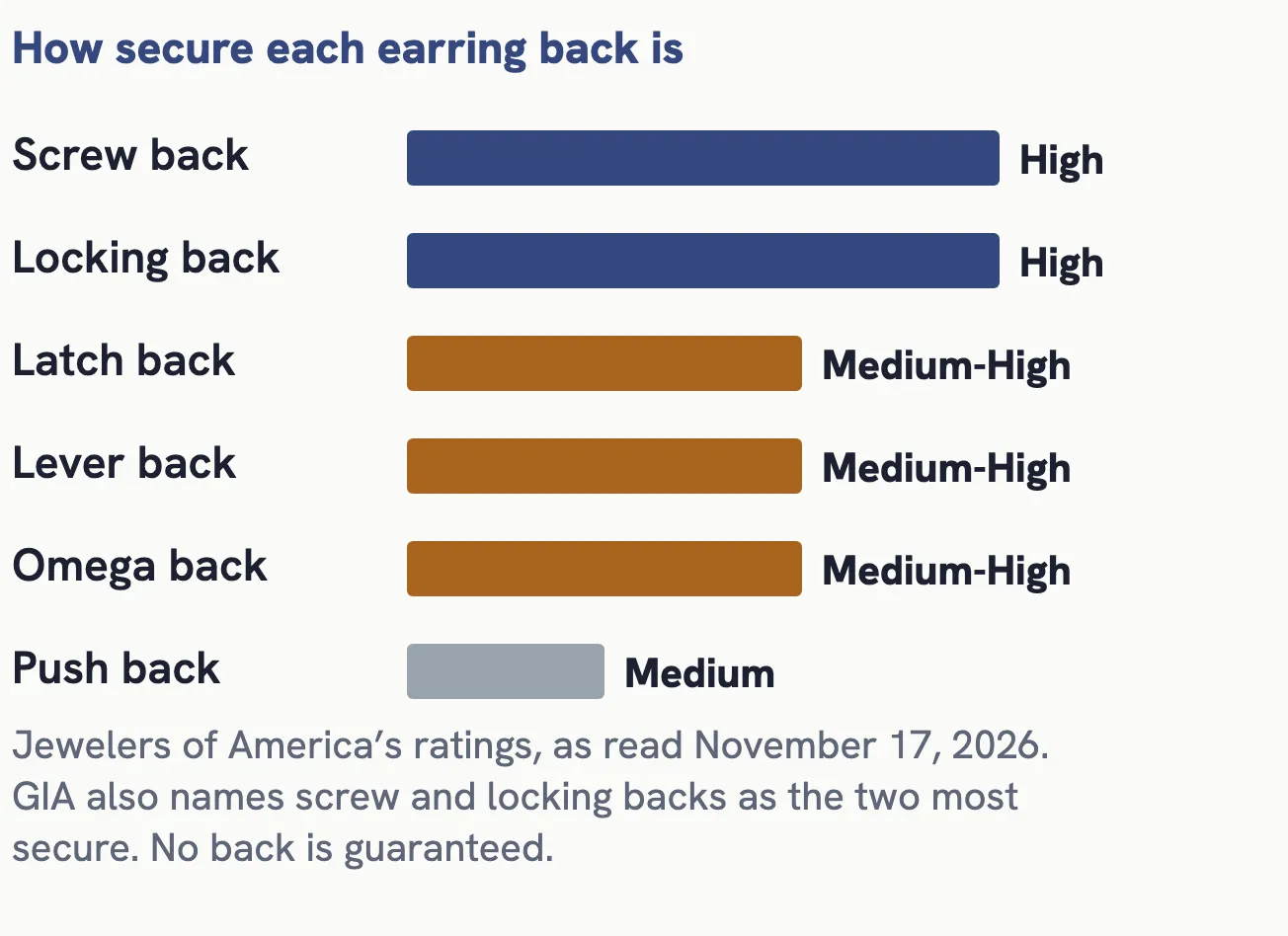
How secure each back is.
Push backs loosen because their curls open up with wear. GIA’s bench tip treats tightening them as routine jeweler work, and warns that making them too tight makes the earrings painful to put on and take off. Screw backs can also loosen as threads wear. No source gives a schedule, so check that the backs feel snug each time you put your earrings in, and have a jeweler look at the posts and backs when your jewelry is cleaned.
Earring backs for heavy earrings and sagging lobes
GIA says a stud droops less because of the earlobe than because of the earring: a large stud on a back too small for it will tip forward. A back with a wider disc, or an omega back on a heavier drop, spreads the weight. We found no study showing that any back or lobe patch prevents stretching.
The Cleveland Clinic says heavy earrings can stretch the lobe over time and an injury can tear it, and that earlobe repair is one of the most common procedures plastic surgeons do. The American Society of Plastic Surgeons put the cost at about $500 to $2,000 in 2021. If a piercing is splitting or a tear won’t heal, see a doctor; after a repair, ask the surgeon when you can re-pierce, which the sources put at weeks to months.
New piercings, sleeping in earrings and metals
- New piercings. The American Academy of Dermatology says to leave the first earrings in for six weeks or more, even at night, or the hole can close. The Cleveland Clinic says earlobes usually heal in about six to eight weeks and cartilage in six months to a year or more. Our ear piercing chart shows where each piercing goes.
- First-piercing jewelry. The Association of Professional Piercers’ standard for a fresh piercing allows only internally threaded or threadless posts, so a stud with an outside-threaded screw back isn’t meant for a brand-new hole.
- Sleeping in earrings. Keep starter studs in at night while a piercing heals. Once it has healed, earrings can catch on bedding and hair, hoops and dangles most of all, and a doctor-reviewed hospital article advises taking earrings out before bed.
- Metals. The AAD names earrings and earring backs among the biggest causes of nickel allergy and lists 18-, 22- or 24-karat yellow gold, sterling silver and platinum among safer choices. If you have a nickel allergy, ask what a white gold is alloyed with before you buy. Our guide to gold karats explains the alloys.
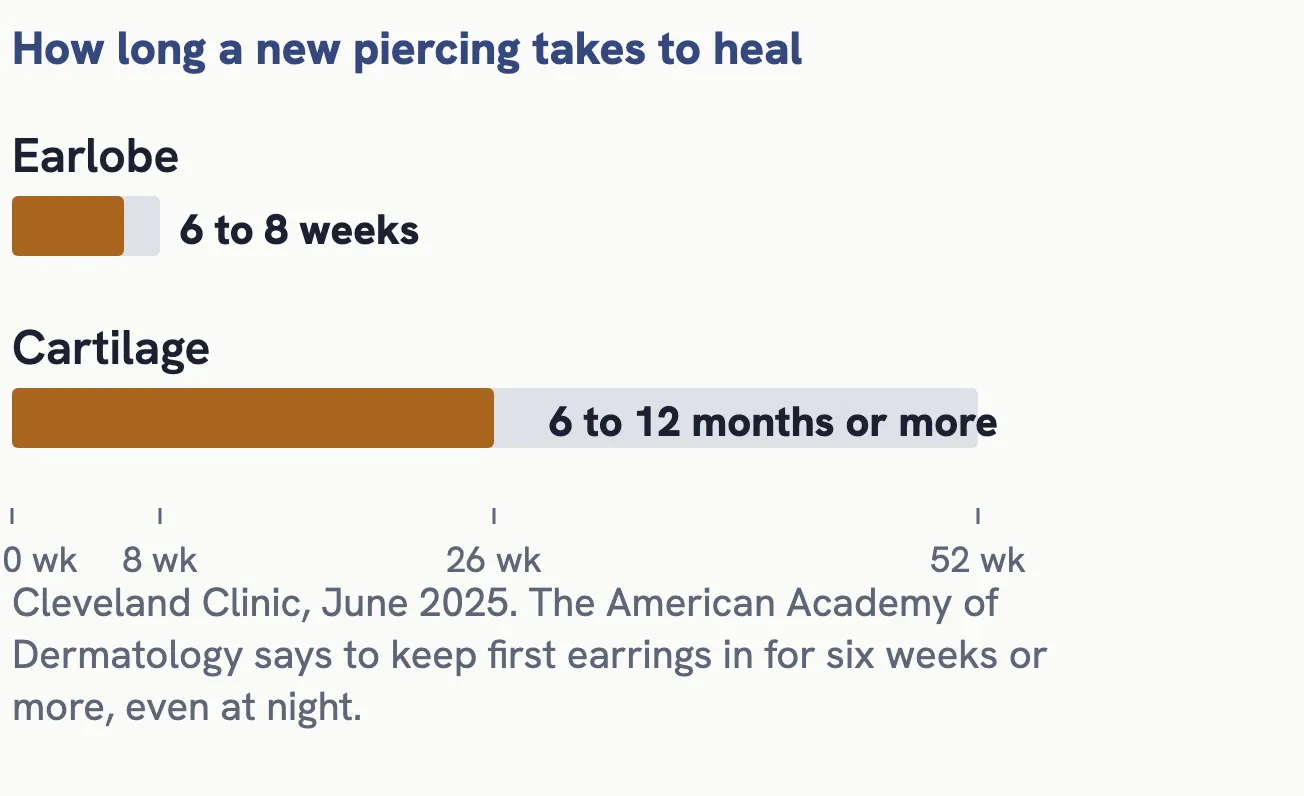
How long a new piercing takes to heal.
What Whitemoon earrings come with
We checked every earring on our site on November 17, 2026:
- Most studs, drops and climbers come with a choice of a screw back or a push back, at no extra cost, chosen on the product page. Our classic solitaire studs, for example, sit on a threaded post with a star-edged back.
- Most hoops and huggies close with a hinged post or a hinged snap.
- Some drops hang from lever backs or French hooks, and a few heavier designs use omega backs.
- Flatback earrings sit on a post with a flat disc behind the ear, made for a second or third piercing.
- Our ear cuff wraps the ear with no back at all.
Every diamond in our earrings is a lab-grown diamond, set in 10K, 14K or 18K gold or in Silvadium, a tarnish-resistant sterling silver. For hygiene, pierced earrings can’t be returned once the seal is broken; everything else follows our 30-day return policy. Our guide to buying diamond jewelry online compares stud prices and backs at other stores.
Whitemoon jewelry is made to order in about 10–15 days and ships free with insurance both ways, with 30-day returns on unworn pieces.
Earring questions
What are the backings of earrings called?
Earring backs, or clutches. The main kinds are push (friction or butterfly), screw, locking, latch, lever, omega and flat backs.
What is a stud earring?
A single piece on a straight post that sits on the front of the earlobe and doesn’t hang, held on by a separate back.
Can you put screw backs on any earrings?
No. A screw back needs a threaded post. A jeweler can usually replace a plain post with a threaded one.
What earring backs don’t fall out?
Screw and locking backs are rated the most secure, then backs built onto the earring such as lever and latch backs. No back is guaranteed, so check them each time you wear the earrings.
Are flat backs better than butterfly backs?
Flat backs sit flush against the ear, which is why they’re used in cartilage and fresh piercings. Butterfly (push) backs are quicker to change but less secure.
What are the best earring backs for sagging earlobes?
A back large enough for the earring, such as a wide disc back, or an omega back on a heavier drop. No back has been shown to stop stretching, so wear heavy earrings for shorter times.
What is a crawler earring?
Another name for an ear climber: an earring that starts at the lobe and runs up along the edge of the ear.
What are clip earrings?
Earrings for unpierced ears that grip the lobe with a hinged clip. A key US patent for the spring clip dates from 1934.
What is the difference between a huggie and a hoop?
A huggie sits snug against the lobe and barely moves; a hoop hangs away from it. Most sellers call hoops under about 15 mm huggies.
Why do piercers use flat back earrings?
For a fresh piercing, piercers follow a standard that allows only internally threaded or threadless posts, and a flat disc sits flush against the skin.
What type of earrings are best for ears?
For a new piercing, plain studs in nickel-free solid 14K gold or better, platinum or implant-grade metal, worn for at least six weeks. For healed ears with a nickel allergy, the AAD lists 18K and higher yellow gold, sterling silver and platinum among safer choices.