
Types of Ear Piercings: Names, Chart and Healing Times
There are about 15 named ear piercings, and they fall into two groups. Lobe piercings go through the soft earlobe, which has no cartilage, and the Cleveland Clinic says they usually heal in about six to eight weeks. Every other ear piercing goes through cartilage: the rim (helix), the small flap in front of the ear canal (tragus), the folds inside the ear (rook, daith, snug) and the bowl (conch). Cartilage piercings take six to twelve months to heal, by the same source, and carry more risk.
We make earrings for healed piercings, including huggies, climbers and flat backs for the upper ear. For this guide we read the Cleveland Clinic, the American Academy of Dermatology, the NHS, the Association of Professional Piercers and recent studies, each dated and linked. It explains where each piercing sits, how long it takes to heal, what the evidence says about pain, guns and risks, and which earrings suit each spot once it has healed. It is general information, not medical advice.
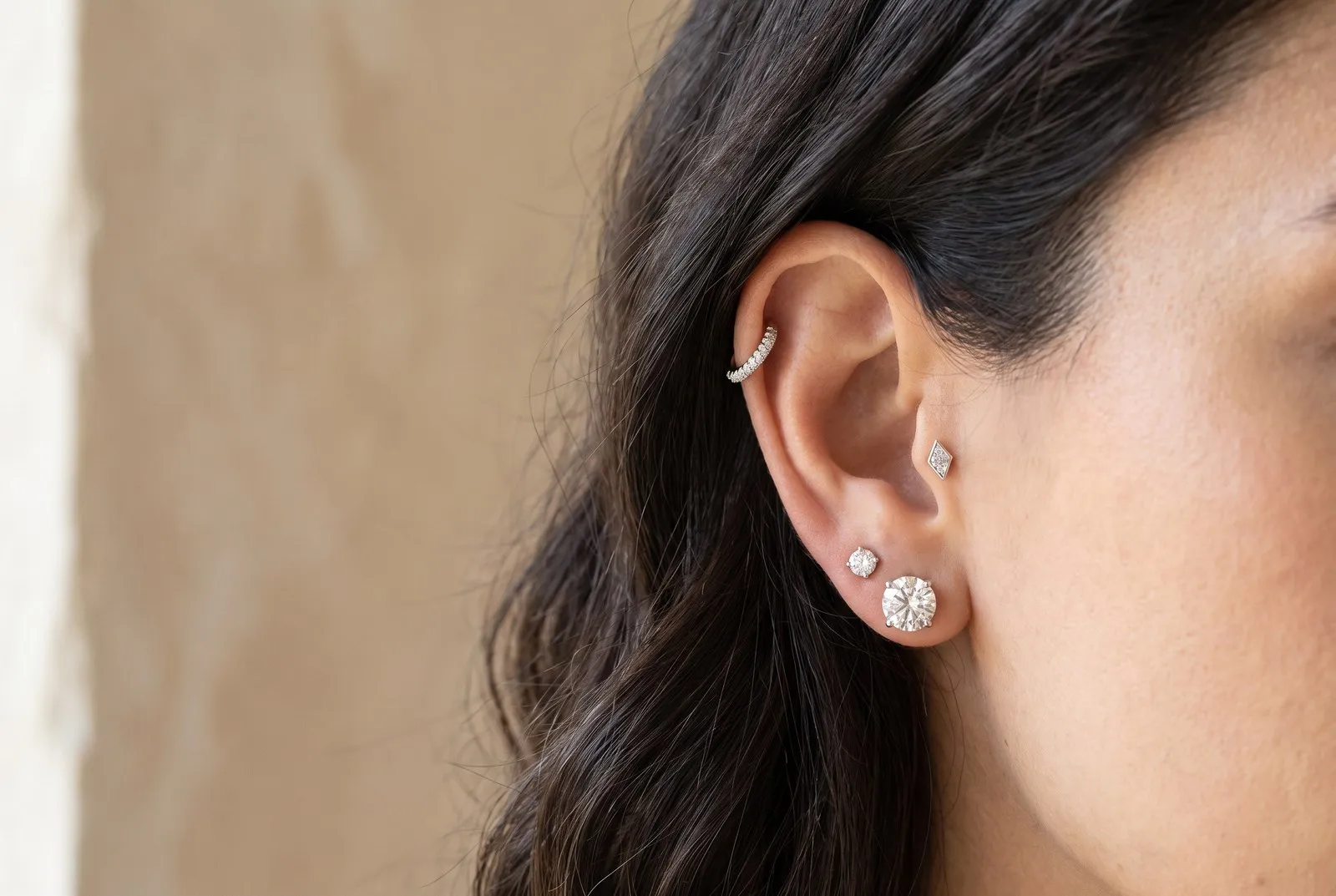
Illustrative image: helix, tragus and two lobe piercings.
Ear piercing chart
The chart marks the usual spot for each piercing on one ear. Ears differ, so a piercer looks at yours and places each piercing to suit its shape; some piercings, such as the rook, snug and anti-tragus, need a big enough fold or bump to hold the jewelry.
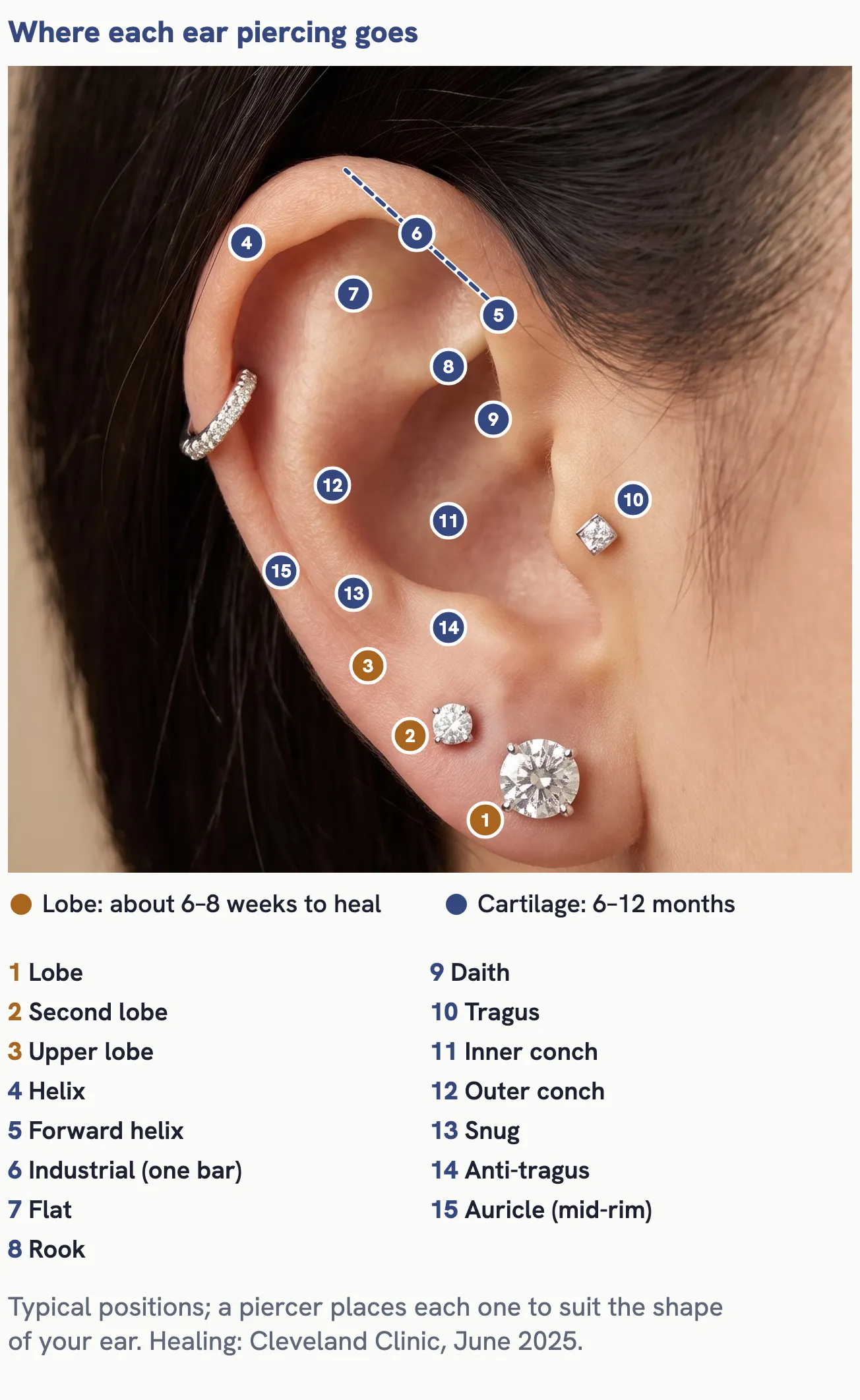
Where each ear piercing usually goes.
Lobe piercings
| Piercing | Where it goes |
|---|---|
| Standard lobe | The centre of the earlobe, front to back |
| Second and third lobe | Above the first hole, usually in a line rising toward the upper lobe |
| Upper (high) lobe | The top of the lobe, just below where the cartilage starts |
| Stacked lobes | Several lobe holes close together, in a line or a small cluster |
| Transverse lobe | Through the lobe from side to side, so a bar runs inside it and both ends show on the edge |
The standard lobe is by far the most common. In a 2026 survey of 9,016 piercings at the University of Iowa, 69.6% were lobe piercings. The upper lobe sits near the edge of the cartilage: a 2023 case letter on keloids after piercings in that zone advises people prone to keloids to treat it like cartilage.
Cartilage piercings
| Piercing | Where it goes |
|---|---|
| Helix | The upper outer rim, on the curve away from the face; a double or triple helix adds holes along the rim |
| Forward helix | The front end of the rim, where it meets the head above the tragus |
| Auricle | The outer rim halfway down, between the upper helix and the lobe |
| Flat | The flat cartilage of the upper ear, inside the rim |
| Industrial | One long bar through two holes across the upper ear, usually from the forward helix to the rim at the back |
| Tragus | The small flap of cartilage in front of the ear canal |
| Anti-tragus | The small bump above the lobe, opposite the tragus |
| Rook | Vertically through the fold at the top of the inner ear, above the daith |
| Daith | Through the small shelf of cartilage where the rim begins, just above the ear canal |
| Snug | Through the inner ridge in the middle of the ear, just above the anti-tragus |
| Inner conch | The centre of the bowl, behind the ear canal opening |
| Outer conch | The flat cartilage between the inner ridge and the rim, outside the bowl |
| Orbital | Two holes close together joined by one ring, usually on the lobe or helix |
A “hidden helix” sits tucked under the fold of the upper rim, so the hole can’t be seen and a charm seems to hang from beneath the rim. It needs a rim with enough curl, so not every ear suits it. The daith takes its name from a client of piercer Erik Dakota, who first pierced one with a curved needle because the cartilage was too stiff for a straight one, according to The Point, the Association of Professional Piercers’ journal.
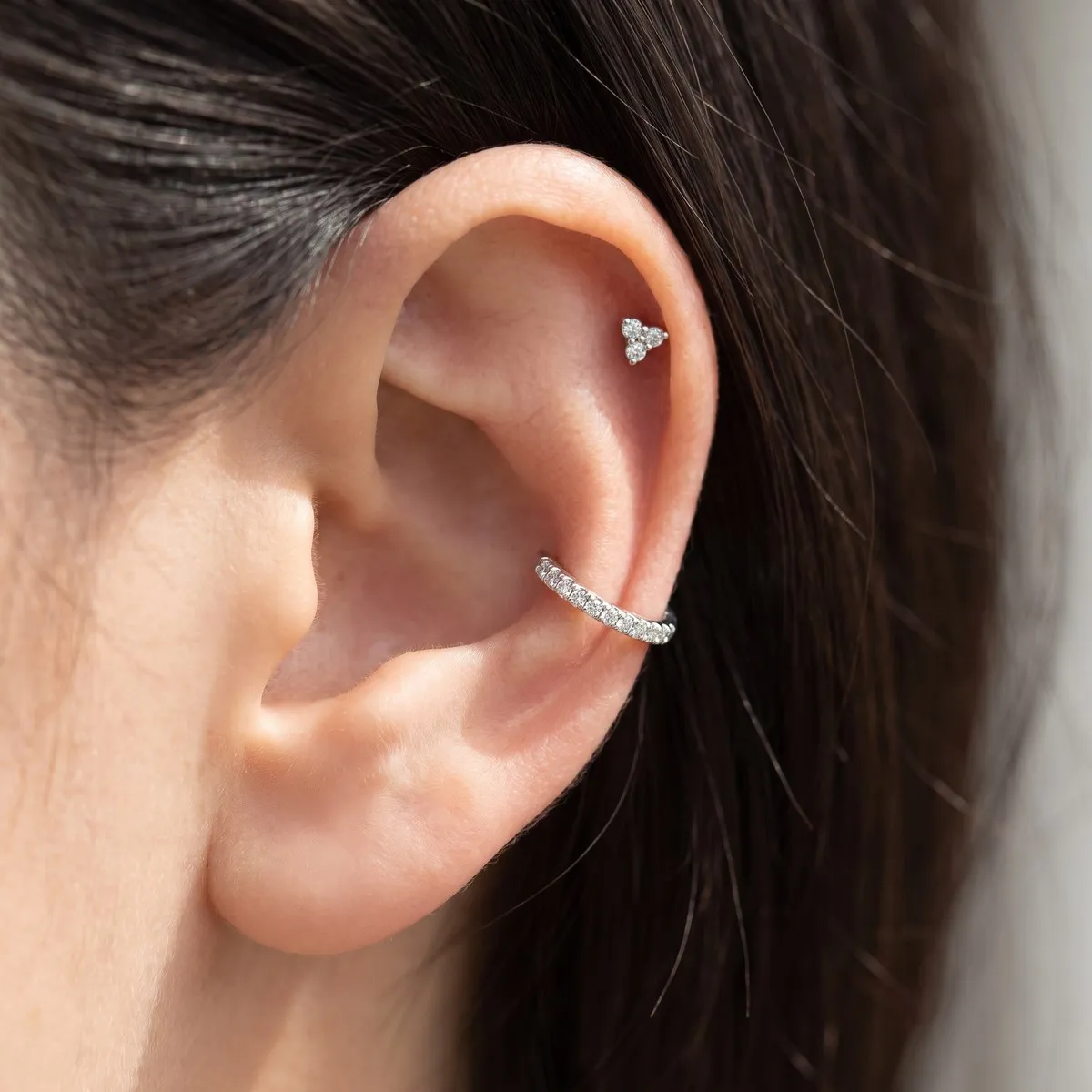
Illustrative image: cartilage piercings in the upper ear.
How long ear piercings take to heal
The Cleveland Clinic says earlobes usually heal in about six to eight weeks and cartilage in six months to a year; it names the daith, rook, conch, helix and tragus at six to twelve months. Other medical sites give three to twelve or four to twelve months for cartilage. Cartilage has no blood supply of its own and is fed through its thin covering layer, which is why it heals slowly. WebMD notes that cartilage heals from the outside in, so a piercing can feel healed before it is.
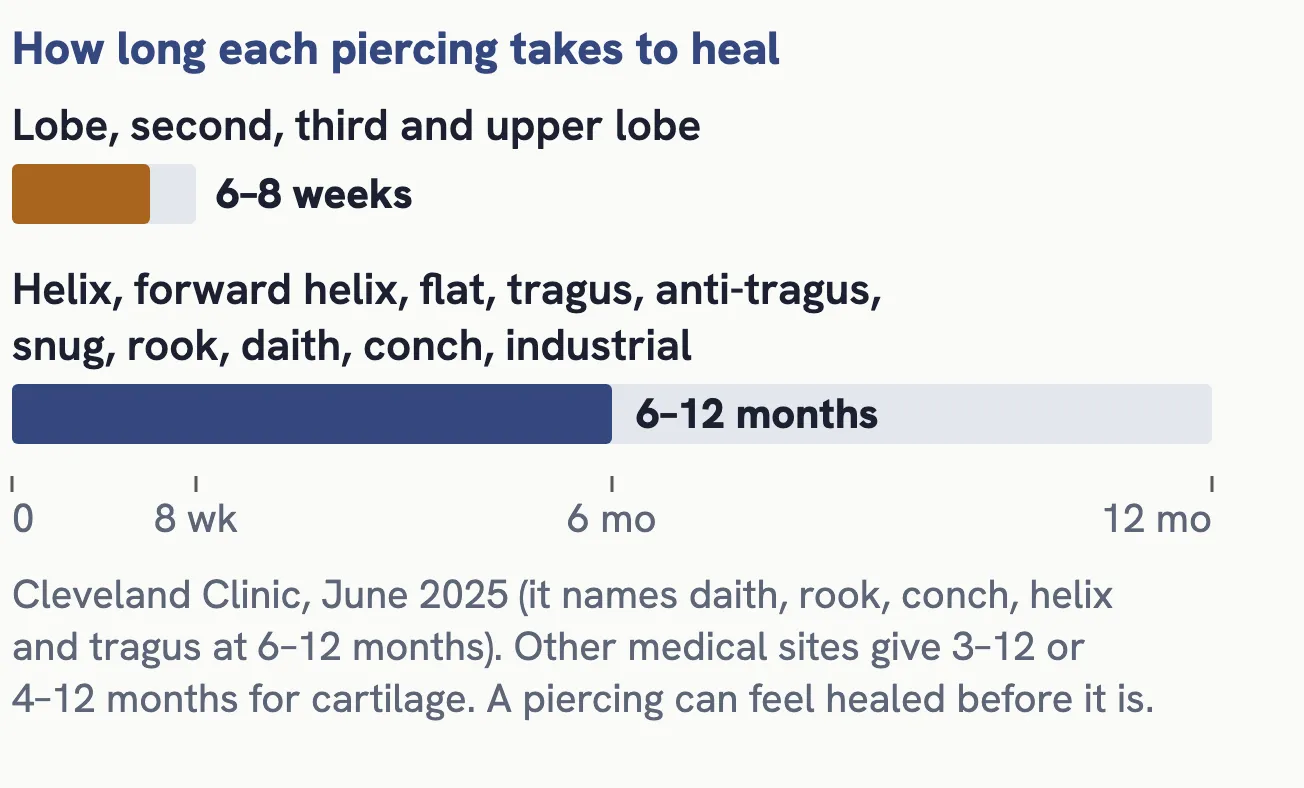
Healing time by tissue, from the Cleveland Clinic.
Change the earring only once the piercing has fully healed: the Cleveland Clinic describes that as no pain, redness, swelling or crusting, with the jewelry turning easily. The American Academy of Dermatology says to leave starter earrings in for six weeks or more, even at night, or the hole can close. The Association of Professional Piercers adds that many piercings need a shorter post once the swelling goes down, fitted by a piercer.
Which ear piercing hurts the most?
No study has measured pain by piercing site, so every 1-to-10 pain chart online is opinion. The Cleveland Clinic explains the pattern: the earlobe is mostly fatty tissue with few nerves, so it hurts least, while cartilage is thicker and has more nerves. Piercers and health sites usually put the thick inner folds (snug, rook, conch and daith) and the two-hole industrial at the top. Feeling faint is common: in a 2023 study of 1,866 people having their earlobes pierced in Shanghai, 10.5% had a fainting-type reaction and 3.11% fainted, so sit or lie down.
Needle or gun?
The Association of Professional Piercers bars its members from using reusable ear piercing guns. It says they can’t be fully sterilized, that the blunt stud works more like a crush than a cut, and that guns are especially risky on cartilage. The Cleveland Clinic recommends needles, especially for children. Rules vary by place: Ontario, for example, allows piercing instruments only on the fleshy part of the earlobe.
The research isn’t settled. The 2026 Iowa survey found the instrument wasn’t an independent predictor of complications, while a 2026 survey of 1,018 women in Riyadh found that use of a piercing gun was. Both are self-reported surveys. Claire’s says it uses a hand-pressured device with pre-sterilized single-use earrings, “never a gun”, and its pages show no needle piercing; in August 2026 it relaunched piercing in about 900 US and Canadian stores, with kits from $29.99.
Risks: infection, rejection and keloids
Cartilage carries more risk than the lobe. In the Iowa survey of 3,270 people, 40.2% of cartilage piercings had some complication against 25.4% of lobe piercings, and infections needing treatment were 2.2% against 1.4%. Cartilage infections are usually caused by Pseudomonas bacteria, can need antibiotics through a drip and can leave the ear permanently misshapen, according to the UK Health Security Agency and a 2001 report in the BMJ. A review of published cases found infections after piercings in the flat area between the rim and the inner ridge led to deformity more often than after helix piercings.
Rejection, when the body slowly pushes jewelry out, is most common in surface piercings such as the eyebrow and navel; no source ranks ear piercings for it. Jewelry that is too thin can migrate, the Association of Professional Piercers says. The American Academy of Dermatology notes that the ear is a common place for keloids, raised scars that grow beyond the wound; at the first sign of thickening it advises taking the earring out.
Aftercare: what not to do
- Don’t touch it except to clean it, with washed hands (AAD, Cleveland Clinic, Association of Professional Piercers).
- Don’t twist the jewelry while it heals, say the Association of Professional Piercers and the Cleveland Clinic; the NHS still says to turn it gently while cleaning, so sources differ.
- Don’t use alcohol or hydrogen peroxide. Cleaning advice varies: sterile saline (Association of Professional Piercers), a mild fragrance-free cleanser and water (AAD), antibacterial soap and water (Cleveland Clinic) or warm salt water (NHS).
- Don’t swim in pools, lakes, the sea or hot tubs until it heals, and don’t sleep on a healing cartilage piercing; a travel pillow helps (Association of Professional Piercers).
- Don’t take the starter earring out early (AAD), and don’t hang charms from it until it heals (Association of Professional Piercers).
- Don’t pierce your own ear. The NHS says to use a qualified, licensed piercer.
- If you think it’s infected, keep the jewelry in unless a doctor says otherwise, and see one, the NHS and Cleveland Clinic say; act quickly for cartilage.
Jewelry for a new piercing
The Association of Professional Piercers’ standard for initial jewelry allows implant-grade titanium or steel, niobium, platinum, and solid 14K-or-higher gold that is nickel- and cadmium-free; gold-plated, gold-filled and vermeil pieces don’t qualify. Posts should be internally threaded or threadless, with a polished surface and a length and thickness that suit the spot. No professional body sets a gauge for ears, but fine-jewelry earring posts are usually about 20 gauge (0.8 mm), while piercers often start lobes at 18 or 16 gauge and cartilage at 16 gauge (1.2 mm). A piercer supplies the first jewelry; everyday fine jewelry is for a piercing that has healed.
Earrings for each healed piercing
| Healed piercing | Styles that usually suit it |
|---|---|
| Lobe, second and third lobe | Studs, hoops, huggies, drops and climbers |
| Upper and stacked lobes | Small studs and huggies |
| Helix, forward helix | Small flat-back studs; small hoops and huggies once healed |
| Flat, tragus, inner conch | Flat-back studs that sit flush |
| Outer conch | A hoop, once healed |
| Daith, rook, snug, anti-tragus | Rings and curved barbells that follow the fold |
| Industrial | One long straight bar |
These are styling suggestions from piercers and jewelry sellers, not rules; Healthline adds that hoops suit the outer conch only after healing and flat backs suit the inner conch. Our guide to earring types and backs explains flat backs, screw backs and the rest.
Daith piercings, migraines and anxiety
The daith is sold online as a “migraine piercing” or “anxiety piercing”, from an acupuncture point in that area. The American Migraine Foundation says no research supports it and doesn’t recommend it, and a Cleveland Clinic headache specialist says any relief is likely a temporary placebo. A 2024 review in the journal Headache found no clinical trials, only a few case reports and one study. There is no controlled study on anxiety either, and none on health benefits for the conch. Get a daith or conch because you like how it looks.
The piercing names people search
- Anxiety piercing: the daith (sometimes the shen men, on a ridge near it); no trial shows it helps.
- Daisy piercing: not a recognized placement; it usually means a daisy-shaped stud worn in a lobe, helix or flat piercing.
- Butterfly kiss piercing: not an ear piercing; one body-jewelry seller uses the name for a piercing on the cheekbone below the eye.
- The 2/3 rule: a styling idea from jewelry sellers, such as two piercings in one area and three in another, not a piercing standard.
- Piercings that “attract love”: meanings given to each placement are beliefs and personal symbolism, not effects.
What an ear piercing costs
A studio piercing fee is often a few tens of dollars per hole, with the jewelry extra, and prices vary by city and studio. Healthline put a tragus piercing at about $25 to $50 in 2020, plus jewelry. Claire’s pierces free with a starter kit, from $29.99 in August 2026.
Whitemoon earrings for healed piercings
Our earrings are made to order for healed piercings, with lab-grown diamonds. On November 18, 2026, in 14K gold:
- Lobes: our round lab-grown diamond studs, such as the classic solitaire pair at $507 for 1 carat total weight (F–G color, VS–SI clarity), with a screw back or a push back.
- Helix and upper lobes: huggie earrings that click shut on a hinge, such as a bezel drop huggie pair at $343.
- Climbing the ear from one lobe hole: ear climbers, such as a heart and graduated round pair at $385.
- Flat, tragus and helix: single flat-back earrings with a straight post and a flat disc back, such as a two-stone bezel design at $124.
For a first piercing, go to a professional piercer for jewelry that meets the standard above, then switch to our pieces once the piercing has healed.
Whitemoon jewelry is made to order in about 10–15 days and ships free with insurance both ways, with 30-day returns on unworn pieces.
Ear piercing questions
What is the most painful piercing in your ear?
No study has ranked them. Cartilage hurts more than the lobe, the Cleveland Clinic says, and piercers usually put the snug, rook, conch, daith and industrial highest. Pain is personal.
What is the 2/3 rule for piercings?
A styling idea from jewelry sellers, such as two piercings in one area of the ear and three in another. It isn’t a piercing standard; a piercer decides spacing from your ear.
What is the anxiety piercing called?
The daith, the piercing through the small shelf of cartilage just above the ear canal. No clinical trial shows it helps anxiety or migraines.
What is a daisy piercing?
Not a recognized piercing. It usually means a daisy-shaped stud worn in a lobe, helix or flat piercing.
What piercing rejects the most?
Surface piercings such as the eyebrow and navel. No source ranks ear piercings for rejection, though jewelry that is too thin can migrate.
What is the riskiest ear piercing to get?
No single one, but cartilage piercings have more complications than lobe piercings, and a cartilage infection is more serious because it can deform the ear.
What is a butterfly kiss piercing?
Not an ear piercing. One body-jewelry seller uses the name for a piercing on the cheekbone below the eye.
How long does it take for an ear piercing to heal before changing it?
About six to eight weeks for a lobe and six to twelve months for cartilage, the Cleveland Clinic says. The AAD says to keep lobe starter studs in for at least six weeks.
Is it better to pierce with a needle or a gun?
The Association of Professional Piercers bars its members from reusable guns, and the Cleveland Clinic recommends needles, especially for cartilage and children. Studies comparing the two disagree.
Does Claire’s use a piercing gun or needle?
Neither, by its own account: Claire’s says it uses a hand-pressured device with pre-sterilized single-use earrings, “never a gun”, and it doesn’t offer needle piercing on its pages.
Is it OK to pierce your own ear?
No. The NHS says to use a qualified, licensed piercer, and the AAD recommends an experienced piercer in a licensed studio.
Does a conch piercing have any benefits?
No research supports health benefits for the conch. The benefit is how it looks.
What is the hardest piercing to heal?
No source ranks them. All cartilage piercings take six to twelve months, and a thick fold like the rook, or a conch made with a punch instead of a needle, can take longer.