Diamond Grading Labs Compared: GIA, IGI, AGS, HRD, GCAL, EGL and GSI
The diamond grading labs shoppers meet most often are GIA and IGI: GIA is the usual benchmark for natural diamonds, and IGI gives lab-grown diamonds full letter grades. HRD Antwerp and GCAL also issue full reports, GSI works closely with retailers, AGS closed its lab at the end of 2022, and the EGL name has covered several separate labs with uneven reputations. Which lab is “best” is partly opinion, so judge a lab by what it prints and whether you can check it.
Here is what each one does today, what we could and couldn’t confirm, and how to weigh a name you don’t recognize. Reports from different labs aren’t a strict match, so the lab name is part of what you are buying.
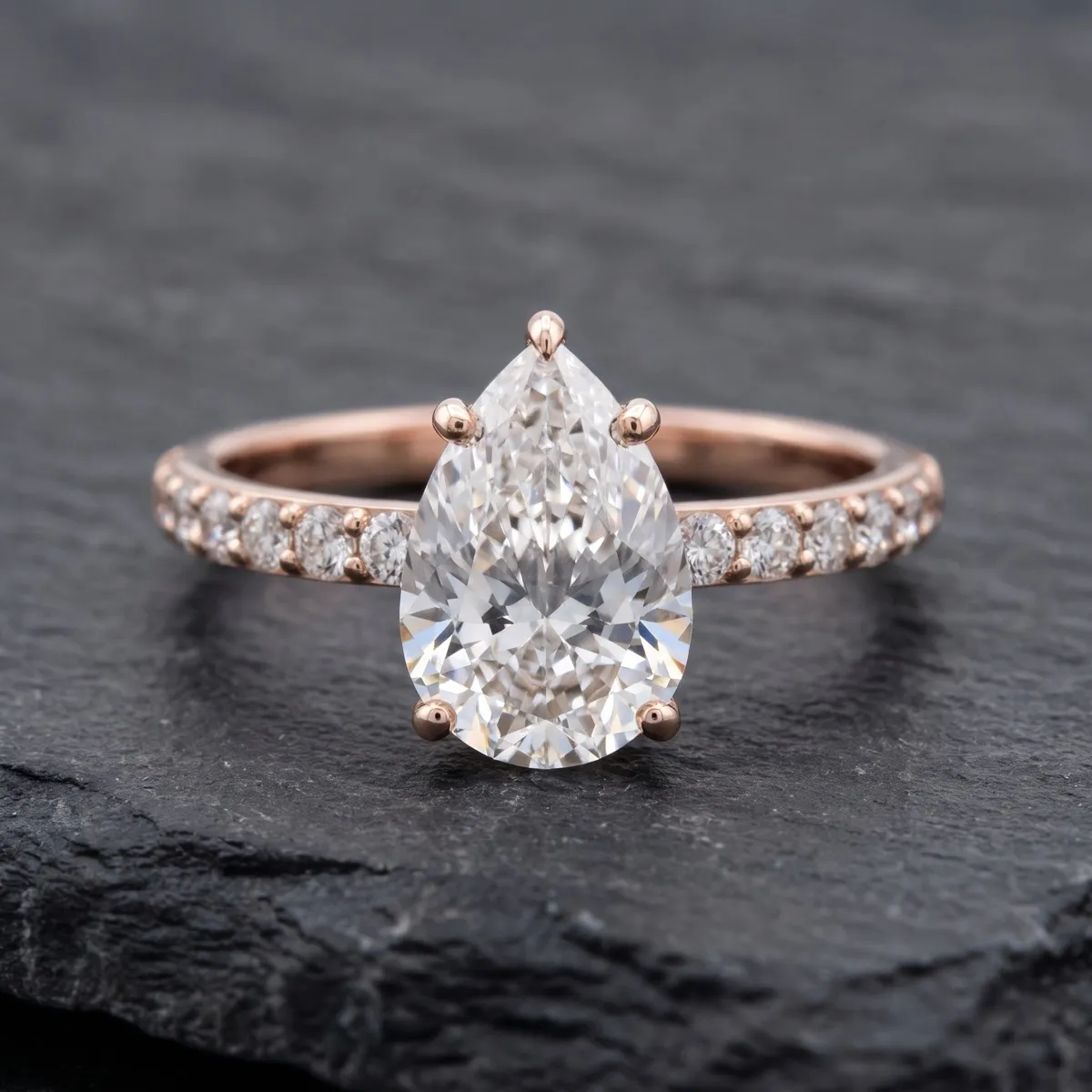
Pictured: a pear-shaped lab-grown diamond solitaire with a pavé band in rose gold. Image created from the ring’s design.
| Lab | Lab-grown diamonds | Worth knowing |
|---|---|---|
| GIA | Premium or Standard class | Nonprofit; usual benchmark for natural diamonds |
| IGI | Full letter grades | Most Whitemoon center stones carry it |
| AGS | Lab closed | Older reports can still be looked up |
| HRD Antwerp | Full reports | Own clarity terms at each end of the scale |
| GCAL | Full reports | Sells a grading guarantee; majority owned by Sarine |
| EGL | Varies by lab | One name, separate labs, mixed standing |
| GSI | Full reports | Works closely with retailers |
| AGL | Not its focus | Mainly grades colored gems |
GIA: the benchmark for natural diamonds
GIA is the lab most of the trade measures others against for natural diamonds. It is an independent nonprofit founded in 1931, it introduced the D-to-Z color scale, and it neither mines nor sells diamonds. For lab-grown stones it now issues a Quality Assessment that classes a stone as Premium or Standard, and older letter-grade reports remain valid. Our GIA certificate guide reads each document line by line.
IGI: full letter grades on lab-grown diamonds
In our experience, IGI is the lab you are most likely to see on a lab-grown diamond. Founded in Antwerp in 1975, it says it has graded lab-grown stones since 2005 and keeps the same color and clarity scales for natural and lab-grown diamonds. The inscription on a lab-grown stone reads “LG” plus the report number, and the comments can state the growth method. Read our IGI certificate guide for the details, or our comparison of IGI vs GIA if you are choosing between the two.
AGS: the lab has closed, and its scale lives on
AGS Laboratories no longer grades diamonds. The lab announced in October 2022 that it would close at the end of that year, with GIA taking over its intellectual property, technology and Las Vegas site. The American Gem Society keeps its 0 to 10 cut scale, where 0 is Ideal, and it says no laboratory now grades to that standard.
You may still see the name in two places. GIA sells an AGS Ideal Report, a digital add-on about light performance for qualifying stones. Older AGS reports can be looked up through the Society, with grading details for reports from 2001 to April 2010 and PDFs for later ones.
HRD Antwerp: a Belgian lab with its own clarity terms
HRD Antwerp is a Belgian lab that grades both natural and lab-grown diamonds. It traces back to the Diamond High Council, set up in 1973, and became a separate business in 2007. It now has labs in Antwerp, Mumbai and Dubai. Its reports use D-to-Z color and a cut scale from Excellent to Fair. The clarity scale reads differently at each end, with Loupe Clean at the top and P1 to P3 at the bottom.
HRD says it tests every stone for origin, marks lab-grown reports clearly on the cover and keeps a digital copy of each report for ten years. Its printed reports carry micro text, fluorescent marks and a hologram.
GCAL: a New York lab built around a guarantee
GCAL is a New York lab founded in 2001 and known for backing its grades with a guarantee. Sarine Technologies, an Israeli diamond technology company, bought a controlling stake in 2023, and the lab now trades as GCAL by Sarine. GCAL says its certificates carry a 100% guarantee, and we haven’t reviewed the terms.
Its GCAL 8X grade looks at eight factors including polish, symmetry, proportions and optical performance. It started on round brilliants in 2021 and later reached fancy shapes. GCAL says fewer than 1% of round brilliants meet it, which is the lab’s own claim. Its lab-grown certificates can list the growth method.
EGL: one name, several separate labs
EGL is a name shared by separate labs, which is the first thing to know about it. In 2014, EGL USA’s New York director told the trade press that EGL International wasn’t affiliated with EGL USA. That same year, RapNet, a large diamond trading network, stopped listing stones graded by any EGL branch from October 1, citing in its opinion confusion and inconsistency among EGL reports. EGL USA objected to being included.
That history is more than a decade old, and we couldn’t confirm which EGL labs still issue reports or how each treats lab-grown diamonds. If you are offered an EGL stone, find out which EGL issued the report, check whether it can be looked up, and don’t assume its grades equal another lab’s.
GSI: a lab that works closely with retailers
GSI, or Gemological Science International, is a New York lab founded in 2005 that serves retailers, manufacturers and wholesalers. It says it is one of the largest labs by volume, with locations on four continents. In 2020 it introduced a lab-grown report that names HPHT or CVD growth and says whether a stone is as grown. Some retail blogs call its grading loose. That is opinion, and we found no independent measurement either way.
AGL: colored gems first
AGL, or American Gemological Laboratories, mainly grades colored gemstones, and a diamond shopper is unlikely to need it. Founded in New York in 1977, it is known for colored stone analysis and country-of-origin reports. In February 2026 it said it had agreed to be acquired by IGI and would keep operating under its own name. We found no sign that diamond grading is part of its usual work.
A note on GRA and moissanite
GRA is a card often sold with moissanite, and we couldn’t verify it as an independent lab. A 2023 article in the Gemmological Association of Australia’s journal looked at GRA certificates supplied with moissanite. It found them modeled closely on GIA’s, with misspellings, measurement disclaimers it judged inaccurate and a QR code leading to a site that showed a security warning. Treat a GRA card as seller paperwork, and remember that moissanite is a different gem from diamond.
What changes from lab to lab on a report
Most reports share the same lines, and a few of them change meaning from one lab to the next. The drawing is our own illustration with made-up values. GIA and IGI publish their own guides, How to Read a GIA Diamond Grading Report and How to Read an IGI Laboratory Grown Diamond Report.
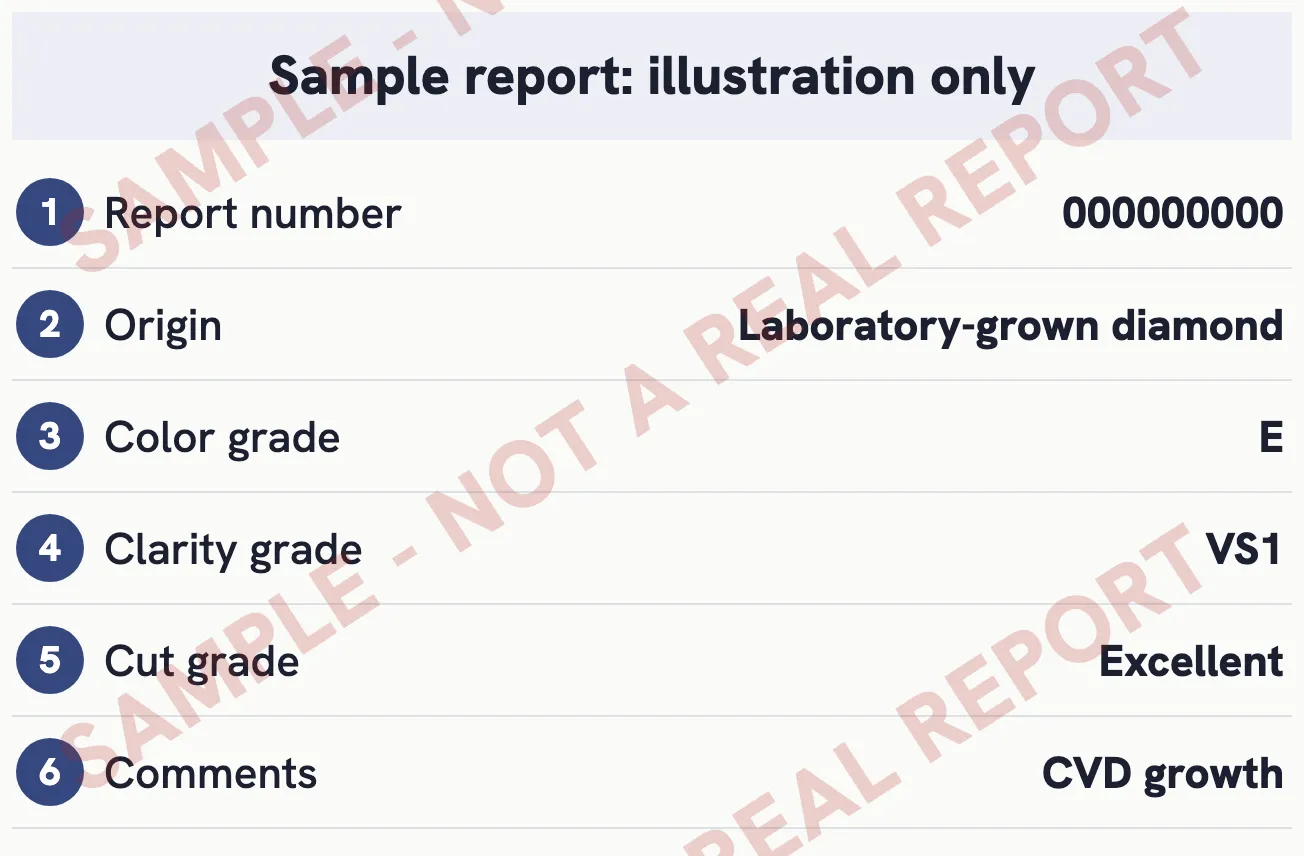
Illustration of a typical report layout, not an actual lab document.
- Report number. Each lab keeps its own records, so check a number on the issuing lab’s own website. A number that lab can’t find is a warning sign.
- Origin. Every lab should say laboratory-grown in plain words. IGI and HRD say they screen every stone, while GIA’s sample for its Quality Assessment says the origin was disclosed and not further tested.
- Color grade. Most labs use D to Z. GIA’s current lab-grown document prints no letter at all.
- Clarity grade. Most labs follow Flawless to Included, HRD uses Loupe Clean and P grades, and GIA’s current lab-grown document prints no grade.
- Cut grade. GIA runs Excellent to Poor on rounds only, IGI runs Ideal to Poor, HRD runs Excellent to Fair, and GCAL adds its 8X grade.
- Comments. IGI, GSI and GCAL can name the growth method here. Read this line on any lab-grown report you are comparing.
For what each term means, including every inclusion a plot can show, see our guide on how to read a diamond certificate.
How to judge a lab you don’t know
A trustworthy report can be checked, says plainly what the stone is, and matches what you see. These five checks work for any lab:
- Look up the number on the lab’s own website and compare every line with the paper.
- Read the origin wording. Laboratory-grown should be stated in plain words, and a moissanite report should never read like a diamond report.
- Look for method and treatment. On a lab-grown stone, a good report says how it was grown and whether it was treated, or tells you it doesn’t address that.
- Ask who the lab works for. A lab that serves mainly one seller or sector isn’t automatically wrong, though it is worth knowing.
- Compare with your eyes. A photo or video of the actual stone is the best check on any grade.
The labs behind Whitemoon center stones
We work with IGI and GIA. The center stone of a Whitemoon engagement ring comes with a report from one of them, and most carry IGI. You can pick a center in the Whitemoon ring builder after choosing a setting such as solitaire engagement rings, bezel engagement rings, marquise engagement rings or pear-shaped engagement rings. To see how the lab and grade affect price at one size, read our 3 carat diamond price guide. Most Whitemoon rings are made to order in about 10–15 days and ship free with insurance both ways, with 30-day returns on unworn pieces and one free resize within 60 days of delivery.
Diamond grading lab questions
What is an HRD certified diamond?
It is a diamond graded by HRD Antwerp, a Belgian lab that began under the Diamond High Council in 1973. The report gives the stone’s color, clarity, cut and carat weight, and a laser inscription can tie it to the stone. HRD issues reports on natural and lab-grown diamonds, and a lab-grown report says so on its cover.
Is EGL as good as GIA?
Most of the trade wouldn’t treat them as equals, though that is opinion and EGL isn’t one lab. In 2014 RapNet stopped listing stones graded by any EGL branch, citing confusion and inconsistency among its reports, and EGL USA objected. We couldn’t confirm which EGL labs still operate. Don’t assume an EGL grade matches a GIA grade, and compare the stones themselves.
What is the difference between GIA and GCAL?
GIA is a nonprofit founded in 1931 and the usual benchmark for natural diamonds. GCAL is a smaller New York lab founded in 2001, now majority owned by Sarine, and it sells its certificates with a guarantee and offers an 8X grade across several shapes. On lab-grown diamonds, GCAL gives full reports, while GIA’s current document gives only Premium or Standard.
Is GSI diamond certification good?
GSI is an established lab with locations on four continents, and many jewelry retailers use it. Whether its grades run loose is disputed: some retail blogs say so, and we found no independent study either way. If you are looking at a GSI stone, check the report online, read how it describes growth and treatment, and judge the stone by eye.
Is a GRA certificate fake or real?
We can’t call it fake, and we couldn’t verify GRA as an independent, accredited lab either. A 2023 gemmological journal article described GRA cards modeled on GIA’s, with spelling errors and inaccurate disclaimers. Treat one as a seller’s paperwork for moissanite and ask what the seller will stand behind. A GRA card doesn’t make moissanite a diamond.
Which diamond certificate is the best?
There is no single best, and any ranking is partly opinion. GIA is the usual benchmark for natural diamonds. For lab-grown diamonds, IGI’s letter grades make stones easier to compare, while GCAL and HRD also give full reports. The most useful certificate is one you can verify online, from a lab that states origin and treatment plainly, on a stone you have seen.
Are certified diamonds better?
A report doesn’t improve the stone, but it does tell you what you are buying. A certified diamond has a recorded weight, grades and identifying marks you can check, which makes it easier to compare and insure. An uncertified stone can be just as attractive, though you have to rely on the seller’s word for its quality.