
Colored Diamonds: Every Fancy Color, Rarest to Most Common
Colored diamonds, also called fancy color diamonds, are diamonds with a strong body color: yellow, brown, pink, blue, green, orange, purple, red, gray, black or milky white. Red is the rarest. Green, purple and orange come next, then blue and pink, and yellow and brown are by far the most common. Natural pinks, blues, reds and greens are among the most expensive gems on earth, and the finest pinks, blues and greens have sold for millions of dollars a carat at auction. Lab-grown colored diamonds cost a tiny fraction of that.
We sell lab-grown colored diamonds as center stones and settings made for them, so we have a stake here, and we’ll keep our own prices separate from the facts. For this guide we read GIA’s research on every color family, the latest world production figures and the auction records, and we compared natural colored diamond prices at a large US retailer with the lab-grown ones in our own ring builder.
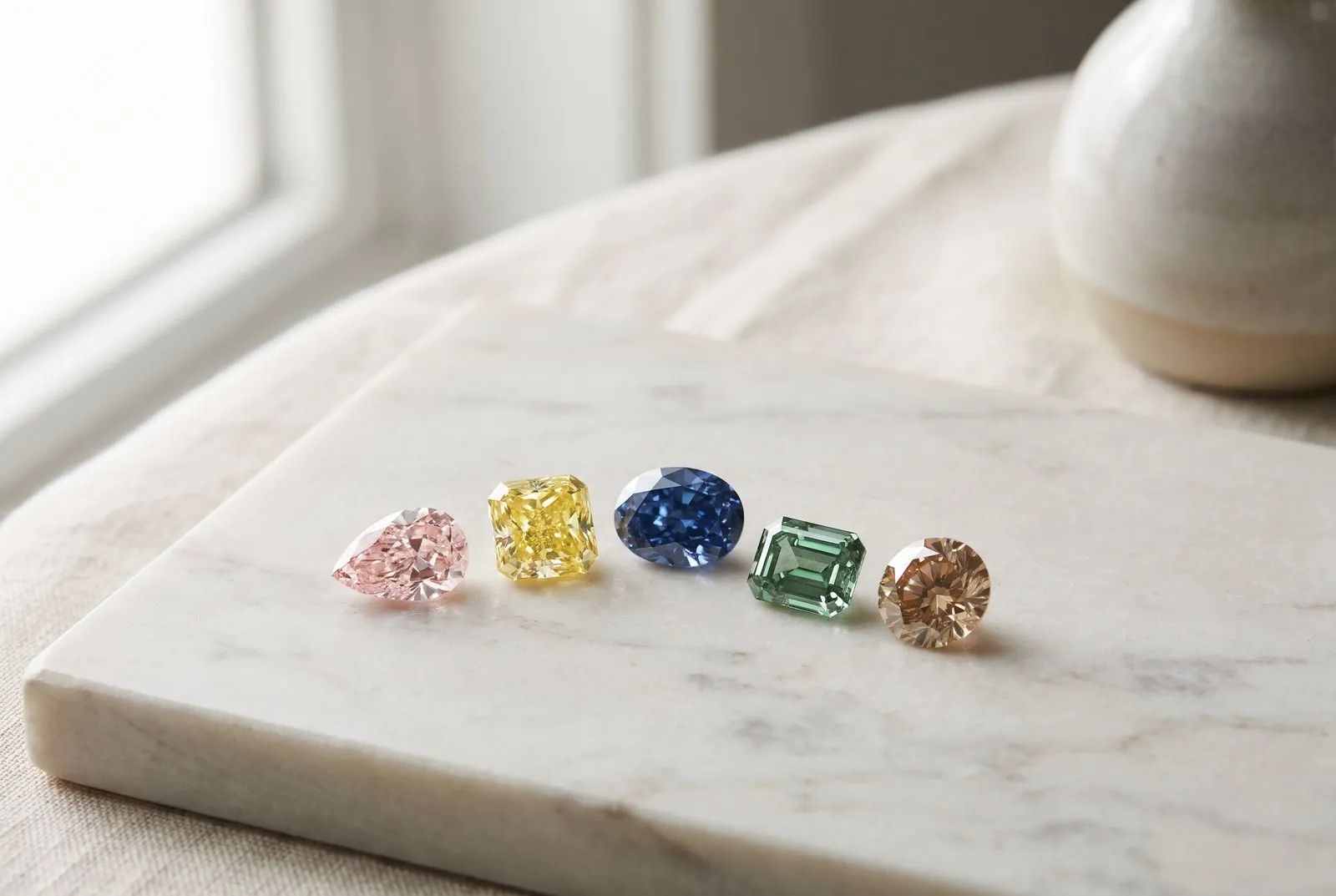
Pictured: pink, yellow, blue, green and champagne diamonds. Illustrative image.
What is a colored diamond?
Most diamonds are graded on GIA’s D-to-Z scale, which runs from colorless (D) to a light yellow, brown or gray tint (Z). A colored diamond is one that falls outside that scale. GIA’s rule depends on the hue:
- Yellow and brown stay on the D-to-Z scale while they’re pale. Once the color is stronger than Z, the stone becomes a fancy color, starting at Fancy Light.
- Every other hue, such as pink, blue or green, makes a diamond a colored diamond even when the tint is faint. The 70.20 carat Idol’s Eye is graded “Very Light blue”.
Value works the opposite way on the two scales. On D-to-Z, less color is worth more. On the fancy scale, a stronger, purer color is worth more. Our diamond color chart covers the D-to-Z grades in detail.
What gives a diamond its color?
Pure diamond is colorless carbon. Color comes from a few stray atoms or flaws in the crystal, and GIA has spent years cataloging which cause goes with which color.
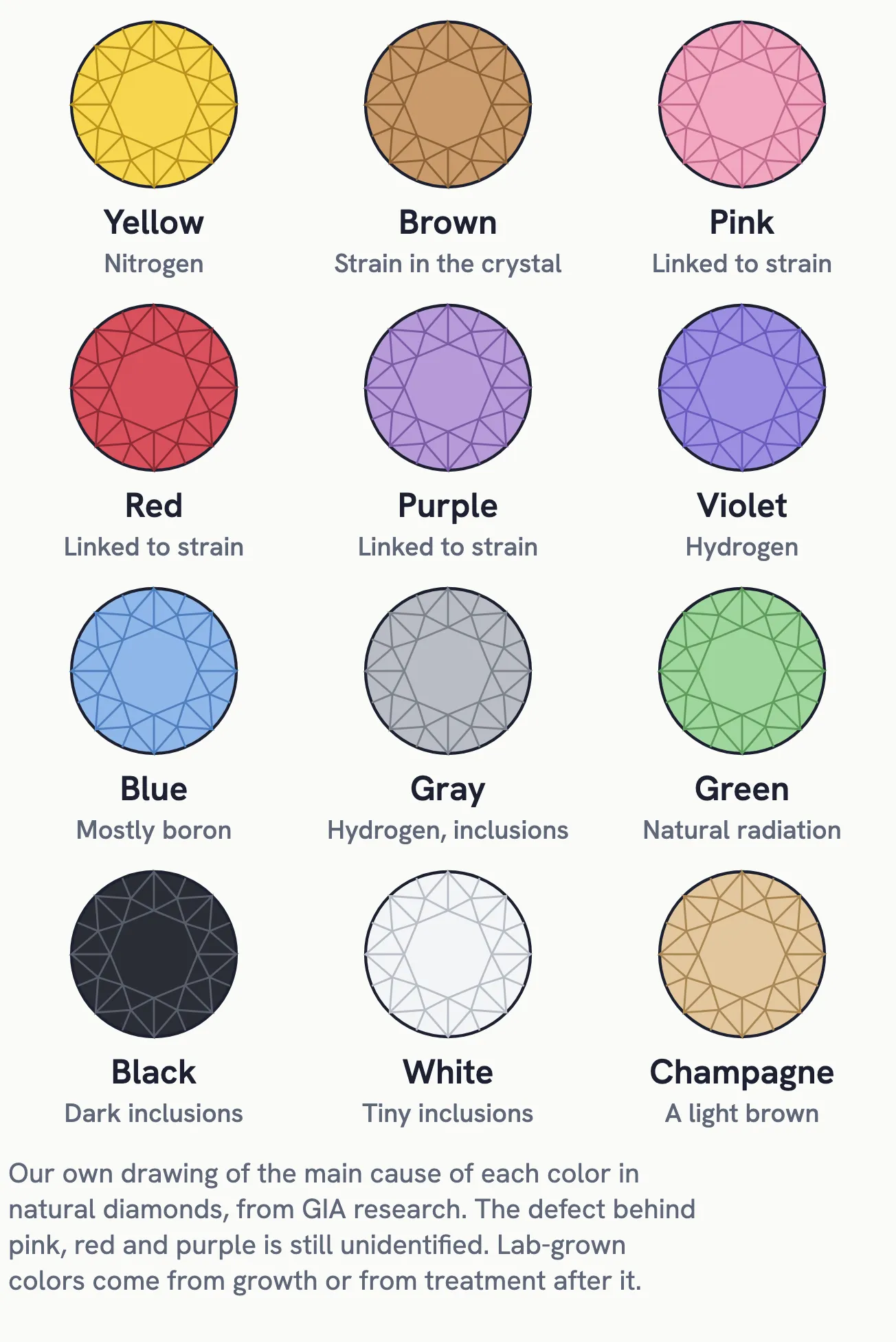
The main cause of each color in natural diamonds. Our own drawing, from GIA research.
- Yellow: nitrogen. In a GIA study of 500 yellow diamonds, nitrogen clusters called cape defects colored about three in four.
- Pink, red and purple: a light-absorbing band linked to plastic deformation, when the crystal was squeezed and sheared deep in the earth. GIA’s 2018 study of 1,000 pinks found the band in 99.2% of them, but the exact defect behind it is still unidentified.
- Brown: usually tiny clusters of missing atoms, also from deformation.
- Blue: boron colored about 35% of the blue, gray and violet diamonds in another GIA study, and more than half of the pure blues. Hydrogen and natural radiation color most of the rest. The Hope Diamond owes its blue to about 360 parts per billion of boron.
- Green: natural radiation is the main cause, behind nearly half the greens GIA sees. Much of it sits in a thin skin on the rough crystal that cutting removes, so many green crystals become pale stones.
- Gray and violet: mostly hydrogen, or tiny inclusions.
- Black: masses of tiny dark inclusions, mostly graphite. White: clouds of nano-inclusions that scatter light and look milky.
Lab-grown colored diamonds get their color differently, from what’s added during growth or from treatment after it. We cover that below.
Every diamond color, from rarest to most common
Sources don’t agree on an exact rarity ladder. Most put red first, but they name different colors in second place. GIA groups the colors roughly like this, and so do we:
- Red, the rarest. GIA’s records show no report describing a diamond simply as “red” between 1957 and 1987, and pure red was only 0.5% of the 90,000-plus pink-family diamonds GIA graded from 2008 to 2016. The 5.11 carat Moussaieff Red is the best-known example. The 0.95 carat Hancock Red sold for $880,000 in 1987, then a record per carat for any gem.
- Green, purple and orange. GIA places these with red among the rarest. On GIA’s own counts, pure orange and pure purple came in even less often than pure green. The 5.03 carat Aurora Green sold for $16.8 million in 2016, and the 14.82 carat Orange for $35.5 million in 2013.
- Blue and pink. Rare and the best known. The 14.62 carat Oppenheimer Blue holds the blue record at $57.5 million (2016). Pink holds two records: the CTF Pink sold for $71.2 million in 2017, a record for any diamond at auction, and the Williamson Pink Star sold for about $5.17 million a carat in 2022, a record per carat for any gem. Rio Tinto’s Argyle mine in Australia, which Rio Tinto called virtually the sole source of a steady supply of pinks, closed in November 2020 after 37 years.
- Gray, white and black. Natural ones are uncommon at the labs, but rarity doesn’t make them expensive, and most black diamonds sold are treated.
- Yellow and brown, the most common. GIA says yellow makes up about 60% of fancy color diamonds. Brown dominates what comes out of the ground: Argyle’s output was 72% brown. Lighter browns are sold under trade names such as champagne and cognac.
You can see the same pattern in what’s for sale. On November 5, 2026, natural fancy color diamonds were 3.6% of the natural diamonds listed at Blue Nile, and more than three in four of those were yellow.
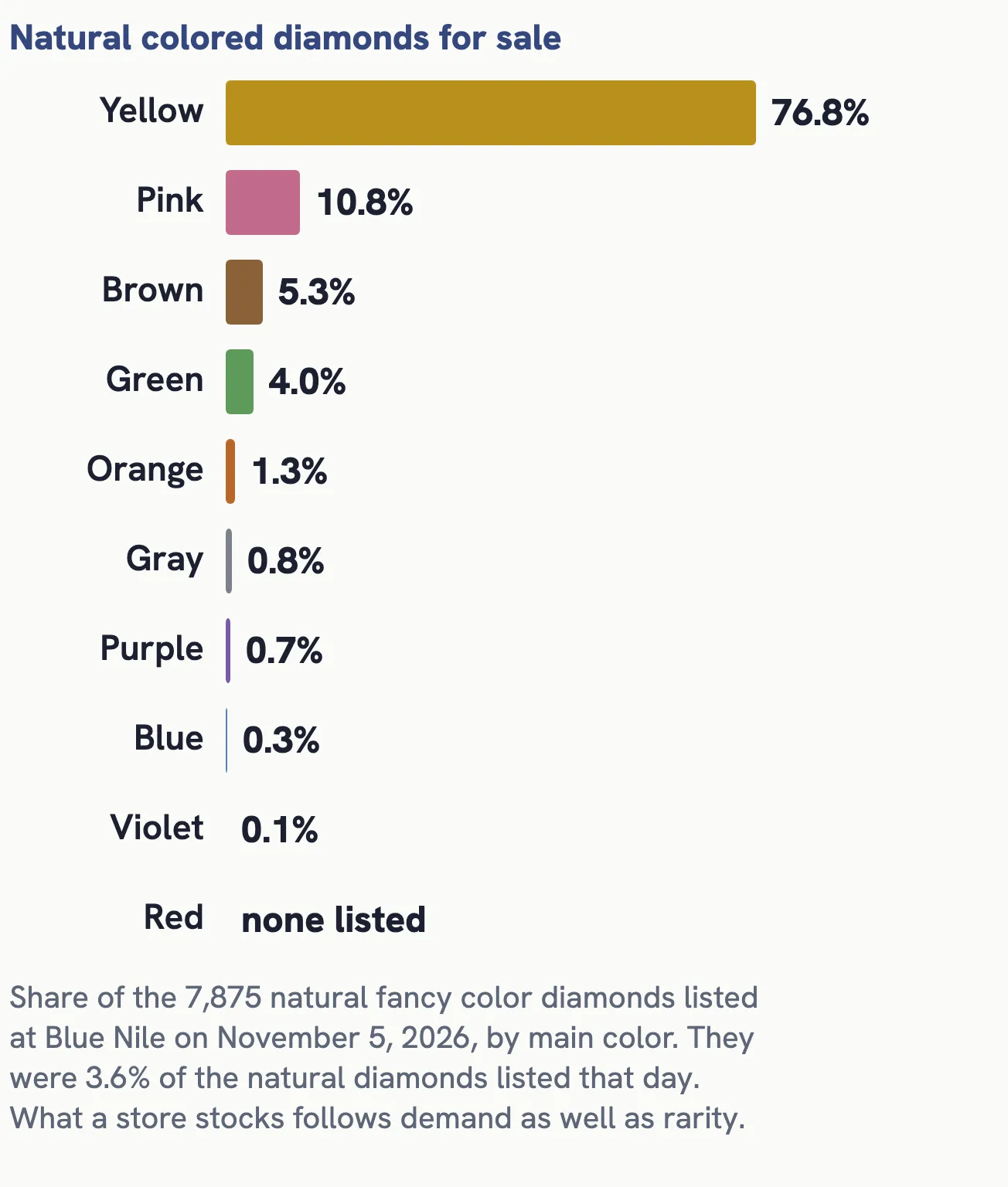
Natural colored diamonds for sale at one large US retailer, by color, November 5, 2026.
How rare are colored diamonds?
GIA estimates that only about one diamond in 10,000 has a fancy color, though it doesn’t say how that figure was measured. Its lab data uses a different base: in the ten years before its 2018 green diamond study, diamonds with natural green, blue or pink-to-red color made up under 0.4% of everything submitted to GIA, and pure green, blue or red hues under 0.07%.
Diamonds in general aren’t rare. The Kimberley Process counted 98.8 million carats of rough diamond mined in 2025, worth $9.23 billion, about 20 tonnes. Colorless and faintly tinted stones come out by the tens of millions of carats. Strong, pure color is the rare part.
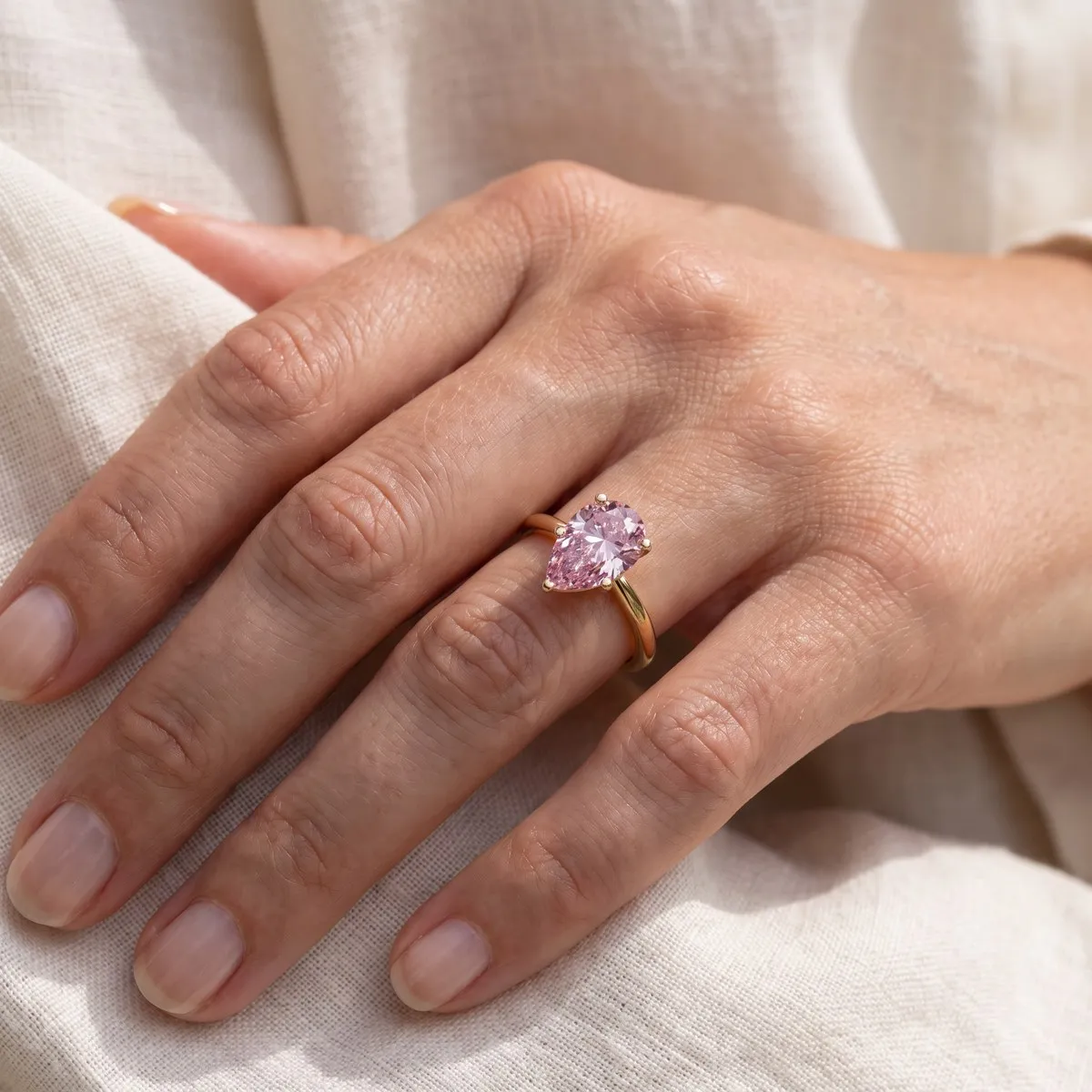
A lab-grown pink pear in a yellow gold solitaire setting. Image created from the design.
How colored diamonds are graded
GIA grades a colored diamond face-up, the way you see it in a ring, while D-to-Z diamonds are graded upside down. The grader names the hue from 27 options, often with a modifier: in “purplish pink” the main color is pink. Then the grader gives one of nine grades that combine how light or dark the color is and how strong:
- Faint, Very Light and Light, for pale tints of any hue except yellow and brown
- Fancy Light and Fancy
- Fancy Intense and Fancy Vivid, the strong colors, which usually sell for the most
- Fancy Dark and Fancy Deep, the darker tones
Fancy Deep and Fancy Dark aren’t a step above Vivid; they describe a darker look. For colored diamonds, color matters far more than clarity or cut, and cutters shape a stone to show the best face-up color rather than the most sparkle. Mixed cuts such as the radiant can even deepen a stone’s color; our guide to diamond shapes covers the radiant and every other cut.
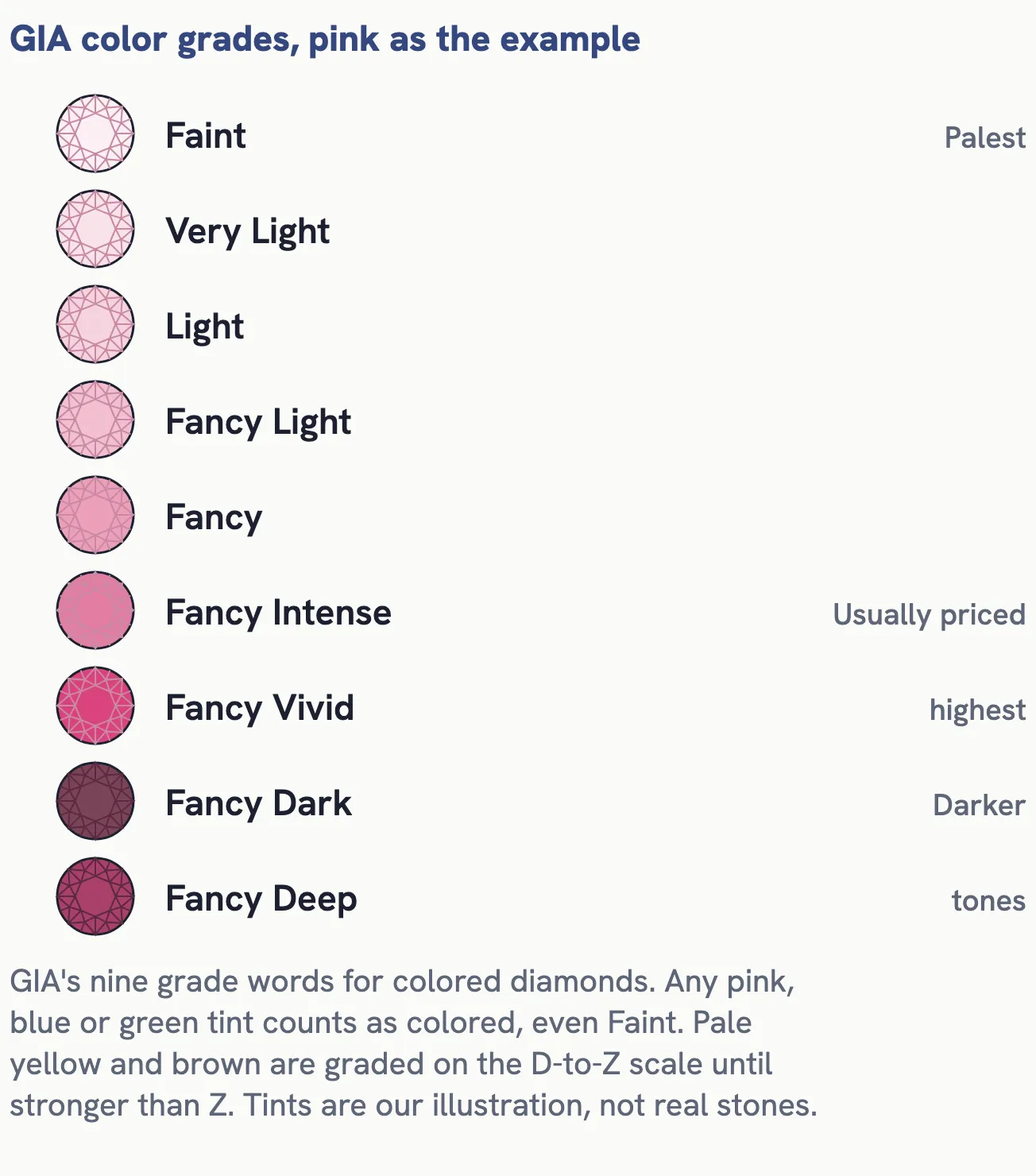
GIA’s nine grades for colored diamonds, with pink as the example. Tints are our illustration.
Every GIA colored diamond report also states whether the color is natural or treated. Green is the hardest call: radiation treatment can look almost identical to natural radiation, so greens get more “undetermined” results than any other color.
Which colored diamond is the most expensive?
Pink, blue, red and green sit at the top. GIA names them as the highest-priced hues, and pink and blue hold the auction records. Our blue diamond price guide lists recent sales by grade. Yellow and brown are the most affordable natural fancy colors. The Graff Vivid Yellow, a 100.09 carat Fancy Vivid yellow, set the yellow record in 2014 at about $163,000 a carat, roughly a thirty-second of the pink record per carat.
Store prices tell the same story at everyday sizes. At Blue Nile on November 5, 2026, a natural colored diamond of about 1 carat typically cost $3,908 in yellow, $3,102 in brown, $7,892 in green and $49,805 in pink. Our pink diamond price guide has the prices by carat. Only two natural blues of that size were listed, and their median was $255,271.
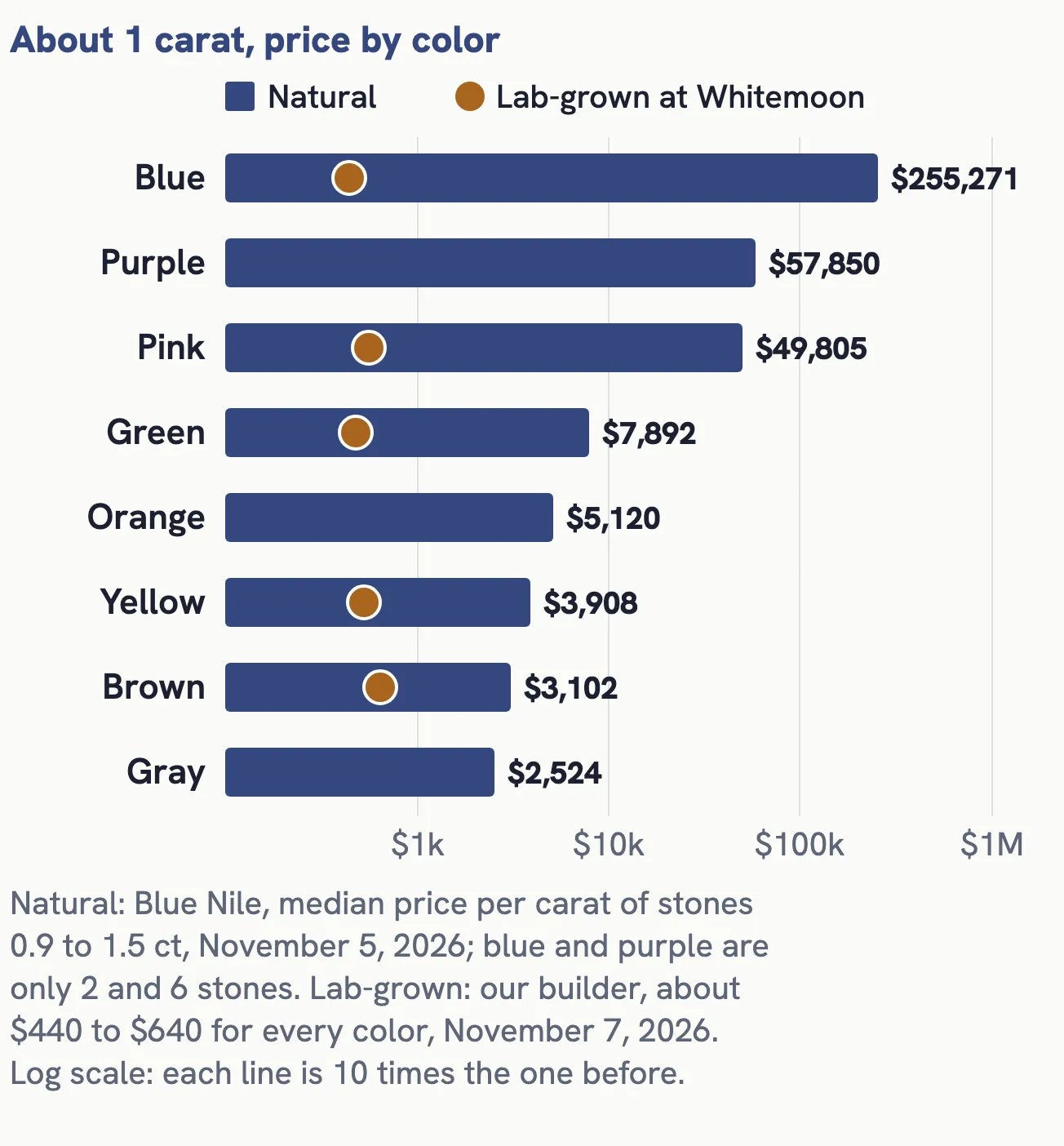
About 1 carat, natural at Blue Nile (November 5, 2026) vs lab-grown in our builder (November 7, 2026).
Prices can also fall. The Fancy Color Research Foundation index shows pinks up 390% since 2005 and yellows up 47%, but the index was flat to slightly down through mid-2026, and the 9.51 carat Mellon Blue sold for about $7 million less in 2025 than in 2014. We don’t think any diamond should be bought as an investment.
Lab-grown colored diamonds
A lab-grown diamond is diamond, with the same crystal as a mined one, and it can be grown in color. Our guide to how lab-grown diamonds are made covers the two growing methods.
- Yellow comes from nitrogen taken in during growth, the same element that colors natural yellows.
- Blue comes from boron added during growth. Lab-grown blues often hold more boron than natural ones, and 85% of those in a GIA study were graded Fancy Intense to Fancy Deep.
- Pink and red are made after growth, by irradiating the stone and then gently heating it. Natural pinks get their color from deformation, which no lab process is known to copy.
The report tells you which you’re buying. On four 2025 IGI reports for lab-grown colored diamonds that we read, a blue grown by the high-pressure method said “As Grown - No indication of post-growth treatment”, while two pinks and a second blue said “Indications of post-growth treatment”. Our guide on how to read a diamond certificate shows where that line sits.
Under the FTC’s jewelry guides, a lab-grown diamond has to be called lab-grown, laboratory-created or similar, right before the word diamond, and words like “real” and “natural” are deceptive for it. A natural diamond whose color was treated must have the treatment disclosed when it affects value or needs special care. Treated natural colors, made by irradiation, high-pressure heating or coatings, sell for much less than untreated natural colors.
In our ring builder on November 7, 2026, lab-grown pink, blue, yellow, green and brown diamonds of about 1 carat typically cost $440 to $640. A 2.03 carat Fancy Intense yellow radiant with an IGI report was $1,055.60. Like all lab-grown diamonds, a lab-grown colored diamond doesn’t hold its retail price on resale, so buy one because you love wearing it. Our Lifetime Upgrade gives you 100% of what you paid as credit toward a new lab-grown piece worth at least 1.5 times as much.
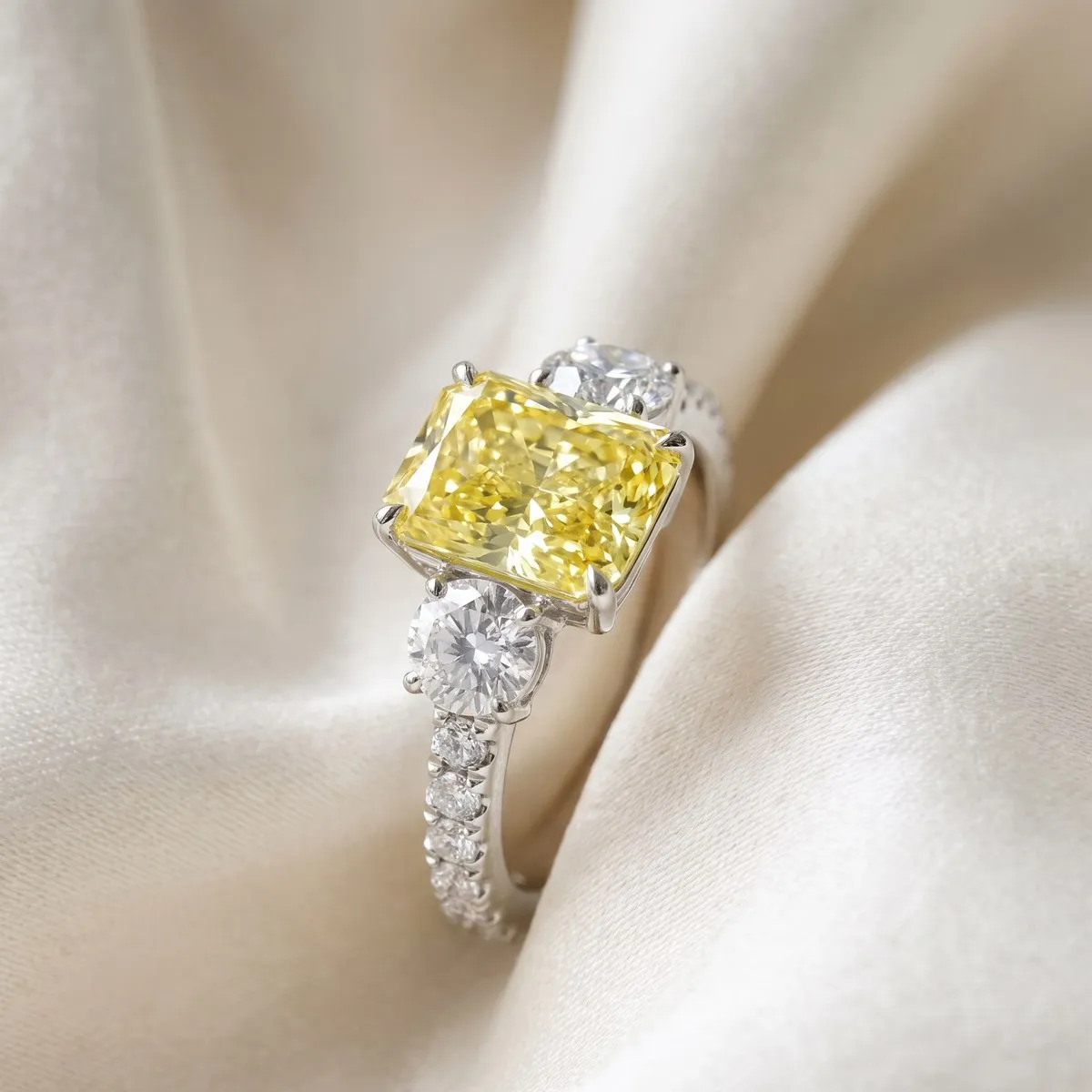
A lab-grown yellow radiant three stone ring in white gold. Image created from the design.
Black diamonds and salt and pepper diamonds
Most black diamonds sold in jewelry are treated, usually irradiated to a green so dark it looks black, or heated until fractures inside turn to graphite, according to GIA. Natural black diamonds owe their color to dense inclusions. Some are carbonado, a black diamond made of many tiny crystals whose origin is still unknown. One of them, the 555.55 carat Enigma, sold for about $4.3 million in 2022, and the seller’s claim that it came from space is an unproven theory.
Salt and pepper diamonds are natural diamonds full of dark and white inclusions, often grayish. It’s a trade name, not a GIA color grade, and we don’t list them.
What do colored diamonds mean?
No gem lab assigns meanings to colors, so treat these as tradition and marketing rather than fact. Blue is often associated with calm and trust, yellow with joy and friendship, green with growth and renewal, pink with romance, red with passion and black with mystery. The Hope Diamond’s famous curse is a legend, not history.
How to choose a colored diamond
A few things matter more for color than for a white diamond. This is our advice:
- Judge the color face-up, the way the stone will sit in the ring. Intensity and evenness matter more than a clarity grade.
- Read the report. For a natural stone, check that the color is natural; for a lab-grown stone, check whether it’s as grown or treated. Our guide to IGI vs GIA reports explains the two labs.
- Think about the metal. In our opinion, yellow gold warms a yellow or pink, while white gold and platinum keep a blue or green looking cool.
- Pick a shape that holds color. Mixed cuts such as the radiant tend to show color more strongly than a round brilliant.
Many of our settings come in versions made for a pink, yellow, blue, green or black center. Browse our pink diamond rings, yellow diamond engagement rings, blue diamond rings, green diamond rings and black diamond rings, then choose the center in our ring builder with its Fancy color filter. Which colors and shapes are in stock changes daily. Most Whitemoon rings are made to order in about 10–15 days and ship free with insurance both ways, with 30-day returns on unworn pieces and one free resize within 60 days of delivery.
Colored diamond questions
Which color diamond is most valuable?
Natural pink, blue, red and green. Pink holds the auction record for any diamond, the CTF Pink at $71.2 million in 2017, and the per-carat record, the Williamson Pink Star at about $5.17 million a carat in 2022. The blue record is the Oppenheimer Blue at $57.5 million in 2016.
What is the rarest diamond color?
Red. GIA issued no report calling a diamond simply “red” from 1957 to 1987, and pure red was only 0.5% of the 90,000-plus pink-family diamonds it graded from 2008 to 2016.
What is the 2nd rarest diamond color?
There’s no agreed answer. GIA groups green, purple and orange with red as the rarest colors, and different sources name each of them, or blue, as second. On GIA’s lab counts, pure orange and pure purple turn up less often than pure green.
What color diamond costs the least?
Among natural fancy colors, yellow and brown. GIA calls yellow the most affordable natural fancy color, and most black diamonds sold are treated and inexpensive. Lab-grown colored diamonds cost far less than natural ones in any color.
Are yellow or white diamonds more valuable?
It depends on the grade. A faint yellow tint lowers a white diamond’s value, but on the fancy scale a stronger yellow raises it. So a Fancy Vivid yellow can cost more than a near-colorless diamond of the same size, while a top colorless diamond can cost more than a Fancy Light yellow.
What is a green color diamond called?
It’s simply called a green diamond, graded for example as Fancy green or Fancy Intense yellowish green. The most famous is the 41 carat Dresden Green. A chameleon diamond is a different thing: a stone with a green tint that changes color when gently heated or kept in the dark.
How rare is a black diamond?
Natural black diamonds are uncommon at the labs: GIA received fewer than 2,000 natural fancy white and black diamonds together from 2008 to 2019. But most black diamonds sold in jewelry are treated, so a black diamond in a store isn’t usually rare.
What are the 12 colors of diamonds?
“Twelve colors” is a retail way of grouping them. GIA uses 27 hue names with modifiers. A practical list is yellow, brown, orange, pink, red, purple, violet, blue, green, gray, black and white, with chameleon as a color-changing type.
Are colored diamonds real diamonds?
Natural colored diamonds are diamonds; the FTC’s definition says diamonds come in many colors. Lab-grown colored diamonds are actual diamonds too, with the same crystal, but they must always be called lab-grown. A natural diamond with treated color is still a diamond, and the treatment must be disclosed.
What color diamond is the most common?
Among colored diamonds, brown and yellow. Brown dominates what’s mined, and yellow makes up about 60% of the fancy color diamonds that are graded and sold.