How Much Does a Blue Diamond Cost? Prices by Carat
Prices last updated November 14, 2026. We recheck them every month. Other stores’ prices come from their listings on November 11.
A lab-grown blue diamond costs about $440 at 1 carat and $944 at 2 carats at Whitemoon. A natural blue diamond is in another league: the 1 to 1.5 carat stones listed at large online stores ran from about $150,000 to $445,000, a 1.36 carat Fancy Intense Blue sold at auction for CHF 355,600, and the best large stones have sold for $2 million to $4 million a carat.
We sell lab-grown blue diamonds, so the lab-grown figures here come from about 13,000 blue stones in our own diamond list. For natural blue we used the 16 stones that three large online stores listed on November 11 and auction results from 2025 and 2026, each named and dated. One thing surprised us in our own numbers: among lab-grown blues the strongest color grade, Fancy Vivid, is the least expensive, the reverse of natural stones.
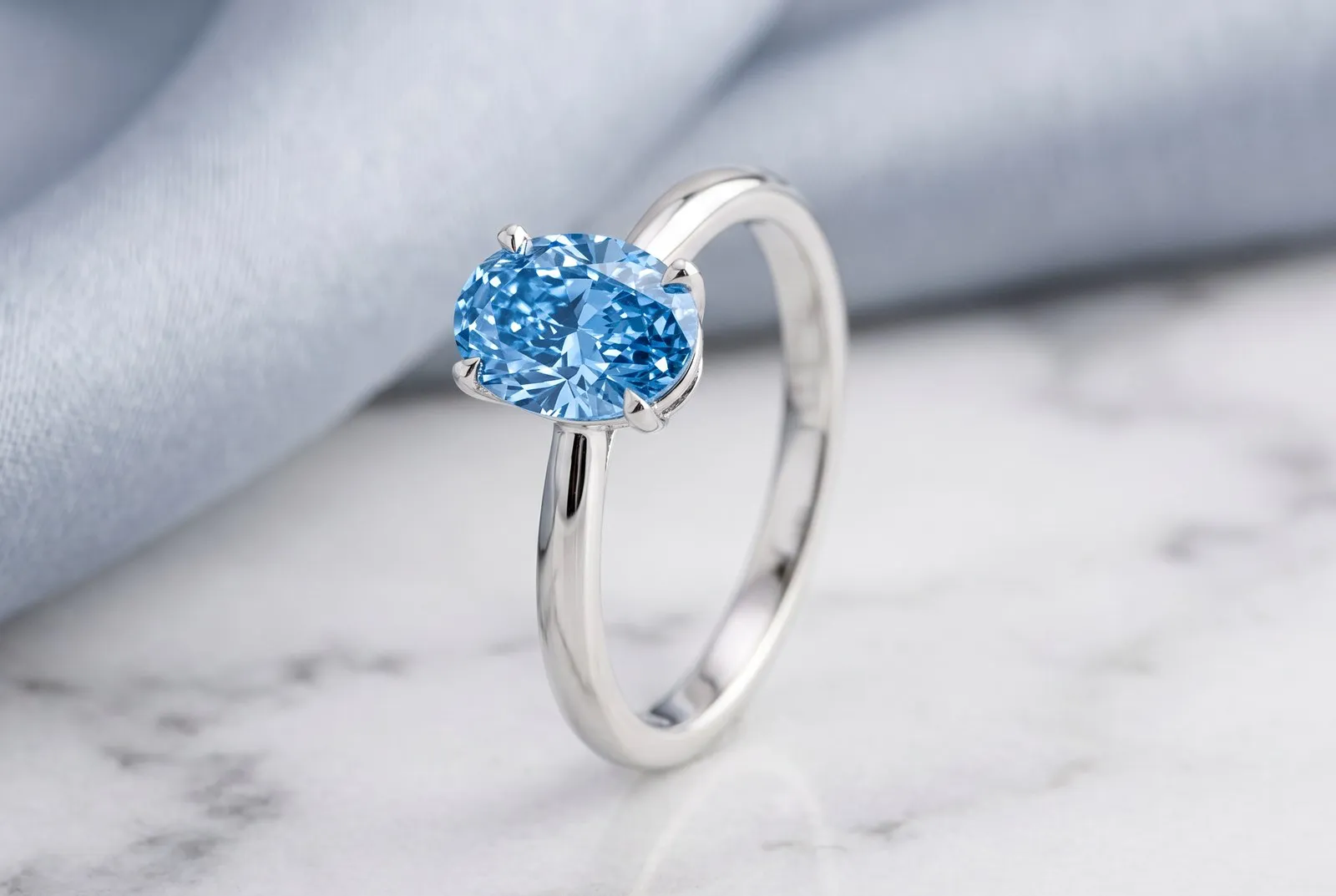
Pictured: an oval solitaire in white gold with a lab-grown blue diamond center. Image created from the design.
How much is a blue diamond worth?
It depends first on whether it’s natural or lab-grown. Both are diamonds under the FTC’s Jewelry Guides, which define a diamond by its carbon crystal and not by where it formed, but one is among the rarest gems on earth and the other is made to order.
| Blue diamond | 1 carat | 2 carats |
|---|---|---|
| Lab-grown at Whitemoon, typical | $440 | $944 |
| Lab-grown at Brilliant Earth, typical | $1,120 | $2,439 |
| Natural, store listings, Fancy Light to Fancy | $150,659 to $445,533 (1.09 to 1.51 carats) | $1,040,031 (one 2.29 carat stone) |
Lab-grown: median price per carat of stones from each weight up to half a carat heavier, scaled to the weight, all color grades and shapes; Brilliant Earth November 11, 2026, Whitemoon November 14. Natural: asking prices of GIA-graded stones at Blue Nile, November 11.
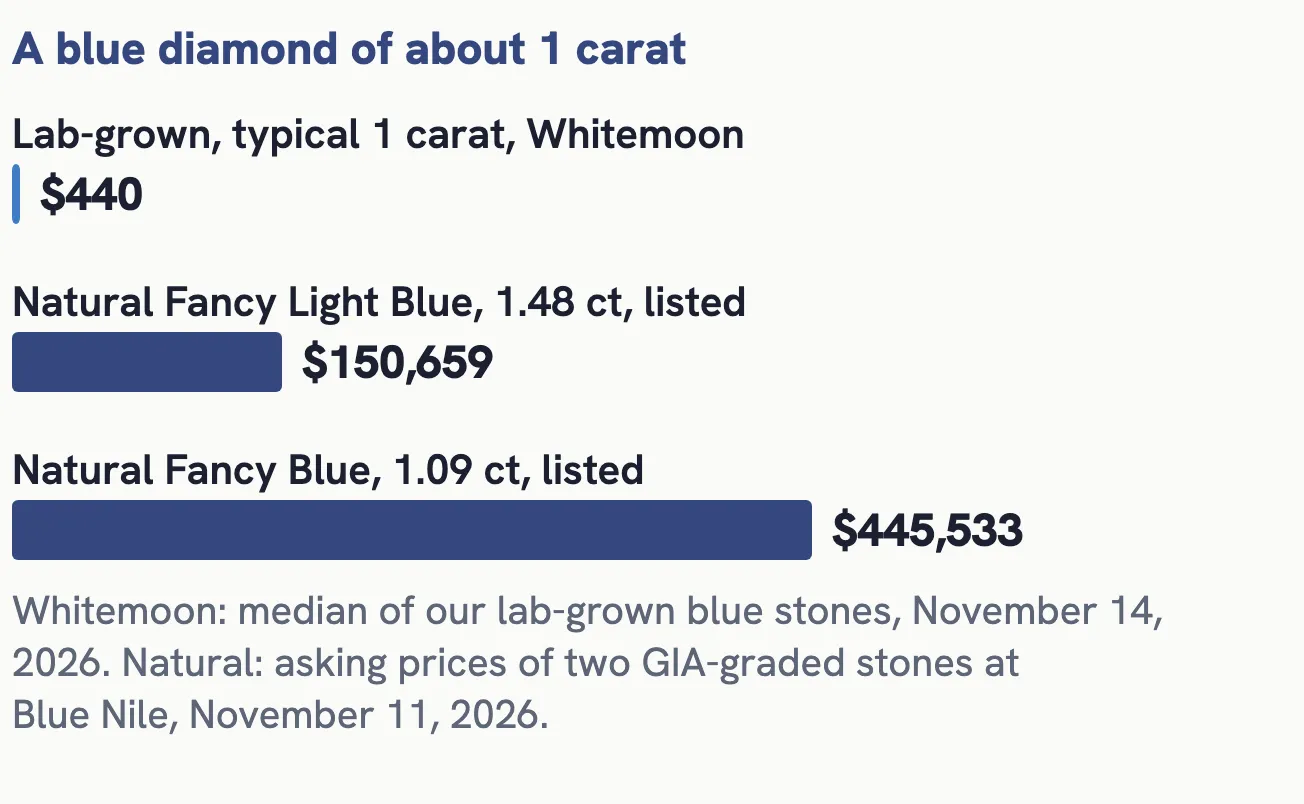
About 1 carat: lab-grown at Whitemoon against two natural stones listed for sale.
Lab-grown blue diamond prices by carat
These are our own prices for lab-grown blue diamonds, across every shape, clarity and color grade.
| Weight | Typical price | Eight in ten cost between | Stones |
|---|---|---|---|
| Half carat | $283 | $188 and $340 | 1,037 |
| 1 carat | $440 | $352 and $640 | 3,667 |
| 1.5 carats | $660 | $516 and $1,080 | 2,033 |
| 2 carats | $944 | $704 and $1,440 | 1,853 |
| 2.5 carats | $1,160 | $900 and $1,853 | 751 |
| 3 carats | $1,493 | $1,128 and $2,400 | 1,362 |
| 4 carats | $1,984 | $1,584 and $3,200 | 561 |
| 5 carats | $2,700 | $2,000 and $4,140 | 530 |
Lab-grown blue diamonds at Whitemoon, November 14, 2026. Median price per carat of stones from each weight up to half a carat heavier, scaled to the weight. On that day the ring builder showed 1,261 lab-grown blue stones ready to choose.
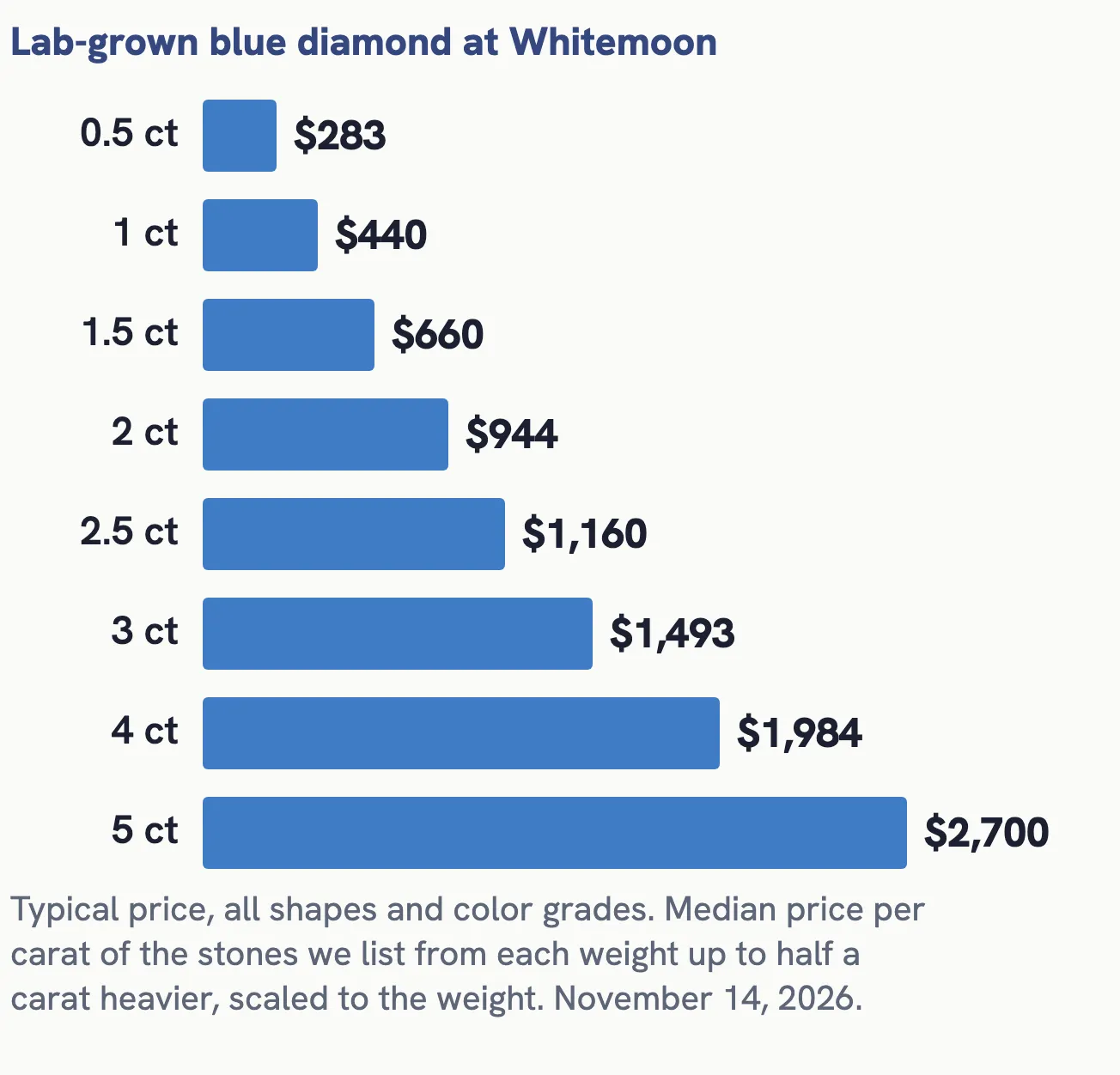
Our lab-grown blue diamond prices from half a carat to 5 carats.
A lab-grown blue costs about 25% to 40% more than a white lab-grown diamond of the same weight with us: $440 against $340 at 1 carat and $2,700 against $1,916 at 5 carats. Our diamond price chart has the white prices at every size.
Here is the same measure at one other store. We compare only with stores priced above us on that date.
| Lab-grown blue | Whitemoon | Brilliant Earth |
|---|---|---|
| Half carat | $283 | $519 |
| 1 carat | $440 | $1,120 |
| 2 carats | $944 | $2,439 |
| 3 carats | $1,493 | $4,031 |
| 5 carats | $2,700 | $6,719 |
Typical price across all color grades and shapes. Brilliant Earth: about 7,500 stones it lists as blue, November 11, 2026; Whitemoon November 14.
Lab-grown blue diamond price by color grade
Labs grade a colored diamond by how strong its color is, from Fancy Light through Fancy and Fancy Intense to Fancy Vivid. In natural blues, stronger color costs far more. Among the lab-grown blues we list it runs the other way.
| Grade | 1 carat | 2 carats | 3 carats | Share of our blue stones |
|---|---|---|---|---|
| Fancy Light Blue | $600 | $1,576 | $3,588 | 1% |
| Fancy Blue | $600 | $1,200 | $2,580 | 2% |
| Fancy Intense Blue | $500 | $1,120 | $1,860 | 8% |
| Fancy Vivid Blue | $440 | $920 | $1,440 | 89% |
Lab-grown blue diamonds at Whitemoon, IGI reports, November 14, 2026; same method as above. The Fancy Light figures at 2 and 3 carats rest on 8 stones each.
The reason is supply. Nearly nine in ten of the lab-grown blue stones we list are Fancy Vivid, so the vivid blue most people picture is also the easiest to find. Paler blues are scarce in lab-grown lists, and most of ours come from the smaller group grown by the high-pressure method, which costs more with us: $522 for a 1 carat Fancy Vivid against $440 across all vivid stones.
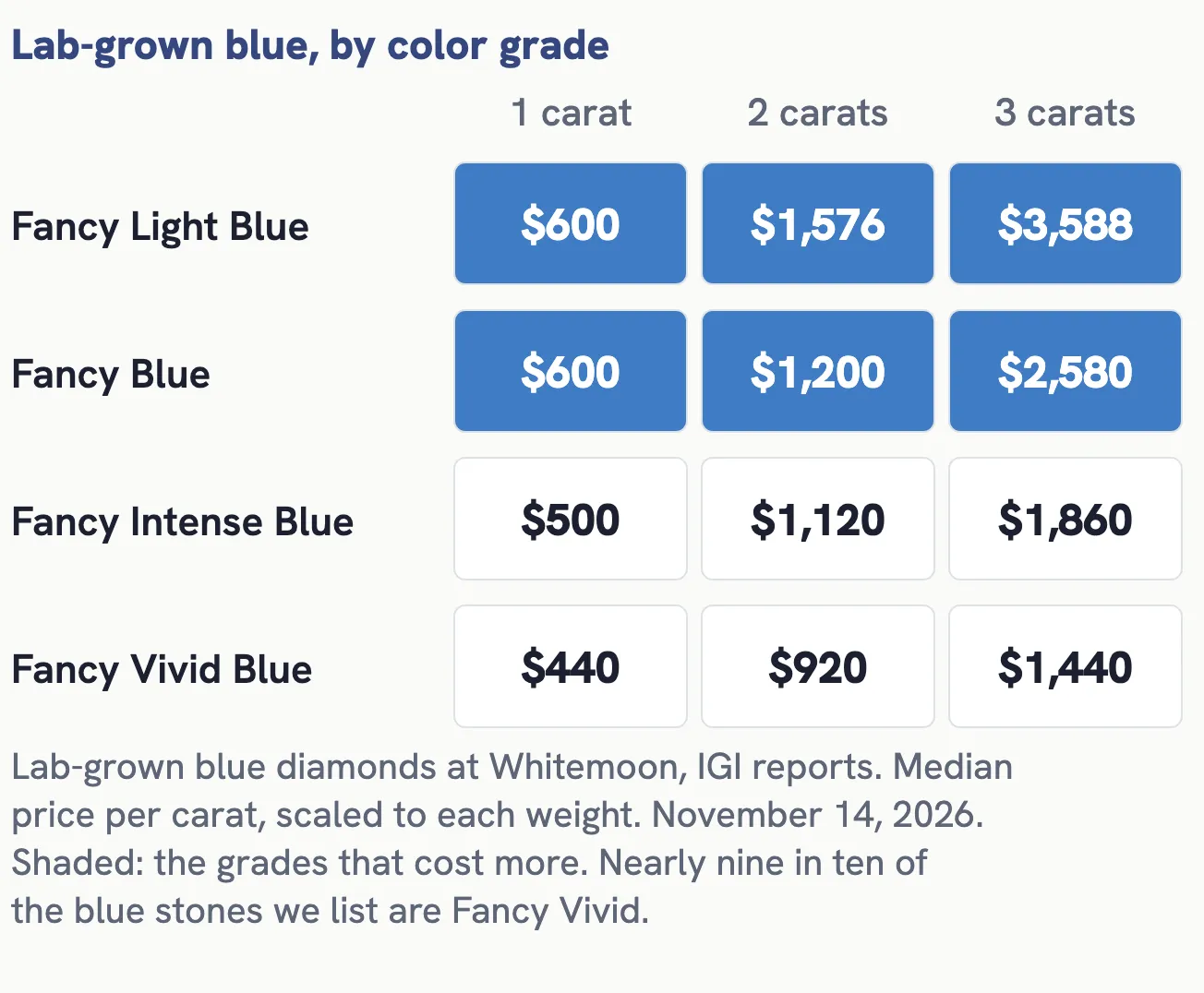
Among our lab-grown blues, the paler grades cost more.
Lab-grown blue diamond price by shape and clarity
| Shape | 1 carat | 2 carats |
|---|---|---|
| Round | $380 | $720 |
| Emerald | $400 | $759 |
| Oval | $440 | $959 |
| Marquise | $440 | $920 |
| Pear | $460 | $1,000 |
| Princess | $472 | $1,040 |
| Radiant | $500 | $912 |
| Heart | $500 | $1,040 |
| Cushion | $547 | $1,040 |
Lab-grown blue diamonds at Whitemoon, all color grades, November 14, 2026. We had 22 princess stones at 2 carats, and too few asscher cuts to give a figure.
Pear, oval and round are the shapes we list most in blue, about 2,300 stones each. Clarity moves the price a little: at 1 carat a VS2 stone was $400, a VS1 $440, a VVS2 $480 and a VVS1 $638. GIA says color matters more than clarity in a blue diamond, because strong color can hide small inclusions. Our diamond shapes guide shows how each shape looks and wears.
Natural blue diamond prices
Natural blue diamonds are too rare for a price chart. The three large online stores we track listed 16 natural blue diamonds between them on November 11, 2026, against about 19,000 lab-grown blue stones. Here are nine of the 15 at Blue Nile, each with a GIA report.
| Weight and shape | GIA color grade | Asking price |
|---|---|---|
| 0.26 carat radiant | Fancy Blue | $11,615 |
| 0.42 carat round | Fancy Light Blue | $70,011 |
| 0.41 carat pear | Fancy Intense Blue | $123,019 |
| 0.79 carat pear | Fancy Intense Blue | $283,123 |
| 1.09 carat pear | Fancy Blue | $445,533 |
| 1.48 carat pear | Fancy Light Blue | $150,659 |
| 1.51 carat oval | Fancy Light Blue | $361,677 |
| 2.29 carat cushion | Fancy Blue | $1,040,031 |
| 4.03 carat pear | Fancy Blue | $1,206,587 |
Asking prices, November 11, 2026. Two stones of the same grade can differ a lot because the listing doesn’t show secondary colors such as gray or green.
What natural blue diamonds sold for at auction
Auction results show what buyers paid. The per-carat figures are our arithmetic on the reported prices, which include the buyer’s fee.
| GIA color grade | Stone | Sale | Price | Per carat |
|---|---|---|---|---|
| Fancy Light Blue | 11.64 carat marquise | Christie’s Geneva, May 2025 | $1.9 million | about $163,000 |
| Fancy Blue | 31.62 carat pear | Christie’s New York, June 2026 | $8.4 million | about $266,000 |
| Fancy Intense Blue | 3.48 carat pear | Sotheby’s New York, December 2025 | $2.6 million | about $747,000 |
| Fancy Intense Blue | 10.02 carats | Sotheby’s New York, June 2026 | $8.7 million | about $868,000 |
| Fancy Vivid Blue | 3.68 carat oval | Christie’s Geneva, May 2025 | $5.8 million | about $1.58 million |
| Fancy Vivid Blue | 5.04 carat marquise | Christie’s New York, June 2026 | $8.1 million | about $1.61 million |
| Fancy Vivid Blue | 10.03 carat cushion, the Mediterranean Blue | Sotheby’s Geneva, May 2025 | $21.5 million | about $2.1 million |
| Fancy Vivid Blue | 9.51 carat pear, the Mellon Blue | Christie’s Geneva, November 2025 | $25.6 million | about $2.7 million |
Sources: Rapaport on Christie’s May 2025 and June 2026 sales and Sotheby’s December 2025 sale; Jeweller Magazine on the 10.02 carat stone; National Jeweler on the Mediterranean Blue and the Mellon Blue.
Grade moves the price more than size does: the 3.68 carat Fancy Vivid sold for about six times as much per carat as the 31.62 carat Fancy Blue. For a stone near 1 carat, a ring with a 1.36 carat Fancy Intense Blue diamond sold for CHF 355,600 at a Phillips sale in Geneva.
Two records still stand. The highest price paid for a blue diamond is the $57.5 million for the 14.62 carat Oppenheimer Blue in May 2016, and the highest per carat is about $4.03 million for the 12.03 carat Blue Moon of Josephine in November 2015.
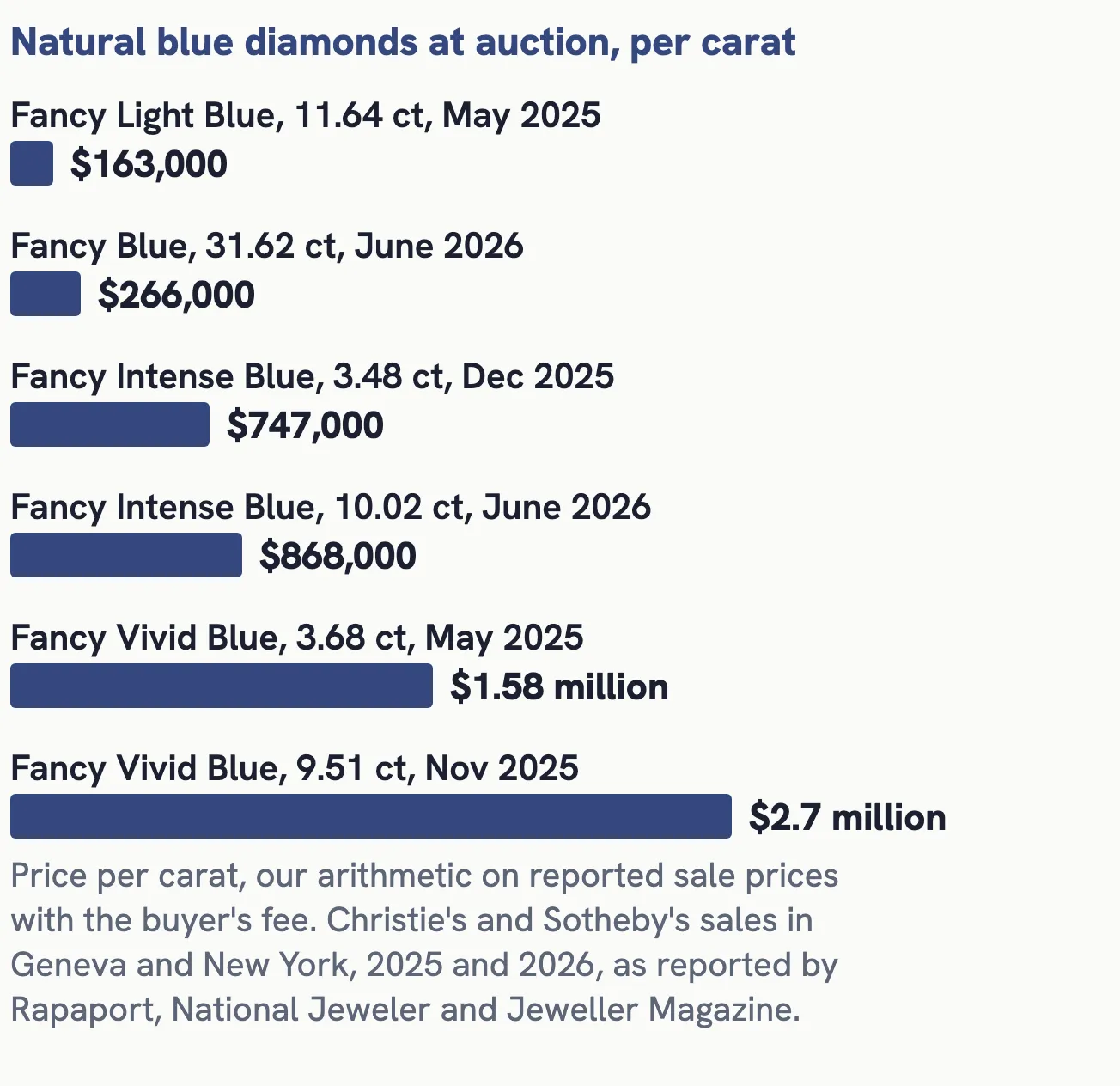
Natural blue diamonds at auction in 2025 and 2026, per carat.
Are natural blue diamond prices rising?
Not lately. The Fancy Color Research Foundation’s index of blue diamond prices fell 0.6% over the year to September 2026, after slipping 0.7% in 2025. The Mellon Blue sold in 2025 for about $7 million less than it made in 2014, and a 6.03 carat Fancy Vivid Blue went unsold at Sotheby’s in May 2026. We report what sold; none of this is investment advice.
Why natural blue diamonds cost so much
Most blue diamonds get their color from traces of boron: less than one boron atom for every million carbon atoms. GIA researcher Evan Smith’s best estimate is that only about 0.02% of mined diamonds are the boron-bearing kind, called type IIb. That’s about 1 in 5,000, and most of those are pale: in GIA’s own records, 42% of pure blue diamonds fell in the three lightest grades.
They also form unusually deep. A 2018 study in the journal Nature found that blue diamonds grew at least 410 kilometers down, about four times deeper than most diamonds, with boron that likely came from ancient seafloor. Today most come from one mine, Cullinan in South Africa. Our guide to colored diamonds covers what causes each color.
What moves the price of a blue diamond
- Strength of color. GIA’s grades for blue run Faint, Very Light, Light, Fancy Light, Fancy, Fancy Intense, Fancy Vivid, Fancy Deep and Fancy Dark. GIA says Fancy Vivid is the most sought after and Fancy Deep the rarest.
- Secondary color. A pure blue is valued most. Gray or green in the color usually lowers the price, and the grade says so, as in the Hope Diamond’s “Fancy Deep grayish blue”.
- Size. Price per carat climbs with weight, as the auction table shows for Fancy Vivid stones.
- Clarity, a little. A 3.47 carat Fancy Intense Blue with an I1 clarity grade still sold for $1.92 million a carat in 2018.
- Whether the color is natural. A natural diamond turned blue by treatment costs much less than a natural-color one. More on that below.
GIA doesn’t give colored diamonds a cut grade, and cutters shape them to hold color. GIA names emerald and cushion cuts as the most popular for blue.
How lab-grown blue diamonds get their color
There are two routes. One adds boron while the diamond grows, the same element that colors natural blues; GIA has found that blue diamonds grown by the high-pressure, high-temperature method carry more boron than natural ones. The other grows the diamond first and changes its color afterward, usually by irradiation.
The grading report tells you which. One IGI report for a lab-grown Fancy Blue round reads “As Grown - No indication of post-growth treatment”, and another for a Fancy Vivid Blue reads “Indications of post-growth treatment”. About nine in ten of the lab-grown blue stones we list were grown by the CVD method and the rest by the high-pressure method, and every one ships with its report, so read the comments line before you choose.
GIA notes that colors produced by irradiation can be sensitive to the heat of a jeweler’s torch. Tell any jeweler who resizes or repairs the ring that the center is a colored lab-grown diamond.
Treated natural blue diamonds
A natural diamond can also be turned blue, by irradiation or by high-pressure treatment. GIA says treated blues cost significantly less than natural-color ones; we found no reliable figure for how much less. Every GIA report states whether the color is natural or treated, and the FTC’s treatment rule says a seller should disclose a treatment that significantly affects a stone’s value. If a natural blue diamond is priced like a white one, ask for the report.
Famous blue diamonds and what they’re worth
- The Hope Diamond. 45.52 carats, graded Fancy Deep grayish blue by GIA, and on display at the Smithsonian. It has no official value; the figures you see online are estimates.
- The Heart of the Ocean. The 56 carat blue diamond in the 1997 film Titanic is fictional, and the film prop was cubic zirconia.
- The Oppenheimer Blue. 14.62 carats, Fancy Vivid Blue, $57.5 million in 2016, still the most paid for a blue diamond.
- The Okavango Blue. 20.46 carats, Fancy Deep blue, found in Botswana and shown in New York in 2021. It hasn’t been sold, so it has no price.
How much a blue diamond ring costs
A ring costs the center stone plus the setting. At Whitemoon on November 14, settings made for a blue center started at $99 in sterling silver, $279 in gold and $819 in platinum. So a typical 1 carat lab-grown blue diamond in the lowest-priced gold setting comes to about $719, and a 2 carat to about $1,223. You choose the setting first and then the stone.
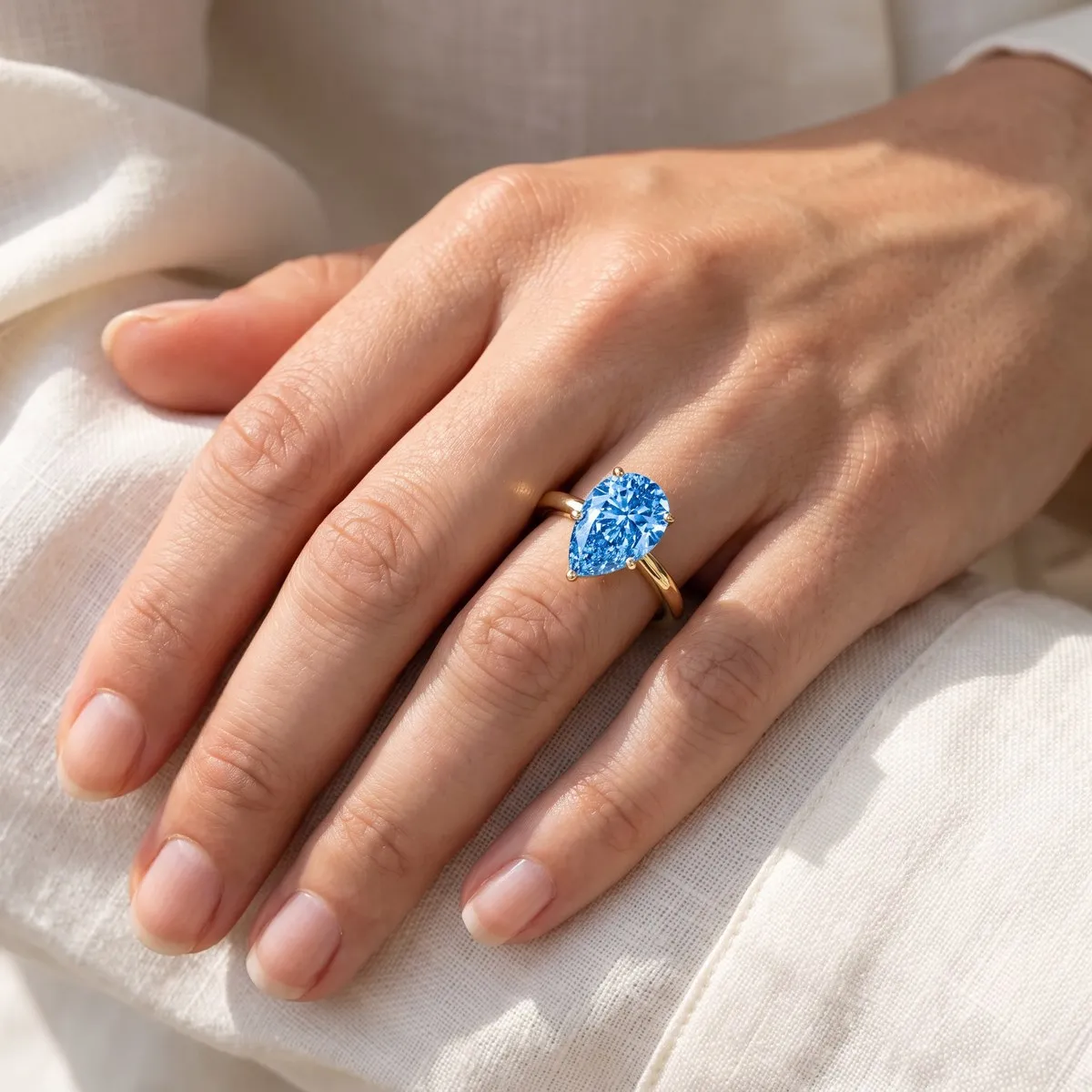
A pear solitaire in yellow gold with a lab-grown blue diamond center. Image created from the design.
Browse blue diamond rings, or narrow it to solitaire, halo, oval, pear or gold. With a natural blue center, the stone alone starts in five figures for a quarter carat, as the listings above show.
Can you tell a natural blue diamond from a lab-grown one?
Not by eye. GIA separates them with imaging and spectroscopy in the laboratory, so the report is your proof: a GIA report on a natural stone states that the color is natural, and a lab-grown report says laboratory-grown and how the stone was made. Our guide to reading a diamond certificate shows where to look.
What a blue diamond is worth when you sell it
Lab-grown diamonds don’t hold their retail price, so buy one to wear and not as an investment. That makes the price you pay up front matter more: at $440 at Whitemoon and $1,120 at Brilliant Earth for a typical 1 carat lab-grown blue, there’s less at stake from day one. Our Lifetime Upgrade gives you 100% of what you paid as credit toward a new lab-grown piece worth at least 1.5 times as much. Our guide to whether lab-grown diamonds are worth it weighs the two kinds.
Natural blue diamonds are bought and sold by a small number of collectors, and as the Mellon Blue shows, even a famous stone can sell for less than it cost.
Shopping for a lab-grown blue diamond at Whitemoon
Pick the shape first, then decide how strong a blue you want; with us the vivid blues cost least. Check the report for the color grade and the treatment comment. Most Whitemoon rings are made to order in about 10–15 days and ship free with insurance both ways, with 30-day returns on unworn pieces and one free resize within 60 days of delivery.
Blue diamond questions
How much is a 1 carat blue diamond?
A typical 1 carat lab-grown blue diamond cost $440 at Whitemoon on November 14, 2026. Natural blue diamonds of 1.09 to 1.51 carats were listed at $150,659 to $445,533 on November 11.
How much does a natural blue diamond cost?
From about $11,600 for a quarter carat Fancy Blue in store listings to millions for large stones. At 2025 and 2026 auctions, prices ran from about $163,000 a carat for Fancy Light Blue to about $2.7 million a carat for a 9.51 carat Fancy Vivid Blue.
How much is a blue diamond worth per carat?
Lab-grown: about $440 a carat at 1 carat and $540 a carat at 5 carats at Whitemoon. Natural: roughly $160,000 to $870,000 a carat for Fancy Light to Fancy Intense stones at recent auctions, and $1.6 million and up for Fancy Vivid.
How much is a blue diamond worth per gram?
A gram is 5 carats. A typical 5 carat lab-grown blue diamond cost $2,700 at Whitemoon on November 14. A natural 5.04 carat Fancy Vivid Blue sold for $8.1 million in June 2026.
How rare is a blue diamond?
GIA researchers estimate that about 0.02% of mined diamonds are the boron-bearing type that is usually blue, about 1 in 5,000, and most of those are pale.
Is a blue diamond more expensive than a white one?
Natural, far more. Lab-grown, a little: a typical 1 carat blue was $440 at Whitemoon against $340 for a white stone.
How much is the 56 carat blue diamond from Titanic worth?
Nothing, as a diamond: the Heart of the Ocean is fictional and the film prop was cubic zirconia. No 56 carat blue diamond has been sold.
How much is the Hope Diamond worth?
There is no official value. It belongs to the Smithsonian and isn’t for sale, so every figure quoted for it is an estimate.
What color of diamond is the most expensive?
By price per carat at auction, pink holds the record and blue is second, at about $4.03 million a carat for the Blue Moon of Josephine in 2015. Our pink diamond price guide has the pink records.