Lab-Grown Diamonds vs Fake Diamonds: Simulants Explained
A fake diamond, or diamond simulant, is a different material that only looks like a diamond: cubic zirconia, moissanite, white sapphire, white topaz, zircon, glass and a few older lab-made stones. A lab-grown diamond is not one of them. It is carbon in the same crystal structure as a mined diamond, with the same hardness, sparkle and chemistry, made in a factory instead of the ground. Of the simulants, none matches diamond on every property; moissanite comes closest in hardness and overall look, and cubic zirconia is the most common.
We sell lab-grown diamonds, and natural diamonds in our ring builder. People often search for “fake diamonds” when they mean lab-grown ones, so we wrote this to set the two apart. The facts come from GIA, the FTC’s Jewelry Guides and its 2019 warning letters to simulant sellers, and published gem property tables, each linked below.
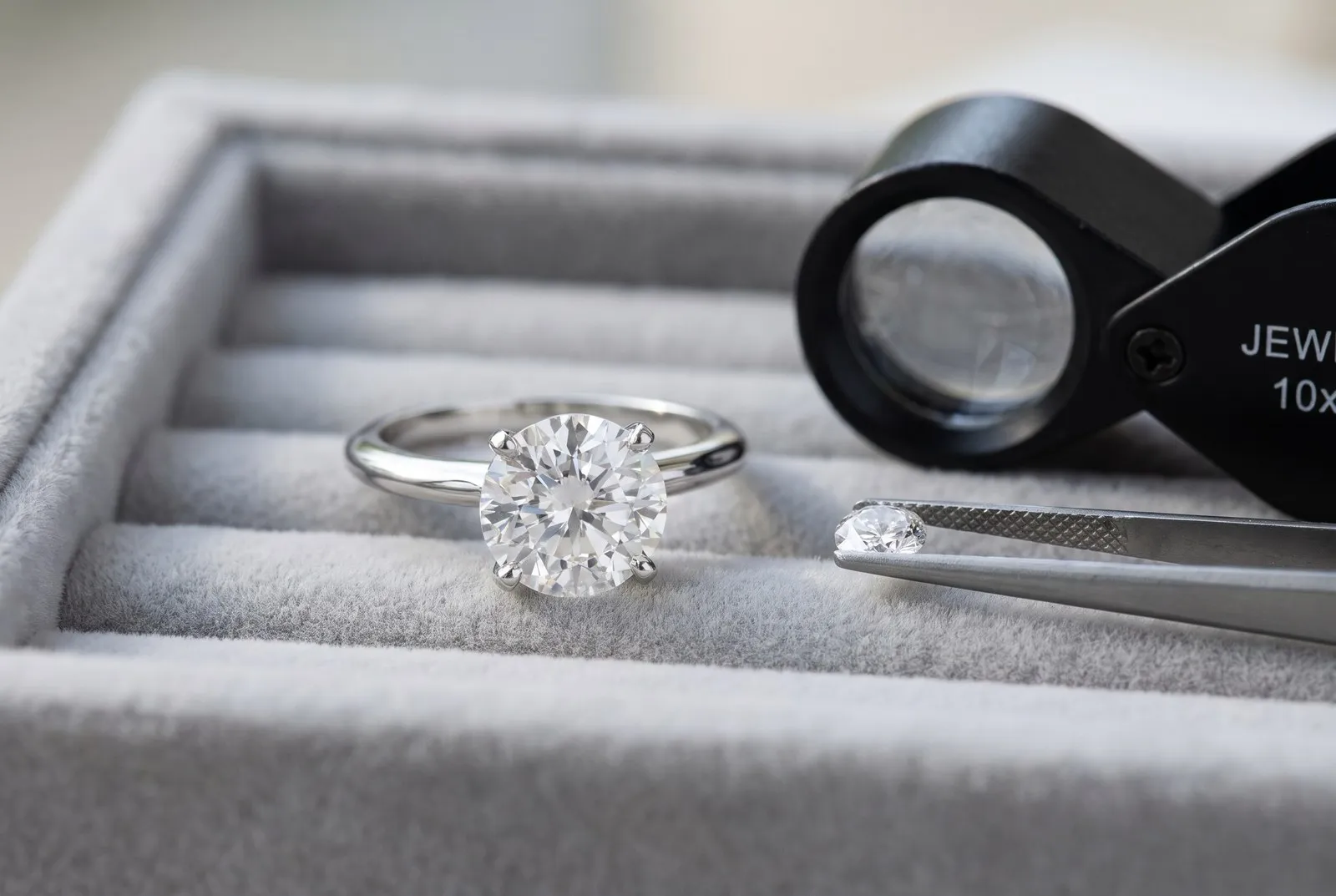
Illustrative image: a solitaire ring, a jeweler’s loupe and stone tweezers.
Lab-grown diamond vs simulant: what’s the difference?
GIA defines a simulant as a material that looks like another gem and is used in its place but has a different chemistry, structure and optical properties. A lab-grown diamond has essentially the same physical, chemical and optical properties as a mined diamond, so GIA does not class it as a simulant.
US advertising guidance draws the same line. The FTC’s Jewelry Guides define a diamond as carbon crystallized in the cubic system, with no mention of where it formed, and say the word “diamond” on its own may not be used for anything else. A simulant must be called a “simulated” or “imitation” diamond, with that word right before “diamond”; the Guides add that “faux” alone isn’t enough, and “lab-created” may only describe a stone that is the real material it names. So “lab-created diamond” can never describe cubic zirconia or moissanite.
The word “synthetic” causes most of the mix-ups. When the FTC revised the Guides in 2018 it cited a survey in which 56% of people thought a “synthetic diamond” was an imitation such as cubic zirconia, which is why “lab-grown” is now the usual term. In 2019 FTC staff sent warning letters to sellers whose simulant names suggested a diamond, such as “lab-created DiamondAura” and “diamondeau”. Our guide to whether lab-grown diamonds are actual diamonds covers the rules in more detail.
The common diamond simulants compared
| Stone | What it is | Brilliance (refractive index) | Fire (dispersion) | Hardness (Mohs) | Weight vs a diamond of the same size |
|---|---|---|---|---|---|
| Diamond, lab-grown or mined | Carbon | 2.42 | 0.044 | 10 | Same |
| Cubic zirconia | Zirconium dioxide, man-made | 2.15–2.18 | 0.058–0.066 | 8–8.5 | About 1.6 to 1.7 times heavier |
| Moissanite | Silicon carbide, man-made | 2.65–2.69 | 0.104 | 9.25 | About 10% lighter |
| White sapphire | Corundum | 1.76–1.77 | 0.018 | 9 | About 14% heavier |
| White topaz | Natural silicate mineral | 1.61–1.64 | 0.014 | 8 | About the same |
| Zircon | Zirconium silicate, natural | 1.81–2.02 | 0.039 | 6–7.5 | About 12% to 34% heavier |
| Glass | Many recipes | 1.48–1.70 | Usually low | About 5–6 | Varies |
Sources: GIA’s 1997 moissanite study and its property table, and gem mineral references for topaz and zircon. Weight is our arithmetic from each stone’s density.
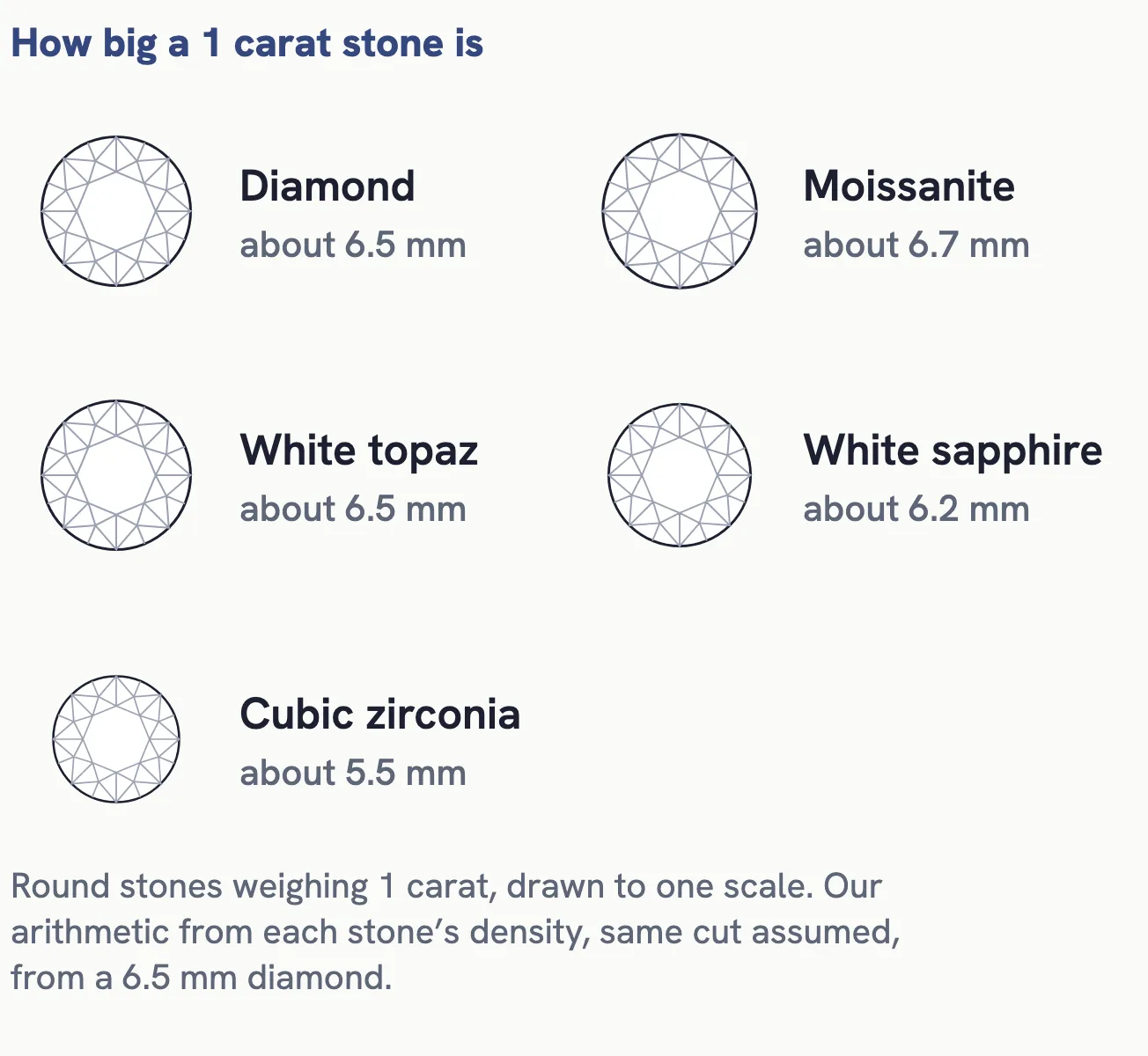
How big a 1 carat stone is, by material.
Cubic zirconia
The most common diamond imitation. It was first sold in 1976 and within five years was being made by the tens of millions of carats a year, according to a 1981 GIA review. GIA says it has a little more fire and less brilliance than diamond, that its flashes of color can look artificial, and that colorless cubic zirconia may turn yellowish over time. It is much heavier than diamond, so a 1 carat cubic zirconia is noticeably smaller than a 1 carat diamond. Our guide to cubic zirconia covers it in full.
Moissanite
Lab-grown silicon carbide, sold for jewelry since the late 1990s. Natural moissanite exists only as tiny grains, so all moissanite in jewelry is man-made. GIA found in 1997 that it was much closer to diamond in look and weight than any earlier imitation. It has more than twice diamond’s fire, which GIA says can give it away in larger stones, and it splits light in two, so its back facets look doubled when you look through it at an angle.
White sapphire
Colorless corundum, natural or lab-made. It is hard and tough enough for a ring, but GIA notes it is less bright and fiery than diamond and needs frequent cleaning to look its best.
White topaz
Plentiful and inexpensive, and almost exactly as heavy as diamond, so a scale won’t tell them apart. GIA says topaz has poor toughness: a sharp knock can split it along its cleavage. Some colorless topaz is coated, and the coating can wear off.
Zircon
A natural gem, not the same thing as cubic zirconia. GIA says zircon’s brilliance and fire caused centuries of confusion with diamond, and it was widely used as a diamond substitute in the early 1900s. It is softer and more brittle than diamond, and its facet edges wear.
Glass and “crystal”
Glass can imitate almost any gem. Lead glass, once called paste, was the diamond imitation of the 1700s. Crystal in the Swarovski sense is glass too: Swarovski’s own brand guide classes its material as crystal glass. Glass is soft and scratches quickly.
Older lab-made simulants
Before cubic zirconia, the lab-made simulants were synthetic rutile from the late 1940s, strontium titanate in the 1950s, and two man-made garnets, YAG and GGG, from the 1960s. GIA says they are rare today and mostly turn up in vintage jewelry. Strontium titanate has almost exactly diamond’s brilliance, but four times its fire and is soft enough to scratch easily.
What is the most realistic fake diamond?
It depends on which property you mean. No simulant matches diamond on all of them, because none is diamond.
| Closest to diamond in | Stone | What gives it away |
|---|---|---|
| Hardness and overall look | Moissanite | Extra fire, doubled facets |
| Brilliance | Strontium titanate | Four times the fire, soft |
| Fire | Zircon | Doubled facets, worn edges |
| Weight | White topaz | Low fire and brilliance |
| Look for the money | Cubic zirconia | Heavy, softer, can yellow |
Our summary from the property table above. In our opinion moissanite comes closest overall and cubic zirconia is the most convincing for the price, but neither is a diamond, lab-grown or mined.
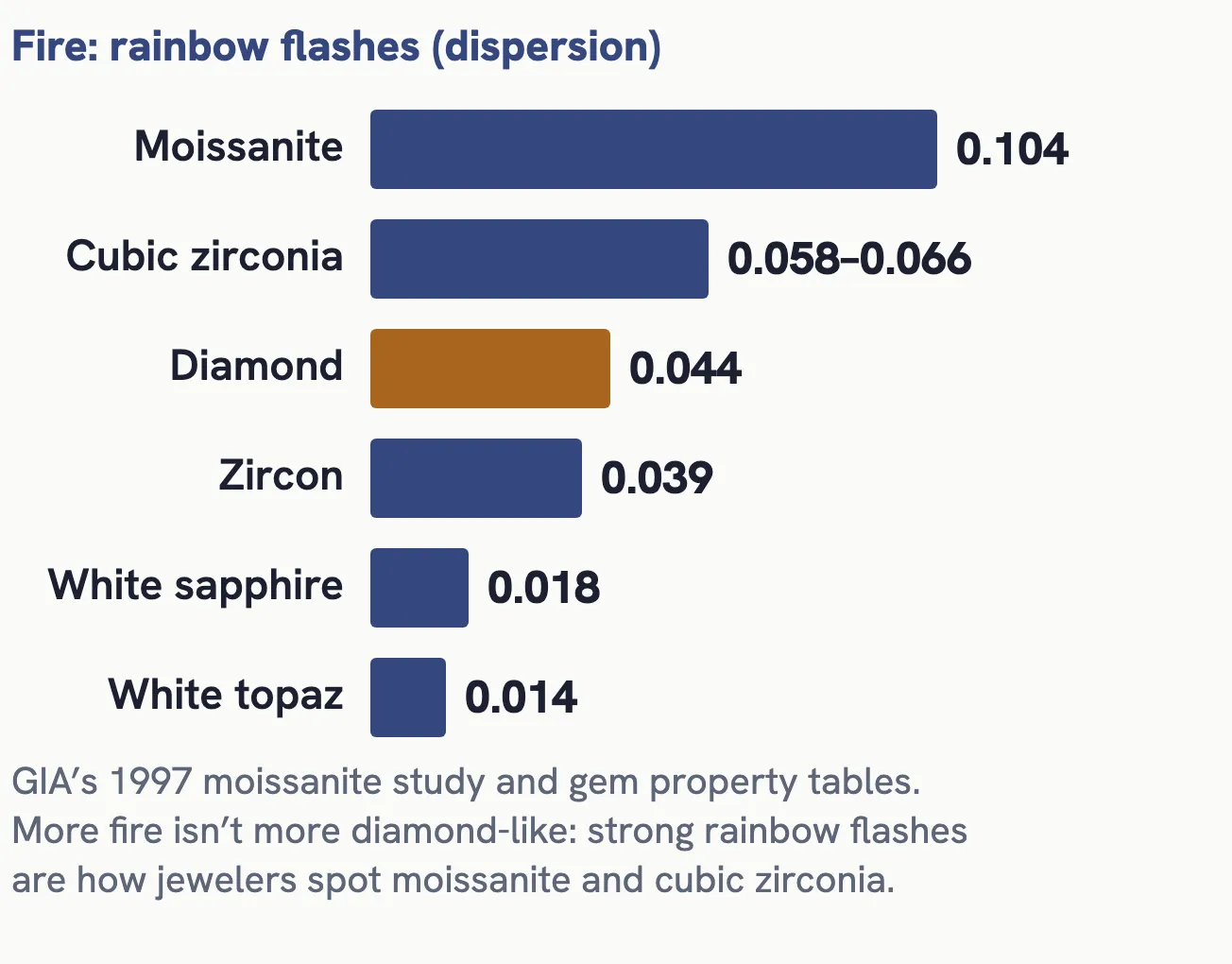
Fire: more isn’t more diamond-like.
What is a “poor man’s diamond”?
An old nickname with no fixed meaning. It has been applied to zircon, rock crystal quartz, white topaz and cubic zirconia. Zircon fits best historically: GIA says it was a lower-cost alternative to diamond in the 19th century.
Some local names sell quartz as “diamonds”. Herkimer diamonds are double-pointed quartz crystals from New York State, and Cape May diamonds are clear quartz pebbles from a New Jersey beach. They are pretty stones and nothing like diamond: quartz has a hardness of 7 and very little fire. Under the FTC’s Guides, the bare word “diamond” is meant only for diamond, so a careful seller calls them quartz.
Is cubic zirconia a lab-grown diamond?
No. Cubic zirconia is zirconium dioxide; a lab-grown diamond is carbon. Both are made in a lab, which is where the confusion starts, but only the diamond is the same material as a mined diamond, so only it may be called a lab-grown or lab-created diamond.
How a jeweler tells them apart
- A thermal diamond tester measures how fast a stone carries heat away. Diamond does it far better than cubic zirconia, glass and most simulants, so they fail. Lab-grown diamonds pass, because they are diamond; the tester can’t show where a diamond formed.
- Moissanite passes a thermal tester too. Every moissanite in GIA’s 1997 study read as diamond. Jewelers use an electrical tester or look for doubled facets, but some lab-grown diamonds made by the high-pressure method also conduct electricity, so only a lab is final.
- Weight and look. Cubic zirconia is heavy for its size, moissanite light; soft simulants show worn facet edges.
- Grading reports. GIA tests every stone sent for a diamond report to confirm it is a diamond. IGI has graded one maker’s moissanite since 2024, but as moissanite, not as diamond.
An inscription alone proves nothing. GIA has found moissanite laser-inscribed with a fake GIA report number copied from a natural diamond. Match the inscription to the report, and have the stone checked. Our guide on how to tell if a diamond is actual diamond walks through the home and jeweler tests.
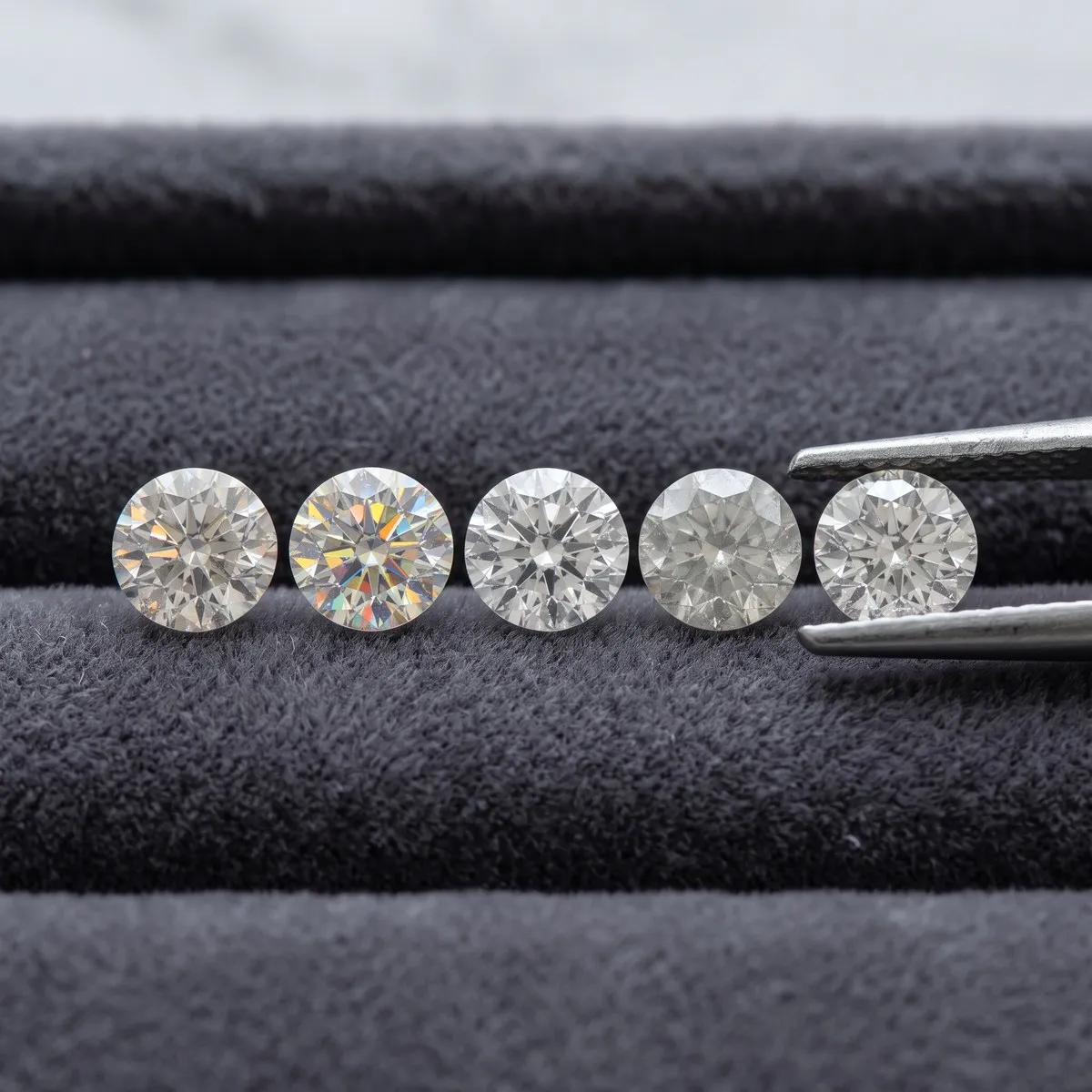
Illustrative image: round stones that look alike to the eye.
How simulants hold up over time
| Stone | Hardness | Everyday wear |
|---|---|---|
| Diamond | 10 | Only diamond readily scratches it; it can still chip from a hard knock |
| Moissanite | 9.25 | Very durable |
| White sapphire | 9 | Durable; needs frequent cleaning |
| Cubic zirconia | 8–8.5 | Scratches more easily; edges wear; may yellow |
| White topaz | 8 | Can split from a blow |
| Zircon | 6–7.5 | Brittle; edges wear |
| Glass | About 5–6 | Scratches and dulls quickly |
Sources: GIA’s guide to gem durability and care pages. GIA notes that dust is mostly quartz, hardness 7, so anything softer slowly loses its polish. The Mohs scale isn’t even: diamond is many times harder than sapphire, not one step.
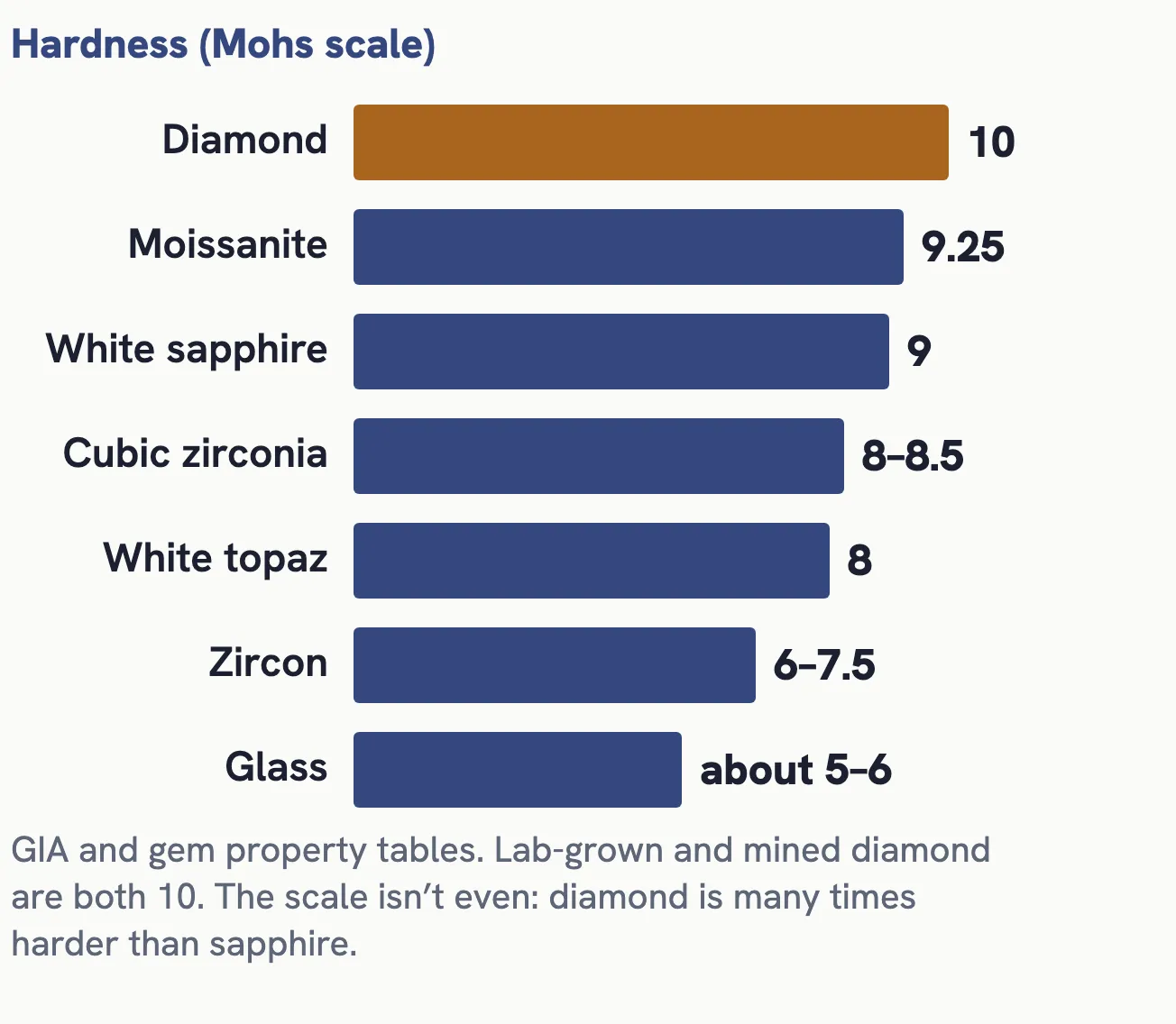
Hardness on the Mohs scale.
What stone is replacing diamonds?
Mostly lab-grown diamond, which is still diamond. In The Knot’s 2026 survey of couples married in 2025, 61% of engagement rings had a lab-grown diamond center, up from 12% in 2019. Moissanite is a small share: in The Knot’s 2021 study, 10% of couples chose a gemstone other than diamond and 28% of those chose moissanite, which works out to about 3% of all the couples surveyed. In March 2026 Charles & Colvard, the best-known moissanite maker, filed for bankruptcy, citing falling lab-grown diamond prices followed by falling moissanite prices.
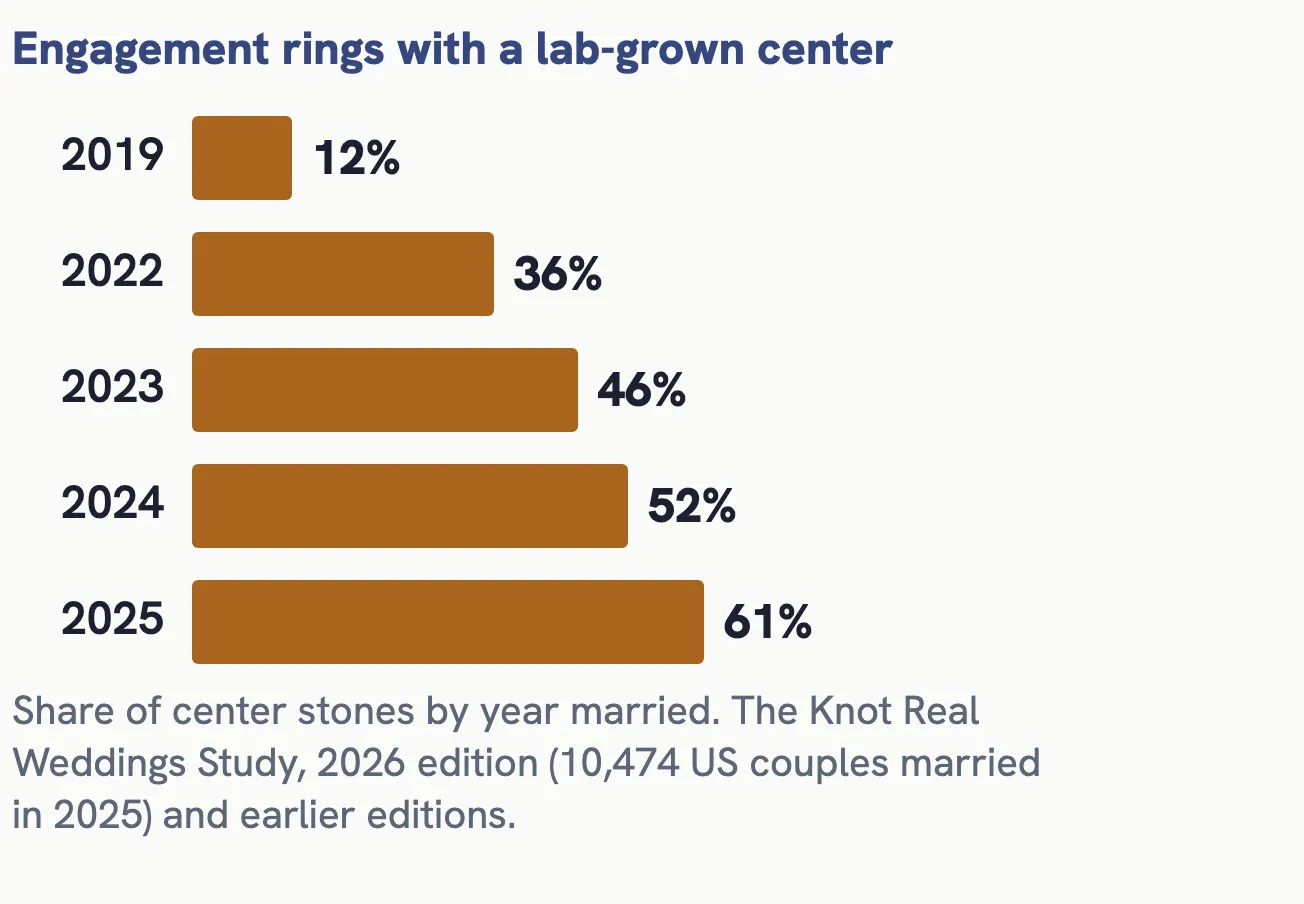
Engagement rings with a lab-grown center, from The Knot’s studies.
That price fall is the point. A lab-grown diamond used to cost far more than a good simulant; on November 17, 2026, a round 1 carat lab-grown diamond of F color and VS1 clarity cost $324 at Whitemoon. Our 1 carat price guide compares it with other stores.
Shopping for a lab-grown diamond at Whitemoon
Every lab-grown diamond center in our ring builder comes with an IGI or GIA report that states it is laboratory-grown and how it was grown, and the report number is usually laser-inscribed on the stone so you can match the two. Browse engagement rings or stud earrings.
Lab-grown diamonds don’t hold their retail price, so buy one to wear and not as an investment. Our Lifetime Upgrade gives you 100% of what you paid as credit toward a new lab-grown piece worth at least 1.5 times as much.
Whitemoon jewelry is made to order in about 10–15 days and ships free with insurance both ways, with 30-day returns on unworn pieces.
Fake diamond questions
Which fake diamond looks most like a diamond?
Moissanite comes closest in hardness and overall look, and cubic zirconia is the most common and convincing for the price. Neither is a diamond.
What is a cheap stone that looks like a diamond?
Cubic zirconia, white topaz and glass are the inexpensive ones. White sapphire and moissanite cost more and wear better.
What is the best fake diamond called?
There is no trade name for it. The FTC’s accepted terms are “simulated diamond” or “imitation diamond”, followed by what the stone actually is, such as cubic zirconia or moissanite.
Is cubic zirconia a lab-grown diamond?
No. Cubic zirconia is zirconium dioxide; a lab-grown diamond is carbon with the same properties as a mined diamond.
How to tell the difference between a lab-grown diamond and a cubic zirconia?
A diamond tester: the lab-grown diamond passes and cubic zirconia fails. Cubic zirconia is also heavier for its size and shows more colored flashes.
Will cubic zirconia pass a diamond tester?
No. A thermal tester measures how fast a stone carries heat away, and cubic zirconia does it far more slowly than diamond, whatever grade the seller gives it.
Which is better, zirconia or moissanite?
Moissanite is harder (9.25 against 8 to 8.5), lighter and more durable; cubic zirconia costs much less. Moissanite shows more rainbow fire.
Which is better, zirconia or sapphire?
White sapphire is harder and tougher, so it wears better; cubic zirconia is brighter and fierier but scratches more easily.
Is Swarovski just cubic zirconia?
Swarovski crystal is glass, which Swarovski’s own brand guide classes as crystal glass. Swarovski also sells cubic zirconia, under the name Swarovski Zirconia.
What is a poor man’s diamond?
An old nickname for a cheaper stand-in for diamond, used for zircon, rock crystal quartz, white topaz and cubic zirconia.
What stone is mistaken for a diamond?
Most often cubic zirconia and moissanite, and historically zircon. Only a tester or a lab report settles it.
What stone is replacing diamonds?
Lab-grown diamond, which is still diamond: 61% of engagement ring centers in The Knot’s 2026 survey.