
What Is Cubic Zirconia? How It’s Made and How It Compares
Cubic zirconia, or CZ, is a man-made crystal of zirconium dioxide that looks like a diamond but isn’t one. It’s clear, fairly hard and very inexpensive, which is why it has been the standard diamond imitation in fashion jewelry since the late 1970s. Compared with a diamond it’s softer and about 1.6 to 1.7 times as heavy, and it shows more rainbow color.
We don’t sell cubic zirconia. We sell diamonds, most of them lab-grown, so read this as a diamond seller’s view. We’ve kept to published measurements, and we’ll say plainly where CZ is the better buy. Below are what it’s made of, how it compares with diamond and other stones, how to tell them apart, what it costs and how long it lasts.
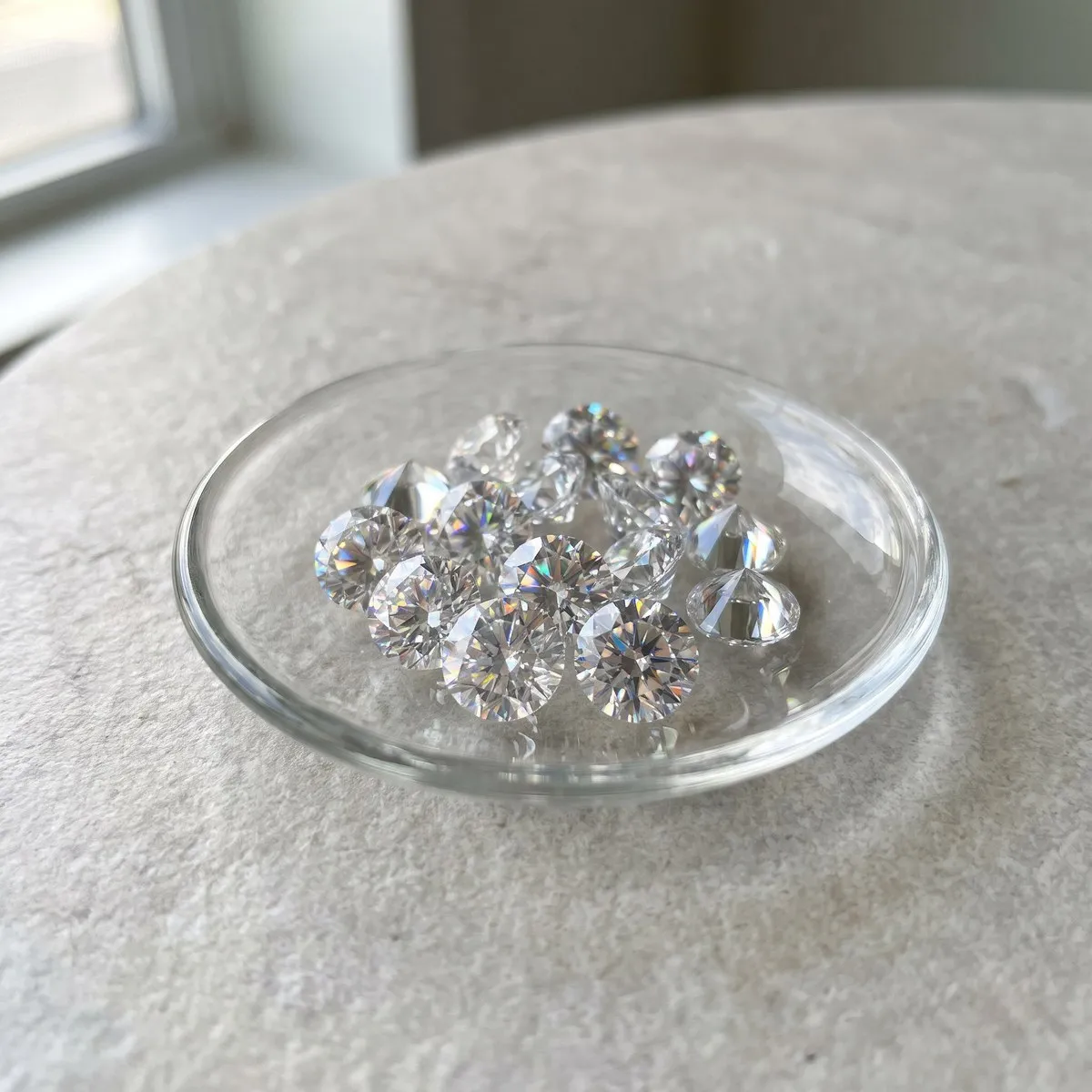
Pictured: loose round colorless stones. Illustrative image.
What is cubic zirconia made of?
Cubic zirconia is made of zirconium dioxide, ZrO2, plus a small amount of a stabilizer. On its own, zirconium dioxide won’t keep its cubic crystal form at room temperature. Adding roughly 10% yttria or 15% calcia, measured by molecules, holds that structure in place. A diamond, in contrast, is essentially pure carbon, so the two share a look and nothing else.
How is cubic zirconia made?
Cubic zirconia is made by a process called skull melting. Zirconium dioxide melts near 2,750 °C, hot enough to destroy most containers, so makers use the material as its own container. The outside stays solid and forms a shell, or “skull”, around the molten center. As the melt cools slowly, crystals grow, and these are then cut and polished into gems.
Every cubic zirconia you’ll find in jewelry is manufactured. Natural cubic zirconium dioxide exists only as tiny grains, first described in 1937 inside the mineral zircon, and these are far too small to cut.
Who invented cubic zirconia?
Scientists at the Lebedev Physical Institute in Moscow, including V. V. Osiko, published the method in 1973. They wanted a crystal for lasers, not jewelry. It reached the gem trade in late 1976, and it changed the market quickly. A 1981 study in GIA’s journal reported that wholesale prices had fallen from over $40 a carat to $4 or less.
Is cubic zirconia a real diamond?
No. Cubic zirconia is a different material with a different chemistry, so it isn’t a diamond of any kind. It’s also not the same thing as a lab-grown diamond, which is carbon crystallized as diamond.
US rules back this up. The FTC’s Jewelry Guides say a seller can’t describe CZ as a diamond, or as a lab-grown or lab-created diamond. A seller may call it “simulated diamond” or “imitation diamond”, as long as that word comes immediately before “diamond” and is just as easy to see. So if a listing says “CZ diamond”, “zirconia diamond” or “faux” on its own, be careful, because that isn’t clear wording.
Cubic zirconia, zircon and zirconium are different things
The similar names cause a lot of confusion:
| Name | What it is | Used for |
|---|---|---|
| Cubic zirconia | Man-made crystal, zirconium dioxide | Diamond imitation |
| Zircon | Natural mineral, zirconium silicate | A gem in its own right |
| Zirconium | A metal | Some rings, and industry |
Cubic zirconia vs diamond and other white stones
By eye, a new cubic zirconia can pass for a diamond at arm’s length. The differences show up in the numbers, and over time in wear. The diamond column applies to mined and lab-grown stones alike.
| Compare | Cubic zirconia | Diamond | Moissanite | White sapphire |
|---|---|---|---|---|
| Mohs hardness | 8–8.5 | 10 | 9.25 | 9 |
| Refractive index | 2.15–2.18 | 2.42 | 2.65–2.69 | 1.76 |
| Dispersion | 0.058–0.066 | 0.044 | 0.104 | 0.018 |
| Specific gravity | 5.56–6.00 | 3.52 | 3.22 | 4.00 |
| Passes a heat tester | No | Yes | Yes | No |
Hardness
CZ is harder than glass and quartz, a common part of household dust, so it holds up reasonably well at first. It’s also somewhat brittle, and with years of daily wear it can pick up fine scratches and worn facet edges. A diamond shrugs off nearly everything except another diamond.
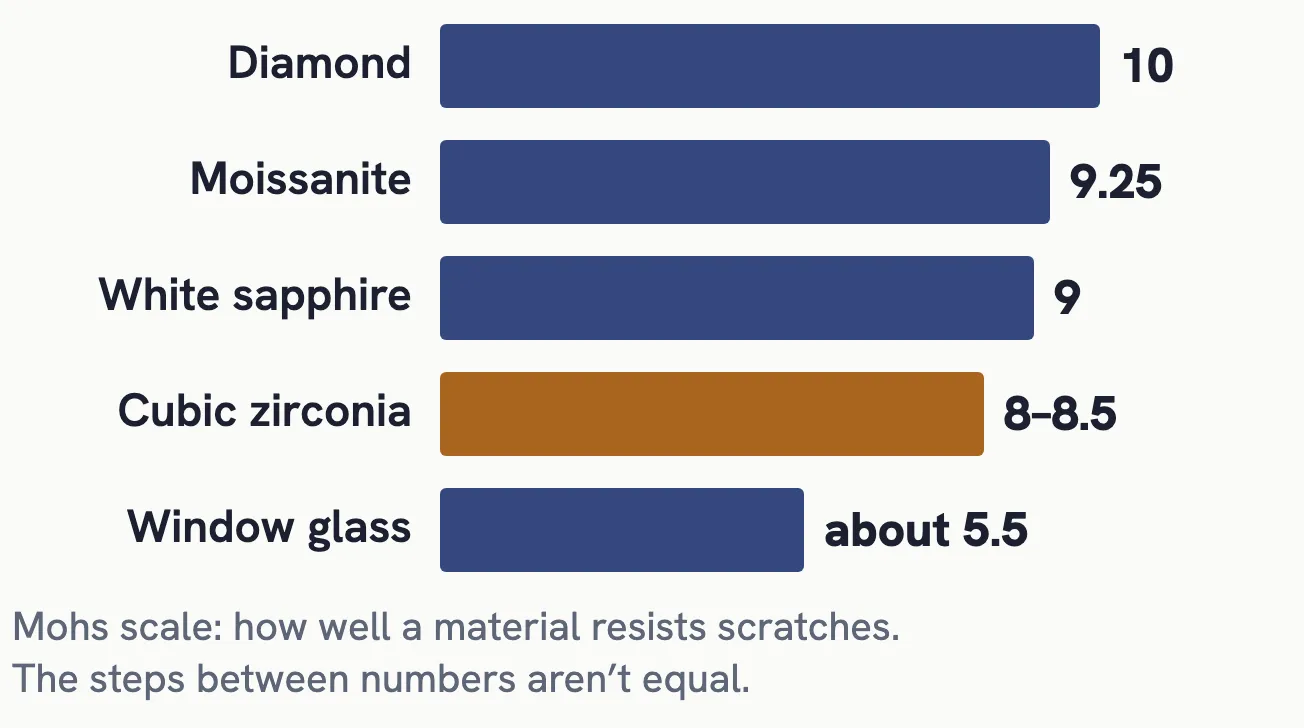
Hardness of cubic zirconia and other white stones.
Sparkle
Refractive index tells you how strongly a stone bends light, which drives white sparkle, and dispersion tells you how much it splits light into rainbow color. CZ scores lower than diamond on the first and higher on the second, so it tends to show more colored flashes and less bright white return. Some people like that, and it isn’t a flaw. It’s also the look most likely to give CZ away when you see it next to a diamond.
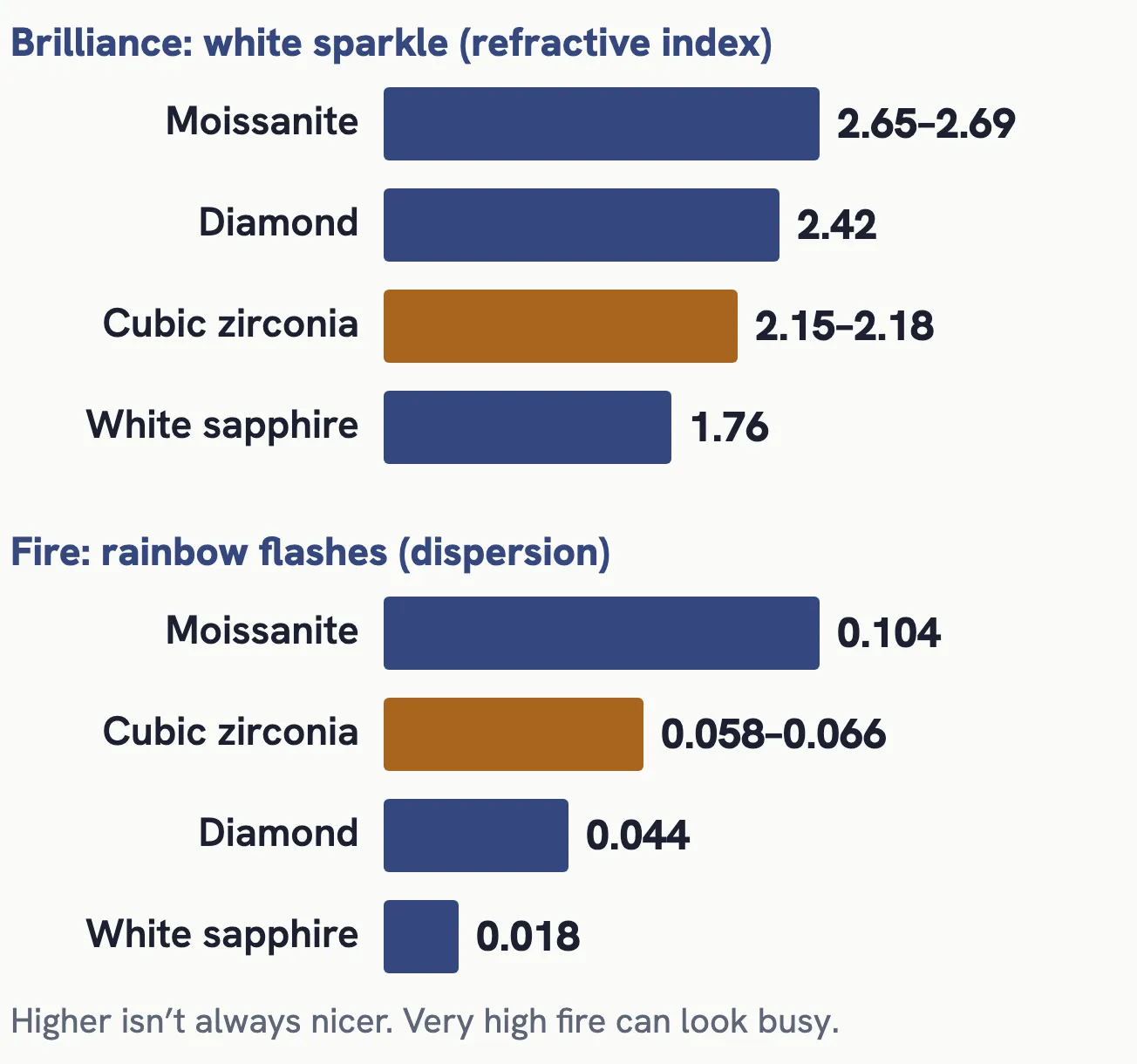
How cubic zirconia’s sparkle measures up against other white stones.
Weight and size
Carats measure weight, not size, and CZ is much heavier than diamond. So a “1 carat” CZ is about 5.5 mm across, while a 1 carat round diamond is about 6.5 mm. A CZ of that same 6.5 mm size weighs about 1.65 carats. Keep this in mind if you’re comparing listings, because a carat figure on CZ doesn’t mean the same size as it does on a diamond.
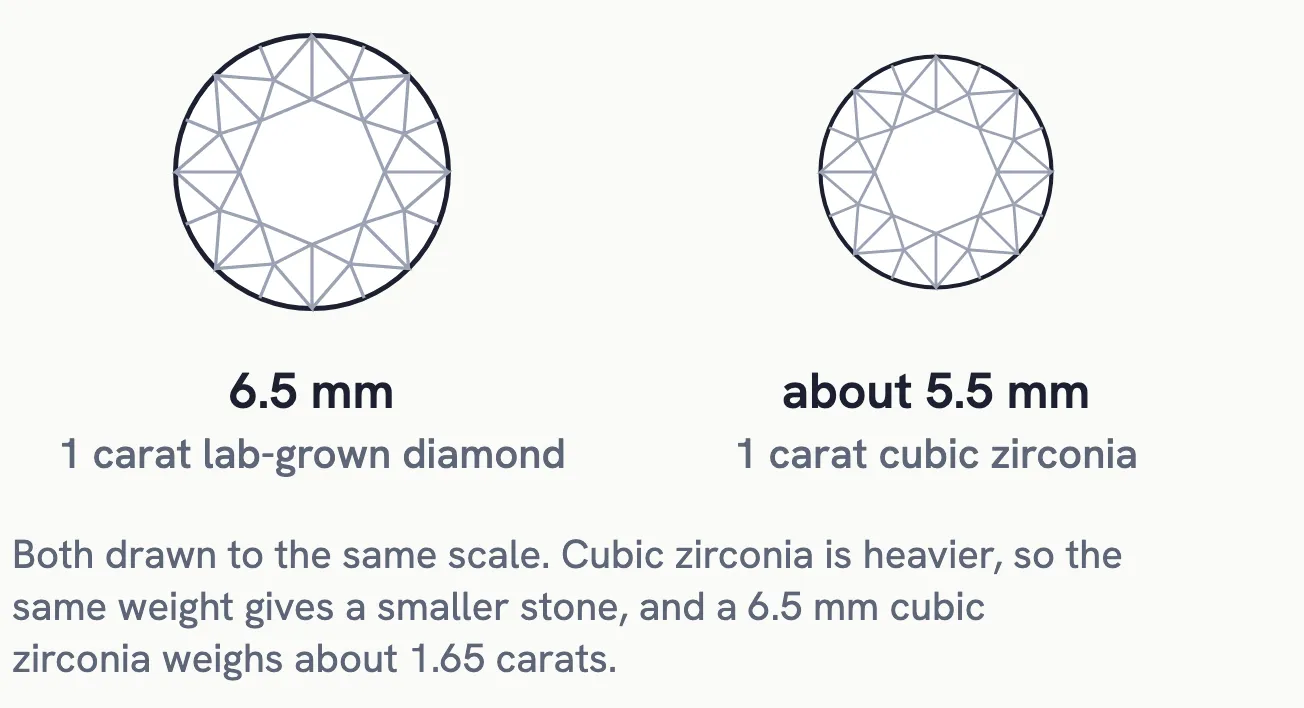
The same weight, two sizes. Drawn to scale.
Cubic zirconia vs lab-grown diamond
The main difference is the material. A lab-grown diamond is a diamond, grown instead of mined, so it has a diamond’s hardness and sparkle. Our guide to whether lab-grown diamonds are real diamonds explains how they’re made. CZ is an imitation, and it costs far less because of that. A lab-grown diamond can also come with an independent report grading the stone, and CZ normally doesn’t.
| Compare | Cubic zirconia | Lab-grown diamond |
|---|---|---|
| Material | Zirconium dioxide | Carbon, as diamond |
| Hardness | 8–8.5 | 10 |
| Grading report | Rarely | Commonly, from IGI or GIA |
| Typical loose price | A few dollars to tens of dollars | $324 for 1 carat, F VS1 |
| Best suited to | Fashion and travel pieces | Everyday and lasting jewelry |
The lab-grown price is a typical Whitemoon price for a round stone with an IGI report on November 4, 2026, before any setting. Neither one is an investment. Lab-grown diamonds don’t hold their retail price, so buy one to wear. Our diamond clarity chart shows how grade moves that price, and our guide to diamond certificates explains what a report tells you.
How to tell cubic zirconia from a diamond
The surest ways are a lab report and a proper tester. Here they are from most to least reliable:
- Report and inscription. A graded diamond usually has a report number, often laser-inscribed on its edge, that you can look up on the lab’s site.
- Heat tester. Diamond moves heat extremely well, and CZ doesn’t, so CZ fails a thermal diamond tester. Lab-grown diamonds pass. Moissanite also passes, so it takes a different tester to rule that out.
- Weight. A loose CZ feels noticeably heavy for its size. This is useful if a jeweler can weigh and measure the stone, and harder once it’s set.
- Loupe. Under magnification a diamond’s facet edges are usually crisp. CZ’s can look a little more rounded or worn, but that isn’t foolproof.
Our guide on how to tell if a diamond is real covers every common test, including the ones that don’t work.
Be wary of home tricks. The fog test only means something next to a comparison stone, the newspaper test works only on loose stones, and UV reactions vary too much to prove anything. Scratching glass tells you nothing either, as CZ and most other gems can do it. If it matters, take the piece to a jeweler.
Does cubic zirconia tarnish or turn skin green?
The stone itself doesn’t tarnish, rust or turn your skin green. Stabilized zirconia resists most chemicals and water. What changes is the metal around it, and CZ is often set in plated or low-cost metal. Green marks on skin usually come from copper in the metal, and that’s a reaction to the base metal or to plating that has worn through.
The same goes for sensitive skin. We know of no documented allergy to zirconia itself in jewelry, but nickel is a common cause of rashes, and some white gold contains it. So if you’re looking for hypoallergenic jewelry, check the metal, not the stone.
How long does cubic zirconia last?
It lasts for years, but it usually won’t stay as bright as it was new. A common estimate is that a stone worn daily starts to look cloudy after about two years, though we haven’t found test data behind that figure. Two things are happening: skin oils and soap leave a film, which you can clean off, and fine scratches build up, which you can’t.
To keep CZ looking its best, wash it now and then in warm, soapy water with a soft toothbrush, and keep it in its own pouch so that diamonds and other harder stones can’t mark it. If it’s set in a ring you wear every day, expect to replace it eventually. For a stone meant for daily wear over decades, diamond’s hardness makes a real difference.
How much is cubic zirconia worth?
Very little, and that’s the point of it. A loose CZ the size of a 1 carat diamond can sell for a few dollars, and larger stones often stay under about $50. Finished pieces cost more because of the metal:
| CZ ring set in | Rough price |
|---|---|
| Plated metal | $20–40 |
| Sterling silver or steel | $50–90 |
| Gold or platinum | $100 and up |
These are rough guides, as prices vary widely. CZ is cheap because the raw material is inexpensive and crystals can be grown in large batches. It has essentially no resale value of its own, although a gold or platinum setting keeps its metal value. You may also see CZ sold as grades from A to AAAAA, but no independent lab or standard sets those grades, so treat them as a seller’s description.
What does CZ mean on jewelry?
A “CZ” stamp means the piece is set with cubic zirconia, and “925 CZ” means sterling silver set with CZ. These stamps follow retail custom, and we haven’t found a rule that requires them, so don’t rely on the absence of a stamp. Any listing that describes a stone as diamond should be clear on whether it’s mined, lab-grown or simulated.
When cubic zirconia makes sense, and when it doesn’t
CZ is a fair choice for costume pieces, for travel when you’d rather leave your diamond at home, or for trying out a ring shape before you commit. It’s also fine for a trend you’ll wear for one season. Just know what you’re buying, and be open about it if it’s a gift.
For a piece worn every day, or one you’d want to keep and pass on, we think a diamond is worth the extra cost, because it will still look the same in decades. That applies to many engagement rings, and to earrings or bracelets worn all the time.
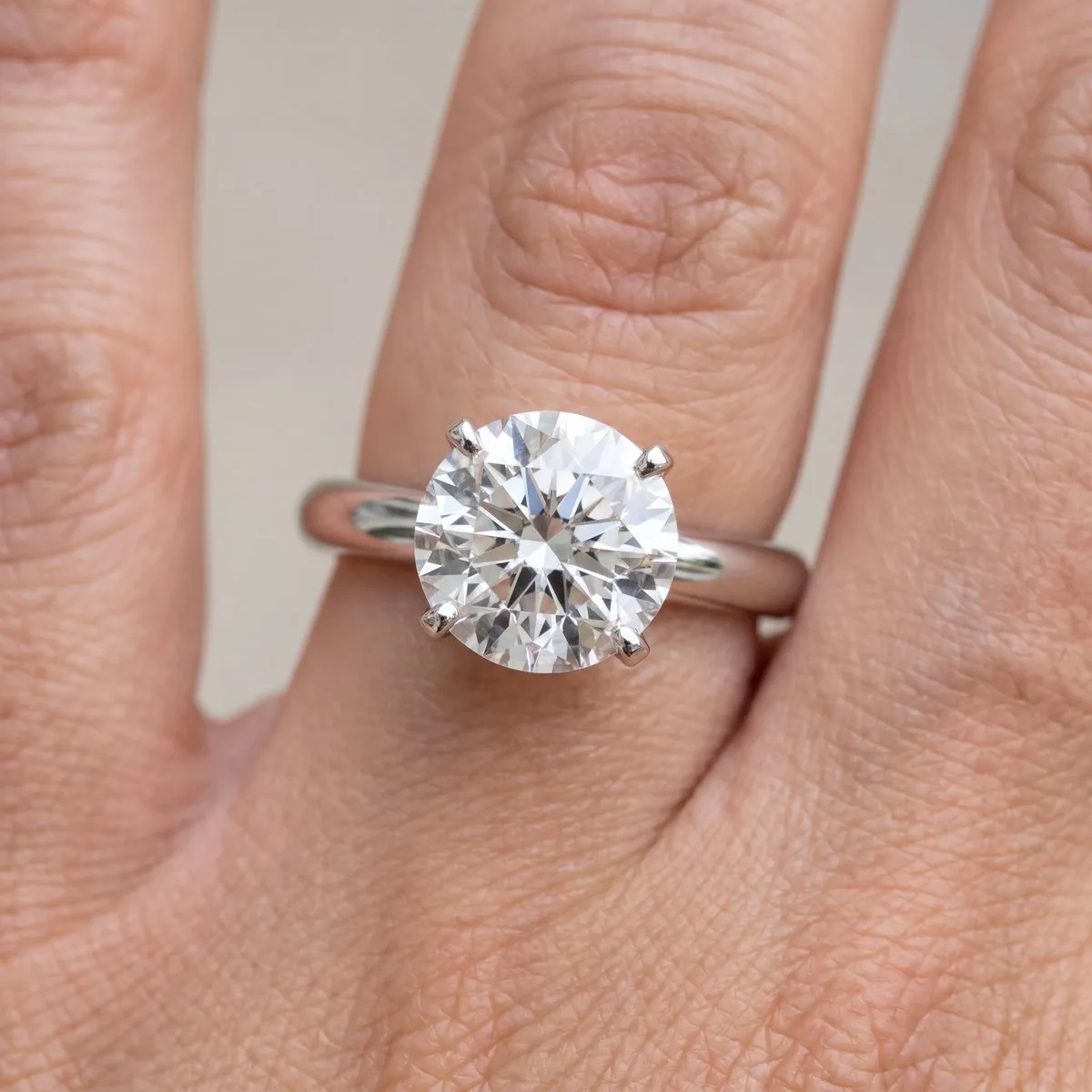
Pictured: a round lab-grown diamond solitaire with a plain platinum band. Image created from the ring’s design.
Diamonds at Whitemoon
We don’t carry cubic zirconia. Our finished jewelry uses lab-grown diamonds, described that way, and the Whitemoon ring builder lists lab-grown and natural center stones with their reports. You can pick a stone there after choosing from our engagement rings, or look at 1 carat lab-grown diamond rings with the center already set. For everyday pieces, see lab-grown diamond stud earrings and lab-grown diamond tennis bracelets. Our Lifetime Upgrade gives you 100% of what you paid as credit toward a new lab-grown piece worth at least 1.5 times as much. Most Whitemoon rings are made to order in about 10–15 days and ship free with insurance both ways, with 30-day returns on unworn pieces and one free resize within 60 days of delivery.
Cubic zirconia questions
Is cubic zirconia worth anything?
Not much. The stone itself has essentially no resale value, since it’s mass-produced and costs a few dollars to buy. If it’s set in gold or platinum, the metal keeps its value, so a CZ ring in solid gold can be worth something for the gold alone.
Will cubic zirconia pass a diamond tester?
No, not a thermal diamond tester. Diamond moves heat far better than CZ, so the tester reads the difference quickly. Lab-grown diamonds pass that test because they’re diamonds. Moissanite also passes, so a tester that also checks for moissanite gives a fuller answer. Our guide to lab-grown diamonds and simulants compares CZ with moissanite, white sapphire and other look-alikes.
Does cubic zirconia tarnish?
No, the stone doesn’t tarnish. If a CZ piece has dulled or darkened, the likely cause is the metal or plating around it, or a film of oil and soap on the stone. Cleaning removes the film, but worn plating or fine scratches on the stone won’t come off.
Does cubic zirconia turn skin green?
The stone doesn’t, but the metal it’s set in might. Copper in low-cost metals and in some alloys can leave a green mark, especially once plating wears through. Keeping the piece dry and choosing sterling silver, gold or platinum makes that much less likely.
How long does cubic zirconia last?
It can last for many years without breaking down, but its look fades with wear. Worn daily, it may start to look cloudy within a few years because of film and fine scratches. Worn occasionally and stored with care, it can stay bright for much longer.
What does CZ mean in jewelry?
CZ stands for cubic zirconia, a man-made diamond imitation. You may see it stamped inside a ring as “CZ”, or as “925 CZ” for sterling silver set with cubic zirconia. It doesn’t mean a type of diamond, even if a listing uses the words “CZ diamond”.
Is zircon the same as cubic zirconia?
No. Zircon is a natural mineral, zirconium silicate, and it has been used as a gem for centuries. Cubic zirconia is a man-made crystal of zirconium dioxide, first produced for sale in the 1970s. The names are similar, but they’re different materials.
How do you pronounce cubic zirconia?
Say it as “KYOO-bik zer-KOH-nee-uh”. Many people just say “C-Z”, which is also how it’s marked on jewelry.