
White Gold Guide: Is It Real Gold, Downsides and Care
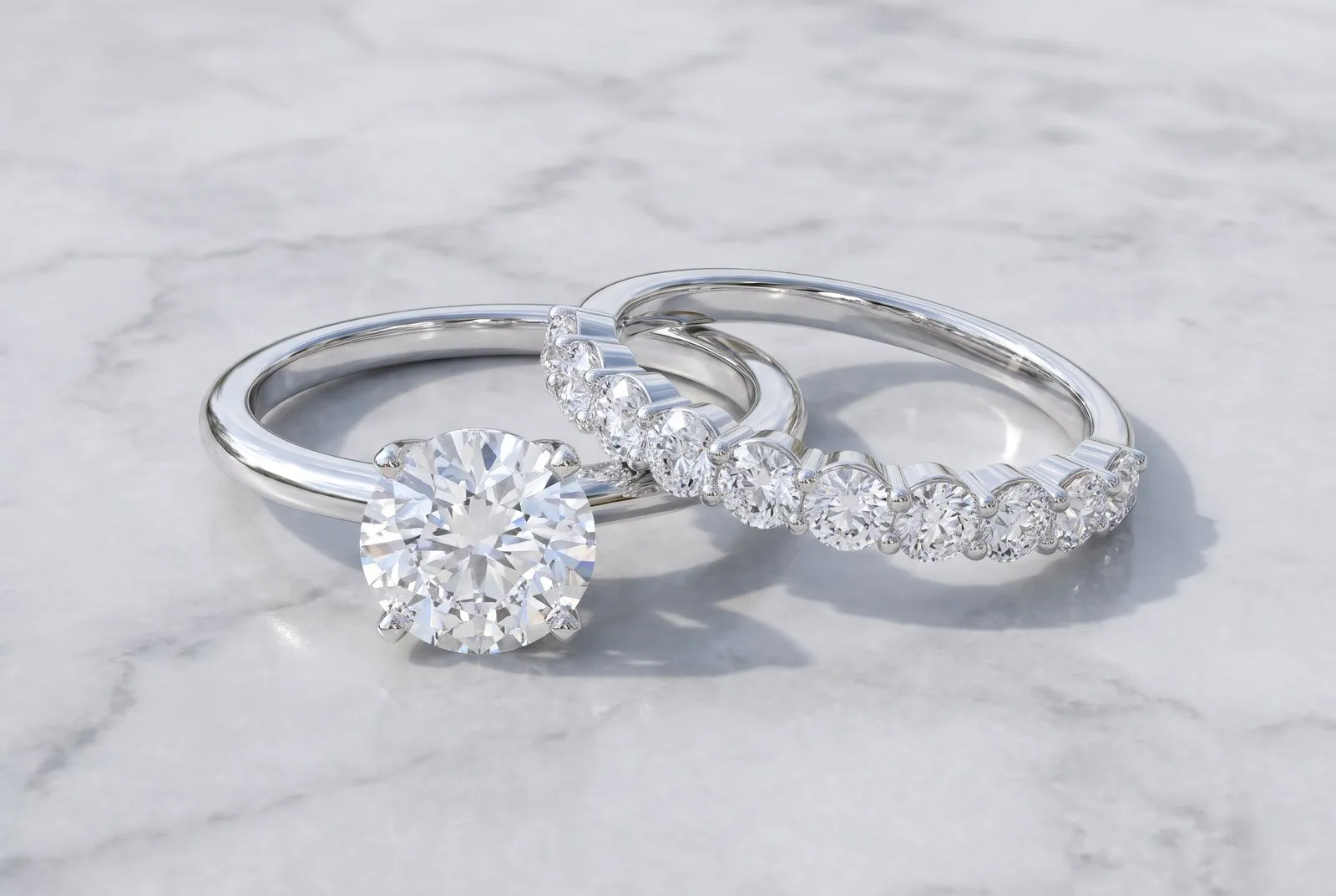
Yes, white gold is real gold. It’s gold mixed with white metals such as palladium or nickel, in the same karats as yellow gold: 14K white gold is 58.3% gold, exactly like 14K yellow. Most white gold is then plated with rhodium, a bright white metal, which wears over time and needs renewing. That upkeep, and the nickel in some white golds, are its main downsides.
At Whitemoon, we make white gold jewelry in 10K, 14K and 18K, and our white gold is rhodium plated (our yellow gold, rose gold and platinum aren’t). For this guide we compared our prices for the same designs in white, yellow and rose gold, set out what our care plans cover for re-plating, and went back to the original records: the 1912 patent, a 1925 court case, the US wartime platinum orders and the FTC’s current rules. Our post on rhodium plating goes deeper into the plating itself.
Is white gold real gold?
Yes. Under the FTC’s Jewelry Guides, a gold item is described by its karat, the share of pure gold in it by weight, and the rule is the same whatever the color (16 CFR §23.3). There’s no separate legal definition of white gold. A piece stamped 14K is 14 parts gold in 24, about 58.3%, whether it looks white, yellow or pink.
- 10K: 41.7% gold
- 14K: 58.3% gold (often stamped 585)
- 18K: 75% gold (often stamped 750)
Since 2018 the FTC Guides have listed 9 karat as an acceptable gold mark, so 10K is no longer the legal floor for solid gold in the US; the 10K minimum now applies only to plated and filled gold. There’s no 22K or 24K white gold: white golds stop at about 21K. Our gold karat guide compares 10K, 14K and 18K in detail.
What is white gold made of?
Gold is yellow, and almost every metal added to it makes it paler. To get a white color, makers add metals that whiten strongly. There are two main families:
- Nickel white golds: hard and strong, and less costly. A metallurgy review describes nickel as the main whitener in the US (Corti, 2011). They can trigger nickel allergy, and an alloy-design article notes they’re more prone to cracking under stress.
- Palladium white golds: softer and easier to set stones in, nickel-free, and dearer. A 14K palladium white can weigh up to 15% more than the same piece in a nickel white (Grice).
Silver, zinc and copper are often in the mix too. We don’t publish the nickel content of our white gold, so if you have a nickel allergy, our guide to metals for sensitive skin explains the options.
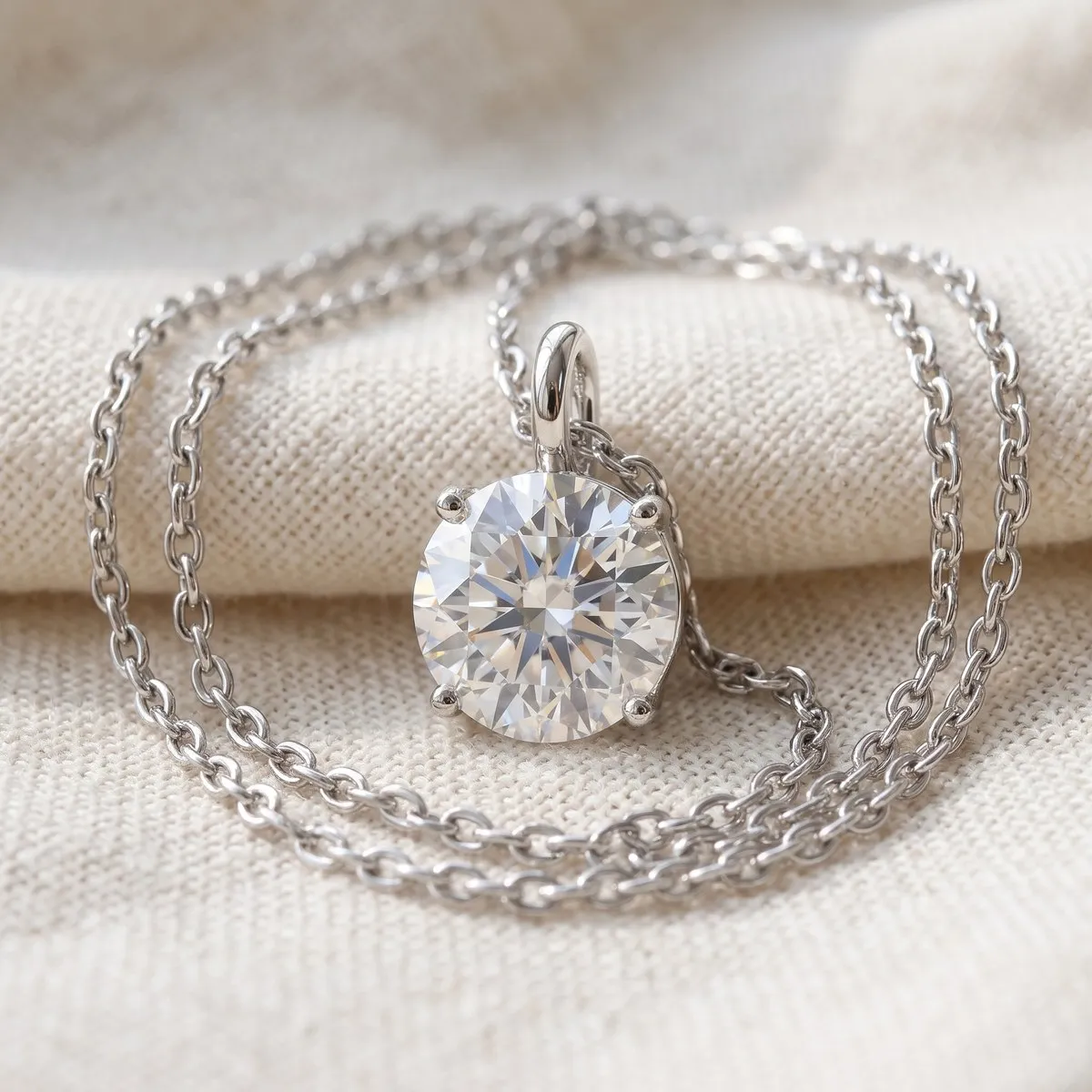
Image created from the design: a round solitaire pendant in white gold. Pendants and earrings rub less than rings, so their plating lasts longer.
Why is white gold rhodium plated?
Because most white gold isn’t fully white on its own. GIA notes that unplated white gold has a faint yellow tint (GIA, 2025). The trade measures this with a yellowness index and sorts white golds into three grades: grade 1 is white enough to wear unplated, grade 2 can go either way, and grade 3 needs plating to look white. A trade article on the scheme says it would be deceptive to call an alloy past the grade 3 limit white gold at all (Ballard). The grades are voluntary; no US rule requires a color grade or plating.
A thin layer of rhodium gives every white gold the same bright, cool white. The World Gold Council says the plating also gives a harder surface with a brighter shine. The FTC says a rhodium layer on precious metal must be disclosed (16 CFR §23.7), so this is us saying it plainly: our white gold is rhodium plated.
Where did white gold come from?
White gold is only about a century old as a common jewelry metal. The records show:
- 1912: the firm Dr. Richter & Co. of Pforzheim, Germany, patented white gold alloys in which nickel replaced part or all of the costly platinum or palladium then used to whiten gold (German patent 267,299). The patent says gold-platinum and gold-palladium white alloys already existed but cost too much.
- 1913: a US federal court later found that “Haffner white gold” was brought to the US from Germany in 1913, and that 14K white gold was in use before 1918.
- World War I: the same court found that when the government took platinum for war purposes, the shortage “stimulated the demand for 18 karat white gold”. The court also struck down a 1920 patent by David Belais, often called the inventor of white gold, for “want of invention” (Belais v. Goldsmith Bros., 1925).
- Art Deco: white gold was set with diamonds alongside platinum, as in a white gold brooch by Raymond Templier, Paris, about 1930, now at the V&A.
- World War II: the War Production Board banned platinum from new US jewelry from October 31, 1942, until the order was revoked on August 20, 1945 (Federal Register, 1942).
So yes, there is vintage white gold. Early pieces were made before rhodium plating was common (a 1935 patent describes it as having become popular by then), so they were sold in the alloy’s own color. A vintage piece that looks bright white today has most likely been plated since. If you like that era, our vintage white gold engagement rings are new pieces in vintage styles.
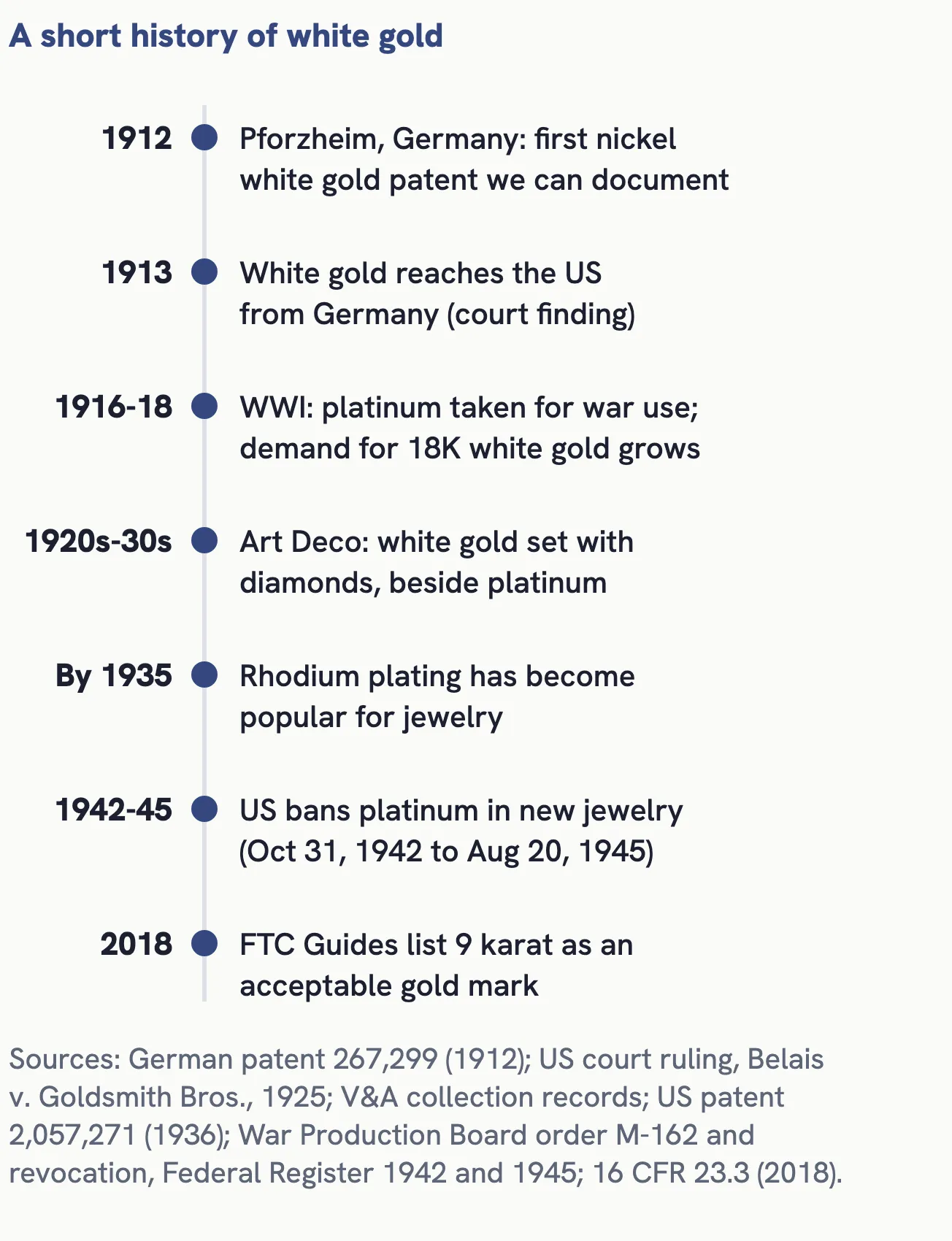
White gold is about a century old as a common jewelry metal. Sources in the chart note.
What are the downsides of white gold?
- The plating wears. Rings rub on the palm side most, and over time the warmer alloy color shows through. Re-plating fixes it, but it’s upkeep.
- Nickel. Some white golds contain nickel, a common skin allergen, and once the plating thins the alloy touches your skin.
- Chlorine. Bleach and pool or hot-tub chemicals can damage gold alloys, and nickel white golds fared worst in a manufacturer’s test (below).
None of these makes white gold a poor choice; they’re the things to know before you buy it. If you’d rather avoid plating altogether, platinum is naturally white, and our post on white gold vs silver covers the budget option.
Does white gold tarnish or turn yellow?
White gold rarely tarnishes. The FTC lets gold alloys of 10K and up be called corrosion resistant (16 CFR §23.11), and rhodium itself doesn’t tarnish. What people usually notice is the plating wearing through: a yellowish or warm patch, often on the underside of a ring. A supplier’s guide for bench jewelers says that yellow tone showing through is the sign to re-plate (Stuller, 2026). The gold underneath hasn’t changed; you’re seeing its own color.
How often does white gold need re-plating?
There’s no set schedule. The same guide says there’s no universal timeline, because it depends on how often you wear the piece and where it rubs; GIA says white gold may need re-plating every few years (GIA, 2025). A ring worn every day rubs more, and wears sooner, than earrings or a pendant. Month counts you’ll see online are retailers’ estimates.
As for cost, three US jewelers we checked on November 19, 2026 listed re-plating one ring at $45 to $59.99 (Fire & Ice Goldsmithing, Siebke Hoyt and Allan Jewelers). At Whitemoon, rhodium re-plating is included in our paid care plans, 3-Year Care (6% of the purchase price), 5-Year Care (10%) and Lifetime Care (18%); you cover insured shipping both ways. Every piece also comes with free cleaning and inspection for as long as you own it. The details are on our Whitemoon Care page.
Is white gold good for an engagement ring?
Yes, it’s a common choice. It’s much harder than pure gold, its white color suits a white diamond, and it costs less than platinum: on November 22, 2026 our half eternity band was $630 in 14K white gold and $975 in platinum. The trade-offs are the plating upkeep and, for some people, nickel. In our view, 14K is a good balance for a ring worn every day: more gold than 10K, for less than 18K. You can see our white gold engagement rings and matching white gold wedding bands.
What karat is best for white gold?
Most white gold is 10K, 14K or 18K, and we offer all three. 10K has the least gold and costs least; 18K has the most gold, and GIA notes that unplated 18K white gold can look warmer. Hardness depends on the alloy more than the karat: an 18K nickel white can be harder than a 14K white, and an 18K palladium white softer. In our opinion 14K suits most rings. On our half eternity band, 14K cost 45% more than 10K and 18K 91% more on November 23, 2026.
Is white gold more expensive than yellow gold?
At the same karat, white and yellow gold hold the same share of gold, so the gold costs the same. White gold can cost more for two reasons: palladium white golds use a costly metal and weigh more for the same design, and plating adds labor. Our own working, from metal prices on November 23, 2026, puts a high-palladium 14K white at up to about 22% more metal value than a nickel white of the same design; that’s an upper limit, not a typical gap.
At Whitemoon, white gold costs the same as yellow and rose gold. On November 23, 2026, our half eternity band was the same price in all three colors at every karat, and our bezel stud earrings and a solitaire setting were the same price in white and yellow gold:
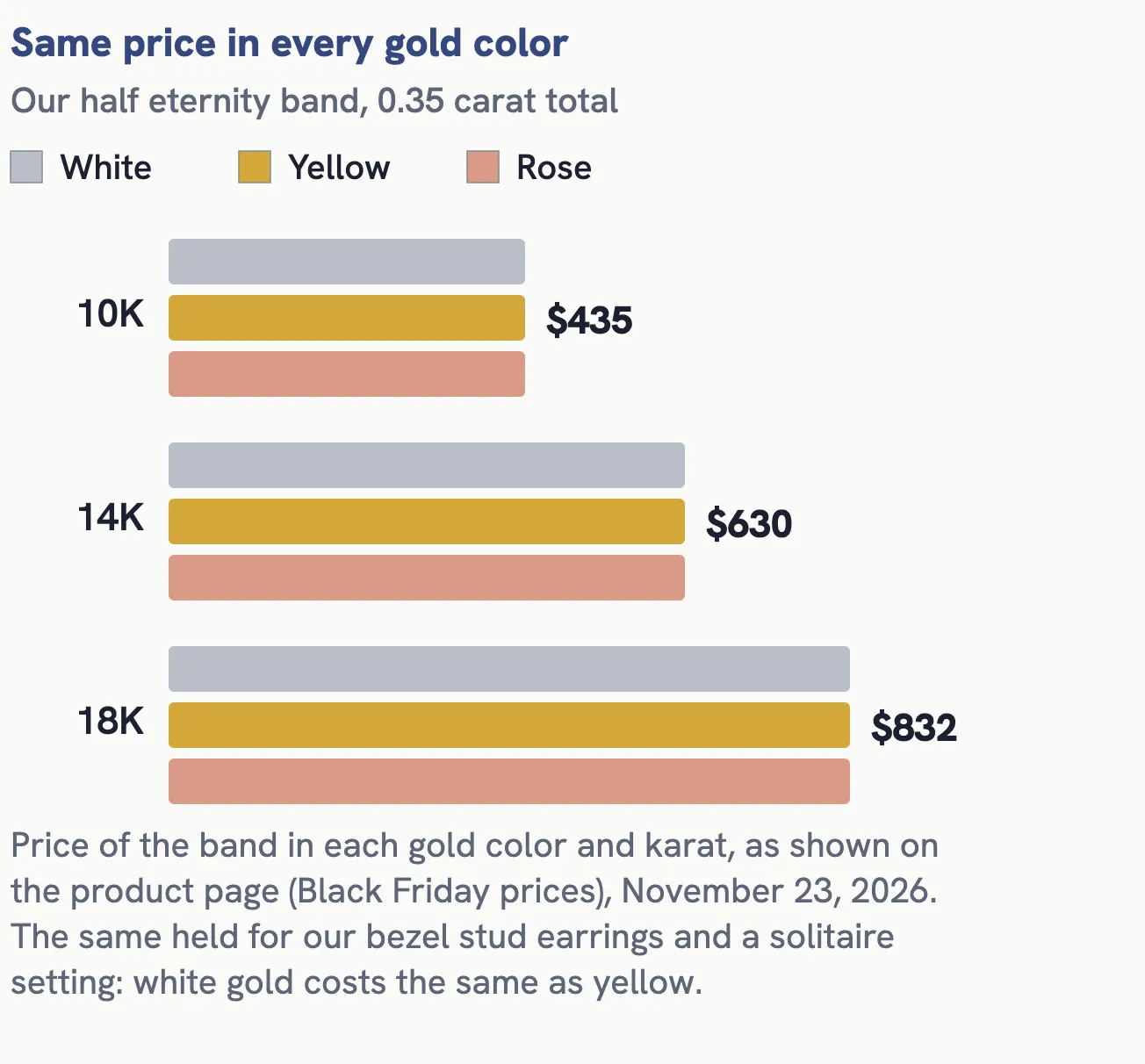
White gold costs the same as yellow and rose gold at Whitemoon. Product page prices, November 23, 2026.
Is white gold worth any money?
Yes, for its gold. A gold buyer values white gold by weight and karat, like any gold. At the gold price of $3,621.20 an ounce on November 23, 2026 (Kitco), a gram of 14K holds about $68 of gold, so a 5 gram 14K ring holds about $340 of gold. Buyers pay a share of that, not all of it. The nickel and rhodium add essentially nothing. A buyer checks the stamp first, then tests with acid or an XRF analyzer; a plated surface can throw off a surface test.
How to clean and care for white gold
For everyday cleaning, GIA suggests warm water with a few drops of mild dish soap, a soft brush and a gentle rinse, and no toothpaste or abrasive polish (GIA, 2015). Our post on keeping a diamond ring bright between cleans walks through it step by step.
Showering won’t harm the gold: GIA says water alone won’t, but it suggests taking white gold off to keep the plating bright, since soaps and shampoos dull it. Chlorine is the real risk. The American Gem Society warns that bleach damages gold alloys irreparably (AGS, 2018), and a jewelry manufacturer’s soak test showed how fast:
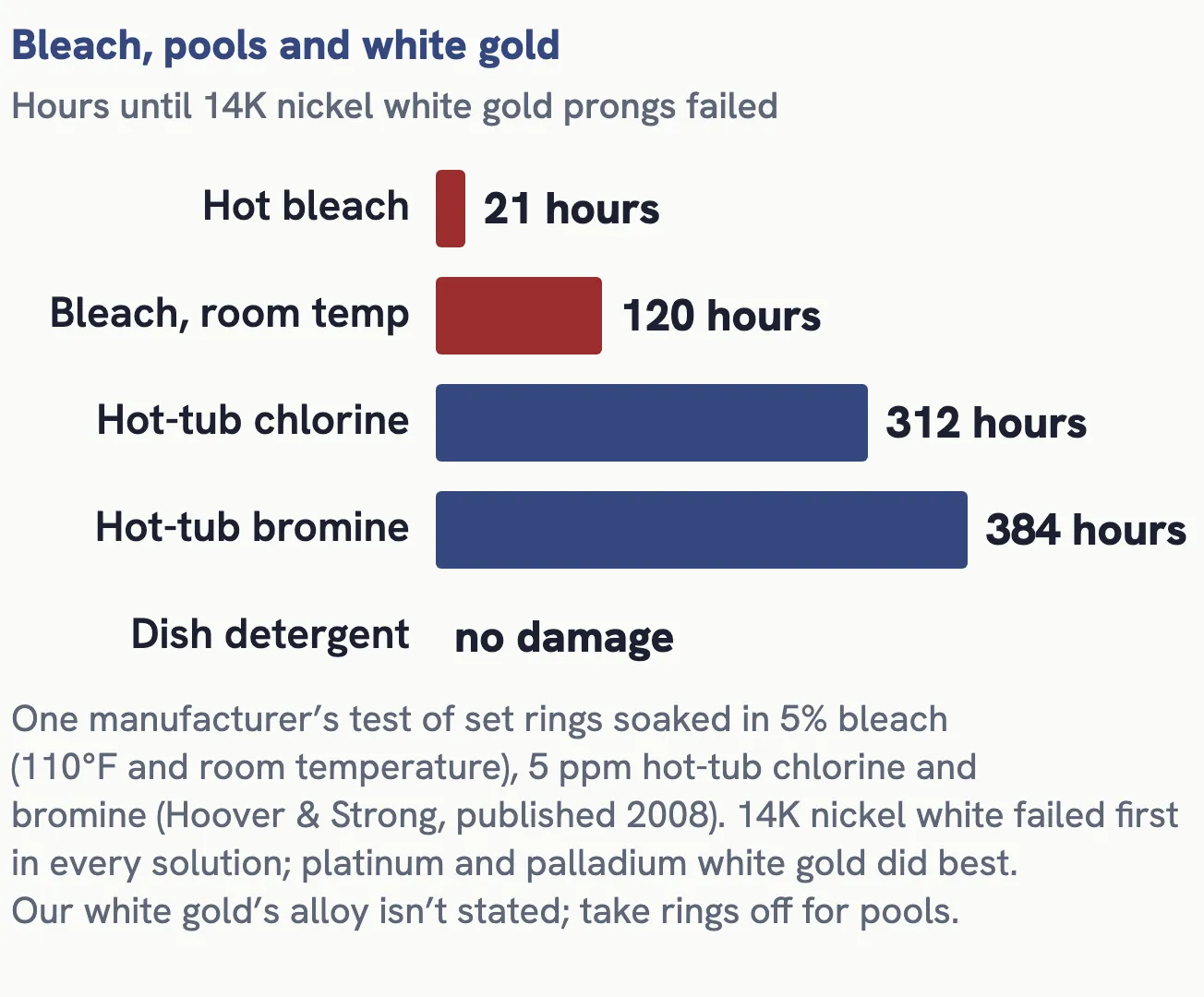
Chlorine attacks gold alloys. One manufacturer’s soak test of set rings (Hoover & Strong).
Prongs on 14K nickel white gold rings failed after about 21 hours in hot bleach and 312 hours in hot-tub chlorine, while dish detergent did nothing (Hoover & Strong). Take rings off for pools, hot tubs and cleaning with bleach. Our care plans don’t cover damage from pools, hot tubs or household chemicals.
Hydrogen peroxide isn’t a recommended jewelry cleaner; the American Gem Society says it isn’t really designed for it. We found no authoritative test of peroxide on white gold, so we’d stick to soap and water.
Can a yellow gold ring be turned into white gold?
Not really. A jeweler can plate a yellow gold ring with rhodium so it looks white, often called dipping, but the ring stays yellow gold underneath, and the yellow shows through as the plating wears. The rhodium must be disclosed if it’s sold. The only way to make a piece white gold all the way through is to melt the gold down and make a new piece in a white alloy.
What does white gold symbolize?
Nothing in particular, as far as we can find. White gold is only about a hundred years old as a common jewelry metal, and we found no historical source for a traditional meaning. People choose it for the look: cool, bright and modern, with a diamond that reads white.
Whitemoon jewelry is made to order in about 10–15 days and ships free with insurance both ways, with 30-day returns on unworn pieces.
Common questions about white gold
Is white gold real gold?
Yes. It’s karat gold mixed with white metals; 14K white gold is 58.3% gold, the same as 14K yellow. It’s usually rhodium plated.
Is white gold cheaper than yellow gold?
Not at the same karat; the gold content is the same. Palladium white golds and plating can make white cost a little more. At Whitemoon, white, yellow and rose gold cost the same.
Does white gold tarnish?
Rarely. Gold of 10K and up resists corrosion, and rhodium doesn’t tarnish. A yellow tinge is usually worn plating, not tarnish.
Why is my white gold turning yellow?
The rhodium plating has worn where the piece rubs, showing the alloy’s own faintly yellow color. Re-plating restores it.
How often does white gold need to be replated?
There’s no fixed schedule. GIA says every few years; a ring worn daily needs it sooner than earrings or a pendant.
How much does it cost to replate white gold?
Three US jewelers listed $45 to $59.99 for one ring in November 2026. At Whitemoon it’s included in our 3-Year, 5-Year and Lifetime Care plans; you pay insured shipping both ways.
Can tarnished white gold be restored?
Yes. A jeweler cleans and polishes the piece and re-plates it with rhodium, which brings back the bright white.
What karat is white gold usually?
10K, 14K or 18K. White gold isn’t made above about 21K, so there’s no 24K white gold.
Is white gold ok to shower with?
Water won’t harm it, but soaps and shampoos dull the plating, so GIA suggests taking it off. Never wear it in pools or hot tubs.
Does hydrogen peroxide clean white gold?
It isn’t a recommended jewelry cleaner. Use warm water, mild dish soap and a soft brush, or a jeweler’s cleaner.
Is there vintage white gold?
Yes. White gold was patented in Germany in 1912, sold in the US from 1913, and used in Art Deco jewelry of the 1920s and 1930s.
Can a yellow gold ring be turned into white gold?
Only on the surface, with rhodium plating that wears and has to be disclosed. To be white gold throughout, it has to be remade.
Is white gold worth any money?
Yes, for its gold: about $68 of gold per gram of 14K at the November 23, 2026 gold price. Buyers pay a share of that.
Is white gold good for an engagement ring?
Yes. It’s durable, suits a white diamond and costs less than platinum. Plan for re-plating every few years.