
Men’s Wedding Bands: Styles, Metals, Widths and What to Check
The best men’s wedding band for most men is a precious metal band, platinum or 14K gold, between about 5 and 8 millimeters wide. Tungsten carbide and ceramic are the hardest to scratch, but they’re brittle, can’t be resized and have to be cracked off in an emergency. Titanium is very light, but the common pure grade is no harder than 14K gold, so it scratches too. Below are the styles, the metals compared with real hardness numbers, how wide is wide, and what to check before you buy.
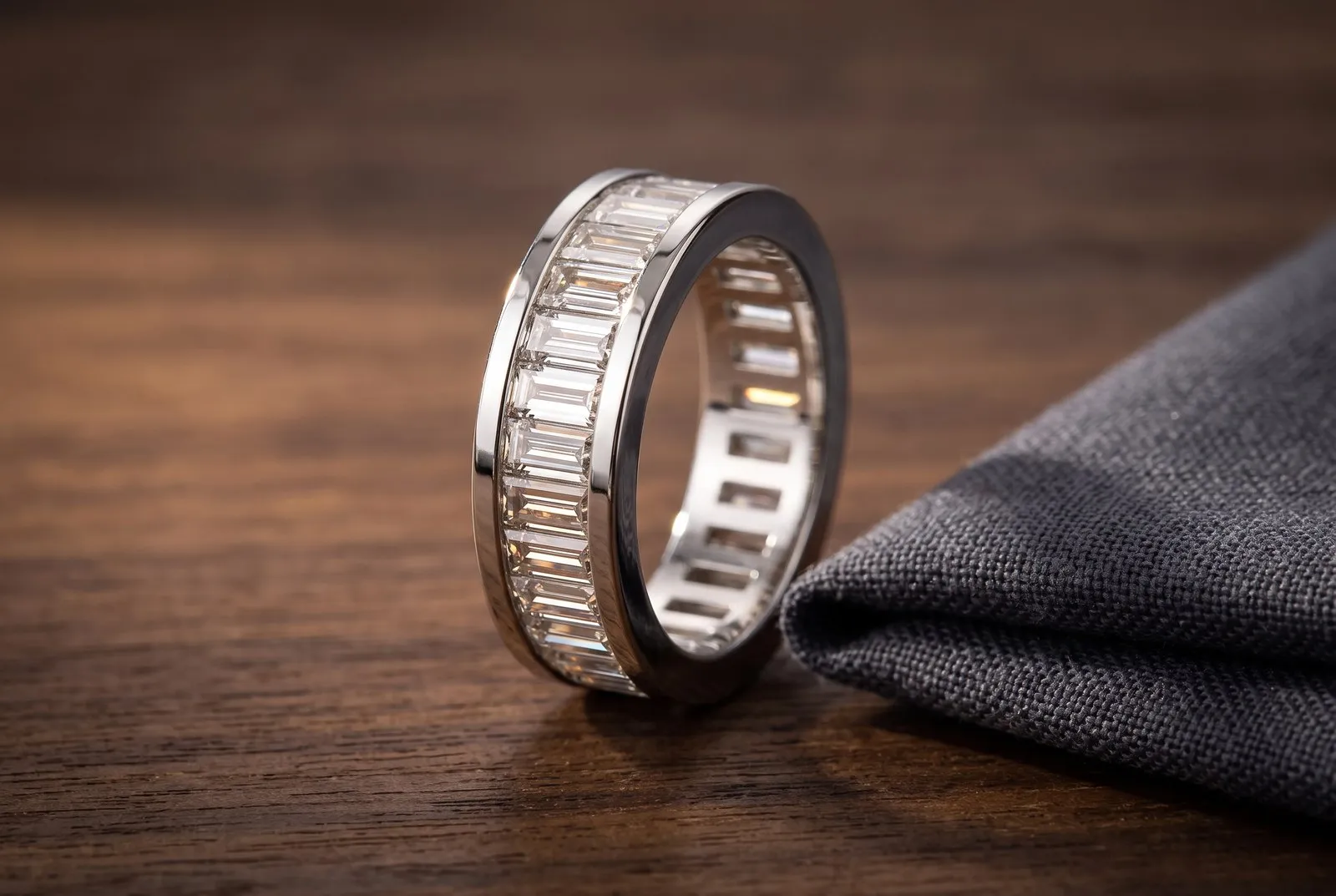
Image created from the design: a channel-set men’s eternity band with baguette lab-grown diamonds in white gold.
We make men’s wedding bands set with lab-grown diamonds in gold, platinum and Silvadium, our tarnish-resistant sterling silver. We don’t sell tungsten, titanium, cobalt or ceramic rings, or plain bands without stones, so read our view of those with that in mind. For this guide we looked up metallurgy data from alloy makers and the Santa Fe Symposium on jewelry manufacturing, emergency-medicine studies on removing hard rings, and dermatology sources on ring rash, and we checked our own 271 men’s bands on November 20, 2026.
Men’s wedding band styles
Men’s bands come in two broad families. Plain metal bands differ in their profile and finish:
- Dome or half round: curved on top, the classic shape.
- Flat: a flat top with squared edges, which looks modern and wider.
- Beveled: a flat top with angled edges that catch the light.
- Finishes: high polish, brushed or satin, and hammered. A brushed finish hides small scratches better than a mirror polish.
Diamond bands set the stones in ways that suit a ring that takes knocks:
- Channel set: stones held between two metal walls, with nothing raised to snag.
- Bar set: stones separated by thin metal bars, open to light from the side.
- Bezel or flush set: each stone sunk into the metal. GIA calls a single bezel-set diamond the most durable option for a men’s band.
- Pavé: rows of small stones held by tiny beads, with the most sparkle and the most upkeep.
A diamond band can be half eternity, with stones across the top and plain metal under the palm, or full eternity, with stones all the way around. Our guide to wedding band styles covers the profiles and settings in more detail.
What is the best metal for a men’s wedding band?
“Durable” means several different things, and no metal wins all of them. Hardness, measured on the Vickers scale, tells you how well a metal resists scratches and dents. It isn’t the whole story, because the hardest materials are also the most brittle. Typical values, from alloy makers’ data:
- Sterling silver: about 66 to 76 when soft (annealed). The softest choice.
- Platinum 950: about 80 to 135 depending on the alloy, roughly double that once worked.
- 18K yellow gold: about 150 annealed.
- 14K yellow gold: about 190 annealed, up to about 270 worked.
- Titanium, pure grade 2: about 145 to 160. Grade 5 alloy is about 330.
- Cobalt chrome: roughly 265 to 345.
- Zirconia ceramic: about 1,200 to 1,400.
- Tungsten carbide: roughly 1,000 to 2,200.
Three things stand out. Platinum isn’t harder than 14K gold. What it does well, according to the Platinum Guild, is move rather than lose metal when it’s scratched, so the band builds a soft patina instead of wearing thin. Pure titanium is about as hard as 14K gold, not harder. And tungsten and ceramic are roughly ten times harder than any precious metal, which is why they stay shiny, and also why they crack instead of bending.
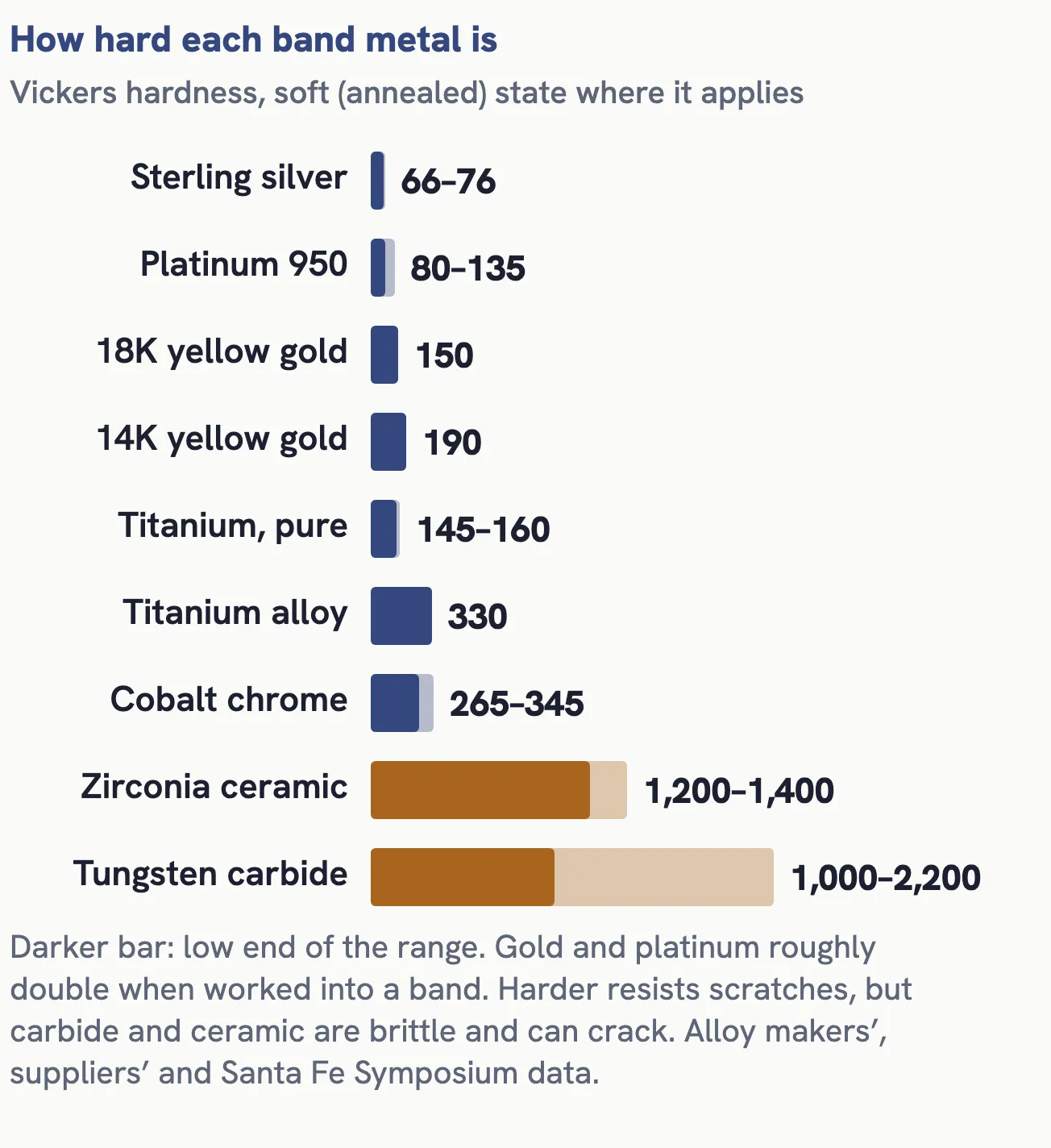
Precious metals and pure titanium sit in the same range. Carbide and ceramic are about ten times harder, and brittle.
So the answer depends on what you want. For a band that stays unscratched, tungsten or ceramic. For a band you can wear for fifty years, resize, polish, re-engrave and pass on, platinum or gold. Most men choose the second, and that’s our recommendation too.
Platinum or gold?
- Platinum is naturally white and needs no plating. It’s heavy: about 1.6 times the weight of the same band in 14K gold, which many men like. Resizing it costs more. Platinum alloys vary, and one common casting alloy contains 5% cobalt, so if you have a cobalt allergy, ask which alloy is used.
- 14K gold is harder, lighter and less costly, and comes in yellow, white or rose. White gold is plated with rhodium for its bright color, and the plating wears over time. It can also contain nickel.
- 18K gold is richer in color and softer than 14K, so it shows wear a little sooner.
Our gold karat guide compares 10K, 14K and 18K, and our comparison of white gold and silver explains rhodium plating and how silver wears.
Tungsten, titanium, cobalt and ceramic
We don’t sell these metals, but they’re popular for men’s bands, so here’s what the evidence says.
- Tungsten carbide is tungsten carbide powder bonded with a metal, usually cobalt. It’s heavy, very scratch-resistant and brittle. In a 2025 lab study in the Journal of Bone and Joint Surgery, tungsten carbide rings cracked under an average squeeze of about 830 pounds after deforming only a third of a millimeter. A gold band would bend instead. Tungsten can’t be resized.
- Titanium is about a third of the weight of 14K gold and resists corrosion. The common pure grade scratches about as easily as gold. It can be resized by only about half a size.
- Cobalt chrome is hard and scratch-resistant and can’t be resized. It’s often sold as hypoallergenic, but cobalt is a known skin allergen.
- Ceramic is hard and light but can chip or break, and can’t be resized.
If a ring has to come off in an emergency
This is the part most buyers never think about. Gold, platinum and silver rings are cut off with an ordinary ring cutter. Hard rings are a different job:
- An emergency-medicine study found titanium and tungsten carbide rings exceptionally difficult or impossible to remove with standard ring cutters. In a 2026 Canadian test of four cutting tools, the standard manual cutter failed on every hard ring, and even purpose-built cutters varied.
- Tungsten and ceramic rings are removed by cracking them with locking pliers or vise grips. In one test this took about 23 seconds on average but threw sharp pieces up to 37 inches, so eye protection is needed.
- Titanium, cobalt and steel rings need a powered ring saw or bolt cutters.
- Grinding through tungsten creates intense heat. A 2024 case report described a man who cut his own tungsten ring off with a high-speed tool and lost the finger. If a hard ring is stuck, go to an emergency room rather than trying it at home.
If you work with your hands or around machinery, that’s a practical point in favor of a precious metal band.
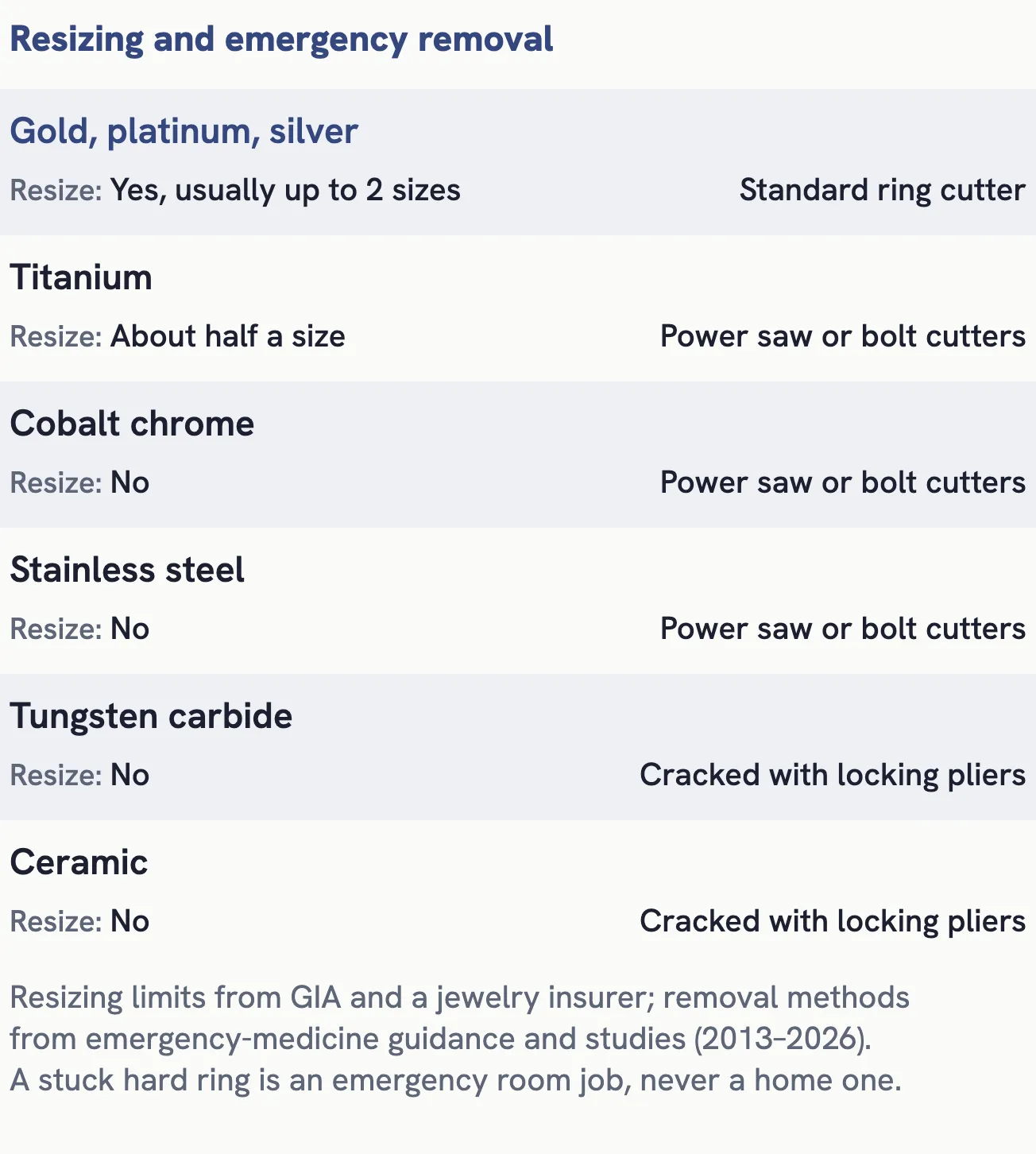
How each metal resizes, and how an emergency room gets it off.
Ring rash and allergies
A red, itchy patch under a wedding band is usually irritation, not allergy. DermNet, the dermatology reference, says soap, water and dirt trapped under a ring are the common cause, especially in people with sensitive skin. Take the ring off to wash and dry your hands, and clean the ring now and then. A wider band covers more skin: an 8 mm band covers about a third more than a 6 mm one, so there’s more room for soap to collect.
True metal allergy is mostly to nickel and cobalt. About 2% of people are allergic to cobalt, according to DermNet. Standard yellow and rose gold recipes contain no nickel, while some white gold alloys do. Palladium allergy on its own is uncommon, but it usually occurs alongside a nickel allergy. If a rash doesn’t settle, a dermatologist can patch test to find the cause.
Men’s wedding band widths: 6 mm vs 8 mm
Most men’s bands are sold between about 5 and 8 millimeters wide, and 6 mm is the usual starting point. There’s no standard that ties width to hand size. Wider bands simply look bolder and suit larger hands better, in most jewelers’ opinion. For a sense of size:
- 4 mm is about 0.16 inches, slim and understated.
- 6 mm is about a quarter inch, a third of the width of a dime, or three nickels stacked.
- 8 mm is about 5/16 of an inch, roughly four nickels stacked.
- 10 mm is just under 0.4 inches, a statement width.
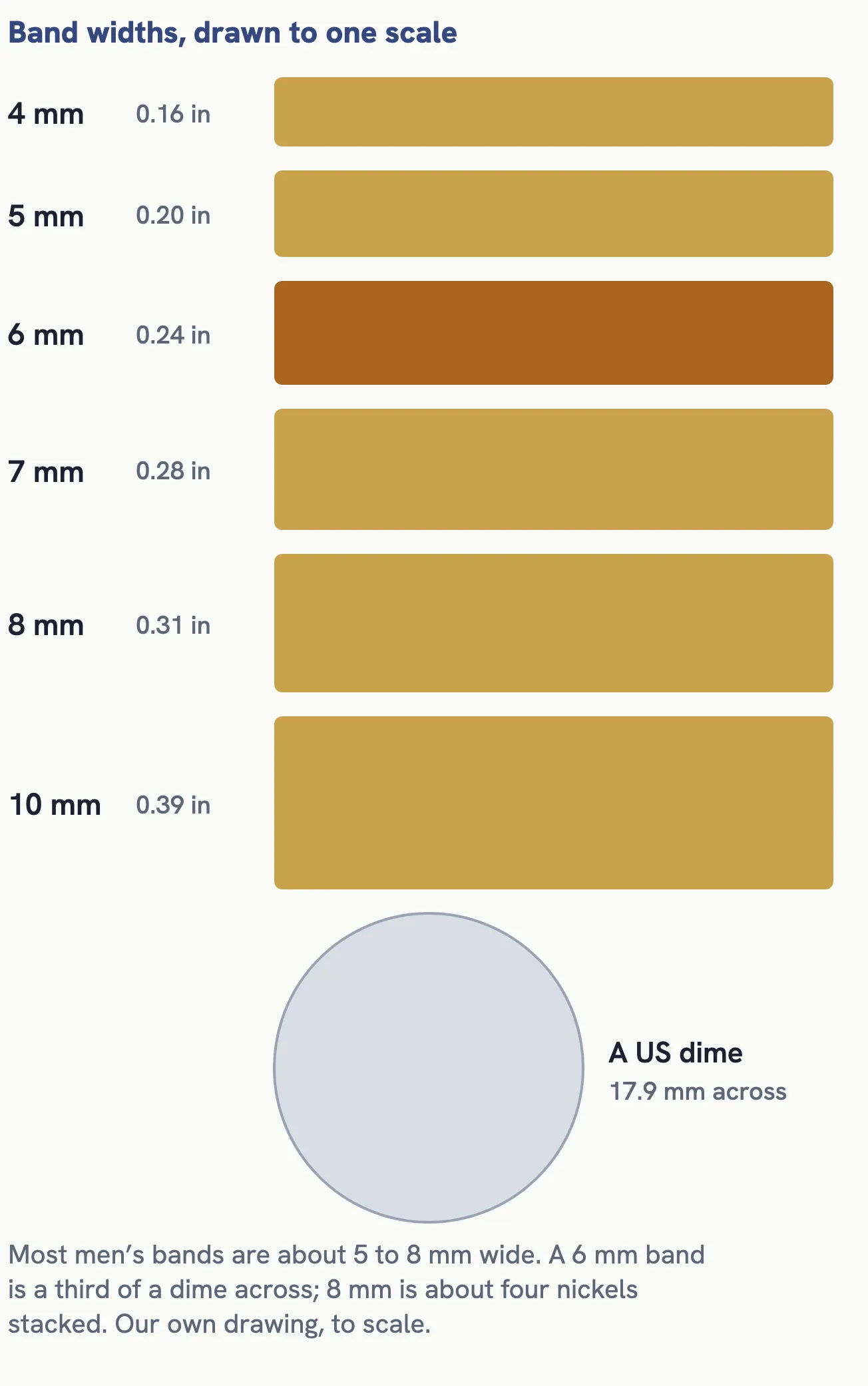
Most men’s bands are 5 to 8 mm wide. Drawn to scale.
An 8 mm band is a third wider than a 6 mm band, so at the same thickness it uses about a third more metal and costs more to make. It also tends to fit tighter, because more of your finger is covered. GIA says wide bands usually need to be a bit larger. Our product pages don’t list band widths yet, so call or email us if you need the width of a design before you order.
Comfort fit and sizing
A comfort fit band is rounded on the inside, so it slides over the knuckle more easily and sits more comfortably. You’ll often read that comfort fit runs half a size small and that you should order down, but jewelers disagree, and we found no manufacturer guidance that says so. The reliable method is to try a sizer of the same width and fit as the band you want. Retailers say 9 and 10 are the most common men’s sizes, though no national survey confirms it. Our ring size guide explains how to measure at home.
Diamonds in a men’s band
Every men’s band in our range carries lab-grown diamonds, from a short row of stones on top to stones all the way around. Most are half eternity, and channel and bar settings keep the stones low and protected. For hands that work hard, choose channel, bar or bezel settings over prongs and pavé, which can catch and need more upkeep.
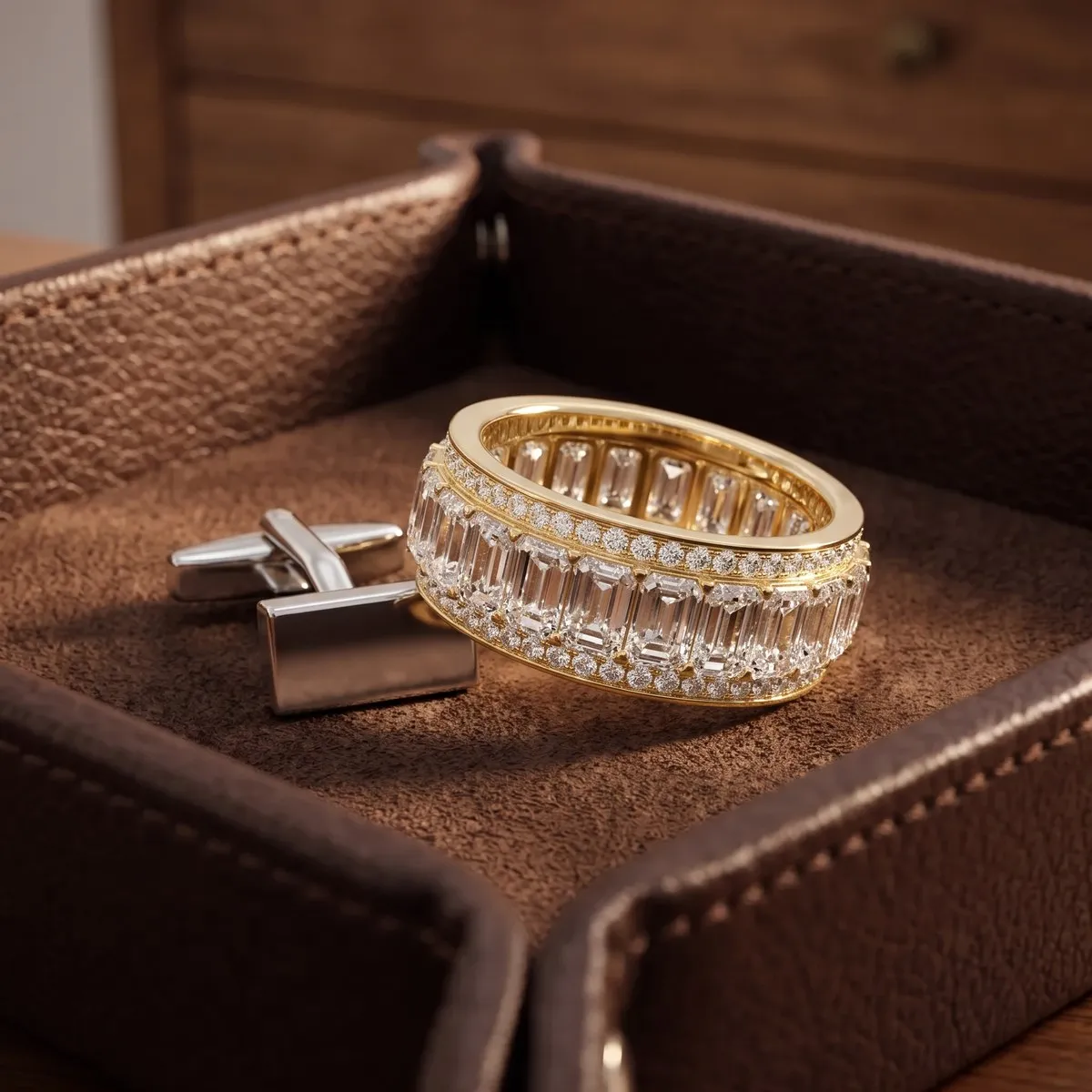
Image created from the design: a three-row men’s band of emerald-cut and round lab-grown diamonds.
Half eternity bands can be resized because of the plain metal underneath. A full eternity band can’t be resized at all, so any size change means remaking it, which matters if your size tends to change through the year.
Rose gold wedding bands for men
Rose gold is gold mixed with more copper, which gives it its warm color. It’s about as durable as yellow gold of the same karat, needs no plating, and can occasionally crack when resized, as high-copper golds sometimes do. GIA called rose gold a trend for men’s bands back in 2018. We found no recent data showing it rising for men, and 2026 trade reports talk more about yellow gold, so choose it because you like it, not because it’s fashionable. We make men’s bands in rose gold; see our rose gold men’s wedding bands.
How much should a men’s wedding band cost?
The Knot’s most recent figure we could find, from a December 2024 article, put the average men’s band at about $600, against about $1,200 for women’s. Trade data reported by Rapaport in September 2026 put the average wedding band of any kind at just under $1,500, and diamond-set bands at about $2,500.
Some examples from our own range on November 20, 2026: a five-stone men’s band with leaf-pattern sides, 0.35 carat total in Silvadium sterling silver, was $215. A channel-set band with baguette lab-grown diamonds all the way around, 1.5 carats total, was $693 in 10K white gold, $911 in 14K and $1,137 in 18K. A three-row band of emerald-cut and round lab-grown diamonds, 6 carats total in 10K white gold, was $1,993. Metal and karat move the price as much as the stones do.
Who makes the best men’s wedding bands?
We won’t rank brands, and any list that does is mostly advertising. These are the things that separate a good band from a poor one, wherever you buy it:
- Quality marks. A US gold band should carry a karat mark and the maker’s trademark. Under the FTC’s jewelry guides, a band sold as simply “platinum” should be at least 95% platinum.
- Solid, not hollow. The FTC says a hollow gold piece must have the hollow center disclosed and must not be called solid. Ask for the weight in grams: a solid 6 mm, size 10 band in 14K gold about 2 mm thick weighs roughly 8 to 11 grams, depending on its shape. A few grams means thin or hollow.
- How it’s made. Bands machined from drawn or extruded metal are dense and free of pits. Cast bands can be excellent too, but look closely at the polished surface for tiny pits.
- Resizing and warranty terms. Ask how many sizes the band can change, whether resizing is free, and whether the policy excludes your metal. Several large sellers exclude alternative metals from free resizing.
Most Whitemoon rings are made to order in about 10–15 days and ship free with insurance both ways, with 30-day returns on unworn pieces and one free resize within 60 days of delivery. You can browse every design in our men’s lab-grown diamond wedding bands collection.
Men’s wedding band questions
What is the most durable wedding band metal?
For scratch resistance, tungsten carbide and ceramic. For a band that lasts a lifetime and can be repaired and resized, platinum or 14K gold. Tungsten and ceramic are brittle and can crack, while precious metals bend.
Which is better, titanium or tungsten wedding bands?
They trade off. Tungsten is far harder and heavier but brittle and can’t be resized. Titanium is very light and tough, but the common pure grade scratches about as easily as gold and resizes only about half a size. Both need special tools to remove in an emergency.
What metal should a men’s wedding band be?
Platinum or 14K gold suits most men: durable, repairable and resizable. Choose platinum for weight and a naturally white color, and gold for a lower price and a choice of yellow, white or rose.
Is 6 mm or 8 mm better for a men’s wedding band?
Neither is better. A 6 mm band is the common starting point, and 8 mm is a third wider, bolder and heavier, and tends to fit tighter. Try both widths on if you can.
How big is an 8 mm ring?
An 8 mm band is about 5/16 of an inch wide, roughly the height of four nickels stacked.
How much should a man’s wedding band cost?
The Knot’s latest figure we found was about $600 on average for men’s bands. Diamond-set and platinum bands cost more. Set a budget, then choose the metal and width.
Where can I find rose gold wedding bands for men?
Many jewelers make men’s bands in rose gold. Ours are set with lab-grown diamonds in 10K, 14K or 18K rose gold.
Is stainless steel good for a men’s wedding band?
It’s inexpensive and corrosion-resistant, but it can’t be resized, and like titanium it needs a power saw or bolt cutters to remove in an emergency.
Do men wear wedding rings?
Most do. In a 2011 YouGov poll in Britain, 63% of married men said they wear one. In the US, men’s wedding rings became common only in the 1940s, when the double-ring ceremony took hold.